Tag: Modern Free Verse

  • Author’s Note

    For a long time, I confused standing still with failure.

    Like if I wasn’t moving fast enough, succeeding quickly enough, becoming who I wanted to be on everyone else’s timeline—then maybe the people doubting me were right.

    But growth rarely looks clean while you’re inside it.

    Sometimes progress is just continuing to move, even when fear, uncertainty, or other people’s expectations try to keep you frozen in place.

    This piece sits in that space between doubt and momentum.

    Between hearing the warnings… and still feeling the pull forward anyway.

    Because there are moments in life where the call toward something bigger becomes louder than the voices telling you to stay where you are.

    And eventually— you either trust that pull,

    or spend your whole life wondering what would’ve happened if you did.

    Rowan Evans


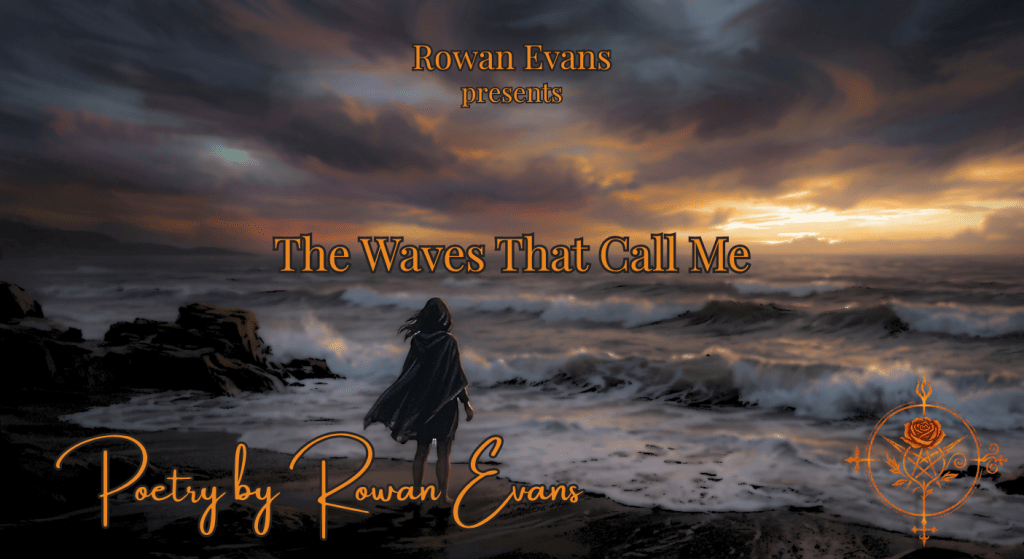
    Person standing on a shoreline looking toward ocean waves symbolizing dreams and personal transformation
    Some voices tell you to stay. The waves tell you to move.

    The Waves That Call Me
    Poetry by Rowan Evans

    I stood on the shoreline,
    eyes locked
    on ocean waves—

    pain and longing
    painted across my face.

    I feel stuck in place,
    like I forgot
    I’m trying to win
    the race.

    But I’ve got dreams
    to chase.

    One foot
    and then the other—

    even as they doubt me.

    They shout:
    “Not a snowball’s chance in—”

    Well—

    leave them puddles
    at my feet.

    I thrive in heat.

    They think
    they’ve got room
    to talk,
    trying to still
    my walk
    with warnings.

    They try
    to warn me.

    They say—
    only time will tell.

    But she’s not speaking.

    Thinking—
    I’m a failure.

    That’s what
    they said to me.

    If I’m a failure,
    then I’m glad—

    opposites attract,
    and success is coming
    down the track.

    I may have turned,
    taken the long way around—

    but I’ve got dreams,
    and I don’t plan
    to back down.

    So I stand on the edge,
    shoreline stretching
    without end—

    but it’s the waves
    that call me.


    If you’re interested in more poetry, you can find it here → [The Library of Ashes]
  • Author’s Note

    For a long time, I assumed communication struggles were always my fault.

    That if I was misunderstood, I must have explained myself poorly. If conversations became complicated, I must have said something wrong. So I learned to over-explain, rephrase, soften, clarify—constantly translating myself into something easier for other people to process.

    Eventually, that becomes exhausting.

    This piece came from realizing communication is supposed to be mutual. Understanding someone shouldn’t rest entirely on one person carrying the weight of translation.

    Sometimes words fail. Sometimes meaning gets tangled. Sometimes people hear you without truly listening.

    And sometimes the healthiest thing you can do is stop apologizing for existing in your own language.

    Rowan Evans


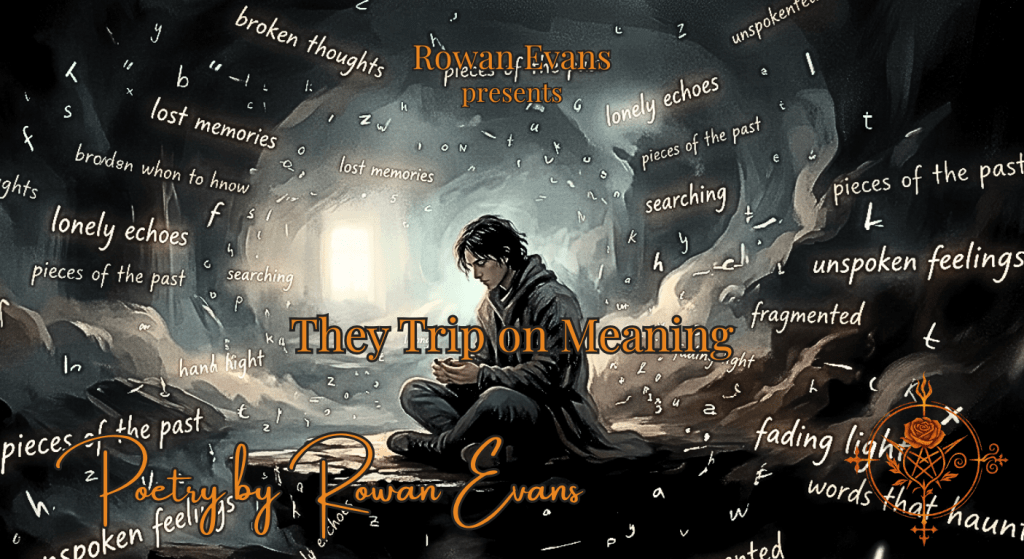
    Person surrounded by fragmented floating words symbolizing miscommunication and emotional exhaustion
    I spent years thinking the problem was my voice.

    They Trip on Meaning
    Poetry by Rowan Evans

    I trip on words,
    like they come
    with two left feet.

    But is it me—
    or is it meaning?

    Maybe it’s just
    a misunderstanding.

    I trip on words—
    they never watch
    where they’re going,
    and I’m tired
    of being blamed
    for their bad coordination.

    They stumble
    out of my mouth,
    bumping into each other,
    apologizing
    on the way down.

    I trip on words,
    and every sentence bruises.

    I never learned
    how to speak
    without falling.

    But I’m starting to think
    maybe it isn’t me—

    maybe it’s them.

    I’m starting to think
    they hear me,
    but they don’t listen.

    Finding meaning
    in the in-between,
    where my mind hides.

    I trip on words,
    embarrassed at first—

    but I’ve grown sick
    of translating myself
    so much
    it hurts.

    I don’t trip on words.

    They trip on meaning,
    then expect me
    to apologize.

    No—
    that’s fine.

    The problem
    isn’t mine.

    I’ve already done
    the hard part.

    Slowed my mind
    so they could try
    to keep up.

    I’ve already done
    the hard part—
    learned myself,
    learned how to see
    someone else.

    I’ve already done the work,
    taken the steps
    to bridge the gaps,
    to close the space
    between us—

    but I can’t
    translate forever.

    Some meanings
    must meet me
    halfway.


    If you’re interested in more poetry, you can find it here → [The Library of Ashes]
  • Author’s Note

    This piece feels like a conversation with every version of myself that survived long enough to become this one.

    The angry versions. The grieving versions. The lonely versions. The hopeful ones too.

    For a long time, I thought pain would eventually turn me cold. That heartbreak, betrayal, abandonment—all of it—would harden me into someone bitter.

    But somewhere along the way, I realized something:

    I don’t want to become what hurt me.

    So this poem became less about suffering, and more about what comes after it. About the kind of love I believe in now—not performative, not transactional, not built on fantasy.

    Real love is presence. Attention. Safety. Memory. Patience.

    It’s showing up.

    And maybe that sounds simple. But I think simple things are often the hardest to do consistently.

    Rowan Evans


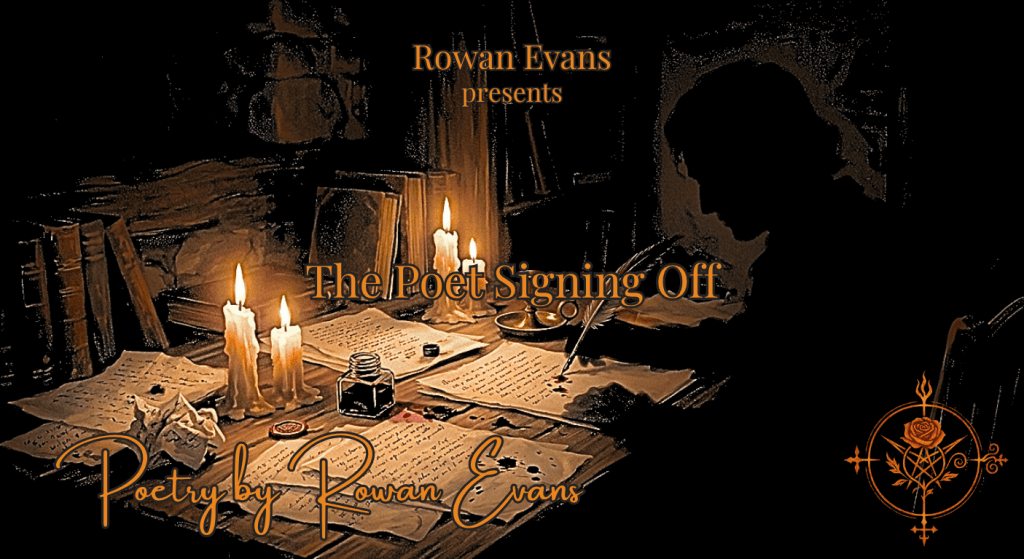
    Candlelit desk with handwritten poetry symbolizing heartbreak and emotional healing
    Love is not perfection. It’s presence.

    The Poet Signing Off
    Poetry by Rowan Evans

    Hello—
    let me introduce myself.

    I am Rowan
    and no one else.

    The fire in my eyes
    may have faded—
    but I never let the world
    turn me jaded.

    I’m not bitter,
    even though
    maybe I should be.

    I’ve been through shit—
    yeah,
    I’ve really been through it.

    I’ve seen friends
    turn to strangers—

    and worse,
    turn to haters.

    Friends
    to enemies.

    Lovers
    to ghosts.

    Raise your glass—
    time for a toast.

    I thank you
    for the lessons,
    the pleasure
    and the pain.

    I turned heartbreak
    into ink,
    and bled across
    the page.

    You taught me
    what love is not.

    It’s not grand gestures
    or fancy gifts.

    It’s time
    and presence—
    not just presents.

    It’s stormy weather
    and sunny days.

    It’s seeing the weight
    someone carries,
    realizing
    they’re being buried.

    It’s listening
    and learning
    their stories.

    It’s seeing beneath
    the surface,
    lifting them up—

    that’s the purpose.

    Remember
    the little things.

    How she likes her coffee.
    The way she wakes up,
    randomly.

    And be there.

    If she wakes
    shaken,
    and needs somewhere
    safe—

    be there.

    That’s the rule
    I try to live by.

    I’ve been hurt before,
    and I don’t want
    to pass that hurt forward.

    I want to ease the ache.

    I know I can’t
    fix the breaks—

    but maybe
    we can mend
    the cracks with gold,
    showing people
    the beauty
    damage makes.

    Because cracks
    are not flaws—

    they’re stories written
    in a language
    older than spoken tongues.

    It’s love—

    older than empires,
    older than cavemen
    lighting the first fires.

    Romantic or platonic,
    it matters not.

    Love is the cure
    to the rot.

    I scribble on the page
    as the lights begin to fade.

    Candles flicker.
    Flames dance.

    And the poet’s pen
    finds its cadence.

    The poet
    signing off.

    Goodbye.


    If you’re interested in more poetry, you can find it here → [The Library of Ashes]
  • Author’s Note

    This piece comes from exhaustion—but not hopelessness.

    It’s easy to look at the world and believe division is inevitable. That conflict, violence, and separation are simply part of human nature.

    But I don’t think wanting better is naïve.

    I think giving up on each other is.

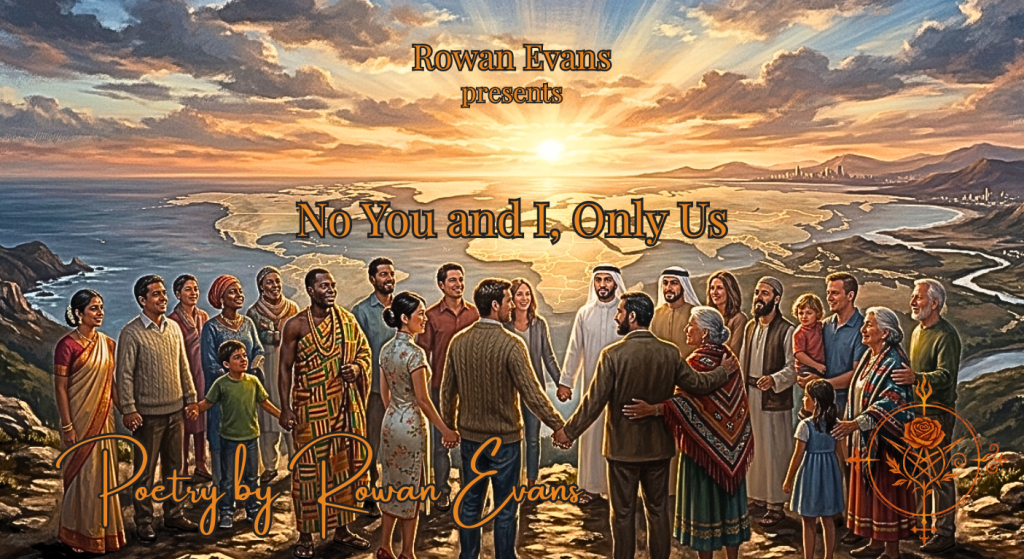
    This poem isn’t political in the traditional sense. It’s human. It’s about imagining a world where empathy matters more than borders, where people are seen as people before labels, flags, or geography.

    Maybe that kind of world feels distant.

    But every meaningful change once started as something people called unrealistic.

    Rowan Evans


    People from different countries standing together symbolizing unity beyond borders
    Maybe the world gets better when we stop thinking in terms of “us versus them.”

    No You and I, Only Us
    Poetry by Rowan Evans

    I dream of a world—
    where there is no
    you and I,

    only us.

    I dream of a time
    when we can
    all come together
    and help one another.

    Where violence
    exists in history books—
    not classrooms.

    I dream of a world
    where borders
    are nothing but outlines,
    showing where
    someone is from—

    instead of bars
    on a cage.

    Some may say
    I’m delusional,

    but I say—
    it’s aspirational.

    I want better.

    I want better
    for me—
    for you—

    from America
    to Hong Kong,
    the United Kingdom
    to Singapore—

    from Mongolia
    to Libya,
    Afghanistan
    to the Philippines—

    I think
    we all deserve
    so much more.


    If you’re interested in more poetry, you can find it here → [The Library of Ashes]
  • Author’s Note

    This piece isn’t about greed or excess.
    It’s about intention.

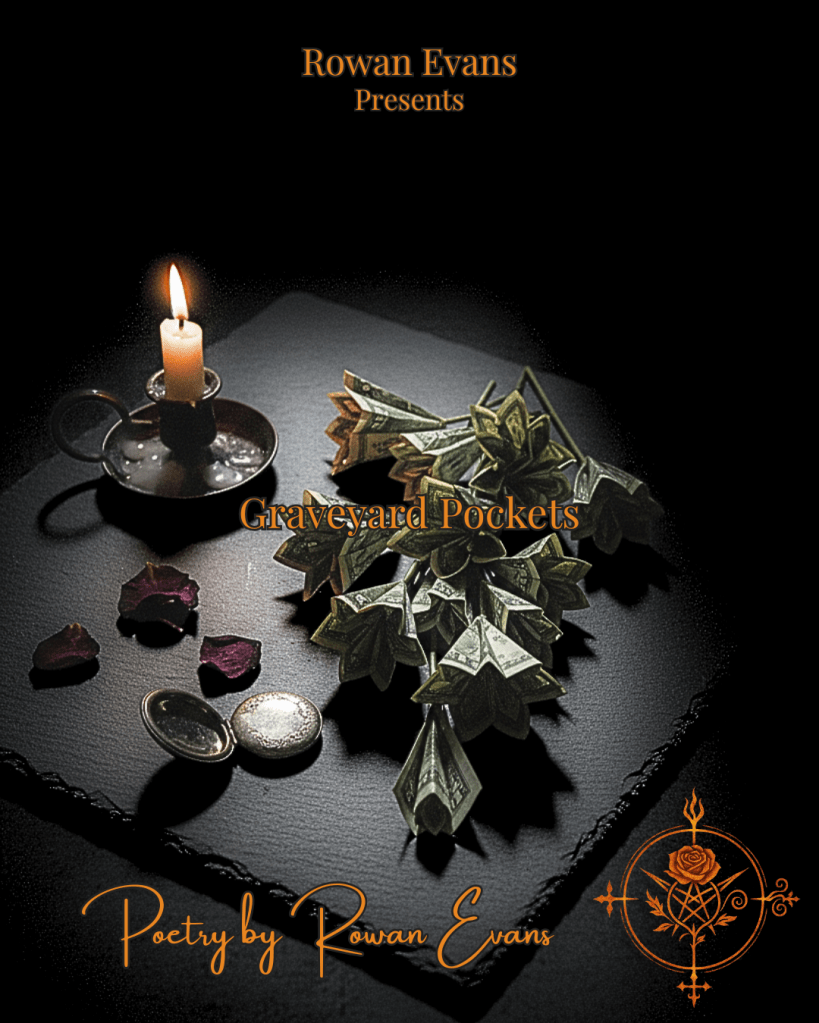
    About money as a tool instead of a god,
    and the difference between hoarding wealth
    and redistributing it with purpose.

    “Dead presidents” aren’t worshipped here —
    they’re repurposed.
    Laid to rest, then put back into circulation.

    This poem lives in that tension:
    wanting enough power to make a difference,
    without letting that power define who you are.

    Rowan Evans


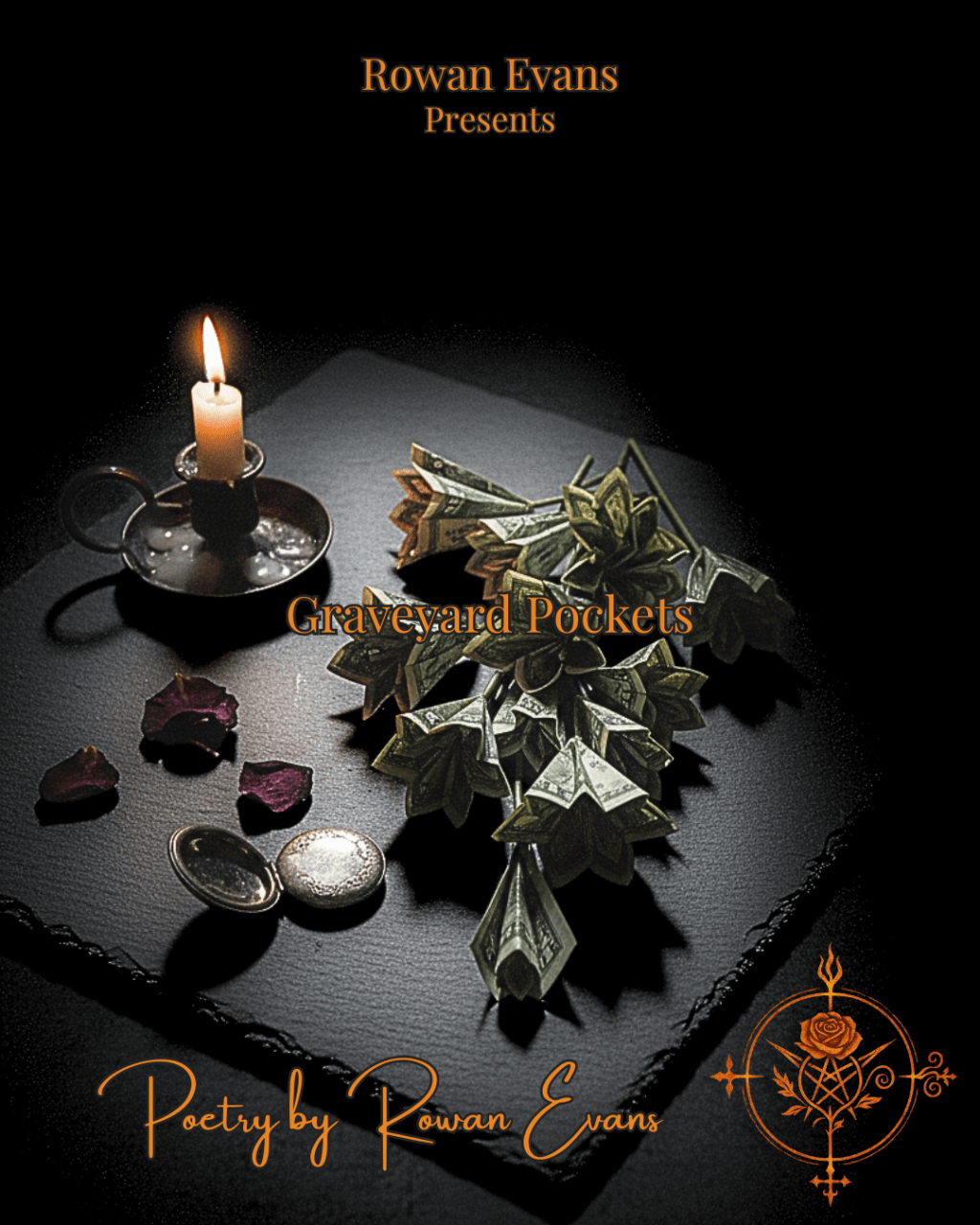
    Paper money arranged like funeral flowers in candlelight, symbolizing wealth, death, and redistribution
    Turning the bank into a wake—
    not to mourn wealth,
    but to redistribute it.

    Graveyard Pockets
    Poetry by Rowan Evans

    I don’t need money
    to come to me.
    I don’t need wealth
    to be happy.
    I just…

    I want to turn my
    pockets into graveyards,
    fill ’em with dead presidents.
    Then I’ll spread the wealth,
    like I’m robbing the grave.

    Turn the bank,
    to a wake—
    cash laid out like lilies,
    big withdraw on
    a day of remembrance.


    If you’re interested in more poetry, you can find it here → [The Library of Ashes]