Sometimes the loudest hater in the room is the one you brought with you.
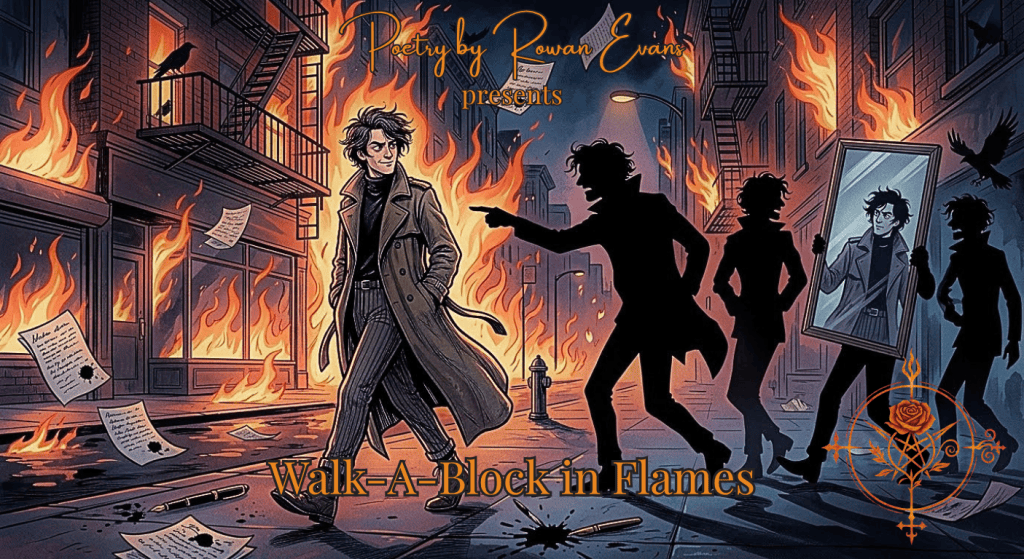
Walk-A-Block in Flames started with the idea of imaginary critics—the voices that somehow manage to find fault with everything you do, even when nobody else is actually saying a damn thing. Naturally, my brain decided the appropriate response was to turn that internal conflict into a ridiculous walk around the block, throw in some wordplay, and see how many times I could make the joke work before the poem eventually turned the joke back on me.
Because beneath all the flames, bravado, and fake enemies, there’s a much simpler realization:
Sometimes the person I’m arguing with is me.
And honestly?
That’s probably the funniest part.
— Rowan Evans
Plot twist: the haters were imaginary, and unfortunately, they had my voice.
Walk-A-Block in Flames Poetry by Rowan Evans
They tell me,
these imaginary haters,
that I’ve fuckin’ created—
they live inside my head,
feeding on my self-doubt—
obsessed with burning the self-down.
They make me take a walk,
a walk around a block
and it’s fucking hot—
I guess you could say,
these imaginary haters made me,
Waka Flocka Flame.
Wait—
I meant to say—
these haters made me
Walk-A-Block In Flames.
Honestly though,
I don’t know
what the fuck
they hate me for—
Is it because my wrist froze?
Nope, I’m broke—
Because I’m the best to ever do it?
Nope, that’s a joke—
Is it because they say
the things I think about me?
Couldn’t be—
because I think I’m great,
and these haters are fake.
I mean literally fake,
figments—
they don’t exist,
it’s just me in this bitch.
Sometimes “I don’t give a fuck” isn’t really apathy. Sometimes it’s exhaustion, overextension, or finally realizing that not everything deserves a piece of you.
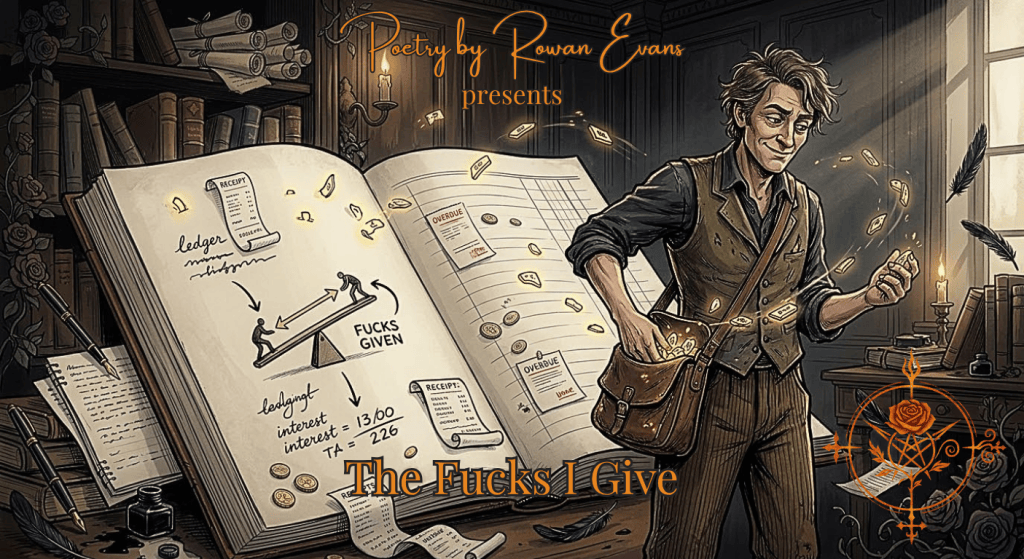
The Fucks I Give takes that idea and turns it into a ridiculous little accounting problem. If I’ve been handing out fucks like they’re an unlimited resource, eventually I’m going to have to audit the books, collect the outstanding balance, and start charging interest.
Underneath the jokes and profanity is something I’m actually pretty serious about: learning to be selective with what gets my attention, my energy, my emotions, and my time.
Because giving a fuck can be an act of love.
So can taking your fucks back.
— Rowan Evans
Apparently, my fucks weren’t free. I’m just finally collecting the outstanding balance.
The Fucks I Give Poetry by Rowan Evans
They said I’m too apathetic,
actin’ like nothing matters,
and it’s pathetic—
they want me to give a fuck,
but shit, I misplaced my bag of fucks—
so I’ve got no fucks to give.
Yeah, I’ll go through
and take all my fucks back—
I’ll walk right up and knock, like—
I’m here to collect my fucks,
and extra fucks too—
it’s a fucking tax,
and there is interest, dude.
You think fucks are endless.
No, I’ve got to be pickier—
because for a minute there,
it was—
fuck everything
and that’s probably
what they’re angry for.
It was fuck this and fuck that—
I was running out of fucks fast.
I sometimes look back at the person I was when I first started writing and wonder how much of that younger version of me is still sitting somewhere inside every poem I create. I started writing at thirteen, the same year I experienced my first heartbreak. Back then, ink wasn’t simply a creative outlet. It was a way to hold myself together, to give shape to feelings I didn’t know how to carry, and to leave a record of myself on the page when I was afraid of losing pieces of who I was.
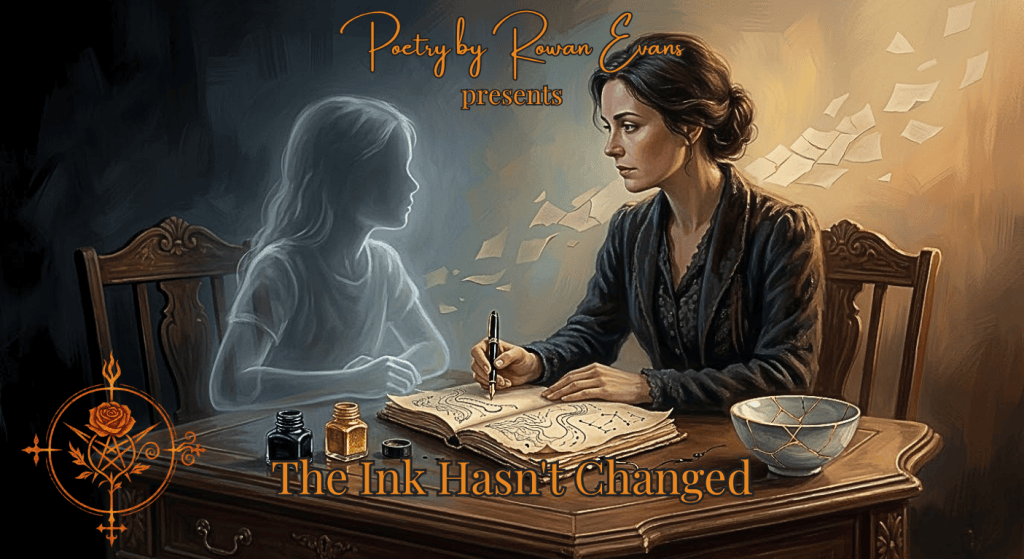
The Ink Hasn’t Changed is about revisiting those beginnings without confusing familiarity with stagnation. The same emotions still find their way into my work: joy, grief, anger, tenderness, laughter, and pain. I’ve continued mapping my soul through poetry, stitching together broken pieces and filling the cracks with whatever gold I could find. The tools and materials may feel familiar, but the person doing the stitching is not the same.
There’s a difference between carrying the same weight and never moving forward. Sometimes, growth means discovering that the thing that once kept you alive can become something you choose to nurture, refine, and share.
My ink hasn’t changed because its purpose never needed to. I have changed. I’ve survived. And the words that once helped me hold myself together now help me understand who I’ve become.
— Rowan Evans
The ink that helped me survive at thirteen still carries my truth at thirty-six. The ink hasn’t changed. I have.
The Ink Hasn’t Changed Poetry by Rowan Evans
I’ve been stuck in the past a lot lately,
just thinking about who I was—
who I was trying to become
and how those early days
set the stage for who I became,
on and off the page.
The same year
I committed myself to ink,
I tasted my first heartbreak—
it was bitter sweet,
hated that it had to come,
but nothing could be done.
That was 2003, I was thirteen—
and she was made to leave.
I took the shattered pieces,
collected in a basket—
I took threads of silver
and sewed myself
back together again.
Cracks patched with gold and ink,
confessions penned in golden ink—
back then
I wrote for me—
I wrote to keep it together,
mentally—
afraid I’d disappear
if I didn’t map my soul in ink.
Turned poetry to cartography,
started mapping the whole of me.
I mapped my soul, wholly—
turned my pain holy.
I tried to translate all of me—
the joy, the pain,
laughter and grief—
and my ink hasn’t changed.
It’s still carrying the same things.
All the same weight, wait—
does that mean I’m stuck in place?
No, just because the ink
has stayed the same—
doesn’t mean I have—I’ve changed,
I’m not the same as I was at thirteen,
now that I’m thirty-six—
and I’m not the same as I was at sixteen,
that’s when I thought my ink was real mean—
but really it was too nice,
the only thing keeping me alive.
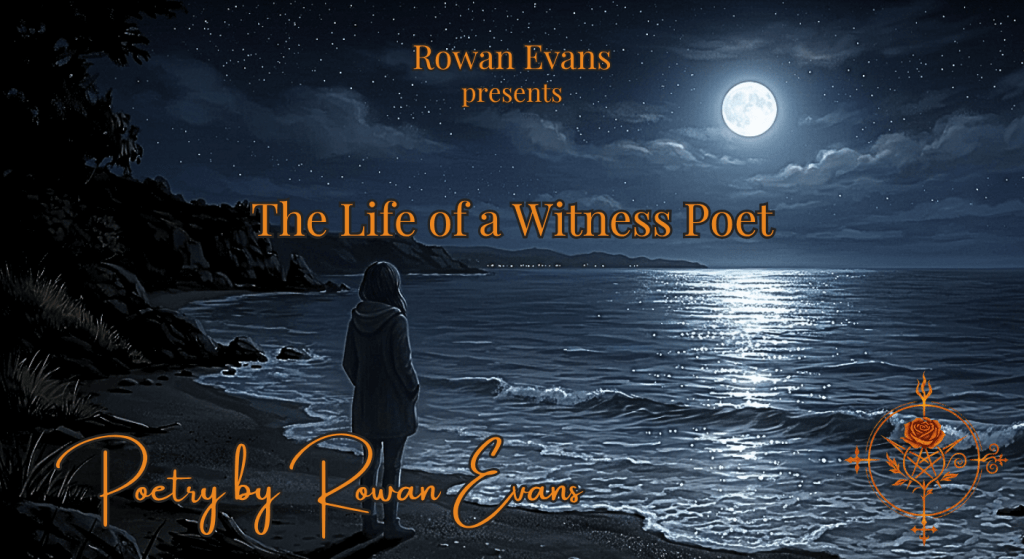
I’ve often described myself as a witness poet—someone who pays attention, who notices the emotional weather around the people I care about, and then translates those observations into poetry.
Sometimes that role feels like a gift.
Sometimes it feels helpless.
Because witnessing doesn’t always come with the ability to change what you see.
You can recognize someone’s strength, admire their resilience, ache alongside their struggles, and still be separated by circumstances larger than either of you.
This poem isn’t about unrequited love.
It isn’t about sacrifice.
It’s about accepting that love isn’t always measured by proximity.
Sometimes love looks like paying attention.
Sometimes it looks like quietly hoping someone feels a little less alone because, somewhere in the world, another heart witnessed their struggle with compassion instead of judgment.
That’s the strange privilege—and responsibility—of being a witness poet.
Not every distance is meant to be closed.
Some are simply meant to be seen.
— Rowan Evans
“Some distances cannot be crossed—but they can still be held with compassion.”
The Life of a Witness Poet Poetry by Rowan Evans
The life of a witness poet—
it’s harder than you think,
when your heart bleeds in ink.
And it only gets harder
when you’ve fallen
for the one you witness.
You see the weight she carries,
you watch from a distance—
your hands tied by the tide,
and the gap—an ocean wide.
You want to be a light in her life—
like the moon in the sky.
You learn to glow quietly,
hoping she’ll look up someday—
not for you,
but for the comfort
you’ve been trying to give
from a distance.
So you learn to love in silence,
in the spaces between her storms—
holding what you can,
honoring what you can’t,
knowing some distances
aren’t meant to be crossed,
only witnessed.
Journey into the Hexverse…
[What I’m Trying to Say] What begins as an exaggerated promise of love slowly strips itself back until only one simple truth remains: real devotion isn’t found in grand gestures—it’s found in consistently showing up.
[I’d Rather Try] Anyone can promise they’d die for someone. But love isn’t built on one dramatic moment—it’s built on showing up, trying again tomorrow, and proving your words through consistent action.
[Pointing Me Home] The final poem in the No Metaphor Left Behind trilogy explores dreams, hope, and belonging. Through moonlight, ocean tides, and quiet conversation, Pointing Me Home reflects on carrying hope long before reaching the place you call home.
[Only Waiting] The second poem in the No Metaphor Left Behind series, exploring the quiet ache of growing up in a place that never truly felt like home—and finally saying aloud what years of metaphor had been trying to express.
[Crossing the Sea] A deeply personal poem about relocation, longing, and the realization that some truths naturally arrive through metaphor—even when we try to leave it behind.
[I’ll Be There to See Your Sunrise] Love has never come easily to me. This poem explores the fear, vulnerability, and quiet courage required to stay emotionally present when connection begins to matter deeply. “I’ll Be There to See Your Sunrise” is about choosing love despite the risk of heartbreak—and promising to remain long enough to witness someone fully.
Some people assume that because I write confessional poetry, vulnerability comes naturally to me.
It doesn’t.
My first instinct is almost always to make a joke.
If something hurts, I’ll reach for humor. If something feels too exposed, I’ll bury it beneath a cartoon reference, a comic book nod, or a punchline that arrives just before the truth does.
This poem is about that instinct.
It explores the strange contradiction at the center of my writing: I’m willing to confess almost anything—as long as I can disguise it first.
The title, 5:01, marks another early morning when my thoughts were moving faster than I could organize them. And “Pull the Punchline Back” became my way of describing what happens when I realize I’ve hidden behind humor for just a second too long.
Sometimes the joke protects me.
Sometimes it prevents me from saying what I actually mean.
This poem lives somewhere between those two realities.
— Rowan Evans
Sometimes the hardest part of confession isn’t finding the words—it’s resisting the joke that tries to replace them.
5:01 (Pull the Punchline Back) Poetry by Rowan Evans
5:01—
the morning comes
and my thoughts run,
like a marathon.
You see—
most the time
my thoughts move quick,
like a sprint—
Usain?
No, insane.
I bolt when I feel
I care too much—
here the vulnerability comes,
so where’s the joke at?
I got to hide that—
pull the punchline back.
I put a brave face on—
they call me Courage,
even though
I’m a cowardly dog.
Isn’t it funny?
I’m a confessional poet,
but I hide the confession
behind a wall of jokes—
and cartoon references—
can’t forget the comic books.
The page is a phone booth,
I go into to change—
but I’m not trying to be a hero here,
there’s no S on my chest.
I’m just here for those
that are stressed and struggling.
And this is my problem,
I’ve got my own problems,
then I take mo’ problems,
they were yo’ problems—
now I’m juggling.
The sad thing is—
the whole time
this is what my mind
has been running from.
It’s incredible—
how fast I Dash,
gone in a Flash,
like I ran to the past
to escape—
everything I want.
Connection.
Reflection.
So I keep my feet moving
until I get where I’m going,
and I’m not showin’—
no signs of slowin’.
Journey into the Hexverse…
[I’d Rather Try] Anyone can promise they’d die for someone. But love isn’t built on one dramatic moment—it’s built on showing up, trying again tomorrow, and proving your words through consistent action.
[Tots, Rocks and All] What begins as a surreal collection of tater tots, rocks, comic book references, and runaway thoughts slowly reveals something much quieter: a poem about creativity, vulnerability, and the simple hope of finding someone willing to hold your heart.
[Ocean Waves (1, 4, 3)] What begins as a surreal collection of tater tots, rocks, comic book references, and runaway thoughts slowly reveals something much quieter: a poem about creativity, vulnerability, and the simple hope of finding someone willing to hold your heart.
[L Words & Heart] A playful, self-aware poem about love, longing, loyalty, and the quiet ways another person can reshape our inner world. What begins as humor slowly reveals a heartfelt confession about affection, imagination, and the faces that linger in our dreams.
[No You and I, Only Us] A hopeful free verse poem about empathy, borders, and imagining a world where humanity matters more than division.
People sometimes talk about depression like it’s constant sadness.
For me, it’s rarely that simple.
Sometimes it’s pressure. Sometimes it’s exhaustion. Sometimes it’s numbness so quiet you don’t notice how deep you’ve sunk until something shifts and suddenly you can breathe again.
That’s where this piece came from.
Not from a dramatic breakthrough— just a morning where the weight felt lighter.
And when you’ve carried storms inside yourself for long enough, even small moments of relief can feel almost unreal.
But one of the hardest things to learn about living with depression is this:
good days don’t erase bad ones, and bad days don’t erase good ones.
The storm passing doesn’t mean it’ll never return.
It means you survived it long enough to recognize clear skies when they arrive.
That’s what Reading the Sky became about for me.
Not curing the storm. Not defeating it.
Just learning its patterns. Learning when the pressure shifts. Learning how to keep breathing through both the thunder and the quiet afterward.
And maybe most importantly—
allowing yourself to enjoy the clean air when it finally comes.
— Rowan Evans
Some victories are simply learning how to breathe again after the storm passes.
Reading the Sky Poetry by Rowan Evans
I woke today
feeling different—
like everything
had changed,
in an instant.
Like the storm inside
had finally gone silent.
The winds had died,
but I was alive.
Smile on my face—
for the first time,
didn’t feel out of place.
I could still see
lightning on the edges
of my perception—
feel the rumble
of thunder
in my chest.
It was softer now.
This storm had passed,
but another
would surely come.
It’s a cycle—
and these things
have a season.
The storms?
They come
and go.
That’ll never change.
It’s learning
to read the sky,
to feel
when the pressure shifts.
Now let me say this plain…
I’ve got depression.
It lives in my chest,
waiting to teach me lessons.
It’s a storm
I’ve weathered—
more than
any one person should.
That’s what makes
days like these—
feel like the cleanest air
I’ve ever breathed.
For a long time, I confused standing still with failure.
Like if I wasn’t moving fast enough, succeeding quickly enough, becoming who I wanted to be on everyone else’s timeline—then maybe the people doubting me were right.
But growth rarely looks clean while you’re inside it.
Sometimes progress is just continuing to move, even when fear, uncertainty, or other people’s expectations try to keep you frozen in place.
This piece sits in that space between doubt and momentum.
Between hearing the warnings… and still feeling the pull forward anyway.
Because there are moments in life where the call toward something bigger becomes louder than the voices telling you to stay where you are.
And eventually— you either trust that pull,
or spend your whole life wondering what would’ve happened if you did.
— Rowan Evans
Some voices tell you to stay. The waves tell you to move.
The Waves That Call Me Poetry by Rowan Evans
I stood on the shoreline,
eyes locked
on ocean waves—
pain and longing
painted across my face.
I feel stuck in place,
like I forgot
I’m trying to win
the race.
But I’ve got dreams
to chase.
One foot
and then the other—
even as they doubt me.
They shout:
“Not a snowball’s chance in—”
Well—
leave them puddles
at my feet.
I thrive in heat.
They think
they’ve got room
to talk,
trying to still
my walk
with warnings.
They try
to warn me.
They say—
only time will tell.
But she’s not speaking.
Thinking—
I’m a failure.
That’s what
they said to me.
If I’m a failure,
then I’m glad—
opposites attract,
and success is coming
down the track.
I may have turned,
taken the long way around—
but I’ve got dreams,
and I don’t plan
to back down.
So I stand on the edge,
shoreline stretching
without end—
I’ve realized over the years that music does more than inspire my writing.
It organizes me.
When my thoughts become too loud, too fragmented, too heavy to carry all at once, music gives them shape. Rhythm turns chaos into movement. Emotion becomes something I can follow instead of drown in.
This piece is about that process.
About the strange balance between instability and expression. Between wobbling and staying upright. Between feeling overwhelmed… and still creating anyway.
The references throughout the poem aren’t random. They reflect the sounds and artists that genuinely help ground me—music that travels across borders the same way emotion does.
Because sometimes healing doesn’t look like silence or peace.
Sometimes it looks like headphones on, music loud, pen moving, and surviving one line at a time.
— Rowan Evans
The ground may shake, but music, ink, and light still hold me upright.
The Music Holds Me Upright Poetry by Rowan Evans
I sit with them
when thoughts get heavy—
the weight
I’ve struggled
to carry.
My spine bends,
but never breaks.
They call me weeble,
the way I wobble
but don’t fall down.
Standing
on shaking ground.
Depression.
Anxiety.
The fire
inside of me.
Flames flicker—
entranced—
the pen
begins
to dance.
When thoughts grow heavy
with the weight
I’ve struggled
to carry—
I write.
Lights.
Camera.
Action.
The page—
a stage.
The pen—
a dancer.
Weaving
ink-stained paths
across lined paper.
Word after word,
I write what hurts—
but I need
the music first.
Soundtrack
to the chaos,
drifting through
Thailand,
Japan,
Korea,
and the Philippines.
Soundscapes
helping my emotions
take shape.
Painting images,
arranging metaphors—
the music becomes
a tour guide
inside my mind.
Each stop
refracting—
light fractured,
split.
A new emotion
coming into focus
as the sound shifts.
And still,
I steady—
not by force,
but by rhythm.
The ground may shake.
The thoughts grow heavy.
But the music,
the ink,
the light—
they hold me upright
every time.
So let the scene roll.
Let the soundtrack swell.
I’ll take every fracture,
every wobble,
every spark—
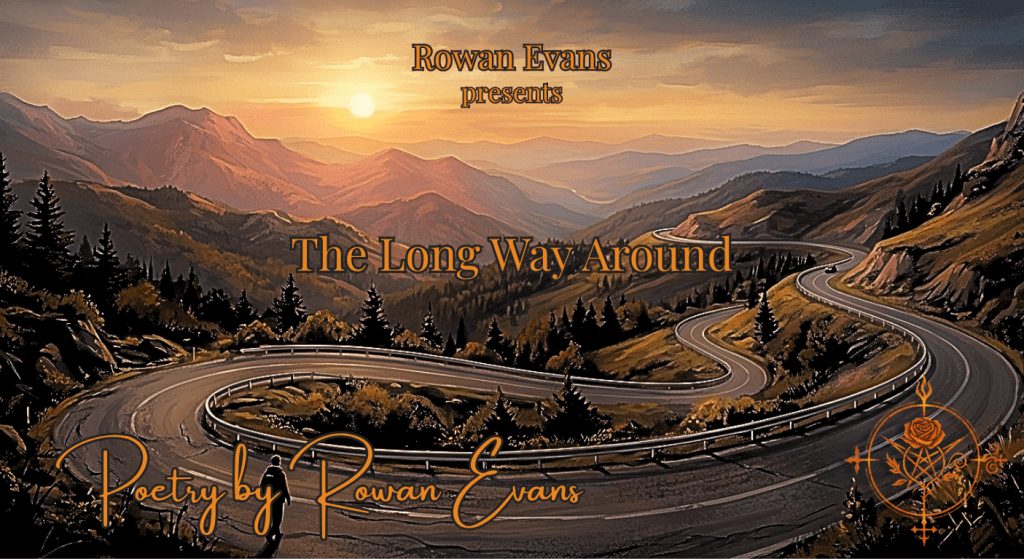
“If you are in a hurry, take the long way around.”
I don’t know where it actually comes from—but the idea stuck.
We’re taught to move fast. To find the most direct path. To get from where we are to where we want to be as efficiently as possible.
But some things don’t survive that kind of movement.
Some growth only happens in the detours. In the delays. In the parts that feel unnecessary while you’re in them.
This piece isn’t about slowing down for the sake of it.
It’s about recognizing that sometimes, the long way isn’t a setback—
it’s the only path that lets you arrive intact.
— Rowan Evans
Not quickly—but whole.
The Long Way Around Poetry by Rowan Evans
If you’re in a hurry,
go the long way ’round—
because sometimes
the straight line
is the one that breaks you.
It’s not ease
that shapes you.
It’s the winding roads
that make you.
It’s the bends,
the breaks,
the slow turns
that teach you.
It’s the corners,
the pauses,
the places you swore
you’d never have to pass through.
And somehow,
by the time you reach the end,
you realize
the long way
was the only way
you could have survived.
Yet still,
you arrive—
not quickly,
but whole.
The long way
is the way
that lasts.
Journey into the Hexverse!
[Where the Tide Calls Me] What if feeling stuck isn’t about being lost—but about resisting where you’re meant to go? Where the Tide Calls Me explores belonging, movement, and the courage to follow an unseen pull.
[Just Before I Arrive] A voice calls from somewhere just out of reach. Just Before I Arrive explores the feeling of being guided through a dream toward connection—only to wake up before you get there.
[Dreaming of Other Streets] What if the places that feel like home aren’t the ones you’ve lived in? This poem explores dreams, memory, and the quiet search for belonging in unfamiliar places
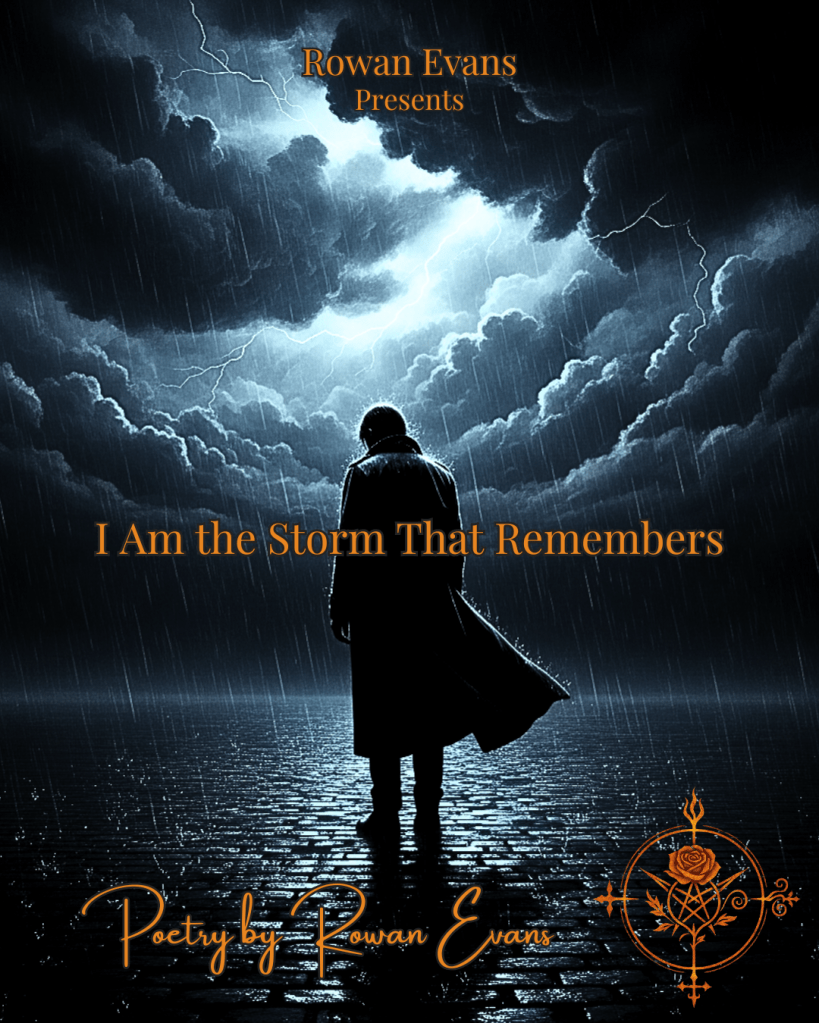
Some people leave, but their weather stays. This poem is not about loss—it is about endurance, memory, and the quiet strength it takes to remain standing when the storm remembers everything.
Some people leave, but their weather stays.
I Am the Storm That Remembers Poetry by Rowan Evans
Everyone comes into our lives for a reason,
but some are only meant for a season.
Then the weather changes,
and they begin to drift.
It may not hit like an immediate shift,
it may slowly unfold and fade.
Yet even as they go,
their footprints linger,
like sunlight caught in the corner of a room,
warm but unreachable.
For me, memories swirl
like storm clouds roiling overhead,
thunder rolling through my chest,
lightning flashing their faces,
voices cutting through the wind—
too sharp to ignore, too loud to forget.
I try to run.
I try to close the windows,
pull the shutters tight.
But the storm is patient.
It seeps through cracks,
slips under doors,
lingers in the spaces I thought I’d cleared.
Rain falls in shards,
drenches my quiet moments,
washes over laughter I can’t recover,
drowns the footprints of the ones who left.
And yet, in the chaos,
there is a strange kind of clarity:
the storm remembers,
and so do I.
I wish I could let it go,
to be like them—
so quick to forget,
so light in the sun.
But I am not.
I am the storm’s echo,
the residue of seasons past,
and somehow, I carry their weight
and my own,
and I am still here,
breathing,
walking,
storm-beaten but alive.