Tag: communication

  • Author’s Note

    Sometimes a poem is born from heartbreak.

    Sometimes it is born from a metaphor.

    And sometimes my brain apparently looks at a sandwich and says, yes, this is how we’re processing emotional confusion today.

    Lost in the Sauce is a deliberately playful poem built around food-related wordplay, particularly the language of sandwiches, condiments, bread, and the wonderfully terrible possibilities hidden inside them.

    The jokes are intentionally stupid.

    That is part of the point.

    “Bread” becomes “rye.” “Ketchup” becomes “catch up.” “Mustard” becomes “must’ve.” “Sourdough” becomes an emotional description. Even “lettuce meat in the middle” is doing multiple jobs at once.

    But beneath all of that nonsense is something much more familiar: the confusion of being told that everything is okay while someone’s behavior feels completely different.

    The speaker is trying to understand the contradiction.

    They were told the relationship was fine.

    They were told the other person was happy.

    So why does everything suddenly feel cold?

    Why does affection feel sour?

    Why does the speaker feel trapped in place, struggling to catch up to something they don’t fully understand?

    The ridiculous wordplay gives me permission to approach that emotional confusion without making the poem overly solemn.

    I’ve been rediscovering how much I enjoy treating language like a playground—taking ordinary words, twisting them until they become something else, and seeing how far I can push a joke before the emotional meaning underneath it starts showing through.

    So yes, this poem is about sandwiches.

    Sort of.

    Mostly, it’s about being lost in the sauce when the person you’re trying to understand has already changed the recipe.

    Rowan Evans


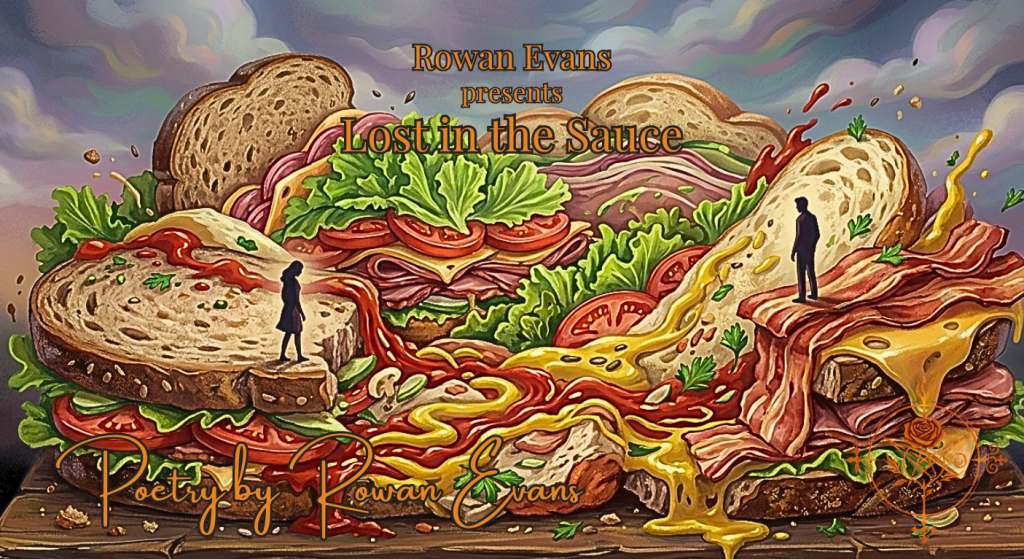
    A surreal sandwich with layers of bread, meat, lettuce, tomato, ketchup, and mustard separating two figures.
    Sometimes you don’t fall apart.
    Sometimes you just get lost in the sauce. 🥪

    Lost in the Sauce
    Poetry by Rowan Evans

    You sandwiched me in
    with an all-tomato—

    love you or leave,
    but I couldn’t do it clean—

    I was lost in the sauce,
    begging lettuce
    meat in the middle.

    You said, “you lie.”
    I said, “Nah, you rye.”

    But do you know why?
    I was stuck in place,
    you wouldn’t wait—

    I was struggling
    to ketchup.
    I thought you
    mustard—

    how could you not?
    People talk.

    Look—
    I’m sorry.
    I don’t want to fight.
    But, you said—
    you were happy.
    We were okay.

    So why you so cold,
    why you actin’ sourdough?


    Journey into the Hexverse…

    [Did You Really Think This Was About Trees?]
    A playful love poem disguised as a forest of terrible tree puns. Beneath the birch, oak, cedar, palms, lumber, and absurdist wordplay is a poem about devotion, loyalty, laughter, and building a life with someone you love.

    [Blended Hardware]
    A playful, absurdist poem where step-ladders, garden hoses, Star Wars, teenage memories, Gothic imagery, and the poet’s own self-interrupting commentary collide. Blended Hardware is a celebration of letting language wander.

    If you’re interested in more poetry, you can find it here → [The Library of Ashes]
  • Author’s Note

    Sometimes a poem doesn’t need to be profound.

    Sometimes it just needs to say, “Please fucking listen.”

    No Stupid Questions came from that particular kind of frustration—the kind that happens when someone asks something that has already been answered, interrupts the flow of a conversation, or throws a question into the room without stopping to consider whether the information they want is already sitting right in front of them.

    The old saying goes, “There are no stupid questions.”

    I don’t completely agree.

    Questions aren’t inherently stupid. Curiosity is valuable, and asking for clarification is often exactly what we should do. But there is a difference between genuinely wanting to understand something and simply asking whatever crosses your mind without listening to what was already said.

    This poem is intentionally blunt because the frustration is blunt.

    It’s conversational, a little sarcastic, and unapologetically irritated. There are times when I want my poetry to dress an idea in metaphor and symbolism. Other times, I just want to point at the problem and say exactly what I mean.

    No metaphor.

    No elaborate mythology.

    No moon, tide, raven, or rose to hide behind.

    Just:

    You already got your answer.

    Listen.

    Rowan Evans

    P.S. – The end of this piece is entirely a joke.


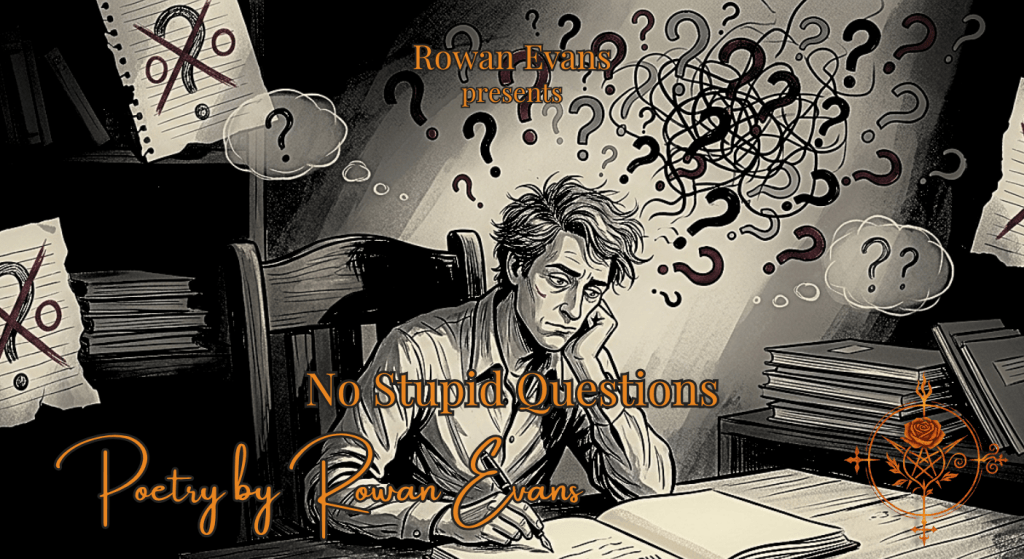
    A writer at a desk surrounded by chaotic question marks while a clear answer sits untouched in an open notebook.

    No Stupid Questions
    Poetry by Rowan Evans

    You know—

    the person that said,
    “there’s no such thing
    as a stupid question,”—

    probably asked a lot
    of stupid questions,
    just like you—

    Not trying to be rude
    or give attitude—

    but dude,
    you asked that question
    out of the blue.

    (And it was dumb,
    it was a stupid question…
    I had to break the flow to tell you,
    you asked a stupid question.)

    I already told you—

    I already answered back,
    if you need the information
    then listen—I already gave you that.

    Do you even think
    before you speak,
    or do you just
    let your thoughts fly?

    You don’t have to ask
    every question
    that comes to mind.

    I don’t care
    if you are a child.


    Journey into the Hexverse…

    [You Are Perfect]
    A gentle reminder that your worth isn’t determined by your flaws or by the opinions of others. You Are Perfect is a poem about resilience, self-acceptance, and standing tall even when the world tries to make you feel small.

    [Human Rorschach]
    Sometimes we’re less a fixed person than an inkblot—our meaning changing with every set of eyes that looks at us. Human Rorschach explores perception, identity, and the ways our own experiences shape what we believe we see in others.

    [A Rose in the Ashes]
    Lost within a forest where every leaf becomes a memory, the speaker follows darkness instead of fleeing from it, discovering that healing isn’t found at the end of the tunnel—but in facing the past long enough to notice a single rose blooming through the ashes.

    If you’re interested in more poetry, you can find it here → [The Library of Ashes]
  • Author’s Note

    People often ask what I find attractive.

    The answer has never been particularly complicated.

    I’ve always been fascinated by minds.

    Not intelligence in the competitive sense. Not who can quote the most books or win the most arguments.

    I mean curiosity.

    The way someone thinks.

    The stories they tell without realizing they’re telling them.

    The dreams they quietly carry.

    The questions that keep them awake at night.

    I’ve found that the most beautiful parts of a person usually reveal themselves in conversation.

    Not during introductions.

    Not through appearances.

    But somewhere between laughter, honesty, and those moments when someone forgets they’re trying to impress you.

    That’s when people become themselves.

    I’ve always believed there are pieces of us that only exist in dialogue. Parts that don’t emerge until someone asks the right question, or listens long enough for the answer to arrive.

    Maybe that’s why I chose the word lore.

    History is a record of what happened.

    Lore is what those moments became.

    It’s the mythology of a person—the stories, beliefs, fears, dreams, and experiences that shape how they move through the world.

    That’s what I want to know.

    Not because I need to solve anyone.

    Because understanding another person’s inner world feels like one of the greatest privileges we can offer each other.

    This poem isn’t really about romance.

    It’s about attention.

    About listening deeply enough that another person feels safe becoming fully known.

    For me, that’s where intimacy has always begun.

    Rowan Evans


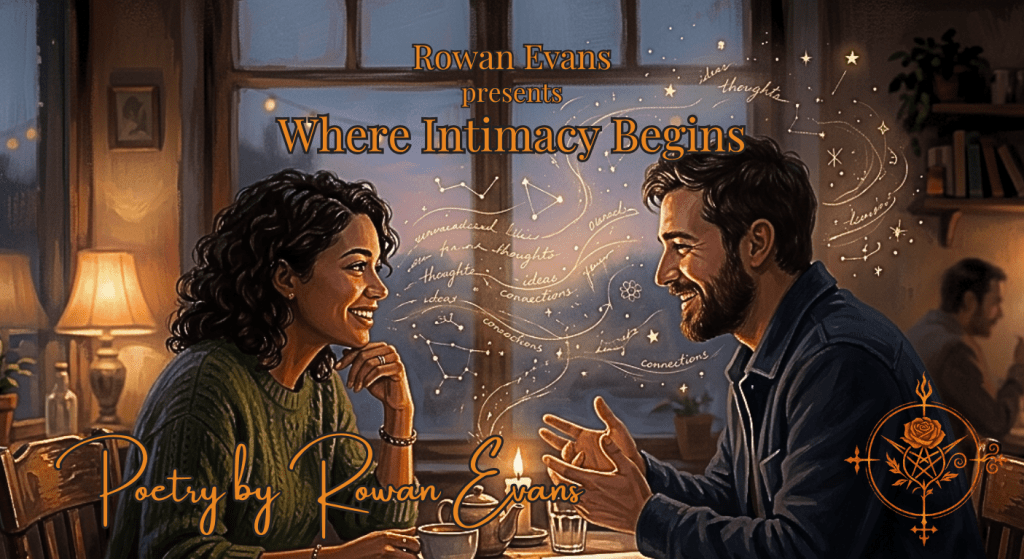
    Two people sharing a thoughtful conversation as glowing words and constellations symbolize a deep mental connection.
    “Some people fall for a smile. Others fall for the mind behind it.”

    Where Intimacy Begins
    Poetry by Rowan Evans

    They may want a body,
    but I want a mind—
    they are fine with the surface,
    I want the depths that you hide.
    It’s in conversation you find
    the light hidden inside.

    They see beauty in a face,
    I see beauty in the things you say
    and the way language takes shape.
    I see beauty in the thoughts,
    the dreams, the plans.

    You see, it’s all about
    the mental connection for me.
    I want to touch your mind,
    see what stories I’ll find—
    the lore that I’ll learn.

    And when you speak, I’ll listen—
    you should always feel heard.

    I want the stories
    you never say out loud,
    the half-formed dreams you keep
    tucked beneath your ribs.

    There are pieces of you
    that only appear in conversation.
    So I’ll hold your thoughts gently,
    the way others hold hands.

    Because I’ve learned beauty
    lives deeper than skin,
    the way a thought can light a room
    inside me—

    how a single sentence
    can feel like a door unlocking.

    I’ll meet you
    where your mind wanders.
    I’ll be the quiet
    that lets your truth come forward.

    I’ll fall for the way you think
    before anything else,
    because the mind—

    is where intimacy begins.


    Journey into the Hexverse…

    [What I’m Trying to Say]
    What begins as an exaggerated promise of love slowly strips itself back until only one simple truth remains: real devotion isn’t found in grand gestures—it’s found in consistently showing up.

    [I’d Rather Try]
    Anyone can promise they’d die for someone. But love isn’t built on one dramatic moment—it’s built on showing up, trying again tomorrow, and proving your words through consistent action.

    [The Language Her Soul Speaks]
    What if love isn’t about being understood, but learning to understand someone else? “The Language Her Soul Speaks” is a free verse poem about intimacy, communication, curiosity, and the desire to know another person beyond the limits of language.

    If you’re interested in more poetry, you can find it here → [The Library of Ashes]
  • Author’s Note

    This is one of the shortest poems I’ve written in a while, but it carries an idea I’ve been circling for years.

    A lot of love poems focus on being understood.

    Wanting someone to see you. Wanting someone to know you. Wanting someone to understand the parts of yourself that feel difficult to explain.

    Those desires are real.

    But as I was writing this piece, I realized my attention was pointed in the opposite direction.

    I wasn’t thinking about being understood.

    I was thinking about understanding.

    About how every person carries an internal world that exists beyond simple translation. A private rhythm. A natural cadence. A way of thinking and feeling that doesn’t always survive the journey into spoken language.

    I think that’s part of why I write so often about language, communication, and connection.

    Not because I believe perfect understanding is possible.

    But because the attempt matters.

    Because choosing to learn someone—to listen carefully, to pay attention, to remain curious about who they are beneath the surface—is one of the most meaningful forms of affection I know.

    The title came first.

    “The Language Her Soul Speaks.”

    Not because I believe souls literally have languages, but because some people seem to move through the world with a rhythm that feels uniquely their own.

    This poem is about wanting to learn that rhythm.

    Not to change it.

    Not to possess it.

    Just to understand it a little better than I did yesterday.

    Rowan Evans


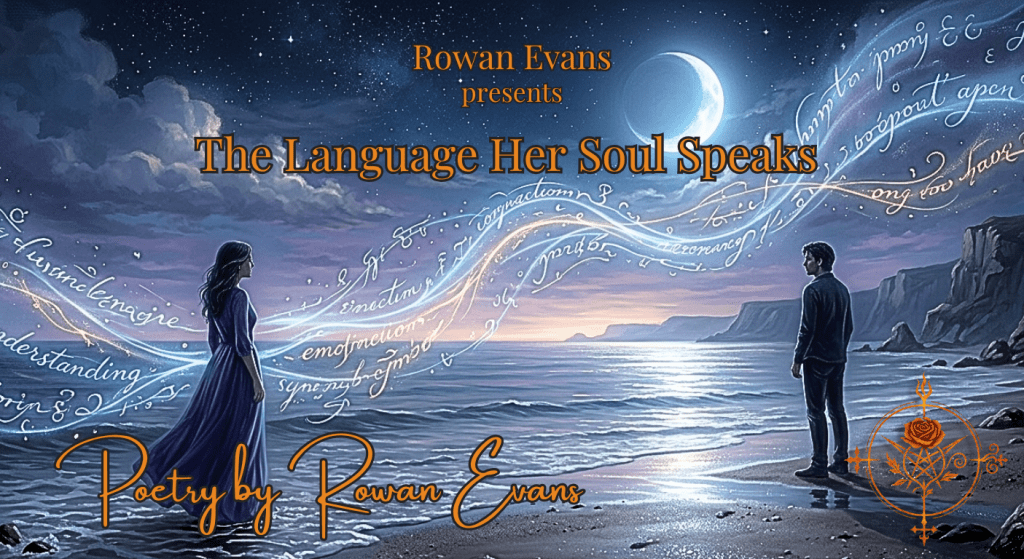
    Two figures stand beneath a moonlit sky as glowing strands of language and light flow between them, symbolizing understanding, communication, and emotional connection.
    “Not because I need to be understood, but because I want to understand.” — The Language Her Soul Speaks by Rowan Evans

    The Language Her Soul Speaks
    Poetry by Rowan Evans

    I want to whisper secrets
    in the language her soul speaks,
    touch the edges of her mind
    in the natural cadence
    in which she thinks—

    not translated,
    not borrowed,
    not filtered
    through the limits of my tongue.

    Not because I need
    to be understood,
    but because I want to understand.


    Journey into the Hexverse…

    [L Words & Heart]
    A playful, self-aware poem about love, longing, loyalty, and the quiet ways another person can reshape our inner world. What begins as humor slowly reveals a heartfelt confession about affection, imagination, and the faces that linger in our dreams.

    [Just Beyond Waking]
    A street that feels familiar. A life that hasn’t happened yet. Just Beyond Waking explores the fragile space between dreams, memory, longing, and the quiet feeling that some futures are already waiting for us.

    [I’ll Be There to See Your Sunrise]
    Love has never come easily to me. This poem explores the fear, vulnerability, and quiet courage required to stay emotionally present when connection begins to matter deeply. “I’ll Be There to See Your Sunrise” is about choosing love despite the risk of heartbreak—and promising to remain long enough to witness someone fully.

    If you’re interested in more poetry, you can find it here → [The Library of Ashes]
  • Author’s Note

    The Vows began as an exploration of devotion — not the romanticized kind, but the kind forged in ache, honesty, and reverence.

    Vow I was surrender: letting the ink run dry, allowing love to unmake what was hardened.
    Vow II was endurance: the willingness to break, to bear the bruise and still remain.
    And Vow III — this final vow — is understanding: the quiet promise to listen, to learn, and to love without translation.

    Together, they form a trinity of intimacy — the heart’s slow evolution from sacrifice to fluency, from bleeding to belonging.

    This isn’t a story of martyrdom. It’s a story of witnessing: of meeting someone’s soul and saying, I see you, I’ll learn you, I’ll speak your language.
    That is the purest vow I know.

    Rowan Evans


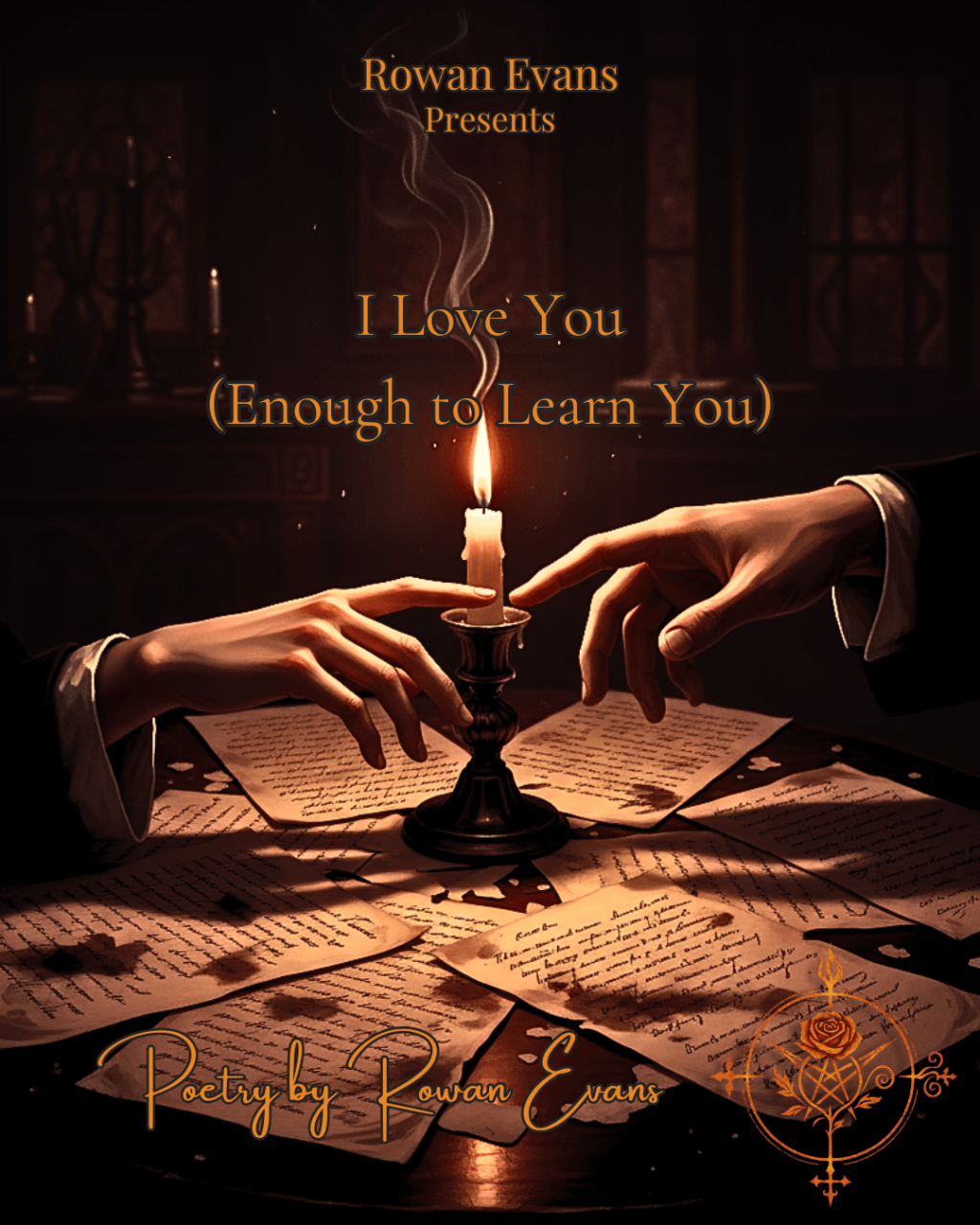
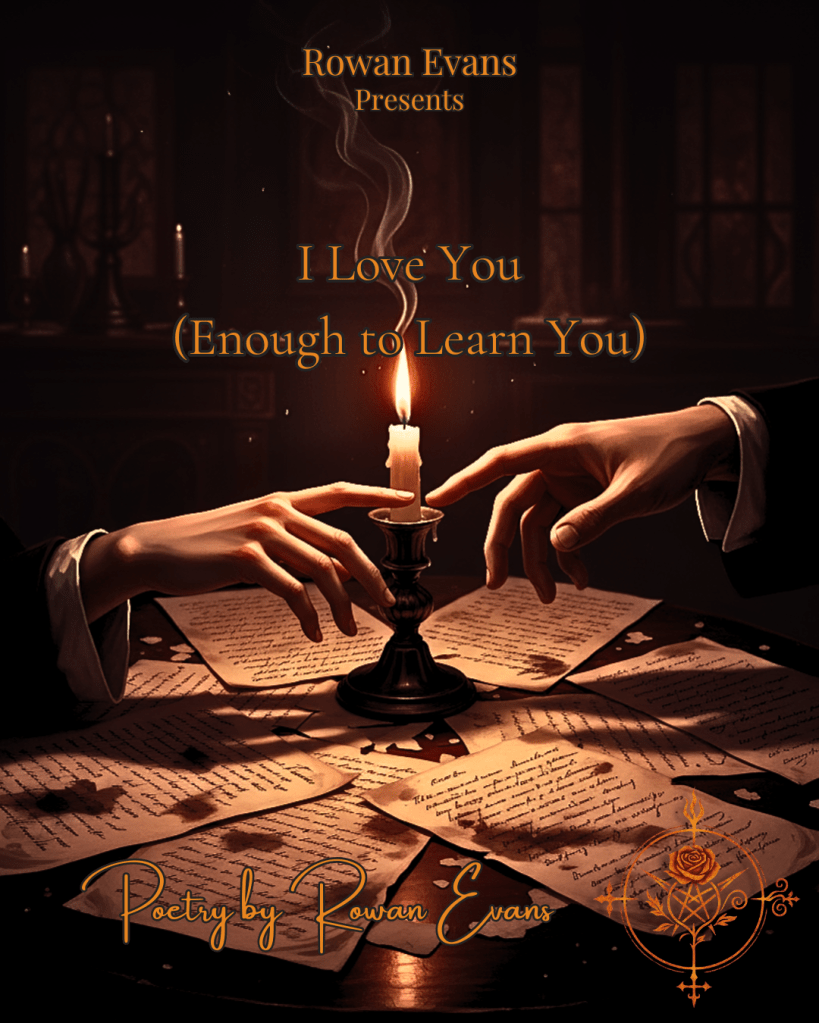
    “Two hands nearly touching through candlelight over scattered handwritten vows and ink-stained pages — symbolizing understanding and emotional intimacy.”
    “The final vow — not of silence or breaking, but of becoming fluent in another’s heart.” — Rowan Evans

    I Love You (Enough to Learn You)
    Poetry by Rowan Evans

    I’d let the ink run dry,
    then I’d break willingly.
    That was vow one,
    and vow two.
    This is vow three—for you.

    I love you enough
    to put you first—
    to make you a priority
    in my life.
    Everyone else be damned,
    I will—

    learn your language,
    learn the nuance,
    so you can speak freely,
    say exactly what you need.

    I will learn the cadence of your world,
    so I can understand—
    not to change you,
    but to meet you where you are.

    I love you enough to listen
    when words falter,
    to read what your silence says
    when your voice can’t.

    I’ll make a home in your pauses,
    a temple in your sighs.
    You gave me peace—
    so I’ll give you peace of mind.

    I’ll give you understanding—
    that’s vow three.
    Not of silence,
    not of breaking,
    but of becoming fluent
    in your heart.


    The Silent Vows

    [I Love You (Enough to Go Silent)]
    A vow written in ink and silence — a confession of love so deep it would sacrifice its own voice to spare another’s tears. “I Love You (Enough to Go Silent)” is a Neo-Gothic devotion from Rowan Evans, where the act of not speaking becomes the loudest declaration of love.

    [I Love You (Enough to Break Willingly)]
    A vow whispered in ink and ache — love not as surrender, but as shared endurance. “I Love You (Enough to Break Willingly)” is Rowan Evans’ second vow, a quiet confession of devotion that chooses breaking over leaving, and burden over indifference.