Some poems arrive carrying trauma, existential questions, complicated metaphors, and enough symbolism to fill a cathedral.
This one showed up carrying a fucking pun.
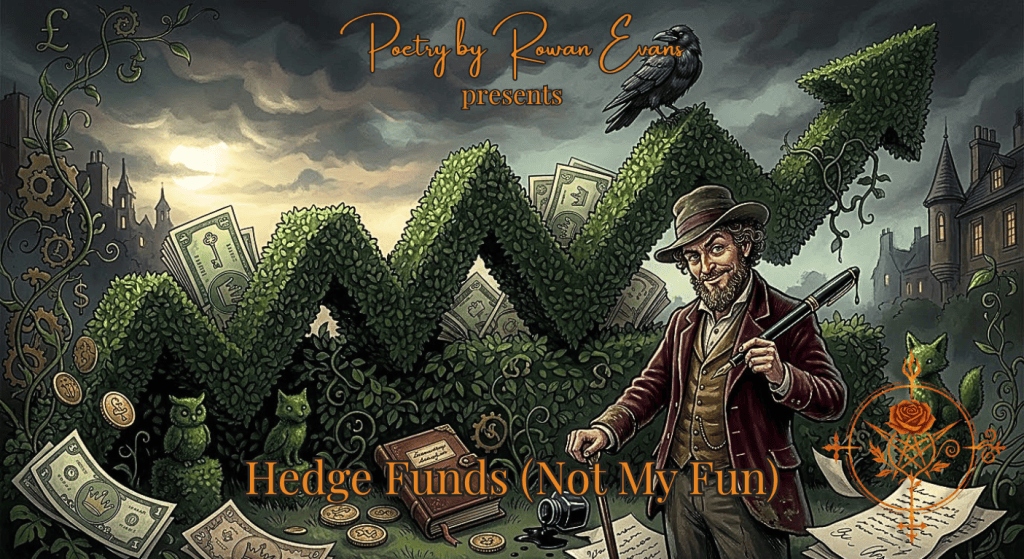
Hedge Funds (Not My Fun) is deliberately stupid. I wanted to play with sound, names, word associations, and the increasingly questionable logic of a joke that refuses to die. Sometimes the page doesn’t need another emotional excavation—it just needs to have a little fun.
So yes, this is a poem about hedge funds.
No, I don’t actually have any.
And apparently, neither does my fun.
— Rowan Evans
The hedge has funds. The funds aren’t mine. Therefore, the fun remains tragically unfunded.
Hedge Funds (Not My Fun) Poetry by Rowan Evans
I think I’m so fucking funny—
I’ll make a Big Pun,
while lookin’ like a Pimp
C—but you can’t see me,
like my name is John
and my time is now—
or at least, I hope it is.
Because I’m trying to get my funds up,
yeah, I want to get my fun up—
so I stack my funds
as high as my hedges—
get it?
Hedge Fund.
That means the money isn’t mine—
so I’m stacking some funds high,
they’re just not my funds, and—
because they’re not my funds,
they do not fund my fun, man.
Sometimes the loudest hater in the room is the one you brought with you.
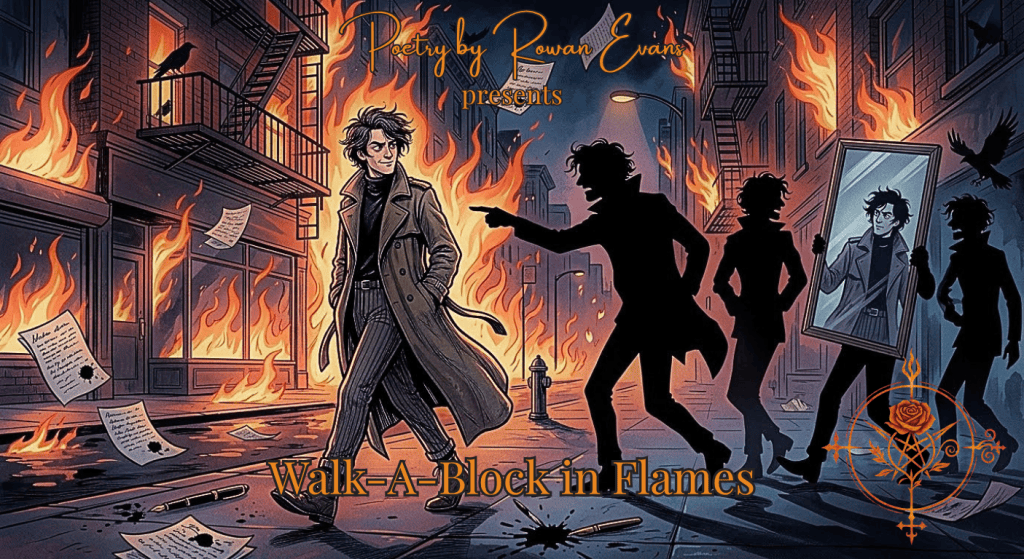
Walk-A-Block in Flames started with the idea of imaginary critics—the voices that somehow manage to find fault with everything you do, even when nobody else is actually saying a damn thing. Naturally, my brain decided the appropriate response was to turn that internal conflict into a ridiculous walk around the block, throw in some wordplay, and see how many times I could make the joke work before the poem eventually turned the joke back on me.
Because beneath all the flames, bravado, and fake enemies, there’s a much simpler realization:
Sometimes the person I’m arguing with is me.
And honestly?
That’s probably the funniest part.
— Rowan Evans
Plot twist: the haters were imaginary, and unfortunately, they had my voice.
Walk-A-Block in Flames Poetry by Rowan Evans
They tell me,
these imaginary haters,
that I’ve fuckin’ created—
they live inside my head,
feeding on my self-doubt—
obsessed with burning the self-down.
They make me take a walk,
a walk around a block
and it’s fucking hot—
I guess you could say,
these imaginary haters made me,
Waka Flocka Flame.
Wait—
I meant to say—
these haters made me
Walk-A-Block In Flames.
Honestly though,
I don’t know
what the fuck
they hate me for—
Is it because my wrist froze?
Nope, I’m broke—
Because I’m the best to ever do it?
Nope, that’s a joke—
Is it because they say
the things I think about me?
Couldn’t be—
because I think I’m great,
and these haters are fake.
I mean literally fake,
figments—
they don’t exist,
it’s just me in this bitch.
Sometimes “I don’t give a fuck” isn’t really apathy. Sometimes it’s exhaustion, overextension, or finally realizing that not everything deserves a piece of you.
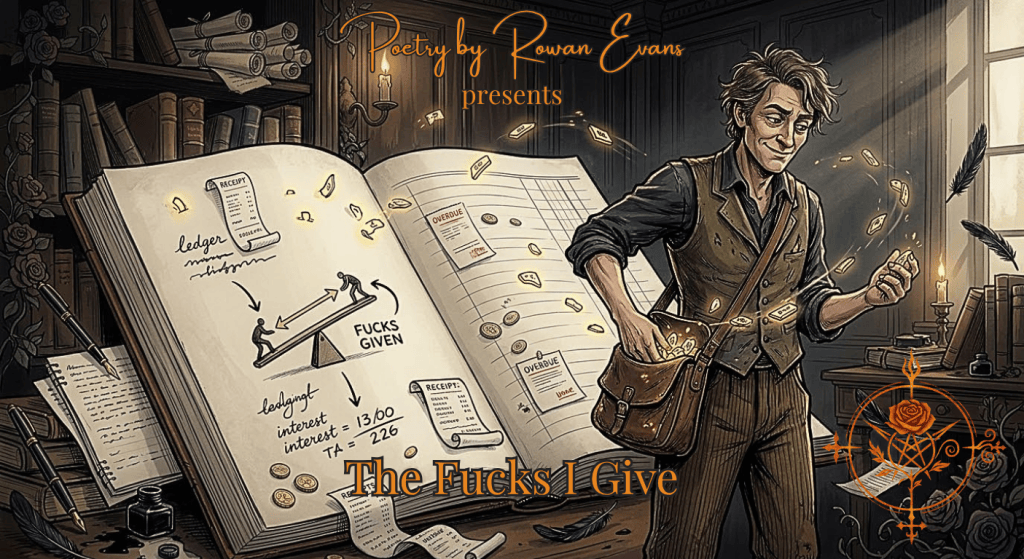
The Fucks I Give takes that idea and turns it into a ridiculous little accounting problem. If I’ve been handing out fucks like they’re an unlimited resource, eventually I’m going to have to audit the books, collect the outstanding balance, and start charging interest.
Underneath the jokes and profanity is something I’m actually pretty serious about: learning to be selective with what gets my attention, my energy, my emotions, and my time.
Because giving a fuck can be an act of love.
So can taking your fucks back.
— Rowan Evans
Apparently, my fucks weren’t free. I’m just finally collecting the outstanding balance.
The Fucks I Give Poetry by Rowan Evans
They said I’m too apathetic,
actin’ like nothing matters,
and it’s pathetic—
they want me to give a fuck,
but shit, I misplaced my bag of fucks—
so I’ve got no fucks to give.
Yeah, I’ll go through
and take all my fucks back—
I’ll walk right up and knock, like—
I’m here to collect my fucks,
and extra fucks too—
it’s a fucking tax,
and there is interest, dude.
You think fucks are endless.
No, I’ve got to be pickier—
because for a minute there,
it was—
fuck everything
and that’s probably
what they’re angry for.
It was fuck this and fuck that—
I was running out of fucks fast.
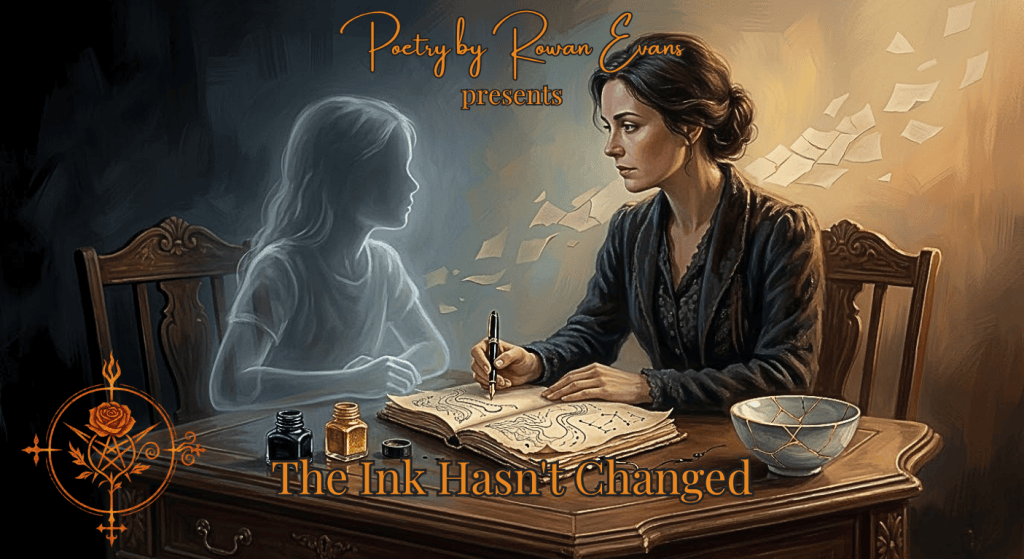
I sometimes look back at the person I was when I first started writing and wonder how much of that younger version of me is still sitting somewhere inside every poem I create. I started writing at thirteen, the same year I experienced my first heartbreak. Back then, ink wasn’t simply a creative outlet. It was a way to hold myself together, to give shape to feelings I didn’t know how to carry, and to leave a record of myself on the page when I was afraid of losing pieces of who I was.
The Ink Hasn’t Changed is about revisiting those beginnings without confusing familiarity with stagnation. The same emotions still find their way into my work: joy, grief, anger, tenderness, laughter, and pain. I’ve continued mapping my soul through poetry, stitching together broken pieces and filling the cracks with whatever gold I could find. The tools and materials may feel familiar, but the person doing the stitching is not the same.
There’s a difference between carrying the same weight and never moving forward. Sometimes, growth means discovering that the thing that once kept you alive can become something you choose to nurture, refine, and share.
My ink hasn’t changed because its purpose never needed to. I have changed. I’ve survived. And the words that once helped me hold myself together now help me understand who I’ve become.
— Rowan Evans
The ink that helped me survive at thirteen still carries my truth at thirty-six. The ink hasn’t changed. I have.
The Ink Hasn’t Changed Poetry by Rowan Evans
I’ve been stuck in the past a lot lately,
just thinking about who I was—
who I was trying to become
and how those early days
set the stage for who I became,
on and off the page.
The same year
I committed myself to ink,
I tasted my first heartbreak—
it was bitter sweet,
hated that it had to come,
but nothing could be done.
That was 2003, I was thirteen—
and she was made to leave.
I took the shattered pieces,
collected in a basket—
I took threads of silver
and sewed myself
back together again.
Cracks patched with gold and ink,
confessions penned in golden ink—
back then
I wrote for me—
I wrote to keep it together,
mentally—
afraid I’d disappear
if I didn’t map my soul in ink.
Turned poetry to cartography,
started mapping the whole of me.
I mapped my soul, wholly—
turned my pain holy.
I tried to translate all of me—
the joy, the pain,
laughter and grief—
and my ink hasn’t changed.
It’s still carrying the same things.
All the same weight, wait—
does that mean I’m stuck in place?
No, just because the ink
has stayed the same—
doesn’t mean I have—I’ve changed,
I’m not the same as I was at thirteen,
now that I’m thirty-six—
and I’m not the same as I was at sixteen,
that’s when I thought my ink was real mean—
but really it was too nice,
the only thing keeping me alive.
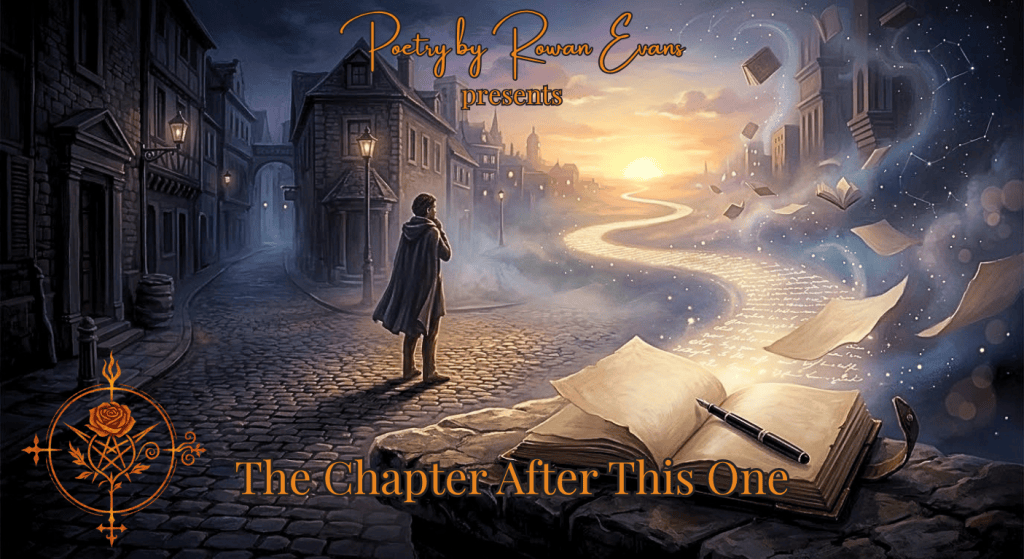
Sometimes, the mind wanders somewhere between waking and dreaming, and the unfamiliar begins to feel strangely like home. Maybe it’s just a dream. Maybe it’s imagination playing with possibilities. Or maybe it’s a reminder that the life we’re living right now isn’t the only story we could ever tell.
The Chapter After This One is about looking beyond a present that might not feel right and remembering that the story isn’t finished. We don’t always get to choose the circumstances of our current chapter, and we can’t simply flip to the ending to see whether everything works out. Sometimes, we have to keep reading, even when the road ahead is uncertain.
But reading isn’t all we can do. We can question the direction, challenge the expectations, and pick up the pen ourselves. We may not control every twist in the plot, but we can make choices that shape what comes next.
The future isn’t a page we’ve already read. It’s a chapter we haven’t reached yet—and perhaps, in more ways than we realize, we’re already helping to write it.
— Rowan Evans
You may not be able to skip to the ending, but you can still pick up the pen and help write what comes next.
The Chapter After This One Poetry by Rowan Evans
I’ve been drifting today— constantly somewhere in-between awake and asleep— between reality and a dream. One moment, I’m sitting alone— the next I’m walking streets I’ve never known.
Yet somehow, those streets feel like home.
I can’t say for certain where I was, but I had a pretty good idea— it felt familiar but not, like I was getting a preview— for a future plot. Like the writers for my life— were showing me, I’m not stuck in the story I got.
And while it’s true, I may not like the current chapter— I just have to keep reading, to find out what comes after— you cannot skip ahead, that’ll only lead you down the wrong road instead.
If you don’t like the direction, pick up a pen—become a co-writer then. You can’t rely on, just anyone, take matters into your own hands. You can shape fate, you can write for your own life— you know you can guide the plot, right?
Journey into the Hexverse
[Everything and Nothing]
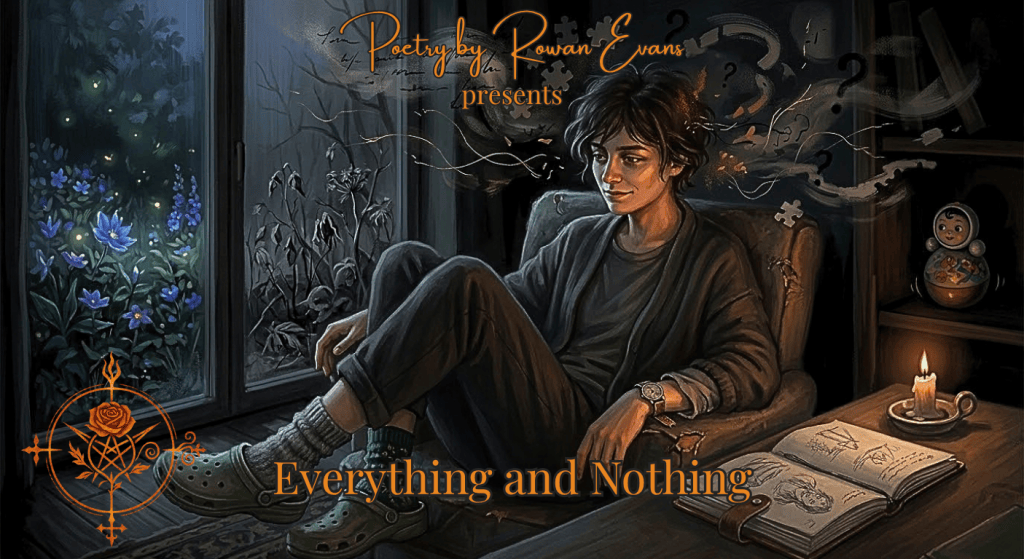
What happens when you’re quiet but observant, overwhelmed yet seemingly empty, surrounded by beauty but sometimes seeing only decay? Everything and Nothing is a confessional poem about overthinking, mental exhaustion, contradiction, and the absurd humor that helps us keep going—even when we’re wobbling in socks and Crocs.
Sometimes, the quietest person in the room has the loudest mind. Sometimes, the person who seems to have nothing to say is trying to sort through a thousand thoughts that never quite finish forming. And sometimes, when someone asks what’s wrong, the honest answer is both everything and nothing.
Everything and Nothing explores the contradictions that can exist within one person: being observant enough to notice everything while struggling to explain what’s happening inside, feeling surrounded by beauty yet sometimes seeing only the rot, and having the spark to create without always having the fuel to keep the fire burning.
But this isn’t a poem that wants to stay solemn. There’s a paradox wearing socks and Crocs, checking a five-dollar wristwatch, and wobbling through life with questionable coordination. Because humor has always had a place beside the heavier truths, and sometimes the absurdity is part of what makes those truths bearable.
I may wobble. I may lose my train of thought before it reaches the station. I may have days when everything feels wrong and days when I can’t explain why nothing seems wrong at all. But falling and wobbling aren’t the same thing.
And if there’s one thing this paradox knows, it’s how to keep wobbling.
— Rowan Evans
Everything is wrong. Nothing is wrong. The thoughts won’t land, the fire won’t always burn, and somehow this paradox keeps wobbling.
Everything and Nothing Poetry by Rowan Evans
When you meet me—
you’ll think I’m quiet.
I don’t say much,
I sit in silence,
with my mouth shut,
but my eyes are open—
watching, closely.
And when you talk to me—
you’ll wish I was quiet.
I’m way too observant—
I see too damn much,
and I hear just the same—
so don’t get mad at me,
when you get flamed.
But once you get to know me—
you’ll get scared when I’m quiet,
you’re suddenly afraid of my silence.
Because It carries weight,
everything I don’t say—
what’s wrong? You’ll wonder,
what’s on your mind?
You’ll find that it’s nothing—
mind’s blank, no thoughts in it.
But what’s wrong?
A lot.
It would take too long
to list every problem I’ve got.
I’m surrounded by beauty,
but sometimes all I see is rot—
lost my mind, where’d I put it?
I forgot—thoughts jammed,
so I missed the shot.
Thoughts move
but never get where they’re—
before another thought
cuts it off—
so it lands short,
missed the runway by a mile.
And that’s the part
that hurts the most—
when the spark is there,
but the fire is quiet.
The fuel is gone,
so you hope you don’t
have to reignite it.
So to answer your question,
what’s wrong?
Everything and nothing—
it’s in constant contradiction,
my existence—
I guess I’m just a paradox
in a pair of socks and crocs,
with a five dollar
Wal-Mart wristwatch.
But don’t worry—
I’m a weeble,
I wobble—
but I don’t fall down.
Journey into the Hexverse
[Through the Page] A heartfelt thank-you to everyone who has journeyed through the pages of Rowan Evans’s poetry. From ravens and monsters to raccoons in silk pajamas, this playful, multilingual poem celebrates the connection between poet and reader—and the meaning found in sharing one’s art.
[Thoughts of You Have Prime Real Estate] A playful romantic poem that turns the idea of someone “living rent-free in your head” into an entire neighborhood, where thoughts become homes—and one special thought gets the best property in town.
[A Person First] A poem about the difference between loving a woman and loving the role someone expects her to play—because partnership requires respect, autonomy, and room to remain a person first.
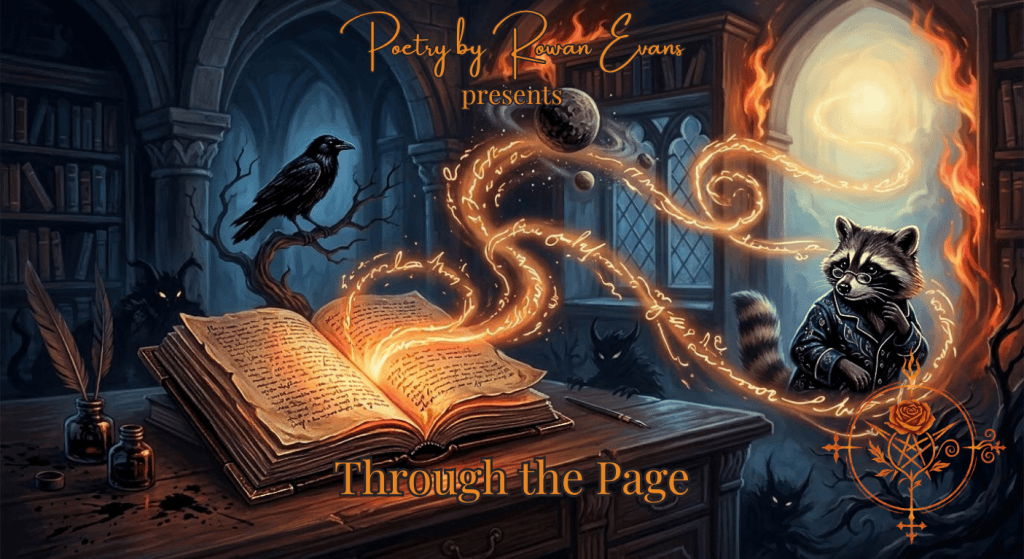
Every poem begins as something inside the writer, but once it reaches the page, it becomes an invitation. An invitation to look closer, wander through unfamiliar worlds, meet the monsters in the margins, and perhaps recognize a little of yourself along the way.
Through the Page is my thank-you to everyone who has taken the time to read my work. Whether you’ve loved a poem, questioned it, laughed at it, or decided it wasn’t for you, you’ve still given something valuable: your time. And in a world where our paths may never cross, that small exchange between my thoughts and your mind means more than you might realize.
Of course, I couldn’t leave a thank-you note alone without sending it through a few ravens and a detour through the fires of my imagination. My pen has never been particularly good at staying on track. But beneath all the chaos is something simple and sincere: thank you for being here, for reading my art, and for becoming part of a journey that began long before these words reached you.
Salamat po. ありがとう.
From the bottom of my heart, thank you.
— Rowan Evans
Somewhere between the ravens, the monsters, and the raccoons in silk pajamas, we met through the page. Thank you for being part of the journey.
Through the Page Poetry by Rowan Evavns
If you’ve taken the time
to sit with my rhymes—
to read the thoughts
from my mind—
I thank you.
Even if you didn’t like
the words that I write—
still I say, thank you.
We’ll more than likely
never meet,
and unless you choose—
no words exchanged.
But we’ve connected—
through the page,
it was my thoughts
to your brain.
You’ve spent time with my ravens,
you’ve seen the monster in the margins—
peaked beyond the curtain,
glanced into my dreams—
a witness
to every confession
screamed.
You walked with me on Pluto,
watched the raccoons in silk pajamas—
you were there
when I gave up on ice,
I was done being cold,
so I wrote fire instead—
I penned the flames from my head,
it’s like I was the Ghost Writer—
possessed by vengeance
and Poets past.
Okay, let me dial it back.
I’m sorry, got a little off track—
but you know by now,
that’s what happens to me—
it’s like my pen
has got happy feet—
anyway, back to the point of this—
because believe it or not,
there was a point to this—
Thank you from the bottom of my heart,
salamat po, for reading my art—
ありがとう, for being even a small part
of this journey that I’m on—
Thank you, and I mean it—
salamat po, without you
none of this has any meaning.
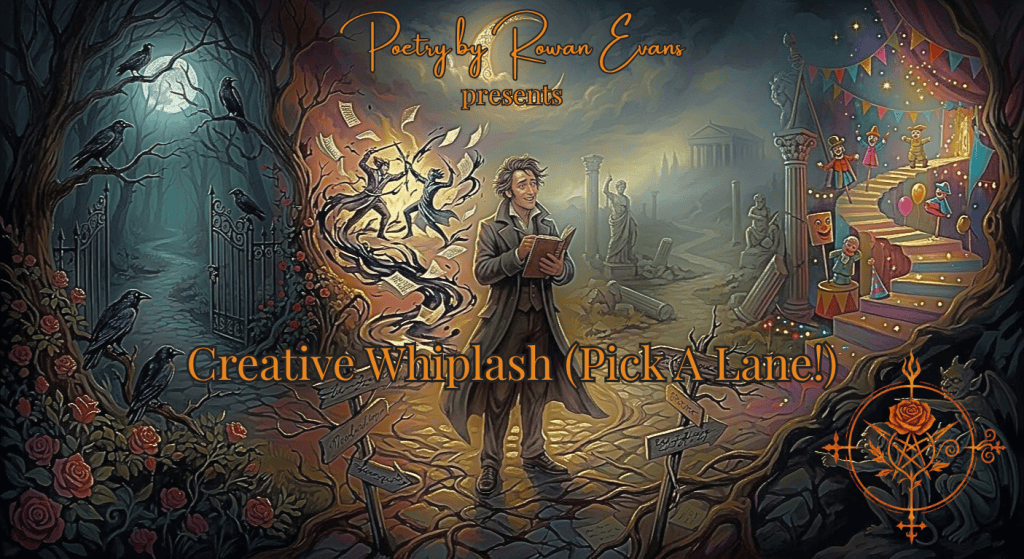
Sometimes the loudest critic in the room is the one living inside your own head.
Creative Whiplash (Pick A Lane!) is about the pressure to define yourself as a writer, choose a style, and stay neatly within its boundaries—even when your creativity refuses to cooperate. One moment, I’m writing gothic poetry; the next, I’m throwing punchlines, weaving mythology, or drawing battle lines with a pen.
And somewhere in the middle of all that, the inner critic starts screaming that nothing makes sense.
The funny part? Sometimes the poem proves the critic wrong before the critic even finishes complaining.
Maybe I don’t need to pick a lane. Maybe creativity was never meant to be a straight road.
— Rowan Evans
Pick a lane? I tried. My creativity took the exit, changed three times, and somehow wrote a poem about it.
Creative Whiplash (Pick A Lane!) Poetry by Rowan Evans
I asked you to show me a metaphor—
you asked, what’s the meta for?
You said you’re a writer, are you sure?
Because I’m not anymore—
run on sentence, run on lines,
zero flow and zero rhymes—
that’s how you write.
Ironic—
I just proved myself
wrong, right?
Well, sometimes I get in my head,
convince myself that nothing I write
is ever good enough—
and no one can call my bluff.
Isn’t that rough?
Pick a lane! Pick a lane!
Repeated, screaming in my brain—
are you a gothic poet,
or do you draw battle lines?
Do you weave myths,
or write comedic shit?
Pick a lane! Pick a lane!
Repeated, screaming in my brain—
giving readers whiplash
with how fast, I switch lanes—
it’s a pain in the neck,
creativity, hard to keep in check.
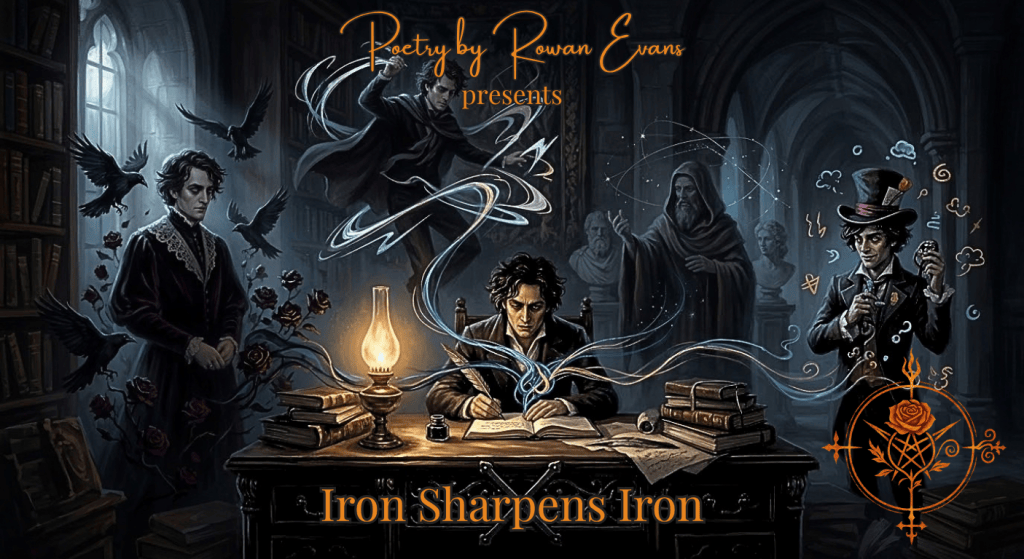
Iron Sharpens Iron is about what happens when every version of my creative mind sits down at the same table: the gothic romantic, the absurdist comic, the mythmaker, the battle-poet, the joke creator, and whatever other voice decides to kick the door open halfway through a line.
The notebook becomes the sparring ring. One thought throws a punch, another throws a punchline, and sometimes Batman apparently gets involved.
I don’t always plan where the thread is going. Sometimes I just follow it until the poem lands somewhere that makes sense.
Maybe that’s the point.
I don’t need to silence the contradictions. I need them to sharpen each other.
— Rowan Evans
I don’t silence the voices in my head. I let them sharpen each other.
Iron Sharpens Iron Poetry by Rowan Evans
I sit by myself— alone in body, crowded in mind— it’s a constant battle of wits, moon-fed goth kid versus the battle-poet turning pens to WMDs.
The notebook— just a test site, where I drop bombs. It’s constant— the scream of the alarms.
I write so much because my mind fights too much— a gothic romantic, an absurdist comic— opinions, opinions, too many opinions— constant contradictions.
Is this a joke?
Are the emotions sincere?
What the fuck— (Batman!) is that reference doing here?
That’s just how my mind is sometimes— I write a line and follow it, (Stalker.) I don’t plan it—I just follow the thread, guide the ship and land it. But sometimes I get lost— I’ll orbit the planet, or drift in my dreams— and they say to make the dreams work, it takes team work— well, I became my own team, every version of me.
Gothic romantic, absurdist comic, mythmaker, joke creator and professional hater— (Jokes. Love ya!) a battle-poet raised on battle rappers and comedians— how I learned to land a punchline, can’t fight with my fists— but can fight with my mind, and I do it all the time— with myself, I spar, iron sharpens iron, after all.
Journey into the Hexverse
[Blindfolded & Still Winning] A playful battle-poetry freestyle about shutting off the inner editor, letting instinct take over, and discovering that sometimes the pen writes best when you stop watching it.
[Literarily Speaking] They think silence means weakness. They should probably have paid more attention to the pen. Literarily Speaking turns gothic imagery, raven feathers, rose-petal ink, and absurd fictional geography into a playful battle-poetry flex about dismantling your enemies with words instead of hate.
[The Playground] What happens when mythology stops being something to hide behind and becomes architecture for the imagination? The Playground (Language, Metaphors and More) explores Rowan Evans’s relationship with language, symbolism, metaphor, humor, and twenty-three years of turning the page into a place where anything can happen.
“Money can’t buy happiness” has always sounded a little too tidy to me.
Money can absolutely buy comfort, convenience, security, experiences, and a whole lot of things that can make life easier. Pretending otherwise misses the point. But there’s a difference between making life more comfortable and making yourself happy.
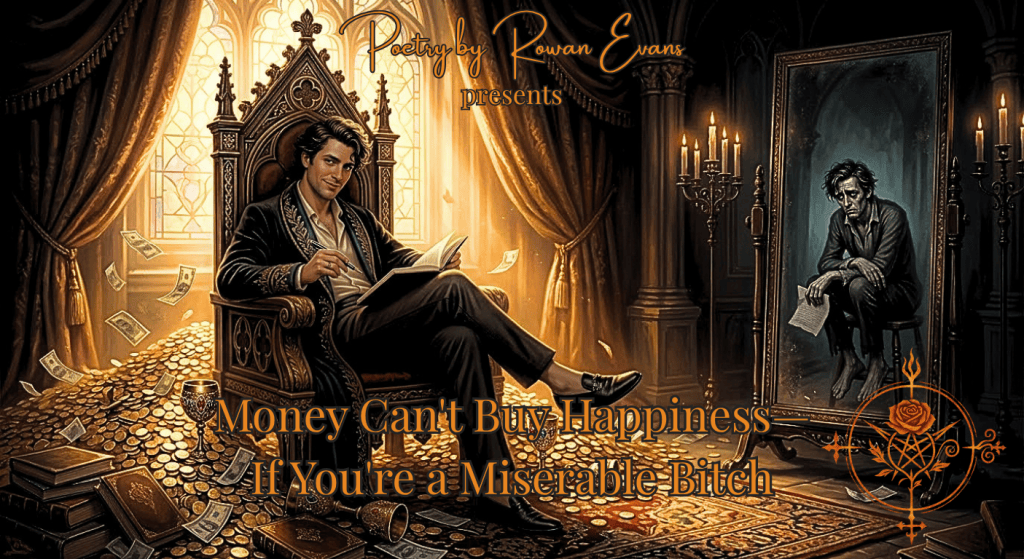
Money Can’t Buy Happiness—If You’re a Miserable Bitch takes that familiar saying, argues with it, insults it a little, and then lands somewhere in the middle: money might change your circumstances, but it can’t do the internal work for you.
If you’re miserable before the money arrives, there’s a decent chance you’ll just become a wealthier miserable person.
So, yeah.
Bitch, please.
— Rowan Evans
Money can buy the room. It can’t decide what happens inside your head.
Money Can’t Buy Happiness—If You’re a Miserable Bitch Poetry by Rowan Evans
They say money can’t buy happiness—
and honestly, that’s half true.
Money doesn’t buy happiness,
money buys things—
and things bring happiness
for a minute it seems—
but money can’t buy happiness?
Bitch, please—
that sounds like something
somebody with money
would say—
because it’s not the cash
that brings the smile,
it’s the ease
the cash brings—
so they say
money can’t buy happiness,
but they’re only half right—
money can’t buy happiness—
if you’re a miserable bitch.
You’ve got to already be happy and shit,
so learn to love what you’ve got.
Because when the money comes,
and you’re swimming in funds—
if you’re not already happy
with where you’re at?
You’ll never be happy after that.
Journey into the Hexverse
[Sick Bird] A short, uncompromising political metaphor that questions the fixation on left versus right when the entire system may be sick. Through the image of a collapsing bird, the poem confronts division, corruption, and the consequences of ignoring the larger failure.
[For the Youth (Remix)] A 2026 remix of Rowan Evans’s original 2024 poem, encouraging young people to embrace their truth, recognize their worth, raise their voices, and become the light they want to see in the world.
[Rose & Ruin] Two minimalist poems exploring the opposing forces within creativity: the thoughts we cultivate into something beautiful and the darker thoughts we transform before they have a chance to decay.