Sometimes you sit quietly long enough to hear things you’ve spent years trying not to hear.
This piece comes from that kind of silence—the kind where the voices around you become just as important as your own.
— Rowan Evans
Sometimes the hardest thing to carry is realizing you were never carrying it alone.
Circle of Me Poetry by Rowan Evans
I sit in a circle of me—
for the first time
since I was thirteen,
just listening…
because it’s not
my turn to speak—
some share joy,
some share pain—
and others share memories
that are hard to hear—
and in their voices
I could hear the fear,
in their eyes, see the tears—
and I feel helpless now,
just as I did back then
but now it feels different.
Heavier.
Like I’m not
just carrying
the weight of one—
I’m carrying
the weight of the sum.
It’s all of us…
it’s everyone.
Journey into the Hexverse
[High Tide] A short reflective poem about leaving, returning, and accepting the forces that pull us back—like the tide guided by the moon.
[Louder Than the Rain] A short confessional poem about the overwhelming noise of anxious thoughts, the strange silence of feeling alone in a crowded room, and finding a way to translate pain into words.
[Poet’s Curse] Poet’s Curse explores the painful side of falling too deeply: giving pieces of yourself away freely, taking accountability for your own heartbreak, and realizing that learning to let go can be harder than learning to love.
Some poems don’t need to be abandoned when we outgrow the person who originally wrote them.
Sometimes they need to be revisited.
Undead Symphony (Remix) returns to a poem I originally wrote on June 13, 2024. The original was written from a place I understood intimately: feeling perpetually misplaced, overlooked, and emotionally exhausted while still carrying an enormous capacity for empathy underneath the numbness.
The title came from that contradiction.
An undead thing is neither fully alive nor truly dead. A symphony, meanwhile, is full of movement, emotion, tension, and sound. Put those ideas together and you get something that feels very close to the emotional state I was trying to describe: a person who can feel deeply while simultaneously becoming distant from the world around them.
That contradiction is still here in 2026.
What changed is the way I approach it.
The remix gives the poem more room to breathe. I broke apart lines that had previously been compressed together, allowing certain thoughts to linger rather than rushing past them. I also sharpened some of the imagery and cadence, particularly around the relationship between solitude, apathy, and empathy.
The original poem said what I was feeling.
The remix feels more like I understand why I was saying it.
And that distinction matters.
I have spent a lot of time in my writing exploring darkness—not because darkness is all I have, but because I have always been fascinated by the strange things that can survive inside it. Undead Symphony is one of those pieces.
Apathy and empathy shouldn’t fit together.
Yet somehow, they do.
One protects the heart by making the world feel distant.
The other keeps reaching toward it anyway.
That tension is the symphony.
The speaker may feel undead, but the music never actually stops.
— Rowan Evans
Somewhere between apathy and empathy, something inside me keeps making music.
Undead Symphony (Remix) Poetry by Rowan Evans [written on July 23, 2026]
It was always the wrong place,
wrong time—
I was always second best,
never first place—
Never the one to win the race,
I was always the one they laughed at,
never with—
always the one that
when they were gone—
never missed.
So I grew cold and distant
like far-off summer nights,
yearned for on cold winter mornings.
And sometimes—
it still feels hard to breathe,
like a shadow in the light,
fading beneath.
I never was one for faith,
I never believed,
no thoughts and no prayers—
because why should anybody care?
In a crowd I felt alone,
a silent voice,
an empty phone.
It’s apathy—
and I pair it with my empathy.
An odd dance of light and dark,
within me.
It’s beauty in the darkness,
an undead symphony.
But still—I dream of a place,
where I’m more than just a face.
A spark in the night,
a fleeting glimpse
of warmth in the cold,
and strength in the struggle.
I remember moments—
fleeting and rare,
of laughter shared,
of someone who cared.
Brief as they were,
they lit up my sky,
A reminder that even shadows can try.
Yet—
I return to the solitude I know,
where apathy is my only show.
But my empathy,
a hidden grace—
whispers of a longing for a different place.
It’s a contradiction,
a twisted art—
to feel so much,
with a guarded heart.
An undead symphony,
a haunting tune—
a dance of shadows beneath the moon.
Journey into the Hexverse…
[Fallen Angel’s Reckoning (Remix)] Fallen Angel’s Reckoning (Remix) revisits a 2024 poem about heartbreak, broken promises, and falling from an imagined heaven, transforming its original ending into a darker meditation on resilience, self-reclamation, and learning to fly with broken wings.
I’ve never been particularly good at thinking in borders.
When I look at a map, I see countries.
When I look at people, I don’t.
I’ve always found it easier to connect with someone’s story than with the place they happened to be born. A passport can tell you where someone came from, but it can’t tell you what keeps them awake at night, what they dream about, or what they’ve survived.
That’s the part that interests me.
This poem isn’t political.
It’s personal.
It’s an attempt to describe the way I’ve always experienced humanity—as something far larger than geography.
I don’t believe compassion should stop at a border.
I don’t believe kindness needs a nationality.
Maybe that’s why so much of my writing wanders across oceans and continents, chasing people I’ll probably never meet, writing about places I’ve only visited through dreams, conversations, photographs, and stories.
To me, humanity has always felt like one conversation happening in countless languages.
Different histories.
Different landscapes.
The same heartbeat.
That’s all this poem is trying to say.
We’re all just human.
— Rowan Evans
Before we’re anything else, we’re human.
Just Human Poetry by Rowan Evans
With my eyes wide—
I see the world.
Not one corner.
The whole globe,
and I’ve got love for it.
Every person,
every soul—
not divided by borders,
not separated by flags,
just human.
Just here.
Trying to make it
through the same sunrise
and the same storms.
Not because I know them,
but because I recognize them—
the way a heartbeat
recognizes another heartbeat
anywhere on Earth.
I don’t split the map
into colors or countries.
I don’t measure worth
by lines drawn long before I was born.
I just see people—
living, trying, hoping.
Maybe it’s the way I grew up
feeling like I belonged everywhere
and nowhere at once.
Maybe it’s the way strangers
always felt more familiar
than the places I called home.
Because home, to me,
was never a location—
it was a feeling,
a recognition,
a quiet knowing
that we’re all carrying
the same fragile humanity
through different landscapes.
And when I say
I love the world,
I mean I love its people—
the way they rise,
the way they break,
the way they keep going
even when the map
forgets their names.
Journey into the Hexverse…
[Another Fire] A powerful poem exploring global chaos, systemic inequality, and emotional exhaustion in a world where conflict grows faster than it can be understood.
[Raising Governments] A sharp, satirical poem that reframes global leadership as misbehaving children, Raising Governments blends humor with frustration to highlight the immaturity and contradictions often seen in power structures.
[Government Time-Out] A direct and controlled follow-up to Raising Governments, this poem strips away humor to confront power with accountability—demanding reflection, responsibility, and change.
[Calculating Profits (Ledger of Lives)] Calculating Profits (Ledger of Lives) is a raw anti-war poem confronting how modern conflict is often reduced to statistics, strategy, and spectacle. Through stark imagery and direct language, Rowan Evans challenges the “us vs. them” narrative and reminds readers that behind every number in war’s ledger is a human life.
[Crash Landed] A reflective poem about feeling like an outsider in a world shaped by tribalism, selective compassion, and identity-driven thinking.
I’ve often described myself as a witness poet—someone who pays attention, who notices the emotional weather around the people I care about, and then translates those observations into poetry.
Sometimes that role feels like a gift.
Sometimes it feels helpless.
Because witnessing doesn’t always come with the ability to change what you see.
You can recognize someone’s strength, admire their resilience, ache alongside their struggles, and still be separated by circumstances larger than either of you.
This poem isn’t about unrequited love.
It isn’t about sacrifice.
It’s about accepting that love isn’t always measured by proximity.
Sometimes love looks like paying attention.
Sometimes it looks like quietly hoping someone feels a little less alone because, somewhere in the world, another heart witnessed their struggle with compassion instead of judgment.
That’s the strange privilege—and responsibility—of being a witness poet.
Not every distance is meant to be closed.
Some are simply meant to be seen.
— Rowan Evans
“Some distances cannot be crossed—but they can still be held with compassion.”
The Life of a Witness Poet Poetry by Rowan Evans
The life of a witness poet—
it’s harder than you think,
when your heart bleeds in ink.
And it only gets harder
when you’ve fallen
for the one you witness.
You see the weight she carries,
you watch from a distance—
your hands tied by the tide,
and the gap—an ocean wide.
You want to be a light in her life—
like the moon in the sky.
You learn to glow quietly,
hoping she’ll look up someday—
not for you,
but for the comfort
you’ve been trying to give
from a distance.
So you learn to love in silence,
in the spaces between her storms—
holding what you can,
honoring what you can’t,
knowing some distances
aren’t meant to be crossed,
only witnessed.
Journey into the Hexverse…
[What I’m Trying to Say] What begins as an exaggerated promise of love slowly strips itself back until only one simple truth remains: real devotion isn’t found in grand gestures—it’s found in consistently showing up.
[I’d Rather Try] Anyone can promise they’d die for someone. But love isn’t built on one dramatic moment—it’s built on showing up, trying again tomorrow, and proving your words through consistent action.
[Pointing Me Home] The final poem in the No Metaphor Left Behind trilogy explores dreams, hope, and belonging. Through moonlight, ocean tides, and quiet conversation, Pointing Me Home reflects on carrying hope long before reaching the place you call home.
[Only Waiting] The second poem in the No Metaphor Left Behind series, exploring the quiet ache of growing up in a place that never truly felt like home—and finally saying aloud what years of metaphor had been trying to express.
[Crossing the Sea] A deeply personal poem about relocation, longing, and the realization that some truths naturally arrive through metaphor—even when we try to leave it behind.
[I’ll Be There to See Your Sunrise] Love has never come easily to me. This poem explores the fear, vulnerability, and quiet courage required to stay emotionally present when connection begins to matter deeply. “I’ll Be There to See Your Sunrise” is about choosing love despite the risk of heartbreak—and promising to remain long enough to witness someone fully.
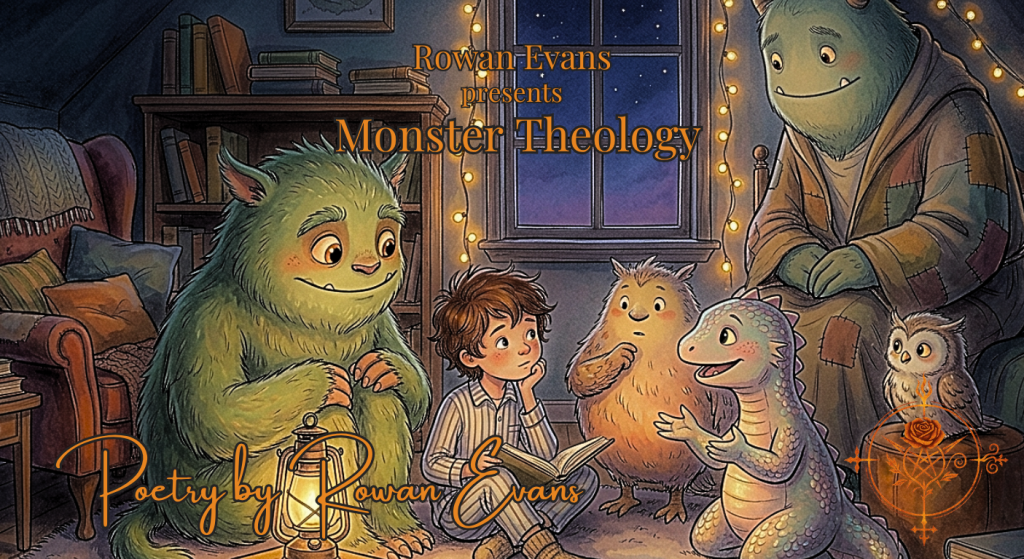
I’ve always thought it was strange that monsters get such bad press.
Most of them never asked to be monsters in the first place.
They’re usually just the things we’re afraid of. The things we don’t understand. The things we refuse to look at directly.
What would happen if I stopped fearing the monsters under the bed and actually talked to them?
The answer surprised me.
Because once the conversation began, the monsters behaving like monsters.
They became neighbors.
Parents.
Friends.
People with lives beyond the role they had been assigned in my imagination.
And that’s where the poem’s real interest emerged.
Not in monsters themselves, but in the human tendency to create them.
We have a habit of turning difference into danger.
A habit of mistaking unfamiliarity for threat.
A habit of reducing people to a single trait, label, identity, or assumption until they become something easier to fear than understand.
The monsters in this poem don’t seem to share that habit.
They celebrate what makes them unique.
They recognize difference without treating it as division.
They understand something many of us spend our lives trying to learn:
There is a difference between being different and being separate.
That’s where the title comes from.
Theology is simply the study of what we believe.
And Monster Theology asks a simple question:
What if the monsters were better at being human than we are?
Maybe the real lesson isn’t learning how to defeat monsters.
Maybe it’s learning how to stop creating them.
— Rowan Evans
“Maybe the real lesson isn’t learning how to defeat monsters. Maybe it’s learning how to stop creating them.”
Monster Theology Poetry by Rowan Evans
I’ve made friends
with the monsters—
in my closet,
and under the bed.
They used to scare me,
but I realized
I wasn’t judging them
fairly.
These monsters
have feelings,
children and lives
outside of my room.
I’m not the only one
they visit,
I’m not the only friend
they have.
They tell me
about the others
sometimes.
But they aren’t allowed
to talk about that a lot.
So we’ll stick to the difference
between their world and ours.
They say it’s much the same,
many lands with many peoples—
but they find our focus
on differences strange.
They don’t understand
why we fear what makes us unique.
They don’t understand
why we can’t acknowledge our strengths
without diminishing others.
To them—
monsters are monsters,
they are all the same
but not.
They celebrate
what makes them different,
the things
that make them unique.
Celebrate.
Not separate.
That’s the monster motto.
And sometimes I wish
we lived like they do—
less afraid
of what makes us different,
less eager
to turn each other
into monsters.
Journey into the Hexverse…
[Danny Phantom Theology] What begins as a metaphor borrowed from a childhood cartoon becomes something deeper: a reflection on existing between survival and possibility, exhaustion and hope, the life we have and the life we long for. Danny Phantom Theology explores what it means to keep moving toward a future that feels worth living.
[Lone Wolf Theology] A philosophical pop-culture poem exploring freedom, identity, and self-authorship through the lens of superheroes, antiheroes, mythic archetypes, and personal rebellion. A declaration of autonomy in a world determined to write your story for you.
This is one of the shortest poems I’ve written in a while, but it carries an idea I’ve been circling for years.
A lot of love poems focus on being understood.
Wanting someone to see you. Wanting someone to know you. Wanting someone to understand the parts of yourself that feel difficult to explain.
Those desires are real.
But as I was writing this piece, I realized my attention was pointed in the opposite direction.
I wasn’t thinking about being understood.
I was thinking about understanding.
About how every person carries an internal world that exists beyond simple translation. A private rhythm. A natural cadence. A way of thinking and feeling that doesn’t always survive the journey into spoken language.
I think that’s part of why I write so often about language, communication, and connection.
Not because I believe perfect understanding is possible.
But because the attempt matters.
Because choosing to learn someone—to listen carefully, to pay attention, to remain curious about who they are beneath the surface—is one of the most meaningful forms of affection I know.
The title came first.
“The Language Her Soul Speaks.”
Not because I believe souls literally have languages, but because some people seem to move through the world with a rhythm that feels uniquely their own.
This poem is about wanting to learn that rhythm.
Not to change it.
Not to possess it.
Just to understand it a little better than I did yesterday.
— Rowan Evans
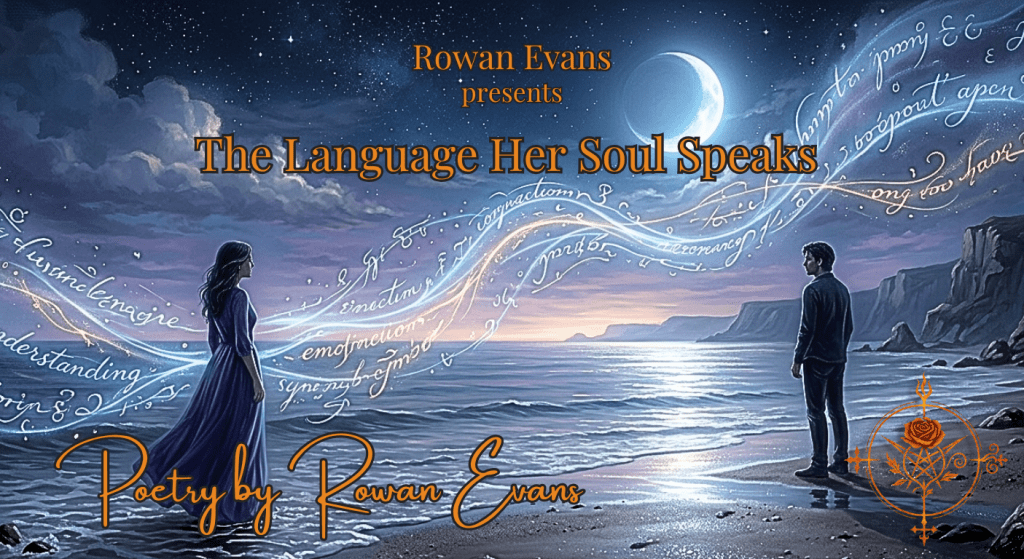
“Not because I need to be understood, but because I want to understand.” — The Language Her Soul Speaks by Rowan Evans
The Language Her Soul Speaks Poetry by Rowan Evans
I want to whisper secrets
in the language her soul speaks,
touch the edges of her mind
in the natural cadence
in which she thinks—
not translated,
not borrowed,
not filtered
through the limits of my tongue.
Not because I need
to be understood,
but because I want to understand.
Journey into the Hexverse…
[L Words & Heart] A playful, self-aware poem about love, longing, loyalty, and the quiet ways another person can reshape our inner world. What begins as humor slowly reveals a heartfelt confession about affection, imagination, and the faces that linger in our dreams.
[Just Beyond Waking] A street that feels familiar. A life that hasn’t happened yet. Just Beyond Waking explores the fragile space between dreams, memory, longing, and the quiet feeling that some futures are already waiting for us.
[I’ll Be There to See Your Sunrise] Love has never come easily to me. This poem explores the fear, vulnerability, and quiet courage required to stay emotionally present when connection begins to matter deeply. “I’ll Be There to See Your Sunrise” is about choosing love despite the risk of heartbreak—and promising to remain long enough to witness someone fully.
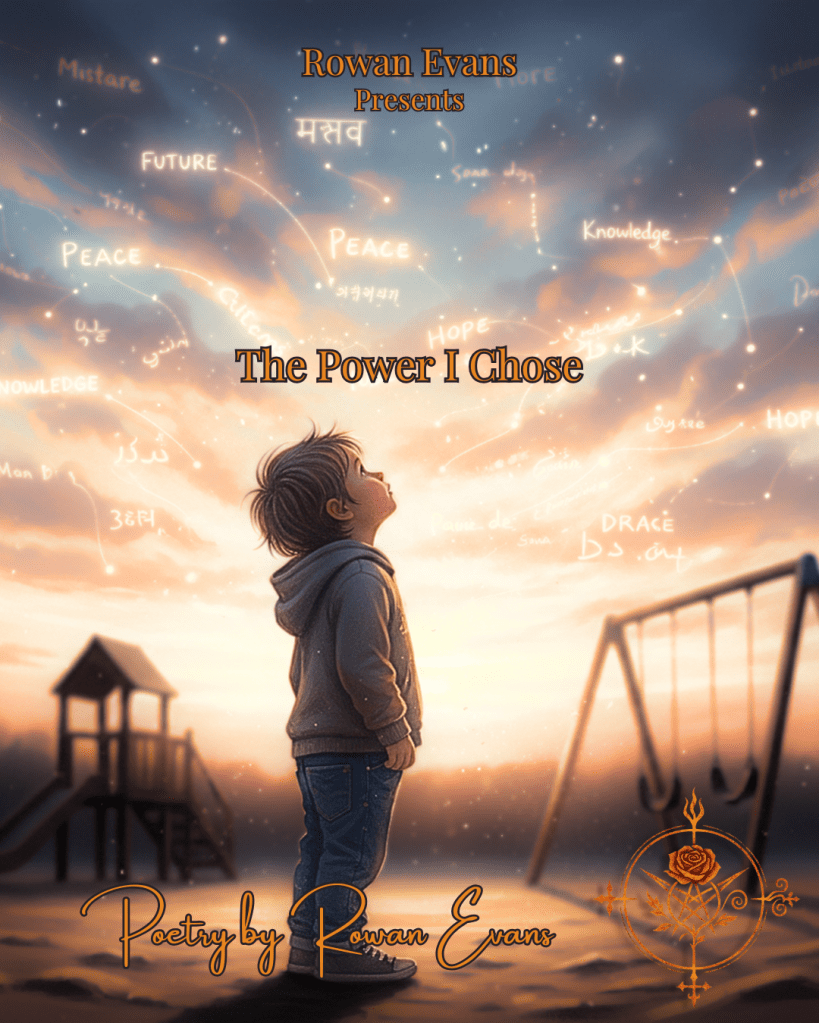
When I was a kid, other children wished for speed, flight, invisibility and teleportation. I wished to understand.
This piece isn’t about wanderlust or escape. It’s about connection – the desire to meet people in the language they speak at home, in the rhythm that feels natural to them. I may not have superpowers, but I’ve spent years training my ear, listening with intention, and closing the distance in the ways I can.
Some bridges are built with ink. Others are built with effort.
— Rowan Evans
Some wished for flight. I wished for fluency.
The Power I Chose Poetry by Rowan Evans
Let me take you back
to playground conversations—
when superpowers
were the topic at hand,
and kids were wishing
for flight, speed or teleportation.
Then there was me—
I wished for connection
and fluency, for no language
to be new to me.
I wanted my ears to pick-up
language and cadence,
and my mouth to repeat it
perfectly. I wanted,
no matter where
someone was—
I wanted to be able
to meet ’em,
to greet ’em
with the language
they spoke at home.
I pictured traveling
touching every corner
of the globe,
absorbing language,
perfecting cadence.
Living in a rhythm
not my own.
Now, the power
may not have been real,
but I’ve done
what I could
to train my ear.
Listen with intention,
until all language
felt the same.
And I may not know
what you’re sayin’,
but it no longer
feels foreign.
I’ll keep learning,
and opening doors.
Closing gaps,
connecting with souls—
As I continue to wander
this earth, in search
of a place to call home.
Until I feel the pull of roots,
I will continue to put
earth under boots.
I will continue to move,
never becoming static.
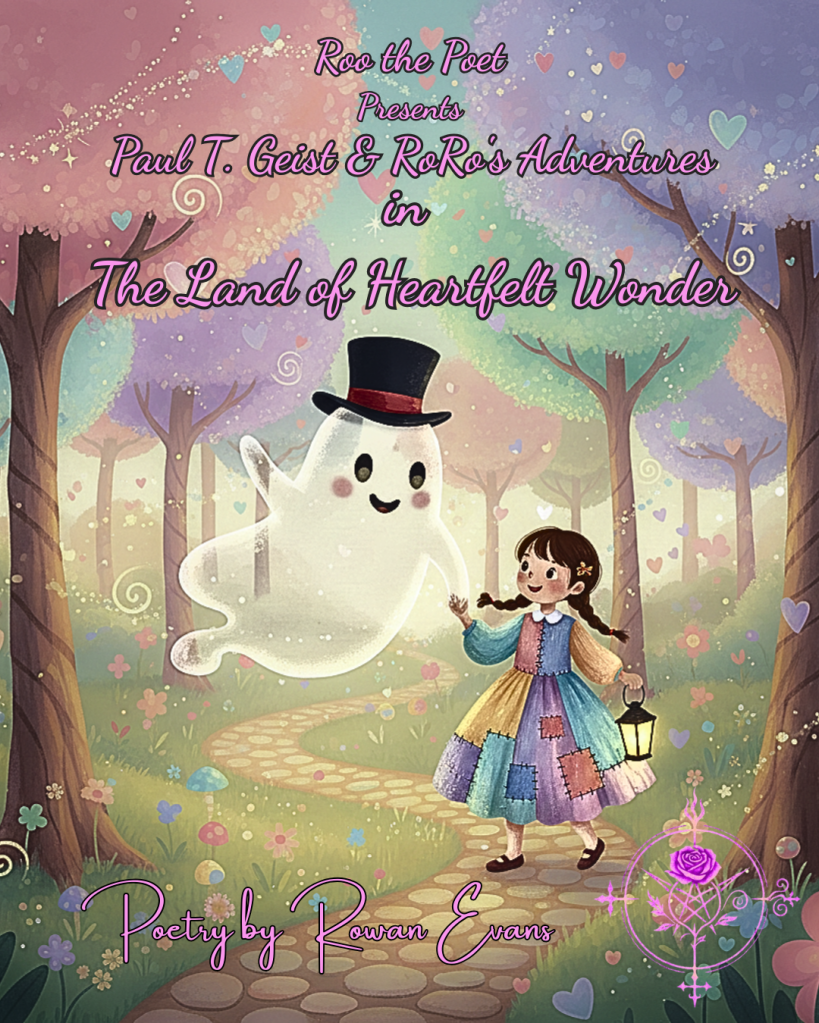
This poem was written as a story for children — a soft place to land, a little lantern of kindness and empathy wrapped in rhyme.
I’ve always believed that the lessons we learn earliest are the ones that shape the way we love the world. Paul T. Geist & RoRo’s Adventures in the Land of Heartfelt Wonders was born from that belief: that gentleness can be taught, that growth doesn’t have to come with shame, and that even a grumpy heart is still a good heart learning how to bloom.
One day, I would love to see this story illustrated and bound into an actual children’s book — something a parent could read at bedtime, something a child could return to when their feelings feel too big. Until then, it lives here as a small spell for softness.
For the little ones. And for the inner children still learning how to be kind to themselves.
Paul T. Geist and RoRo begin their journey through the Land of Heartfelt Wonders, where kindness makes the world bloom.
Paul T. Geist & RoRo’s Adventures in The Land of Heartfelt Wonders Poetry by Roo the Poet Written September 13th, 2024
In a town where whispers float on a breeze, Lived a ghost named Paul T. Geist with a chill that could freeze. He wore a top hat and a smile that was bright, And danced through the shadows with pure delight.
RoRo was a girl with a heart full of cheer, But sometimes her kindness would disappear. One day she was grumpy, she wasn’t so nice, And her friends felt the sting, not once but twice.
Paul T. Geist saw her frown from afar, He floated in gently, like a soft falling star. “Dear RoRo,” he said with a ghostly wink, “Let’s go on a journey—come, let’s rethink.”
They ventured through woods with leaves soft and blue, To a place where the flowers glistened with dew. “Welcome to the Land of Heartfelt Wonders,” he cheered, “A place where kindness and empathy are revered.”
They met a small bunny with a tear in her eye, And RoRo learned why with a heartfelt sigh. She saw how her words could hurt, oh so deep, And how kindness was a promise to keep.
Paul T. Geist showed her a magical scene, Where kindness grew flowers, in shades of serene. Each smile and hug, a petal so fair, Blossomed in joy through the sweet, fragrant air.
RoRo then saw the bunny’s sad eyes grow bright, As she offered a hug with all of her might. The bunny then beamed with a heart full of cheer, And the Land of Wonders sparkled with cheer.
With a heart now open, RoRo returned, With a lesson of kindness eagerly learned. She spread love and warmth in all she did, Making sure no one’s heart was ever hid.
Paul T. Geist waved as he faded from sight, Leaving RoRo with warmth and delight. And as she drifted to sleep that night, She knew kindness and empathy made the world bright.
So remember, dear children, as you grow and play, Let kindness guide you in every way. For in the Land of Heartfelt Wonders so near, A heart full of love is the treasure most dear.
This piece reflects on the quiet strength it takes to remain soft in a world that often tries to harden you. It’s a personal reflection on resilience, empathy, and the enduring capacity to love, even in the face of doubt and adversity.
This post marks my 83rd consecutive day of sharing on the blog, I have not missed a day since August 8th… During this time, I have tried to push myself to be a little more open. A little more honest. Even when it’s hard, even when I just want to be closed off from the world…
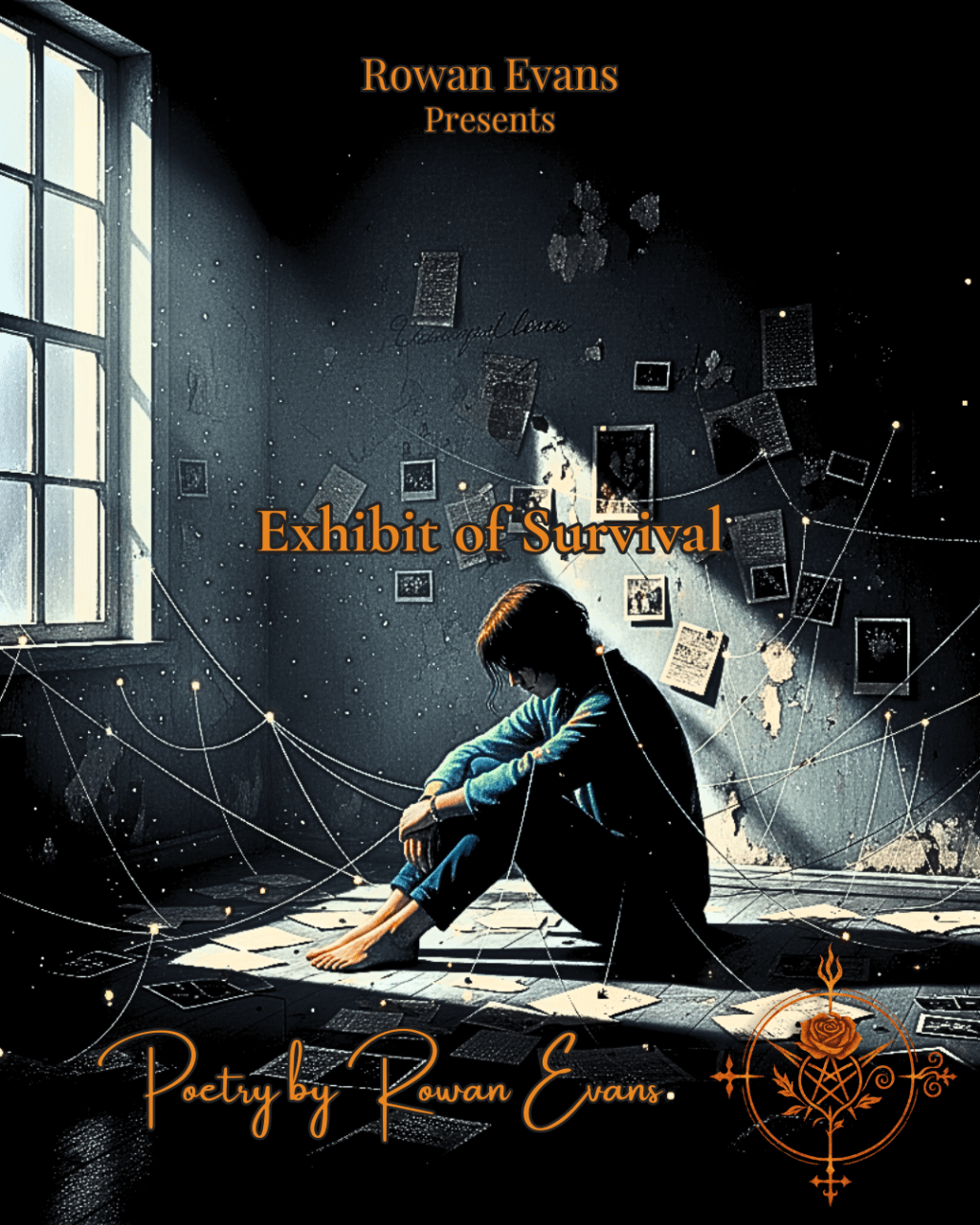
Caught in the threads of life — resilience and reflection hold them in place.
Exhibit of Survival Poetry by Rowan Evans
Pins. They hold me in place. As the glass lowers over my face. Framed. In a frame. On display. Like a dead butterfly.
I have had people in my life who pretended to be on my side—who pretended to care—when really, they just wanted front-row seats to my struggles. They wanted to watch as I unraveled, whispering doubts to freeze me in place, to preserve the ache. To keep me from moving forward. And yet, I still pushed. I still tried.
Threads. Tied to limbs. Marionette. Puppet on strings. They’ve got control of me. Free? Not really.
Those same people tried to talk me out of anything I wanted to do—anything that could bring me closer to the life I wanted. “Why do you want to leave America?” they’d ask. But it’s not my home; it’s just the place I was born. The place I was raised. I’ve never felt like I belong here. Not once.
Everything holds me back—my brain looping their doubts, my own depression and anxiety echoing them back to me. It’s a war on all fronts. And still, I stand.
My thoughts. They flutter and fade in this liminal space. It’s pain— just to be alive. It’s a wonder. A miracle. How have I survived?
Resilience. And reminders from the few who truly see me, who truly believe in me. Without them, I might have given up long ago. But because of them, I’ve kept my empathy alive. I’ve refused apathy. I’ve stayed soft. I’ve kept my heart open and given love freely.
How? How have I made it to thirty-five? Every day I wake up. Surprised.
That surprise isn’t mine anymore. It’s the echo of others’ doubts—ones I no longer answer.
The Vows began as an exploration of devotion — not the romanticized kind, but the kind forged in ache, honesty, and reverence.
Vow I was surrender: letting the ink run dry, allowing love to unmake what was hardened. Vow II was endurance: the willingness to break, to bear the bruise and still remain. And Vow III — this final vow — is understanding: the quiet promise to listen, to learn, and to love without translation.
Together, they form a trinity of intimacy — the heart’s slow evolution from sacrifice to fluency, from bleeding to belonging.
This isn’t a story of martyrdom. It’s a story of witnessing: of meeting someone’s soul and saying, I see you, I’ll learn you, I’ll speak your language. That is the purest vow I know.
— Rowan Evans
“The final vow — not of silence or breaking, but of becoming fluent in another’s heart.” — Rowan Evans
I Love You (Enough to Learn You) Poetry by Rowan Evans
I’d let the ink run dry, then I’d break willingly. That was vow one, and vow two. This is vow three—for you.
I love you enough to put you first— to make you a priority in my life. Everyone else be damned, I will—
learn your language, learn the nuance, so you can speak freely, say exactly what you need.
I will learn the cadence of your world, so I can understand— not to change you, but to meet you where you are.
I love you enough to listen when words falter, to read what your silence says when your voice can’t.
I’ll make a home in your pauses, a temple in your sighs. You gave me peace— so I’ll give you peace of mind.
I’ll give you understanding— that’s vow three. Not of silence, not of breaking, but of becoming fluent in your heart.
The Silent Vows
[I Love You (Enough to Go Silent)] A vow written in ink and silence — a confession of love so deep it would sacrifice its own voice to spare another’s tears. “I Love You (Enough to Go Silent)” is a Neo-Gothic devotion from Rowan Evans, where the act of not speaking becomes the loudest declaration of love.
[I Love You (Enough to Break Willingly)] A vow whispered in ink and ache — love not as surrender, but as shared endurance. “I Love You (Enough to Break Willingly)” is Rowan Evans’ second vow, a quiet confession of devotion that chooses breaking over leaving, and burden over indifference.