Tag: Vulnerability

  • Author’s Note

    Some poems don’t need to be abandoned when we outgrow the person who originally wrote them.

    Sometimes they need to be revisited.

    Undead Symphony (Remix) returns to a poem I originally wrote on June 13, 2024. The original was written from a place I understood intimately: feeling perpetually misplaced, overlooked, and emotionally exhausted while still carrying an enormous capacity for empathy underneath the numbness.

    The title came from that contradiction.

    An undead thing is neither fully alive nor truly dead. A symphony, meanwhile, is full of movement, emotion, tension, and sound. Put those ideas together and you get something that feels very close to the emotional state I was trying to describe: a person who can feel deeply while simultaneously becoming distant from the world around them.

    That contradiction is still here in 2026.

    What changed is the way I approach it.

    The remix gives the poem more room to breathe. I broke apart lines that had previously been compressed together, allowing certain thoughts to linger rather than rushing past them. I also sharpened some of the imagery and cadence, particularly around the relationship between solitude, apathy, and empathy.

    The original poem said what I was feeling.

    The remix feels more like I understand why I was saying it.

    And that distinction matters.

    I have spent a lot of time in my writing exploring darkness—not because darkness is all I have, but because I have always been fascinated by the strange things that can survive inside it. Undead Symphony is one of those pieces.

    Apathy and empathy shouldn’t fit together.

    Yet somehow, they do.

    One protects the heart by making the world feel distant.

    The other keeps reaching toward it anyway.

    That tension is the symphony.

    The speaker may feel undead, but the music never actually stops.

    Rowan Evans


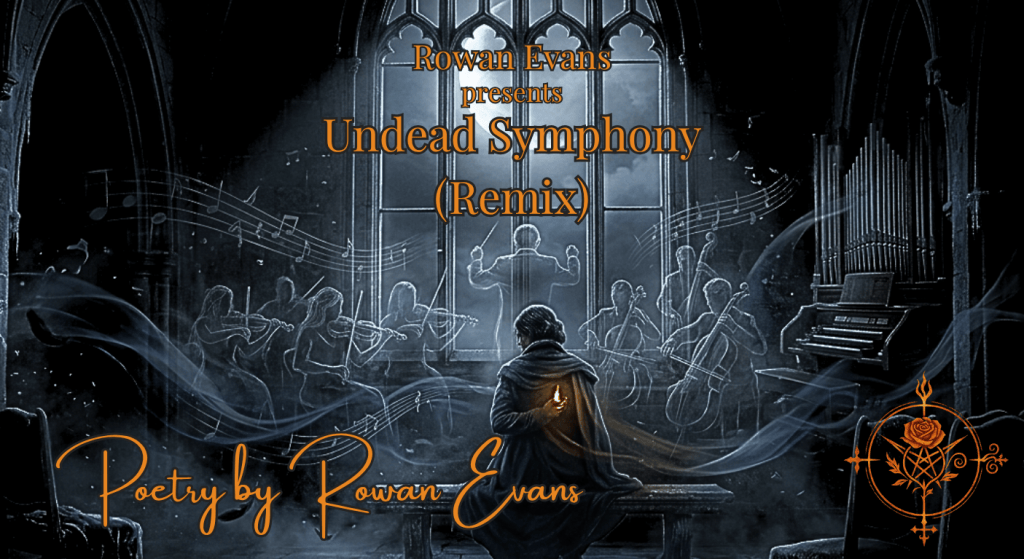
    A solitary figure sits beneath a moonlit window as ghostly music and shadows surround a small warm light.
    Somewhere between apathy and empathy, something inside me keeps making music.

    Undead Symphony (Remix)
    Poetry by Rowan Evans
    [written on July 23, 2026]

    It was always the wrong place,
    wrong time—

    I was always second best,
    never first place—

    Never the one to win the race,
    I was always the one they laughed at,
    never with—

    always the one that
    when they were gone—

    never missed.

    So I grew cold and distant
    like far-off summer nights,
    yearned for on cold winter mornings.

    And sometimes—

    it still feels hard to breathe,
    like a shadow in the light,
    fading beneath.

    I never was one for faith,
    I never believed,
    no thoughts and no prayers—

    because why should anybody care?

    In a crowd I felt alone,
    a silent voice,
    an empty phone.

    It’s apathy—
    and I pair it with my empathy.
    An odd dance of light and dark,
    within me.

    It’s beauty in the darkness,
    an undead symphony.

    But still—I dream of a place,
    where I’m more than just a face.
    A spark in the night,
    a fleeting glimpse
    of warmth in the cold,
    and strength in the struggle.

    I remember moments—
    fleeting and rare,
    of laughter shared,
    of someone who cared.

    Brief as they were,
    they lit up my sky,

    A reminder that even shadows can try.

    Yet—
    I return to the solitude I know,
    where apathy is my only show.

    But my empathy,
    a hidden grace—

    whispers of a longing for a different place.

    It’s a contradiction,
    a twisted art—
    to feel so much,
    with a guarded heart.

    An undead symphony,
    a haunting tune—

    a dance of shadows beneath the moon.


    Journey into the Hexverse…

    [Fallen Angel’s Reckoning (Remix)]
    Fallen Angel’s Reckoning (Remix) revisits a 2024 poem about heartbreak, broken promises, and falling from an imagined heaven, transforming its original ending into a darker meditation on resilience, self-reclamation, and learning to fly with broken wings.

    If you’re interested in more poetry, you can find it here → [The Library of Ashes]
  • Author’s Note

    Love Addict (High on Love) is me taking one of my recurring themes—how intensely I experience love—and pushing the metaphor until it becomes impossible to ignore.
     
    I’ve often written about love as something intoxicating. A rush. A chemical reaction. Something that can make the world feel brighter and the mind move faster. But this poem asks what happens when that metaphor is taken literally enough to become uncomfortable.
     
    Because sometimes I don’t simply want love.
     
    I crave it.
     
    There is a difference.
     
    The language of addiction works here because love can create its own strange cycle: anticipation, euphoria, uncertainty, withdrawal, craving, and the desperate desire for another hit of the feeling that made everything seem worthwhile.
     
    And, naturally, my response to that craving is to write.
     
    That’s one of the things I find fascinating about my relationship with poetry. I don’t merely write about what I’m feeling—I often metabolize the feeling through language. I take the emotion, push it through rhythm and metaphor, turn it over until I can see its shape, and then put it on the page.
     
    So the final joke is also the truth.
     
    I get high on love.
     
    Then I get high on writing about getting high on love.
     
    And apparently, the cycle continues.
     
    Maybe that’s the real habit.
     
    Rowan Evans


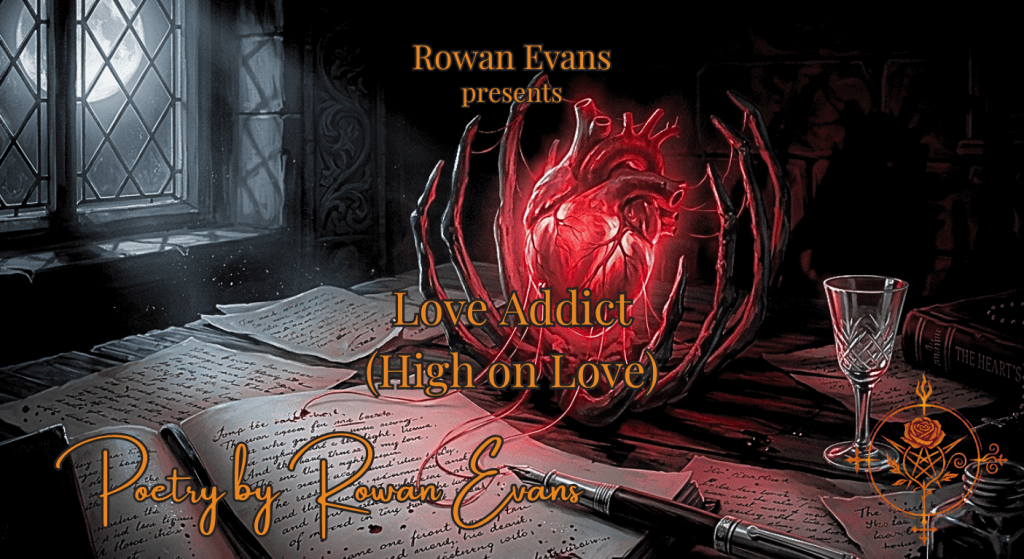
    A glowing crimson heart surrounded by dark shadows, with crimson ink flowing from it into a fountain pen and poetry pages.
    Some people chase love. I apparently write it until the high wears off—and then write another poem.

    Love Addict (High on Love)
    Poetry by Rowan Evans

    I get high on love
    like it’s a drug
    and I’m an addict
    with a habit,
    fighting for every hit
    that I can get—

    if I could,
    I would OD on it.
    Inject it straight
    to my chest,
    in-between the ribs—
    where the heart lives.

    I’d take the risk,
    the comedown, the crash,
    just to feel one moment
    where love doesn’t pass.

    I get the shakes and quake,
    knot in the stomach—cold sweats,
    when love doesn’t sit in the chest—
    it feels fake, not worth the weight.

    Wait—
    what was I saying?

    I get high on love
    like it’s a drug
    and I’m an addict,
    so I write lines
    that expand the mind,
    to feed the habit.


    Journey into the Hexverse…

    [Poet’s Curse]
    Poet’s Curse explores the painful side of falling too deeply: giving pieces of yourself away freely, taking accountability for your own heartbreak, and realizing that learning to let go can be harder than learning to love.

    [When I Fall]
    When I Fall is a vulnerable poem about loving without reservation, feeling everything deeply, and refusing to make the heart smaller just because wholehearted love can sometimes lead to loneliness and pain.

    If you’re interested in more poetry, you can find it here → [The Library of Ashes]
  • Author’s Note

    There is a particular kind of heartbreak that doesn’t have a villain.

    Sometimes nobody betrayed you.

    Nobody lied.

    Nobody promised you something they couldn’t give.

    Sometimes someone simply exists, speaks to you, makes you feel something—and your heart decides to build an entire mythology around it.

    That is where Poet’s Curse came from.

    I’ve joked before about having a poet’s curse: the tendency to fall into feelings quickly, to hear a little beauty in someone’s voice and suddenly find myself wading into the waves after it. But beneath the joke is something I’ve had to become more honest about.

    Sometimes my heartbreak is partly mine.

    Not because I was wrong to feel what I felt, but because I have a habit of giving pieces of myself away before I’ve figured out whether there is somewhere safe for them to land.

    The person in this poem didn’t necessarily do anything wrong. She didn’t promise me forever. She didn’t lead me somewhere just to abandon me. She talked—and I listened. I heard a siren’s song, and
    I chose to wade into the water.

    So this isn’t a poem about blaming her.

    It’s about looking at myself afterward and admitting something uncomfortable:

    I learned how to hold on long before I learned how to let go.

    And maybe that’s the real curse.

    Not that I love too deeply.

    Not that I feel too much.

    But that once I give someone a piece of my heart, I don’t always know how to take my hands away from the fire.

    Sometimes the only way forward is to stop calling that weakness a curse and start learning the skill I never had—

    how to let go without becoming less capable of love.

    Rowan Evans


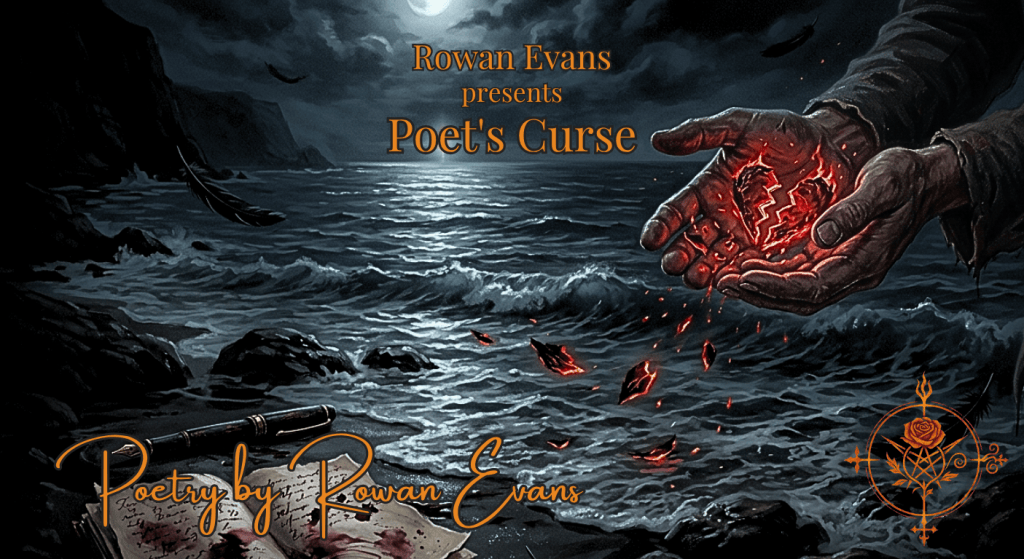
    A fountain pen and open notebook beside dark ocean waves while glowing fragments of a crimson heart drift away.
    Sometimes the hardest thing to learn isn’t how to love—it’s how to let go of what you’ve already given away.

    Poet’s Curse
    Poetry by Rowan Evans

    Here we go again
    it’s another season of sin,
    the poet’s back
    heartbroken with a pen.

    Yeah, went and fuckin’
    did it again—

    it’s my fault
    my heart is cracked,
    with pieces missing.

    You see, I give them away
    too freely, it’s such a pain
    to be me, I get hooked
    too easily—

    she did nothing wrong,
    she didn’t lead me on, just talked
    and I heard a siren’s song—

    I waded into the waves,
    prayed for things to change.

    Pardon the moment of slowness,
    give me a moment while I own this
    and take accountability for my part
    in breaking my heart.

    It’s a poet’s curse—

    I only learned how to hold on.
    I never learned how to let go,
    my feelings and emotion
    like hot coals in my hands.


    Journey into the Hexverse…

    [When I Fall]
    When I Fall is a vulnerable poem about loving without reservation, feeling everything deeply, and refusing to make the heart smaller just because wholehearted love can sometimes lead to loneliness and pain.

    If you’re interested in more poetry, you can find it here → [The Library of Ashes]
  • Author’s Note

    When I Fall is about the way I experience love when I stop trying to make it smaller.

    I have never been particularly good at feeling things halfway. When something reaches my heart, it tends to go deeper than the surface—into the marrow, into the places where emotion becomes difficult to separate from identity. That intensity can be beautiful, but it can also hurt when the love I give doesn’t find its way back to me.

    The easy response would be to close myself off.

    To dim the light.

    To protect myself by pretending I don’t feel as deeply as I do.

    But I don’t want to do that.

    There is something important about refusing to treat your capacity for love as a flaw simply because someone else couldn’t—or wouldn’t—meet you there. Sometimes loving wholeheartedly means accepting that you may get hurt. Sometimes being honest about what you feel means sitting with the loneliness afterward.

    That doesn’t mean the answer is to become colder.

    I would rather keep my heart open.

    I would rather love the way I love—whole, honest, and unhidden—than spend my life making myself smaller just to avoid the possibility of pain.

    Maybe falling hard isn’t the problem.

    Maybe the real courage is choosing to keep getting back up without becoming afraid of the fall.

    Rowan Evans


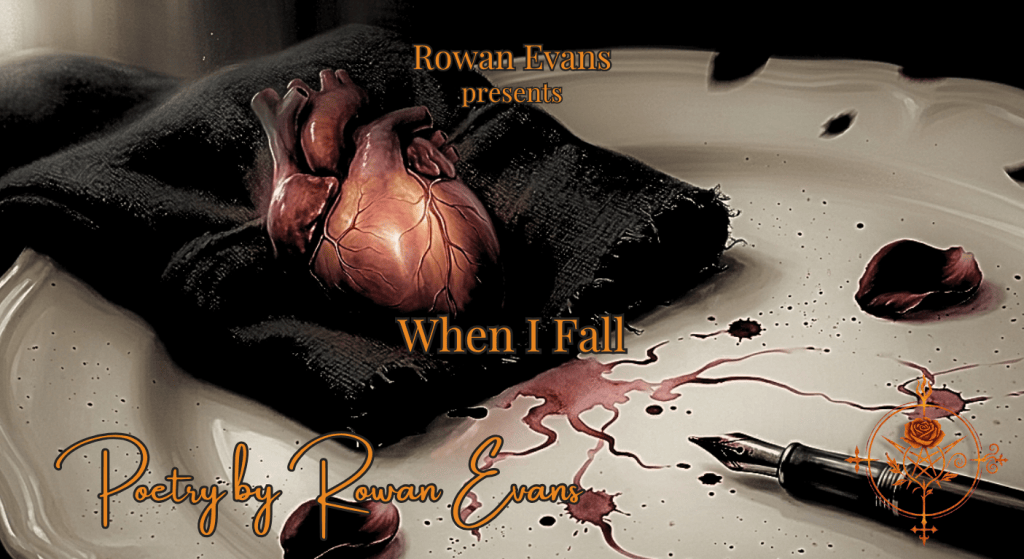
    An open heart beside a fountain pen, spilling crimson ink across a porcelain writing surface in a dark, intimate scene.
    I would rather love wholeheartedly than make my heart smaller just to make the fall hurt less.

    When I Fall
    Poetry by Rowan

    When I fall, I fall hard.
    I feel it all or nothing—
    when it comes to matters of the heart.

    There is no middle ground,
    no in-between—
    it’s all or nothing for me.

    I send out love,
    and no one returns with it.
    so I sit alone—
    it’s the same as always,
    I’m used to it.

    I wear my heart on my sleeve,
    exposed to the elements.
    That means I feel things deeply,
    nothing is surface level—
    everything is marrow deep.

    So I pour myself in crimson ink
    across a porcelain page—
    the only place
    that I can put this pain.

    Still, I don’t close myself.
    I don’t dim the light.
    I don’t pretend my heart is smaller
    than it is.
    I love the way I love—
    whole, honest, unhidden—
    even if it leaves me alone sometimes.


    Journey into the Hexverse…

    [Where the Metaphors Lead]
    Some truths are easier to write than they are to say aloud. “Where the Metaphors Lead” explores the quiet space between dreams, confession, and the courage it takes to let another person know how deeply they’ve become woven into your inner world.

    [Beach to Beach (How I Get There)]
    A dream becomes a journey between familiar shores and unfamiliar cities in Beach to Beach (How I Get There), a poem about imagined travel, ocean crossings, longing, and the places we hope to someday reach while awake.

    [The World Shifted Around Us]
    The world transformed around us—beach, city streets, jungle—but we never moved. Sometimes love isn’t found in words, but in the quiet certainty of someone remaining clear while everything else fades.

    [I’d Rather Try]
    Anyone can promise they’d die for someone. But love isn’t built on one dramatic moment—it’s built on showing up, trying again tomorrow, and proving your words through consistent action.

    If you’re interested in more poetry, you can find it here → [The Library of Ashes]
  • Author’s Note

    There are two versions of every poet.

    The one who can write about anything, and the one who struggles to write the one thing that matters most.

    This poem begins with confidence—almost arrogance—as the speaker celebrates the ability to write in any voice, on any subject, from any perspective. But beneath that confidence is a question I’ve wrestled with for years: if it’s so easy to write about everything, why is it so difficult to write one completely honest sentence?

    Humor, metaphors, references, and wordplay are some of my favorite tools. They help me explore ideas, soften difficult emotions, and make heavy subjects more approachable. But they can also become places to hide.

    One Honest Sentence is about recognizing that difference. Sometimes the greatest challenge isn’t finding beautiful language—it’s finding the courage to stop decorating the truth long enough to simply say it.

    Rowan Evans


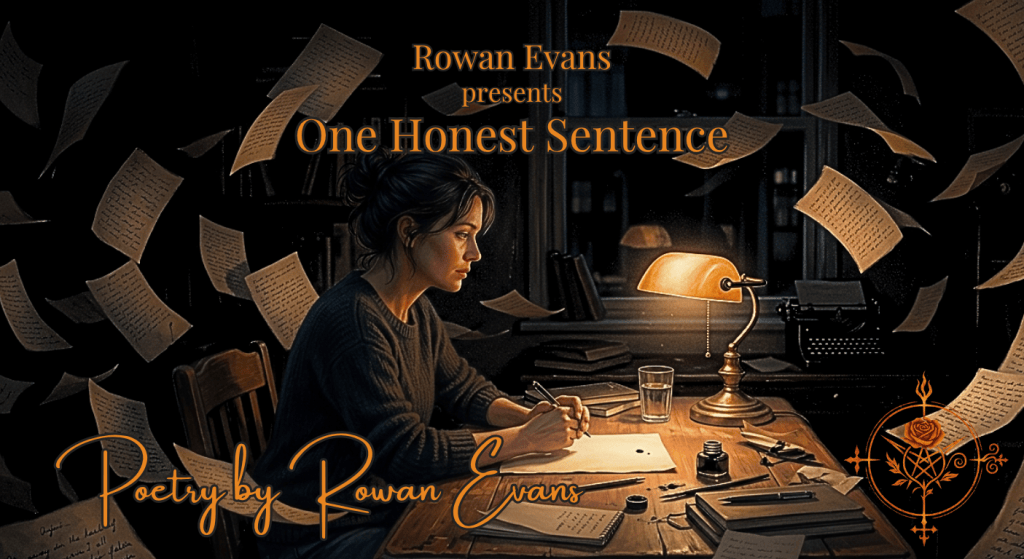
    A solitary writer sits before a blank page while countless handwritten pages float around them, symbolizing the struggle between creativity and emotional honesty.
    Writing beautifully is a skill.

    Writing honestly is a different kind of courage.

    One Honest Sentence
    Poetry by Rowan Evans

    I don’t usually like to do this, but
    I’m going to do it anyway, because
    I’m tired of pretending—

    why should I lie and say
    I’m not that guy,
    when I know I am.

    Give me a pen,
    and I can write anything.

    If a person can think it
    or have an experience,
    I can turn it into poetry.
    I do it by stringing ink
    into so many pretty lines—

    but I don’t bother to try
    and rhyme, most of the time.

    I wrote poem after poem—
    I can write a poem about the search for home
    while feeling alone in a crowded room,
    talking about how this house feels like a tomb.

    I can write island hopping epics—

    I can silence skeptics,
    put their opinions in the septic—

    they don’t know
    shhh—

    it’s no wonder they talk a lot,
    their minds are empty, got no thoughts.
    So the verbal diarrhea doesn’t stop—

    and when I read what they write,
    I call them Watson
    ’cause their lines are elementary.

    I’ve written thirty lines of flex
    and after thirty lines,
    you’re probably wondering—

    what’s next?

    Well—

    how about we pivot
    from flex to truth?

    Earlier I said—

    give me a pen and I can
    write anything.

    I can take the joy, the pain,
    the sun, the rain
    and write a whole damn series—

    it’s even easier
    if it didn’t happen to me,
    I can write about it for days—
    poem after poem,
    different angles of the same thing.

    Because it’s easy
    writing about just anything—

    what’s hard is writing
    a single truth,
    without burying it in jokes
    and misdirection.

    And maybe that’s the joke—

    I can write whole worlds,
    but not one honest sentence
    without my pulse stuttering.

    Like what would happen—
    if I just said it?

    If I turned 1-4-3 to letters
    and I just meant it?

    Would the world cease to be?

    I guess I’m just afraid—

    because once I say it,
    I can’t unsay it.

    Once I write it,
    it becomes real.

    And real things
    can be lost,
    can be rejected,
    can be held—

    and I don’t know
    which scares me more.

    So again I ask—

    what would happen
    if I just said it?

    Maybe you’d laugh.
    Maybe you’d freeze.
    Maybe you’d say it back.

    Maybe nothing would change
    except—

    I’d finally be done
    hiding behind metaphors.


    Journey into the Hexverse…

    [Noon Is Loud]
    If four in the morning belongs to truth, then noon belongs to impossible memories. Noon Is Loud is a playful free verse poem filled with absurd boasts, pop culture references, and tongue-in-cheek mythology that explores how easily imagination can rewrite reality.

    [Just Human]
    Just Human is a reflective free verse poem about seeing people before borders, choosing empathy over division, and finding home in our shared humanity rather than on a map.

    [Director’s Commentary]
    Director’s Commentary is a self-aware free verse poem that turns the poet’s recurring metaphors into the subject itself, exploring creativity, artistic habits, and the humorous inner critic that follows every writer from draft to draft.

    [The Answer Is (Yes)]
    What kind of writer am I? Mythmaker, confessor, comedian, philosopher, dream-architect, romantic, storyteller, and diss-poet. This self-reflective poem explores the impossibility of fitting creativity into a single category—and embraces every version of the truth a pen can touch.

    [Before We Created the Labels]
    Ancient gods return to a fractured world shaped by borders, identities, and separation. “Before We Created the Labels” explores humanity’s divisions through mythic imagery, sacred ritual, and symbolic collapse—asking what remains when we learn to see one another beyond labels.

    If you’re interested in more poetry, you can find it here → [The Library of Ashes]
  • Author’s Note

    Some poems begin with an idea. Others begin with a feeling that refuses to leave.

    This one was written in the early hours of the morning, during that familiar stretch of time when the world grows quiet enough for my thoughts to become louder than everything else.

    I’ve always found it easier to write than to speak. Conversations ask for immediate answers. Poetry allows me to sit with a feeling until I understand it well enough to translate it into language.

    Many of the recurring images throughout my recent work—the moon, the tide, distant shores, dreams, and city streets—have become a personal symbolic language. They aren’t separate subjects anymore. They all point toward the same emotional center.

    This poem finally acknowledges that.

    Sometimes the metaphors aren’t hiding anything.

    Sometimes they’re quietly leading us back to the truth we were trying not to say.

    Rowan Evans


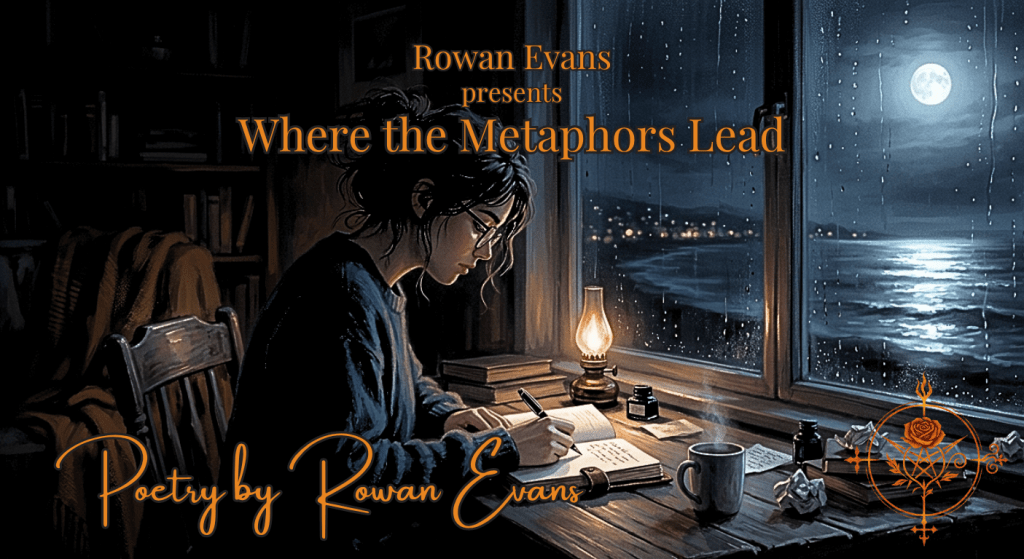
    A lone writer journaling by moonlight at four in the morning while the moon reflects across a calm ocean beyond the window.
    Some feelings only find their voice after midnight, where dreams, memory, and metaphor become impossible to tell apart.

    Where the Metaphors Lead
    Poetry by Rowan Evans

    It’s funny how I find myself here again,
    four AM—it’s just me, the music and my pen.
    I’ve got so many thoughts with so much to say,
    my lips move but no sound comes—
    like I lost one voice, when I found the other.

    And it’s not that I can’t speak—

    it’s just that words don’t come easily,
    when they try to come verbally.

    But on the page,
    everything lines up—

    the thoughts, the feelings,
    the things I never say out loud.
    Ink doesn’t trip over itself
    the way my voice does.

    So here are a few
    truths for you—

    there is a woman
    she is on my mind constantly,
    yeah, she is simultaneously
    the easiest and hardest to talk to.

    She makes me feel like I can be me—
    completely.

    And honestly,
    I’ve never really had that
    with anybody else—

    every beautiful line I write
    about the moon in the sky,
    the ocean and tide—

    yeah, most of the time
    it leads back to her
    in my mind.

    And every dream, I translate in ink—
    the shores I walk in sleep,
    secrets I try not to keep,
    even when it’s hard to speak—

    I lay them on the page and pray
    that they’ll reach their destination one day.

    So I sit here,
    four AM again,
    writing the things
    I can’t say out loud—

    hoping one day
    I’ll find the courage
    to speak them aloud.


    Journey into the Hexverse…

    [The World Shifted Around Us]
    The world transformed around us—beach, city streets, jungle—but we never moved. Sometimes love isn’t found in words, but in the quiet certainty of someone remaining clear while everything else fades.

    [Every Night, The Same Flight]
    Every night begins with the same flight. Between wakefulness and sleep, an airport appears, a familiar shoreline waits beyond the journey, and the same dream asks whether some destinations find us before we’re ready to find them.

    [Where I Belonged]
    A bedroom becomes an airport in the space between sleep and waking. Where I Belonged explores liminal consciousness, uncertainty, and the strange moments when reality feels suspended between two worlds

    [Opposites Coasts of the Same Silence]
    What separates two people isn’t always an ocean. Sometimes it’s the silence between everything left unsaid. Opposite Coasts of the Same Silence explores longing, distance, dreams, and the quiet hope that even across impossible divides, someone might still hear your voice.

    [Ocean Waves (1, 4, 3)]
    A moonlit shoreline, a rowboat full of ducks, a piggybank with no cents, and a confession hidden in plain sight. Ocean Waves (1, 4, 3) explores how humor, wordplay, and absurdity can become a side door to vulnerability when the truth feels too difficult to say directly.

    [Call of the Tide]
    A poem about identity, displacement, and the quiet pull toward something beyond the shoreline you were born on. Sometimes the tide calls louder than the anthem.

    If you’re interested in more poetry, you can find it here → [The Library of Ashes]
  • Author’s Note

    Some poems don’t begin with an idea.

    They begin with resistance.

    This one came from that familiar place I’ve written about before: four in the morning, when the world is quiet enough that my thoughts become impossible to ignore.

    I started writing about fear, but somewhere along the way I realized I wasn’t afraid of the page.

    The page has never been the problem.

    Ink has always been brave.

    It says the things I hesitate to speak.

    The real fear has always been what happens after the words exist.

    What happens when a confession leaves the safety of metaphor.

    When it stops being “the moon,” “the tide,” or “the shore,” and simply becomes the truth.

    If you’ve read much of my recent work, you’ll probably recognize many of the images here. The moon. The bay. The ocean. The distant shoreline. Dreams that feel more like memories than imagination.

    They’re all still here.

    Only this time, the poem admits something they’ve been pointing toward all along.

    Sometimes metaphors aren’t hiding the truth.

    They’re slowly teaching us how to say it.

    Rowan Evans


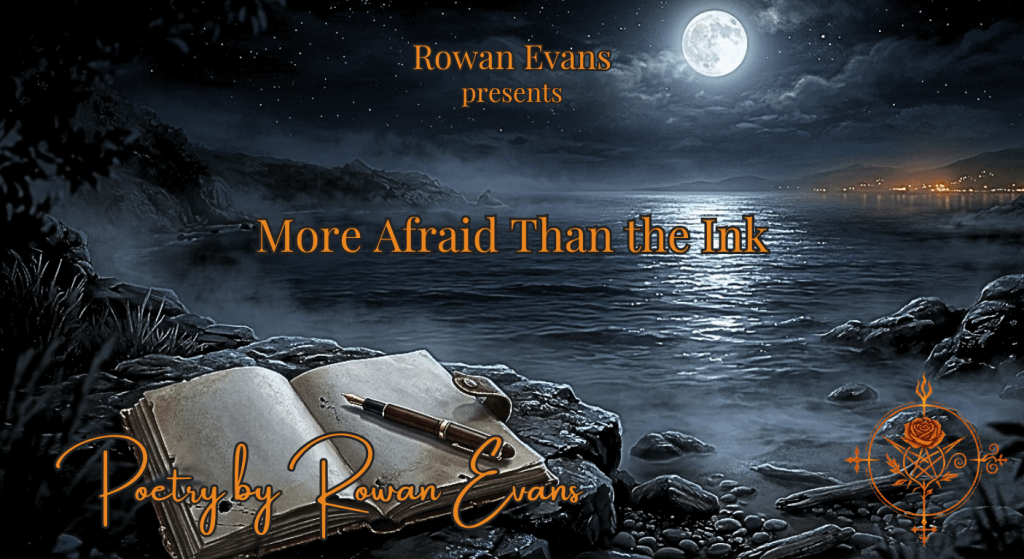
    An open journal and fountain pen beside a moonlit bay with shimmering reflections across calm water.
    Sometimes the ink is willing to tell the truth long before the poet is.

    More Afraid Than the Ink
    Poetry by Rowan Evans

    Four AM again—
    I breathe in and try to center myself,
    but it doesn’t seem to help.
    My mind wanders—
    moving from idea to truth
    and back again,
    carrying a collection of images
    and broken metaphors.

    The ink runs from my pen—
    like it’s scared of it.
    Because sometimes,
    my thoughts are dark
    and there’s no light in it.
    It trembles—
    lines becoming jagged
    as the truth hits
    a little too close to home.

    And the metaphors
    are broken for sure—
    it’s like I see the moon,
    but it doesn’t shimmer anymore.
    I don’t see the bay,
    I don’t feel the tide.

    There’s no ache,
    no longing for connection—
    across a divide
    an ocean wide.

    Okay, I lied.

    At night, when I close my eyes
    and my head hits the pillow—
    I feel the tide,
    it tugs at the heartstrings inside.
    I hear the waves, feel the ocean spray—
    and I see the familiar shimmer,
    the way the moon’s light trembles
    across dark water.

    The tide is why I dream of your shores—
    it’s why I walk your streets in sleep.
    And the moon provides the spotlight
    for every confession
    I speak with eyes closed…

    for every confession
    that I cannot say aloud,
    not outside of my dreams—not now,
    because I’m more afraid
    than the ink is.


    Journey into the Hexverse…

    [When the Veil Is Thin]
    Some truths wait until after four in the morning to make themselves known. When the Veil Is Thin explores insomnia, longing, quiet vulnerability, and the thoughts that become impossible to ignore before dawn.

    [Ocean Waves (1, 4, 3)]
    A moonlit shoreline, a rowboat full of ducks, a piggybank with no cents, and a confession hidden in plain sight. Ocean Waves (1, 4, 3) explores how humor, wordplay, and absurdity can become a side door to vulnerability when the truth feels too difficult to say directly.

    [The Language Her Soul Speaks]
    What if love isn’t about being understood, but learning to understand someone else? “The Language Her Soul Speaks” is a free verse poem about intimacy, communication, curiosity, and the desire to know another person beyond the limits of language.

    If you’re interested in more poetry, you can find it here → [The Library of Ashes]

  • Author’s Note

    There seems to be something about four in the morning.

    Not because it’s magical in any supernatural sense, but because it’s quiet enough that there’s nowhere left for your thoughts to hide.

    I’ve written several poems that begin around that hour, and they all seem to share the same quality: honesty arrives before I have time to edit it.

    This poem came from one of those mornings.

    I wasn’t trying to write a love poem.

    I was trying to understand why certain thoughts become louder when the rest of the world falls silent.

    The title, When the Veil Is Thin, can be read a lot of ways. Some people hear something mystical in it. For me, it’s more psychological.

    The veil is simply the distance between what I feel and what I’m willing to admit.

    During the day, that veil is thick.

    By four in the morning…

    it becomes almost transparent.

    This poem isn’t really about insomnia.

    It’s about the moments when the truth finally stops whispering and starts speaking clearly enough that you can no longer pretend not to hear it.

    Rowan Evans


    A sleepless writer sits beside an open notebook as moonlight fades into the first light of dawn through a bedroom window.
    Some truths wait until the world is quiet enough to be heard.

    When the Veil Is Thin
    Poetry by Rowan Evans

    It’s after four AM
    and the veil is thin—
    I should be asleep
    but my mind won’t
    cease to speak.

    It won’t stop the talk—
    I try to write, just anything—
    because this is when the truth
    seems to sing,
    it rings through the ink—

    It’s you in every thought—
    and I can’t seem to shake
    this feeling in my chest.

    It’s not a weight, just an ache—
    sometimes it keeps me awake.

    And I try—I try so hard
    to just say the things,
    but I bite my tongue
    and my mouth snaps shut.

    It’s got me screaming—
    what the…

    Why am I still up?

    I’m still awake,
    with thoughts I can’t shake.
    With dreams just out of reach
    of shores I’m longing for—

    I just need to be clear.
    It’s not the thought
    of your hand in mine.

    It’s the thought of our time,
    together, intertwined—

    maybe when dawn breaks
    this feeling will ease—
    but for now, it lingers,
    soft as the moon on my skin.

    The veil thins again—
    and in the hush before morning,
    your name is the only truth
    that doesn’t fade.

    The sky begins to pale—
    and I let the thought of you
    carry me into sleep.


    Journey into the Hexverse…

    [Where Intimacy Begins]
    For some, attraction begins with appearance. For others, it begins with conversation. Where Intimacy Begins explores the beauty of curiosity, deep listening, and the quiet connection that forms when two minds truly meet.

    [The Life of a Witness Poet]
    What does it mean to love someone when the greatest act of care is simply witnessing their life? This poem explores quiet devotion, distance, and the compassionate heart of a witness poet.

    [What I’m Trying to Say]
    What begins as an exaggerated promise of love slowly strips itself back until only one simple truth remains: real devotion isn’t found in grand gestures—it’s found in consistently showing up.

    [Recognizes Home]
    A free-verse poem exploring the difference between love as dependency and love as choice. It challenges the idea that love must be need-based, instead centering the quiet strength of choosing someone while still remaining whole on your own.

    If you’re interested in more poetry, you can find it here → [The Library of Ashes]
  • Author’s Note

    People often ask what I find attractive.

    The answer has never been particularly complicated.

    I’ve always been fascinated by minds.

    Not intelligence in the competitive sense. Not who can quote the most books or win the most arguments.

    I mean curiosity.

    The way someone thinks.

    The stories they tell without realizing they’re telling them.

    The dreams they quietly carry.

    The questions that keep them awake at night.

    I’ve found that the most beautiful parts of a person usually reveal themselves in conversation.

    Not during introductions.

    Not through appearances.

    But somewhere between laughter, honesty, and those moments when someone forgets they’re trying to impress you.

    That’s when people become themselves.

    I’ve always believed there are pieces of us that only exist in dialogue. Parts that don’t emerge until someone asks the right question, or listens long enough for the answer to arrive.

    Maybe that’s why I chose the word lore.

    History is a record of what happened.

    Lore is what those moments became.

    It’s the mythology of a person—the stories, beliefs, fears, dreams, and experiences that shape how they move through the world.

    That’s what I want to know.

    Not because I need to solve anyone.

    Because understanding another person’s inner world feels like one of the greatest privileges we can offer each other.

    This poem isn’t really about romance.

    It’s about attention.

    About listening deeply enough that another person feels safe becoming fully known.

    For me, that’s where intimacy has always begun.

    Rowan Evans


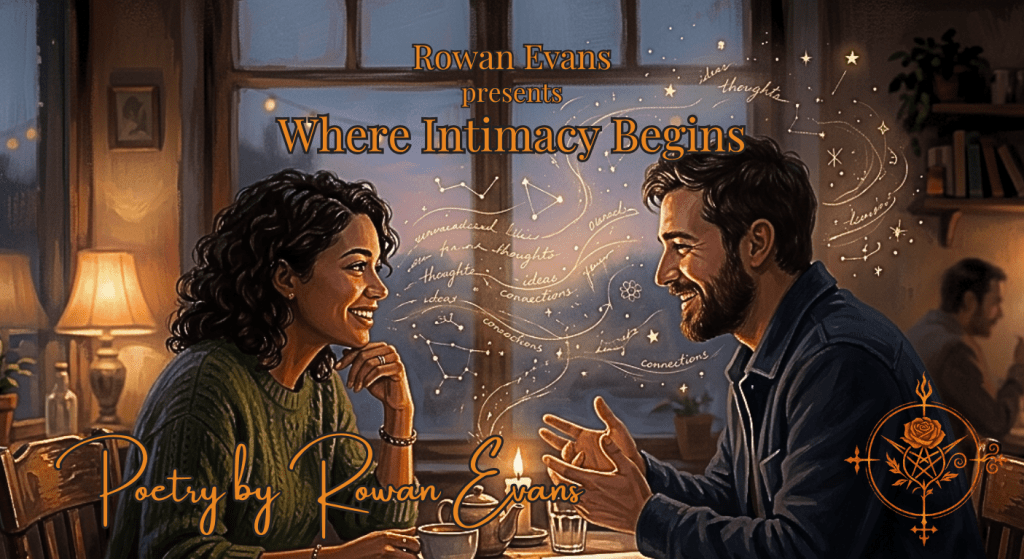
    Two people sharing a thoughtful conversation as glowing words and constellations symbolize a deep mental connection.
    “Some people fall for a smile. Others fall for the mind behind it.”

    Where Intimacy Begins
    Poetry by Rowan Evans

    They may want a body,
    but I want a mind—
    they are fine with the surface,
    I want the depths that you hide.
    It’s in conversation you find
    the light hidden inside.

    They see beauty in a face,
    I see beauty in the things you say
    and the way language takes shape.
    I see beauty in the thoughts,
    the dreams, the plans.

    You see, it’s all about
    the mental connection for me.
    I want to touch your mind,
    see what stories I’ll find—
    the lore that I’ll learn.

    And when you speak, I’ll listen—
    you should always feel heard.

    I want the stories
    you never say out loud,
    the half-formed dreams you keep
    tucked beneath your ribs.

    There are pieces of you
    that only appear in conversation.
    So I’ll hold your thoughts gently,
    the way others hold hands.

    Because I’ve learned beauty
    lives deeper than skin,
    the way a thought can light a room
    inside me—

    how a single sentence
    can feel like a door unlocking.

    I’ll meet you
    where your mind wanders.
    I’ll be the quiet
    that lets your truth come forward.

    I’ll fall for the way you think
    before anything else,
    because the mind—

    is where intimacy begins.


    Journey into the Hexverse…

    [What I’m Trying to Say]
    What begins as an exaggerated promise of love slowly strips itself back until only one simple truth remains: real devotion isn’t found in grand gestures—it’s found in consistently showing up.

    [I’d Rather Try]
    Anyone can promise they’d die for someone. But love isn’t built on one dramatic moment—it’s built on showing up, trying again tomorrow, and proving your words through consistent action.

    [The Language Her Soul Speaks]
    What if love isn’t about being understood, but learning to understand someone else? “The Language Her Soul Speaks” is a free verse poem about intimacy, communication, curiosity, and the desire to know another person beyond the limits of language.

    If you’re interested in more poetry, you can find it here → [The Library of Ashes]
  • Author’s Note

    Some people assume that because I write confessional poetry, vulnerability comes naturally to me.

    It doesn’t.

    My first instinct is almost always to make a joke.

    If something hurts, I’ll reach for humor. If something feels too exposed, I’ll bury it beneath a cartoon reference, a comic book nod, or a punchline that arrives just before the truth does.

    This poem is about that instinct.

    It explores the strange contradiction at the center of my writing: I’m willing to confess almost anything—as long as I can disguise it first.

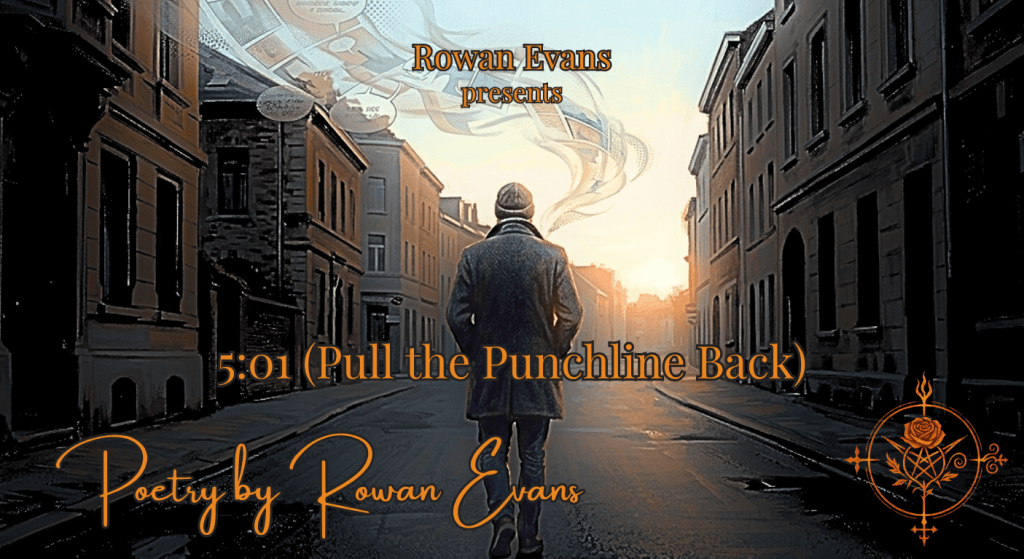
    The title, 5:01, marks another early morning when my thoughts were moving faster than I could organize them. And “Pull the Punchline Back” became my way of describing what happens when I realize I’ve hidden behind humor for just a second too long.

    Sometimes the joke protects me.

    Sometimes it prevents me from saying what I actually mean.

    This poem lives somewhere between those two realities.

    Rowan Evans


    A lone person walking through an empty street at sunrise while faded comic book imagery dissolves into the morning light, symbolizing humor giving way to emotional honesty.
    Sometimes the hardest part of confession isn’t finding the words—it’s resisting the joke that tries to replace them.

    5:01 (Pull the Punchline Back)
    Poetry by Rowan Evans

    5:01—
    the morning comes
    and my thoughts run,
    like a marathon.

    You see—
    most the time
    my thoughts move quick,
    like a sprint—
    Usain?

    No, insane.

    I bolt when I feel
    I care too much—

    here the vulnerability comes,
    so where’s the joke at?
    I got to hide that—
    pull the punchline back.

    I put a brave face on—
    they call me Courage,
    even though
    I’m a cowardly dog.

    Isn’t it funny?
    I’m a confessional poet,
    but I hide the confession
    behind a wall of jokes—

    and cartoon references—
    can’t forget the comic books.

    The page is a phone booth,
    I go into to change—
    but I’m not trying to be a hero here,
    there’s no S on my chest.

    I’m just here for those
    that are stressed and struggling.

    And this is my problem,
    I’ve got my own problems,
    then I take mo’ problems,
    they were yo’ problems—

    now I’m juggling.

    The sad thing is—
    the whole time
    this is what my mind
    has been running from.

    It’s incredible—
    how fast I Dash,
    gone in a Flash,
    like I ran to the past
    to escape—

    everything I want.

    Connection.
    Reflection.

    So I keep my feet moving
    until I get where I’m going,
    and I’m not showin’—
    no signs of slowin’.


    Journey into the Hexverse…

    [I’d Rather Try]
    Anyone can promise they’d die for someone. But love isn’t built on one dramatic moment—it’s built on showing up, trying again tomorrow, and proving your words through consistent action.

    [Tots, Rocks and All]
    What begins as a surreal collection of tater tots, rocks, comic book references, and runaway thoughts slowly reveals something much quieter: a poem about creativity, vulnerability, and the simple hope of finding someone willing to hold your heart.

    [Ocean Waves (1, 4, 3)]
    What begins as a surreal collection of tater tots, rocks, comic book references, and runaway thoughts slowly reveals something much quieter: a poem about creativity, vulnerability, and the simple hope of finding someone willing to hold your heart.

    [L Words & Heart]
    A playful, self-aware poem about love, longing, loyalty, and the quiet ways another person can reshape our inner world. What begins as humor slowly reveals a heartfelt confession about affection, imagination, and the faces that linger in our dreams.

    [No You and I, Only Us]
    A hopeful free verse poem about empathy, borders, and imagining a world where humanity matters more than division.

    If you’re interested in more poetry, you can find it here → [The Library of Ashes]