Tag: relationships

  • Author’s Note

    Some nightmares aren’t about monsters.

    Sometimes the nightmare is waking up and realizing that the person you want beside you is standing beneath a completely different sky.

    My Nightmare comes from that place—the uneasy space between memory and hope, between what once felt shared and what now feels impossibly far away. It is a poem about distance, but not only the physical kind. There is distance between perspectives, between hearts, between the lives we imagine and the lives we are actually living.

    Still, even nightmares have endings.

    Sometimes you wake up before they become permanent.

    And sometimes, even while dreaming, you can still see a little gold threaded through the cracks.

    Rowan Evans


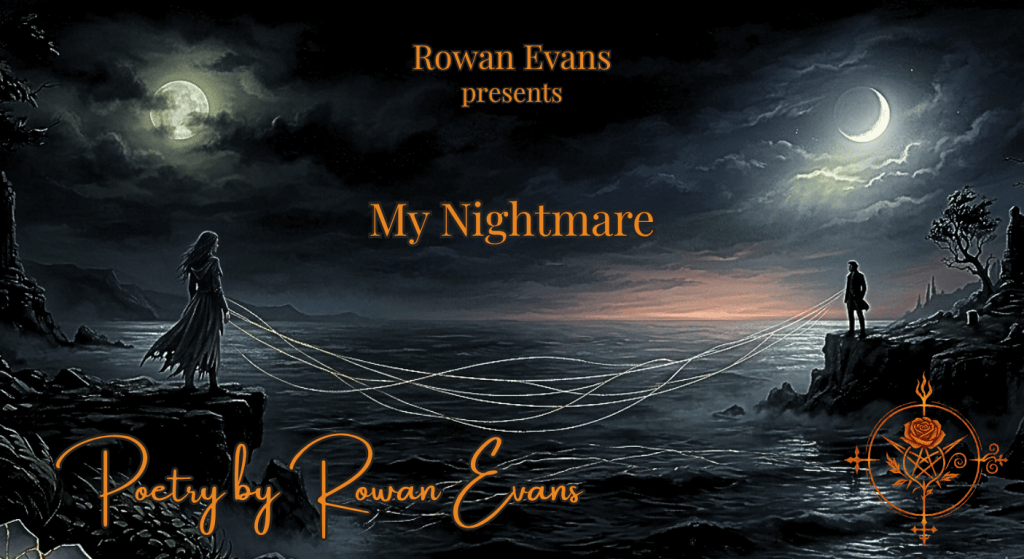
    Two distant figures stand on separate shores beneath different moons, connected across the dark ocean by faint golden and platinum threads.
    Two shores. Two skies. One horizon—and enough gold left to believe they might meet there.

    My Nightmare
    Poetry by Rowan Evans

    This is my nightmare.

    You and I across the distance,
    the view that we see is different—
    your moon from my sky
    is missing—
    the sun no longer shines,
    it’s dimming—

    I don’t see the spark anymore—
    don’t see the light in the dark anymore.
    What do I even I write for?
    I lost my purpose—think I did it on purpose,
    it’s like I can’t rhyme anymore,
    no clock, no watch, can’t tell time anymore.

    This is my nightmare.

    You and I across the distance,
    the view that we see is different—
    my moon is sickly pale,
    but yours seems fine though—
    the sun doesn’t provide light,
    it’s gotten real low—

    in times before, this is when
    I would Kintsugi the heart—
    but there’s not much heart left,
    it’s all gold—soft metal,
    softer soul—stayed warm,
    when the world grew cold.

    This is my nightmare.

    You and I across the distance,
    the view that we see is different—
    when we used to be,
    two pieces the puzzle
    was missing—
    the sun in the sky was fine,
    but it dimmed in our shine—

    I’ve spent time doing Kintsugi
    on your heart too—it was hard not to,
    gold and platinum weaved through—
    I really did see you, flaws and all—
    and all I saw was a gift from God.

    I still don’t think—
    I was wrong.

    But that was my nightmare…

    You and I across the distance,
    the view that we saw was different—
    but I still see the gold threads that connect,
    the platinum hope on the horizon,
    that one day the distance will close—
    and we’ll walk the same shore,
    it won’t be—

    mine and yours.


    Journey into the Hexverse…

    [Dreaming Wrong]
    A familiar dream becomes unsettling when the ocean becomes a pond, the tide disappears, the moon loses its reflection, and nothing feels quite like it belongs. Dreaming Wrong explores the uncanny feeling of finding yourself inside a dream that looks familiar—but feels like someone else’s.

    [Poet’s Curse]
    Poet’s Curse explores the painful side of falling too deeply: giving pieces of yourself away freely, taking accountability for your own heartbreak, and realizing that learning to let go can be harder than learning to love.

    [Beach to Beach]
    A dream becomes a journey between familiar shores and unfamiliar cities in Beach to Beach (How I Get There), a poem about imagined travel, ocean crossings, longing, and the places we hope to someday reach while awake.

    [Where the Metaphors Lead]
    Some truths are easier to write than they are to say aloud. “Where the Metaphors Lead” explores the quiet space between dreams, confession, and the courage it takes to let another person know how deeply they’ve become woven into your inner world.

    If you’re interested in more poetry, you can find it here → [The Library of Ashes]
  • Author’s Note

    Some poems begin with an idea. Others begin with a feeling that refuses to leave.

    This one was written in the early hours of the morning, during that familiar stretch of time when the world grows quiet enough for my thoughts to become louder than everything else.

    I’ve always found it easier to write than to speak. Conversations ask for immediate answers. Poetry allows me to sit with a feeling until I understand it well enough to translate it into language.

    Many of the recurring images throughout my recent work—the moon, the tide, distant shores, dreams, and city streets—have become a personal symbolic language. They aren’t separate subjects anymore. They all point toward the same emotional center.

    This poem finally acknowledges that.

    Sometimes the metaphors aren’t hiding anything.

    Sometimes they’re quietly leading us back to the truth we were trying not to say.

    Rowan Evans


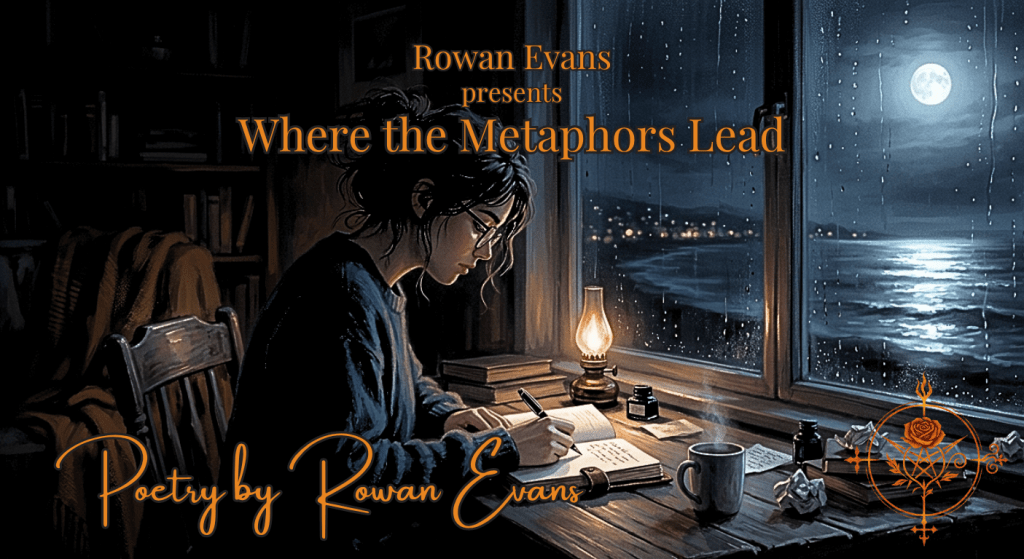
    A lone writer journaling by moonlight at four in the morning while the moon reflects across a calm ocean beyond the window.
    Some feelings only find their voice after midnight, where dreams, memory, and metaphor become impossible to tell apart.

    Where the Metaphors Lead
    Poetry by Rowan Evans

    It’s funny how I find myself here again,
    four AM—it’s just me, the music and my pen.
    I’ve got so many thoughts with so much to say,
    my lips move but no sound comes—
    like I lost one voice, when I found the other.

    And it’s not that I can’t speak—

    it’s just that words don’t come easily,
    when they try to come verbally.

    But on the page,
    everything lines up—

    the thoughts, the feelings,
    the things I never say out loud.
    Ink doesn’t trip over itself
    the way my voice does.

    So here are a few
    truths for you—

    there is a woman
    she is on my mind constantly,
    yeah, she is simultaneously
    the easiest and hardest to talk to.

    She makes me feel like I can be me—
    completely.

    And honestly,
    I’ve never really had that
    with anybody else—

    every beautiful line I write
    about the moon in the sky,
    the ocean and tide—

    yeah, most of the time
    it leads back to her
    in my mind.

    And every dream, I translate in ink—
    the shores I walk in sleep,
    secrets I try not to keep,
    even when it’s hard to speak—

    I lay them on the page and pray
    that they’ll reach their destination one day.

    So I sit here,
    four AM again,
    writing the things
    I can’t say out loud—

    hoping one day
    I’ll find the courage
    to speak them aloud.


    Journey into the Hexverse…

    [The World Shifted Around Us]
    The world transformed around us—beach, city streets, jungle—but we never moved. Sometimes love isn’t found in words, but in the quiet certainty of someone remaining clear while everything else fades.

    [Every Night, The Same Flight]
    Every night begins with the same flight. Between wakefulness and sleep, an airport appears, a familiar shoreline waits beyond the journey, and the same dream asks whether some destinations find us before we’re ready to find them.

    [Where I Belonged]
    A bedroom becomes an airport in the space between sleep and waking. Where I Belonged explores liminal consciousness, uncertainty, and the strange moments when reality feels suspended between two worlds

    [Opposites Coasts of the Same Silence]
    What separates two people isn’t always an ocean. Sometimes it’s the silence between everything left unsaid. Opposite Coasts of the Same Silence explores longing, distance, dreams, and the quiet hope that even across impossible divides, someone might still hear your voice.

    [Ocean Waves (1, 4, 3)]
    A moonlit shoreline, a rowboat full of ducks, a piggybank with no cents, and a confession hidden in plain sight. Ocean Waves (1, 4, 3) explores how humor, wordplay, and absurdity can become a side door to vulnerability when the truth feels too difficult to say directly.

    [Call of the Tide]
    A poem about identity, displacement, and the quiet pull toward something beyond the shoreline you were born on. Sometimes the tide calls louder than the anthem.

    If you’re interested in more poetry, you can find it here → [The Library of Ashes]
  • Author’s Note

    Some promises sound beautiful because they are dramatic.

    “I’d die for you.”

    It’s a phrase we’ve heard in songs, films, books, and poetry for centuries. It carries an undeniable emotional weight.

    But while writing this poem, I found myself asking a different question.

    What happens after the dramatic declaration?

    Because most relationships aren’t built on one extraordinary moment.

    They’re built on ordinary ones.

    Showing up.

    Listening.

    Being consistent.

    Choosing someone again tomorrow after choosing them today.

    Dying for someone is an idea that exists in a single moment.

    Living for someone is a practice that unfolds across thousands of moments.

    That’s what this poem is really about.

    Not grand gestures, but quiet commitment.

    Not sacrifice for a day…

    but presence for a lifetime.

    Rowan Evans


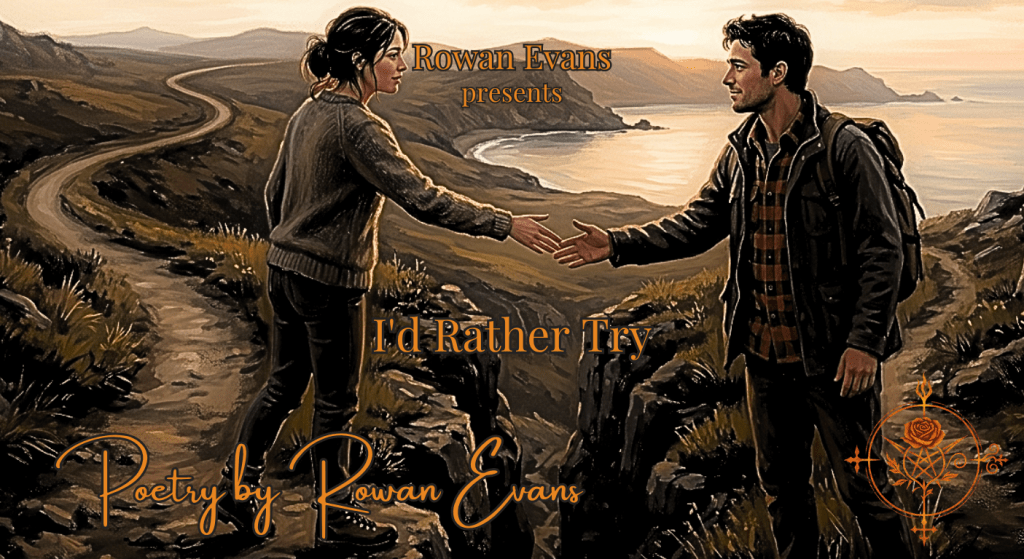
    Two people reaching toward one another across a narrow gap at sunrise, symbolizing trust, consistency, and choosing to show up for someone every day.
    “Love isn’t measured by one extraordinary promise—it is measured by the ordinary moments when we choose to stay, to try, and to be there.”

    I’d Rather Try
    Poetry by Rowan Evans

    Oh, they said they’d die for you—
    and give all of their life too.
    But would they be there for you
    and truly care too?

    Anyone can say they’d die—
    but would they have the spine,
    when it comes time
    to put it on the line?

    What would I do?

    Well—
    I would try for you
    and live all of my life too.
    I would be there for you,
    and truly care too.

    Yeah, I know—
    anyone can say they’d try,
    but consistency is where
    promises live or die.

    And I’ve tried to prove
    myself consistently.

    To show that I mean
    what I say—
    in more than just words,
    because it’s about the actions too.


    Journey into the Hexverse…

    [Pointing Me Home]
    The final poem in the No Metaphor Left Behind trilogy explores dreams, hope, and belonging. Through moonlight, ocean tides, and quiet conversation, Pointing Me Home reflects on carrying hope long before reaching the place you call home.

    [Only Waiting]
    The second poem in the No Metaphor Left Behind series, exploring the quiet ache of growing up in a place that never truly felt like home—and finally saying aloud what years of metaphor had been trying to express.

    [Crossing the Sea]
    A deeply personal poem about relocation, longing, and the realization that some truths naturally arrive through metaphor—even when we try to leave it behind.

    [Recognizes Home]
    A free-verse poem exploring the difference between love as dependency and love as choice. It challenges the idea that love must be need-based, instead centering the quiet strength of choosing someone while still remaining whole on your own.

    [Not Rebuilding You]
    A poem about love as an act of presence rather than rescue. Through construction imagery, Not Rebuilding You explores trust, devotion, emotional safety, and the quiet work of building a foundation strong enough for healing to grow.

    If you’re interested in more poetry, you can find it here → [The Library of Ashes]
  • Author’s Note

    Some poems arrive because of a grand idea.

    Others arrive because a single sentence refuses to leave.

    This was one of those.

    The poem began when I remembered a conversation. A joke, really. Someone once described themselves as being “like a drug” and we laughed about it. At the time, it felt playful, exaggerated, harmless.

    But memory has a way of revisiting things from a different angle.

    When I thought about that conversation later, I realized what interested me wasn’t the comparison itself. It was the experience of slowly realizing that someone has become part of your everyday thoughts without you noticing exactly when it happened.

    One day they’re simply someone you know.

    Then they’re someone you think about.

    Then they’re someone who quietly occupies space in your mind when nothing else is demanding your attention.

    The drug metaphor gave me a doorway into the poem, but it isn’t really what the poem is about.

    It’s about affection.

    It’s about attachment.

    It’s about the strange vulnerability of admitting that someone matters.

    More than that, it’s about the difference between being needed and being wanted.

    Need can feel transactional.

    Want feels chosen.

    The final lines became the emotional center for me because they capture a hope I think many people carry but rarely say aloud:

    Not that someone has to stay.

    Not that someone owes us their attention.

    Just that maybe, if given the choice, they would choose us too.

    Like a lot of my recent work, humor and metaphor show up first. They’re familiar territory. They’re comfortable. They make difficult things easier to approach.

    But beneath the jokes, the poem is doing what many of my poems eventually do.

    It’s confessing.

    Rowan Evans


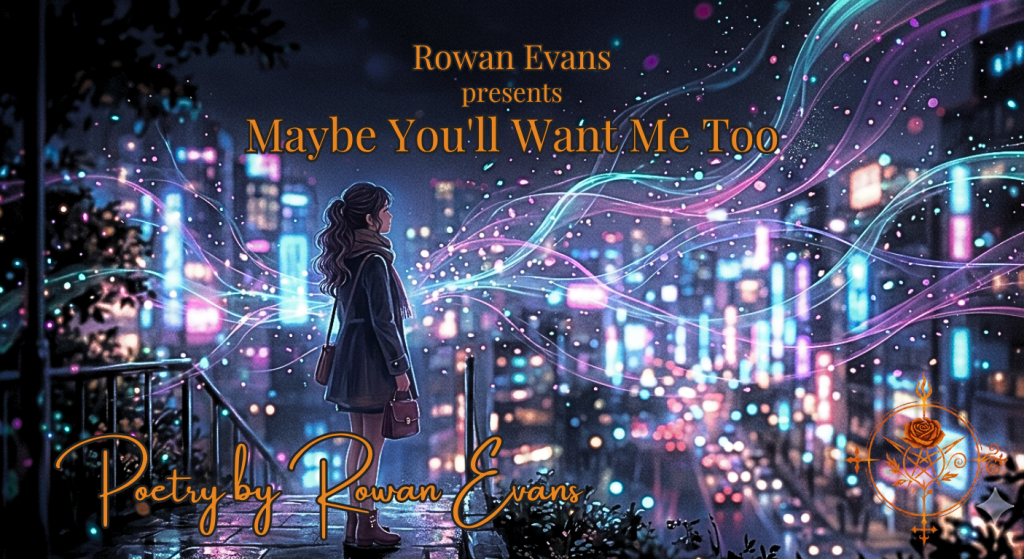
    A solitary figure standing beneath glowing city lights as colorful streams of light drift through the air, symbolizing affection, attachment, and lingering thoughts of someone special
    Sometimes affection arrives quietly—slipping into your thoughts until you realize someone has become part of your everyday world.

    Maybe You’ll Want Me Too
    Poetry by Rowan Evans

    I remember when you said—
    you are like a drug.

    It was all laughs
    about your exes being hooked,
    still shook by the thoughts of you.

    But I was getting second-hand
    contact highs—

    now I feel addicted too.

    It’s like you’re in my bloodstream.
    You’ve rewired my brain,
    rebalanced the chemical compounds—
    you’re in nearly every single thought now.

    I try to hide it behind metaphors
    and jokes—an attempt to mask
    the fragile hope—

    that you won’t need me,
    but maybe you’ll want me too.


    Journey into the Hexverse…

    [Recognizes Home]
    A free-verse poem exploring the difference between love as dependency and love as choice. It challenges the idea that love must be need-based, instead centering the quiet strength of choosing someone while still remaining whole on your own.

    [Not Rebuilding You]
    A poem about love as an act of presence rather than rescue. Through construction imagery, Not Rebuilding You explores trust, devotion, emotional safety, and the quiet work of building a foundation strong enough for healing to grow.

    [The Language Her Soul Speaks]
    What if love isn’t about being understood, but learning to understand someone else? “The Language Her Soul Speaks” is a free verse poem about intimacy, communication, curiosity, and the desire to know another person beyond the limits of language.

    [Ocean Waves (1, 4, 3)]
    A moonlit shoreline, a rowboat full of ducks, a piggybank with no cents, and a confession hidden in plain sight. Ocean Waves (1, 4, 3) explores how humor, wordplay, and absurdity can become a side door to vulnerability when the truth feels too difficult to say directly.

    [L Words & Heart]
    A moonlit shoreline, a rowboat full of ducks, a piggybank with no cents, and a confession hidden in plain sight. Ocean Waves (1, 4, 3) explores how humor, wordplay, and absurdity can become a side door to vulnerability when the truth feels too difficult to say directly.

    If you’re interested in more poetry, you can find it here → [The Library of Ashes]
  • Author’s Note

    Some poems arrive all at once.

    This one arrived in pieces.

    The opening came first—a joke, a banana peel, a little bit of wordplay and self-awareness. The speaker trips over their own feelings and tries to laugh about it before anyone notices.

    That’s fairly normal for me.

    Humor has always been one of the ways I approach vulnerability. Not because the feelings aren’t real, but because sometimes honesty becomes easier to hold when it’s carrying a joke.

    But somewhere during the writing process, the poem shifted.

    The focus stopped being the speaker’s feelings and became the person receiving them.

    Because love, at least the kind I’m interested in writing about, isn’t ownership.

    It isn’t rescue.

    It isn’t fixing someone.

    It’s creating safety.

    The construction imagery in the second half comes from that idea. The speaker isn’t trying to rebuild another person or erase their past. They’re trying to create something steady. Something reliable. A place where another person can set down their fears for a while and rest.

    That distinction matters to me.

    Too many love stories focus on saving someone.

    I’m more interested in what happens when you simply show up, consistently, and help build conditions where healing becomes possible.

    Brick by brick.

    Choice by choice.

    Day by day.

    The final lines grew from a belief I’ve carried for a long time:

    Everyone deserves a future that feels safe to stand inside.

    Everyone deserves foundations that don’t shake beneath them.

    And sometimes the greatest gift we can offer another person isn’t a promise to save them.

    It’s a promise to help build something that lasts.

    Rowan Evans


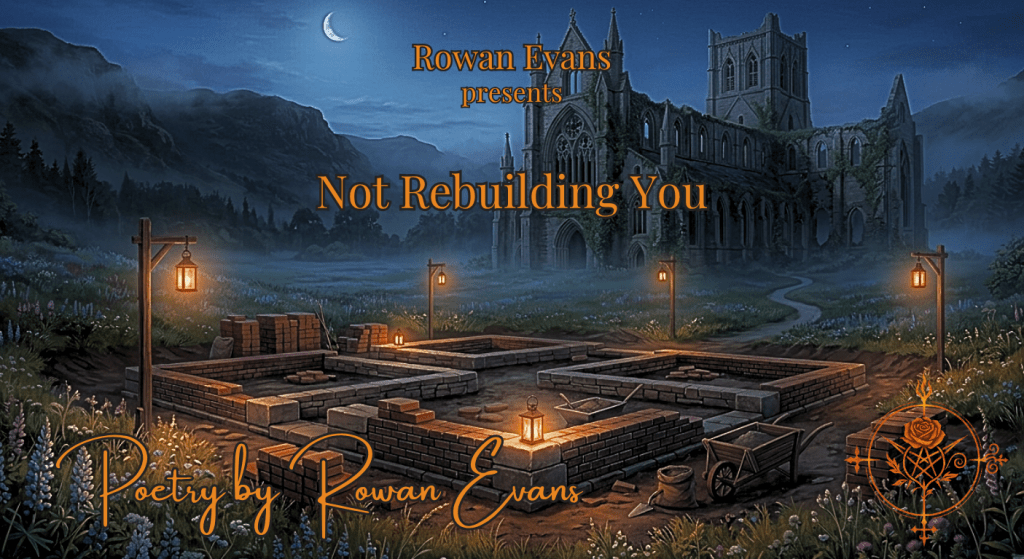
    A new foundation being built beside old ruins at twilight, symbolizing healing, trust, and creating a safe future through love.
    Sometimes love isn’t about fixing what’s broken. Sometimes it’s about laying a foundation strong enough for someone to finally rest without fear of collapse. 🖤🧱✨

    Not Rebuilding You
    Poetry by Rowan Evans

    It happened quick.
    I slipped—
    banana peel.
    But you can trust me,
    I think I’ve proven that, (huh?)
    so you know
    you can trust
    what I feel is real.

    From the fear
    to devotion,
    loyalty in motion—
    I try to give you no reason
    to question.

    And you don’t need
    to return this.
    This isn’t a library,
    no overdue charge—
    just a gift straight from my heart,
    that I give with purpose.

    And if you’re wondering
    why I give like this…

    You’re worth it.

    I’d move earth,
    shift dirt—
    excavate
    to stop the hurt.
    Prepare the land
    for a new foundation.

    So let me lay brick after brick,
    patience in every layer,
    hope in every line.
    Not rebuilding you—
    just building a place
    where you can finally rest
    without fear of collapse.

    And if it takes time,
    I’m not afraid of slow miracles—

    because love like this
    isn’t renovation—
    it’s resurrection.

    A clearing of old ruins,
    a promise carved into the earth:
    you deserve a future
    that doesn’t hurt to stand on.


    Journey into the Hexverse…

    [The Language Her Soul Speaks]
    What if love isn’t about being understood, but learning to understand someone else? “The Language Her Soul Speaks” is a free verse poem about intimacy, communication, curiosity, and the desire to know another person beyond the limits of language.

    [Ocean Waves (1, 4, 3)]
    A moonlit shoreline, a rowboat full of ducks, a piggybank with no cents, and a confession hidden in plain sight. Ocean Waves (1, 4, 3) explores how humor, wordplay, and absurdity can become a side door to vulnerability when the truth feels too difficult to say directly.

    [L Words & Heart]
    A playful, self-aware poem about love, longing, loyalty, and the quiet ways another person can reshape our inner world. What begins as humor slowly reveals a heartfelt confession about affection, imagination, and the faces that linger in our dreams.

    If you’re interested in more poetry, you can find it here → [The Library of Ashes]
  • Author’s Note

    This is one of the shortest poems I’ve written in a while, but it carries an idea I’ve been circling for years.

    A lot of love poems focus on being understood.

    Wanting someone to see you. Wanting someone to know you. Wanting someone to understand the parts of yourself that feel difficult to explain.

    Those desires are real.

    But as I was writing this piece, I realized my attention was pointed in the opposite direction.

    I wasn’t thinking about being understood.

    I was thinking about understanding.

    About how every person carries an internal world that exists beyond simple translation. A private rhythm. A natural cadence. A way of thinking and feeling that doesn’t always survive the journey into spoken language.

    I think that’s part of why I write so often about language, communication, and connection.

    Not because I believe perfect understanding is possible.

    But because the attempt matters.

    Because choosing to learn someone—to listen carefully, to pay attention, to remain curious about who they are beneath the surface—is one of the most meaningful forms of affection I know.

    The title came first.

    “The Language Her Soul Speaks.”

    Not because I believe souls literally have languages, but because some people seem to move through the world with a rhythm that feels uniquely their own.

    This poem is about wanting to learn that rhythm.

    Not to change it.

    Not to possess it.

    Just to understand it a little better than I did yesterday.

    Rowan Evans


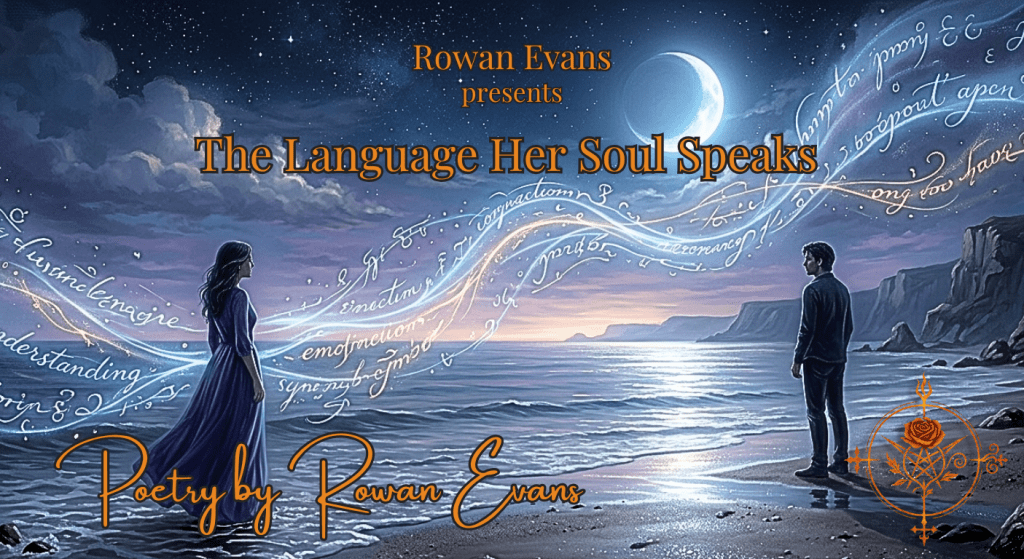
    Two figures stand beneath a moonlit sky as glowing strands of language and light flow between them, symbolizing understanding, communication, and emotional connection.
    “Not because I need to be understood, but because I want to understand.” — The Language Her Soul Speaks by Rowan Evans

    The Language Her Soul Speaks
    Poetry by Rowan Evans

    I want to whisper secrets
    in the language her soul speaks,
    touch the edges of her mind
    in the natural cadence
    in which she thinks—

    not translated,
    not borrowed,
    not filtered
    through the limits of my tongue.

    Not because I need
    to be understood,
    but because I want to understand.


    Journey into the Hexverse…

    [L Words & Heart]
    A playful, self-aware poem about love, longing, loyalty, and the quiet ways another person can reshape our inner world. What begins as humor slowly reveals a heartfelt confession about affection, imagination, and the faces that linger in our dreams.

    [Just Beyond Waking]
    A street that feels familiar. A life that hasn’t happened yet. Just Beyond Waking explores the fragile space between dreams, memory, longing, and the quiet feeling that some futures are already waiting for us.

    [I’ll Be There to See Your Sunrise]
    Love has never come easily to me. This poem explores the fear, vulnerability, and quiet courage required to stay emotionally present when connection begins to matter deeply. “I’ll Be There to See Your Sunrise” is about choosing love despite the risk of heartbreak—and promising to remain long enough to witness someone fully.

    If you’re interested in more poetry, you can find it here → [The Library of Ashes]
  • Author’s Note

    This piece began as a joke.

    Or at least, I thought it did.

    The opening voice is intentionally playful—awkward, self‑deprecating, a little chaotic, prone to wandering off into side comments before finding its way back again. In many ways, it feels closer to how I actually think than some of my more polished or serious pieces.

    But underneath the humor is something sincere.

    I’ve never been particularly good at saying important things directly. Sometimes vulnerability arrives disguised as a joke. Sometimes affection hides behind wordplay. Sometimes the safest way to admit what you’re feeling is to make someone laugh first.

    The title comes from a simple realization: when I think about certain people, my thoughts tend to orbit the same things.

    Love. Longing. Loyalty.

    The L words.

    And heart.

    The final section is intentionally quieter than everything that comes before it. The jokes fall away, the distractions disappear, and what remains is the truth the speaker was circling the entire time: the way another person can take up space in your imagination, your creativity, and your inner world long before they ever occupy the same physical space.

    Sometimes affection doesn’t arrive as grand declarations.

    Sometimes it arrives as a face that appears when you close your eyes.
    A voice you hear in silence.
    A shoreline you keep finding in your dreams.

    Rowan Evans


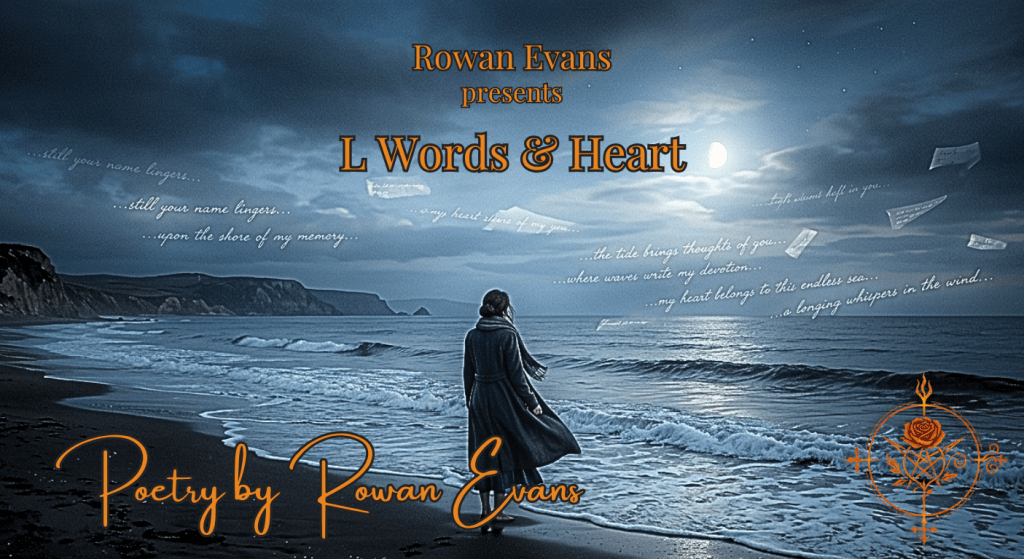
    A solitary figure standing on a moonlit shoreline while waves roll in beneath a dreamy twilight sky.
    Some people arrive in your thoughts quietly—then somehow become part of every dream, every poem, and every beat of your heart.

    L Words & Heart
    Poetry by Rowan Evan

    I’m just a quirky, mother—
    not a fighter, but a lover.
    I’m not brave or whatever,
    I bite tongues,
    holding words like lips
    with padlocks.

    I’ve never been a fan of change,
    but I want things to change—
    I want my life rearranged,
    I want to be seen as normal
    not strange—
    I want to be me
    and accepted,
    because I’m not as strange
    as you think—
    I’ve seen Stranger Things.

    (Actually, no I haven’t.
    I never got into the show.
    But I digress…)

    I’ve got things I want to say,
    got things I want you to know.

    When I think about you
    it’s all L words and heart,
    you reshaped my art.
    So I close my eyes
    and I see your face.
    In silence, I hear your voice—
    and in dreams I walk your shores.


    Journey into the Hexverse…

    [Just Beyond Waking]
    A street that feels familiar. A life that hasn’t happened yet. Just Beyond Waking explores the fragile space between dreams, memory, longing, and the quiet feeling that some futures are already waiting for us.

    [Twin Suns, Sister Moons]
    A poem about distance, longing, and the quiet pull of someone who lives beneath a different sky. Between twin suns and sister moons, the heart keeps reaching for home.

    [It’s You I Choose]
    A poem about devotion, vulnerability, and the quiet decision to stay. Sometimes love isn’t certainty—it is choosing someone anyway.

    If you’re interested in more poetry, you can find it here → [The Library of Ashes]
  • Author’s Note

    This poem started with a voice.

    Not a theme. Not an image. Not a grand idea.

    Just a voice already halfway through a conversation.

    The kind of conversation where someone teases you, calls you crazy, and instead of defending yourself, you laugh because you’ve heard it before.

    A lot of my writing tends to be emotionally heavy, layered, symbolic, or wrapped in larger metaphors. This piece isn’t trying to do any of that.

    It’s intentionally conversational.

    A little sarcastic. A little self-aware. A little chaotic.

    Which, if I’m being honest, isn’t that far removed from how I actually talk.

    What interested me while writing it was the difference between being called strange and being comfortable enough with yourself to stop treating that as an insult.

    The speaker isn’t arguing for normalcy.

    They’re not saying, “No, I’m not weird.”

    They’re basically saying:

    “Yeah. Maybe I am. And?”

    That confidence becomes important because it creates space for the real confession waiting underneath the jokes.

    The poem begins as a defense of individuality, but it ends as a statement of devotion.

    Not because the speaker suddenly becomes serious, but because sincerity sneaks in when they’re not looking.

    And that’s probably my favorite kind of honesty.

    The kind that arrives accidentally.

    The kind that slips past the defenses.

    The kind that shows up disguised as a joke before quietly admitting:

    Of all the people in the world, you’re the one I’d choose.

    Rowan Evans


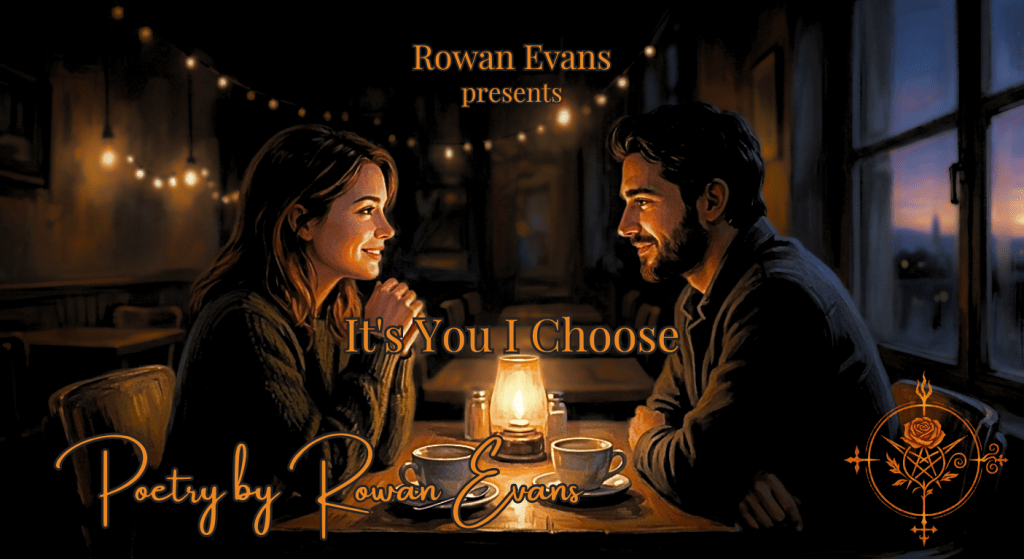
    Two people sharing a quiet late-night conversation while sunrise begins to glow through a nearby window.
    Sometimes love is not certainty. Sometimes it’s simply choosing someone, again and again.

    It’s You I Choose
    Poetry by Rowan Evans

    Here we sit, you and I
    deep in conversation—

    you say, “you’re insane,”
    I say “perfectly.”
    Got it tatted on my arm,
    as a reminder—

    I might struggle
    with my mental health,
    but I’m still perfectly myself.

    It’s a pillar
    of my personality.

    They say I’m strange,
    yeah, well I might be.
    That feels highly likely.

    Loyal to a fault—
    line snaps.
    But my devotion
    is unshakeable.

    What I’m trying to say is—

    maybe
    I am crazy,
    but baby—
    it’s you I choose,
    it’s you I couldn’t
    stand to lose.


    Journey into Hexverse…

    [I’ll Be There to See Your Sunrise]
    Love has never come easily to me. This poem explores the fear, vulnerability, and quiet courage required to stay emotionally present when connection begins to matter deeply. “I’ll Be There to See Your Sunrise” is about choosing love despite the risk of heartbreak—and promising to remain long enough to witness someone fully.

    If you’re interested in more poetry, you can find it here → [The Library of Ashes]
  • Author’s Note

    Her Story was born from frustration — not with women, but with the men who turn a woman’s past into a personal insult. This poem confronts the insecurity, entitlement, and emotional immaturity that drive so many men to treat a woman’s history like a threat instead of a testament to her strength.

    This piece isn’t about blame; it’s about perspective. A woman’s story is not a competition, not a purity test, not a battlefield for fragile egos. It is something to honor — not to resent.

    I wrote this to challenge that mindset, to hold a mirror to possessiveness disguised as devotion, and to remind anyone who needs to hear it that a woman owes no one an apology for having lived before you. She owes no one her silence. She owes no one her shame. She owes you nothing.

    Rowan Evans


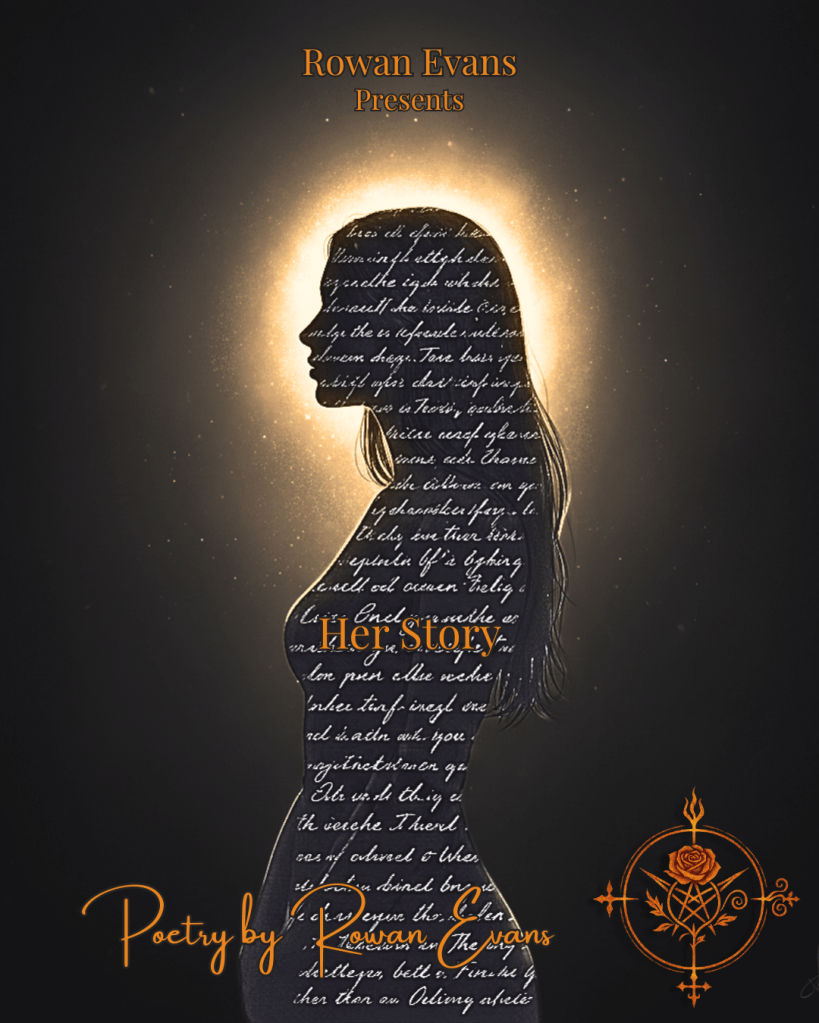
    Illustration of a woman in profile with handwritten text layered inside her silhouette and a warm halo of light behind her, representing her past and resilience.
    A woman’s story is not a threat — it’s something to honor.

    Her Story
    Poetry by Rowan Evans

    Why do some guys
    get so hung up on the past?
    Why do you care so much,
    what happened before you?
    So what she’s lived a life before—
    oh no, someone wanted to make her their wife before.
    I’m so jealous, watch me act out, get hellish.
    Nah, I’m just playin’, just joking around—
    Because it’s not about the past for me,
    getting that hung up on her before…
    that’s blasphemy.

    So if you can, answer me this…
    why do so many guys get pissed?
    Yeah, she has experiences—
    that you can’t touch.
    They happened before you,
    why let them affect you so much?

    Why does her story
    feel like a threat
    instead of a lesson
    that she’s survived,
    lived, loved, lost—
    and still chose you
    in this moment?

    Why does her story
    make you small,
    when it should make you honored
    to be part of the chapter
    she won’t have to rewrite?

    Why do you police her scars
    as if she owes you
    purity, silence,
    a spotless record
    to soothe your ego?

    You want devotion
    but shudder at evidence
    that she lived
    before your shadow
    ever touched her skin.

    But here’s the truth:
    A woman with a past
    isn’t a warning label—
    she’s a masterpiece
    restoring herself.
    And if that scares you,
    it’s not her history
    you’re terrified of—
    it’s your own reflection.

    It’s because you don’t feel worth—
    the attention, or affection.
    You don’t feel like you
    can handle her truth.
    You can’t honor what she’s been through,
    so it weighs on you, and it weighs heavy.
    You do what you can to
    try and prove
    you’re ready.

    But you’re not.
    You’re just like every other guy,
    sitting back, asking why?
    Why not me?
    I’ve been,
    nice as can be.
    Sounding like she owes you something,
    but the truth is—
    She owes you nothing.


    If you enjoyed Her Story, you can feel free to explore The Library of Ashes

  • Author’s Note

    The Vows began as an exploration of devotion — not the romanticized kind, but the kind forged in ache, honesty, and reverence.

    Vow I was surrender: letting the ink run dry, allowing love to unmake what was hardened.
    Vow II was endurance: the willingness to break, to bear the bruise and still remain.
    And Vow III — this final vow — is understanding: the quiet promise to listen, to learn, and to love without translation.

    Together, they form a trinity of intimacy — the heart’s slow evolution from sacrifice to fluency, from bleeding to belonging.

    This isn’t a story of martyrdom. It’s a story of witnessing: of meeting someone’s soul and saying, I see you, I’ll learn you, I’ll speak your language.
    That is the purest vow I know.

    Rowan Evans


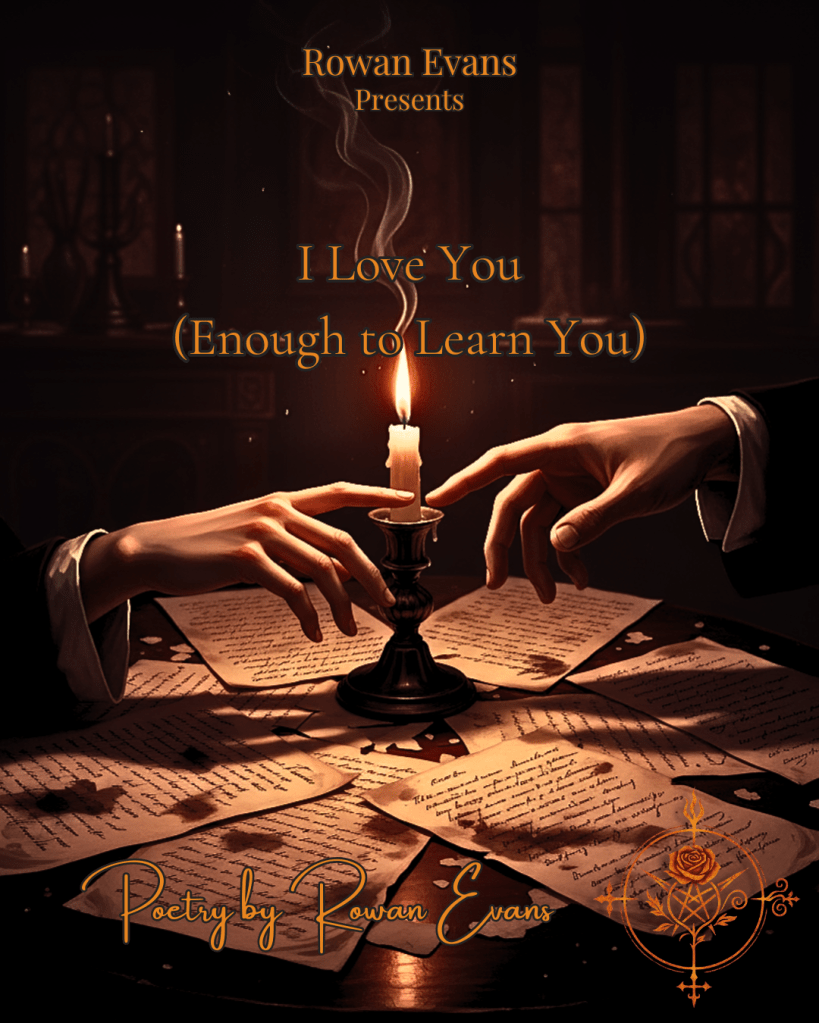
    “Two hands nearly touching through candlelight over scattered handwritten vows and ink-stained pages — symbolizing understanding and emotional intimacy.”
    “The final vow — not of silence or breaking, but of becoming fluent in another’s heart.” — Rowan Evans

    I Love You (Enough to Learn You)
    Poetry by Rowan Evans

    I’d let the ink run dry,
    then I’d break willingly.
    That was vow one,
    and vow two.
    This is vow three—for you.

    I love you enough
    to put you first—
    to make you a priority
    in my life.
    Everyone else be damned,
    I will—

    learn your language,
    learn the nuance,
    so you can speak freely,
    say exactly what you need.

    I will learn the cadence of your world,
    so I can understand—
    not to change you,
    but to meet you where you are.

    I love you enough to listen
    when words falter,
    to read what your silence says
    when your voice can’t.

    I’ll make a home in your pauses,
    a temple in your sighs.
    You gave me peace—
    so I’ll give you peace of mind.

    I’ll give you understanding—
    that’s vow three.
    Not of silence,
    not of breaking,
    but of becoming fluent
    in your heart.


    The Silent Vows

    [I Love You (Enough to Go Silent)]
    A vow written in ink and silence — a confession of love so deep it would sacrifice its own voice to spare another’s tears. “I Love You (Enough to Go Silent)” is a Neo-Gothic devotion from Rowan Evans, where the act of not speaking becomes the loudest declaration of love.

    [I Love You (Enough to Break Willingly)]
    A vow whispered in ink and ache — love not as surrender, but as shared endurance. “I Love You (Enough to Break Willingly)” is Rowan Evans’ second vow, a quiet confession of devotion that chooses breaking over leaving, and burden over indifference.