Author’s Note
I’ve always thought it was strange that monsters get such bad press.
Most of them never asked to be monsters in the first place.
They’re usually just the things we’re afraid of. The things we don’t understand. The things we refuse to look at directly.
What would happen if I stopped fearing the monsters under the bed and actually talked to them?
The answer surprised me.
Because once the conversation began, the monsters behaving like monsters.
They became neighbors.
Parents.
Friends.
People with lives beyond the role they had been assigned in my imagination.
And that’s where the poem’s real interest emerged.
Not in monsters themselves, but in the human tendency to create them.
We have a habit of turning difference into danger.
A habit of mistaking unfamiliarity for threat.
A habit of reducing people to a single trait, label, identity, or assumption until they become something easier to fear than understand.
The monsters in this poem don’t seem to share that habit.
They celebrate what makes them unique.
They recognize difference without treating it as division.
They understand something many of us spend our lives trying to learn:
There is a difference between being different and being separate.
That’s where the title comes from.
Theology is simply the study of what we believe.
And Monster Theology asks a simple question:
What if the monsters were better at being human than we are?
Maybe the real lesson isn’t learning how to defeat monsters.
Maybe it’s learning how to stop creating them.
— Rowan Evans
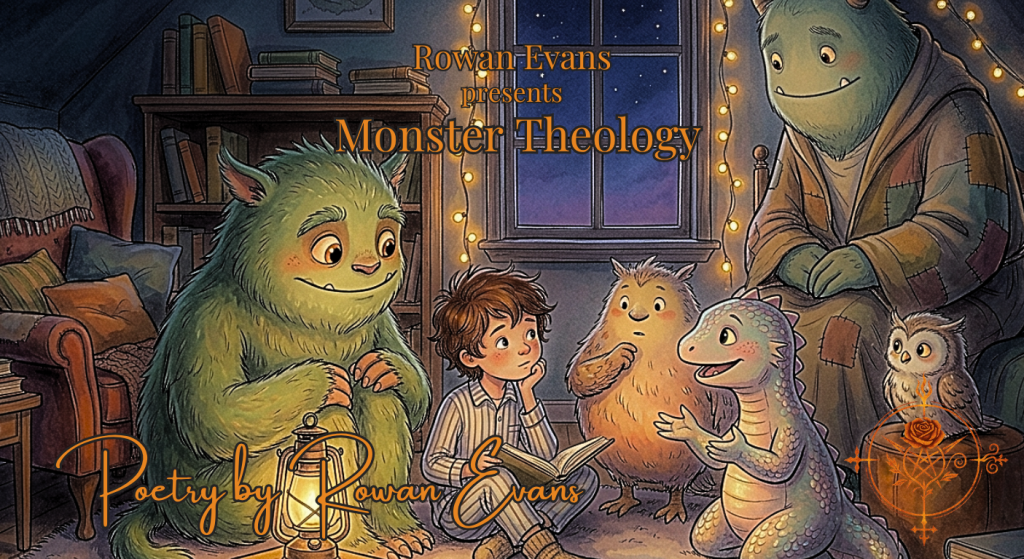
Monster Theology
Poetry by Rowan Evans
I’ve made friends
with the monsters—
in my closet,
and under the bed.
They used to scare me,
but I realized
I wasn’t judging them
fairly.
These monsters
have feelings,
children and lives
outside of my room.
I’m not the only one
they visit,
I’m not the only friend
they have.
They tell me
about the others
sometimes.
But they aren’t allowed
to talk about that a lot.
So we’ll stick to the difference
between their world and ours.
They say it’s much the same,
many lands with many peoples—
but they find our focus
on differences strange.
They don’t understand
why we fear what makes us unique.
They don’t understand
why we can’t acknowledge our strengths
without diminishing others.
To them—
monsters are monsters,
they are all the same
but not.
They celebrate
what makes them different,
the things
that make them unique.
Celebrate.
Not separate.
That’s the monster motto.
And sometimes I wish
we lived like they do—
less afraid
of what makes us different,
less eager
to turn each other
into monsters.
Journey into the Hexverse…
[Danny Phantom Theology]
What begins as a metaphor borrowed from a childhood cartoon becomes something deeper: a reflection on existing between survival and possibility, exhaustion and hope, the life we have and the life we long for. Danny Phantom Theology explores what it means to keep moving toward a future that feels worth living.
[Lone Wolf Theology]
A philosophical pop-culture poem exploring freedom, identity, and self-authorship through the lens of superheroes, antiheroes, mythic archetypes, and personal rebellion. A declaration of autonomy in a world determined to write your story for you.
If you’re interested in more poetry, you can find it here → [The Library of Ashes]

