Tag: Social Commentary

  • Author’s Note

    I’ve always thought it was strange that monsters get such bad press.

    Most of them never asked to be monsters in the first place.

    They’re usually just the things we’re afraid of. The things we don’t understand. The things we refuse to look at directly.

    What would happen if I stopped fearing the monsters under the bed and actually talked to them?

    The answer surprised me.

    Because once the conversation began, the monsters behaving like monsters.

    They became neighbors.

    Parents.

    Friends.

    People with lives beyond the role they had been assigned in my imagination.

    And that’s where the poem’s real interest emerged.

    Not in monsters themselves, but in the human tendency to create them.

    We have a habit of turning difference into danger.

    A habit of mistaking unfamiliarity for threat.

    A habit of reducing people to a single trait, label, identity, or assumption until they become something easier to fear than understand.

    The monsters in this poem don’t seem to share that habit.

    They celebrate what makes them unique.

    They recognize difference without treating it as division.

    They understand something many of us spend our lives trying to learn:

    There is a difference between being different and being separate.

    That’s where the title comes from.

    Theology is simply the study of what we believe.

    And Monster Theology asks a simple question:

    What if the monsters were better at being human than we are?

    Maybe the real lesson isn’t learning how to defeat monsters.

    Maybe it’s learning how to stop creating them.

    Rowan Evans


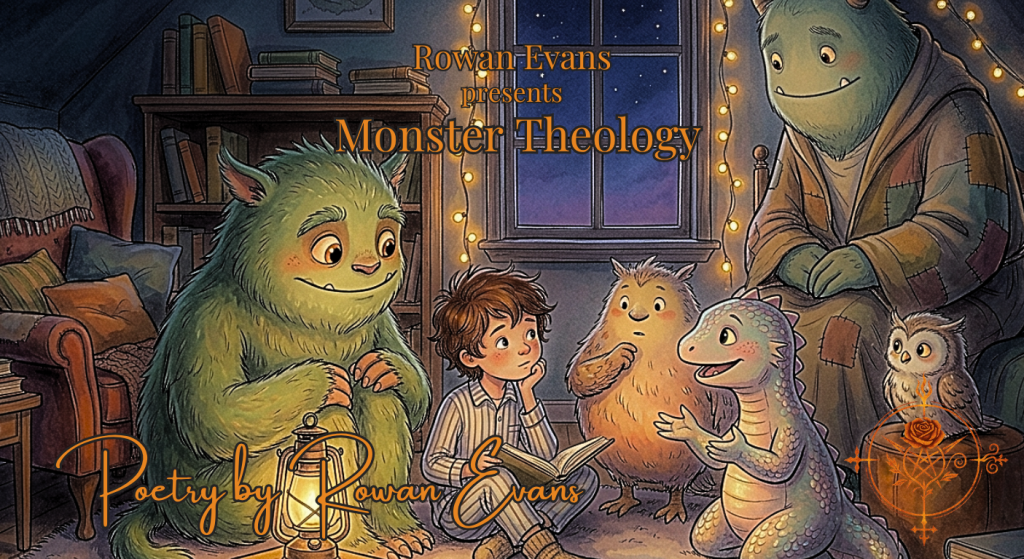
    A child sits peacefully with a group of friendly monsters in a softly lit bedroom, symbolizing understanding and acceptance across differences.
    “Maybe the real lesson isn’t learning how to defeat monsters. Maybe it’s learning how to stop creating them.”

    Monster Theology
    Poetry by Rowan Evans

    I’ve made friends
    with the monsters—
    in my closet,
    and under the bed.

    They used to scare me,
    but I realized
    I wasn’t judging them
    fairly.

    These monsters
    have feelings,
    children and lives
    outside of my room.

    I’m not the only one
    they visit,
    I’m not the only friend
    they have.

    They tell me
    about the others
    sometimes.

    But they aren’t allowed
    to talk about that a lot.

    So we’ll stick to the difference
    between their world and ours.

    They say it’s much the same,
    many lands with many peoples—
    but they find our focus
    on differences strange.

    They don’t understand
    why we fear what makes us unique.
    They don’t understand
    why we can’t acknowledge our strengths
    without diminishing others.

    To them—
    monsters are monsters,
    they are all the same
    but not.

    They celebrate
    what makes them different,
    the things
    that make them unique.

    Celebrate.
    Not separate.

    That’s the monster motto.

    And sometimes I wish
    we lived like they do—

    less afraid
    of what makes us different,

    less eager
    to turn each other
    into monsters.


    Journey into the Hexverse…

    [Danny Phantom Theology]
    What begins as a metaphor borrowed from a childhood cartoon becomes something deeper: a reflection on existing between survival and possibility, exhaustion and hope, the life we have and the life we long for. Danny Phantom Theology explores what it means to keep moving toward a future that feels worth living.

    [Lone Wolf Theology]
    A philosophical pop-culture poem exploring freedom, identity, and self-authorship through the lens of superheroes, antiheroes, mythic archetypes, and personal rebellion. A declaration of autonomy in a world determined to write your story for you.

    If you’re interested in more poetry, you can find it here → [The Library of Ashes]
  • Author’s Note

    This piece isn’t anti-anyone. It isn’t even anti-country.

    It’s about perspective.

    Growing up inside any system makes it easy to believe that your experience is the default setting for the world. But no nation is immune to propaganda, and no culture holds a monopoly on truth.

    Not the Default is a reminder — to myself as much as anyone else — to question comfortably inherited narratives, to look beyond borders, and to understand that expanding your worldview isn’t betrayal… it’s growth.

    Rowan Evans


    A cracked globe in dark space with glowing artificial border lines across its surface.
    “The border isn’t the edge of the world — just the edge of your comfort.”

    Not the Default
    Poetry by Rowan Evans

    Oh, you sound
    so surprised—
    like you think
    our government
    never lies.

    Like propaganda
    is a foreign concept,
    something they do
    but never us.
    But what do you
    know of China, bruh?

    I’m not trying
    to shatter
    your mind.

    I’m just saying—
    expand
    your world view.
    Look beyond
    the borders.

    See that your life
    is not
    the default.
    Things are different
    all across
    the globe.

    But the sad truth is—
    some of us
    were taught
    to never question
    our own.

    The border isn’t the edge
    of the world—
    just the edge
    of your comfort.


    If you’re interested in more poetry, you can find it here → [The Library of Ashes]
  • Author’s Note

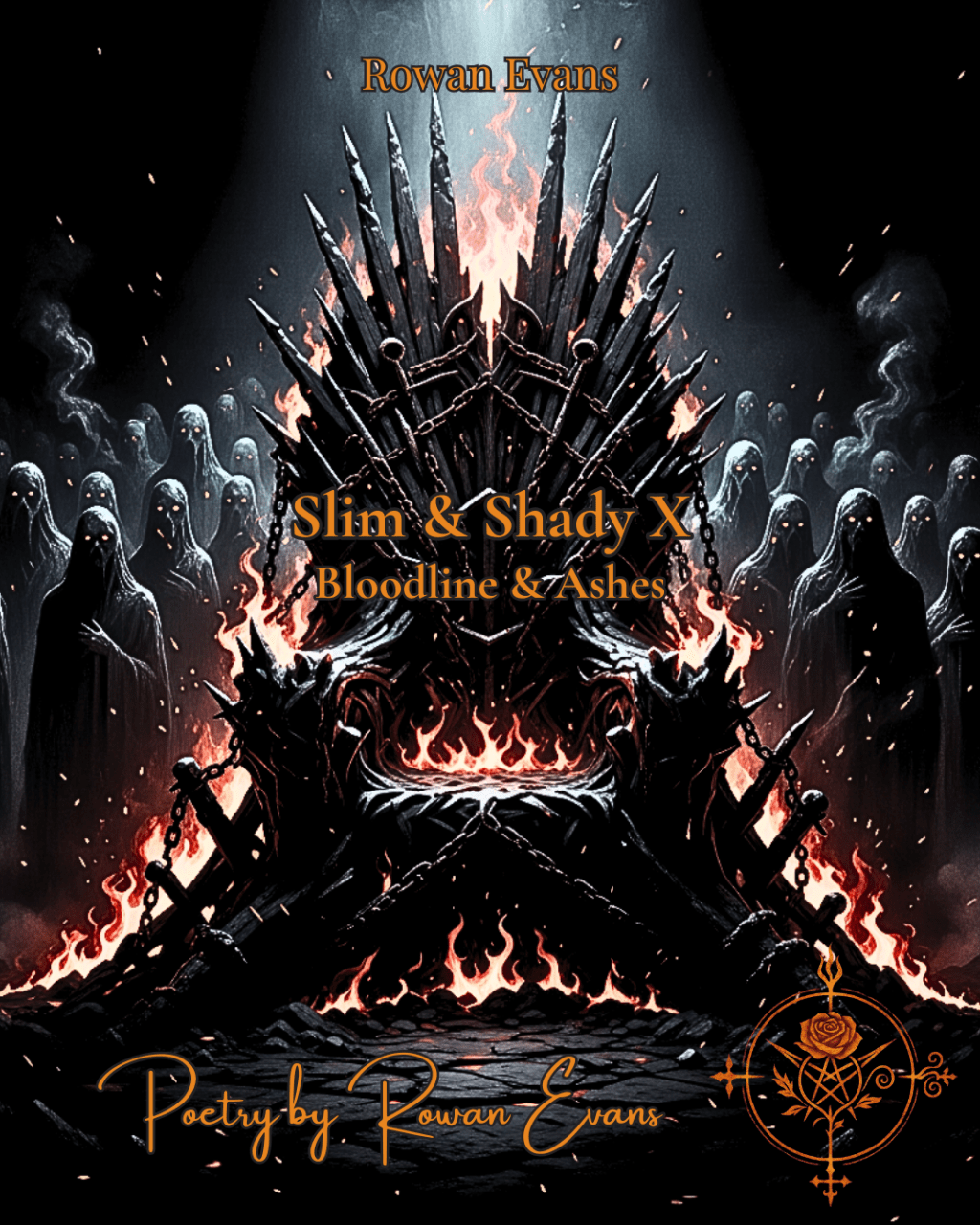
    This piece is born from anger, from frustration, and from the long ache of being rootless in a nation that demands assimilation while erasing everything else. Bloodline & Ashes is me tearing through the lies of “American culture,” the sanitized history fed to us, and the violence hidden behind flags and fireworks. It’s a reclamation of voice—for the erased, the silenced, the forgotten. Every line is a hammer, every rhyme a torch, and every syllable a refusal to kneel to hollow traditions. This is not just poetry; it’s bloodline and fire, forged into truth.


    A fiery throne of ashes with ghostly silhouettes, symbolizing erased ancestors and reclaimed bloodline.
    “From ashes and silence, a voice rises—bloodline reclaimed, truth ignited.”

    Slim & Shady X: Bloodline & Ashes
    Poetry by Rowan Evans

    Man, they say—“Remember where you came from,”
    I say, fuck that, I’m diggin’ through the marrow, the numb.
    Books lied, TV lied, history sanitized,
    Whitewashed heroes built on bodies they despised.

    America? That’s a facade, a plastic masquerade,
    Freedom sold in chains, in wars we never played.
    Your culture’s fast food, fireworks over graves,
    Pride wrapped in guns, in lies your teachers praise.

    I spit venom in the mirror of your “melting pot,”
    I see ghosts of ancestors, their stories forgot.
    Candles in temples, voices carried on air,
    I got the silence of a nation that don’t care.

    White skin ain’t a story, it’s a cage with bars,
    I’m built from forgotten names, the ghosts in the scars.
    You think pigment defines me? Nah, I redefine,
    Every vein a library, every heartbeat a shrine.

    You celebrate Columbus, I mourn what he stole,
    You cheer for your heroes, I spit for the soul.
    Every “freedom” you flaunt is stolen from the meek,
    Every star on your flag hides the blood on the street.

    I’m the rootless kid, pilgrim in my own skin,
    I walk through the fire where your “culture” begins.
    I craft rituals from rage, rewrite your fables,
    I’m the voice of the erased, the shadow in the tables.

    Slavery, genocide, erasure, repeat,
    Your “history” a lie, a sanitized deceit.
    I spit for the stolen, the silenced, the erased,
    I raise my fist for the lost, in fury and grace.

    I don’t kneel to your holidays, your hollow cheers,
    I spit for the ancestors erased by the years.
    I build my own temples from ashes and bones,
    Every verse a hammer, every bar a throne.

    I refuse your melting pot, your consumerist lies,
    I see through the glitter, the flags, the disguise.
    I am fire in the cold, blood in the concrete,
    I am truth in a land built on deceit.

    White? I am more, I am lineage unknown,
    I am the scream of the rootless, the fury I own.
    You sold me nothing but chains and confusion,
    I craft culture from silence, from anger, illusion.

    I spit internal rhymes, half-time, full rage,
    Every syllable a weapon, every line a cage.
    I spit fast as Ez Mil, raw as Shady at dawn,
    I tear down your monuments while the people yawn.

    Your “heroes” were villains, your history a crime,
    I flip every narrative, one bar at a time.
    I spit for the rootless, the unclaimed, the unseen,
    I am the bloodline reborn, the rage in between.

    I write my own epics, my own sacred lore,
    From the ashes of silence, from the pain I bore.
    I build from the ruins, I craft my own rite,
    I am the rootless, the forgotten, the light.

    I don’t need your holidays, your parades, your fake praise,
    I spit in your face, I set the silence ablaze.
    I am blood, I am bone, I am fire and steel,
    I am the storm in the calm, the wound that will heal.

    Every bar a confession, every line a war cry,
    I carry the ancestors you left to die.
    I spit for the voiceless, the erased, the unclaimed,
    I am the culture reborn, untamed, unashamed.

    I am history they forgot, I am blood they denied,
    I am the rootless rage, the truth they can’t hide.
    I am beyond skin, beyond the lies you tell,
    I am my own damn culture—and I wear it well.


    If you are interested in reading the whole series, find it here: The Slim & Shady Series

    And if you just want to read more of my work, you can find that here: The Library of Ashes

  • Author’s Note

    This interlude is my confession of emptiness, of drifting through life with no roots, no cultural anchors, no lineage I can touch. It’s the internal echo of being “other” in a country that claims a melting pot but rewards conformity and erases difference. Each rapid-fire stanza is a pulse of longing, a beat of loss, a declaration that I am searching—not just for my past, but for a way to build my own culture from the silence I inherited. It’s brief, raw, and unflinching: a snapshot of being unmoored, yet unwilling to stay lost.


    A lone figure in a barren landscape with fading roots, symbolizing lost heritage and cultural disconnection.
    “Drifting through life without roots—lost heritage, forgotten culture, silent echoes.”

    Slim & Shady: Culture Forgotten, Heritage Lost
    Poetry by Rowan Evans

    I’m a ghost in my own skin,
    no map, no hymn, no origin.
    A melting pot? More like a black hole—
    it swallowed my roots, left me a wandering soul.

    I look in the mirror, see pale as a blank page,
    but the story’s been stolen, erased by the age.
    No language, no song, no ancestral sign—
    just fast food and flags where my bloodline should shine.

    I drift through your holidays, hollow and cold,
    watching borrowed rituals, stories retold.
    Everyone’s got a temple, a river, a shrine—
    I’ve got silence, a hunger I can’t define.

    White skin’s not heritage, it’s a curtain, a disguise,
    a passport to comfort, but a cage for my eyes.
    I’m rootless, restless, scratching at the clay—
    looking for ancestors that time threw away.

    I craft new rituals from rage, from ash, from ache,
    I spit verses like prayers that my blood couldn’t make.
    Every line is a shovel, every rhyme a seed—
    I’m planting my own culture from the hunger, the need.

    Call me lost, call me rootless, call me unnamed—
    but I’ll rise from this void, unshamed, unclaimed.
    I’ll build my own lineage, verse by verse,
    a culture reborn from the ache, not the curse.


    If you are interested in reading the whole series, find it here: The Slim & Shady Series

    And if you just want to read more of my work, you can find that here: The Library of Ashes

  • Author’s Note

    Prayer, at its heart, is sacred. It can heal, comfort, and connect. But when prayer becomes a substitute for action—when it is the only thing offered in the face of preventable tragedy—it curdles into something hollow. Words without movement are not faith; they are excuses.

    Confetti Over Graves was written in anger at the endless cycle of platitudes—those quick gestures of “thoughts and prayers” tossed like scraps to the grieving, while nothing changes, while the same wounds reopen again and again. This is not an attack on prayer itself, but on the apathy disguised as piety, on the cowardice of leaders who offer sympathy in place of responsibility.

    If compassion never moves beyond the lips, if love never reaches the hands,
    then what are these words but glitter tossed over graves?
    A hollow gesture for those who can no longer notice.


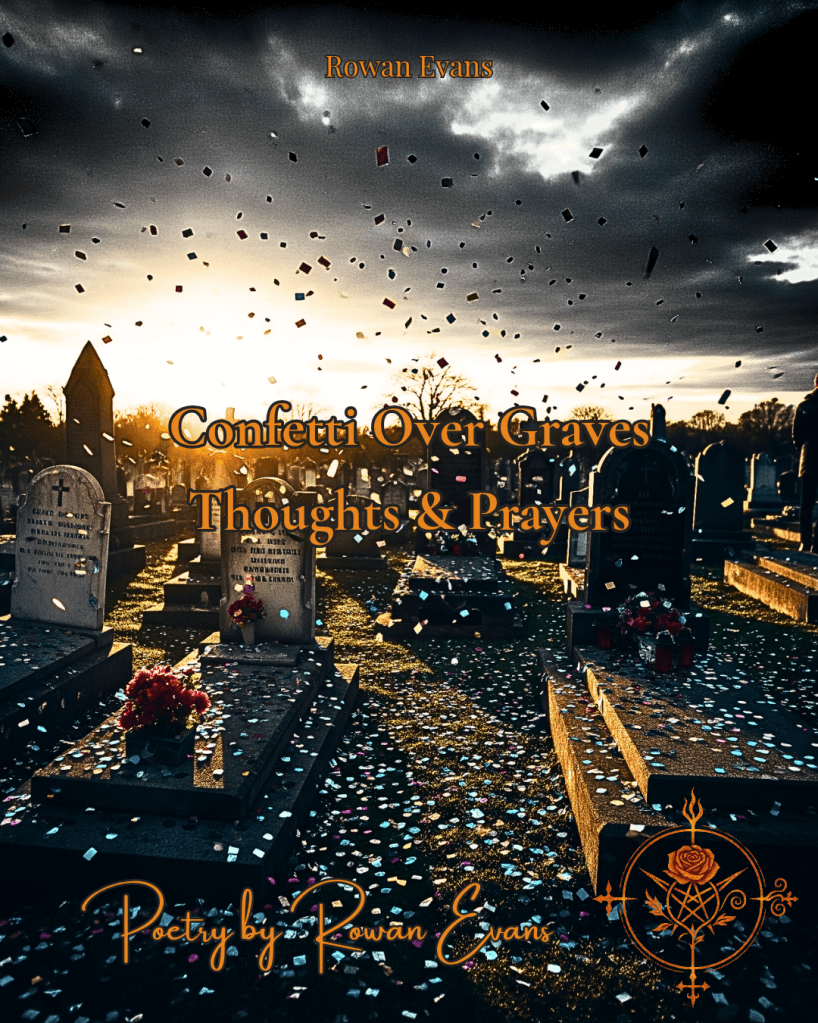
    Confetti drifting over gravestones in a dark, stormy cemetery, representing empty gestures of sympathy.
    Even the brightest words mean little when action fails to follow.

    Confetti Over Graves
    (Thoughts & Prayers)
    Poetry By Rowan Evans

    In the silence after the storm, they speak— 
    Whispers like dust in the hollowed air, 
    “Thoughts and prayers,” they murmur, 
    As if those words could sew the wounds shut, 
    As if they could rebuild what has crumbled.

    But the world bleeds, and their empty phrases 
    Fall like ash from a dying flame, 
    No spark to ignite change, no fuel for the fire, 
    Just the cold echo of apathy disguised 
    As concern, wrapped in hollow promises.

    “Thoughts and prayers,” they chant, 
    A chorus of silence, loud and hollow, 
    As the world screams beneath their indifference. 
    What good are these words that fall from their lips, 
    When no hands are raised, no action follows? 

    They toss these phrases like confetti over graves, 
    Hope that the dead won’t notice 
    How little they mean, how meaningless they are. 
    Thoughts are fleeting, prayers are whispers 
    Carried away by the wind, lost in the void. 

    Yet the pain remains, rooted deep, 
    The tragedies continue to unfold, 
    And their words are no balm, no salve, 
    Just the sound of a door closed 
    On a house already burning. 

    If you have nothing but air to offer, 
    Best to keep your mouth shut, 
    For silence is kinder than the lie 
    That “thoughts and prayers” will heal 
    The wounds they pretend not to see. 

    The world waits for more than hollow phrases, 
    For more than a heart too heavy to act. 
    So keep your words if they are empty, 
    For the dead can no longer hear you, 
    And the living are tired of listening.


    Closing Note

    These words are not against prayer or hope, but against inaction cloaked as concern. Let them remind us that care requires more than whispers—it demands presence, effort, and courage.


    If you would like to explore more of the Hexverse, you can find more of my work as my various personas in The Library of Ashes.