Author’s Note
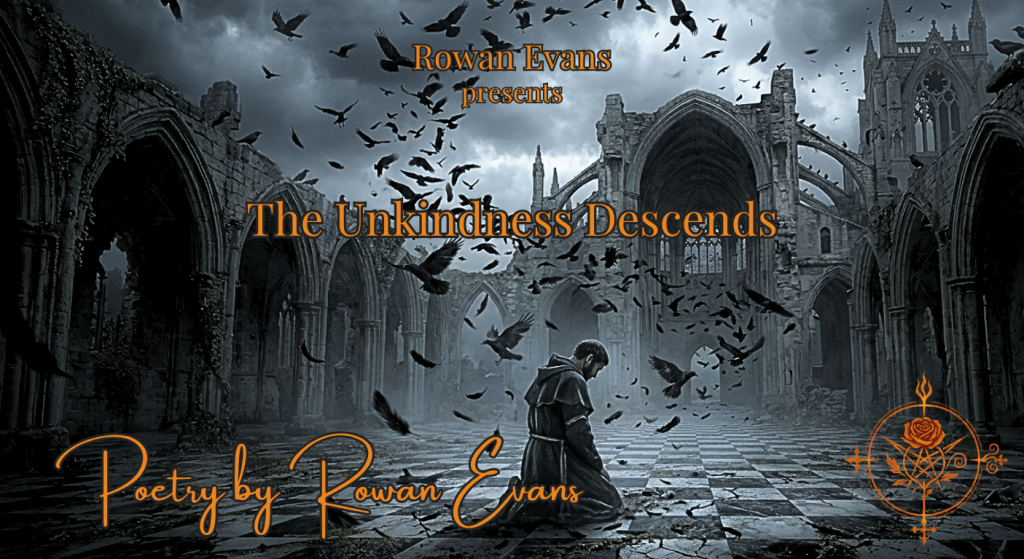
This piece began with a single image:
a person kneeling on broken marble while ravens circled overhead.
From there, the symbolism unfolded naturally.
Ravens have carried countless meanings across cultures and mythologies throughout history. Omens. Messengers. Witnesses. Archivists of the dead. Harbingers of transformation. Keepers of memory. In some traditions they are feared. In others, revered.
I didn’t want to narrow them down to one interpretation here.
What interested me more was the tension between collapse and observation—the feeling of being seen during moments of unraveling, and the uncertainty of whether those watching forces are condemning you, mourning you, studying you, guiding you, or simply recording what happened.
That’s why the poem never fully explains the ravens.
Even the collective noun “unkindness” became important to me while writing. It carries two meanings at once: a literal group of ravens, and the emotional atmosphere surrounding the speaker. The word itself becomes part of the tension.
By the end of the piece, the ravens remain unresolved intentionally.
They part. They watch. They follow.
Whether that final image feels threatening, protective, spiritual, psychological, or transformative depends almost entirely on how the reader chooses to see them.
And I think that uncertainty is the point.
— Rowan Evans
The Unkindness Descends
Poetry by Rowan Evans
I kneel on broken marble,
the unkindness circling overhead.
Ravens watching as I come undone.
Witnesses to my fall,
the ravens land—
one by one,
the unkindness descends
upon me.
I am lost in the black mass—
wing and feather flapping
as ravens move to circle me.
My eyes scanned the ravens
as they surrounded me,
each uttered something—
a word, a message.
Perhaps, it was a lesson?
Maybe I read it all wrong,
and they were just keeping record—
witnesses to my collapse.
I rose to my feet.
The ravens watched me.
I moved.
They parted
like the Red Sea.
Each step forward,
their eyes traced my path.
As I moved through,
they closed in behind me.
Following.
Journey into the Hexverse…
[I Write Cathedrals]
“I Write Cathedrals” explores faith, doubt, belonging, and the search for meaning beyond certainty. Through Gothic spiritual imagery and confessional reflection, the poem examines how writing can become a sacred space for questioning, wonder, and the people who feel displaced by traditional structures of belief.
[Drought Resistant]
“Drought Resistant” is a confessional poem about growing up poor in California’s Central Valley—where triple-digit heat, EBT cycles, dry ramen, and hard landscapes become part of emotional memory. Blending humor, slang, and working-class reflection, the poem explores survival, regional identity, and complicated love for the place that shaped you.
[Escaped to the Page]
“Escaped to the Page” is a confessional meta-poem about individuality, artistic identity, and surviving through writing. Blending sharp confidence with emotional vulnerability, the poem explores the difference between shared labels and lived experience—and the ways art becomes inseparable from the life behind it.
[Ink as a Second Mouth]
“Ink as a Second Mouth” explores the distance between thought and speech, and the ways writing can become a form of survival, continuity, and self-translation. Through confessional imagery and reflections on growth, identity, and articulation, the poem examines what it means to keep becoming through language.
If you’re interested in more poetry, you can find it here → [The Library of Ashes]

