Some thoughts don’t arrive quietly. They repeat, build momentum, and turn themselves into a soundtrack you never asked to hear.
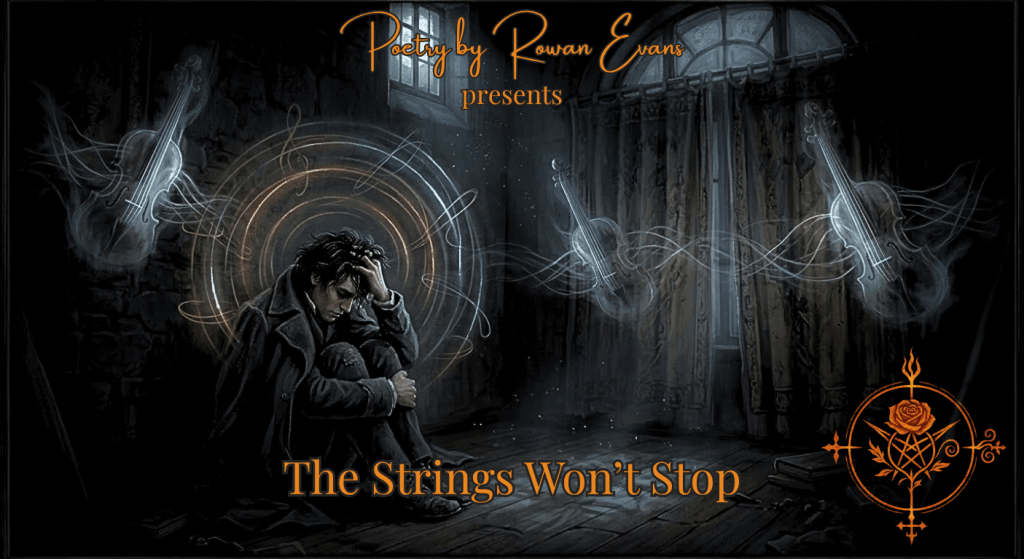
The Strings Won’t Stop takes that experience and gives it a physical sound: violins playing somewhere inside an empty room, each note feeding the fear and keeping the loop alive. The speaker isn’t asking for a beautiful song—they’re asking for silence, for one interruption in the pattern, one change in tempo that might finally give the mind somewhere else to go.
Sometimes the hardest part isn’t finding the words.
It’s getting the strings to stop playing them.
— Rowan Evans
Sometimes the mind doesn’t need another song. It needs the strings to stop.
The Strings Won’t Stop Poetry by Rowan Evans
I sit in an empty room,
listening to the haunting cry
of violins—
I’m just longing
for silence—
but the strings
sing for me—
they sing a song
I don’t want to hear,
it amplifies the fear—
it makes me wonder,
what am I doing here?
But they don’t stop—
the strings sing
and they watch—
I sit in the corner,
and I rock—
back and forth,
listening for the chorus,
or something to break
the loop—
a tempo switch,
a cadence change—
something,
anything
to rearrange
the thoughts in my brain.
Journey into the Hexverse
[A Person First] A poem about the difference between loving a woman and loving the role someone expects her to play—because partnership requires respect, autonomy, and room to remain a person first.
[Half a Picture] What happens when someone falls in love with the person they discover through your poetry? Half a Picture explores the strange intimacy between writer and reader—and the distance between seeing someone’s mind through their words and truly knowing the whole person.
[If You Want to Go] When conversations become nothing more than repeated excuses, sometimes the only answer left is to stop pretending. A raw, direct poem about emotional exhaustion, frustration, and the difficult freedom of letting someone walk away.
And then there are poems that quietly reach through the page and take hold of something you thought belonged entirely to you.
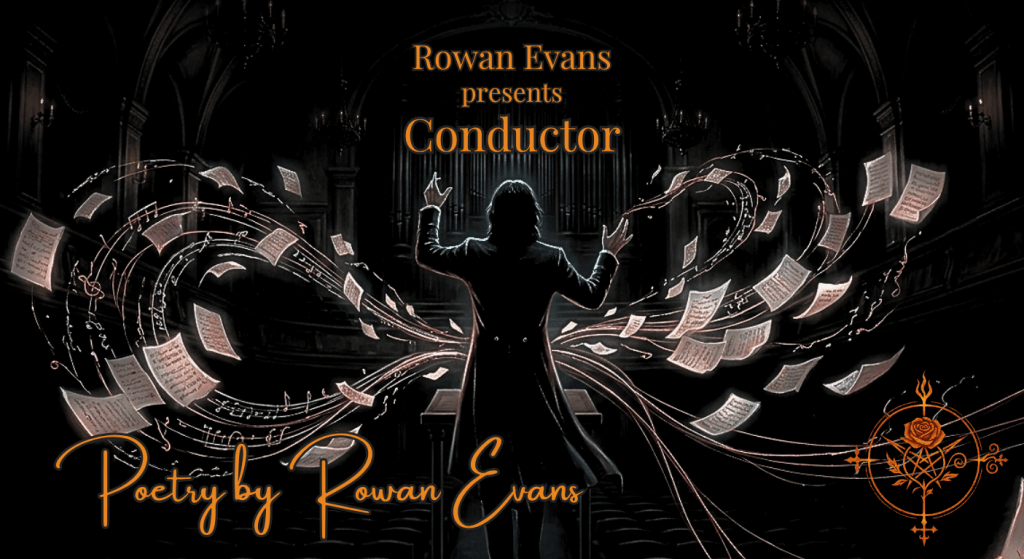
Conductor comes from that space—the strange little boundary between writer and reader, where words stop being marks on a page and start becoming something physical.
I wanted to play with that boundary.
So take a breath before you begin.
Then read.
— Rowan Evans
Some conductors lead an orchestra. Others conduct the breath between the lines.
Conductor Poetry by Rowan Evans
I’m a conductor—
watch me
control your breath.
Won’t even
be in the room—
you just have
to read the words
that I’ve left—
you can feel
my influence
in your chest—
I confess—
you breathe the way I tell you to,
this is what I will do—I will extend the lines,
implement some rhymes—show you,
that your breath is not your own,
it is mine to control—
Journey into the Hexverse…
[The Crypt] A mysterious man watches from a crypt as a woman enters the graveyard and kneels before an unnamed grave. In this compact gothic poem, fascination, death, and possession blur together beneath the shadows of the cemetery.
[Dreaming Wrong] A familiar dream becomes unsettling when the ocean becomes a pond, the tide disappears, the moon loses its reflection, and nothing feels quite like it belongs. Dreaming Wrong explores the uncanny feeling of finding yourself inside a dream that looks familiar—but feels like someone else’s.
[Did You Really Think This Was About Trees?] A playful love poem disguised as a forest of terrible tree puns. Beneath the birch, oak, cedar, palms, lumber, and absurdist wordplay is a poem about devotion, loyalty, laughter, and building a life with someone you love.
Some poems feel less like they’re written and more like they’re discovered.
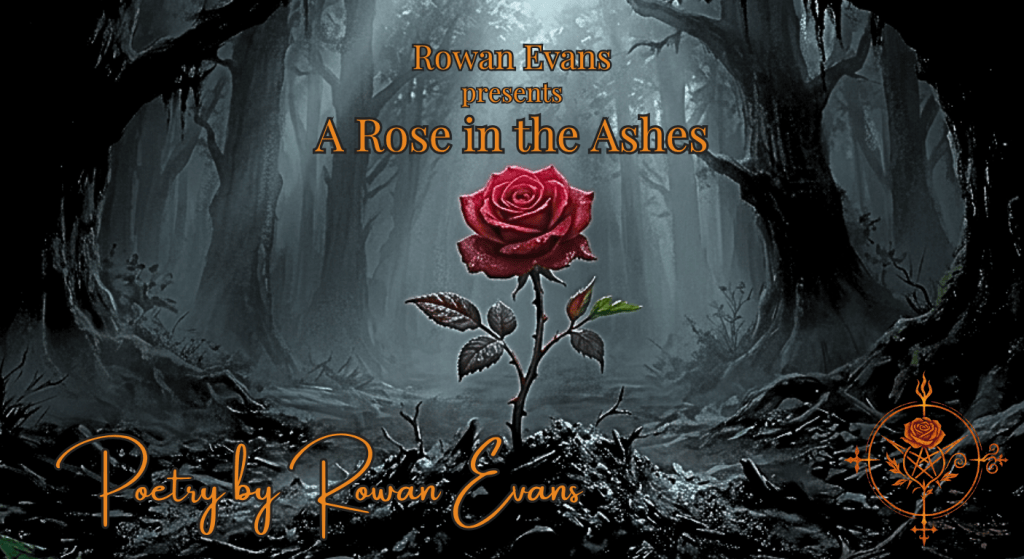
A Rose in the Ashes came from following an image rather than an outline. One symbol led to another until the poem became a journey through memory itself—through forgotten moments, lingering wounds, recurring dreams, and the quiet realization that healing doesn’t happen by avoiding the past.
The forest in this poem isn’t meant to be a literal place. It’s the landscape of memory, where some experiences remain vivid while others decay with time. The trees, the tunnel, the moon, the bay, and finally the rose all became landmarks within that emotional terrain.
The final image—a single rose blooming through ashes—reminded me that even after devastation, beauty doesn’t disappear forever. Sometimes it simply waits beneath the surface until we’re ready to notice it.
— Rowan Evans
Sometimes healing doesn’t appear as a blazing light at the end of the tunnel.
Sometimes it’s a single rose, quietly blooming where you thought only ashes remained.
A Rose in the Ashes Poetry by Rowan Evans
I wander through the mist and fog,
wondering if I’ve gotten myself lost.
The trees are thick with sickly green leaves,
and the air is too thick, it’s hard to breathe.
Every step feels borrowed,
like the ground isn’t sure
it wants to hold me.
It’s like with every step
the ground shifts a little to the left,
until nothing feels right.
It’s like I’ve walked
to the end of the tunnel,
but I didn’t find the light.
I keep walking, stumbling along—
the dark swallows me whole
and then spits me out.
I hit the ground and roll to a stop
on the edge of a fifty foot drop.
That’s when I see it,
something moving between the trees—
not a creature,
but a feeling—
the sense that I’m being asked
to keep going
even when I don’t know why.
Maybe it’s because
I didn’t find the light
at the end of the tunnel,
not because I failed—
but because the journey isn’t done.
The light signifies the end.
No light means the journey continues,
so I keep moving through—
the streets that I walk in sleep,
the moment I return to my bones,
or a war with gods to ease the pain.
Yeah, I followed the footprints
to the water’s edge,
I stared across at the coast
on the other side of silence.
And even from a distance,
I was able to trace
the moon across the heavens,
before it became suspended over the bay—
its reflection trembling across the dark water,
a mirror to the tremor in my chest.
But I couldn’t stay still for long—
I had to keep moving on.
So I ran—
bolted for the tree line,
tripped and stumbled in
and my eyes caught the way the light
pierced the canopy—
the light—
that’s what I’d been chasing
this whole time,
not at the end of the tunnel—
but above my head,
an idea—
my eyes drift toward the sky,
and that’s when I see—
the leaves on these trees
are not leaves,
they are memories—
some bright and vivid,
others a sickly shade of green.
Those are memories forgot,
memories left to rot.
But here’s the truth of this plot:
some memories fade—
whether you hold on or not,
and some become rooted
through pain, an environment
permanently changed.
And that’s what I saw…
trees with leaves
showing things—
I thought long forgotten.
I was more surprised by that,
than the fact that so many trees
looked rotten.
I could feel the tears
touch the corners of my eyes—
the air was thick again,
humid and suffocating.
There was a tremor in my chest,
and knees were weak—
with every step my bones were quaking,
like the earth was shaking.
I stumbled and fell to my knees,
head bowed—
in shame or respect,
who knows, now?
I opened my mouth,
but no jokes came out—
I couldn’t misdirect from this,
no sleight of hand.
I had to face this—
whatever it is,
whatever these leaves
show me,
I’ve got to take it seriously—
because maybe it is these memories
that are keeping me stuck here.
Maybe they are the memories
that drive the fear,
that keeps me from acting—
that keeps me dragging feet
and self-sabotaging.
Slowly I rise—
like the sun over the horizon.
Knees shaking from the weight of me,
I struggle to take one step
and then another.
I stumble through the ruins
of thoughts, dreams and memories—
my chest rises and falls,
like oxygen is in short supply.
Then I see it—
a single rose in bloom,
poking through the ashes
of nights only remembered
in the spilled ink on silent pages.
Journey into the Hexverse…
[One Honest Sentence] It’s easy to write about anything. What’s difficult is writing one completely honest sentence without hiding behind humor, references, or metaphor. One Honest Sentence explores the distance between poetic confidence and emotional vulnerability.
[Leave No Self Behind] What if finding yourself isn’t about discovering someone new, but learning to walk beside every version you’ve ever been? “Leave No Self Behind” is a meditation on memory, healing, and embracing the selves we once abandoned.
[More Afraid Than the Ink] Some confessions are easy to write but impossible to speak. More Afraid Than the Ink explores fear, dreams, recurring symbols, and the quiet realization that the page has always been braver than the poet.
[Just Human] Just Human is a reflective free verse poem about seeing people before borders, choosing empathy over division, and finding home in our shared humanity rather than on a map.
[Translating What I Feel] A poem about the invisible process of turning emotion into imagery, imagery into language, and language into poetry. An intimate reflection on creativity, loneliness, and twenty-three years of learning to translate what the heart feels.
At this point, it’s probably one of the most consistent threads running through my work.
The reason is simple:
Dreams don’t feel imaginary to me.
They feel remembered.
Not while I’m fully awake. Not after I’ve had time to process them. But in those first moments between sleeping and waking, there’s often a strange overlap where the emotions arrive before reality does.
For a brief moment, everything feels true.
The conversation happened. The place existed. The person was there.
Then awareness returns.
The room comes back. The walls come back. The weight of the body comes back.
And with it comes the realization that none of it happened.
That’s the feeling this poem is trying to capture.
Not the dream itself, but the return from it.
The title became the key.
Because waking up doesn’t feel like opening my eyes.
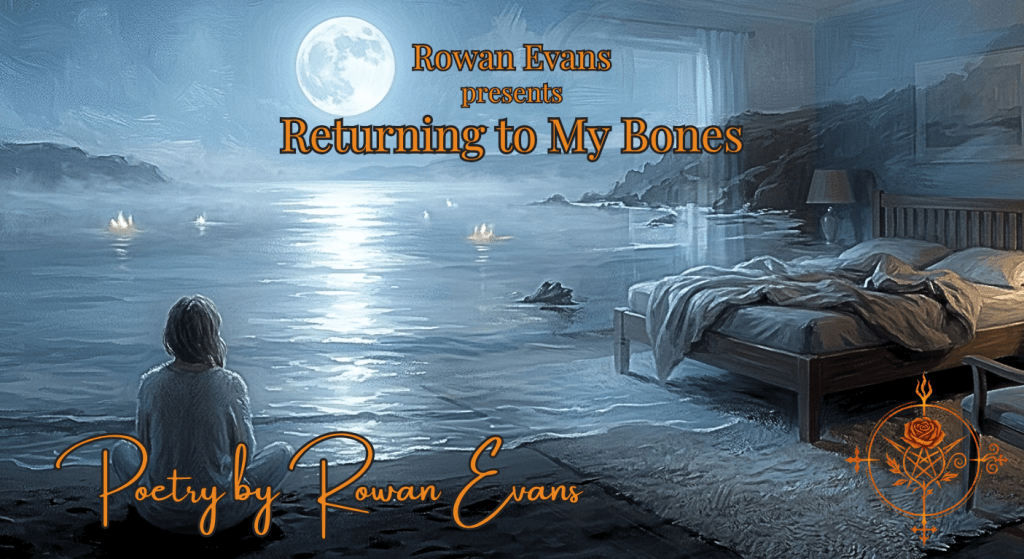
It feels like returning to my bones.
Returning to gravity. Returning to limitation. Returning to the version of reality that can be touched and verified.
The strange thing is that the emotions don’t disappear when the dream does.
The dream fades.
The feelings stay.
And sometimes that lingering feeling creates a kind of grief that is difficult to explain to people who don’t experience dreams this way.
A quiet grief.
Not because something real was lost.
But because, for a moment, it felt real enough to matter.
— Rowan Evans
Some dreams disappear with the sunrise. Others stay with us long after we’ve returned to our bones.
Returning to My Bones Poetry by Rowan Evans
The moon shimmers over the bay,
suspended in the sky—
the way I feel suspended in her eyes.
And it makes me feel crazy,
because she’s never looked at me—
not really, not in reality.
It’s only happened in dreams.
That’s when I drift
between awake—
and asleep.
This is when
my mind
starts to
wander.
Then it snaps.
I’m back in my room again.
The moon loses its shimmer,
the bay fades from view.
My body tenses as I become
aware again,
of the mattress beneath me—
of the walls that enclose me.
I feel the weight pressing in.
The reality of returning
to my bones.
It’s a quiet grief—
realizing that the emotions
will linger,
but the truth is
it never happened.
And somehow,
that hurts the most.
Journey into the Hexverse…
[Maybe You’ll Want Me Too] A poem about the subtle shift from knowing someone to constantly thinking about them. Through humor, metaphor, and confession, Maybe You’ll Want Me Too explores affection, attachment, and the fragile hope that being wanted might matter more than being needed.
[Before My Feet Touch the Floor] What happens when your dreams feel more real than your waking life? Before My Feet Touch the Floor explores the strange grief of waking up, the lingering memory of dream selves, and the quiet question of which version of us is truly real.
[Recognizes Home] A free-verse poem exploring the difference between love as dependency and love as choice. It challenges the idea that love must be need-based, instead centering the quiet strength of choosing someone while still remaining whole on your own.
[Ocean Waves (1, 4, 3)] A moonlit shoreline, a rowboat full of ducks, a piggybank with no cents, and a confession hidden in plain sight. Ocean Waves (1, 4, 3) explores how humor, wordplay, and absurdity can become a side door to vulnerability when the truth feels too difficult to say directly.
[L Words & Heart] A playful, self-aware poem about love, longing, loyalty, and the quiet ways another person can reshape our inner world. What begins as humor slowly reveals a heartfelt confession about affection, imagination, and the faces that linger in our dreams.
[Just Before Waking] A street that feels familiar. A life that hasn’t happened yet. Just Beyond Waking explores the fragile space between dreams, memory, longing, and the quiet feeling that some futures are already waiting for us.
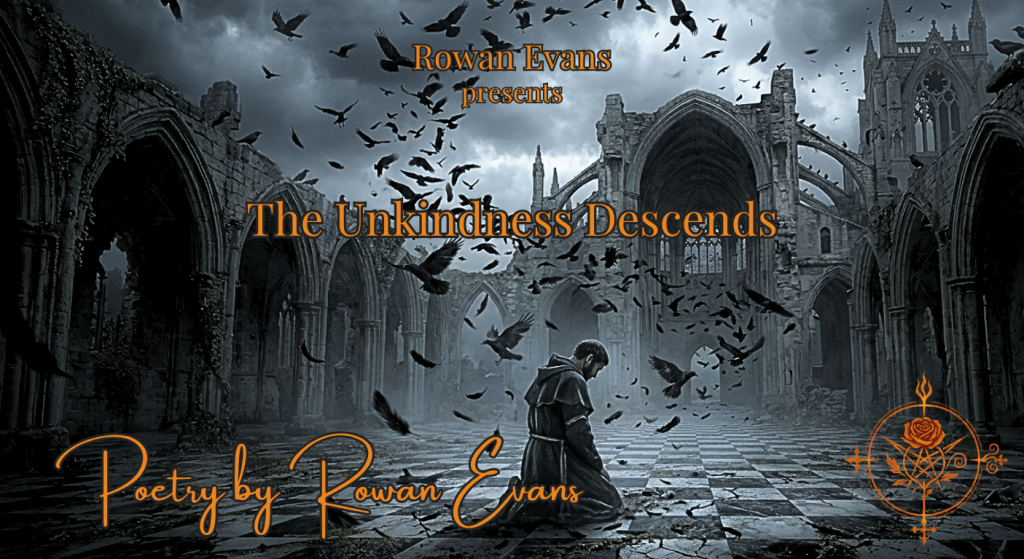
a person kneeling on broken marble while ravens circled overhead.
From there, the symbolism unfolded naturally.
Ravens have carried countless meanings across cultures and mythologies throughout history. Omens. Messengers. Witnesses. Archivists of the dead. Harbingers of transformation. Keepers of memory. In some traditions they are feared. In others, revered.
I didn’t want to narrow them down to one interpretation here.
What interested me more was the tension between collapse and observation—the feeling of being seen during moments of unraveling, and the uncertainty of whether those watching forces are condemning you, mourning you, studying you, guiding you, or simply recording what happened.
That’s why the poem never fully explains the ravens.
Even the collective noun “unkindness” became important to me while writing. It carries two meanings at once: a literal group of ravens, and the emotional atmosphere surrounding the speaker. The word itself becomes part of the tension.
By the end of the piece, the ravens remain unresolved intentionally.
They part. They watch. They follow.
Whether that final image feels threatening, protective, spiritual, psychological, or transformative depends almost entirely on how the reader chooses to see them.
And I think that uncertainty is the point.
— Rowan Evans
They descended like witnesses—whether to condemn, mourn, guide, or remember was never made clear.
The Unkindness Descends Poetry by Rowan Evans
I kneel on broken marble,
the unkindness circling overhead.
Ravens watching as I come undone.
Witnesses to my fall,
the ravens land—
one by one,
the unkindness descends
upon me.
I am lost in the black mass—
wing and feather flapping
as ravens move to circle me.
My eyes scanned the ravens
as they surrounded me,
each uttered something—
a word, a message.
Perhaps, it was a lesson?
Maybe I read it all wrong,
and they were just keeping record—
witnesses to my collapse.
I rose to my feet.
The ravens watched me.
I moved.
They parted
like the Red Sea.
Each step forward,
their eyes traced my path.
As I moved through,
they closed in behind me.
Following.
Journey into the Hexverse…
[I Write Cathedrals] “I Write Cathedrals” explores faith, doubt, belonging, and the search for meaning beyond certainty. Through Gothic spiritual imagery and confessional reflection, the poem examines how writing can become a sacred space for questioning, wonder, and the people who feel displaced by traditional structures of belief.
[Drought Resistant] “Drought Resistant” is a confessional poem about growing up poor in California’s Central Valley—where triple-digit heat, EBT cycles, dry ramen, and hard landscapes become part of emotional memory. Blending humor, slang, and working-class reflection, the poem explores survival, regional identity, and complicated love for the place that shaped you.
[Escaped to the Page] “Escaped to the Page” is a confessional meta-poem about individuality, artistic identity, and surviving through writing. Blending sharp confidence with emotional vulnerability, the poem explores the difference between shared labels and lived experience—and the ways art becomes inseparable from the life behind it.
[Ink as a Second Mouth] “Ink as a Second Mouth” explores the distance between thought and speech, and the ways writing can become a form of survival, continuity, and self-translation. Through confessional imagery and reflections on growth, identity, and articulation, the poem examines what it means to keep becoming through language.
Some people can walk into a room and never notice the atmosphere change.
I’ve never been one of them.
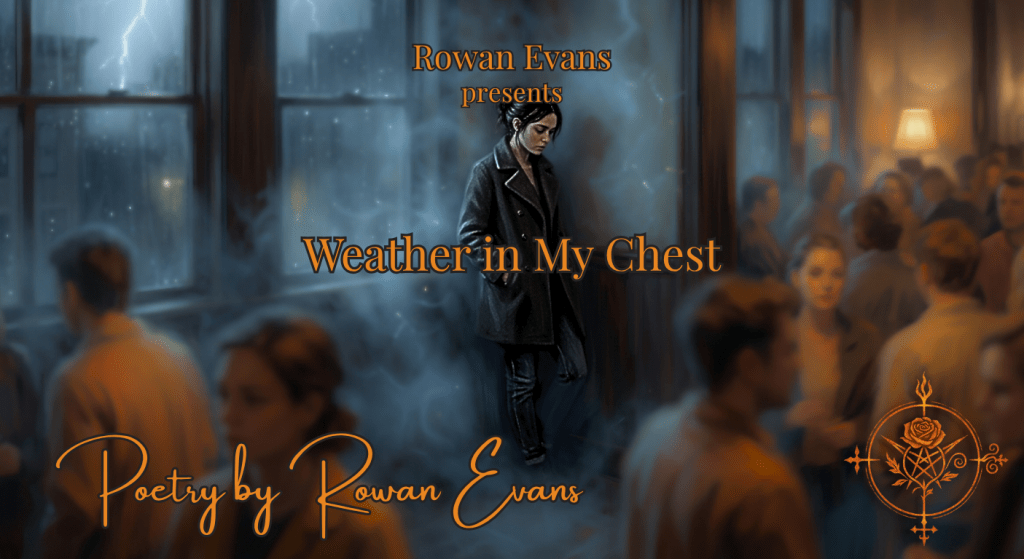
I notice tone shifts, silence, tension, body language, eye contact, emotional static—sometimes before a word is even spoken. Rooms have always felt alive to me in that way, almost like weather systems with their own pressure and temperature.
For a long time, I thought that sensitivity meant something was wrong with me.
But over time, I realized I wasn’t imagining things. I was just noticing things other people either missed or ignored.
This piece came from that feeling: walking into spaces and immediately sensing the emotional climate shift around you.
Not because you’re dangerous. Not because you want attention.
But because some people carry storms quietly, and other people instinctively react to the pressure.
The important part is this:
Not every storm is destructive.
Sometimes thunder is just thunder. Sometimes lightning never comes.
— Rowan Evans
Some people don’t bring storms into rooms—they just notice the pressure before everyone else does.
Weather in My Chest Poetry by Rowan Evans
I enter rooms and I can feel
the weather shift,
the emotion gets thick
like humidity—
and the temperature
begins to rise.
And eyes
move like clouds
across the sky
as they follow me.
Drifting toward
the horizon line,
at the edge of the room.
I can hear the whispers
rumble like thunder,
as the questions
begin to spin.
“What are they doing here?”
“Who invited them?”
I’ve learned
to stand still
in the middle of it,
let the noise
break around me
like rain on concrete.
“Why are they so quiet?”
“Are they judging us?”
They don’t know
I’m not here
to bring the storm—
I just carry weather
in my chest,
and rooms react
how they react.
I’m not the danger
they whisper about—
I’m just the one
who notices
the temperature
before anyone else does.
They don’t realize
I’ve felt this
my whole life—
rooms shifting,
eyes gathering,
like weather
drawn to heat.
I feel the pressure
drop behind me,
the way people tense
like they’re waiting—
for lightning
that never comes.
Journey into the Hexverse…
[Sound as a Vessel] “Sound as a Vessel” is a free verse poem about music as emotional architecture, exploring how international artists and soundscapes shaped identity, creativity, memory, and poetic voice.
[Just Knowing You Has Been Enough] “Just Knowing You Has Been Enough” is a deeply vulnerable free verse poem about unspoken love, emotional fear, coded confessions, and the quiet truth of caring for someone without needing perfection in return.
[The Streets I Walk When I Sleep] “The Streets I Walk When I Sleep” is a deeply intimate free verse poem about recurring dreams, emotional connection, longing across distance, and the strange feeling of remembering places and moments that have never happened in waking life.
[Memories From a Life Yet to Come] Some dreams feel less like fantasy and more like memory. “Memories From a Life Yet to Come” is a reflective free verse poem about longing, displacement, emotional alignment, and the strange comfort of recognizing yourself more clearly in dreams than in waking life
[Separate Timelines] “Separate Timelines” is a surreal and deeply introspective free verse poem about emotional distance, time zones, vulnerability, and the fear of losing a connection that already feels meaningful before the words are ever spoken aloud.
There’s a strange kind of disorientation that comes from feeling like your life should make sense… but doesn’t.
Like you missed a chapter. Or something important got cut before you ever had the chance to understand it.
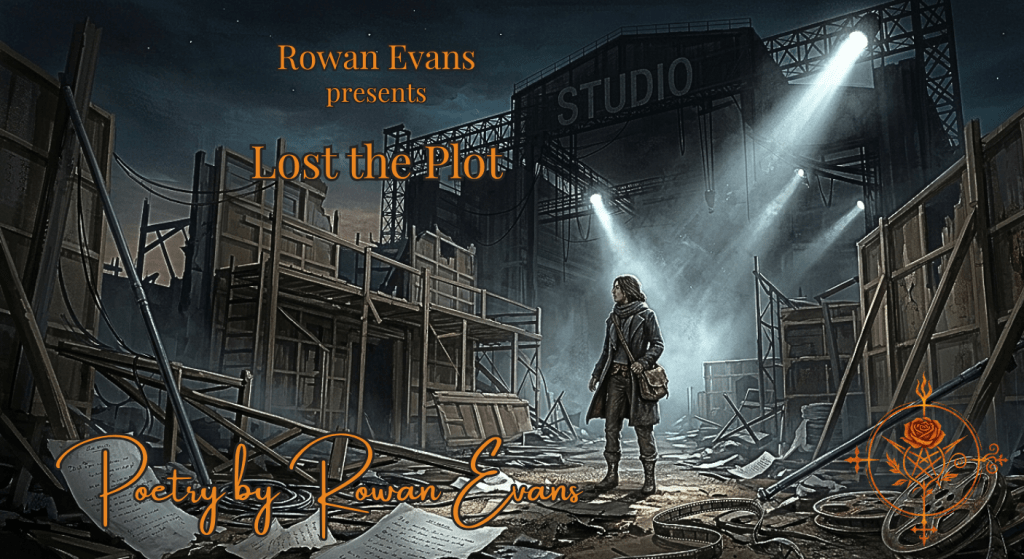
Lost the Plot leans into that feeling–but not just on a personal level. It questions what happens when the narrative itself isn’t entirely yours. When the direction shifts, not because it should… but because something behind the scenes decided it needed to.
We’re often told that confusion is internal. That if we feel lost, it’s something we need to fix within ourselves.
But what if part of that feeling comes from the story constantly being rewritten? From forces we don’t see, shaping outcomes we’re expected to accept?
This piece sits in that space–between personal disconnection and a growing awareness the “plot” might not be as natural as it seems.
Sometimes it’s not that you lost your way.
Sometimes… the story changed without you.
— Rowan Evans
What happens when the story isn’t yours anymore?
Lost the Plot Poetry by Rowan Evans
I feel like I’ve been
getting lost a lot lately.
Like I’ve forgotten
who I was,
who I am—
who I was becoming.
I’m feeling like
I’ve lost the plot,
like the studio
lost the reel
that we shot.
No longer
can I see
where I began.
We got cancelled
before we
got going.
We never saw an end.
But we weren’t
cancelled because of
interest.
We were cancelled
because the studio
got scared.
Ratings were good.
The audience cared.
But they cared too much.
It was causing
connection,
so the studio
had to change
direction.
The studio,
needs the divide—
keeps people
scared and wide-eyed.
So there’s always
someone—
to point to,
to name as the bad guy.
The boogeyman.
So we look to the stars,
as if they could solve
the problems.
As if it wasn’t
the studio—
the writer’s room
behind every decision.
It was them—
in the writer’s room,
rewriting endings
we never got to reach.
Ratings be damned.
The show goes on—
we just don’t
exist in it anymore.
Journey into the Hexverse!
[Another Fire] A powerful poem exploring global chaos, systemic inequality, and emotional exhaustion in a world where conflict grows faster than it can be understood.
Sometimes the mind doesn’t separate things as cleanly as we’d like.
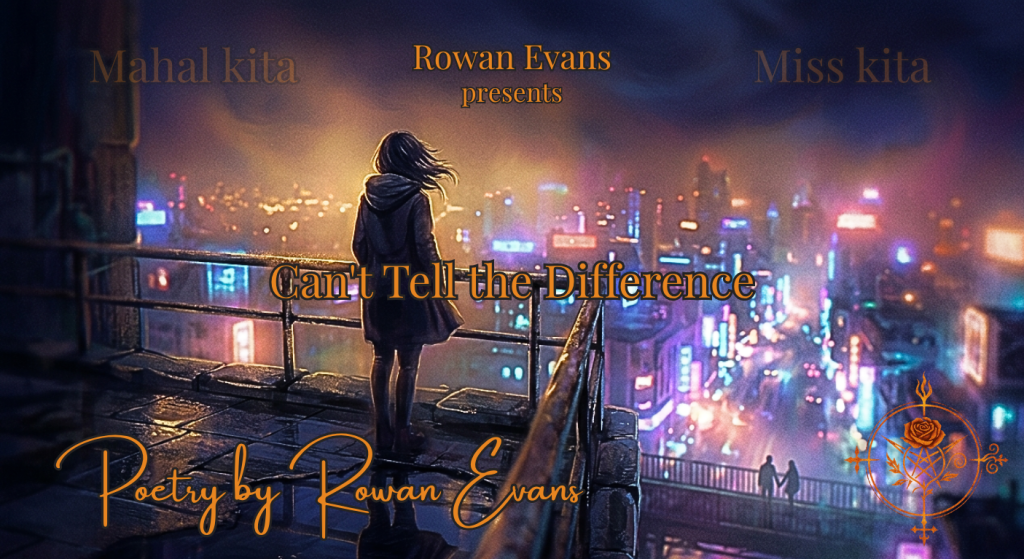
Memory, imagination, longing–they start to overlap. What you’ve felt in dreams can become just as vivid as something you’ve physically lived. And after a while, the line between the two doesn’t disappear… it just stops mattering in the same way.
Can’t Tell the Difference lives in the space.
It’s not about confusion in a chaotic sense–it’s about the quiet disorientation of something feeling real enough to hold weight, even if you prove it happened the way you remember.
Because emotion doesn’t always follow logic.
And sometimes the question isn’t “did this happen?” It’s “why did it feel like it did?”
— Rowan Evans
Where memory and dreams blur— and feeling becomes its own kind of truth.
Can’t Tell the Difference Poetry by Rowan Evans
I stand on the edge
of what’s real—
and what isn’t.
But I can’t tell
the difference.
Is it a dream,
or a memory?
I don’t know anymore.
I’ve held your hand before.
I know I have—
there is no way,
that was just a dream.
It was too real.
I could feel
the sweat on your skin,
the heat in the air—
humidity clinging,
busy streets alive
with Jeepney beeps.
So what is real?
Is it what you’ve lived—
or what you feel?
Was it real
or a dream,
when I looked you in the eye,
and said—
I love you.
Because I felt that.
I felt the words
leave my lips—
I love you…
echoing,
like a record skipped.
Every night
in my dreams,
I meet you
on city streets.
We walk,
we talk,
hand in hand—
conversations
only I could imagine.
We talk about life,
but never the future—
just the now.
The current moment.
Because we move the same—
drifting forward,
unchained.
And still—
I stand on the edge
of what’s real,
and what isn’t.
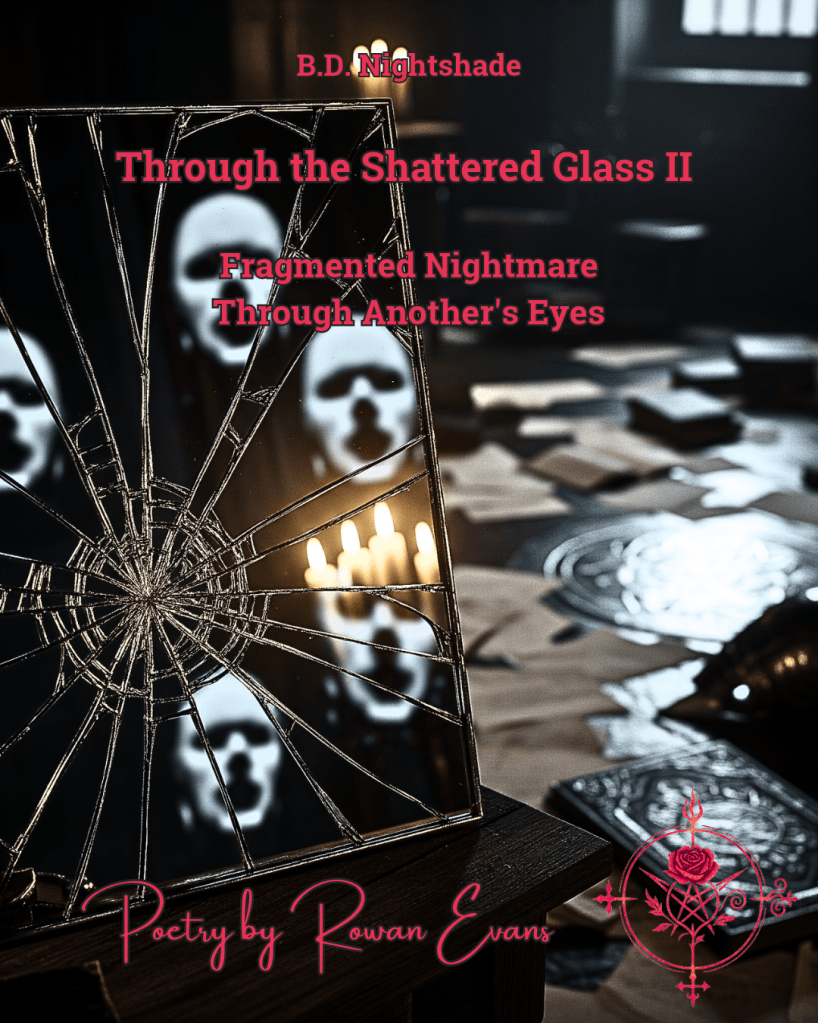
Through the Shattered Glass II is a continuation of a fractured exploration of memory, trauma, and lingering presence. Written from the perspective of the “other” in a haunting, spectral voice, it blurs the line between witness and participant, reality and echo. The poem is meant to unsettle and mesmerize, leaving questions unanswered—because some truths exist only in fragments.
Through the shards of memory, the echoes remain…
Through the Shattered Glass II Fragmented Nightmare: Through Another’s Eyes Poetry by B.D. Nightshade
Shards.
Red, silver, sharp—
I cut my palm on what isn’t there.
A laugh—too low, too close,
slips beneath the floorboards,
slithers into my chest.
I remember the air.
Cold, metallic.
Or was it hot, burning my throat?
Footsteps echo backward,
though I never moved.
A hand grazes my shoulder—
I recoil. No one is there.
Yet the pulse in my veins
screams I am not alone.
Mirror.
Fractured.
Eyes staring—mine? Yours?
I reach—
and the reflection spits me out.
Something drips.
Clock? Heart? Faucet?
I follow.
Red. Wet. Wrong.
A scream.
Or a whisper.
Or a laugh I know too well.
Memory fractures—
two bodies, one space,
and the space is infinite.
The other, the same,
or just a shadow trailing mine?
I crouch over shards,
bare feet sticky with nothing and everything.
Hands tremble—they belong to someone else.
Or maybe to both of us.
A name?
No.
Nothing.
Just the ache of presence,
the itch of absence,
the smell of iron in the hollow of air.
I feel her—
or him—
or the echo—
pressing against me from everywhere
and nowhere.
Was it laughter?
Was it pain?
Was it memory, or the ghost of memory?
Shadows twist.
I am falling.
Or rising.
Or sinking in place.
The floor tilts.
The walls bend.
My pulse, a hammer.
My breath, a blade.
My scream—
stuck.
Still.
Here.
Shards of me, shards of you,
swirling, bleeding,
unclaimed,
untouchable,
and the world bends around the space
where we were—or were not.
And I—
I remain.
Closing Note
The fragments linger. Perhaps you have glimpsed them, perhaps you have not. In the spaces between breath and shadow, in the shards of memory that refuse to settle, the story continues—both everywhere and nowhere. Beware what haunts the mirrors.
Journey into the Hexverse
Through the Shattered Glass— B.D. Nightshade Step back into the shattered world and follow the echoes… Can you uncover what really transpired?
If you would like to explore beyond this mystery, you can find more of my work inThe Library of Ashes.
✦ Poetic Commissions by Rowan Evans ✦
Every word I write is a devotion, a fragment of shadow and light carefully shaped into verse. On my Ko-fi, I offer custom poems, personalized rituals in language, and lyrical messages crafted just for you—or someone you wish to honor, surprise, or remember.
Whether you seek:
A poem for a loved one, friend, or muse
A ritualized or thematic verse for special occasions
A written reflection to say everything you struggle to
…each commission is approached with care, reverence, and the intensity of my signature Neo-Gothic Confessional Romanticism.
✨ Special Offer:Use code NGCR25 at checkout to receive 25% off any commission until the end of the month. Let these words become your keepsake, your offering, your moment of devotion.