Author’s Note
Some poems feel less like they’re written and more like they’re discovered.
A Rose in the Ashes came from following an image rather than an outline. One symbol led to another until the poem became a journey through memory itself—through forgotten moments, lingering wounds, recurring dreams, and the quiet realization that healing doesn’t happen by avoiding the past.
The forest in this poem isn’t meant to be a literal place. It’s the landscape of memory, where some experiences remain vivid while others decay with time. The trees, the tunnel, the moon, the bay, and finally the rose all became landmarks within that emotional terrain.
The final image—a single rose blooming through ashes—reminded me that even after devastation, beauty doesn’t disappear forever. Sometimes it simply waits beneath the surface until we’re ready to notice it.
— Rowan Evans
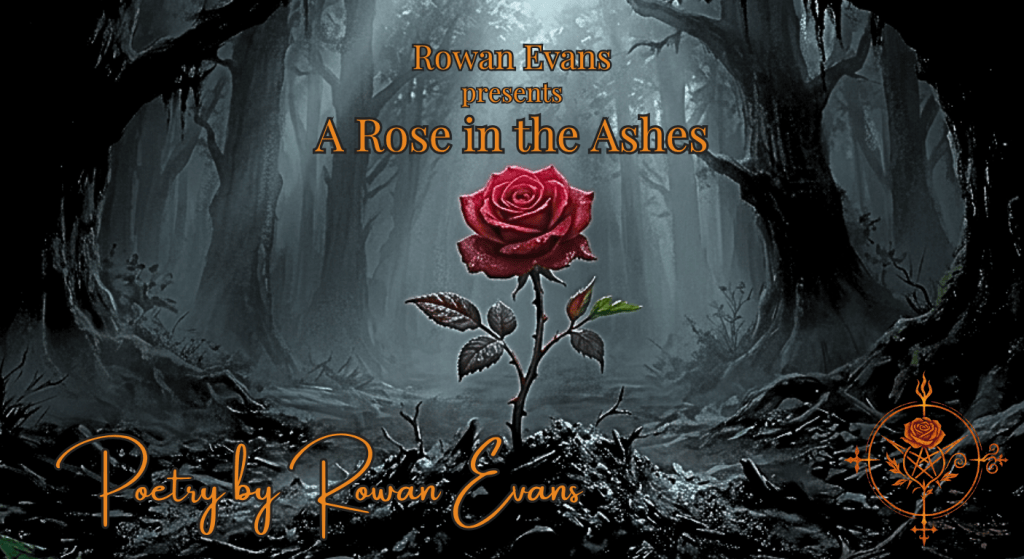
Sometimes it’s a single rose, quietly blooming where you thought only ashes remained.
A Rose in the Ashes
Poetry by Rowan Evans
I wander through the mist and fog,
wondering if I’ve gotten myself lost.
The trees are thick with sickly green leaves,
and the air is too thick, it’s hard to breathe.
Every step feels borrowed,
like the ground isn’t sure
it wants to hold me.
It’s like with every step
the ground shifts a little to the left,
until nothing feels right.
It’s like I’ve walked
to the end of the tunnel,
but I didn’t find the light.
I keep walking, stumbling along—
the dark swallows me whole
and then spits me out.
I hit the ground and roll to a stop
on the edge of a fifty foot drop.
That’s when I see it,
something moving between the trees—
not a creature,
but a feeling—
the sense that I’m being asked
to keep going
even when I don’t know why.
Maybe it’s because
I didn’t find the light
at the end of the tunnel,
not because I failed—
but because the journey isn’t done.
The light signifies the end.
No light means the journey continues,
so I keep moving through—
the streets that I walk in sleep,
the moment I return to my bones,
or a war with gods to ease the pain.
Yeah, I followed the footprints
to the water’s edge,
I stared across at the coast
on the other side of silence.
And even from a distance,
I was able to trace
the moon across the heavens,
before it became suspended over the bay—
its reflection trembling across the dark water,
a mirror to the tremor in my chest.
But I couldn’t stay still for long—
I had to keep moving on.
So I ran—
bolted for the tree line,
tripped and stumbled in
and my eyes caught the way the light
pierced the canopy—
the light—
that’s what I’d been chasing
this whole time,
not at the end of the tunnel—
but above my head,
an idea—
my eyes drift toward the sky,
and that’s when I see—
the leaves on these trees
are not leaves,
they are memories—
some bright and vivid,
others a sickly shade of green.
Those are memories forgot,
memories left to rot.
But here’s the truth of this plot:
some memories fade—
whether you hold on or not,
and some become rooted
through pain, an environment
permanently changed.
And that’s what I saw…
trees with leaves
showing things—
I thought long forgotten.
I was more surprised by that,
than the fact that so many trees
looked rotten.
I could feel the tears
touch the corners of my eyes—
the air was thick again,
humid and suffocating.
There was a tremor in my chest,
and knees were weak—
with every step my bones were quaking,
like the earth was shaking.
I stumbled and fell to my knees,
head bowed—
in shame or respect,
who knows, now?
I opened my mouth,
but no jokes came out—
I couldn’t misdirect from this,
no sleight of hand.
I had to face this—
whatever it is,
whatever these leaves
show me,
I’ve got to take it seriously—
because maybe it is these memories
that are keeping me stuck here.
Maybe they are the memories
that drive the fear,
that keeps me from acting—
that keeps me dragging feet
and self-sabotaging.
Slowly I rise—
like the sun over the horizon.
Knees shaking from the weight of me,
I struggle to take one step
and then another.
I stumble through the ruins
of thoughts, dreams and memories—
my chest rises and falls,
like oxygen is in short supply.
Then I see it—
a single rose in bloom,
poking through the ashes
of nights only remembered
in the spilled ink on silent pages.
Journey into the Hexverse…
[One Honest Sentence]
It’s easy to write about anything. What’s difficult is writing one completely honest sentence without hiding behind humor, references, or metaphor. One Honest Sentence explores the distance between poetic confidence and emotional vulnerability.
[Leave No Self Behind]
What if finding yourself isn’t about discovering someone new, but learning to walk beside every version you’ve ever been? “Leave No Self Behind” is a meditation on memory, healing, and embracing the selves we once abandoned.
[More Afraid Than the Ink]
Some confessions are easy to write but impossible to speak. More Afraid Than the Ink explores fear, dreams, recurring symbols, and the quiet realization that the page has always been braver than the poet.
[Just Human]
Just Human is a reflective free verse poem about seeing people before borders, choosing empathy over division, and finding home in our shared humanity rather than on a map.
[Translating What I Feel]
A poem about the invisible process of turning emotion into imagery, imagery into language, and language into poetry. An intimate reflection on creativity, loneliness, and twenty-three years of learning to translate what the heart feels.
If you’re interested in more poetry, you can find it here → [The Library of Ashes]