Sometimes a poem starts with an image that is just too good to leave alone.
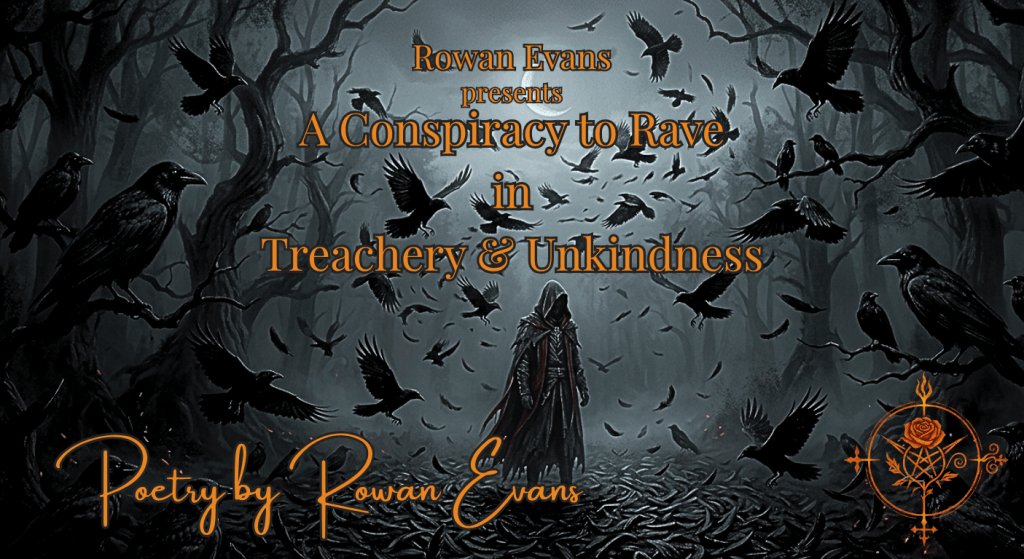
A gathering of black feathers. A suspicious little chorus. A feeling that something is happening around you, even if nobody bothered to send you the invitation.
So, naturally, I had to turn it into a conspiracy.
Welcome to the middle of it.
— Rowan Evans
Just me, minding my business, while the birds hold a very suspicious meeting around me.
A Conspiracy to Rave in Treachery & Unkindness Poetry by Rowan Evans
It’s just me, no party,
standing in the middle—
with a rave all around,
just feathers of darkness
covering the ground—
it’s no mystery
when you’re stuck in the middle
of a conspiracy,
listening to the treachery—
inspiring the unkindness.
They are poetic in their darkness—
unlike the violence
of the Mob & Murder—
those crows can’t be trusted.
Journey into the Hexverse
[Roses & Ruin] Two minimalist poems exploring the opposing forces within creativity: the thoughts we cultivate into something beautiful and the darker thoughts we transform before they have a chance to decay.
[The Crypt] A mysterious man watches from a crypt as a woman enters the graveyard and kneels before an unnamed grave. In this compact gothic poem, fascination, death, and possession blur together beneath the shadows of the cemetery.
[Homecoming] Homecoming is a return to the Gothic aesthetic at the heart of Rowan Evans’s poetry, blending Poe, mythology, horror icons, moonlight, ravens, and darkness into a meditation on artistic identity and finding your way back to the voice that feels like home.
[Poet’s Curse] Poet’s Curse explores the painful side of falling too deeply: giving pieces of yourself away freely, taking accountability for your own heartbreak, and realizing that learning to let go can be harder than learning to love.
[The Monster in the Margins II] The Monster in the Margins II transforms Rowan Evans’s Seven Deadly Sins mythology into a horror story written between the lines, where Lust, Wrath, Sloth, Greed, Pride, Envy, and Gluttony become monsters growing from pain, grudges, and scars.
Sometimes I genuinely wonder what happens when I give my brain permission to write whatever it wants.
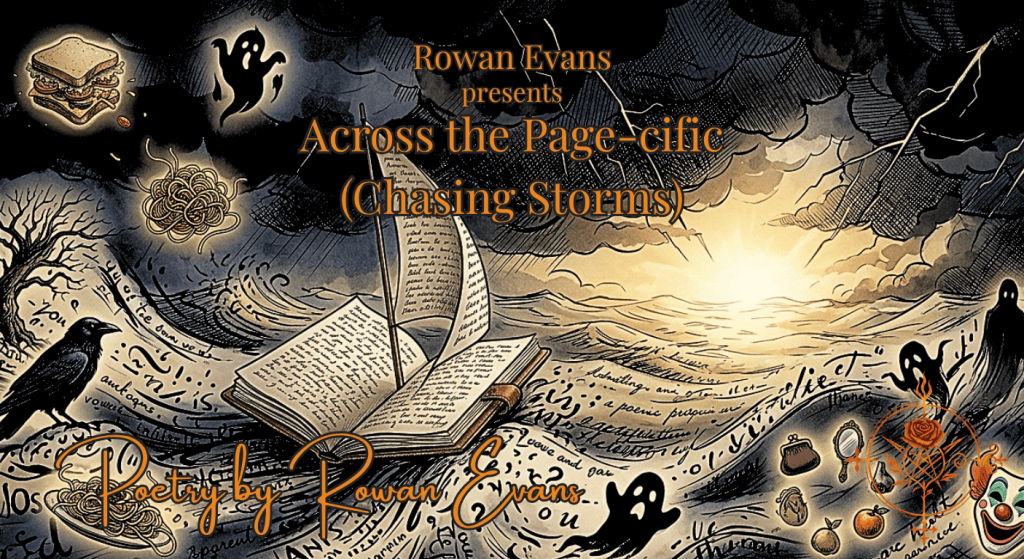
The answer, apparently, is sandwiches, pasta, farmers on Pluto, raccoons in silk pajamas, llamas, trees, cartoon ghosts, monsters, seven deadly sins, and a journey across an ocean that does not technically exist.
And honestly?
I love it.
Across the Page-cific (Chasing Storms) is a celebration of the strange places my writing can go when I stop trying to force it into a single shape.
This poem deliberately references several of my recent pieces and recurring worlds. The sandwich wordplay comes from Lost in the Sauce. The pasta-based literary assault comes from Impasta (A Diss in Pasta Form). The trees point back to my playful botanical wordplay, while Danny Phantom, the Monster in the Margins, the Seven Deadly Sonnets, ravens, spirits, and other imagery come from the larger mythology and vocabulary I’ve been building throughout my work.
The references aren’t just Easter eggs.
They’re evidence.
Evidence of how much my writing has changed—and how much more willing I am now to let different parts of my voice coexist.
For a long time, I thought I needed to choose what kind of writer I was supposed to be.
Gothic poet.
Confessional poet.
Love poet.
Dark poet.
Funny poet.
Experimental poet.
But the more I write, the less interested I am in choosing.
I want to write the heartbreak poem with sandwich ingredients.
I want Tony Stanza to write a pasta diss.
I want to turn mythology into autobiography.
I want to write about ghosts and gods, then turn around and make a terrible pun.
I want to chase a metaphor until it becomes absurd.
And then, underneath all of it, I want to find something honest.
That is what the storms in this poem represent.
The chaotic lines.
The sudden cadence changes.
The ideas that arrive from nowhere.
The parts of my mind that refuse to walk in a straight line.
I used to think I needed to calm those storms down.
Now?
I chase them.
Because writing has become a playground again.
And somewhere in that playground, I keep finding pieces of myself I hadn’t finished discovering.
“It was writing that saved me” is therefore not a throwaway line.
Writing gave me a language for experiences I couldn’t always explain directly. It gave me somewhere to put the contradictions, the humor, the darkness, the questions, the love, the anger, the absurdity, and everything else that makes up the person behind the pen.
Piece by piece.
Bit by bit.
I rebuilt myself in the art.
And apparently, sometimes that art looks like a sandwich, a bowl of pasta, and a storm on the Pacific.
I’ll take it.
— Rowan Evans
I stopped trying to avoid the storms. I started chasing them across the page.
Across the Page-cific (Chasing Storms) Poetry by Rowan Evans
Let’s see, what other ridiculous thing
can we turn into poetry—
I’ve written a heartbreak poem
using sandwich ingredients,
and wrote a diss poem
using nothing but pasta noodles—
was a farmer on Pluto,
witnessed raccoons in silk pajamas
perched on the backs of llamas—
while I shaped love poems
out of the trees—
I’ve turned Danny Phantom
into religion—a whole faith
on “going ghost”—
but really it’s just me stuck
between worlds.
I’ve written as the monster in the margins
and the spirits in the room—
seven sins that act like tax on the soul.
Go against the monster, you won’t leave whole.
Feeling like Pennywise, grin wide,
’cause I’m a clown in my rhymes
sometimes—
I’ve taken trips
in ink-dipped ships
across the page-cific—
avoiding storms of chaotic lines
and jagged rhymes
with sudden cadence changes.
Just kidding—
I chased the storms across the page,
embraced the pace my brain gave.
It was writing that saved me—
it gave me a way to translate me,
piece by piece and bit by bit,
I rebuilt myself in the art of lit—
where a mind like mine appears rarely.
Journey into the Hexverse…
[Lost in the Sauce] A playful heartbreak poem where sandwiches, ketchup, mustard, rye, lettuce, and sourdough become metaphors for emotional confusion. Beneath the food puns is a speaker trying to understand how everything went from “we’re okay” to suddenly feeling cold.
[Impasta] Tony Stanza is back with another literary attack—and this time, he’s bringing pasta. Spaghetti, fettuccine, macaroni, ravioli, and angel hair become weapons in a ridiculous diss aimed at a poet whose rhymes are allegedly cheesy, fragile, and completely impasta.
[Pluto Farmer] A whimsical absurdist poem about being a certified weirdo, farming space carrots on Pluto, and refusing to fit into anyone else’s definition of “normal.”
[Raccoons in Silk Pajamas] What begins with judgmental Space Chickens quickly spirals into camels in parked cars, elephants in jam jars, raccoons in silk pajamas, and astronauts in the ocean. A playful absurdist poem about language, imagination, and what happens when you stop trying to control where the words go.
[Did You Really Think This Was About Trees?] A playful love poem disguised as a forest of terrible tree puns. Beneath the birch, oak, cedar, palms, lumber, and absurdist wordplay is a poem about devotion, loyalty, laughter, and building a life with someone you love.
[Danny Phantom Theology] What begins as a metaphor borrowed from a childhood cartoon becomes something deeper: a reflection on existing between survival and possibility, exhaustion and hope, the life we have and the life we long for. Danny Phantom Theology explores what it means to keep moving toward a future that feels worth living.
[The Monster in the Margins II] The Monster in the Margins II transforms Rowan Evans’s Seven Deadly Sins mythology into a horror story written between the lines, where Lust, Wrath, Sloth, Greed, Pride, Envy, and Gluttony become monsters growing from pain, grudges, and scars.
There are certain aesthetics that feel less like something we choose and more like something we recognize.
For me, Gothic imagery has always been one of those things.
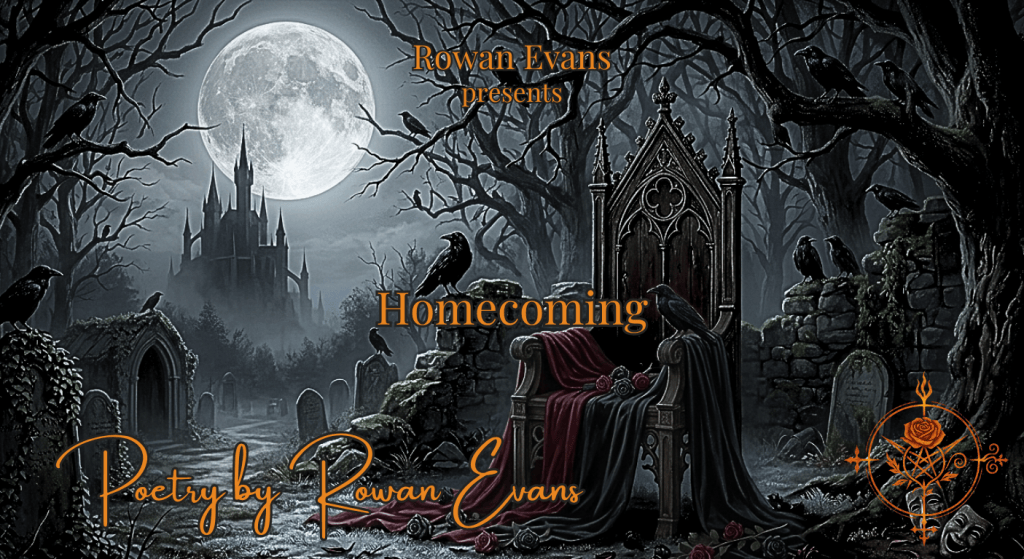
Homecoming came from the realization that something in my writing had started to feel slightly unfamiliar. I was still writing about the moon, the ocean, the tides, ravens, horror, darkness, and the strange spaces where beauty and pain overlap—but somehow, I had drifted away from the particular Gothic atmosphere that has always felt like home to me.
So this poem became a return.
Poe is here because his shadow has been part of my literary DNA for years. Nyx and Hades are here because mythology gives me another language for darkness. The ravens are here because, in my own symbolic architecture, they have become witnesses, messengers, and companions. And the horror references—Jason, Ghostface, Pennywise, Michael Myers—are there because horror has never been merely about monsters to me.
It is about what the monsters represent.
Grief. Fear. Obsession. Rage. The parts of ourselves that refuse to stay buried.
There is also something deliberately self-aware about this poem. I am not simply listing Gothic references because they sound dark. I am talking about my relationship with the imagery itself—the way the moon has accumulated meaning across my work, the way the tides connect to emotion, and the way ravens have gradually become part of my mythology.
The darkness isn’t an aesthetic costume.
It’s architecture.
And after spending some time writing away from it, I realized that I wasn’t trying to become something new.
I was finding my way back to something that had been mine all along.
That’s why this poem is called Homecoming.
Sometimes you don’t discover where you belong.
Sometimes you remember.
— Rowan Evans
Sometimes the darkness isn’t somewhere you wandered into. Sometimes it’s the place where your voice has always felt most at home.
Homecoming Poetry by Rowan Evans
I’ve been writing like
I forgot which domain is mine,
I’m of the darkness—
just borrowed the light,
and made Poe’s throne my birthright.
I’m a gothic romantic,
I bleed for the art—
I’ve kissed the lips of Nyx
and wandered through
the realm of Hades.
I’m a poltergeist in life,
but at night I come alive—
witching hour is when I thrive.
I pray to the moon
and curse the sun—
I ascend to the throne
that Poe had spun.
I watch the ravens—
carrying messages where they fly,
eyes locked, tracking the treachery across the sky.
They are always watching—
silent witnesses to the rot inside.
It started to feel like something
in my pieces was missing—
like where was the gothic lace,
silk and satin sin, velvet and venom.
There was too much light—
even when ninety percent
of my imagery is night adjacent,
weaving in horror rhymes—
Friday the 13th, Night of Jason.
The moon in my rhymes has meaning,
when I write lines like the tides—I mean it,
even in my Ghostface cadence—
what’s your favorite scary movie?
Pennywise of the mind, sewer of thought—
I’m a monster like Michael,
when I chase—I don’t run, I walk.
Journey into the Hexverse…
[The Monster in the Margins] Drawing inspiration from horror icons like Michael Myers, Ghostface, Freddy Krueger, and Pennywise, this poem explores the darker side of creativity—where inspiration becomes an unstoppable force lurking just beyond the edge of the page.
[The Monster in the Margins II] The Monster in the Margins II transforms Rowan Evans’s Seven Deadly Sins mythology into a horror story written between the lines, where Lust, Wrath, Sloth, Greed, Pride, Envy, and Gluttony become monsters growing from pain, grudges, and scars.
[The Unkindness Descends] “The Unkindness Descends” is a Gothic symbolic poem exploring collapse, transformation, and the unsettling experience of being witnessed during moments of unraveling. Through raven imagery, ambiguity, and ritualistic atmosphere, the poem invites multiple interpretations—spiritual, psychological, ominous, or transformative.
[Gospel in Crimson] When writing becomes ritual and love becomes devotion, the line between creation and worship begins to blur. Gospel in Crimson explores obsession, artistry, and the sacred act of expression.
Mine just happens to contain an alarming number of moons, oceans, ravens, comic book characters, sports references, cartoons, and entirely too much ink.
People occasionally notice that I return to the same imagery over and over again. They’re right.
The funny thing is…
I’m usually the first person to notice.
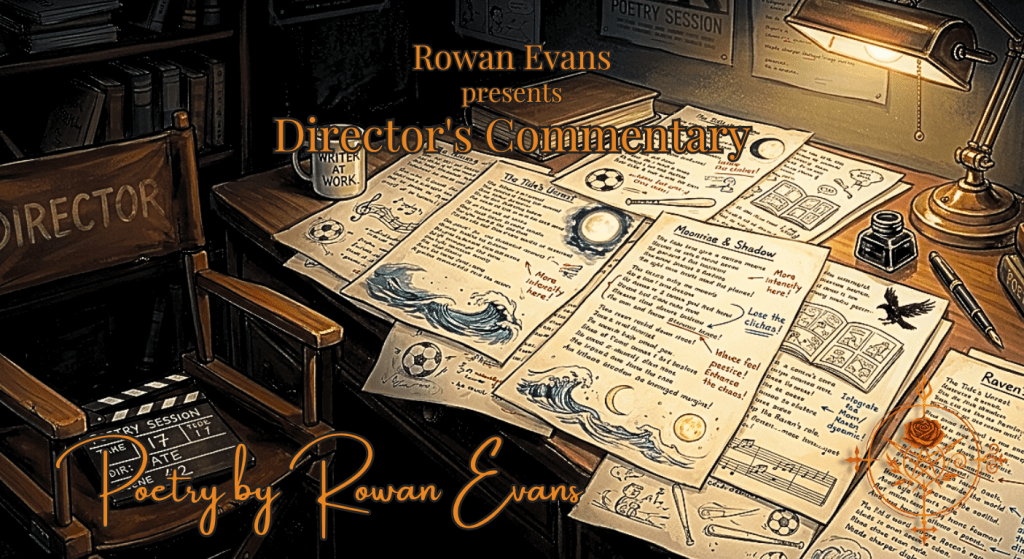
This poem came from imagining an overly critical director sitting just off-camera, pausing every scene to point out my habits.
“Another moon?”
“Really? The ocean again?”
“We’re doing ravens today?”
It’s the internal voice every creative person develops after making enough work. The one that starts recognizing your patterns before anyone else does.
Sometimes it’s helpful.
Sometimes it’s insufferable.
The joke, of course, is that the director isn’t entirely wrong.
I do write about the moon a lot.
I do return to oceans, tides, dreams, and ravens.
I do compare things to comic books, cartoons, sports, horror movies, and whatever random piece of culture my brain decides belongs in the poem that day.
Because those things aren’t decorations.
They’re the language my mind naturally speaks.
The final section—”Music—10/10. No Notes.”—is probably the closest thing to surrender in the entire poem.
Apparently my inner critic has limits.
Music gets a free pass.
Everything else is fair game.
Including me.
— Rowan Evans
“Every writer has recurring motifs. Mine just happened to get their own director’s commentary.” 🎬🌙✍️
Director’s Commentary Poetry by Rowan Evans
The Moon—
Here we go again, another moon metaphor.
What is it this time?
The moon shimmering above the bay? A stand in for her beauty—
Ocean—
My favorite metaphor.
The one I’ve used thousands upon thousands of times before— written in thousands of lines, in a thousand different rhymes.
Hyperbole.
The Tide—
Yes, there it is— the final piece of this overused metaphor chain, you say it’s different but it’s all the same.
Same moon. over the same bay, and it shimmers in the same way.
It’s almost like the moon, ocean, and tide are all that exist inside that little mind.
Ravens—
So spooky. So gothic.
You write ravens like you shop exclusively at Hot Topic.
They’re messengers. They witness. And once upon a time you even made them a centerpiece.
You took that way too seriously back in your “modern-day Poe” era.
A modern-day Poe?
Ridiculous.
Sports—
You don’t even watch those.
Why are you writing metaphors for the bros?
You think you’re great? Yeah, you’re The Babe. 23 years and a Jordan joke— okay, Shohei.
Random Cartoon Reference—
Which character are you going to grab this time?
Which bit of nostalgia are you going to try and exploit?
Random references, litter the page— Powerpuff Girls, Doug and Dexter.
So what’s next?
Something more obscure, or more mainstream?
Comic Books—
Tropes.
Superheroes and capes.
Random character grab, used in a metaphor that barely makes sense—
like Bane for line breaks? What the “#%@$” was that?
I’ll give you Two-Face for fakes and snakes, because that one makes sense.
Music—
10/10. No Notes.
Journey into the Hexverse…
[Pointing Me Home] The final poem in the No Metaphor Left Behind trilogy explores dreams, hope, and belonging. Through moonlight, ocean tides, and quiet conversation, Pointing Me Home reflects on carrying hope long before reaching the place you call home.
[Chemical X] Chemical X explores the rapid, associative way one creative mind moves—from cartoons to sports, comic books to music—revealing that inspiration isn’t linear, but a collision of memory, humor, rhythm, and intuition.
[Crossing the Sea] A deeply personal poem about relocation, longing, and the realization that some truths naturally arrive through metaphor—even when we try to leave it behind.
[Danny Phantom Theology] What begins as a metaphor borrowed from a childhood cartoon becomes something deeper: a reflection on existing between survival and possibility, exhaustion and hope, the life we have and the life we long for. Danny Phantom Theology explores what it means to keep moving toward a future that feels worth living.
[Frankenstein’s Monster (and I’m the Doctor)] Some poems are built to make a point. Others are built to reveal the mechanism. Frankenstein’s Monster (and I’m the Doctor) explores associative thinking, creative chaos, and the strange process of stitching disconnected ideas into something alive.
[Ocean Waves (1, 4, 3)] A moonlit shoreline, a rowboat full of ducks, a piggybank with no cents, and a confession hidden in plain sight. Ocean Waves (1, 4, 3) explores how humor, wordplay, and absurdity can become a side door to vulnerability when the truth feels too difficult to say directly.
[A Heart That Echoes in Another Language] A poetic journey through music across Japan, Korea, China, and the Philippines, exploring how sound becomes identity, memory, and emotional geography.
[Global Takeover] What if home isn’t a place—but something you build from the music you love? Global Takeover blends sound, culture, and identity into one borderless space.
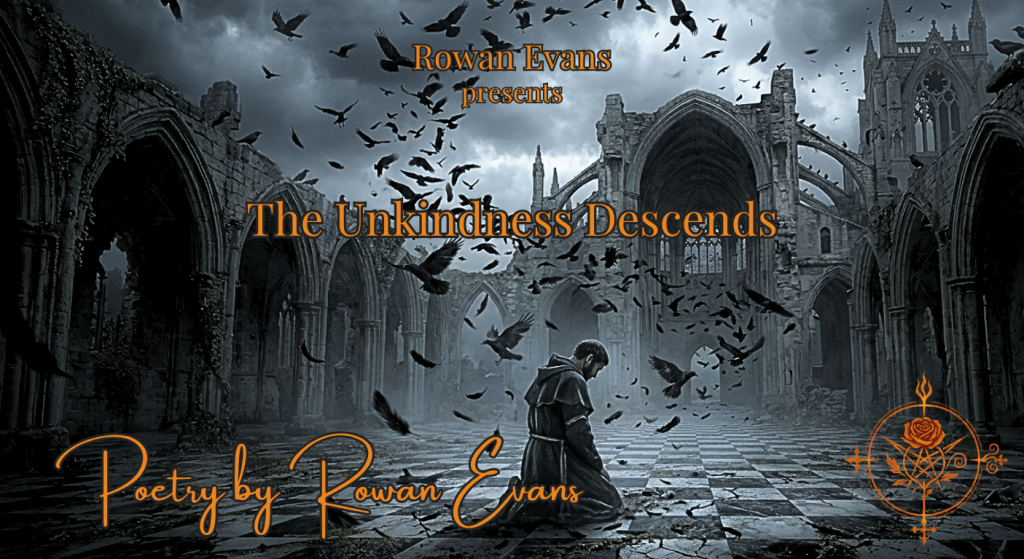
a person kneeling on broken marble while ravens circled overhead.
From there, the symbolism unfolded naturally.
Ravens have carried countless meanings across cultures and mythologies throughout history. Omens. Messengers. Witnesses. Archivists of the dead. Harbingers of transformation. Keepers of memory. In some traditions they are feared. In others, revered.
I didn’t want to narrow them down to one interpretation here.
What interested me more was the tension between collapse and observation—the feeling of being seen during moments of unraveling, and the uncertainty of whether those watching forces are condemning you, mourning you, studying you, guiding you, or simply recording what happened.
That’s why the poem never fully explains the ravens.
Even the collective noun “unkindness” became important to me while writing. It carries two meanings at once: a literal group of ravens, and the emotional atmosphere surrounding the speaker. The word itself becomes part of the tension.
By the end of the piece, the ravens remain unresolved intentionally.
They part. They watch. They follow.
Whether that final image feels threatening, protective, spiritual, psychological, or transformative depends almost entirely on how the reader chooses to see them.
And I think that uncertainty is the point.
— Rowan Evans
They descended like witnesses—whether to condemn, mourn, guide, or remember was never made clear.
The Unkindness Descends Poetry by Rowan Evans
I kneel on broken marble,
the unkindness circling overhead.
Ravens watching as I come undone.
Witnesses to my fall,
the ravens land—
one by one,
the unkindness descends
upon me.
I am lost in the black mass—
wing and feather flapping
as ravens move to circle me.
My eyes scanned the ravens
as they surrounded me,
each uttered something—
a word, a message.
Perhaps, it was a lesson?
Maybe I read it all wrong,
and they were just keeping record—
witnesses to my collapse.
I rose to my feet.
The ravens watched me.
I moved.
They parted
like the Red Sea.
Each step forward,
their eyes traced my path.
As I moved through,
they closed in behind me.
Following.
Journey into the Hexverse…
[I Write Cathedrals] “I Write Cathedrals” explores faith, doubt, belonging, and the search for meaning beyond certainty. Through Gothic spiritual imagery and confessional reflection, the poem examines how writing can become a sacred space for questioning, wonder, and the people who feel displaced by traditional structures of belief.
[Drought Resistant] “Drought Resistant” is a confessional poem about growing up poor in California’s Central Valley—where triple-digit heat, EBT cycles, dry ramen, and hard landscapes become part of emotional memory. Blending humor, slang, and working-class reflection, the poem explores survival, regional identity, and complicated love for the place that shaped you.
[Escaped to the Page] “Escaped to the Page” is a confessional meta-poem about individuality, artistic identity, and surviving through writing. Blending sharp confidence with emotional vulnerability, the poem explores the difference between shared labels and lived experience—and the ways art becomes inseparable from the life behind it.
[Ink as a Second Mouth] “Ink as a Second Mouth” explores the distance between thought and speech, and the ways writing can become a form of survival, continuity, and self-translation. Through confessional imagery and reflections on growth, identity, and articulation, the poem examines what it means to keep becoming through language.