Author’s Note
Some poems arrive as observations.
Others arrive as questions.
This one began with a question I wasn’t entirely prepared to answer:
Who am I without writing?
I’ve spent more than two decades translating my inner world into poetry. Over time, writing stopped feeling like something I do and started feeling like the place where I exist most completely.
That’s a strange realization.
Because poetry isn’t simply expression for me—it’s construction.
Every poem is assembled from fragments: memories, emotions, images, conversations, dreams, fears, humor, hope. I rarely invent from nothing. I gather pieces of lived experience and stitch them together until they begin breathing on their own.
That’s where the title comes from.
Victor Frankenstein wasn’t remembered because he created life.
He was remembered because he assembled it.
That’s often what writing feels like to me.
I gather disconnected thoughts, broken emotions, recurring symbols, and scattered moments, then bind them together until they become something capable of standing on its own.
The result isn’t always comfortable.
Sometimes it’s beautiful.
Sometimes it’s monstrous.
Most often…
it’s simply honest.
— Rowan Evans
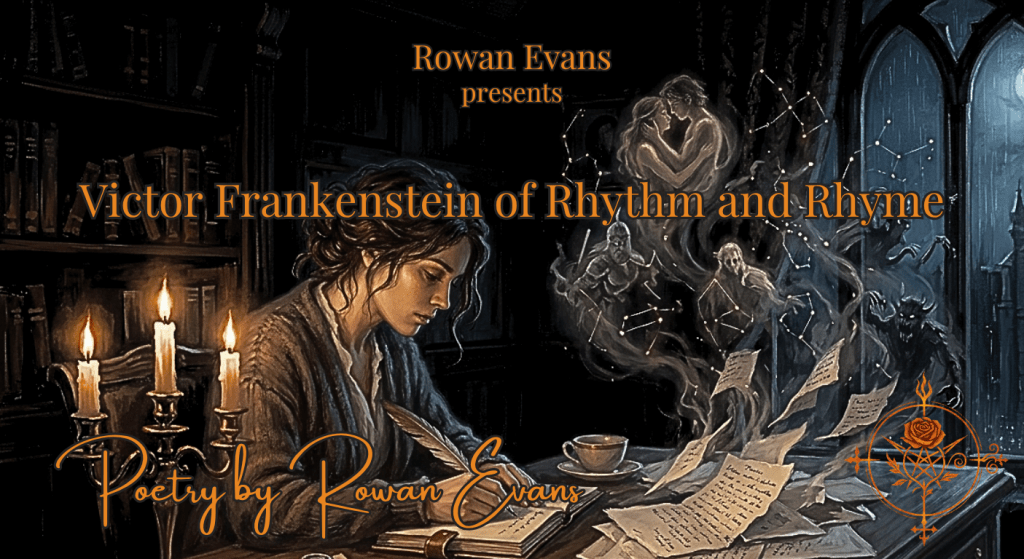
Victor Frankenstein of Rhythm and Rhyme
Poetry by Rowan Evans
I’ll be honest—
I don’t know who I am
without this,
without the ink to bleed—
what does my life even mean?
I know it means something—
but I’ve lost sight of it.
Because I’m like a god here—
I control the shape
the ink takes
and decide what it makes.
I create every piece
in my image.
I write universes into existence—
populate them with ghosts,
lovers, gods and monsters.
And every version of myself
I couldn’t survive as alone.
I translate my mental health
from the inside, no distance.
I take my mind
translate it into lines
and images—
stitch them together
as metaphors—
Victor Frankenstein
of rhythm, rhyme and imagery.
Journey into the Hexverse…
[Pointing Me Home]
The final poem in the No Metaphor Left Behind trilogy explores dreams, hope, and belonging. Through moonlight, ocean tides, and quiet conversation, Pointing Me Home reflects on carrying hope long before reaching the place you call home.
[Caller ID: Destiny]
Sometimes the places we visit in our dreams feel more like home than the places we wake up in. Caller ID: Destiny explores longing, belonging, and the quiet feeling that life is calling you toward somewhere new.
[Monster Theology]
What if the monsters under the bed weren’t monsters at all? Monster Theology explores difference, belonging, and the human tendency to fear what we don’t understand through a conversation with the creatures we’ve spent our lives imagining.
[Frankenstein’s Monster (and I’m the Doctor)]
Some poems are built to make a point. Others are built to reveal the mechanism. Frankenstein’s Monster (and I’m the Doctor) explores associative thinking, creative chaos, and the strange process of stitching disconnected ideas into something alive.
[I’ll Be There to See Your Sunrise]
Love has never come easily to me. This poem explores the fear, vulnerability, and quiet courage required to stay emotionally present when connection begins to matter deeply. “I’ll Be There to See Your Sunrise” is about choosing love despite the risk of heartbreak—and promising to remain long enough to witness someone fully.
If you’re interested in more poetry, you can find it here → [The Library of Ashes]


Leave a Reply