Tag: Frankenstein

  • Author’s Note

    Some poems arrive as observations.

    Others arrive as questions.

    This one began with a question I wasn’t entirely prepared to answer:

    Who am I without writing?

    I’ve spent more than two decades translating my inner world into poetry. Over time, writing stopped feeling like something I do and started feeling like the place where I exist most completely.

    That’s a strange realization.

    Because poetry isn’t simply expression for me—it’s construction.

    Every poem is assembled from fragments: memories, emotions, images, conversations, dreams, fears, humor, hope. I rarely invent from nothing. I gather pieces of lived experience and stitch them together until they begin breathing on their own.

    That’s where the title comes from.

    Victor Frankenstein wasn’t remembered because he created life.

    He was remembered because he assembled it.

    That’s often what writing feels like to me.

    I gather disconnected thoughts, broken emotions, recurring symbols, and scattered moments, then bind them together until they become something capable of standing on its own.

    The result isn’t always comfortable.

    Sometimes it’s beautiful.

    Sometimes it’s monstrous.

    Most often…

    it’s simply honest.

    — Rowan Evans
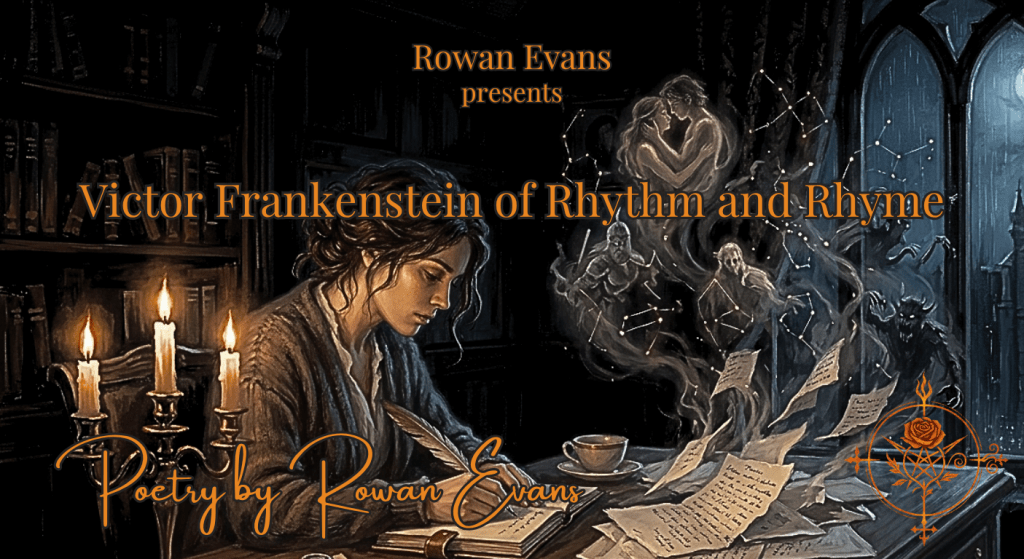

    A poet writing by candlelight as handwritten pages transform into stitched-together figures made from words, symbolizing creativity, identity, and the act of creating poetry.
    “Every poem begins as fragments—thoughts, memories, emotions, and images—stitched together until they learn how to breathe.”

    Victor Frankenstein of Rhythm and Rhyme
    Poetry by Rowan Evans

    I’ll be honest—
    I don’t know who I am
    without this,
    without the ink to bleed—

    what does my life even mean?

    I know it means something—
    but I’ve lost sight of it.

    Because I’m like a god here—
    I control the shape
    the ink takes
    and decide what it makes.

    I create every piece
    in my image.

    I write universes into existence—
    populate them with ghosts,
    lovers, gods and monsters.

    And every version of myself
    I couldn’t survive as alone.

    I translate my mental health
    from the inside, no distance.

    I take my mind
    translate it into lines
    and images—
    stitch them together
    as metaphors—

    Victor Frankenstein
    of rhythm, rhyme and imagery.


    Journey into the Hexverse…

    [Pointing Me Home]
    The final poem in the No Metaphor Left Behind trilogy explores dreams, hope, and belonging. Through moonlight, ocean tides, and quiet conversation, Pointing Me Home reflects on carrying hope long before reaching the place you call home.

    [Caller ID: Destiny]
    Sometimes the places we visit in our dreams feel more like home than the places we wake up in. Caller ID: Destiny explores longing, belonging, and the quiet feeling that life is calling you toward somewhere new.

    [Monster Theology]
    What if the monsters under the bed weren’t monsters at all? Monster Theology explores difference, belonging, and the human tendency to fear what we don’t understand through a conversation with the creatures we’ve spent our lives imagining.

    [Frankenstein’s Monster (and I’m the Doctor)]
    Some poems are built to make a point. Others are built to reveal the mechanism. Frankenstein’s Monster (and I’m the Doctor) explores associative thinking, creative chaos, and the strange process of stitching disconnected ideas into something alive.

    [I’ll Be There to See Your Sunrise]
    Love has never come easily to me. This poem explores the fear, vulnerability, and quiet courage required to stay emotionally present when connection begins to matter deeply. “I’ll Be There to See Your Sunrise” is about choosing love despite the risk of heartbreak—and promising to remain long enough to witness someone fully.

    If you’re interested in more poetry, you can find it here → [The Library of Ashes]
  • Author’s Note

    This poem didn’t start with a message.

    It started with frustration.

    Not the kind that arrives fully formed or carefully structured—but the kind that builds in fragments. Small irritations. Cultural noise. Half-remembered references. Thoughts that don’t arrive in order, but all at once.

    What I wanted to capture here wasn’t a linear argument or a polished reflection on anger or identity.

    It was the process itself.

    The way the mind can jump from one idea to another without asking permission. The way language doesn’t always behave politely. The way emotion and memory and absurdity can occupy the same space without resolving into anything clean.

    The Batman reference, the cartoon interruption, the sudden shift in tone—none of it is meant to smooth into coherence.

    It’s meant to feel like it actually feels inside the moment of thinking it.

    The line “This is how my mind works” is the turning point for me in the piece.

    Not because it explains everything, but because it stops pretending everything needs to be explained.

    Some poems are built to argue a point.

    This one is built to show the mechanism.

    And the ending—“Frankenstein’s Monster / And I’m the doctor”—isn’t meant as metaphor in the traditional sense.

    It’s closer to recognition.

    That the thing being called chaos is also something being assembled. Intentionally or not. Carefully or not. But still assembled.

    And that sometimes the person inside the noise is also the one holding the pieces.

    — Rowan Evans


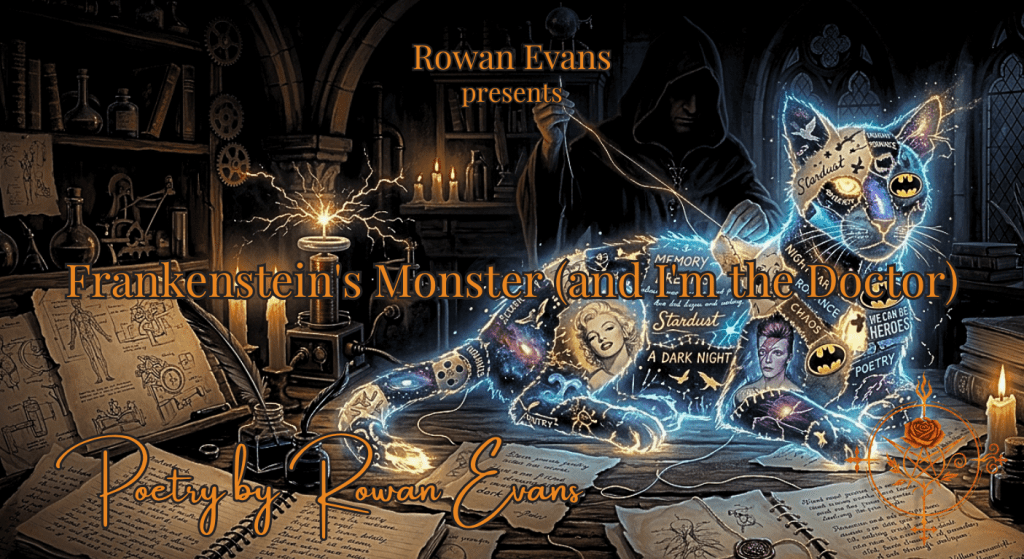
    A poet in a gothic laboratory assembling glowing fragments of words and images into a patchwork creation made from poetry and imagination.
    “My poetry? Frankenstein’s Monster. And I’m the doctor.” Sometimes creativity isn’t about finding order—it’s about assembling the pieces and bringing them to life.

    Frankenstein’s Monster (and I’m the Doctor)
    Poetry by Rowan Evans

    I’m sick of my surroundings;
    sick of these fakes,
    sick of the snakes,
    they’re all just Batman villains—
    Two-face.

    Crazy is the way
    they made me.
    Twisted thoughts
    that wouldn’t stop—
    pop goes the weasel,
    I R Baboon.

    This is how my mind works.
    It links two things
    that are seemingly opposites.
    They have nothing in common,
    but still I piece them together—

    my poetry?
    Frankenstein’s Monster.

    And I’m the doctor.


    Journey into the Hexverse…

    [Violets Are Violet (Roses Are Complicated)]
    A simple observation leads to an absurd conclusion: violets aren’t blue, roses aren’t always red, and the classic love poem may be far less accurate than advertised. A humorous free-verse poem about overthinking, flower symbolism, and the unintended consequences of analyzing clichés too closely.

    [It’s Just Me but Super]
    A playful free-verse poem about cartoons, imagination, cosmic wanderings, and the strange magic of creativity. Through wordplay, nostalgia, and absurd humor, Rowan Evans explores what happens when ordinary life meets an extraordinary imagination.

    [100 Grand and a Book Deal]
    A playful collision of candy bars, comic book heroes, basketball legends, and cosmic metaphors. Beneath the jokes lies a reflection on twenty-three years of writing, creativity, and the dream of building something lasting one line at a time.

    If you’re interested in more poetry, you can find it here → [The Library of Ashes]