Sometimes the loudest critic in the room is the one living inside your own head.
Creative Whiplash (Pick A Lane!) is about the pressure to define yourself as a writer, choose a style, and stay neatly within its boundaries—even when your creativity refuses to cooperate. One moment, I’m writing gothic poetry; the next, I’m throwing punchlines, weaving mythology, or drawing battle lines with a pen.
And somewhere in the middle of all that, the inner critic starts screaming that nothing makes sense.
The funny part? Sometimes the poem proves the critic wrong before the critic even finishes complaining.
Maybe I don’t need to pick a lane. Maybe creativity was never meant to be a straight road.
— Rowan Evans
Pick a lane? I tried. My creativity took the exit, changed three times, and somehow wrote a poem about it.
Creative Whiplash (Pick A Lane!) Poetry by Rowan Evans
I asked you to show me a metaphor—
you asked, what’s the meta for?
You said you’re a writer, are you sure?
Because I’m not anymore—
run on sentence, run on lines,
zero flow and zero rhymes—
that’s how you write.
Ironic—
I just proved myself
wrong, right?
Well, sometimes I get in my head,
convince myself that nothing I write
is ever good enough—
and no one can call my bluff.
Isn’t that rough?
Pick a lane! Pick a lane!
Repeated, screaming in my brain—
are you a gothic poet,
or do you draw battle lines?
Do you weave myths,
or write comedic shit?
Pick a lane! Pick a lane!
Repeated, screaming in my brain—
giving readers whiplash
with how fast, I switch lanes—
it’s a pain in the neck,
creativity, hard to keep in check.
Iron Sharpens Iron is about what happens when every version of my creative mind sits down at the same table: the gothic romantic, the absurdist comic, the mythmaker, the battle-poet, the joke creator, and whatever other voice decides to kick the door open halfway through a line.
The notebook becomes the sparring ring. One thought throws a punch, another throws a punchline, and sometimes Batman apparently gets involved.
I don’t always plan where the thread is going. Sometimes I just follow it until the poem lands somewhere that makes sense.
Maybe that’s the point.
I don’t need to silence the contradictions. I need them to sharpen each other.
— Rowan Evans
I don’t silence the voices in my head. I let them sharpen each other.
Iron Sharpens Iron Poetry by Rowan Evans
I sit by myself— alone in body, crowded in mind— it’s a constant battle of wits, moon-fed goth kid versus the battle-poet turning pens to WMDs.
The notebook— just a test site, where I drop bombs. It’s constant— the scream of the alarms.
I write so much because my mind fights too much— a gothic romantic, an absurdist comic— opinions, opinions, too many opinions— constant contradictions.
Is this a joke?
Are the emotions sincere?
What the fuck— (Batman!) is that reference doing here?
That’s just how my mind is sometimes— I write a line and follow it, (Stalker.) I don’t plan it—I just follow the thread, guide the ship and land it. But sometimes I get lost— I’ll orbit the planet, or drift in my dreams— and they say to make the dreams work, it takes team work— well, I became my own team, every version of me.
Gothic romantic, absurdist comic, mythmaker, joke creator and professional hater— (Jokes. Love ya!) a battle-poet raised on battle rappers and comedians— how I learned to land a punchline, can’t fight with my fists— but can fight with my mind, and I do it all the time— with myself, I spar, iron sharpens iron, after all.
Journey into the Hexverse
[Blindfolded & Still Winning] A playful battle-poetry freestyle about shutting off the inner editor, letting instinct take over, and discovering that sometimes the pen writes best when you stop watching it.
[Literarily Speaking] They think silence means weakness. They should probably have paid more attention to the pen. Literarily Speaking turns gothic imagery, raven feathers, rose-petal ink, and absurd fictional geography into a playful battle-poetry flex about dismantling your enemies with words instead of hate.
[The Playground] What happens when mythology stops being something to hide behind and becomes architecture for the imagination? The Playground (Language, Metaphors and More) explores Rowan Evans’s relationship with language, symbolism, metaphor, humor, and twenty-three years of turning the page into a place where anything can happen.
It’s Almost Like I Know What I’m Doing is a little self-audit that turns into a flex before I can stop it.
I started by wondering whether my writing had become too much swagger and not enough emotion—whether the ink was simply running free without anything underneath it. Then I remembered how long I’ve been doing this, where some of that rhythm came from, and why I learned to turn anger into cadence and pain into something that could make me laugh.
Maybe the swagger isn’t the absence of emotion.
Maybe it’s one of the ways I’ve learned to carry it.
This piece is me looking at the machinery behind my own writing and realizing that the things I sometimes question—rhythm, rhyme, comedy, aggression, timing, and instinct—aren’t accidents anymore.
They’re tools.
And apparently, after all these years, I might actually know how to use them.
— Rowan Evans
After twenty-three years of shaping ink, maybe the swagger isn’t accidental.
It’s Almost Like I Know What I’m Doing Poetry by Rowan Evans
It’s like my writing has become
all swagger, no emotion—
it’s like the ink is coastin’,
like the edge of the sea—
but there’s no tide to guide me.
So my lines run free—
sometimes that’s not a problem for me,
other times it feels like it ends tragically,
like I’m going to say some shit,
and make people mad at me—
but if it happens naturally,
I’ll take the consequences, happily.
When the switch flips
and my mind shifts—
I can feel the slow drip,
emotions begin to slip
and my thoughts trip—
trip up and stumble,
drop the ball—fumble.
It’s only round one,
get ready to rumble—
this is a battle,
a bit more than a scuffle,
slide my feet—shuffle.
I’ve got twenty-nine years
putting marks on paper—
twenty-three years
as a real ink shaper—
I’ve poured my heart into this,
my whole life has been ink-stained—
spent years translating pain,
nearly thirty years,
laying my rage on the page—
it started early—
I was maybe nine or ten,
getting bullied back then.
I hated the bullies, hated school too.
Hated the fact they thought
they were too cool—
too small to fight back,
but I could write—
so I could bite back.
Used my ink to launch an attack,
went full scale—
you see,
I cut my teeth on bars
and that’s why—
my lines go hard.
I started at nine
learning the legends rhymes—
y’all gon’ make me lose my mind,
until even I’m asking
what My Name Is…
Never mind. False alarm.
I found it—
it was inside rhyming,
learning comedic timing—
yeah, I took the rage
and taught it how
to joke its way
across the page—
whether happy or in pain.
All it changed is
how I worded some things,
it’s almost like—
I know what I’m doing.
Journey into the Hexverse
[New God With a Pen] A battle-poet power fantasy where Superman’s rage, Batman’s fear, Darkseid’s cosmic authority, and the Anti-Life Equation collide with rhyme, turning an ordinary pen into something worthy of New God status.
[Lessons Without Kindness] A reflection on learning self-respect from a relationship that changed—the lessons hidden in manipulation, silence, and loss, and the realization that you don’t have to shrink yourself to make someone else feel tall.
[The Sacred Timeline] From childhood stories about Dragon Ball Z, Power Rangers, and Pokémon to gothic cathedrals, ravens, roses, identity, healing, and experimentation, The Sacred Timeline traces how Rowan Evans’s relationship with the pen evolved across thirty-six years—and how the ink remained while the writer kept changing.
Others arrive already carrying the scent of decay.
These two minimalist pieces were written as companions—two sides of the same creative process. One looks toward cultivation, growth, and the strange beauty of watching an idea become something tangible. The other looks toward the thoughts that come darker, older, or already beginning to rot.
Together, Rose and Ruin sit in the same garden.
One grows.
One decays.
Both become poetry.
— Rowan Evans
Rose & Ruin Poems by Rowan Evans
Somewhere between ink and imagination, the garden begins to bloom.
Rose Poetry by Rowan Evans
I plant a seed and water it,
creativity and ink, fertilizing it—
watching masterpieces bloom
in a garden of thoughts.
Even the thoughts that rot can still become something worth writing.
Ruin Poetry by Rowan Evans
I use ’em—
before the thoughts rot,
but I’m a gothic poet—
I’ll still use the rotten thoughts,
I see the world through ’em.
Journey into the Hexverse…
[Conductor] A dark, intimate poem about the strange power words can have over the reader—where rhythm, rhyme, and line breaks become instruments capable of reaching beyond the page.
[The Answer Is (Yes)] What kind of writer am I? Mythmaker, confessor, comedian, philosopher, dream-architect, romantic, storyteller, and diss-poet. This self-reflective poem explores the impossibility of fitting creativity into a single category—and embraces every version of the truth a pen can touch.
[Finish What You Started] A dark introspective poem about confronting the past, carrying old versions of yourself, and realizing that the only way forward is through the fire.
Some poems begin with an idea. Others begin with a feeling that refuses to leave.
This one was written in the early hours of the morning, during that familiar stretch of time when the world grows quiet enough for my thoughts to become louder than everything else.
I’ve always found it easier to write than to speak. Conversations ask for immediate answers. Poetry allows me to sit with a feeling until I understand it well enough to translate it into language.
Many of the recurring images throughout my recent work—the moon, the tide, distant shores, dreams, and city streets—have become a personal symbolic language. They aren’t separate subjects anymore. They all point toward the same emotional center.
This poem finally acknowledges that.
Sometimes the metaphors aren’t hiding anything.
Sometimes they’re quietly leading us back to the truth we were trying not to say.
— Rowan Evans
Some feelings only find their voice after midnight, where dreams, memory, and metaphor become impossible to tell apart.
Where the Metaphors Lead Poetry by Rowan Evans
It’s funny how I find myself here again,
four AM—it’s just me, the music and my pen.
I’ve got so many thoughts with so much to say,
my lips move but no sound comes—
like I lost one voice, when I found the other.
And it’s not that I can’t speak—
it’s just that words don’t come easily,
when they try to come verbally.
But on the page,
everything lines up—
the thoughts, the feelings,
the things I never say out loud.
Ink doesn’t trip over itself
the way my voice does.
So here are a few
truths for you—
there is a woman
she is on my mind constantly,
yeah, she is simultaneously
the easiest and hardest to talk to.
She makes me feel like I can be me—
completely.
And honestly,
I’ve never really had that
with anybody else—
every beautiful line I write
about the moon in the sky,
the ocean and tide—
yeah, most of the time
it leads back to her
in my mind.
And every dream, I translate in ink—
the shores I walk in sleep,
secrets I try not to keep,
even when it’s hard to speak—
I lay them on the page and pray
that they’ll reach their destination one day.
So I sit here,
four AM again,
writing the things
I can’t say out loud—
hoping one day
I’ll find the courage
to speak them aloud.
Journey into the Hexverse…
[The World Shifted Around Us] The world transformed around us—beach, city streets, jungle—but we never moved. Sometimes love isn’t found in words, but in the quiet certainty of someone remaining clear while everything else fades.
[Every Night, The Same Flight] Every night begins with the same flight. Between wakefulness and sleep, an airport appears, a familiar shoreline waits beyond the journey, and the same dream asks whether some destinations find us before we’re ready to find them.
[Where I Belonged] A bedroom becomes an airport in the space between sleep and waking. Where I Belonged explores liminal consciousness, uncertainty, and the strange moments when reality feels suspended between two worlds
[Opposites Coasts of the Same Silence] What separates two people isn’t always an ocean. Sometimes it’s the silence between everything left unsaid. Opposite Coasts of the Same Silence explores longing, distance, dreams, and the quiet hope that even across impossible divides, someone might still hear your voice.
[Ocean Waves (1, 4, 3)] A moonlit shoreline, a rowboat full of ducks, a piggybank with no cents, and a confession hidden in plain sight. Ocean Waves (1, 4, 3) explores how humor, wordplay, and absurdity can become a side door to vulnerability when the truth feels too difficult to say directly.
[Call of the Tide] A poem about identity, displacement, and the quiet pull toward something beyond the shoreline you were born on. Sometimes the tide calls louder than the anthem.
This one began with a question I wasn’t entirely prepared to answer:
Who am I without writing?
I’ve spent more than two decades translating my inner world into poetry. Over time, writing stopped feeling like something I do and started feeling like the place where I exist most completely.
That’s a strange realization.
Because poetry isn’t simply expression for me—it’s construction.
Every poem is assembled from fragments: memories, emotions, images, conversations, dreams, fears, humor, hope. I rarely invent from nothing. I gather pieces of lived experience and stitch them together until they begin breathing on their own.
That’s where the title comes from.
Victor Frankenstein wasn’t remembered because he created life.
He was remembered because he assembled it.
That’s often what writing feels like to me.
I gather disconnected thoughts, broken emotions, recurring symbols, and scattered moments, then bind them together until they become something capable of standing on its own.
The result isn’t always comfortable.
Sometimes it’s beautiful.
Sometimes it’s monstrous.
Most often…
it’s simply honest.
— Rowan Evans
“Every poem begins as fragments—thoughts, memories, emotions, and images—stitched together until they learn how to breathe.”
Victor Frankenstein of Rhythm and Rhyme Poetry by Rowan Evans
I’ll be honest—
I don’t know who I am
without this,
without the ink to bleed—
what does my life even mean?
I know it means something—
but I’ve lost sight of it.
Because I’m like a god here—
I control the shape
the ink takes
and decide what it makes.
I create every piece
in my image.
I write universes into existence—
populate them with ghosts,
lovers, gods and monsters.
And every version of myself
I couldn’t survive as alone.
I translate my mental health
from the inside, no distance.
I take my mind
translate it into lines
and images—
stitch them together
as metaphors—
Victor Frankenstein
of rhythm, rhyme and imagery.
Journey into the Hexverse…
[Pointing Me Home] The final poem in the No Metaphor Left Behind trilogy explores dreams, hope, and belonging. Through moonlight, ocean tides, and quiet conversation, Pointing Me Home reflects on carrying hope long before reaching the place you call home.
[Caller ID: Destiny] Sometimes the places we visit in our dreams feel more like home than the places we wake up in. Caller ID: Destiny explores longing, belonging, and the quiet feeling that life is calling you toward somewhere new.
[Monster Theology] What if the monsters under the bed weren’t monsters at all? Monster Theology explores difference, belonging, and the human tendency to fear what we don’t understand through a conversation with the creatures we’ve spent our lives imagining.
[Frankenstein’s Monster (and I’m the Doctor)] Some poems are built to make a point. Others are built to reveal the mechanism. Frankenstein’s Monster (and I’m the Doctor) explores associative thinking, creative chaos, and the strange process of stitching disconnected ideas into something alive.
[I’ll Be There to See Your Sunrise] Love has never come easily to me. This poem explores the fear, vulnerability, and quiet courage required to stay emotionally present when connection begins to matter deeply. “I’ll Be There to See Your Sunrise” is about choosing love despite the risk of heartbreak—and promising to remain long enough to witness someone fully.
Mine just happens to contain an alarming number of moons, oceans, ravens, comic book characters, sports references, cartoons, and entirely too much ink.
People occasionally notice that I return to the same imagery over and over again. They’re right.
The funny thing is…
I’m usually the first person to notice.
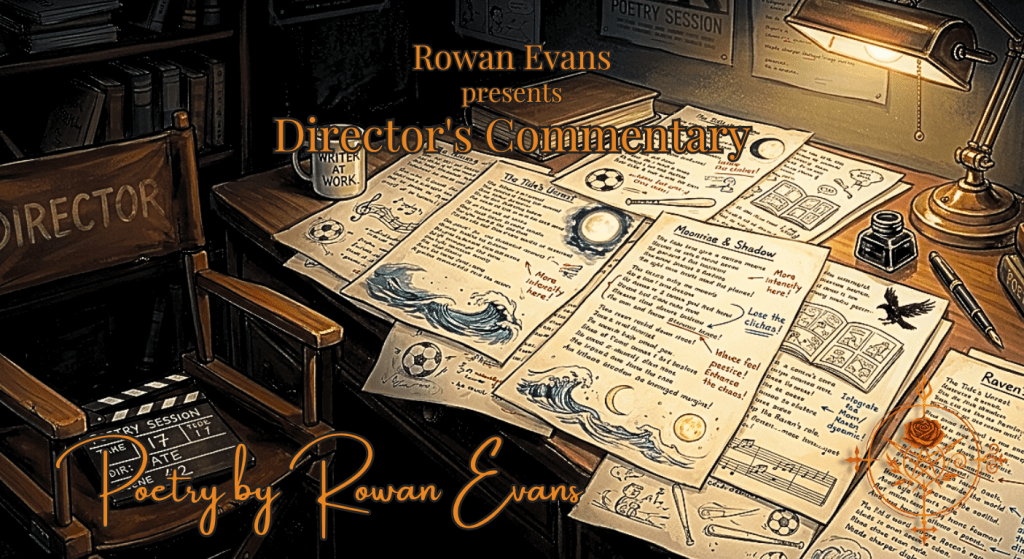
This poem came from imagining an overly critical director sitting just off-camera, pausing every scene to point out my habits.
“Another moon?”
“Really? The ocean again?”
“We’re doing ravens today?”
It’s the internal voice every creative person develops after making enough work. The one that starts recognizing your patterns before anyone else does.
Sometimes it’s helpful.
Sometimes it’s insufferable.
The joke, of course, is that the director isn’t entirely wrong.
I do write about the moon a lot.
I do return to oceans, tides, dreams, and ravens.
I do compare things to comic books, cartoons, sports, horror movies, and whatever random piece of culture my brain decides belongs in the poem that day.
Because those things aren’t decorations.
They’re the language my mind naturally speaks.
The final section—”Music—10/10. No Notes.”—is probably the closest thing to surrender in the entire poem.
Apparently my inner critic has limits.
Music gets a free pass.
Everything else is fair game.
Including me.
— Rowan Evans
“Every writer has recurring motifs. Mine just happened to get their own director’s commentary.” 🎬🌙✍️
Director’s Commentary Poetry by Rowan Evans
The Moon—
Here we go again, another moon metaphor.
What is it this time?
The moon shimmering above the bay? A stand in for her beauty—
Ocean—
My favorite metaphor.
The one I’ve used thousands upon thousands of times before— written in thousands of lines, in a thousand different rhymes.
Hyperbole.
The Tide—
Yes, there it is— the final piece of this overused metaphor chain, you say it’s different but it’s all the same.
Same moon. over the same bay, and it shimmers in the same way.
It’s almost like the moon, ocean, and tide are all that exist inside that little mind.
Ravens—
So spooky. So gothic.
You write ravens like you shop exclusively at Hot Topic.
They’re messengers. They witness. And once upon a time you even made them a centerpiece.
You took that way too seriously back in your “modern-day Poe” era.
A modern-day Poe?
Ridiculous.
Sports—
You don’t even watch those.
Why are you writing metaphors for the bros?
You think you’re great? Yeah, you’re The Babe. 23 years and a Jordan joke— okay, Shohei.
Random Cartoon Reference—
Which character are you going to grab this time?
Which bit of nostalgia are you going to try and exploit?
Random references, litter the page— Powerpuff Girls, Doug and Dexter.
So what’s next?
Something more obscure, or more mainstream?
Comic Books—
Tropes.
Superheroes and capes.
Random character grab, used in a metaphor that barely makes sense—
like Bane for line breaks? What the “#%@$” was that?
I’ll give you Two-Face for fakes and snakes, because that one makes sense.
Music—
10/10. No Notes.
Journey into the Hexverse…
[Pointing Me Home] The final poem in the No Metaphor Left Behind trilogy explores dreams, hope, and belonging. Through moonlight, ocean tides, and quiet conversation, Pointing Me Home reflects on carrying hope long before reaching the place you call home.
[Chemical X] Chemical X explores the rapid, associative way one creative mind moves—from cartoons to sports, comic books to music—revealing that inspiration isn’t linear, but a collision of memory, humor, rhythm, and intuition.
[Crossing the Sea] A deeply personal poem about relocation, longing, and the realization that some truths naturally arrive through metaphor—even when we try to leave it behind.
[Danny Phantom Theology] What begins as a metaphor borrowed from a childhood cartoon becomes something deeper: a reflection on existing between survival and possibility, exhaustion and hope, the life we have and the life we long for. Danny Phantom Theology explores what it means to keep moving toward a future that feels worth living.
[Frankenstein’s Monster (and I’m the Doctor)] Some poems are built to make a point. Others are built to reveal the mechanism. Frankenstein’s Monster (and I’m the Doctor) explores associative thinking, creative chaos, and the strange process of stitching disconnected ideas into something alive.
[Ocean Waves (1, 4, 3)] A moonlit shoreline, a rowboat full of ducks, a piggybank with no cents, and a confession hidden in plain sight. Ocean Waves (1, 4, 3) explores how humor, wordplay, and absurdity can become a side door to vulnerability when the truth feels too difficult to say directly.
[A Heart That Echoes in Another Language] A poetic journey through music across Japan, Korea, China, and the Philippines, exploring how sound becomes identity, memory, and emotional geography.
[Global Takeover] What if home isn’t a place—but something you build from the music you love? Global Takeover blends sound, culture, and identity into one borderless space.
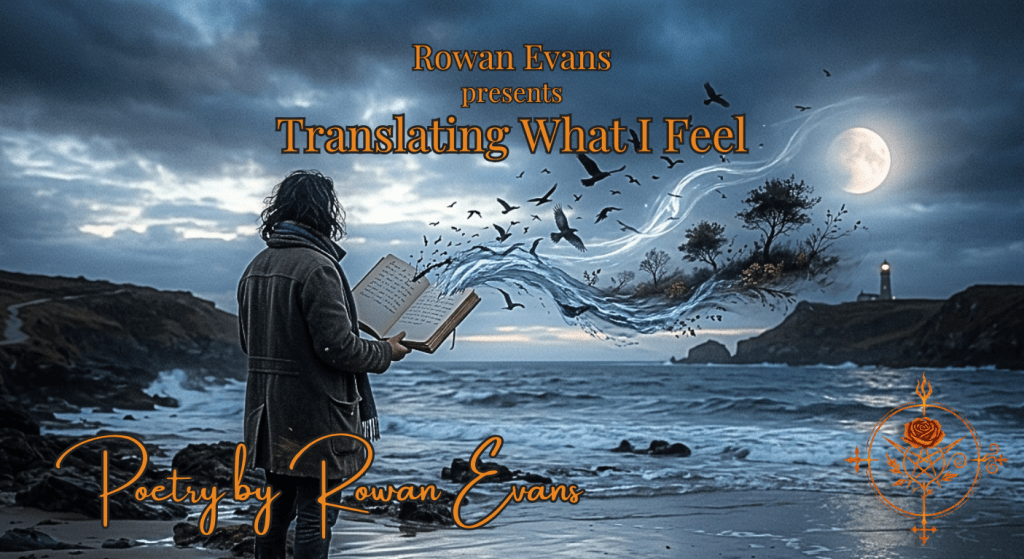
A single figure standing alone, staring into the distance like the opening shot of a film.
At first, the poem exists entirely outside the body. The speaker is observed rather than understood. We see the wind. The trees. The dirt beneath their feet. We hear a voice describing loneliness from a distance.
Then the question arrives:
“Is that the truth or the depression talking?”
For me, that’s the moment the camera moves.
The poem stops observing the speaker and starts inhabiting them.
Everything before that question is external.
Everything after it is internal.
The scenery gives way to self-examination. The loneliness becomes less important than the act of interrogating it. The poem begins pulling apart its own construction, examining how emotions become images and how images eventually become language.
In many ways, this piece accidentally became a poem about my entire creative process.
I’ve spent twenty-three years translating feelings into words.
Not just the dramatic emotions. Not just love, grief, or heartbreak.
Everything.
The strange moments. The passing thoughts. The questions that linger longer than they should.
The title came from that realization.
Because that’s what poetry has always felt like to me.
Translation.
An emotion enters one side of the mind.
An image emerges from the other.
And somewhere in between, a poem happens.
— Rowan Evans
Every poem begins as a feeling before it becomes a language.
Translating What I Feel Poetry by Rowan Evans
I stand, staring into the distance,
alone in this instance—
it’s just me and the breeze,
running through the trees.
I can feel cold dirt and stone
beneath my feet.
Wind brushes skin,
feather-light
like finger tips—
it reminds me
of how alone I am.
Is that the truth
or the depression talking?
Because sometimes
I feel alone
when there are people
around me.
That last stanza
moved like the tide.
A long line—
followed by one shorter,
then longer again.
Even when I don’t say it,
the ocean imagery arrives.
I don’t even have to try—
it just pours out of me,
like a dam breaking.
Everything held back,
rushes forth as the pen
hits the page.
You get the opening lines,
that’s where the truth slips.
Mid-stanza
is where the truth sits.
Then one or two lines
to really make the truth hit.
You see—
this is the creative side of me.
I feel something then translate it
inside of me,
from data to image
then I spit it in ink on the page.
I’ve spent 23 years
translating what I feel—
love, loneliness and rage…
happiness and pain.
Two sides of the coin,
they’re different
but the same.
So there I stood…
staring into the distance,
unsure if I was alone in that instance—
it was just me and the thoughts
running through my mind.
Slowly being translated
into poetic lines.
Journey into the Hexverse…
[Where Music Becomes Weather] Some songs feel like storms. Others feel like shelter. Where Music Becomes Weather explores how music shapes emotion, memory, and the landscapes we carry within us.
[Returning to My Bones] Some dreams fade the moment we wake. Others leave behind emotions that linger long after reality returns. Returning to My Bones explores the strange grief of leaving a dream that felt real enough to matter.
[Recognizes Home] A free-verse poem exploring the difference between love as dependency and love as choice. It challenges the idea that love must be need-based, instead centering the quiet strength of choosing someone while still remaining whole on your own.
Not the kind that arrives fully formed or carefully structured—but the kind that builds in fragments. Small irritations. Cultural noise. Half-remembered references. Thoughts that don’t arrive in order, but all at once.
What I wanted to capture here wasn’t a linear argument or a polished reflection on anger or identity.
It was the process itself.
The way the mind can jump from one idea to another without asking permission. The way language doesn’t always behave politely. The way emotion and memory and absurdity can occupy the same space without resolving into anything clean.
The Batman reference, the cartoon interruption, the sudden shift in tone—none of it is meant to smooth into coherence.
It’s meant to feel like it actually feels inside the moment of thinking it.
The line “This is how my mind works” is the turning point for me in the piece.
Not because it explains everything, but because it stops pretending everything needs to be explained.
Some poems are built to argue a point.
This one is built to show the mechanism.
And the ending—“Frankenstein’s Monster / And I’m the doctor”—isn’t meant as metaphor in the traditional sense.
It’s closer to recognition.
That the thing being called chaos is also something being assembled. Intentionally or not. Carefully or not. But still assembled.
And that sometimes the person inside the noise is also the one holding the pieces.
— Rowan Evans
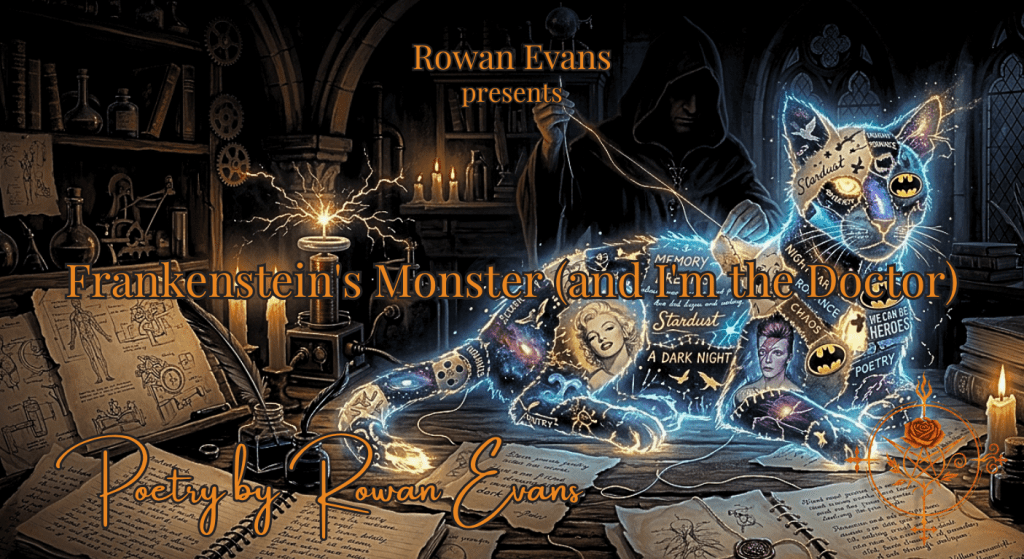
“My poetry? Frankenstein’s Monster. And I’m the doctor.” Sometimes creativity isn’t about finding order—it’s about assembling the pieces and bringing them to life.
Frankenstein’s Monster (and I’m the Doctor) Poetry by Rowan Evans
I’m sick of my surroundings;
sick of these fakes,
sick of the snakes,
they’re all just Batman villains—
Two-face.
Crazy is the way
they made me.
Twisted thoughts
that wouldn’t stop—
pop goes the weasel,
I R Baboon.
This is how my mind works.
It links two things
that are seemingly opposites.
They have nothing in common,
but still I piece them together—
my poetry?
Frankenstein’s Monster.
And I’m the doctor.
Journey into the Hexverse…
[Violets Are Violet (Roses Are Complicated)] A simple observation leads to an absurd conclusion: violets aren’t blue, roses aren’t always red, and the classic love poem may be far less accurate than advertised. A humorous free-verse poem about overthinking, flower symbolism, and the unintended consequences of analyzing clichés too closely.
[It’s Just Me but Super] A playful free-verse poem about cartoons, imagination, cosmic wanderings, and the strange magic of creativity. Through wordplay, nostalgia, and absurd humor, Rowan Evans explores what happens when ordinary life meets an extraordinary imagination.
[100 Grand and a Book Deal] A playful collision of candy bars, comic book heroes, basketball legends, and cosmic metaphors. Beneath the jokes lies a reflection on twenty-three years of writing, creativity, and the dream of building something lasting one line at a time.
Sometimes writing becomes survival before you even realize that’s what it’s turned into.
This piece came from the realization that I often disappear into craft when my mind gets too loud. I’ll drift into rhyme schemes, metaphors, cadence, imagery—anything that helps me stay afloat emotionally.
Not because I’m trying to escape life completely.
More because writing gives shape to feelings that otherwise feel impossible to carry.
A lot of this poem revolves around rootlessness: the feeling of growing in soil that never fully nurtured you, while still refusing to break under the pressure of it. And I think that distinction matters.
Struggling to root yourself somewhere doesn’t mean you’re weak. Sometimes it simply means the environment around you was never meant to hold the version of you that was trying to grow.
So this piece became less about collapse and more about persistence.
About continuing to create meaning even while feeling displaced.
About refusing to let your environment define your voice.
— Rowan Evans
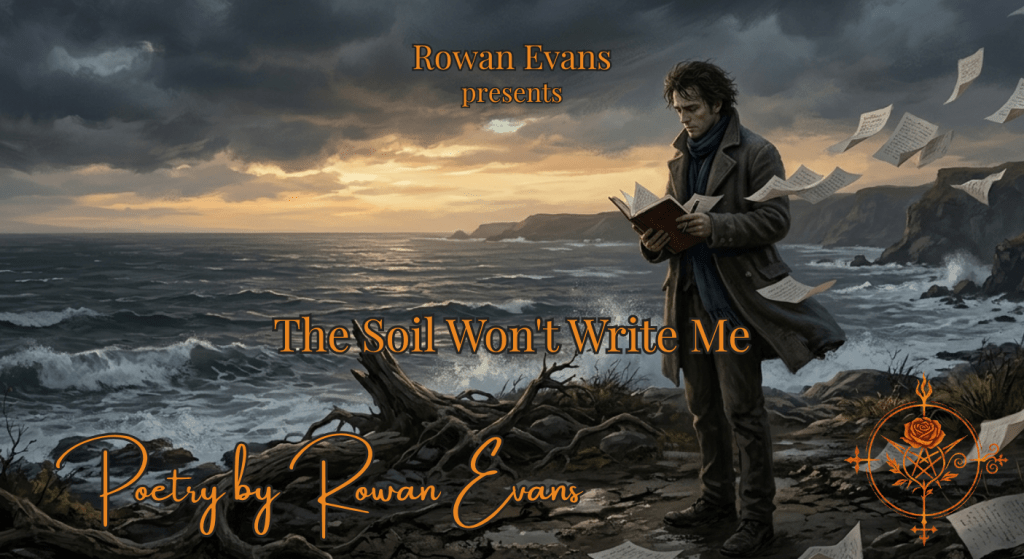
Some roots fail because the soil was never meant to hold them.
The Soil Won’t Write Me Poetry by Rowan Evans
I’m sorry—
I got lost again.
Drifting between lines,
bouncing between rhymes—
if life’s a game,
I keep forgetting to play.
Too focused on the craft,
lost sight of the life behind it.
Don’t worry—
I’m not in danger.
I’ve just gone quiet—
trying to silence
a mental riot.
Thoughts get too loud,
become a stranger to myself.
I get lost in the craft,
turn the pen to a life raft.
Ink crashes
like waves overhead,
carrying secrets
in the cadence
of the tides.
Because every rhyme
is a shoreline
on ocean’s edge.
And this is how it works for me—
it starts small
then quickly grows—
a seed
into a tree.
A tree big and tall,
but the foundation is weak—
there are no roots here
to anchor me.
They say I’d waver
in the slightest breeze.
But that’s not true,
just because I have no roots—
doesn’t mean that I will falter,
it just means
life won’t come with ease.
It just means
this soil wasn’t right for me—
and these people
cannot speak for me,
I write what I think
in ink and let that
carry what I mean.
All that means—
I won’t let this soil write for me.
And I’ll deal with
this stuck feeling,
that I feel
deep inside—
in the only way
I know how…
I’ve got to write it out,
can’t ignore it.
Got to ride it out.
Journey into the Hexverse…
[The Needle Doesn’t Point North] “The Needle Doesn’t Point North” is a deeply personal free verse poem about displacement, identity, and spending a lifetime feeling emotionally disconnected from the place you were born while being drawn toward distant shores.
[Weather in My Chest] “Weather in My Chest” is a free verse poem about emotional hyperawareness, social tension, and the quiet experience of carrying internal storms into rooms that react before a singl[e word is spoken.
[Sound as a Vessel] “Sound as a Vessel” is a free verse poem about music as emotional architecture, exploring how international artists and soundscapes shaped identity, creativity, memory, and poetic voice.
[Just Knowing You Has Been Enough] “Just Knowing You Has Been Enough” is a deeply vulnerable free verse poem about unspoken love, emotional fear, coded confessions, and the quiet truth of caring for someone without needing perfection in return.
[The Streets I Walk When I Sleep] “The Streets I Walk When I Sleep” is a deeply intimate free verse poem about recurring dreams, emotional connection, longing across distance, and the strange feeling of remembering places and moments that have never happened in waking life.
[Memories From a Life Yet to Come] Some dreams feel less like fantasy and more like memory. “Memories From a Life Yet to Come” is a reflective free verse poem about longing, displacement, emotional alignment, and the strange comfort of recognizing yourself more clearly in dreams than in waking life
[Separate Timelines] “Separate Timelines” is a surreal and deeply introspective free verse poem about emotional distance, time zones, vulnerability, and the fear of losing a connection that already feels meaningful before the words are ever spoken aloud.