Sometimes the loudest critic in the room is the one living inside your own head.
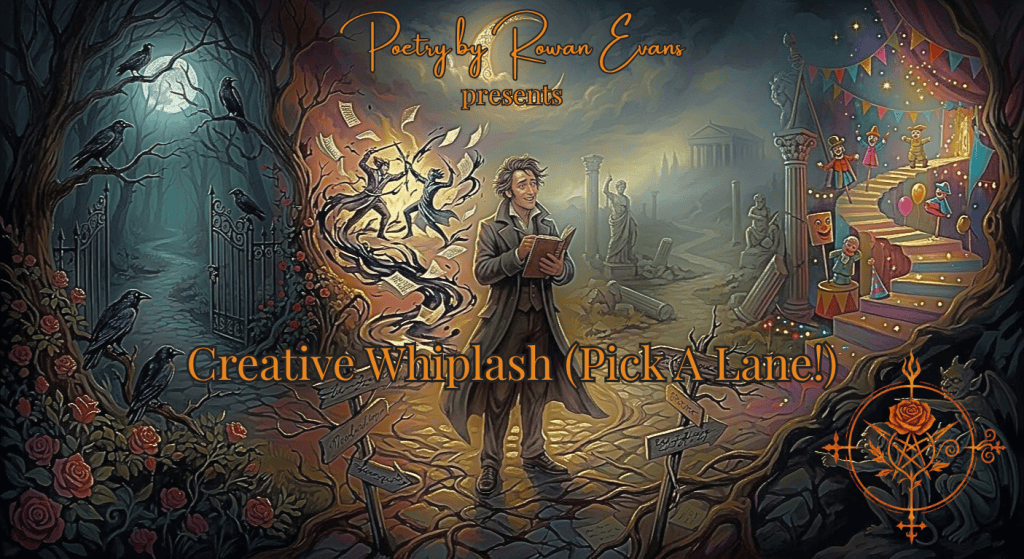
Creative Whiplash (Pick A Lane!) is about the pressure to define yourself as a writer, choose a style, and stay neatly within its boundaries—even when your creativity refuses to cooperate. One moment, I’m writing gothic poetry; the next, I’m throwing punchlines, weaving mythology, or drawing battle lines with a pen.
And somewhere in the middle of all that, the inner critic starts screaming that nothing makes sense.
The funny part? Sometimes the poem proves the critic wrong before the critic even finishes complaining.
Maybe I don’t need to pick a lane. Maybe creativity was never meant to be a straight road.
— Rowan Evans
Pick a lane? I tried. My creativity took the exit, changed three times, and somehow wrote a poem about it.
Creative Whiplash (Pick A Lane!) Poetry by Rowan Evans
I asked you to show me a metaphor—
you asked, what’s the meta for?
You said you’re a writer, are you sure?
Because I’m not anymore—
run on sentence, run on lines,
zero flow and zero rhymes—
that’s how you write.
Ironic—
I just proved myself
wrong, right?
Well, sometimes I get in my head,
convince myself that nothing I write
is ever good enough—
and no one can call my bluff.
Isn’t that rough?
Pick a lane! Pick a lane!
Repeated, screaming in my brain—
are you a gothic poet,
or do you draw battle lines?
Do you weave myths,
or write comedic shit?
Pick a lane! Pick a lane!
Repeated, screaming in my brain—
giving readers whiplash
with how fast, I switch lanes—
it’s a pain in the neck,
creativity, hard to keep in check.
This one began with a question I wasn’t entirely prepared to answer:
Who am I without writing?
I’ve spent more than two decades translating my inner world into poetry. Over time, writing stopped feeling like something I do and started feeling like the place where I exist most completely.
That’s a strange realization.
Because poetry isn’t simply expression for me—it’s construction.
Every poem is assembled from fragments: memories, emotions, images, conversations, dreams, fears, humor, hope. I rarely invent from nothing. I gather pieces of lived experience and stitch them together until they begin breathing on their own.
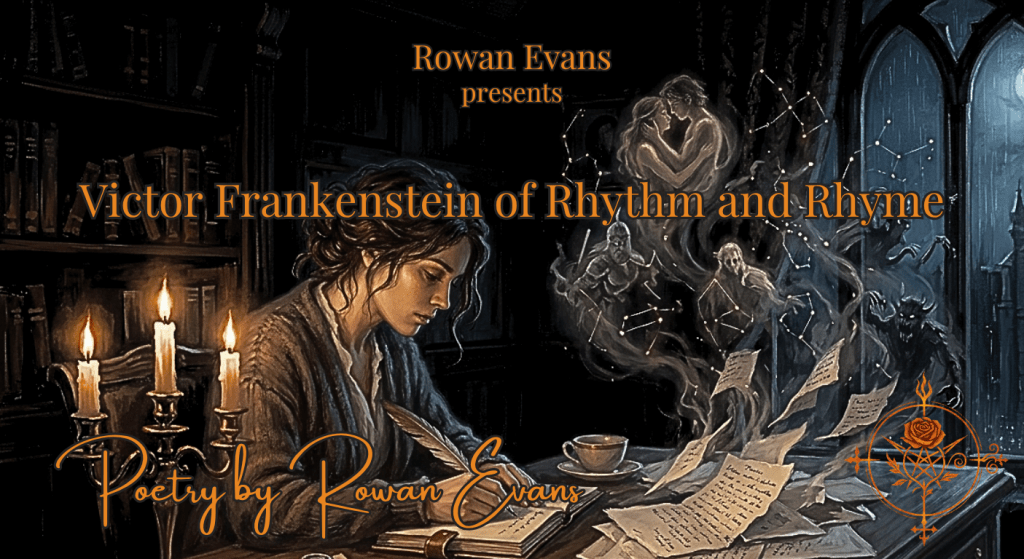
That’s where the title comes from.
Victor Frankenstein wasn’t remembered because he created life.
He was remembered because he assembled it.
That’s often what writing feels like to me.
I gather disconnected thoughts, broken emotions, recurring symbols, and scattered moments, then bind them together until they become something capable of standing on its own.
The result isn’t always comfortable.
Sometimes it’s beautiful.
Sometimes it’s monstrous.
Most often…
it’s simply honest.
— Rowan Evans
“Every poem begins as fragments—thoughts, memories, emotions, and images—stitched together until they learn how to breathe.”
Victor Frankenstein of Rhythm and Rhyme Poetry by Rowan Evans
I’ll be honest—
I don’t know who I am
without this,
without the ink to bleed—
what does my life even mean?
I know it means something—
but I’ve lost sight of it.
Because I’m like a god here—
I control the shape
the ink takes
and decide what it makes.
I create every piece
in my image.
I write universes into existence—
populate them with ghosts,
lovers, gods and monsters.
And every version of myself
I couldn’t survive as alone.
I translate my mental health
from the inside, no distance.
I take my mind
translate it into lines
and images—
stitch them together
as metaphors—
Victor Frankenstein
of rhythm, rhyme and imagery.
Journey into the Hexverse…
[Pointing Me Home] The final poem in the No Metaphor Left Behind trilogy explores dreams, hope, and belonging. Through moonlight, ocean tides, and quiet conversation, Pointing Me Home reflects on carrying hope long before reaching the place you call home.
[Caller ID: Destiny] Sometimes the places we visit in our dreams feel more like home than the places we wake up in. Caller ID: Destiny explores longing, belonging, and the quiet feeling that life is calling you toward somewhere new.
[Monster Theology] What if the monsters under the bed weren’t monsters at all? Monster Theology explores difference, belonging, and the human tendency to fear what we don’t understand through a conversation with the creatures we’ve spent our lives imagining.
[Frankenstein’s Monster (and I’m the Doctor)] Some poems are built to make a point. Others are built to reveal the mechanism. Frankenstein’s Monster (and I’m the Doctor) explores associative thinking, creative chaos, and the strange process of stitching disconnected ideas into something alive.
[I’ll Be There to See Your Sunrise] Love has never come easily to me. This poem explores the fear, vulnerability, and quiet courage required to stay emotionally present when connection begins to matter deeply. “I’ll Be There to See Your Sunrise” is about choosing love despite the risk of heartbreak—and promising to remain long enough to witness someone fully.
Music has always been more than background noise to me.
It’s emotional architecture.
There are songs that feel tied to specific versions of myself, specific periods of my life, specific emotional states I don’t know how to explain outside of sound.
When I write, I usually start with music first. Not ideas. Not themes. Feeling.
I sit in silence with headphones on and let the music guide me somewhere emotionally honest.
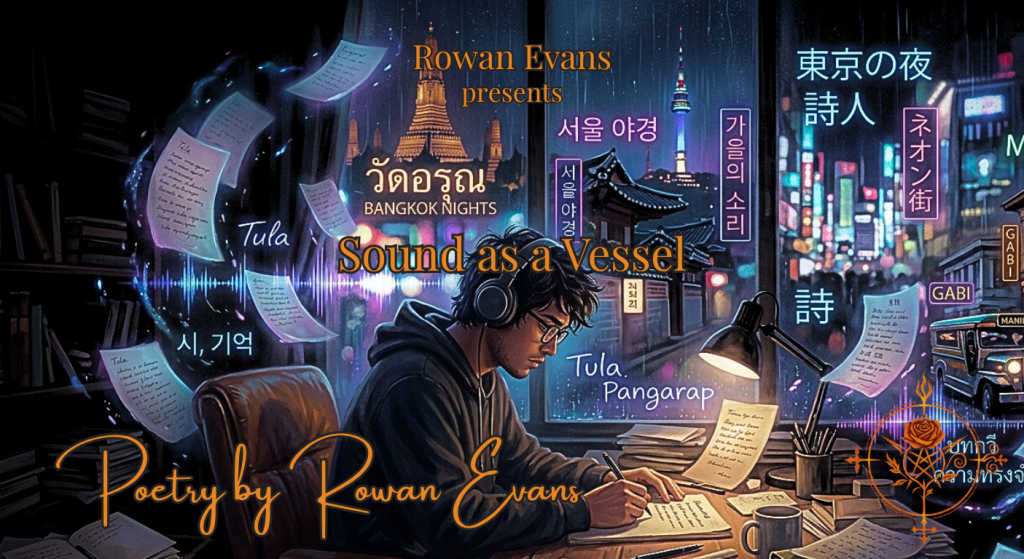
This piece came from thinking about how deeply international my creative influences really are.
A lot of the sounds that shaped me came from places I’ve never physically been: the Philippines, South Korea, Japan, Thailand.
And over time, those influences stopped feeling external. They became part of my emotional language.
Part of my rhythm. Part of my imagery. Part of how I understand myself creatively.
Also: yes, “Morning Daughters” is intentional.
It’s a poetic translation of the J-pop group Morning Musume because the translated phrasing fit the cadence of the piece better.
That felt appropriate for a poem about translation, transformation, and reshaping influence into something personal.
Because that’s ultimately what art is.
Taking in sound, emotion, memory, culture— and turning it into your own voice.
— Rowan Evans
Some people travel by plane. I travel by sound.
Sound as a Vessel Poetry by Rowan Evans
I want to take a moment
to talk about process—
the way I’ll sit
in silence,
with nothing
but the sound
from my headphones.
I sit, unmoved
and let the music
wrap around me.
I let it guide my emotion
and lead me where it may.
This is when I reach
across shores,
ignoring borders—
I reach for the sounds
that soothe me,
the sounds that move me
and make me feel.
I follow the notes
like they’re breadcrumbs—
back to the places
my body has never lived
but my heart remembers.
This is how I travel—
how I return
to the versions of myself
I haven’t met yet.
I put my headphones on
and drift away—
through different worlds,
from XG to Young Ji—
MILLI and 4EVE.
Then I drift back—
MC Sniper, Outsider
and Drunken Tiger.
It’s like I walk
through time,
using sound
as the vessel.
Then I hit Japan,
Morning Daughters
surround me.
Up next THE GAZETTE,
then Hamasaki Ayumi. (Queen!)
These are the sounds
that shaped my DNA.
Eminem lit the fire,
Ez Mil made it brighter.
I broke teeth
on Lee Hyori. (Queen!)
And I’ve expanded,
put more colors
on the canvas.
More lines
in my rhymes.
BINI, SB
19 and G22
Hev Abi, Skusta Clee,
Sarah Geronimo too—
just to change the shape
of the soundscape.
I use sound like paint
to make pictures,
mix it with my emotions
to find the perfect hue.
Journey into the Hexverse…
[Just Knowing You Has Been Enough] “Just Knowing You Has Been Enough” is a deeply vulnerable free verse poem about unspoken love, emotional fear, coded confessions, and the quiet truth of caring for someone without needing perfection in return.
[The Streets I Walk When I Sleep] “The Streets I Walk When I Sleep” is a deeply intimate free verse poem about recurring dreams, emotional connection, longing across distance, and the strange feeling of remembering places and moments that have never happened in waking life.
[Memories From a Life Yet to Come] Some dreams feel less like fantasy and more like memory. “Memories From a Life Yet to Come” is a reflective free verse poem about longing, displacement, emotional alignment, and the strange comfort of recognizing yourself more clearly in dreams than in waking life
[Separate Timelines] “Separate Timelines” is a surreal and deeply introspective free verse poem about emotional distance, time zones, vulnerability, and the fear of losing a connection that already feels meaningful before the words are ever spoken aloud.
The things we listen to, the artists we connect with, the sounds that shape how we think and feel… they build something in us.
Something that doesn’t need borders.
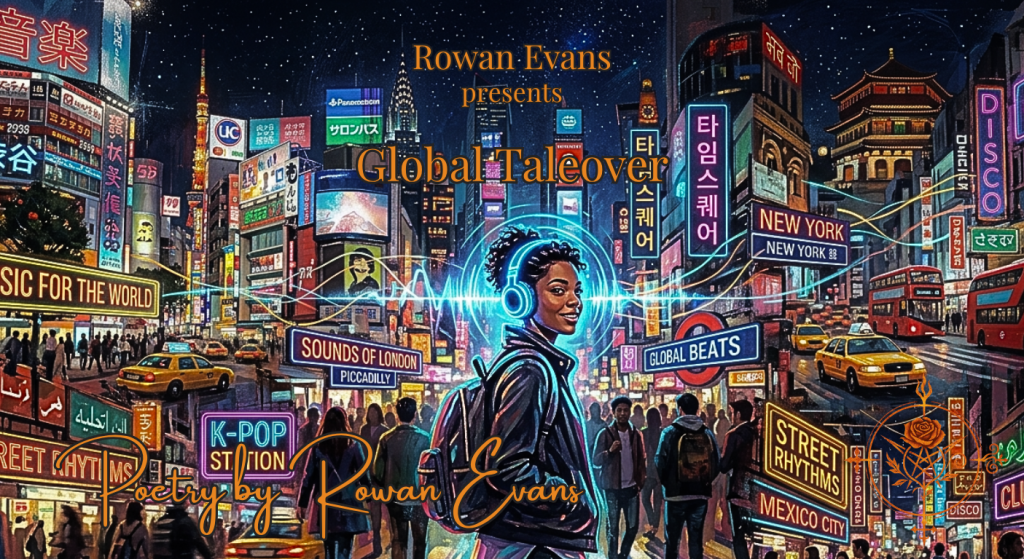
This piece is me leaning into that—letting all those influences exist in the same space, without trying to separate them by origin or language.
Because at some point, it stops being “global.”
It just becomes you.
— Rowan Evans
No borders. No passport. Just sound.
Global Takeover Poetry by Rowan Evans
Watch me— it’s a global takeover.
Take a right off MILLI Ave, look for the big house on the corner of Pixxie Street— address: 4EVE.
Walk up to the gate, punch in the code— SB19.
Keep your eyes on me—
like a sniper, MC. I’m The Outsider— fighting style: Drunken Tiger.
Paper on the table— the GazettE. Headline reads: Filth in the Beauty.
Sitting at an café— LM.C in my headphones.
Notebook open, ink scrawled across the page— Tommy february6…
it’s a date.
Stamped in sound— no passport needed.
I built a home out of everything I listen to.
Journey into the Hexverse!
[Of No Single Nation] What if belonging isn’t tied to where you’re from? Of No Single Nation explores identity beyond borders, reframing home as something found in connection rather than geography.
[Two Americans] What does it mean to share a country, a language, and still feel completely different? Two Americans explores identity, culture, and the quiet disconnect between people who should feel the same—but don’t.