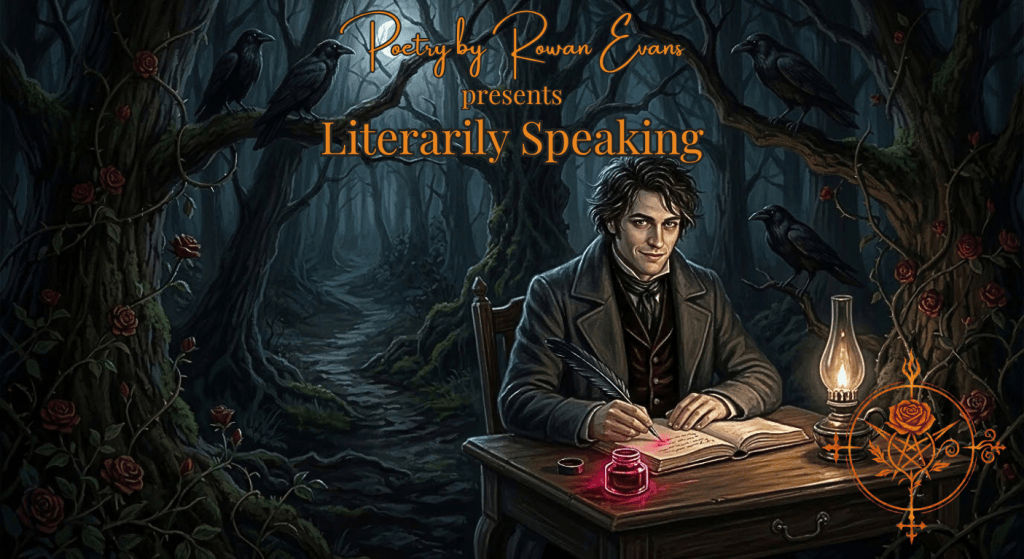
Literarily Speaking plays with the old assumption that silence means weakness—and then turns that assumption into a playground for metaphor, gothic imagery, and wordplay. The speaker doesn’t need fists, fury, or actual hatred to make an impact. A pen, a raven feather, a few rose petals, and a sufficiently sharp vocabulary will do just fine.
The mythology of Wish-A-Motherfucker Wood and the Fuck Around Valley is deliberately ridiculous, because this piece knows exactly what it is doing: dressing poetic confidence up like a threat before revealing that the real damage is entirely literary.
The point isn’t to hate harder.
It’s to write sharper.
Literarily speaking.
— Rowan Evans
I don’t need hate to eviscerate you—literarily speaking.
Literarily Speaking Poetry by Rowan Evans
They think because I’m quiet,
I’m an easy target—
so they talk a lot,
and they talk
like they forgot
where I stood,
bitch, I came up in the—
Wish-A-Motherfucker Wood.
Nestled in the Fuck Around valley,
come around here—you’ll Find Out.
So I pen my threats
in fresh crimson—
ink made from rose petals,
quill from raven feather—
that’s why I write the way I do—
because I know Unkindness well.
I know the world can be cruel,
but being full of hate isn’t cool—
and that’s why
I write the way I do—
I don’t need hate
to eviscerate you…
literarily speaking…
Journey into the Hexverse
[The Playground] What happens when mythology stops being something to hide behind and becomes architecture for the imagination? The Playground (Language, Metaphors and More) explores Rowan Evans’s relationship with language, symbolism, metaphor, humor, and twenty-three years of turning the page into a place where anything can happen.
And then there are poems that quietly reach through the page and take hold of something you thought belonged entirely to you.
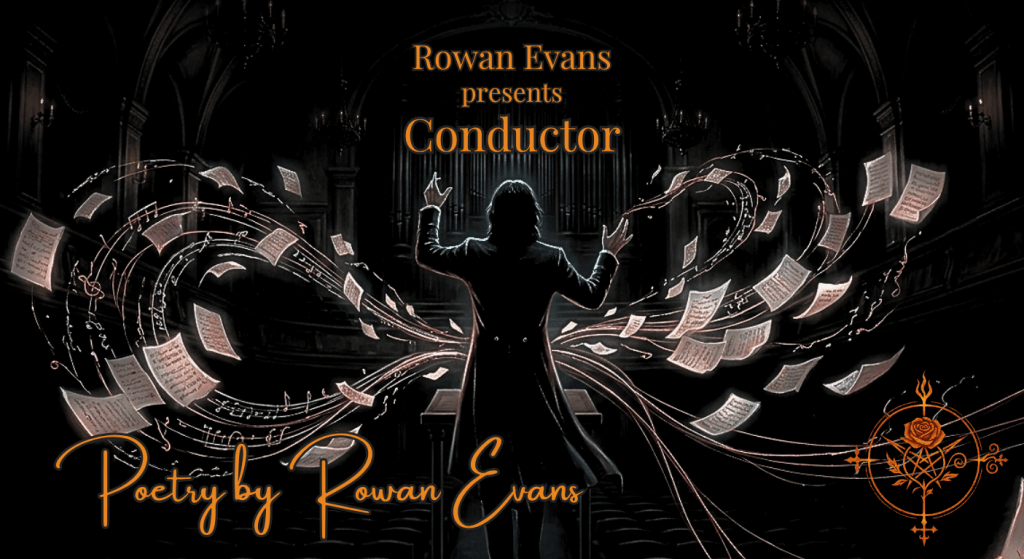
Conductor comes from that space—the strange little boundary between writer and reader, where words stop being marks on a page and start becoming something physical.
I wanted to play with that boundary.
So take a breath before you begin.
Then read.
— Rowan Evans
Some conductors lead an orchestra. Others conduct the breath between the lines.
Conductor Poetry by Rowan Evans
I’m a conductor—
watch me
control your breath.
Won’t even
be in the room—
you just have
to read the words
that I’ve left—
you can feel
my influence
in your chest—
I confess—
you breathe the way I tell you to,
this is what I will do—I will extend the lines,
implement some rhymes—show you,
that your breath is not your own,
it is mine to control—
Journey into the Hexverse…
[The Crypt] A mysterious man watches from a crypt as a woman enters the graveyard and kneels before an unnamed grave. In this compact gothic poem, fascination, death, and possession blur together beneath the shadows of the cemetery.
[Dreaming Wrong] A familiar dream becomes unsettling when the ocean becomes a pond, the tide disappears, the moon loses its reflection, and nothing feels quite like it belongs. Dreaming Wrong explores the uncanny feeling of finding yourself inside a dream that looks familiar—but feels like someone else’s.
[Did You Really Think This Was About Trees?] A playful love poem disguised as a forest of terrible tree puns. Beneath the birch, oak, cedar, palms, lumber, and absurdist wordplay is a poem about devotion, loyalty, laughter, and building a life with someone you love.
Some poems feel less like they’re written and more like they’re discovered.
A Rose in the Ashes came from following an image rather than an outline. One symbol led to another until the poem became a journey through memory itself—through forgotten moments, lingering wounds, recurring dreams, and the quiet realization that healing doesn’t happen by avoiding the past.
The forest in this poem isn’t meant to be a literal place. It’s the landscape of memory, where some experiences remain vivid while others decay with time. The trees, the tunnel, the moon, the bay, and finally the rose all became landmarks within that emotional terrain.
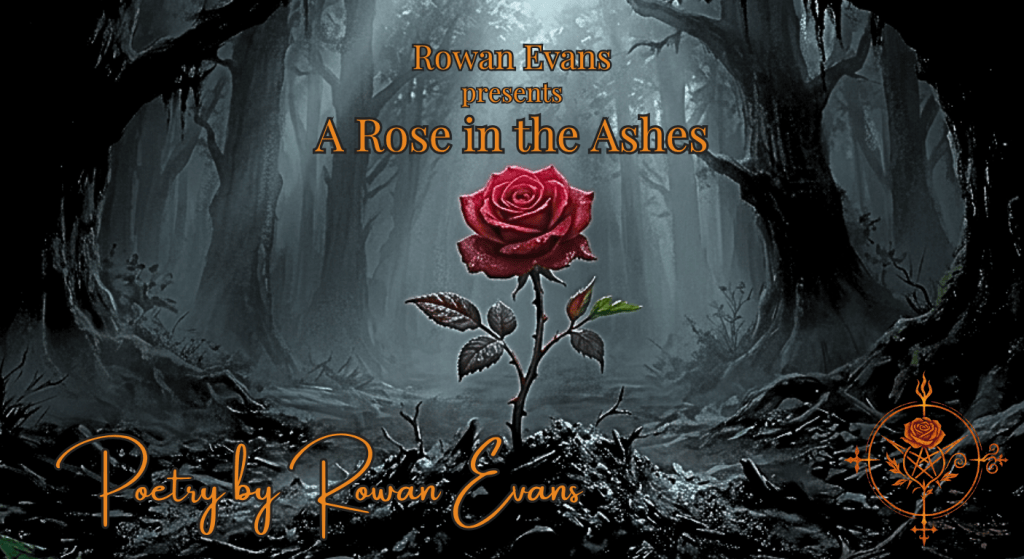
The final image—a single rose blooming through ashes—reminded me that even after devastation, beauty doesn’t disappear forever. Sometimes it simply waits beneath the surface until we’re ready to notice it.
— Rowan Evans
Sometimes healing doesn’t appear as a blazing light at the end of the tunnel.
Sometimes it’s a single rose, quietly blooming where you thought only ashes remained.
A Rose in the Ashes Poetry by Rowan Evans
I wander through the mist and fog,
wondering if I’ve gotten myself lost.
The trees are thick with sickly green leaves,
and the air is too thick, it’s hard to breathe.
Every step feels borrowed,
like the ground isn’t sure
it wants to hold me.
It’s like with every step
the ground shifts a little to the left,
until nothing feels right.
It’s like I’ve walked
to the end of the tunnel,
but I didn’t find the light.
I keep walking, stumbling along—
the dark swallows me whole
and then spits me out.
I hit the ground and roll to a stop
on the edge of a fifty foot drop.
That’s when I see it,
something moving between the trees—
not a creature,
but a feeling—
the sense that I’m being asked
to keep going
even when I don’t know why.
Maybe it’s because
I didn’t find the light
at the end of the tunnel,
not because I failed—
but because the journey isn’t done.
The light signifies the end.
No light means the journey continues,
so I keep moving through—
the streets that I walk in sleep,
the moment I return to my bones,
or a war with gods to ease the pain.
Yeah, I followed the footprints
to the water’s edge,
I stared across at the coast
on the other side of silence.
And even from a distance,
I was able to trace
the moon across the heavens,
before it became suspended over the bay—
its reflection trembling across the dark water,
a mirror to the tremor in my chest.
But I couldn’t stay still for long—
I had to keep moving on.
So I ran—
bolted for the tree line,
tripped and stumbled in
and my eyes caught the way the light
pierced the canopy—
the light—
that’s what I’d been chasing
this whole time,
not at the end of the tunnel—
but above my head,
an idea—
my eyes drift toward the sky,
and that’s when I see—
the leaves on these trees
are not leaves,
they are memories—
some bright and vivid,
others a sickly shade of green.
Those are memories forgot,
memories left to rot.
But here’s the truth of this plot:
some memories fade—
whether you hold on or not,
and some become rooted
through pain, an environment
permanently changed.
And that’s what I saw…
trees with leaves
showing things—
I thought long forgotten.
I was more surprised by that,
than the fact that so many trees
looked rotten.
I could feel the tears
touch the corners of my eyes—
the air was thick again,
humid and suffocating.
There was a tremor in my chest,
and knees were weak—
with every step my bones were quaking,
like the earth was shaking.
I stumbled and fell to my knees,
head bowed—
in shame or respect,
who knows, now?
I opened my mouth,
but no jokes came out—
I couldn’t misdirect from this,
no sleight of hand.
I had to face this—
whatever it is,
whatever these leaves
show me,
I’ve got to take it seriously—
because maybe it is these memories
that are keeping me stuck here.
Maybe they are the memories
that drive the fear,
that keeps me from acting—
that keeps me dragging feet
and self-sabotaging.
Slowly I rise—
like the sun over the horizon.
Knees shaking from the weight of me,
I struggle to take one step
and then another.
I stumble through the ruins
of thoughts, dreams and memories—
my chest rises and falls,
like oxygen is in short supply.
Then I see it—
a single rose in bloom,
poking through the ashes
of nights only remembered
in the spilled ink on silent pages.
Journey into the Hexverse…
[One Honest Sentence] It’s easy to write about anything. What’s difficult is writing one completely honest sentence without hiding behind humor, references, or metaphor. One Honest Sentence explores the distance between poetic confidence and emotional vulnerability.
[Leave No Self Behind] What if finding yourself isn’t about discovering someone new, but learning to walk beside every version you’ve ever been? “Leave No Self Behind” is a meditation on memory, healing, and embracing the selves we once abandoned.
[More Afraid Than the Ink] Some confessions are easy to write but impossible to speak. More Afraid Than the Ink explores fear, dreams, recurring symbols, and the quiet realization that the page has always been braver than the poet.
[Just Human] Just Human is a reflective free verse poem about seeing people before borders, choosing empathy over division, and finding home in our shared humanity rather than on a map.
[Translating What I Feel] A poem about the invisible process of turning emotion into imagery, imagery into language, and language into poetry. An intimate reflection on creativity, loneliness, and twenty-three years of learning to translate what the heart feels.
Perspective is one of the strangest things we possess.
Two people can stand in the same place, witness the same moment, and walk away carrying completely different worlds inside them.
I’ve spent a lot of time thinking about that—not as something that separates us, but as something that makes us interesting.
This poem isn’t saying one perspective is better than another. It isn’t about claiming superiority.
It’s about accepting that no one else can inhabit your mind.
No one else sees exactly what you see, makes the same connections, or experiences the same emotional landscape. We can describe our inner worlds through art, conversation, and metaphor, but there will always be a distance between experiencing something and hearing someone describe it.
As a poet, I spend much of my life trying to bridge that distance.
This poem acknowledges that the bridge will never be perfect—and that’s okay.
Our perspectives don’t need to become identical to be meaningful.
Sometimes it’s enough to simply recognize that every person is looking through a different window.
— Rowan Evans
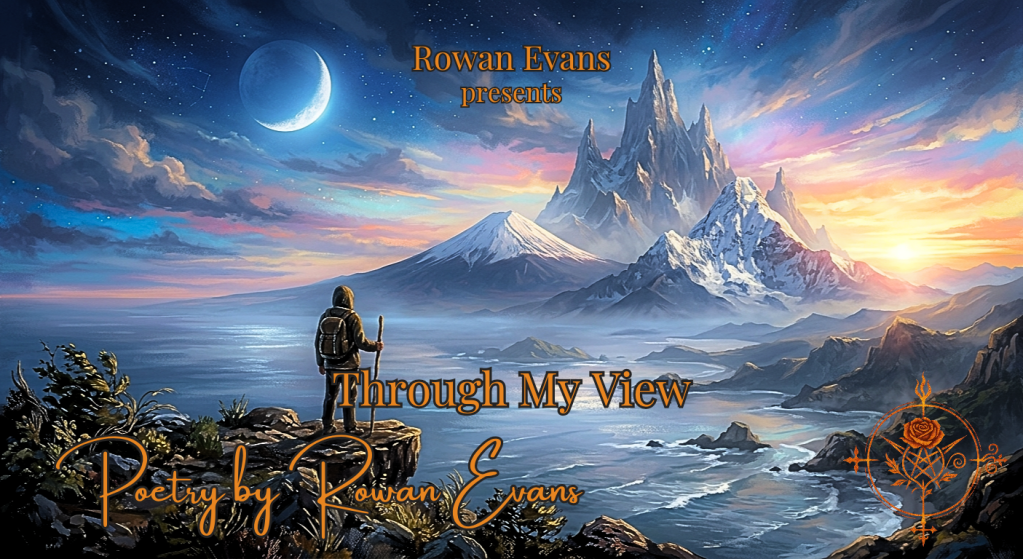
No one else can stand exactly where you stand or see the world through your eyes.
Through My View Poetry by Rowan Evans
It’s eight, I hear the birds chirp. It’s late, I’m awake— what’s new?
Silence. It’s violence— the words that I choose, when I’m cut loose.
Like my thoughts, I’m off leash— you can’t stop me.
I’ve got a mind that stacks lines, mountains high, metaphors rise—
higher than Fuji, higher than Everest.
You’ll never finish this climb, your mountains will never match mine. You could do this for the rest of your life—
but you’ll never cross my ocean, you’ll never see my moon with your own eyes. You’ll never feel the pull of my tide—
because your mind doesn’t work like mine. You’ll never see the beauty in my horizon line—
the way the colors shift and shine with the change of time.
You’ll never see the world like— I do, you’ll never see the world through— my view.
Journey into the Hexverse…
[Just Human] Just Human is a reflective free verse poem about seeing people before borders, choosing empathy over division, and finding home in our shared humanity rather than on a map.
[Monster Theology] What if the monsters under the bed weren’t monsters at all? Monster Theology explores difference, belonging, and the human tendency to fear what we don’t understand through a conversation with the creatures we’ve spent our lives imagining.
[Before We Created The Labels] Ancient gods return to a fractured world shaped by borders, identities, and separation. “Before We Created the Labels” explores humanity’s divisions through mythic imagery, sacred ritual, and symbolic collapse—asking what remains when we learn to see one another beyond labels.
[No You and I, Ony Us] A hopeful free verse poem about empathy, borders, and imagining a world where humanity matters more than division.
[Two Americans] What does it mean to share a country, a language, and still feel completely different? Two Americans explores identity, culture, and the quiet disconnect between people who should feel the same—but don’t.
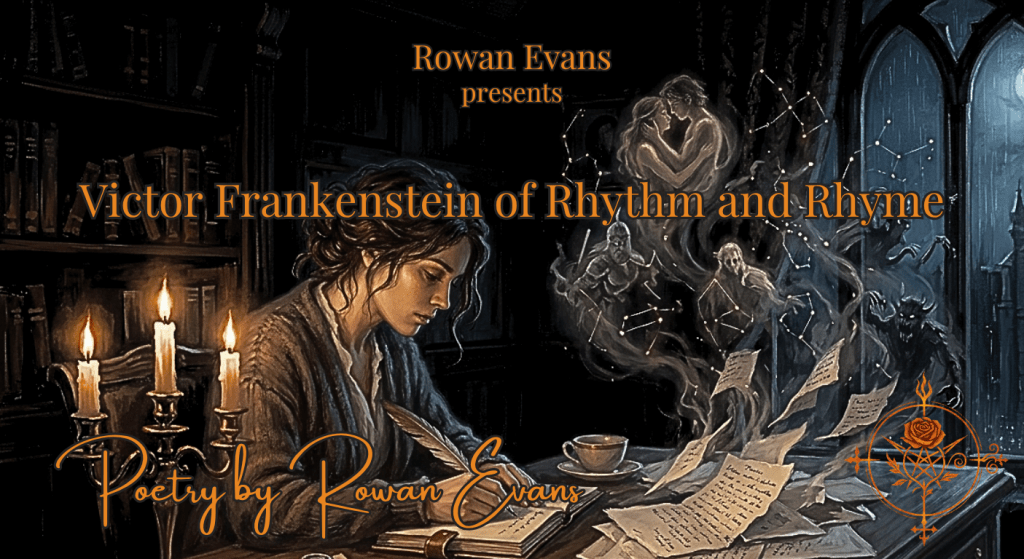
This one began with a question I wasn’t entirely prepared to answer:
Who am I without writing?
I’ve spent more than two decades translating my inner world into poetry. Over time, writing stopped feeling like something I do and started feeling like the place where I exist most completely.
That’s a strange realization.
Because poetry isn’t simply expression for me—it’s construction.
Every poem is assembled from fragments: memories, emotions, images, conversations, dreams, fears, humor, hope. I rarely invent from nothing. I gather pieces of lived experience and stitch them together until they begin breathing on their own.
That’s where the title comes from.
Victor Frankenstein wasn’t remembered because he created life.
He was remembered because he assembled it.
That’s often what writing feels like to me.
I gather disconnected thoughts, broken emotions, recurring symbols, and scattered moments, then bind them together until they become something capable of standing on its own.
The result isn’t always comfortable.
Sometimes it’s beautiful.
Sometimes it’s monstrous.
Most often…
it’s simply honest.
— Rowan Evans
“Every poem begins as fragments—thoughts, memories, emotions, and images—stitched together until they learn how to breathe.”
Victor Frankenstein of Rhythm and Rhyme Poetry by Rowan Evans
I’ll be honest—
I don’t know who I am
without this,
without the ink to bleed—
what does my life even mean?
I know it means something—
but I’ve lost sight of it.
Because I’m like a god here—
I control the shape
the ink takes
and decide what it makes.
I create every piece
in my image.
I write universes into existence—
populate them with ghosts,
lovers, gods and monsters.
And every version of myself
I couldn’t survive as alone.
I translate my mental health
from the inside, no distance.
I take my mind
translate it into lines
and images—
stitch them together
as metaphors—
Victor Frankenstein
of rhythm, rhyme and imagery.
Journey into the Hexverse…
[Pointing Me Home] The final poem in the No Metaphor Left Behind trilogy explores dreams, hope, and belonging. Through moonlight, ocean tides, and quiet conversation, Pointing Me Home reflects on carrying hope long before reaching the place you call home.
[Caller ID: Destiny] Sometimes the places we visit in our dreams feel more like home than the places we wake up in. Caller ID: Destiny explores longing, belonging, and the quiet feeling that life is calling you toward somewhere new.
[Monster Theology] What if the monsters under the bed weren’t monsters at all? Monster Theology explores difference, belonging, and the human tendency to fear what we don’t understand through a conversation with the creatures we’ve spent our lives imagining.
[Frankenstein’s Monster (and I’m the Doctor)] Some poems are built to make a point. Others are built to reveal the mechanism. Frankenstein’s Monster (and I’m the Doctor) explores associative thinking, creative chaos, and the strange process of stitching disconnected ideas into something alive.
[I’ll Be There to See Your Sunrise] Love has never come easily to me. This poem explores the fear, vulnerability, and quiet courage required to stay emotionally present when connection begins to matter deeply. “I’ll Be There to See Your Sunrise” is about choosing love despite the risk of heartbreak—and promising to remain long enough to witness someone fully.
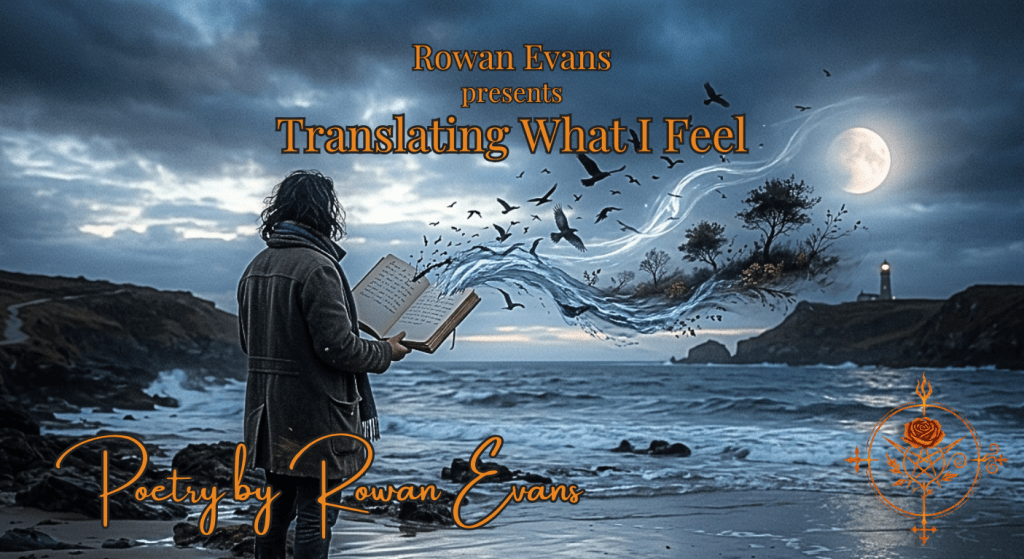
A single figure standing alone, staring into the distance like the opening shot of a film.
At first, the poem exists entirely outside the body. The speaker is observed rather than understood. We see the wind. The trees. The dirt beneath their feet. We hear a voice describing loneliness from a distance.
Then the question arrives:
“Is that the truth or the depression talking?”
For me, that’s the moment the camera moves.
The poem stops observing the speaker and starts inhabiting them.
Everything before that question is external.
Everything after it is internal.
The scenery gives way to self-examination. The loneliness becomes less important than the act of interrogating it. The poem begins pulling apart its own construction, examining how emotions become images and how images eventually become language.
In many ways, this piece accidentally became a poem about my entire creative process.
I’ve spent twenty-three years translating feelings into words.
Not just the dramatic emotions. Not just love, grief, or heartbreak.
Everything.
The strange moments. The passing thoughts. The questions that linger longer than they should.
The title came from that realization.
Because that’s what poetry has always felt like to me.
Translation.
An emotion enters one side of the mind.
An image emerges from the other.
And somewhere in between, a poem happens.
— Rowan Evans
Every poem begins as a feeling before it becomes a language.
Translating What I Feel Poetry by Rowan Evans
I stand, staring into the distance,
alone in this instance—
it’s just me and the breeze,
running through the trees.
I can feel cold dirt and stone
beneath my feet.
Wind brushes skin,
feather-light
like finger tips—
it reminds me
of how alone I am.
Is that the truth
or the depression talking?
Because sometimes
I feel alone
when there are people
around me.
That last stanza
moved like the tide.
A long line—
followed by one shorter,
then longer again.
Even when I don’t say it,
the ocean imagery arrives.
I don’t even have to try—
it just pours out of me,
like a dam breaking.
Everything held back,
rushes forth as the pen
hits the page.
You get the opening lines,
that’s where the truth slips.
Mid-stanza
is where the truth sits.
Then one or two lines
to really make the truth hit.
You see—
this is the creative side of me.
I feel something then translate it
inside of me,
from data to image
then I spit it in ink on the page.
I’ve spent 23 years
translating what I feel—
love, loneliness and rage…
happiness and pain.
Two sides of the coin,
they’re different
but the same.
So there I stood…
staring into the distance,
unsure if I was alone in that instance—
it was just me and the thoughts
running through my mind.
Slowly being translated
into poetic lines.
Journey into the Hexverse…
[Where Music Becomes Weather] Some songs feel like storms. Others feel like shelter. Where Music Becomes Weather explores how music shapes emotion, memory, and the landscapes we carry within us.
[Returning to My Bones] Some dreams fade the moment we wake. Others leave behind emotions that linger long after reality returns. Returning to My Bones explores the strange grief of leaving a dream that felt real enough to matter.
[Recognizes Home] A free-verse poem exploring the difference between love as dependency and love as choice. It challenges the idea that love must be need-based, instead centering the quiet strength of choosing someone while still remaining whole on your own.