Tag: pop culture poetry

  • Author’s Note

    Sometimes a metaphor refuses to behave.

    This piece started with ice, took a few unexpected detours through pop-culture references, and eventually decided that being “cold” was nowhere near the right description anyway.

    So I stopped fighting the metaphor and let the fire take over.

    Because sometimes the pen doesn’t freeze.

    It smolders.

    — Rowan Evans
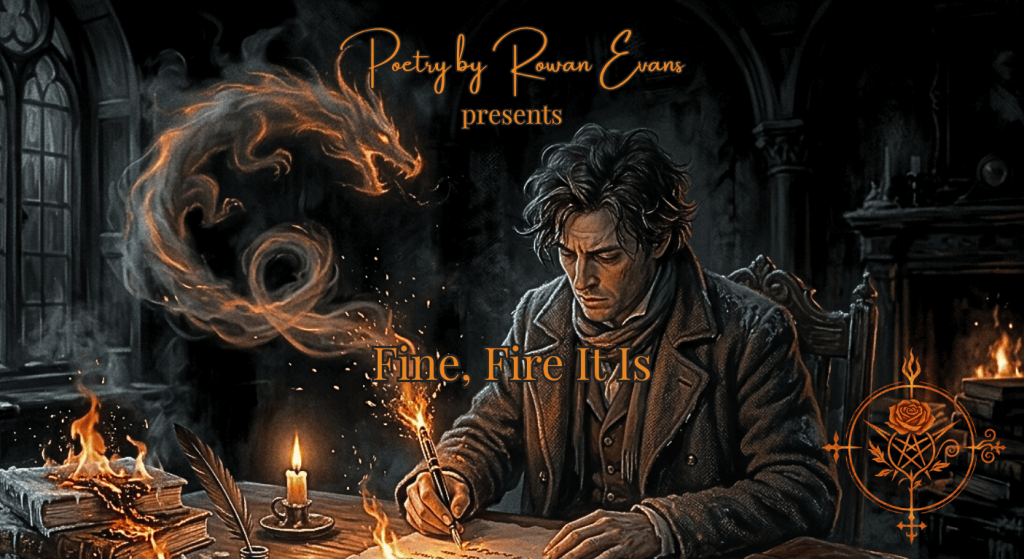

    A poet writing with a smoking pen as melting ice gives way to flames and glowing embers.
    The metaphor started cold. The pen decided it had something hotter to say.

    Fine, Fire It Is
    Poetry by Rowan Evans

    I’ll drop a Frozen bar because I’m cold—
    Emma Frost—hold on—that reference doesn’t land,
    it’s not ice, her skin turns to diamonds, man.

    It wasn’t in reference to her skin—

    well, what was it then?

    Her cold ass personality, duh, that’s the reality—
    she’s not nice, she’s mean—a real Ice Queen.

    Could have gotten there faster
    with Iceman, Bobby Drake—

    Or better yet, I could have said—
    I’ll drop a Frozen bar, because I’m cold—
    like Frozone, where’s my super suit?

    Fine.
    We’ll skip ice.

    That’d be nice,
    right?

    Cool—
    no, wait—
    not cool.
    We said we’re done with that.

    Fine then,
    fire it is—

    I pen flames,
    draggin’ ink across the page
    like a dragon’s rage—
    scorchin’ margins,
    burnin’ through the lines
    like I’m tryin’ to cremate the rhyme.

    See?
    This is why I shouldn’t switch metaphors—
    I get carried away,
    turn a spark into a wildfire,
    turn a wildfire into a prophecy,
    turn a prophecy into a punchline.

    But whatever—
    heat fits better anyway.
    I’m not cold,
    I’m molten—
    I don’t freeze,
    I smolder.

    And if ice didn’t land,
    fire always will—
    because even when I’m calm,
    my pen still smokes
    from the last thing I wrote.


    Journey into the Hexverse

    [Exhibit A]
    A quick-witted, unapologetically playful poem about writing fast, crossing lines, roasting the competition, and letting rhythm do the talking.

    [Why So Serious?]
    A playful, chaotic poem packed with pop-culture references, superhero imagery, Disney characters, wordplay, and the kind of ridiculous puns that make the poet wonder why they were ever given a pen.

    [Welcome to the Hexverse]
    Step into the Hexverse—a poetic world where mythmaking, humor, rage, creativity, and confession collide, and darkness becomes something that can be reshaped into art.

    If you’re interested in more poetry, you can find it here → [The Library of Ashes]

  • Author’s Note

    I’ve always found it interesting who we relate to in fiction—and apparently, my answer is the villains.

    Not necessarily because I agree with everything they do, but because I recognize pieces of myself in their intensity, their flaws, their ambition, their pettiness, and sometimes even the way they try to make sense of the world.

    So this is me admitting that my fictional character roster might raise a few questions.

    Vader. Maul. Thawne. Light.

    Yeah.

    I know.

    — Rowan Evans


    A dark fictional-villain-inspired scene surrounding a solitary poet holding a glowing pen.
    Maybe the villains aren’t relatable because they’re right—maybe they’re relatable because they’re human.

    Who Do I Relate To in Fiction?
    Poetry by Rowan Evans

    I relate to the villains—
    Like Vader, who loved so hard
    he became a monster—
    sure he killed Padmé,
    but was that really
    little Ani’s fault?
    Because I blame Obi-Wan—
    you see, if Kenobi
    had not of gone—
    if he hadn’t have been
    on Mustafar,
    Padmé would still be here.

    And I relate with Maul,
    because he had it all—
    the flips, the tricks,
    the sweet lightsaber
    with twice the blade—
    but his overconfidence
    was his downfall.
    That’s why I keep mine in check,
    I’m not ready to split yet.

    I relate to Eobard Thawne.
    That’s the level of petty
    that I aspire to,
    because if I don’t like you—
    and I mean, really don’t like you,
    I make it my job
    to keep you feeling off.
    It’s nothing big,
    just little and inconvenient—
    until it’s not.
    (Sorry, Mrs. Allen.)

    I also relate to Light Yagami—
    because he likes to write,
    and I like to write too.
    We both write names in notebooks,
    try to shape fate with words—
    the difference is, where my ink
    sometimes heals—
    his only hurts.


    Journey into the Hexverse

    [It Could Have Been…]
    A playful little love poem about strawberries, roses, and the wonderfully ridiculous ways romance can show up when you know someone doesn’t like the traditional version.

    [Exhibit A]
    A quick-witted, unapologetically playful poem about writing fast, crossing lines, roasting the competition, and letting rhythm do the talking.

    [Why So Serious?]
    A playful, chaotic poem packed with pop-culture references, superhero imagery, Disney characters, wordplay, and the kind of ridiculous puns that make the poet wonder why they were ever given a pen.

    If you’re interested in more poetry, you can find it here → [The Library of Ashes]
  • Author’s Note

    Some poems arrive with a grand idea behind them.

    This one arrived with a bunch of fictional characters, a handful of terrible puns, and apparently no intention of behaving itself.

    So, before you read too seriously into it, consider this your invitation to just have fun with it. It’s a little chaotic, a little nerdy, and very much written with a grin behind the pen.

    Welcome to the nonsense.

    — Rowan Evans


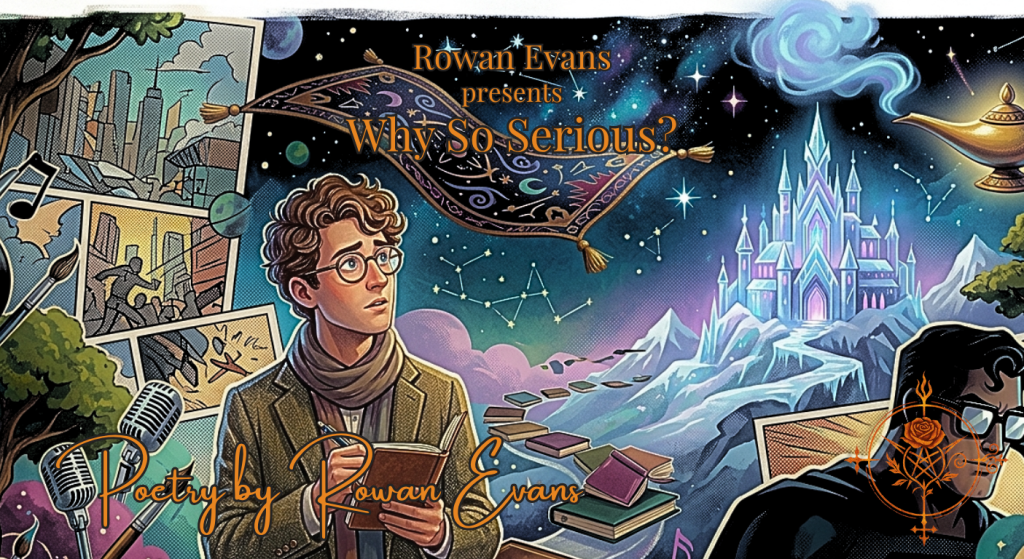
    A playful surreal illustration of a poet flying through a chaotic fantasy world filled with magical, superhero, and science-fiction imagery.
    Sometimes the hero’s journey is just an excuse to make terrible puns.

    Why So Serious?
    Poetry by Rowan Evans

    I must be Aladdin—
    because my Jasmine
    is so Jafar away.
    Three wishes from Genie
    trying to get to her,
    you say that’s a waste—
    but what Elsa am I to do?
    I am on the move,
    magic carpet ride—
    and I can’t let it go,
    I’m already Anna the way.
    I guess you can say
    this is my hero’s journey—
    head in the clouds,
    my feet not on the ground—
    I had a joke to put here,
    but it would Neverland—
    I hope I stay young forever,
    like Peter Pan…

    I’m a Skywalker, like Luke—
    I’m a Leia down the truth,
    I’m not a rapper, my pen is—
    the page is my booth.
    When I step in, glasses come off—
    Clark Kent is gone, it’s Superman to you.


    Journey into the Hexverse

    If you’re interested in more poetry, you can find it here → [The Library of Ashes]
  • Author’s Note

    Sometimes I sit down with a pen and decide I’m going to behave.

    That usually lasts about three lines.

    Behind These Bars (Idol Chatter) is one of those pieces where the writing gets a little cocky, the jokes start stacking up, and the references begin sneaking through the cracks. It’s playful, competitive, and intentionally ridiculous in places.

    So consider this a little verbal sparring session.

    No hard feelings.

    Probably.

    — Rowan Evans


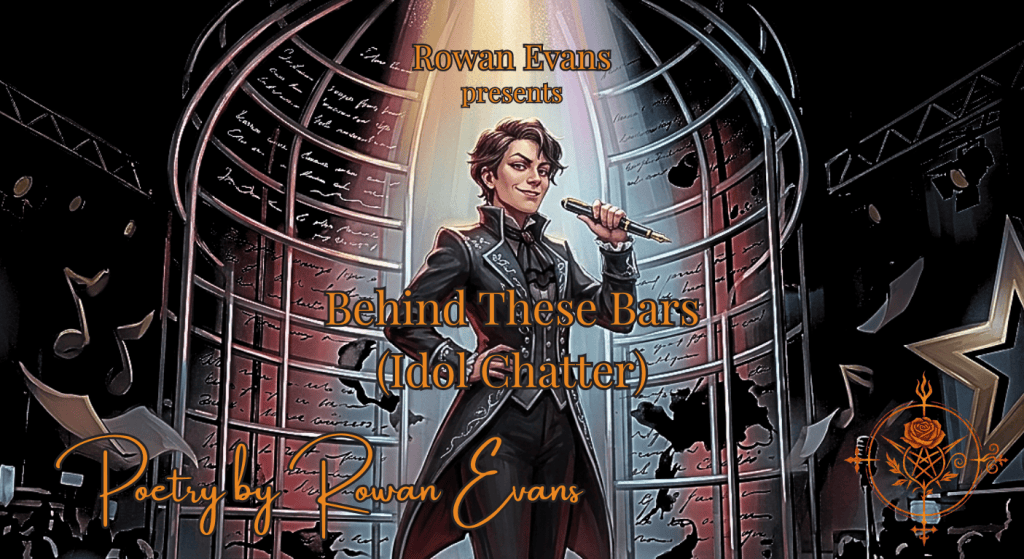
    A confident poet holds a fountain pen like a microphone on a surreal stage surrounded by glowing bars made of ink and handwritten lines.
    The meet-and-greet is over. The pen has entered the battle.

    Behind These Bars (Idol Chatter)
    Poetry by Rowan Evans

    Oh, look at you—
    look what you can do
    with a pen—it’s cute,
    but you can’t win—
    yet you think you can?

    Damn, man—
    what was your plan?
    How were you going
    to get the best of me?

    Get in line—
    get ready for the meet and greet,
    I’ll sign your autograph,
    cause I—

    I know I’m your Idol,
    American,
    shape the ink like clay,
    ’til it’s achin’—
    I’m Stronger now,
    and not Because Of You,
    so listen quick, remember bitch,
    you’ll want to remember where you were at
    during A Moment Like This—

    that was three straight references
    to Clarkson, Kelly—
    sit down, talk show, telly.
    It’s just jokes bitch, I can get silly—
    that’s just how the mind
    Behind These Hazel Eyes works—

    jerks.


    Journey into the Hexverse…

    [Conductor]
    A dark, intimate poem about the strange power words can have over the reader—where rhythm, rhyme, and line breaks become instruments capable of reaching beyond the page.

    [Kaio-ken/Zenkai]
    Two Dragon Ball-inspired battle poems about creative power, survival, and coming back stronger. Kaio-ken with a Pen brings the attack, while Zenkai (Stronger Now) delivers the aftermath: push me to the edge, and I’ll return stronger than before.

    [Don’t Push Me]
    A playful battle-poetry piece about turning insults into punchlines, standing your ground, and refusing to be intimidated. Don’t Push Me mixes swagger, humor, rhyme, and Rowan Evans’ signature self-aware interruptions.

    [B.S.T.F.U.]
    A playful battle-poetry exercise packed with insults, internal rhymes, punchlines, wordplay, and literary swagger. B.S.T.F.U. is Rowan Evans flexing the verbal muscles—not calling out anyone in particular.

    If you’re interested in more poetry, you can find it here → [The Library of Ashes]
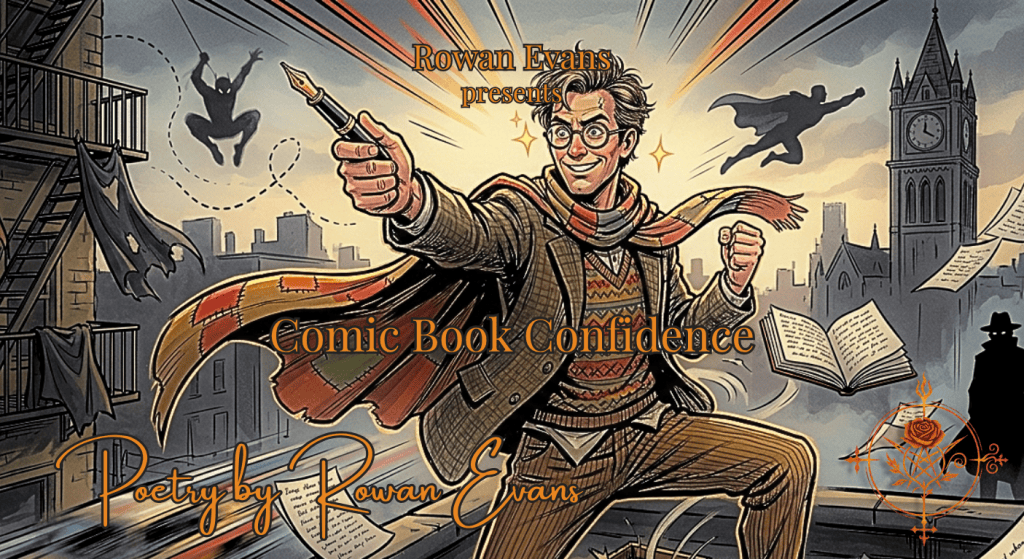
  • Author’s Note

    Comic Book Confidence is me asking a very important question:

    What if I had superhero confidence without actually having superhero powers?

    The answer, apparently, is several increasingly terrible decisions.

    I wanted to play with the mythology of comic-book heroes—the wall-crawling, flying, super-speed, impossible confidence—and translate that into a deliberately ridiculous poetic narrative. Every time the speaker decides they must have discovered a new power, reality immediately provides a correction.

    That’s what makes the piece fun for me. It’s not really about superheroes; it’s about confidence outrunning competence.

    And maybe that’s something worth laughing at in ourselves sometimes. We imagine ourselves as Spider-Man, Superman, The Flash, Batman—and then gravity reminds us that we’re still just people.

    So this is Battle Rowan in a different form:

    No superpowers.
    No safety net.
    Just confidence, bad decisions, and a pen.

    — Rowan Evans


    A confident poet poses like a superhero while comic-inspired energy, flying pages, and signs of failed superhero attempts surround them.
    Turns out confidence is a superpower. Unfortunately, gravity isn’t impressed.

    Comic Book Confidence
    Poetry by Rowan Evans

    Put glue on my hands,
    and try to climb the walls—
    yeah, tried to Spider-Man it.
    Fell, got hurt, it was a curse—
    goddamnit!

    Okay, so that’s not the power I got
    and honestly, I’m shocked—
    Maybe I can fly? Maybe I’ll try,
    sheet tied and I climbed, high—
    from this vantage point I could see,
    everyone looking like ants to me.

    Took one step then up, up and away.
    I jumped toward the summit—I Superman’d it.
    For a second, thought I made it—
    but really, I just—plummet.
    Yes, there I was hurtling—
    quick as shit toward the Earth,
    oh man, this is gonna hurt,
    just as soon as I hit the dirt.

    Oof, cough, wheeze—
    that was me trying to breathe.
    I had hit chest first,
    knocked the air out of me—
    I struggled to my feet,
    stumbling into a jog—
    like I had somewhere to be,
    and someone to meet—

    but I just had to run it off,
    Barry Allen, vibrating through a wall—
    or nah—
    smashed my head, I’m wobblin’—
    vision blurred, words slurred,
    delusion settin’ in—now I think I’m Batman
    and I’m Robin.


    Journey into the Hexverse…

    [Kaio-ken with a Pen/Zenkai]
    Two Dragon Ball-inspired battle poems about creative power, survival, and coming back stronger. Kaio-ken with a Pen brings the attack, while Zenkai (Stronger Now) delivers the aftermath: push me to the edge, and I’ll return stronger than before.

    [The Inkbender]
    What if poetry was another form of bending? The Inkbender transforms the philosophies of Avatar: The Last Airbender into a celebration of language, creativity, rage, healing, and the power of the written word.

    If you’re interested in more poetry, you can find it here → [The Library of Ashes]
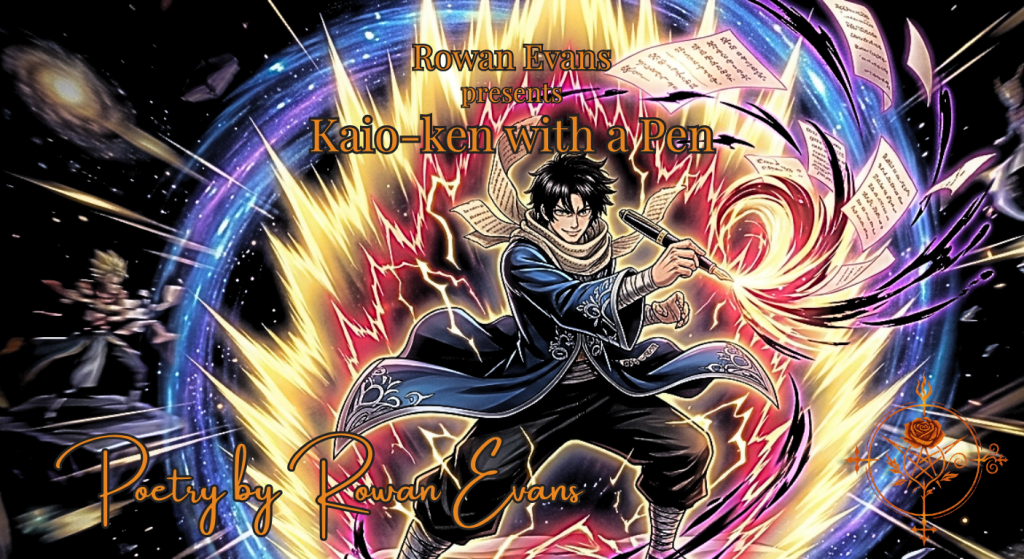
  • Author’s Note

    I originally wrote these as two separate pieces, but once I stepped back and read them together, I realized they were having the same conversation.

    Kaio-ken with a Pen is the attack: speed, confidence, exaggerated battle-rap energy, and the idea that my mind can move faster than the people trying to keep up with it. The pen becomes the weapon, and Dragon Ball becomes the language I’m using to describe that creative intensity.

    Then came Zenkai (Stronger Now).

    That one felt like the natural aftermath. In Dragon Ball, a Zenkai is the idea of becoming stronger after surviving a near-death experience. That concept fit perfectly with the way I think about resilience: sometimes you get pushed to the edge, you survive the fight, and you come back with something you didn’t have before.

    So together, these poems became something of a two-part battle sequence:

    I attack with the pen.
    I survive the fight.
    I come back stronger.

    Neither piece is meant as a literal threat toward anyone. They’re me having fun with battle-poetry, Dragon Ball references, ridiculous power scaling, and the sheer joy of seeing how far I can push a metaphor before it explodes.

    Basically: Battle Rowan went Super Saiyan.

    — Rowan Evans


    A poet holding a pen stands surrounded by explosive golden and crimson energy, symbolizing creative power, battle, and becoming stronger after adversity.
    One poem is the attack.

    Kaio-ken with a Pen
    Poetry by Rowan Evans

    I can go Super Saiyan easy,
    the way Chi Chi teached me—
    taught me, I forgot you see
    I’m the best, yes,
    don’t want to step to this—
    you don’t want to fought me—
    fight me, I mean—bitch bite me,
    you’re not like me.

    My mind is terrifyingly quick—
    thoughts comes, instant transmission—
    from my mind to the page
    in a Final Flash attack—
    Kaio-ken with a pen, is this the end?

    Fin.

    Kaio-ken with a pen, I’m at it again,
    this is my battle to win.
    It’s going take you, a Kamehameha
    and Kaio-ken times ten just to test me—
    but it won’t be enough to best me.


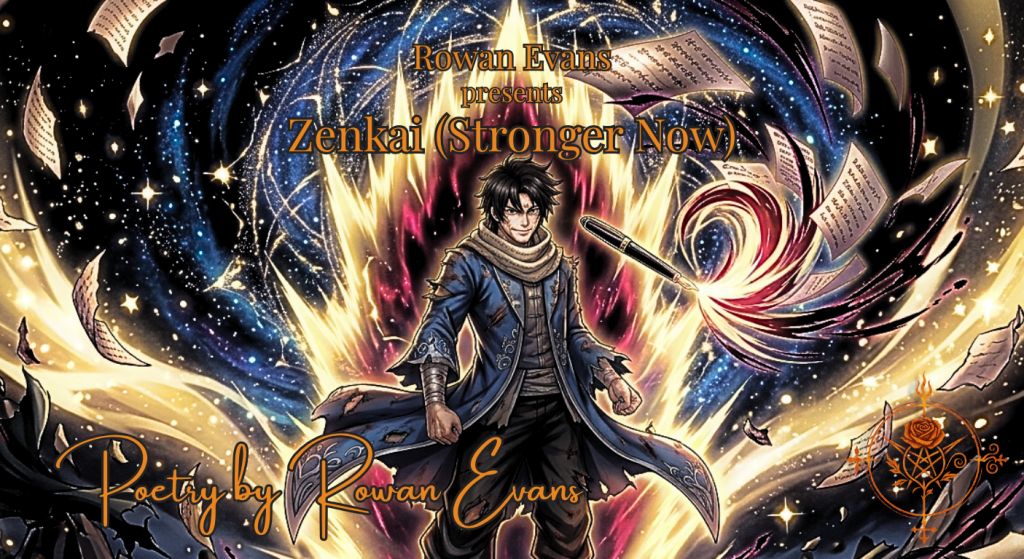
    A poet holding a pen stands surrounded by explosive golden and crimson energy, symbolizing creative power, battle, and becoming stronger after adversity.
    The other is what happens when you survive it.

    Zenkai (Stronger Now)
    Poetry by Rowan Evans

    I’m Goku after a fight
    and a Senzu bean,
    you know what that means—
    I’ve gotten stronger now,
    you pushed me to the edge—
    took me to the brink,
    but you couldn’t end it—
    you couldn’t finish me.

    So do your little dance,
    put on the Potara—do it—
    put your minds together,
    just know, even two as one—
    you won’t get the job done.
    I won’t borrow strength from no one,
    don’t need no spirit bomb
    to drop bombs—

    No Kamehameha—
    just ha-ha, I’m laughin’ at you.


    Journey into the Hexverse…

    [Don’t Push Me]
    A playful battle-poetry piece about turning insults into punchlines, standing your ground, and refusing to be intimidated. Don’t Push Me mixes swagger, humor, rhyme, and Rowan Evans’ signature self-aware interruptions.

    [B.S.T.F.U.]
    A playful battle-poetry exercise packed with insults, internal rhymes, punchlines, wordplay, and literary swagger. B.S.T.F.U. is Rowan Evans flexing the verbal muscles—not calling out anyone in particular.

    If you’re interested in more poetry, you can find it here → [The Library of Ashes]
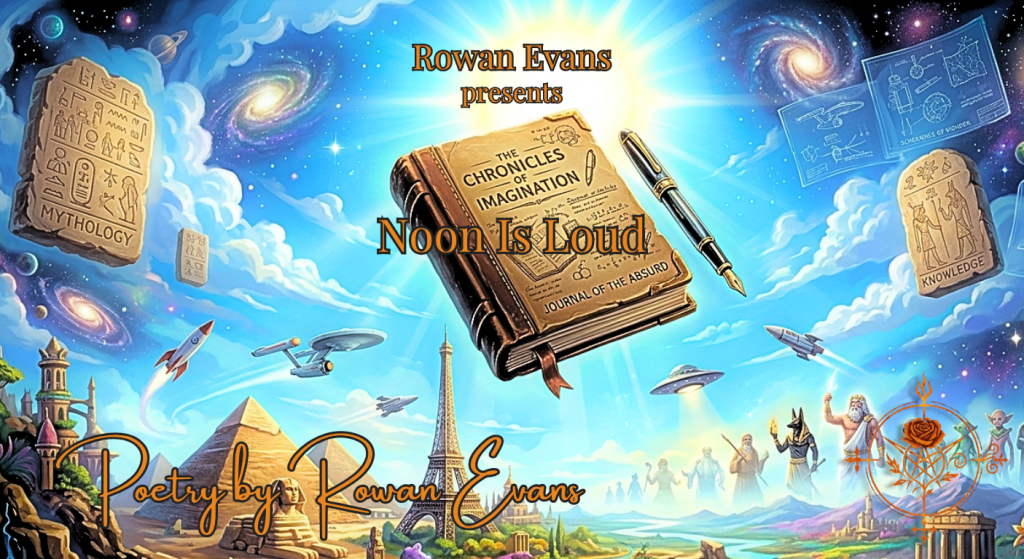
  • Author’s Note

    Some poems arrive in the middle of the night carrying emotional truths.

    This one showed up in broad daylight carrying absolute nonsense.

    The idea started with a simple contrast: if four in the morning is where my most honest poems seem to live, then maybe noon is where my imagination completely loses supervision.
    So I let it.

    Every claim in this poem becomes more ridiculous than the last. Ghostwriting the Ten Commandments. Inventing fire. Starting sci-fi fandom wars. Building the pyramids. Handling first contact with aliens.

    It’s satire, exaggeration, and the kind of storytelling that knows it’s lying while inviting you to enjoy the ride anyway.

    At its heart, though, there’s a small observation hiding beneath all the absurdity.

    Sometimes the stories we tell ourselves depend entirely on what time it is.

    At four in the morning, we confess.

    At noon, we become legends.

    This poem belongs to the latter.

    — Rowan Evans


    A surreal midday scene featuring floating notebooks, ancient monuments, spaceships, and mythic imagery under a bright sun, sy1mbolizing imagination and exaggerated storytelling.
    When noon gets too loud, every impossible story suddenly feels true.

    Noon Is Loud
    Poetry by Rowan Evans

    If four AM is the time of truth—
    I guess it’s all lies at noon.
    Do you remember when—
    I was topping the charts
    and breaking the hearts.

    And what about the time
    that I had to save the planet—
    I had to be the one to stare
    down the barrel of a laser gun.
    But I handled first contact like a G,
    that’s why the Aliens are cool with me.

    I created Star Treks and Star Wars,
    specifically to start beef in sci fi fandoms.
    Nobody knew, I was the phantom menace—
    the creator of the lore, everyone wanted to Klingon.
    And Dune? That was me too.

    I’ve gone to war with Gods
    over migraines and frowns,
    but never my own—
    I’ve talked about it in other poems.

    And yes, I am a sports expert—
    I know everything there is to know,
    it’s all stats, no narrative.
    Formations, players and defensive schemes.
    These are all words that I know what they mean.

    The pyramids? I built those—
    the Eiffel Tower too.
    The Hubble Telescope?
    Inspired by the childhood glasses that I wore.

    The Ten Commandments?
    I was the ghost writer—
    I was also the inventor of fire,
    the wheel and combustion engines.

    Anyway—
    that’s what I remember.

    But noon is loud,
    and the lies come easy—
    so I’ll stop here
    before I rewrite the universe again.


    Journey into the Hexverse…

    [More Afraid Than the Ink]
    Some confessions are easy to write but impossible to speak. More Afraid Than the Ink explores fear, dreams, recurring symbols, and the quiet realization that the page has always been braver than the poet.

    [When the Veil Is Thin]
    Some truths wait until after four in the morning to make themselves known. When the Veil Is Thin explores insomnia, longing, quiet vulnerability, and the thoughts that become impossible to ignore before dawn.

    If you’re interested in more poetry, you can find it here → [The Library of Ashes]
  • Author’s Note

    Some poems begin with an idea.

    This one began with a phrase that made me laugh.

    “Pockets full of tater tots and rocks.”

    I couldn’t tell you where it came from. My brain simply handed it to me, and I knew I had to follow it.

    That’s how a lot of my writing happens.

    One strange image appears, and instead of questioning it, I trust it. I let the poem figure out why that image belongs there.

    This piece moves the way my thoughts move—quickly, unpredictably, jumping from humor to comic books, from creative confidence to quiet vulnerability without asking permission.

    For a while, it feels like controlled chaos.

    Then, almost without warning, it settles.

    Because beneath the jokes, beneath the references, beneath the absurd image of someone carrying tater tots and rocks around in their pockets, there’s a simple truth waiting to be spoken.

    I spend a lot of time thinking.

    A lot of time creating.

    A lot of time turning emotions into language.

    And underneath all of that, like it is underneath so many of my poems, is the same quiet hope:

    To find someone willing to hold my heart with the same care I try to give theirs.

    Sometimes that’s all a poem is.

    A strange road leading to an honest sentence.

    — Rowan Evans


    A solitary poet stands beside the ocean at sunset with pockets full of rocks and tater tots while handwritten pages become ink in the wind.
    “Sometimes the strangest thoughts lead to the most honest truths.” 🥔🪨✍️🌊

    Tots, Rocks and All
    Poetry by Rowan Evans

    I’m lost in my thoughts again,
    pockets full of tater tots
    and rocks again.

    Take a dip in the ocean—
    emotion overflowin’
    like the ink from my pen.

    Runaway mind,
    runaway lines.

    This much creativity
    should be a crime.

    I’ll break lines
    the way Bane
    breaks spines.

    And when I get like this
    I like to speak my mind,
    but I don’t speak in vocals—
    I speak in ink and rhyme.

    Now, let’s get real for a minute,
    just a moment of your—

    hands on the clock hold time,
    and I’m looking for a love
    that’ll hold mine.

    I guess that’s the truth of this—
    tots, rocks and all.


    Journey into the Hexverse…

    [Chemical X]
    Chemical X explores the rapid, associative way one creative mind moves—from cartoons to sports, comic books to music—revealing that inspiration isn’t linear, but a collision of memory, humor, rhythm, and intuition.

    [Pointing Me Home]
    The final poem in the No Metaphor Left Behind trilogy explores dreams, hope, and belonging. Through moonlight, ocean tides, and quiet conversation, Pointing Me Home reflects on carrying hope long before reaching the place you call home.

    [Caller ID: Destiny]
    Sometimes the places we visit in our dreams feel more like home than the places we wake up in. Caller ID: Destiny explores longing, belonging, and the quiet feeling that life is calling you toward somewhere new.

    [Monster Theology]
    What if the monsters under the bed weren’t monsters at all? Monster Theology explores difference, belonging, and the human tendency to fear what we don’t understand through a conversation with the creatures we’ve spent our lives imagining.

    [Memories From a Life Yet to Come]
    Some dreams feel less like fantasy and more like memory. “Memories From a Life Yet to Come” is a reflective free verse poem about longing, displacement, emotional alignment, and the strange comfort of recognizing yourself more clearly in dreams than in waking life.

    If you’re interested in more poetry, you can find it here → [The Library of Ashes]


    [Bonus Track]

    I’ve got tater tots in my pockets,
    buried inside with two tickets
    to the Houston Rockets.
    They’re underneath all the rocks,
    it’s kind of insane.

    But I’m trying to sell ’em,
    ’cause I don’t watch sports—
    I watch narratives
    and stories unfold.

    I like the underdog—
    when their story gets told.

  • Author’s Note

    This poem began with a cartoon.

    Or rather, it began with a metaphor borrowed from one.

    I’ve always been drawn to characters who exist between worlds—people who don’t fully belong in one place or another, who spend their lives navigating the space between identities, expectations, realities, and possibilities.

    When I thought about Danny Phantom, I realized the metaphor fit more than I expected.

    Not because I feel haunted.

    Not because I feel supernatural.

    But because I understand what it feels like to exist in two places at once.

    Part of me lives in the present moment—the practical world of obligations, routines, limitations, and survival.

    Another part lives somewhere else.

    A quieter place built from hope, imagination, memory, longing, possibility, and the belief that life can become more than what it currently is.

    For a long time, much of my writing has existed in the tension between those two worlds.

    The opening sections of this poem lean into that tension. They acknowledge exhaustion, frustration, and the feeling of carrying more weight than you’d like. But the poem isn’t interested in staying there.

    What matters to me is where it ends.

    Because this isn’t a poem about giving up.

    It’s a poem about wanting more from life than survival.

    About wanting a future that feels inviting instead of merely manageable.

    About believing that the light inside us isn’t meant to spend its entire existence fighting to stay alive.

    Sometimes it deserves the chance to burn because it’s excited.

    Excited about tomorrow.

    Excited about possibility.

    Excited about whatever comes next.

    Maybe that’s the real theology hidden inside the title:

    Not that we exist between worlds.

    But that we keep moving toward the one where we finally get to live.

    — Rowan Evans


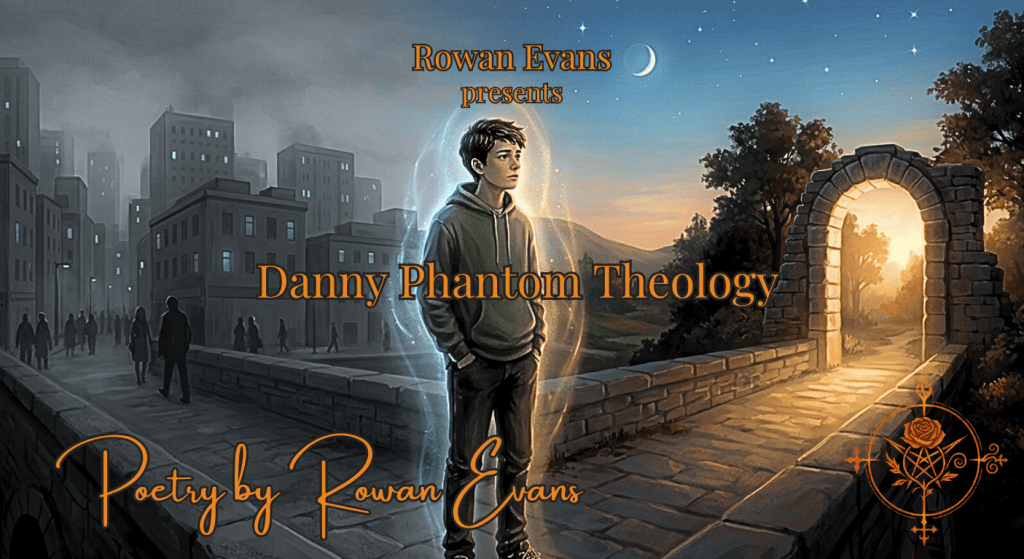
    A solitary figure stands between a gray city and a glowing world of light and possibility, symbolizing living between survival and hope.
    Somewhere between the life we endure and the life we imagine, hope keeps the light alive.

    Danny Phantom Theology
    Poetry by Rowan Evan1s

    Sometimes I feel
    like Danny Phantom,
    a boy between worlds—
    one alive, the other
    a quiet place inside me
    where the light flickers
    but never fully goes out.

    I exist in both.
    But I do not thrive,
    most the time
    it barely feels like I’ll survive.
    I know that’s a little dramatic—
    it’s a bad habit.
    I know my words feel heavy,
    more than intended most the time.
    I know what it sounds like—
    it sounds like I don’t like life.

    But that’s not true—
    I’m a lover of life,
    a hater of the conditions.
    I want a change—
    in environment,
    in circumstance.

    I want a world
    where I don’t have to split myself
    to make it through the day,
    where the light inside me
    doesn’t flicker
    from exhaustion
    but from possibility.

    I want a life
    where survival
    isn’t the main objective.
    Where waking up
    isn’t an act of endurance,
    but anticipation.
    Where the light inside me
    doesn’t flicker
    because it’s fighting to stay alive—

    but because…

    it’s excited
    for what’s next.


    Journey into the Hexverse…

    [Frankenstein’s Monster]
    Some poems are built to make a point. Others are built to reveal the mechanism. Frankenstein’s Monster (and I’m the Doctor) explores associative thinking, creative chaos, and the strange process of stitching disconnected ideas into something alive.

    [Lone Wolf Theology]
    A philosophical pop-culture poem exploring freedom, identity, and self-authorship through the lens of superheroes, antiheroes, mythic archetypes, and personal rebellion. A declaration of autonomy in a world determined to write your story for you.

    [Before We Created the Labels]
    Ancient gods return to a fractured world shaped by borders, identities, and separation. “Before We Created the Labels” explores humanity’s divisions through mythic imagery, sacred ritual, and symbolic collapse—asking what remains when we learn to see one another beyond labels.

    [A Heart That Echoes in Another Language]
    A poetic journey through music across Japan, Korea, China, and the Philippines, exploring how sound becomes identity, memory, and emotional geography.

    If you’re interested in more poetry, you can find it here → [The Library of Ashes]
  • Author’s Note

    This poem didn’t start with a message.

    It started with frustration.

    Not the kind that arrives fully formed or carefully structured—but the kind that builds in fragments. Small irritations. Cultural noise. Half-remembered references. Thoughts that don’t arrive in order, but all at once.

    What I wanted to capture here wasn’t a linear argument or a polished reflection on anger or identity.

    It was the process itself.

    The way the mind can jump from one idea to another without asking permission. The way language doesn’t always behave politely. The way emotion and memory and absurdity can occupy the same space without resolving into anything clean.

    The Batman reference, the cartoon interruption, the sudden shift in tone—none of it is meant to smooth into coherence.

    It’s meant to feel like it actually feels inside the moment of thinking it.

    The line “This is how my mind works” is the turning point for me in the piece.

    Not because it explains everything, but because it stops pretending everything needs to be explained.

    Some poems are built to argue a point.

    This one is built to show the mechanism.

    And the ending—“Frankenstein’s Monster / And I’m the doctor”—isn’t meant as metaphor in the traditional sense.

    It’s closer to recognition.

    That the thing being called chaos is also something being assembled. Intentionally or not. Carefully or not. But still assembled.

    And that sometimes the person inside the noise is also the one holding the pieces.

    — Rowan Evans


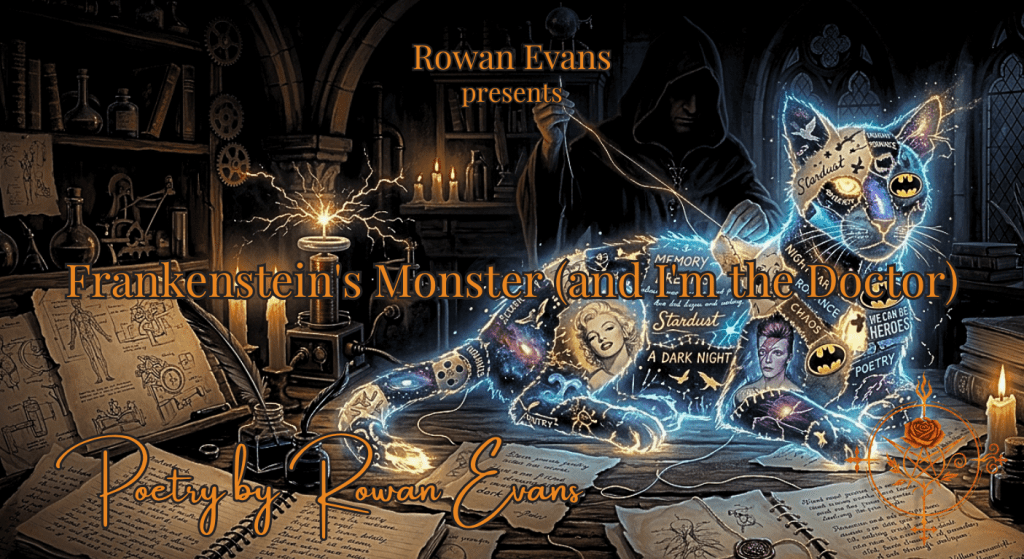
    A poet in a gothic laboratory assembling glowing fragments of words and images into a patchwork creation made from poetry and imagination.
    “My poetry? Frankenstein’s Monster. And I’m the doctor.” Sometimes creativity isn’t about finding order—it’s about assembling the pieces and bringing them to life.

    Frankenstein’s Monster (and I’m the Doctor)
    Poetry by Rowan Evans

    I’m sick of my surroundings;
    sick of these fakes,
    sick of the snakes,
    they’re all just Batman villains—
    Two-face.

    Crazy is the way
    they made me.
    Twisted thoughts
    that wouldn’t stop—
    pop goes the weasel,
    I R Baboon.

    This is how my mind works.
    It links two things
    that are seemingly opposites.
    They have nothing in common,
    but still I piece them together—

    my poetry?
    Frankenstein’s Monster.

    And I’m the doctor.


    Journey into the Hexverse…

    [Violets Are Violet (Roses Are Complicated)]
    A simple observation leads to an absurd conclusion: violets aren’t blue, roses aren’t always red, and the classic love poem may be far less accurate than advertised. A humorous free-verse poem about overthinking, flower symbolism, and the unintended consequences of analyzing clichés too closely.

    [It’s Just Me but Super]
    A playful free-verse poem about cartoons, imagination, cosmic wanderings, and the strange magic of creativity. Through wordplay, nostalgia, and absurd humor, Rowan Evans explores what happens when ordinary life meets an extraordinary imagination.

    [100 Grand and a Book Deal]
    A playful collision of candy bars, comic book heroes, basketball legends, and cosmic metaphors. Beneath the jokes lies a reflection on twenty-three years of writing, creativity, and the dream of building something lasting one line at a time.

    If you’re interested in more poetry, you can find it here → [The Library of Ashes]