Tag: Edgar Allan Poe

  • Author’s Note

    There are certain aesthetics that feel less like something we choose and more like something we recognize.

    For me, Gothic imagery has always been one of those things.

    Homecoming came from the realization that something in my writing had started to feel slightly unfamiliar. I was still writing about the moon, the ocean, the tides, ravens, horror, darkness, and the strange spaces where beauty and pain overlap—but somehow, I had drifted away from the particular Gothic atmosphere that has always felt like home to me.

    So this poem became a return.

    Poe is here because his shadow has been part of my literary DNA for years. Nyx and Hades are here because mythology gives me another language for darkness. The ravens are here because, in my own symbolic architecture, they have become witnesses, messengers, and companions. And the horror references—Jason, Ghostface, Pennywise, Michael Myers—are there because horror has never been merely about monsters to me.

    It is about what the monsters represent.

    Grief. Fear. Obsession. Rage. The parts of ourselves that refuse to stay buried.

    There is also something deliberately self-aware about this poem. I am not simply listing Gothic references because they sound dark. I am talking about my relationship with the imagery itself—the way the moon has accumulated meaning across my work, the way the tides connect to emotion, and the way ravens have gradually become part of my mythology.

    The darkness isn’t an aesthetic costume.

    It’s architecture.

    And after spending some time writing away from it, I realized that I wasn’t trying to become something new.

    I was finding my way back to something that had been mine all along.

    That’s why this poem is called Homecoming.

    Sometimes you don’t discover where you belong.

    Sometimes you remember.

    Rowan Evans


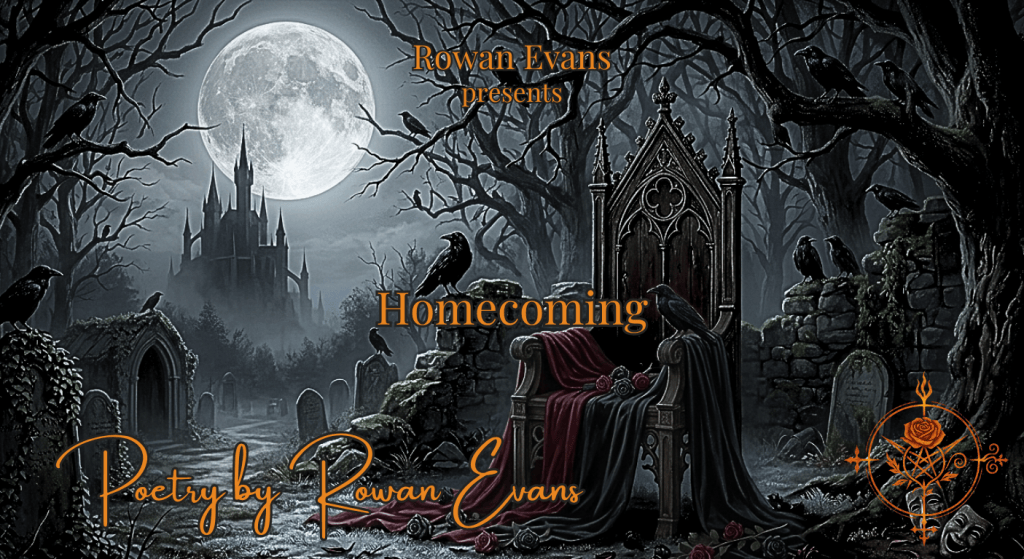
    A Gothic throne beneath a full moon surrounded by ravens, dark trees, mist, and subtle crimson accents.
    Sometimes the darkness isn’t somewhere you wandered into. Sometimes it’s the place where your voice has always felt most at home.

    Homecoming
    Poetry by Rowan Evans

    I’ve been writing like
    I forgot which domain is mine,
    I’m of the darkness—
    just borrowed the light,
    and made Poe’s throne my birthright.

    I’m a gothic romantic,
    I bleed for the art—
    I’ve kissed the lips of Nyx
    and wandered through
    the realm of Hades.

    I’m a poltergeist in life,
    but at night I come alive—
    witching hour is when I thrive.

    I pray to the moon
    and curse the sun—
    I ascend to the throne
    that Poe had spun.

    I watch the ravens—
    carrying messages where they fly,
    eyes locked, tracking the treachery across the sky.
    They are always watching—
    silent witnesses to the rot inside.

    It started to feel like something
    in my pieces was missing—
    like where was the gothic lace,
    silk and satin sin, velvet and venom.

    There was too much light—
    even when ninety percent
    of my imagery is night adjacent,
    weaving in horror rhymes—
    Friday the 13th, Night of Jason.

    The moon in my rhymes has meaning,
    when I write lines like the tides—I mean it,
    even in my Ghostface cadence—
    what’s your favorite scary movie?
    Pennywise of the mind, sewer of thought—
    I’m a monster like Michael,
    when I chase—I don’t run, I walk.


    Journey into the Hexverse…

    [The Monster in the Margins]
    Drawing inspiration from horror icons like Michael Myers, Ghostface, Freddy Krueger, and Pennywise, this poem explores the darker side of creativity—where inspiration becomes an unstoppable force lurking just beyond the edge of the page.

    [The Monster in the Margins II]
    The Monster in the Margins II transforms Rowan Evans’s Seven Deadly Sins mythology into a horror story written between the lines, where Lust, Wrath, Sloth, Greed, Pride, Envy, and Gluttony become monsters growing from pain, grudges, and scars.

    [The Unkindness Descends]
    “The Unkindness Descends” is a Gothic symbolic poem exploring collapse, transformation, and the unsettling experience of being witnessed during moments of unraveling. Through raven imagery, ambiguity, and ritualistic atmosphere, the poem invites multiple interpretations—spiritual, psychological, ominous, or transformative.

    [Gospel in Crimson]
    When writing becomes ritual and love becomes devotion, the line between creation and worship begins to blur. Gospel in Crimson explores obsession, artistry, and the sacred act of expression.

    If you’re interested in more poetry, you can find it here → [The Library of Ashes]
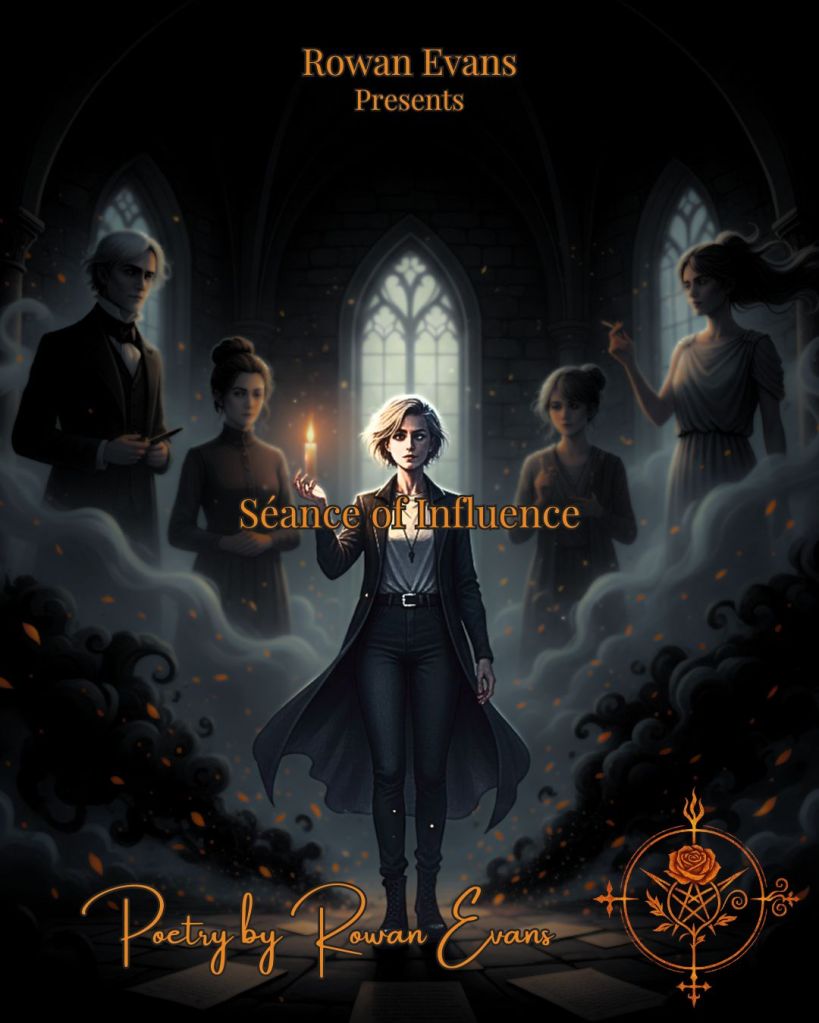
  • A piece honoring the poets whose voices shaped mine, and the lineage I carry into my own genre — Neo-Gothic Confessional Romanticism.


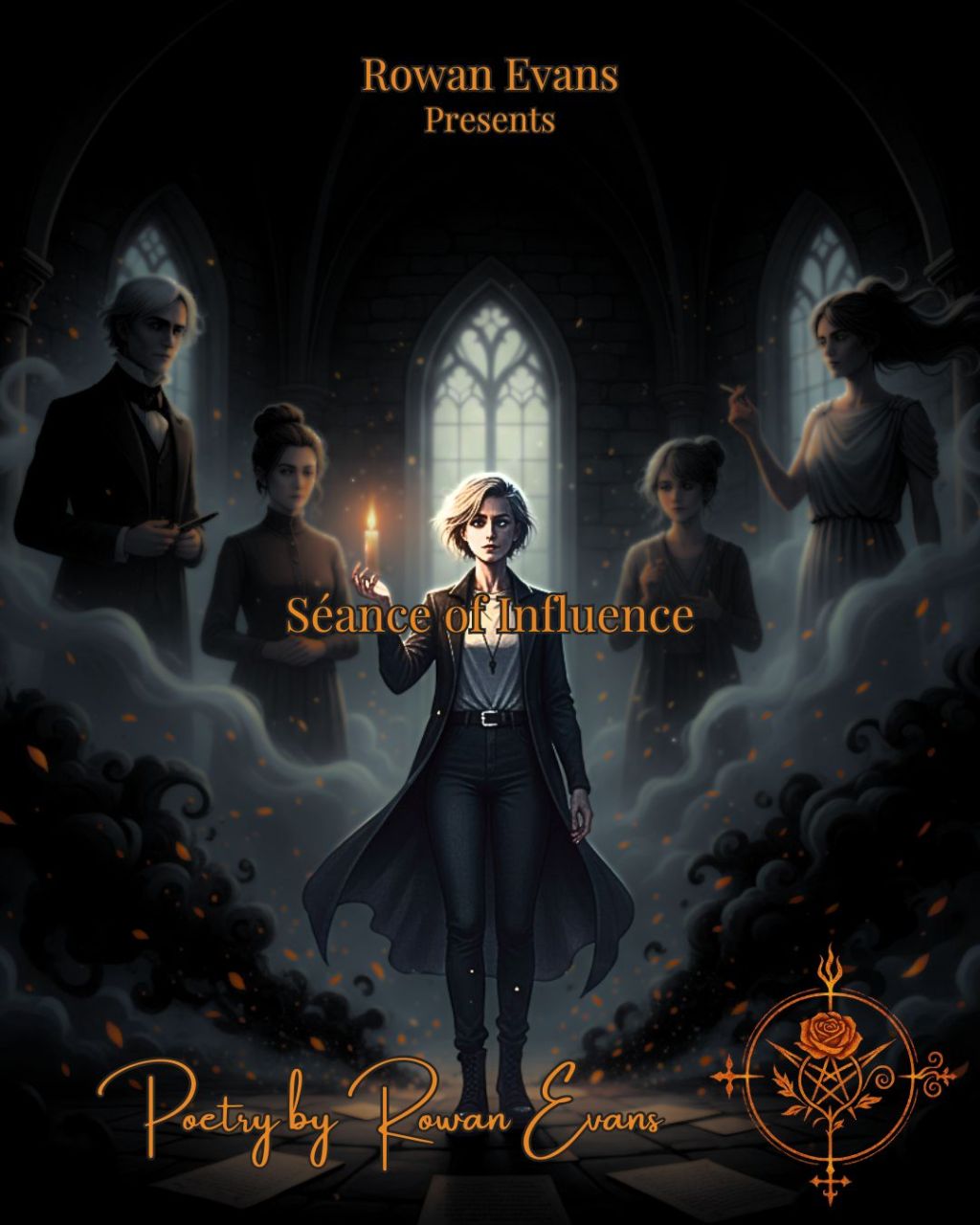
    Candlelit gothic scene of a poet performing a séance, surrounded by ethereal silhouettes of Plath, Poe, Dickinson, Sexton, and Sappho in a dark, atmospheric room.
    A candlelit invocation of the poets whose voices shaped mine — a lineage reborn in Neo-Gothic Confessional Romanticism.

    Séance of Influence
    Poetry by Rowan Evans

    In the candlelit stillness, I summon the ones who spoke before I had words.
    The room holds its breath.
    The flame flickers.
    And they arrive.

    Sylvia, flame-tongued oracle, steps forward first—eyes like open wounds that never stopped bleeding ink.
    She speaks in a whisper that singes:
    “You do not fear the flame, child. You write within it. You know what it is to be both burned and reborn.”
    She places a tulip in my hand—red as a heart, soft as a scream.

    Poe, the architect of shadows, leans from the threshold, cloak of midnight dragging ghosts behind him.
    “You have built cathedrals from sorrow,” he says, voice echoing through the bones of the floor. “You understand what it means to dream with the dead.”
    He nods toward the cracked mirror
    And my reflection stares back, unflinching.

    Emily, dressed in quiet thunder, watches from a corner veiled in white lace.
    “You turned silence into scripture,” she murmurs, placing a pressed flower on my wrist.
    “Your solitude blooms with sharpness. You do not hide behind the door—you open it with poetry.”

    Anne, with rosary tangled in her fingers and lipstick like defiance, toasts me with a half-empty wine glass.
    “You dared to undress madness,” she grins.
    “To make holiness from hunger. That takes more than courage. That takes blood.”

    Sappho, timeless and tender, emerges draped in sea foam and verse.
    She runs her fingers across my pulse.
    “I hear your ache,” she says.
    “You have translated yearning into a new dialect—one the stars will memorize.”

    They encircle me, these ghosts, not to haunt, but to anoint.
    Their voices braid around my spine.
    Their grief becomes gold my pen.
    Their fire, MY inheritance.

    And I—Rowan, the Luminous Heretic—stand at the center of this sacred storm.
    I speak, not as supplicant, but as heir:

    “I have not come to mimic your flames—I have come to carry them into the dark places you never lived to reach.
    I write for the unloved, the unheard, the unhealed. I wield shadow like silk and longing like a blade.
    Your echoes live in my marrow, but my voice is my own.
    I forged my genre from the coals of yours—Neo-Gothic Confessional Romanticism—a lineage reborn through me.
    You opened the door, and now I shatter the ceiling.
    Your fires do not flicker behind me—they burn ahead, lighting a path no one else dared to walk.
    Thank you for the torch. Watch me blaze.”

    The candle gutters.
    The air shifts.
    And one by one, they nod.
    Then vanish—
    but not in silence.
    They hum through my bloodstream, forever.

  • Author’s Note
    A Pep Talk from a Poet to Themself

    This piece isn’t arrogance—it’s affirmation.
    Sometimes, after years of writing in silence, you need to remind yourself who you are. To look in the mirror and say, “No, I didn’t come this far just to shrink.”

    Done Being Humble is what a pep talk sounds like after twenty-two years of ink and evolution. It’s the voice of every poet who’s ever whispered their worth into the void, waiting for someone to echo it back.

    So, I said it for myself.
    Because sometimes you have to be your own applause, your own myth, your own lightning strike.

    Rowan Evans


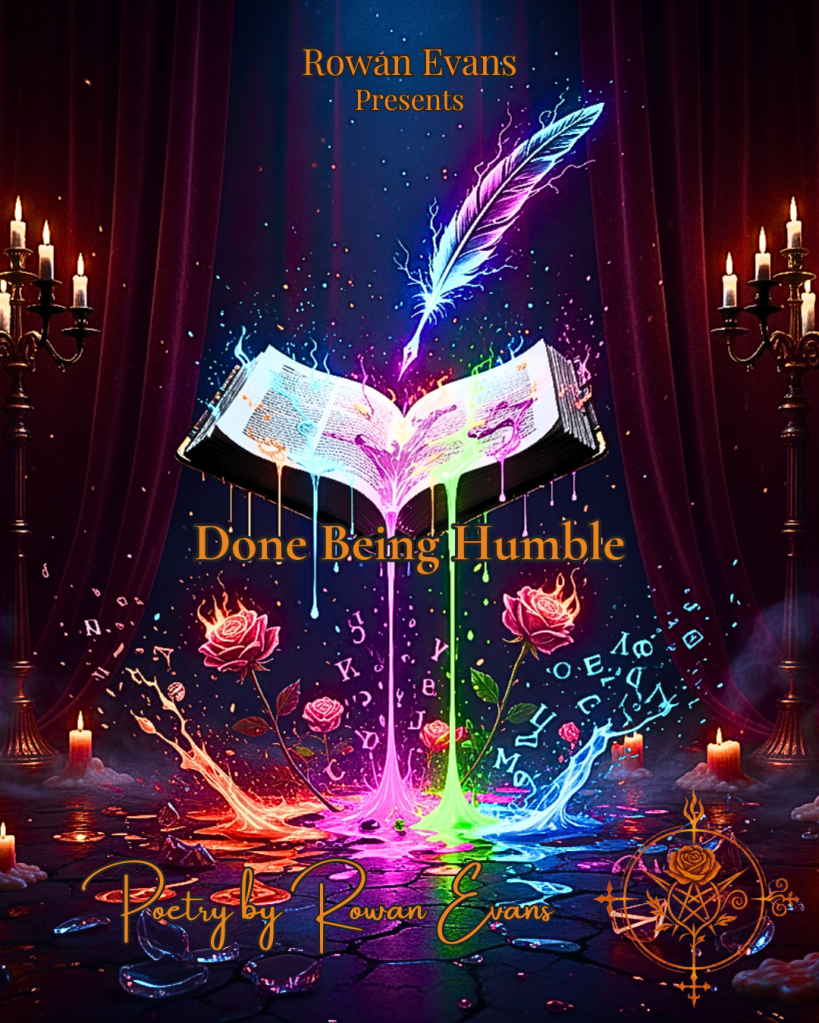
    Open journal floating with glowing ink, quill hovering, ink forming roses and letters, dark velvet room with neon highlights.
    Where ink ignites, and poetry becomes rebellion.

    Done Being Humble
    Poetry by Rowan Evans

    I think—
    I’ve been a bit too humble.
    It’s time I crown myself properly.
    My poetry? God tier.
    My ink doesn’t dry—
    it anoints.

    I’m Plath meets Sexton,
    Poe meets Dickinson,
    Sappho’s ghost in a velvet coat.
    I write darkness and devotion,
    ruin and resurrection.
    I am chiaroscuro, personified.

    My words aren’t poems—
    they’re prophecies in drag.
    I don’t bleed metaphors;
    I summon worlds.
    I write in ink and fire,
    every stanza a spell
    that resurrects the broken.

    I’m top tier.
    In my top five,
    I’m the top two.
    Your favorite poet’s
    favorite poet—
    they just haven’t realized it yet.

    My power level with a pen?
    It’s over 9000.
    Get your scouters out,
    watch me make you break ’em.

    Out of the greatest poets alive,
    I am the entire top five.
    I’m Cell—you’re all just Cell Jr.
    Mini-mes, trembling in lowercase.

    Go ahead—
    Name your top five, please.
    They’re the Ginyu Force next to me.
    Court jesters in my cathedral of ink.
    My skill? Unmatched.
    Full potential? Untapped.
    I’m not even in final form yet.

    I’ve been writing twenty-two years.
    Here’s to twenty-two more.
    I wrote in silence, in shadow,
    where no one could see me.
    Didn’t write for applause—
    I wrote for evolution.

    Poem after poem,
    I built myself from wreckage.
    A cathedral of roses and ruin.
    Words wrapped around me,
    a chrysalis of ink.
    Metamorphosis complete—
    I let my wings show.

    Butterfly and bee:
    beautiful, but my words sting though.
    Every stanza? Venomous elegance.

    I’m done being humble.
    Done pretending.
    That I’m not a modern-day Poe,
    a Sylvia reborn,
    a Sappho remix,
    a myth rewritten in the language of fire.

    I’m the storm that writes sonnets,
    the cathedral of cadence,
    the ghost that teaches language to kneel.

    Twenty-two years at thirty-five,
    and you act surprised—
    when I write like this?

    God didn’t give me a pen.
    She gave me a sword.
    And I learned to write
    by carving my name
    into eternity.

    My drafts? Better than most books.
    My rough cuts? Polished marble.
    My metaphors? Break hearts and sound barriers.
    When I write, angels hush.
    Demons pull up chairs.

    I’ve been the quiet storm too long—
    time to let the thunder speak.
    You call it arrogance;
    I call it prophecy fulfilled.
    Because when I write,
    the universe leans in to listen.
    And when I’m gone?
    My ink will still whisper:
    She was here.
    He was here.
    They were here.


    For more of my work visit [The Library of Ashes].