Tag: moon poetry

  • Author’s Note

    There are some places that become more than places.

    An ocean can be a physical distance, a horizon, a body of water stretching farther than the eye can follow. But sometimes it becomes something else entirely—a canvas, a metaphor, a meeting place between two people who happen to be standing on opposite sides of the world.

    Let Me Be Pacific began with a simple invitation: let me show you the ocean the way I see it.

    From there, the words wandered where they wanted to go.

    Purple skies. Silver moons. Dark water. Rhymes. Trees. Wordplay.

    And eventually, the Pacific became more than scenery.

    It became the space between here and there—and the reminder that something can cross an enormous distance without ever needing to disappear.

    So, for a moment, come sit beside me on the shoreline.

    Let me paint you a picture.

    Rowan Evans


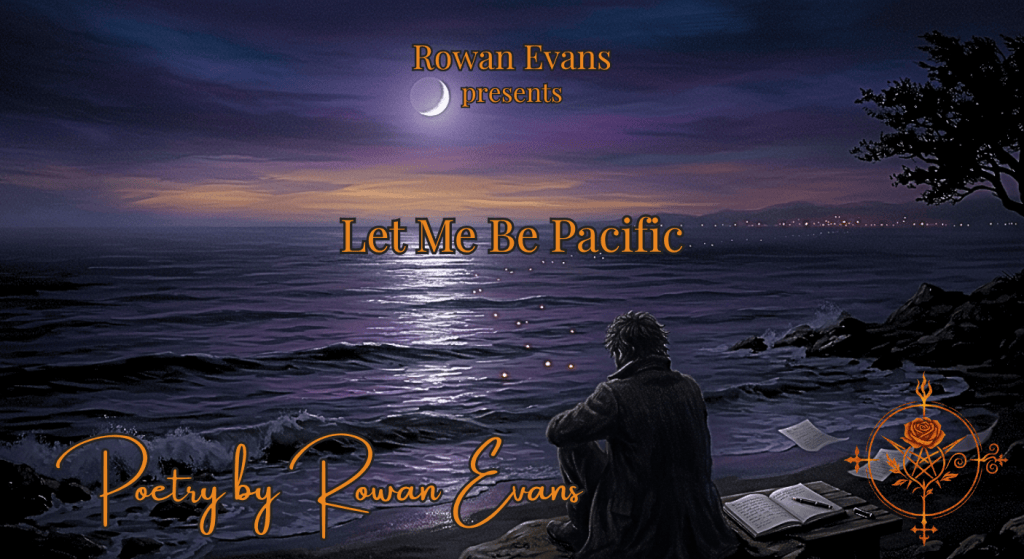
    A solitary poet sits beside the Pacific at twilight beneath a silver moon, watching its reflection shimmer across the waves.
    The Pacific may separate two shores, but poetry has never been particularly good at respecting distance.

    Let Me Be Pacific
    Poetry by Rowan Evans

    Here let me take my words
    and paint a picture for you—
    the sky in shades of purple and blue,
    lit by the silver moon—
    it lingers over the bay,
    that’s where it stays—
    watching over the tide,
    and I sit on the shoreline—
    watching the ocean’s waves.

    Which ocean? Okay,
    here let me try and spell it out,
    let me be Pacific—
    it’s off the California coast,
    it touches the Philippine Sea,
    sits between Japan and Me.

    Now back to the imagery—
    there was me, next to a happy little tree,
    and the moon was shimmering,
    trembling across dark water—
    back on the shoreline,
    having written more lines,
    not less, but more rhymes.

    So let me stay Pacific—
    specific in the way I see the sea,
    how every wave feels like a message
    sent across the world to me.
    I sit, I rhyme, I watch the tide—
    the ocean’s big, but so’s my mind.

    And if you ask me why I write
    beside this ocean every night—
    it’s because the tide keeps teaching me
    how distance isn’t always far,
    how even the Pacific can carry a heart
    from California to wherever you are.


    Journey into the Hexverse…

    [My Nightmare]
    A poem about the nightmare of loving someone across distance, seeing the world from different perspectives, and holding onto the hope that the cracks can still be repaired—and that someday two separate shores might become one.

    [Rose & Ruin]
    Two minimalist poems exploring the opposing forces within creativity: the thoughts we cultivate into something beautiful and the darker thoughts we transform before they have a chance to decay.

    [Across the Page-cific]
    A playful, autobiographical journey through the strange places poetry can take me—from sandwich heartbreak and pasta diss poems to gothic monsters, mythology, ravens, ghosts, and storms across the page. Beneath the absurdity is something deeply personal: the realization that writing gave me a way to rebuild myself, piece by piece.

    If you’re interested in more poetry, you can find it here → [The Library of Ashes]
  • Author’s Note

    There are certain aesthetics that feel less like something we choose and more like something we recognize.

    For me, Gothic imagery has always been one of those things.

    Homecoming came from the realization that something in my writing had started to feel slightly unfamiliar. I was still writing about the moon, the ocean, the tides, ravens, horror, darkness, and the strange spaces where beauty and pain overlap—but somehow, I had drifted away from the particular Gothic atmosphere that has always felt like home to me.

    So this poem became a return.

    Poe is here because his shadow has been part of my literary DNA for years. Nyx and Hades are here because mythology gives me another language for darkness. The ravens are here because, in my own symbolic architecture, they have become witnesses, messengers, and companions. And the horror references—Jason, Ghostface, Pennywise, Michael Myers—are there because horror has never been merely about monsters to me.

    It is about what the monsters represent.

    Grief. Fear. Obsession. Rage. The parts of ourselves that refuse to stay buried.

    There is also something deliberately self-aware about this poem. I am not simply listing Gothic references because they sound dark. I am talking about my relationship with the imagery itself—the way the moon has accumulated meaning across my work, the way the tides connect to emotion, and the way ravens have gradually become part of my mythology.

    The darkness isn’t an aesthetic costume.

    It’s architecture.

    And after spending some time writing away from it, I realized that I wasn’t trying to become something new.

    I was finding my way back to something that had been mine all along.

    That’s why this poem is called Homecoming.

    Sometimes you don’t discover where you belong.

    Sometimes you remember.

    Rowan Evans


    A Gothic throne beneath a full moon surrounded by ravens, dark trees, mist, and subtle crimson accents.
    Sometimes the darkness isn’t somewhere you wandered into. Sometimes it’s the place where your voice has always felt most at home.

    Homecoming
    Poetry by Rowan Evans

    I’ve been writing like
    I forgot which domain is mine,
    I’m of the darkness—
    just borrowed the light,
    and made Poe’s throne my birthright.

    I’m a gothic romantic,
    I bleed for the art—
    I’ve kissed the lips of Nyx
    and wandered through
    the realm of Hades.

    I’m a poltergeist in life,
    but at night I come alive—
    witching hour is when I thrive.

    I pray to the moon
    and curse the sun—
    I ascend to the throne
    that Poe had spun.

    I watch the ravens—
    carrying messages where they fly,
    eyes locked, tracking the treachery across the sky.
    They are always watching—
    silent witnesses to the rot inside.

    It started to feel like something
    in my pieces was missing—
    like where was the gothic lace,
    silk and satin sin, velvet and venom.

    There was too much light—
    even when ninety percent
    of my imagery is night adjacent,
    weaving in horror rhymes—
    Friday the 13th, Night of Jason.

    The moon in my rhymes has meaning,
    when I write lines like the tides—I mean it,
    even in my Ghostface cadence—
    what’s your favorite scary movie?
    Pennywise of the mind, sewer of thought—
    I’m a monster like Michael,
    when I chase—I don’t run, I walk.


    Journey into the Hexverse…

    [The Monster in the Margins]
    Drawing inspiration from horror icons like Michael Myers, Ghostface, Freddy Krueger, and Pennywise, this poem explores the darker side of creativity—where inspiration becomes an unstoppable force lurking just beyond the edge of the page.

    [The Monster in the Margins II]
    The Monster in the Margins II transforms Rowan Evans’s Seven Deadly Sins mythology into a horror story written between the lines, where Lust, Wrath, Sloth, Greed, Pride, Envy, and Gluttony become monsters growing from pain, grudges, and scars.

    [The Unkindness Descends]
    “The Unkindness Descends” is a Gothic symbolic poem exploring collapse, transformation, and the unsettling experience of being witnessed during moments of unraveling. Through raven imagery, ambiguity, and ritualistic atmosphere, the poem invites multiple interpretations—spiritual, psychological, ominous, or transformative.

    [Gospel in Crimson]
    When writing becomes ritual and love becomes devotion, the line between creation and worship begins to blur. Gospel in Crimson explores obsession, artistry, and the sacred act of expression.

    If you’re interested in more poetry, you can find it here → [The Library of Ashes]