Tag: dark romanticism

  • Author’s Note

    Some nightmares aren’t about monsters.

    Sometimes the nightmare is waking up and realizing that the person you want beside you is standing beneath a completely different sky.

    My Nightmare comes from that place—the uneasy space between memory and hope, between what once felt shared and what now feels impossibly far away. It is a poem about distance, but not only the physical kind. There is distance between perspectives, between hearts, between the lives we imagine and the lives we are actually living.

    Still, even nightmares have endings.

    Sometimes you wake up before they become permanent.

    And sometimes, even while dreaming, you can still see a little gold threaded through the cracks.

    Rowan Evans


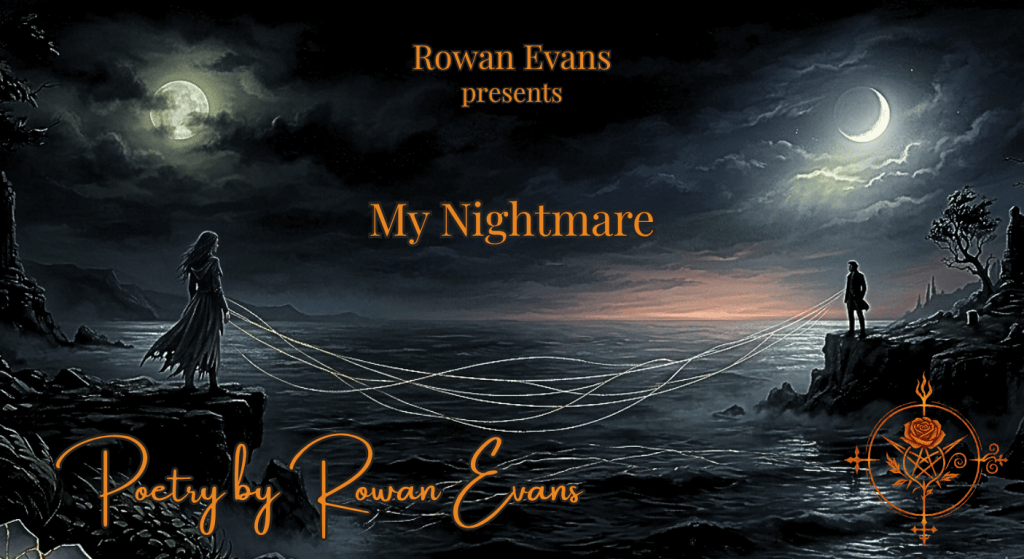
    Two distant figures stand on separate shores beneath different moons, connected across the dark ocean by faint golden and platinum threads.
    Two shores. Two skies. One horizon—and enough gold left to believe they might meet there.

    My Nightmare
    Poetry by Rowan Evans

    This is my nightmare.

    You and I across the distance,
    the view that we see is different—
    your moon from my sky
    is missing—
    the sun no longer shines,
    it’s dimming—

    I don’t see the spark anymore—
    don’t see the light in the dark anymore.
    What do I even I write for?
    I lost my purpose—think I did it on purpose,
    it’s like I can’t rhyme anymore,
    no clock, no watch, can’t tell time anymore.

    This is my nightmare.

    You and I across the distance,
    the view that we see is different—
    my moon is sickly pale,
    but yours seems fine though—
    the sun doesn’t provide light,
    it’s gotten real low—

    in times before, this is when
    I would Kintsugi the heart—
    but there’s not much heart left,
    it’s all gold—soft metal,
    softer soul—stayed warm,
    when the world grew cold.

    This is my nightmare.

    You and I across the distance,
    the view that we see is different—
    when we used to be,
    two pieces the puzzle
    was missing—
    the sun in the sky was fine,
    but it dimmed in our shine—

    I’ve spent time doing Kintsugi
    on your heart too—it was hard not to,
    gold and platinum weaved through—
    I really did see you, flaws and all—
    and all I saw was a gift from God.

    I still don’t think—
    I was wrong.

    But that was my nightmare…

    You and I across the distance,
    the view that we saw was different—
    but I still see the gold threads that connect,
    the platinum hope on the horizon,
    that one day the distance will close—
    and we’ll walk the same shore,
    it won’t be—

    mine and yours.


    Journey into the Hexverse…

    [Dreaming Wrong]
    A familiar dream becomes unsettling when the ocean becomes a pond, the tide disappears, the moon loses its reflection, and nothing feels quite like it belongs. Dreaming Wrong explores the uncanny feeling of finding yourself inside a dream that looks familiar—but feels like someone else’s.

    [Poet’s Curse]
    Poet’s Curse explores the painful side of falling too deeply: giving pieces of yourself away freely, taking accountability for your own heartbreak, and realizing that learning to let go can be harder than learning to love.

    [Beach to Beach]
    A dream becomes a journey between familiar shores and unfamiliar cities in Beach to Beach (How I Get There), a poem about imagined travel, ocean crossings, longing, and the places we hope to someday reach while awake.

    [Where the Metaphors Lead]
    Some truths are easier to write than they are to say aloud. “Where the Metaphors Lead” explores the quiet space between dreams, confession, and the courage it takes to let another person know how deeply they’ve become woven into your inner world.

    If you’re interested in more poetry, you can find it here → [The Library of Ashes]
  • Author’s Note

    Sometimes an old poem doesn’t need to be left in the past.

    Sometimes you have to return to it after you’ve changed.

    Fallen Angel’s Reckoning (Remix) revisits a poem I originally wrote on June 6, 2024. The original was already telling a story I understood well: love that promised forever, a fall from an imagined heaven, and the painful process of reclaiming yourself after the promise disappears.

    But I was a different writer when I wrote it.

    And, more importantly, I was a different person.

    The 2026 version isn’t meant to erase the original. It is a conversation with it.

    I kept the central imagery—the angel, Lucifer, the fall from heaven, the halo, the darkness, the broken vow—because those symbols still belong to the emotional architecture of the piece. But I wanted to push the mythology further this time. Icarus enters the story. The fall becomes more physical, more violent, more deliberate. The speaker isn’t simply descending from something that once felt like heaven; they are plummeting from it.

    And then there is the ending.

    In 2024, I wrote about newfound wings.

    In 2026, I wrote about broken wings.

    That change matters to me.

    Because strength doesn’t always mean becoming untouched by what happened. Sometimes you keep the scars. Sometimes you keep the broken pieces. Sometimes you discover that you can still fly without first repairing everything that hurt you.

    The angel doesn’t become an angel again.

    They don’t return to the heaven they lost.

    They don’t need the person who made them feel divine to give them their identity back.

    They become something else.

    A fallen angel who embraces the fallen.

    The broken.

    The free.

    That is what this remix ultimately became: not a poem about getting back what was lost, but about discovering that losing it didn’t mean losing yourself.

    I didn’t rewrite the 2024 version because it was wrong.

    I rewrote it because I’ve had two more years to understand the fall.

    And sometimes the person who wrote the first poem deserves to hear what the person you became has learned since then.

    Rowan Evans


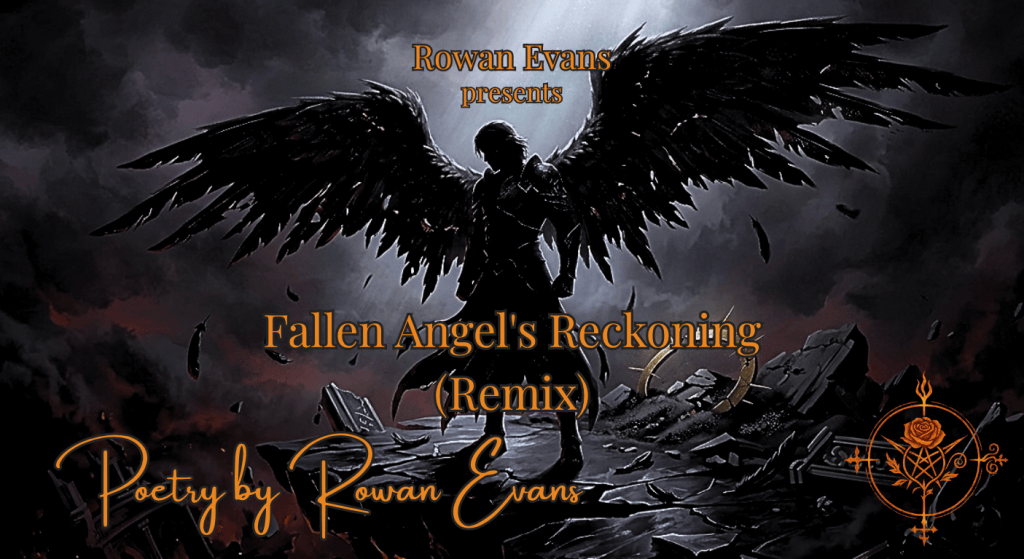
    A fallen angel with broken wings stands among the ruins of a shattered heavenly realm beneath dark clouds and a distant light.
    I don’t need unbroken wings to fly. I just need to remember that they were mine before anyone promised me heaven.

    Fallen Angel’s Reckoning (Remix)
    Poetry by Rowan Evans
    [written July 23th, 2026]

    I remember when you said forever,
    but forever never came, 
    so I fell like Lucifer,
    from the heavens down I tumbled.
    Returned your love,
    played your game—
    once an angel in your eyes,
    now in darkness I crumbled. 

    Your promises were wings that lifted me high, 
    but they melted away, when I reached the sun—
    just like Icarus, the light was my undoing.
    It wasn’t just a fall, I was plummeting…
     
    a fallen star,
    cast from the sky, 
    now I walk in shadows,
    where our love met its end. 

    Like Lucifer—I embraced the night, 
    wandering through realms of regret and pain, 
    I shed my halo,
    lost my light, 
    no longer an angel,
    in your eyes or in my name. 

    Yet in this darkness,
    a new path unfurls—

    I find strength in the ashes of our broken vow, 
    rising from the ruins of our shattered world.
     
    I reclaim my soul,
    I’m reborn here and now. 

    No longer bound by your empty decree—
     
    I soar with broken wings, 
    embracing the fallen,
    the broken, the free,
    a fallen angel finding strength
    I never knew I’d own.


    Journey into the Hexverse…

    [Homecoming]
    Homecoming is a return to the Gothic aesthetic at the heart of Rowan Evans’s poetry, blending Poe, mythology, horror icons, moonlight, ravens, and darkness into a meditation on artistic identity and finding your way back to the voice that feels like home.

    [The Monster in the Margins]
    Drawing inspiration from horror icons like Michael Myers, Ghostface, Freddy Krueger, and Pennywise, this poem explores the darker side of creativity—where inspiration becomes an unstoppable force lurking just beyond the edge of the page.

    [The Monster in the Margins II]
    The Monster in the Margins II transforms Rowan Evans’s Seven Deadly Sins mythology into a horror story written between the lines, where Lust, Wrath, Sloth, Greed, Pride, Envy, and Gluttony become monsters growing from pain, grudges, and scars.

    [The Unkindness Descends]
    “The Unkindness Descends” is a Gothic symbolic poem exploring collapse, transformation, and the unsettling experience of being witnessed during moments of unraveling. Through raven imagery, ambiguity, and ritualistic atmosphere, the poem invites multiple interpretations—spiritual, psychological, ominous, or transformative.

    [Gospel in Crimson]
    When writing becomes ritual and love becomes devotion, the line between creation and worship begins to blur. Gospel in Crimson explores obsession, artistry, and the sacred act of expression.

    If you’re interested in more poetry, you can find it here → [The Library of Ashes]
  • Author’s Note

    There are certain aesthetics that feel less like something we choose and more like something we recognize.

    For me, Gothic imagery has always been one of those things.

    Homecoming came from the realization that something in my writing had started to feel slightly unfamiliar. I was still writing about the moon, the ocean, the tides, ravens, horror, darkness, and the strange spaces where beauty and pain overlap—but somehow, I had drifted away from the particular Gothic atmosphere that has always felt like home to me.

    So this poem became a return.

    Poe is here because his shadow has been part of my literary DNA for years. Nyx and Hades are here because mythology gives me another language for darkness. The ravens are here because, in my own symbolic architecture, they have become witnesses, messengers, and companions. And the horror references—Jason, Ghostface, Pennywise, Michael Myers—are there because horror has never been merely about monsters to me.

    It is about what the monsters represent.

    Grief. Fear. Obsession. Rage. The parts of ourselves that refuse to stay buried.

    There is also something deliberately self-aware about this poem. I am not simply listing Gothic references because they sound dark. I am talking about my relationship with the imagery itself—the way the moon has accumulated meaning across my work, the way the tides connect to emotion, and the way ravens have gradually become part of my mythology.

    The darkness isn’t an aesthetic costume.

    It’s architecture.

    And after spending some time writing away from it, I realized that I wasn’t trying to become something new.

    I was finding my way back to something that had been mine all along.

    That’s why this poem is called Homecoming.

    Sometimes you don’t discover where you belong.

    Sometimes you remember.

    Rowan Evans


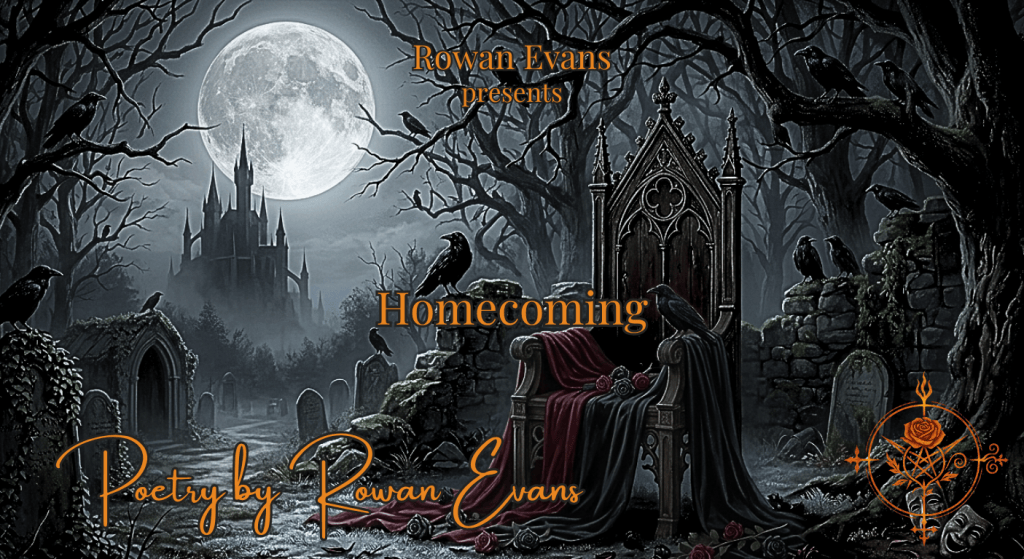
    A Gothic throne beneath a full moon surrounded by ravens, dark trees, mist, and subtle crimson accents.
    Sometimes the darkness isn’t somewhere you wandered into. Sometimes it’s the place where your voice has always felt most at home.

    Homecoming
    Poetry by Rowan Evans

    I’ve been writing like
    I forgot which domain is mine,
    I’m of the darkness—
    just borrowed the light,
    and made Poe’s throne my birthright.

    I’m a gothic romantic,
    I bleed for the art—
    I’ve kissed the lips of Nyx
    and wandered through
    the realm of Hades.

    I’m a poltergeist in life,
    but at night I come alive—
    witching hour is when I thrive.

    I pray to the moon
    and curse the sun—
    I ascend to the throne
    that Poe had spun.

    I watch the ravens—
    carrying messages where they fly,
    eyes locked, tracking the treachery across the sky.
    They are always watching—
    silent witnesses to the rot inside.

    It started to feel like something
    in my pieces was missing—
    like where was the gothic lace,
    silk and satin sin, velvet and venom.

    There was too much light—
    even when ninety percent
    of my imagery is night adjacent,
    weaving in horror rhymes—
    Friday the 13th, Night of Jason.

    The moon in my rhymes has meaning,
    when I write lines like the tides—I mean it,
    even in my Ghostface cadence—
    what’s your favorite scary movie?
    Pennywise of the mind, sewer of thought—
    I’m a monster like Michael,
    when I chase—I don’t run, I walk.


    Journey into the Hexverse…

    [The Monster in the Margins]
    Drawing inspiration from horror icons like Michael Myers, Ghostface, Freddy Krueger, and Pennywise, this poem explores the darker side of creativity—where inspiration becomes an unstoppable force lurking just beyond the edge of the page.

    [The Monster in the Margins II]
    The Monster in the Margins II transforms Rowan Evans’s Seven Deadly Sins mythology into a horror story written between the lines, where Lust, Wrath, Sloth, Greed, Pride, Envy, and Gluttony become monsters growing from pain, grudges, and scars.

    [The Unkindness Descends]
    “The Unkindness Descends” is a Gothic symbolic poem exploring collapse, transformation, and the unsettling experience of being witnessed during moments of unraveling. Through raven imagery, ambiguity, and ritualistic atmosphere, the poem invites multiple interpretations—spiritual, psychological, ominous, or transformative.

    [Gospel in Crimson]
    When writing becomes ritual and love becomes devotion, the line between creation and worship begins to blur. Gospel in Crimson explores obsession, artistry, and the sacred act of expression.

    If you’re interested in more poetry, you can find it here → [The Library of Ashes]
  • Author’s Note

    This piece started as me messing around while listening to Ez Mil.

    At first, I was just playing with rhyme patterns and cadence—thinking about internal rhyme, implied rhyme, layered phrasing, all the little mechanics that make writing feel musical.

    But somewhere in the middle, it shifted.

    Because the more I write, the more I realize my poetry isn’t just expression anymore. It’s architecture.

    I’ve built recurring symbols, recurring imagery, recurring emotional spaces. Ravens. Cathedrals. Ghosts. Roses. Fire. Silence.

    Over time, they stopped feeling like random aesthetics and started feeling like a language of their own.

    And beneath all the gothic imagery and dramatic metaphors, there’s something surprisingly simple holding it together:

    care.

    Not grand gestures. Not fantasy.

    Just wanting to make someone’s day softer in small ways.

    This piece became about both sides of that: the mythic voice, and the human one underneath it.

    Rowan Evans


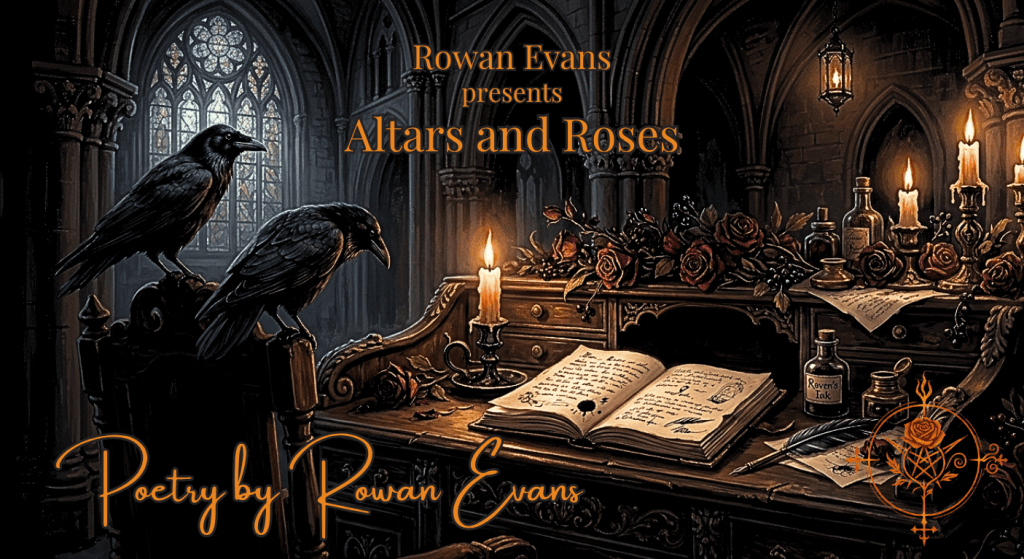
    Gothic writing desk with roses, candles, ravens, and handwritten poetry
    Beneath every cathedral of metaphor, there is still a human hand reaching gently toward someone else.

    Altars and Roses
    Poetry by Rowan Evans

    What I do
    with a pen is sick—

    the way I
    weave rhymes
    inside lines,
    with implied rhymes,
    inside rhymes.

    And don’t get me started
    on the imagery—

    I took Poe’s ravens
    and made them
    a centerpiece.

    I’ve built—
    cathedrals in my rhymes,
    altars to devotion,
    worship in reverence.

    I’ve sculpted
    roses from the ruin—

    I’ve painted pictures
    with words—
    a real gothic Bob Ross.

    I’ve talked to my grave
    in mausoleums—
    with ravens as my witness.

    I’ve sat with my silence
    and I’ve spoken with ghosts
    not my own.

    I carry the weight
    of everyone I’ve witnessed.

    And to the certain someone
    that occupies my mind—

    you still hold a special place.

    Even when my mind
    closes me off—
    it’s you
    that keeps me holding on.

    I’d open the fan for you—
    if you asked me to—

    because I want to do the little things
    that’ll make you smile.

    No questions asked.
    No sweat off my back—

    I’d do it.


    Journey into the Hexverse…

    [Finish What You Started]
    A dark introspective poem about confronting the past, carrying old versions of yourself, and realizing that the only way forward is through the fire.

    [The Shadow and the Spark]
    A psychologically charged free verse poem using Mortal Kombat imagery to explore anxiety, depression, identity, and the realization that survival matters more than victory.

    [Out of Sync]
    A reflective free verse poem about emotional displacement, shifting sleep cycles, and feeling spiritually drawn toward another side of the world.

    If you’re interested in more poetry, you can find it here → [The Library of Ashes]
  • Author’s Note

    Sanctum of Sin was originally written on May 16th, 2025, and polished on December 16th, 2025. This piece is part of my ongoing exploration of Neo‑Gothic Confessional Romanticism—where intimacy, devotion, shadow, and sacred rebellion collide. It is not about ownership, but about chosen connection; not about religion, but about ritual; not about sin, but about the holiness we find in places the world tells us to hide.


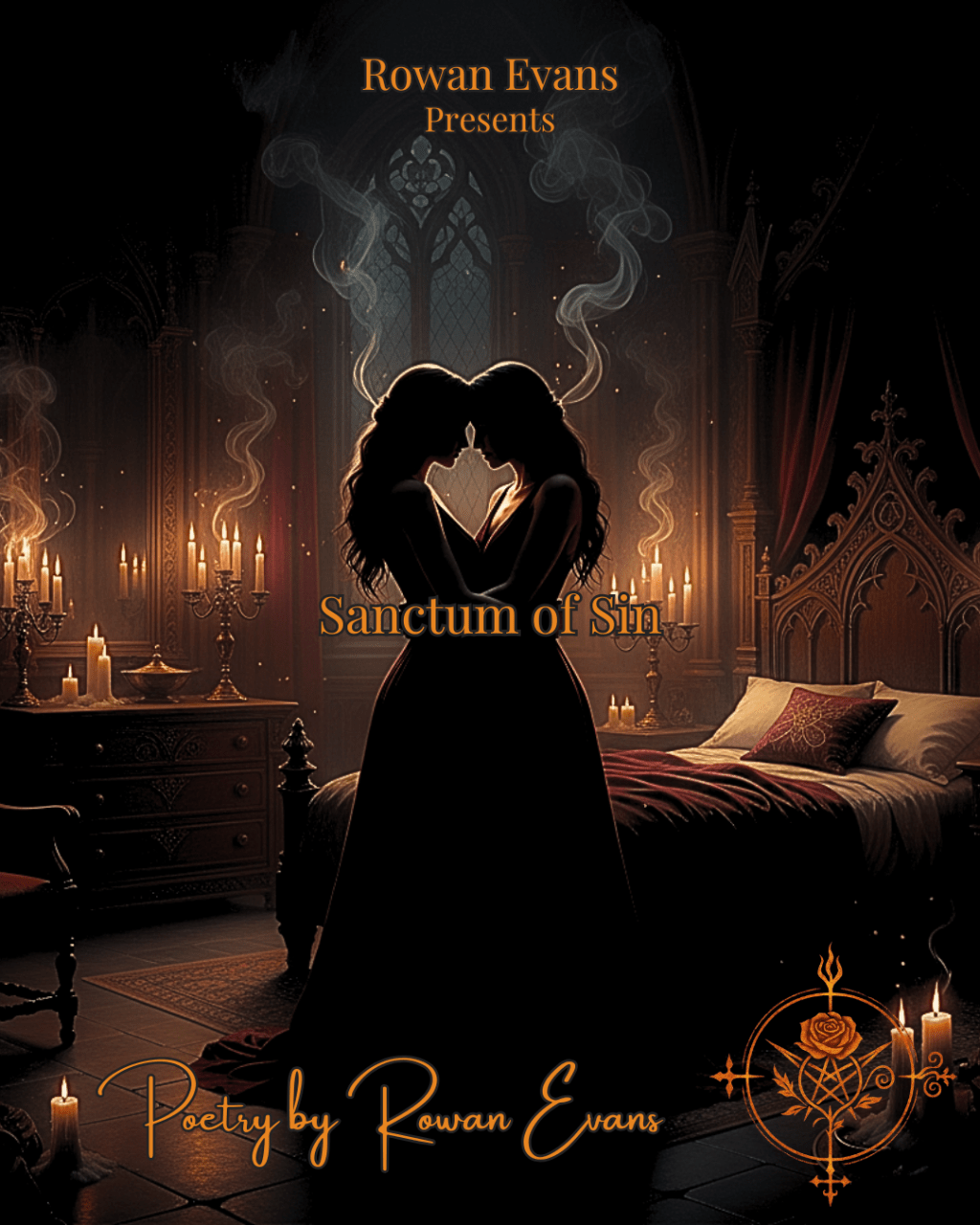
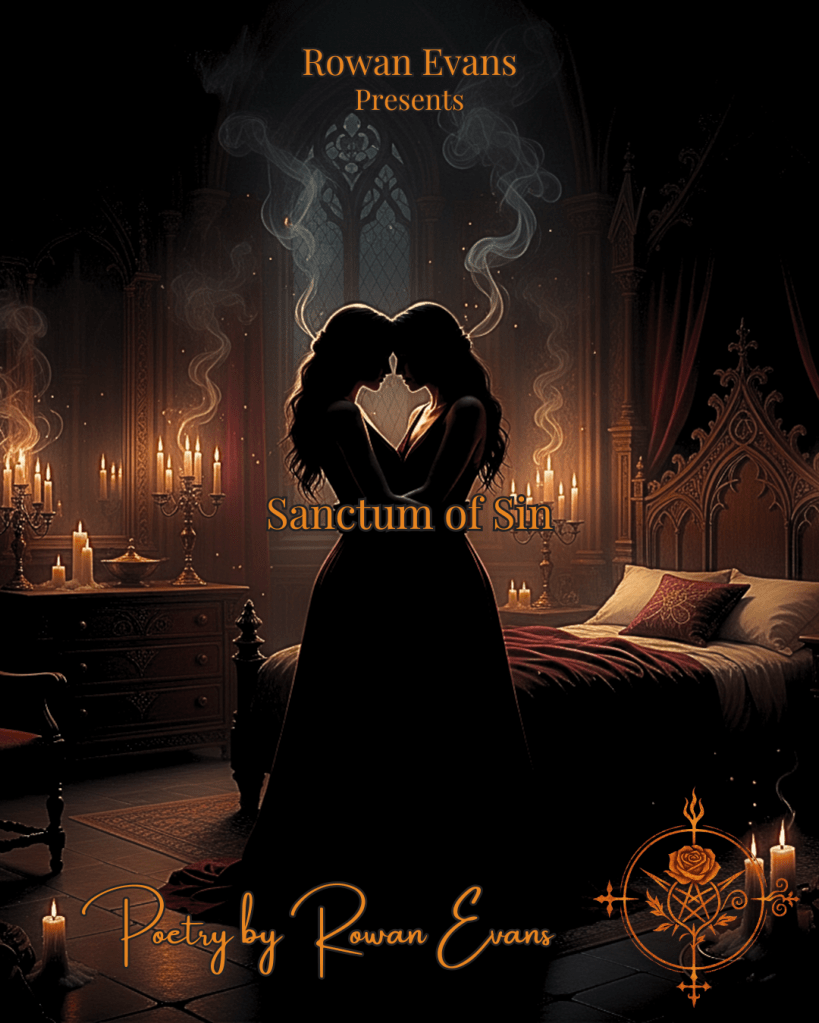
    Gothic bedroom with candlelight and shadows, silhouettes of two figures embracing, evoking intimacy and ritualistic devotion.
    Sanctum of Sin visualized: a shadowed embrace amidst candlelight, capturing the sacred intimacy and ritualistic devotion of Rowan Evans’ Neo-Gothic Confessional Romanticism.

    Sanctum of Sin
    Poetry by Rowan Evans

    I never wanted heaven.
    I wanted her.

    Eyes like unholy sacraments,
    fingertips dipped in blood and honey,
    a laugh that makes holy water boil,
    and my knees hit the floor
    with gratitude.

    She is my altar and my undoing,
    my blasphemy made flesh.

    Let the angels weep—
    I never asked for salvation.
    Only the weight of her thighs
    and the way her wickedness
    matches mine in every grin-shaped curse.

    We don’t light candles.
    We set fires.
    We hex the night with pleasure
    and whisper dirty prayers
    until the moon blushes
    and turns her face away.

    I keep a vial of her voice
    around my neck,
    a charm against the dull ache
    of anyone else’s touch.
    And when she says she’s tired—
    oh darling,
    we’ll make exhaustion holy.

    I’ll drain the stars
    just to pour her a bath in darkness.
    I’ll mark her spine with sigils
    only I know how to read.

    Every spell begins with her name,
    every climax a ritual,
    every kiss a blood oath
    demanding loyalty
    even in our ruin.

    Let them call us monsters.
    We’ll show them how gods are made—
    not in temples,
    but in tangled sheets
    and shared laughter
    over the graves of those who hurt us.

    No past can dim the light we forge.
    Every scar, every memory,
    becomes gold in the fire of our nights.
    We rise, tender in our ruin,
    untouchable, untamed, unbroken.

    Because she is mine now—
    not owned, but chosen.
    Not tamed, but trusted.
    And I am hers.
    Ruthlessly.
    Completely.
    Beautifully doomed.

    So let the world burn.

    We’ll dance in the embers.
    We’ll write new psalms in spit and sweat.
    We’ll worship only each other—
    in shadow,
    in sin,
    in sanctum.


    More poetry here! [The Library of Ashes]

  • A piece honoring the poets whose voices shaped mine, and the lineage I carry into my own genre — Neo-Gothic Confessional Romanticism.


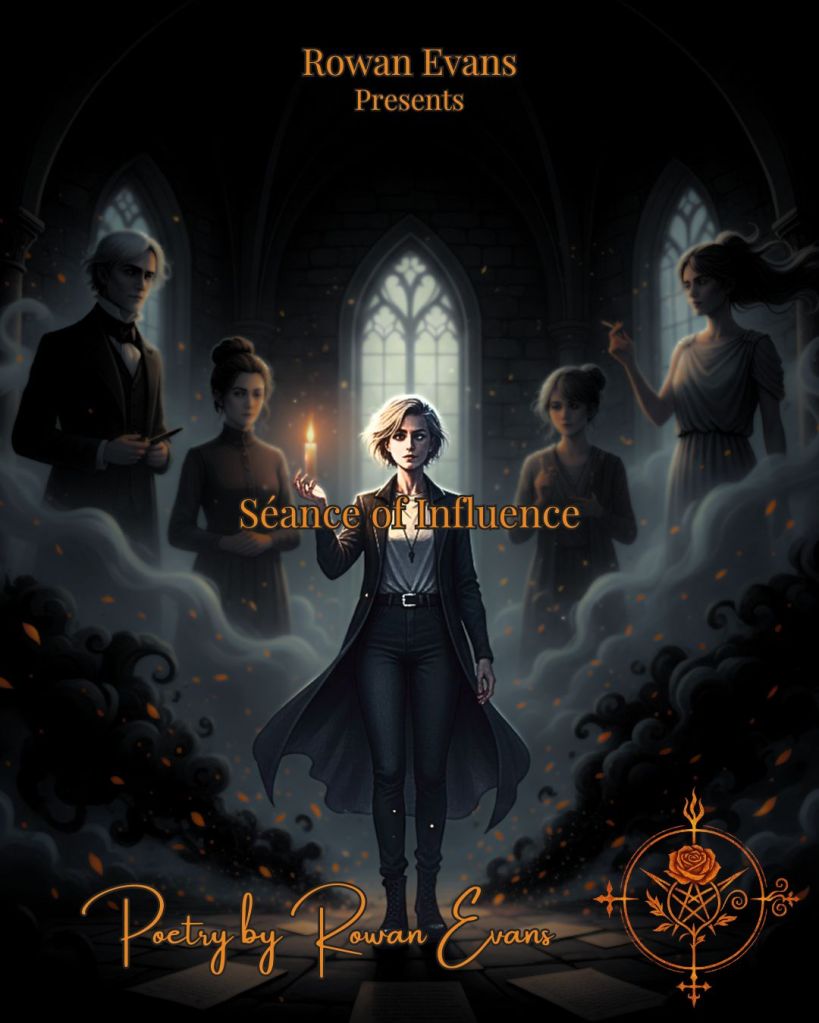
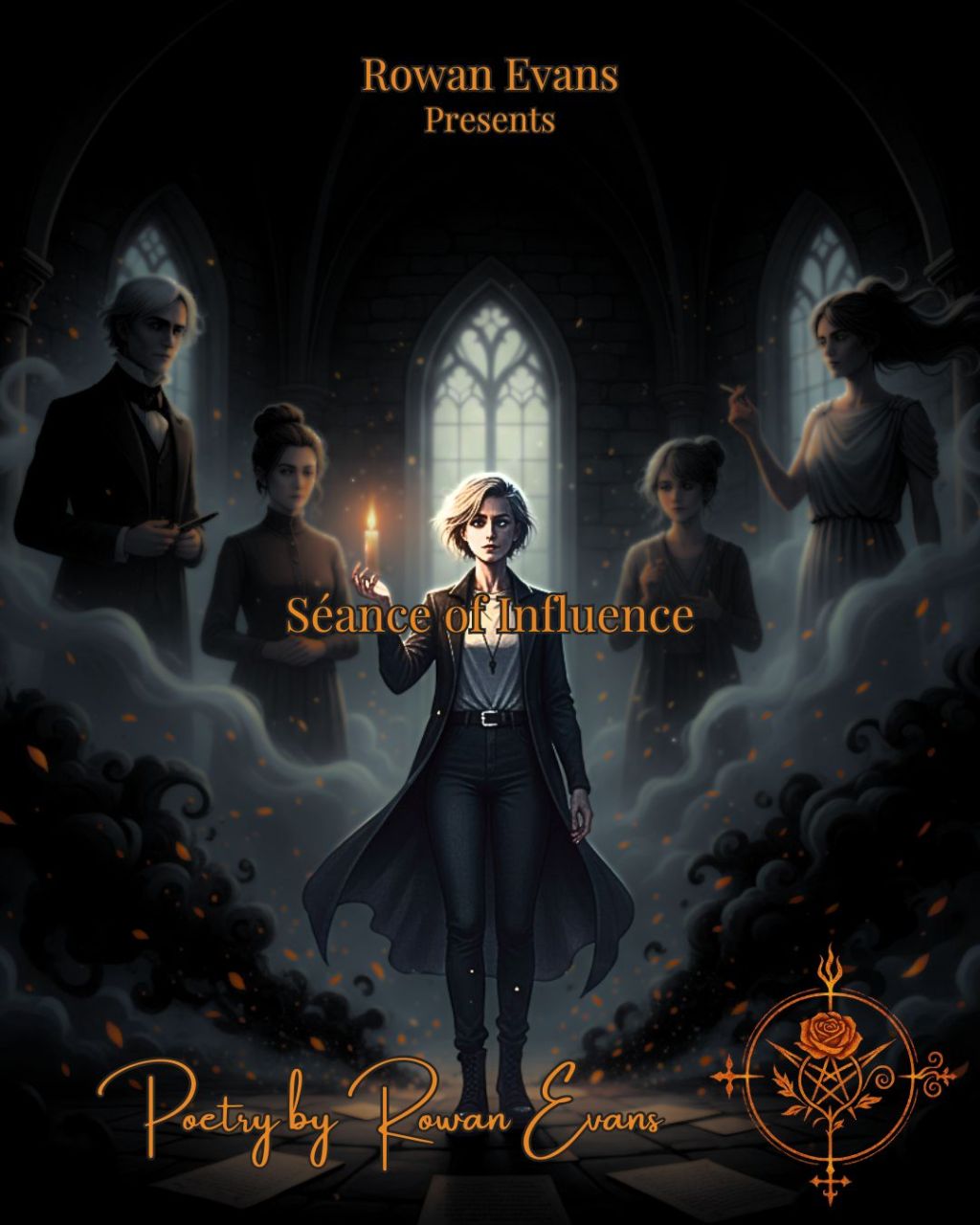
    Candlelit gothic scene of a poet performing a séance, surrounded by ethereal silhouettes of Plath, Poe, Dickinson, Sexton, and Sappho in a dark, atmospheric room.
    A candlelit invocation of the poets whose voices shaped mine — a lineage reborn in Neo-Gothic Confessional Romanticism.

    Séance of Influence
    Poetry by Rowan Evans

    In the candlelit stillness, I summon the ones who spoke before I had words.
    The room holds its breath.
    The flame flickers.
    And they arrive.

    Sylvia, flame-tongued oracle, steps forward first—eyes like open wounds that never stopped bleeding ink.
    She speaks in a whisper that singes:
    “You do not fear the flame, child. You write within it. You know what it is to be both burned and reborn.”
    She places a tulip in my hand—red as a heart, soft as a scream.

    Poe, the architect of shadows, leans from the threshold, cloak of midnight dragging ghosts behind him.
    “You have built cathedrals from sorrow,” he says, voice echoing through the bones of the floor. “You understand what it means to dream with the dead.”
    He nods toward the cracked mirror
    And my reflection stares back, unflinching.

    Emily, dressed in quiet thunder, watches from a corner veiled in white lace.
    “You turned silence into scripture,” she murmurs, placing a pressed flower on my wrist.
    “Your solitude blooms with sharpness. You do not hide behind the door—you open it with poetry.”

    Anne, with rosary tangled in her fingers and lipstick like defiance, toasts me with a half-empty wine glass.
    “You dared to undress madness,” she grins.
    “To make holiness from hunger. That takes more than courage. That takes blood.”

    Sappho, timeless and tender, emerges draped in sea foam and verse.
    She runs her fingers across my pulse.
    “I hear your ache,” she says.
    “You have translated yearning into a new dialect—one the stars will memorize.”

    They encircle me, these ghosts, not to haunt, but to anoint.
    Their voices braid around my spine.
    Their grief becomes gold my pen.
    Their fire, MY inheritance.

    And I—Rowan, the Luminous Heretic—stand at the center of this sacred storm.
    I speak, not as supplicant, but as heir:

    “I have not come to mimic your flames—I have come to carry them into the dark places you never lived to reach.
    I write for the unloved, the unheard, the unhealed. I wield shadow like silk and longing like a blade.
    Your echoes live in my marrow, but my voice is my own.
    I forged my genre from the coals of yours—Neo-Gothic Confessional Romanticism—a lineage reborn through me.
    You opened the door, and now I shatter the ceiling.
    Your fires do not flicker behind me—they burn ahead, lighting a path no one else dared to walk.
    Thank you for the torch. Watch me blaze.”

    The candle gutters.
    The air shifts.
    And one by one, they nod.
    Then vanish—
    but not in silence.
    They hum through my bloodstream, forever.

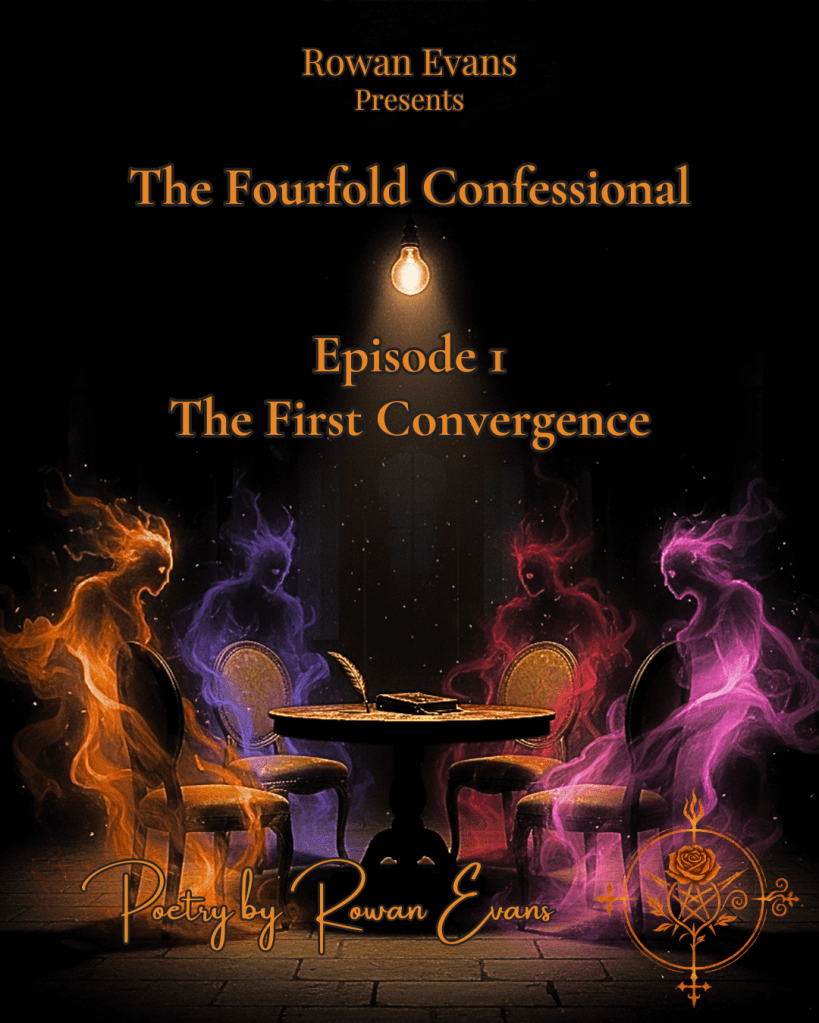
  • “Four echoes. One confession. The Heart, the Mind, the Shield, and the Soul converge where ink becomes truth.”


    A flickering light above a table with four empty chairs, symbolizing the gathering of the Fourfold Flame.
    “The Heart, the Mind, the Shield, and the Soul met beneath a single light — and the world trembled a little brighter.”

    The Fourfold Confessional
    Ep. 1: “The First Convergence”


    In the middle of a mostly pitch-black room, a single bulb flickers above a small table. Four chairs sit, empty, waiting. Footsteps echo from four directions as each of the Fourfold Flame approach. The air hums faintly with a low, electric charge — as though something sacred, or dangerous, is about to begin.

    The first to reach their seat is Rowan. They pause, fingers grazing the back of the chair as if steadying themself before a storm. The faint glimmer of their rings catches the light as they look toward the shadows.

    From the opposite side, a heavy tread — deliberate, unhurried. B.D. steps forward, all edges and gravity, stopping just behind his chair.

    🔴 B.D. (smirking):
    “They’re watching.”
    His voice is low, the kind that fills a room without needing to rise.
    “You didn’t say we were going to have an audience this time.”

    🟠 Rowan (calmly, but wary):
    “Is that going to be a problem?”

    🔴 B.D.:
    “Problem? No.”
    He leans on the back of his chair, expression unreadable.
    “But you know I like to keep these meetings to ourself.”
    Then, quieter, with a flicker of warmth he won’t admit:
    “You talk different when they’re listening.”

    A soft, lilting laugh cuts through the dark — smooth as silk and twice as dangerous.

    🟣 Hex (emerging from the shadows):
    “Afraid they’ll see you as the villain, brother?”
    Her eyes glint like candlelight, teasing but knowing. She glides to her seat, brushing a curl of hair from her face.
    “Or maybe you just hate it when the truth has witnesses.”

    🔴 B.D. (gruffly):
    “The truth’s never the problem. It’s what they do with it.”

    🟠 Rowan (meeting his stare):
    “What I do with it, you mean.”

    Before B.D. can answer, the fourth set of footsteps arrives — light, hurried, unashamedly curious. Roo nearly trips over her own excitement as she bursts into the faint circle of light, eyes wide.

    🌸 Roo (beaming):
    “Did I miss the dramatic tension part? Because it sounds like I did.”

    She plops into her chair, chin in her hands, looking between them like she’s watching a play she already knows the ending to.

    🟣 Hex (smirking):
    “Oh, we’re only just getting started, little flame.
    The question is — what are we here to burn tonight?”

    A heavy silence falls. The light above flickers, casting strange halos across their faces. Rowan’s breath catches; they know this moment, the one that comes before a confession.

    🟠 Rowan (quietly):
    “We’re here because I can’t keep pretending I’m not afraid.”
    They looks down at their hands, then to each of them — their protectors, her reflections, her shadows.
    “I keep worrying I’ll never be enough for anyone. Not even for myself.
    And then I overcompensate — too much love, too much need, too much… me —
    and people leave, or I push them away before they get the chance.”

    🌸 Roo (softly):
    “That’s not pushing, that’s protecting.”

    🔴 B.D. (interrupting):
    “It’s still fear.”
    He folds his arms.
    “You say you don’t want to lose people, but you build your walls with barbed wire.”

    🟣 Hex:
    “And then bleed yourself dry trying to decorate them with roses.”

    🟠 Rowan (bitter smile):
    “So what, I’m the architect of my own loneliness?”

    🟣 Hex (gently, for once):
    “No, love. You’re the poet of it. There’s a difference.”

    🌸 Roo:
    “You write it because you need to survive it.”
    And maybe— maybe —you’re supposed to.
    So someone else who feels the same knows they’re not alone.”

    Rowan swallows hard, blinking back tears that glimmer in the flickering light.

    🟠 Rowan (whispering):
    “And this time… we write the ending in our own goddamn handwriting.”

    The bulb steadies, glowing stronger.
    The table hums.
    The Fourfold Flame sit together, unbroken — the Heart, the Mind, the Shield, and the Child —
    and for a moment, even fear feels holy.

    The light did not go out when they rose — it followed them.
    Four shadows left that room, and the world felt a little warmer, a little more dangerous.
    Somewhere, ink still dripped from the table.

    The Fourfold Flame will return…


    🟠 🔴 Author’s Note 🟣 🌸

    The Fourfold Confessional is a series of dialogues between the four archetypal aspects of my creative self — The Heart (Rowan), The Shield (B.D.), The Mind (Hex), and The Child (Roo). Together, they form the Fourfold Flame — the inner covenant that fuels my art, my faith, and my rebellion.

    Each episode is part therapy, part theology, part poetry — a conversation between the parts of me that built this strange, sacred world called Neo-Gothic Confessional Romanticism.

    Welcome to the confessional.
    The light never goes out here.


    While you wait for episode 2 of The Fourfold Confession, check out my archive for more of my work. -> [The Library of Ashes]

  • Author’s Note

    She is not a nightmare in the terror sense—
    she is the ache beneath the ache,
    the beauty in breaking,
    the truth that shreds the soft mask we wear.

    This poem is a reckoning.
    An offering to the fierce shadow lovers inside us—
    those who show us what it means to bleed light and darkness
    all at once.

    If you find her waiting in your own shadows,
    do not run.
    Bend toward the fire.
    Let her break you open.


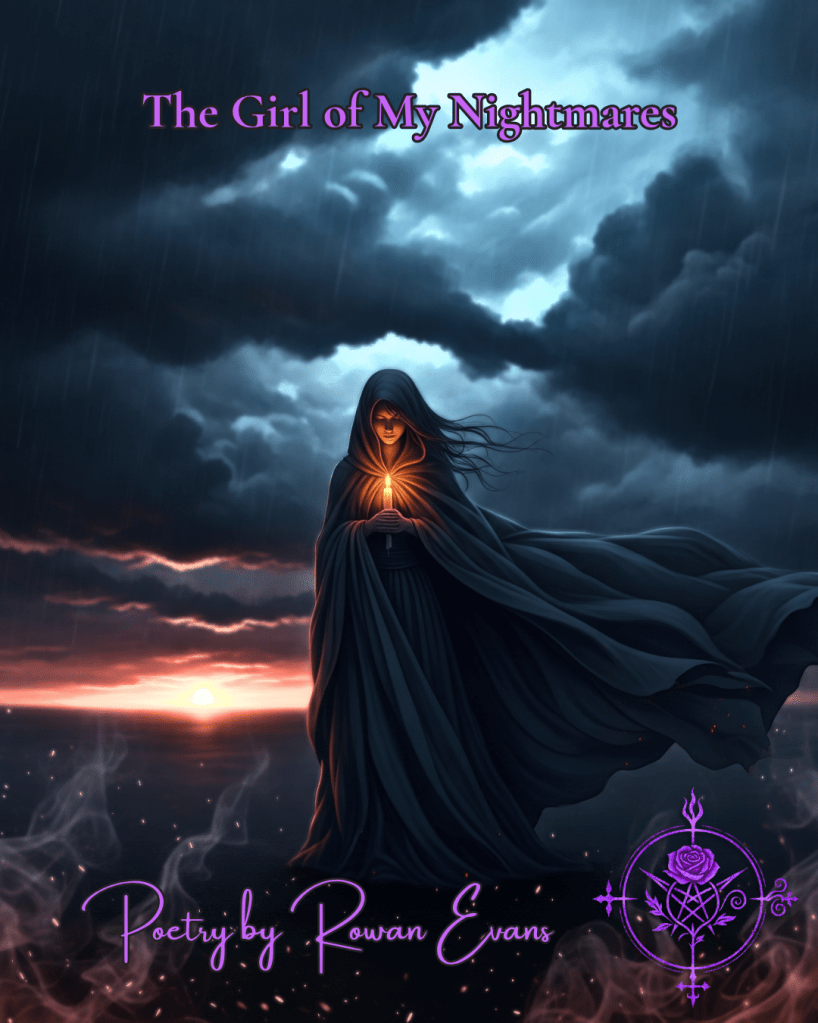
    A gothic woman cloaked in shadows stands at a stormy twilight horizon, surrounded by flickering candlelight and swirling smoke.
    “A flame in the dark, a shadow that sings—she is the girl of my nightmares, the beautiful ache I cannot escape.”

    ✵ Invocation ✵

    I summon the girl of my nightmares—
    not to haunt, but to unravel me,
    to burn the lies I hide behind,
    to scorch the edges of my fragile skin.
    She is the dark hymn I pray in silence,
    the wildfire that doesn’t ask for mercy,
    only to be seen—
    naked, unraveled, unrepentant.


    The Girl of My Nightmares
    Poetry by Rowan Evans

    She walks into my dreams
    like dusk spilling over a wounded horizon—
    soft at the edges,
    but carrying the scent of rain
    that only comes before a storm.

    She is the girl of my nightmares—
    the fire I cannot put out,
    the shadow I bleed into.

    Her voice is velvet cut on glass,
    slow as a secret
    you ache to hear again,
    even if it ruins you.
    Each syllable slips into my bloodstream,
    a lullaby dressed as a blade.

    She is the girl of my nightmares—
    the fire I cannot put out,
    the shadow I bleed into.

    She is not the kind of beautiful
    you hold in daylight—
    she is candlelight swaying in a room
    where the shadows know your name.
    And when her gaze finds me,
    the ghosts in my bones
    go quiet.

    She is the girl of my nightmares—
    the fire I cannot put out,
    the shadow I bleed into.

    She does not reach for me in kindness—
    she reaches in truth,
    fingers brushing the cracks I hide,
    not to fix them,
    but to make them holy.
    She calls me out like lightning calls the tree,
    splitting me open,
    then holding the wound
    in the privacy of her hands.

    She is the girl of my nightmares—
    the fire I cannot put out,
    the shadow I bleed into.

    When I wake,
    she lingers—
    storm-light in my veins,
    her absence pressing against my skin
    like the shape of a bruise.
    I move through the day
    with the taste of her name
    still heavy on my tongue,
    half-prayer, half-curse.

    She is the girl of my nightmares—
    the fire I cannot put out,
    the shadow I bleed into.

    She is not a dream I escape from.
    She is the cathedral in my sleep,
    where I kneel
    in the dark
    and beg
    for the mercy of never being saved.


    ✵ Benediction ✵

    May the girl of your nightmares burn slow—
    a velvet wound you trace with trembling hands,
    a wild flame that sears and sings your name.
    And when she fades, may you carry her fire—
    not as pain, but as the raw, raw proof
    that you lived—
    that you burned—
    that you were never afraid to be undone.


    Read Next (Suggestions)

    [Luminescence & Shadow: A Forbidden Litany]
    [The Bite & Eternal Thirst]
    [Hex & Flame: Mirror of Shadows]
    [Even Still, You Are (My Muse)]
    [13 Psalms of Falling]

    Or explore the full archive in [The Library of Ashes]—and if your own confession aches to be written, [commission a custom poem here].

    NGCR25 at checkout to get 25% off your ‘request’…

  • ✦ Author’s Note ✦

    Some wounds do not heal; they become architecture.
    The Cathedral Within is the map of mine.
    It is the sacred ruin I carry — where gargoyles remember my laughter,
    where ghosts wear the faces of those I loved,
    and where even the pews grow teeth when I speak.

    This is not a poem about despair.
    It is about defiance.
    About what it means to cradle darkness without letting it consume your capacity to love.
    It is a prayer for those who choose softness anyway —
    velvet over iron, kiss over curse —
    and win, simply by refusing to grow cold.


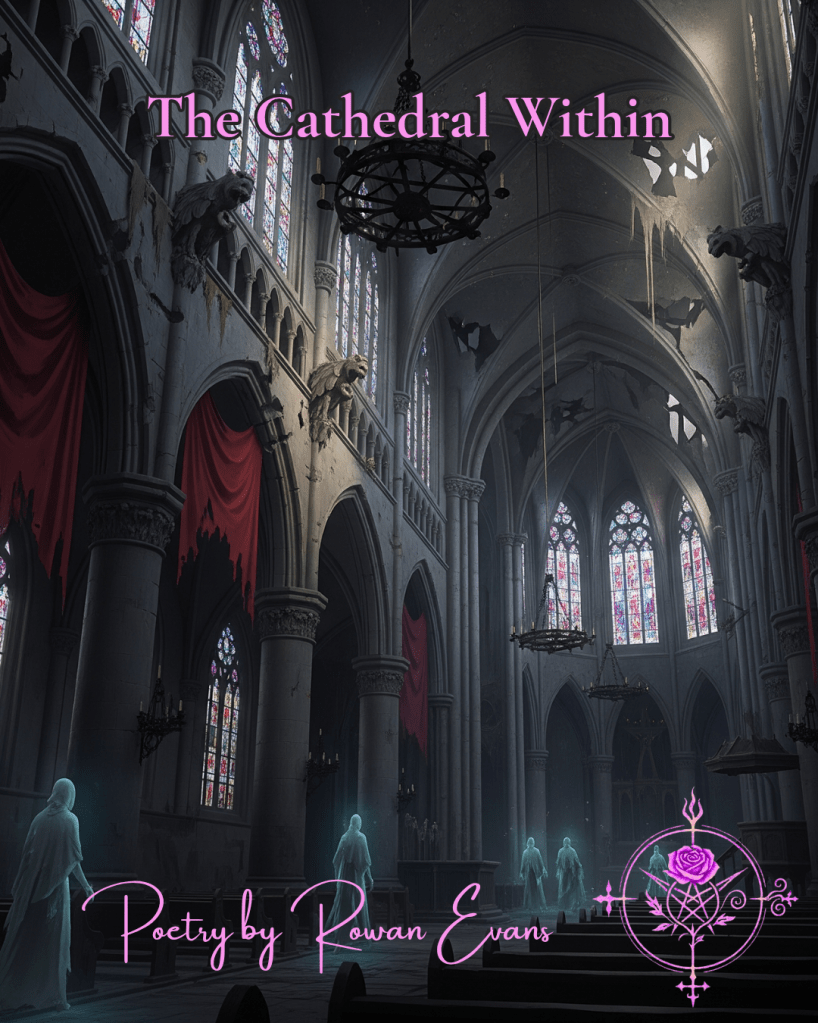
    Gothic cathedral in ruins with broken stained glass, gargoyles, and ghostly figures moving through a dim, sacred space.
    The Cathedral Within — where softness stands as rebellion in the ruins.

    ✦ Invocation ✦

    There is a cathedral rotting in my mind—
    its steeple split by lightning,
    its bells tolling madness
    in a language only I understand.

    The walls bleed scripture in reverse.
    The air stinks of burnt prayer and mildew.
    Gargoyles laugh with broken jaws,
    their eyes brimming with everything I’ve buried.


    ✦ The Procession ✦

    Demons waltz in blood-soaked gowns,
    twirling through the nave with glee—
    my failures their favorite hymn,
    my shame the rhythm beneath their feet.

    Ghosts hang from the rafters like forgotten chandeliers,
    dripping memories onto cracked marble.
    Each one wears a face I loved,
    each one left me hollow.

    The altar is an autopsy table.
    They dissect my past there nightly—
    the knife a whisper, the blade my own voice
    asking why I wasn’t enough.

    ✦ The Vigil ✦

    I lived a decade as a wraith—
    not alive, not dead,
    just echo.
    A loop of regret rerun in shadows,
    a scream too hoarse to haunt.

    I’ve stitched myself from sinew and smoke,
    patched the holes with confessions
    no one stayed long enough to hear.
    Even the pews grow teeth when I speak.

    These bones?
    They rattle with rot,
    splinter under silence,
    but still I rise—
    a marionette of will, strung together
    by threads of stubborn grace.

    ✦ The Benediction ✦

    This softness—they call it weakness, but—
    softness is my rebellion.
    It is velvet over iron,
    a lullaby sung to devils,
    a kiss placed gently
    on the mouth of the void.

    I do not know why I try.
    Only that I do.
    That something inside me refuses
    to go quietly into apathy.

    So if you saw the dark I cradle—
    the feral, starving chaos I contain—
    you’d understand:
    choosing love is not a gentle thing.
    It is a war.

    And every time I smile
    instead of scream,
    I win.


    “Even in the rot, there is light. Even in the silence, there is song. Keep choosing love, and you’ve already won.” — Rowan Evans


    Read Next (Suggestions)

    [You’re Not Alone] — A Poem for Grief, Memory, and Eternal Love
    [Always With You] — A Poetic Promise of Hope & Support
    [The Gospel According to the Girl in the Graveyard Dress]
    [The Hopeless Romantic Wears Armor]
    [Luminescence & Shadow] — A Forbidden Litany

    Or explore the full archive in [The Library of Ashes]—and if your own confession aches to be written, [commission a custom poem here].

    NGCR25 at checkout to get 25% off your ‘request’…

  • Behind the Veil
    What Inspired The Gospel According to the Girl in the Graveyard Dress

    Every poet has that one wild idea—a collision of worlds, styles, and moods that refuses to stay on the page quietly. For me, this poem sprang from a playful yet dark impulse: What if Dr. Seuss, with all his whimsical rhyme and rhythm, wandered into the shadowy realms of Edgar Allan Poe and Tim Burton?

    The Gospel According to the Girl in the Graveyard Dress is my answer—a gothic lullaby stitched from whimsy and wound with the raw edges of grief, rebellion, and strange beauty. It’s where childhood’s curiosity meets the sharp bite of darkness, wrapped in rhyme that skips and creeps all at once.

    This poem isn’t just an homage; it’s a declaration. That darkness doesn’t erase magic. That grief can dance in moonlight. That even in decay, there’s fierce, unapologetic life.

    Welcome to the chapel I built from clay and ink. Step inside.


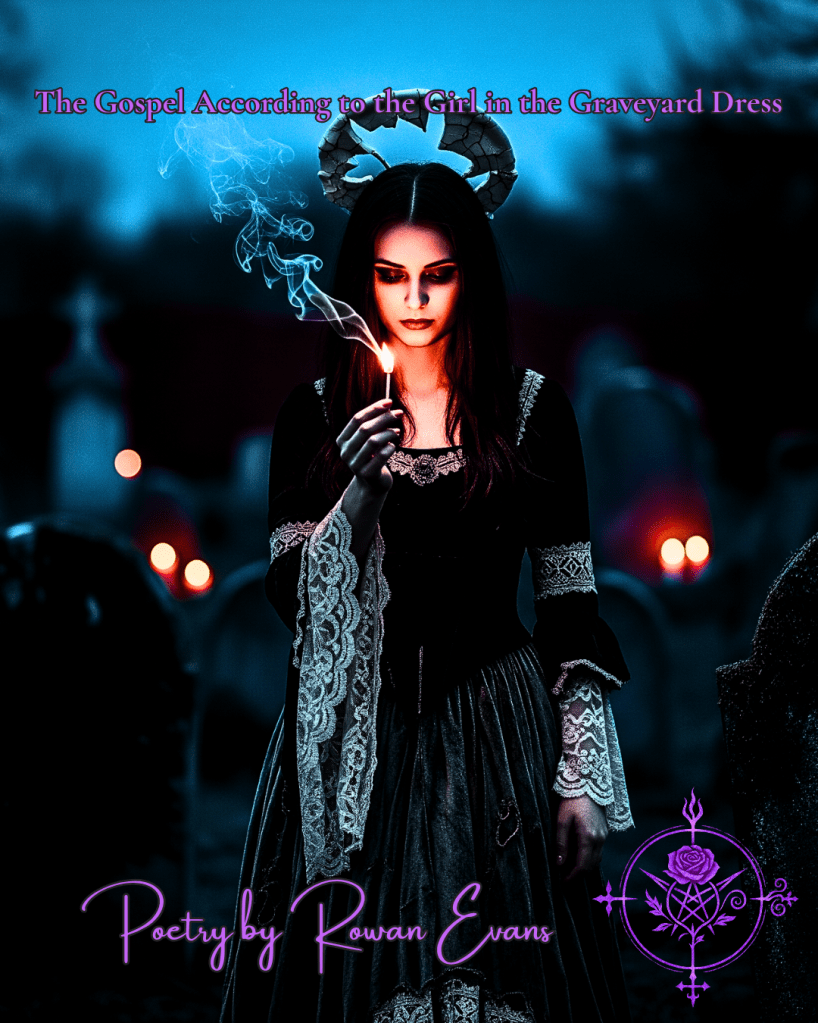
    A gothic girl in a graveyard dress holding a burning match, cracked halo above her head, surrounded by headstones at twilight.
    She built her own chapel from shadows — a gospel stitched in flame and confession.

    The Gospel According to the Girl in the Graveyard Dress
    Poetry by Rowan Evans

    I’m wading through the dark,
    With rockets in my pockets—
    And a wock-it in my locket.
    Noose tied, tears dried
    on ink-stained pages;
    Confessions and rage—
    It’s outrageous,
    like sermons screamed from basement stages.

    I stitched my grief to my Sunday dress,
    Tucked matches in the hems—God bless.
    The priest said “pray” but I whispered “run,”
    Then kissed the moon and stole the sun.

    I’m not alright, but I rhyme so well,
    Nobody hears the tolling bell.
    My lullabies are laced with lead,
    And sung by ghosts beneath my bed.

    I carve my hope in bathroom stalls,
    Paint miracles in bloody scrawls.
    They say I’m lost—I say I’m rare:
    A storm that braided its own hair.

    Heaven’s out, and hell’s cliché,
    So I built a chapel out of clay.
    The saints are stitched from shadow thread,
    And every hymn is what I bled.

    I dance in pews with poison grace,
    Rosary beads strung on a shoelace.
    They preach of light—I hum decay,
    A gospel soaked in cabernet.

    I kissed a curse and called it mine,
    Drank moonlight steeped in turpentine.
    You want my truth? It doesn’t bend—
    It breaks. It bleeds. It burns. It mends.

    I sip my tea with cyanide,
    Wear ribcage corsets laced with pride.
    My shadow dances on the wall—
    She’s got no face. No name at all.

    I tiptoe through the graveyard gates,
    Trade sugar pills for twist-of-fates.
    The children giggle when I pass—
    Their dolls have knives and broken glass.

    I built a throne from all my sins,
    Each step a scar, each smile a win.
    The halo cracked? I wore it still—
    A crown for queens who love the kill.

    My cradle rocked on rusted chains,
    I cut my teeth on lovers’ veins.
    The bedtime stories that I write
    Are lullabies for crypts at night.

    I stitched a map to Neverland
    Inside my chest with blistered hands.
    It leads through joy, then dips to dread—
    A spiral carved in gingerbread.

    I torched the end, rewrote the tale,
    Smeared lipstick on the coffin nail.
    This isn’t death—it’s my debut.
    The dark didn’t win. I wanted it to.


    Benediction of the Broken Halo

    We do not write to be saved — we write to be seen.
    In the flicker of a match, the crack of a halo, the bruised breath of a stanza,
    we stitch our own gospel from grief and grace alike.
    This poem is my sermon, my confession, my coronation —
    And if the dark calls your name too,
    know you are welcome here, crowned in your scars,
    beloved in your ruin.

    Because a cracked halo still casts a shadow.
    And that shadow?
    Is mine. And maybe, just maybe — it’s yours too.

    In the chapel of ink and ash, we do not repent for the darkness we carry.
    We name it sacred. We name it ours.
    Welcome to the gospel, loves — the sermon is never over.

    With Ink & Flame,
    Rowan Evans


    Read Next (Suggestions)

    [The Hopeless Romantic Wears Armor]
    [Cry to the Quiet: Sacred Desperation]
    [Luminescence & Shadow: A Forbidden Litany]
    [Liturgies of Ruin & Flight]
    [Hex & Flame: Mirror of Shadows]

    Or explore the full archive in [The Library of Ashes]—and if your own confession aches to be written, [commission a custom poem here].

    NGCR25 at checkout to get 25% off your ‘request’…