Tag: poetic identity

  • Author’s Note

    Some poems come from a single voice.

    This one comes from the argument.

    Iron Sharpens Iron is about what happens when every version of my creative mind sits down at the same table: the gothic romantic, the absurdist comic, the mythmaker, the battle-poet, the joke creator, and whatever other voice decides to kick the door open halfway through a line.

    The notebook becomes the sparring ring. One thought throws a punch, another throws a punchline, and sometimes Batman apparently gets involved.

    I don’t always plan where the thread is going. Sometimes I just follow it until the poem lands somewhere that makes sense.

    Maybe that’s the point.

    I don’t need to silence the contradictions. I need them to sharpen each other.

    — Rowan Evans
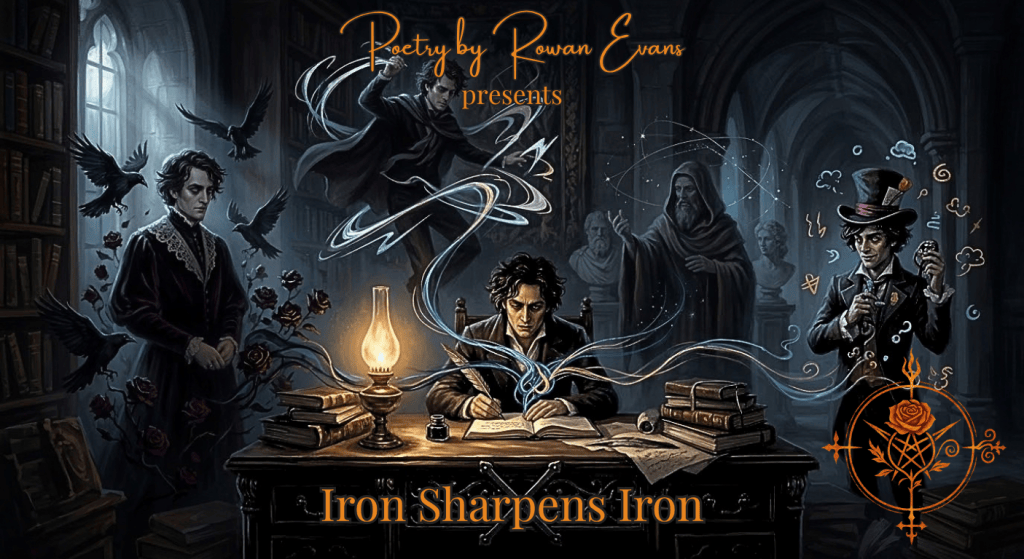

    A poet surrounded by multiple shadowy versions of themselves representing gothic romance, humor, mythology, and battle poetry, all connected by glowing strands of ink.
    I don’t silence the voices in my head. I let them sharpen each other.

    Iron Sharpens Iron
    Poetry by Rowan Evans

    I sit by myself—
    alone in body,
    crowded in mind—
    it’s a constant battle of wits,
    moon-fed goth kid
    versus the battle-poet
    turning pens to WMDs.

    The notebook—
    just a test site,
    where I drop bombs.
    It’s constant—
    the scream of the alarms.

    I write so much
    because my mind
    fights too much—
    a gothic romantic,
    an absurdist comic—
    opinions, opinions,
    too many opinions—
    constant contradictions.

    Is this a joke?

    Are the emotions sincere?

    What the fuck— (Batman!)
    is that reference doing here?

    That’s just how my mind is sometimes—
    I write a line and follow it, (Stalker.)
    I don’t plan it—I just follow the thread,
    guide the ship and land it.
    But sometimes I get lost—
    I’ll orbit the planet,
    or drift in my dreams—
    and they say to make the dreams work,
    it takes team work—
    well, I became my own team,
    every version of me.

    Gothic romantic, absurdist comic,
    mythmaker, joke creator
    and professional hater— (Jokes. Love ya!)
    a battle-poet raised on battle rappers
    and comedians—
    how I learned to land a punchline,
    can’t fight with my fists—
    but can fight with my mind,
    and I do it all the time—
    with myself, I spar,
    iron sharpens iron, after all.


    Journey into the Hexverse

    [Blindfolded & Still Winning]
    A playful battle-poetry freestyle about shutting off the inner editor, letting instinct take over, and discovering that sometimes the pen writes best when you stop watching it.

    [Literarily Speaking]
    They think silence means weakness. They should probably have paid more attention to the pen. Literarily Speaking turns gothic imagery, raven feathers, rose-petal ink, and absurd fictional geography into a playful battle-poetry flex about dismantling your enemies with words instead of hate.

    [The Playground]
    What happens when mythology stops being something to hide behind and becomes architecture for the imagination? The Playground (Language, Metaphors and More) explores Rowan Evans’s relationship with language, symbolism, metaphor, humor, and twenty-three years of turning the page into a place where anything can happen.

    If you’re interested in more poetry, you can find it here → [The Library of Ashes]
  • Author’s Note

    There is a strange kind of intimacy in being known through words.

    A reader can walk through your thoughts, recognize pieces of themselves in your metaphors, and feel close to the person behind the page. Sometimes that closeness becomes something deeper—feelings forming around a voice, a mind, a collection of carefully chosen pieces of a life.

    But a page is still only a page.

    Half a Picture steps into that uncomfortable space between being seen and being truly known. It isn’t dismissing the feelings that can grow through poetry; those feelings can be completely real. It is simply looking at what happens when someone falls for the person they’ve encountered through the words, while the rest of the picture remains outside the frame.

    — Rowan Evans


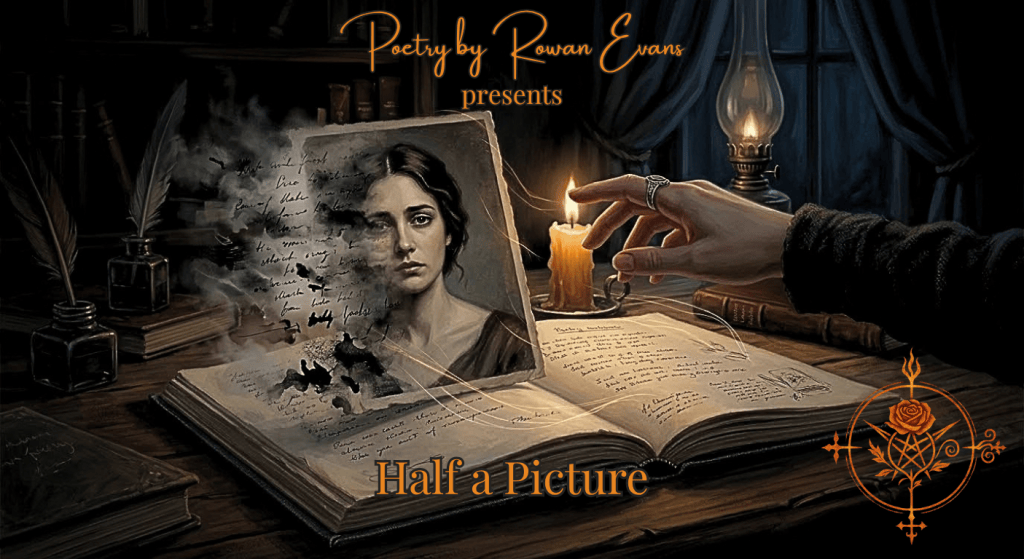
    An open poetry notebook beside a photograph showing only half of a person's blurred image, symbolizing the partial picture readers receive through writing.
    You can know someone’s words by heart and still only have half the picture.

    Half a Picture
    Poetry by Rowan Evans

    I’m going to talk about something
    I don’t talk about a lot—

    it’s an interesting thing,
    the way people cling—

    messages received—

    “I love you,”

    excuse me, what?
    That’s a strong way to start—
    and I’m flattered, really.

    But they don’t know me,
    not really—
    I know they think they do,
    because they’ve read my words—
    seen my mind
    and walked through my thoughts—

    that’s how they feel,
    and to them it’s real—
    who am I to say it’s not?

    But they fell in love
    with half a picture—

    a blurred photo—

    and a vague description of me.


    Journey into the Hexverse

    [All for Me]
    When thunder becomes applause, lightning turns into paparazzi, and rain rolls out a flooded red carpet, one poet starts wondering whether nature’s celebration has gone a little too far.

    [Lessons Without Kindness]
    A reflection on learning self-respect from a relationship that changed—the lessons hidden in manipulation, silence, and loss, and the realization that you don’t have to shrink yourself to make someone else feel tall.

    [The Metaphor Machine]
    A poem that takes apart its own machinery as it runs—breaking lines, breaking thoughts, and following metaphors from moonlight to tides, oceans, shorelines, and city streets.

    If you’re interested in more poetry, you can find it here → [The Library of Ashes]
  • Author’s Note

    Sometimes I go back into the fire.

    Not to rewrite what I was, but to see what happens when the person holding the pen has changed.

    “Hell’s Protégé” began in December 2024. This remix, written in July 2026, keeps the bones of that original piece while giving the language a little more room to breathe, sharpen, and burn.

    Same Hell.

    Different poet.

    — Rowan Evans


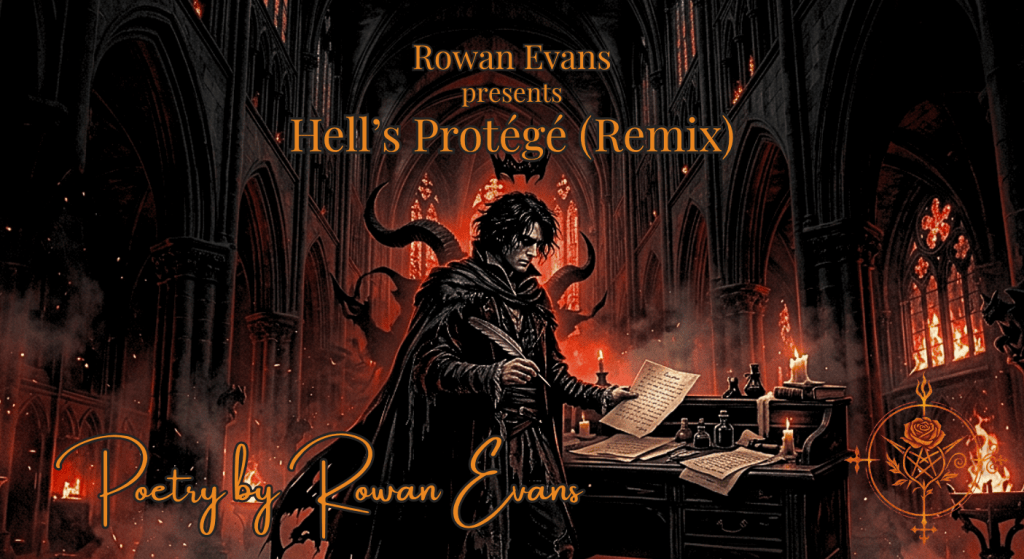
    A gothic illustration of a poet standing in an infernal cathedral surrounded by flames, ash, dark shadows, and a symbolic crown.
    Same Hell. Different poet.

    Hell’s Protégé (Remix)
    Poetry by Rowan Evans
    (written July 30th, 2026)

    They call me the evil one—
    horns on my dome,
    devils on my shoulders,
    calling Hell my home.
    Chasing dreams—
    he promised in infernal schemes,
    under the Morningstar’s light,
    unraveling at the seams.

    The noose hangs loose—for-her,
    Lucifer’s muse, pen in my fist,
    spitting truth like molten fuse.
    Aspiring to be your poetic, satanic leader,
    words sharp as blades,
    cutting deeper and deeper.

    Kool-Aid in red solo cups,
    toasts raised to sin,
    pages pinned to the corkboard—
    where do I begin?
    It’s a crime scene in rhyme scheme,
    a fevered conspiracy,
    lines so wicked…

    even Hell envies me.

    I’m Satan’s next of kin,
    heir to his throne,
    sitting beside him,
    a kingdom of fire my own.
    Next in line,
    when his time is done,
    Hell’s mini-me,
    wielding the infernal tongue.

    Feel the brimstone burn with every word I spit,
    a pyroclastic flow of raw, unholy grit—

    you smell the sulfur,
    you hear the chains rattle,
    every verse a battlefield,
    every line a battle.

    The taste of ashes lingers,
    bitter and raw,
    the ink on my skin reads:
    “Hell’s Final Law.”

    The roar of the damned is my symphony of screams,
    I’m the nightmare invading your holy dreams—

    but don’t confuse the darkness
    for a lack of art—
    every rhyme a blade,
    cutting straight to the heart.
    You feel the heat,
    see the flames dance and twirl,
    I’m not here to save…

    just to own this world.

    So call me what you want—
    devil, poet, deceiver,
    but bow when you hear me,
    your cult leader.
    the crown is mine,
    infernal and divine,
    Hell’s next ruler,
    writing my diabolic design.


    Journey into the Hexverse

    [Hell’s Protégé & Caged Birds Don’t Bow]
    Dive into Rowan Evans’ twin poems, Hell’s Protégé and Caged Birds Don’t Bow, where fire meets freedom. Explore devotion, rebellion, and unapologetic truth through lyrical darkness and diss-track energy.

    If you’re interested in more poetry, you can find it here → [The Library of Ashes]
  • Author’s Note

    There are certain aesthetics that feel less like something we choose and more like something we recognize.

    For me, Gothic imagery has always been one of those things.

    Homecoming came from the realization that something in my writing had started to feel slightly unfamiliar. I was still writing about the moon, the ocean, the tides, ravens, horror, darkness, and the strange spaces where beauty and pain overlap—but somehow, I had drifted away from the particular Gothic atmosphere that has always felt like home to me.

    So this poem became a return.

    Poe is here because his shadow has been part of my literary DNA for years. Nyx and Hades are here because mythology gives me another language for darkness. The ravens are here because, in my own symbolic architecture, they have become witnesses, messengers, and companions. And the horror references—Jason, Ghostface, Pennywise, Michael Myers—are there because horror has never been merely about monsters to me.

    It is about what the monsters represent.

    Grief. Fear. Obsession. Rage. The parts of ourselves that refuse to stay buried.

    There is also something deliberately self-aware about this poem. I am not simply listing Gothic references because they sound dark. I am talking about my relationship with the imagery itself—the way the moon has accumulated meaning across my work, the way the tides connect to emotion, and the way ravens have gradually become part of my mythology.

    The darkness isn’t an aesthetic costume.

    It’s architecture.

    And after spending some time writing away from it, I realized that I wasn’t trying to become something new.

    I was finding my way back to something that had been mine all along.

    That’s why this poem is called Homecoming.

    Sometimes you don’t discover where you belong.

    Sometimes you remember.

    — Rowan Evans


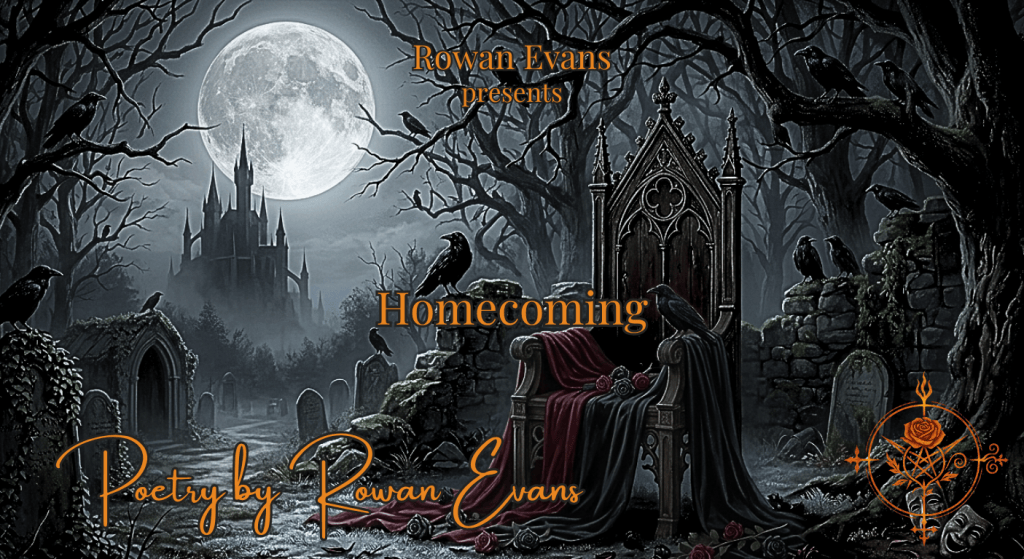
    A Gothic throne beneath a full moon surrounded by ravens, dark trees, mist, and subtle crimson accents.
    Sometimes the darkness isn’t somewhere you wandered into. Sometimes it’s the place where your voice has always felt most at home.

    Homecoming
    Poetry by Rowan Evans

    I’ve been writing like
    I forgot which domain is mine,
    I’m of the darkness—
    just borrowed the light,
    and made Poe’s throne my birthright.

    I’m a gothic romantic,
    I bleed for the art—
    I’ve kissed the lips of Nyx
    and wandered through
    the realm of Hades.

    I’m a poltergeist in life,
    but at night I come alive—
    witching hour is when I thrive.

    I pray to the moon
    and curse the sun—
    I ascend to the throne
    that Poe had spun.

    I watch the ravens—
    carrying messages where they fly,
    eyes locked, tracking the treachery across the sky.
    They are always watching—
    silent witnesses to the rot inside.

    It started to feel like something
    in my pieces was missing—
    like where was the gothic lace,
    silk and satin sin, velvet and venom.

    There was too much light—
    even when ninety percent
    of my imagery is night adjacent,
    weaving in horror rhymes—
    Friday the 13th, Night of Jason.

    The moon in my rhymes has meaning,
    when I write lines like the tides—I mean it,
    even in my Ghostface cadence—
    what’s your favorite scary movie?
    Pennywise of the mind, sewer of thought—
    I’m a monster like Michael,
    when I chase—I don’t run, I walk.


    Journey into the Hexverse…

    [The Monster in the Margins]
    Drawing inspiration from horror icons like Michael Myers, Ghostface, Freddy Krueger, and Pennywise, this poem explores the darker side of creativity—where inspiration becomes an unstoppable force lurking just beyond the edge of the page.

    [The Monster in the Margins II]
    The Monster in the Margins II transforms Rowan Evans’s Seven Deadly Sins mythology into a horror story written between the lines, where Lust, Wrath, Sloth, Greed, Pride, Envy, and Gluttony become monsters growing from pain, grudges, and scars.

    [The Unkindness Descends]
    “The Unkindness Descends” is a Gothic symbolic poem exploring collapse, transformation, and the unsettling experience of being witnessed during moments of unraveling. Through raven imagery, ambiguity, and ritualistic atmosphere, the poem invites multiple interpretations—spiritual, psychological, ominous, or transformative.

    [Gospel in Crimson]
    When writing becomes ritual and love becomes devotion, the line between creation and worship begins to blur. Gospel in Crimson explores obsession, artistry, and the sacred act of expression.

    If you’re interested in more poetry, you can find it here → [The Library of Ashes]