There’s a particular kind of confidence that comes from realizing your haters are not actually bringing anything new to the table.
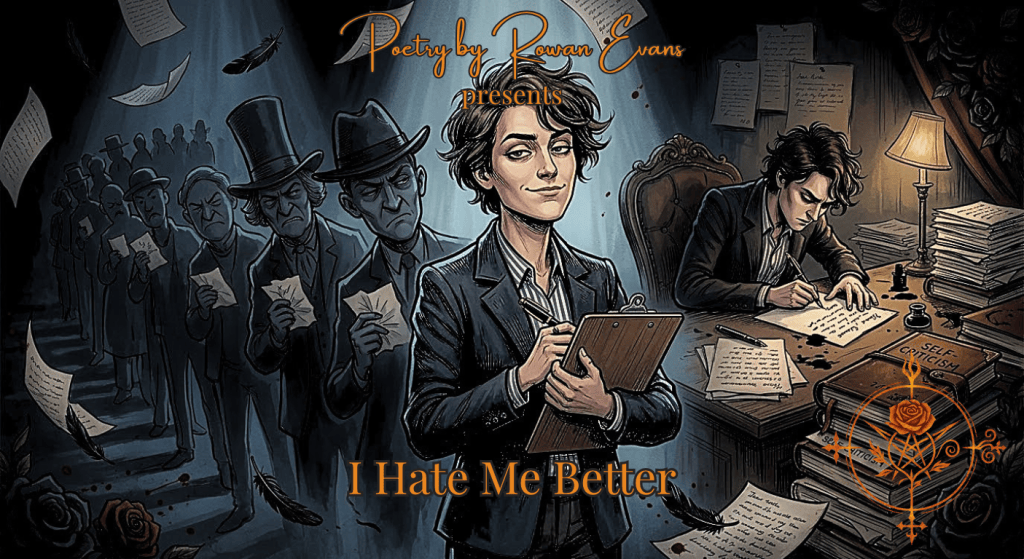
I Hate Me Better is me taking that idea to its most ridiculous conclusion. If someone wants to hate me, they’re going to have to compete with the person who has been doing it the longest: me.
I’ve spent years turning self-doubt into jokes, anger into poems, and internal criticism into something I can actually put on a page. So when somebody else shows up with their little collection of insults, my first thought isn’t necessarily how dare you?
It’s more like—
That’s it?
If you’re going to hate me, at least bring your A-game.
Because I’ve been practicing.
— Rowan Evans
If you’re going to hate me, get in line. I’ve been doing this longer than you have.
I Hate Me Better Poetry by Rowan Evans
If you’re gonna hate me,
you got to hate me better—
every year since I was 16,
I’ve written myself
a fuck you letter.
That’s twenty years—
I’ve been telling myself,
to go and fuck myself.
It’s not unusual for me to say it.
Fuck you, Rowan—
and I’m not playin’.
So if you hate me—
sign your name
and get in line.
I’ll get to you—
I’ll do it, one at a time.
I’ll walk right up, like—
what the fuck’s up, mate?
I won’t do it two-faced,
no coins flipped—so don’t trip,
this isn’t luck, bitch.
Some poems arrive carrying trauma, existential questions, complicated metaphors, and enough symbolism to fill a cathedral.
This one showed up carrying a fucking pun.
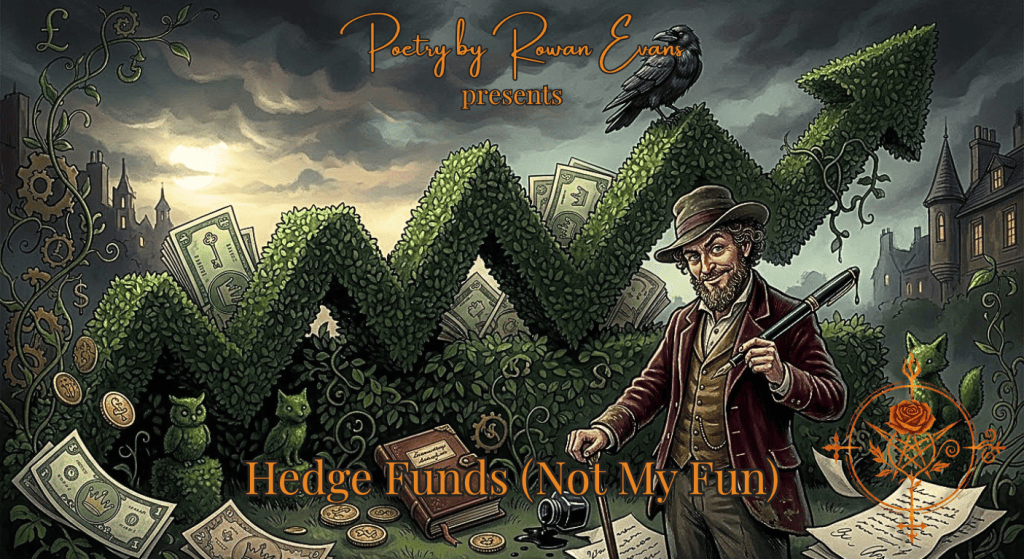
Hedge Funds (Not My Fun) is deliberately stupid. I wanted to play with sound, names, word associations, and the increasingly questionable logic of a joke that refuses to die. Sometimes the page doesn’t need another emotional excavation—it just needs to have a little fun.
So yes, this is a poem about hedge funds.
No, I don’t actually have any.
And apparently, neither does my fun.
— Rowan Evans
The hedge has funds. The funds aren’t mine. Therefore, the fun remains tragically unfunded.
Hedge Funds (Not My Fun) Poetry by Rowan Evans
I think I’m so fucking funny—
I’ll make a Big Pun,
while lookin’ like a Pimp
C—but you can’t see me,
like my name is John
and my time is now—
or at least, I hope it is.
Because I’m trying to get my funds up,
yeah, I want to get my fun up—
so I stack my funds
as high as my hedges—
get it?
Hedge Fund.
That means the money isn’t mine—
so I’m stacking some funds high,
they’re just not my funds, and—
because they’re not my funds,
they do not fund my fun, man.
Sometimes “I don’t give a fuck” isn’t really apathy. Sometimes it’s exhaustion, overextension, or finally realizing that not everything deserves a piece of you.
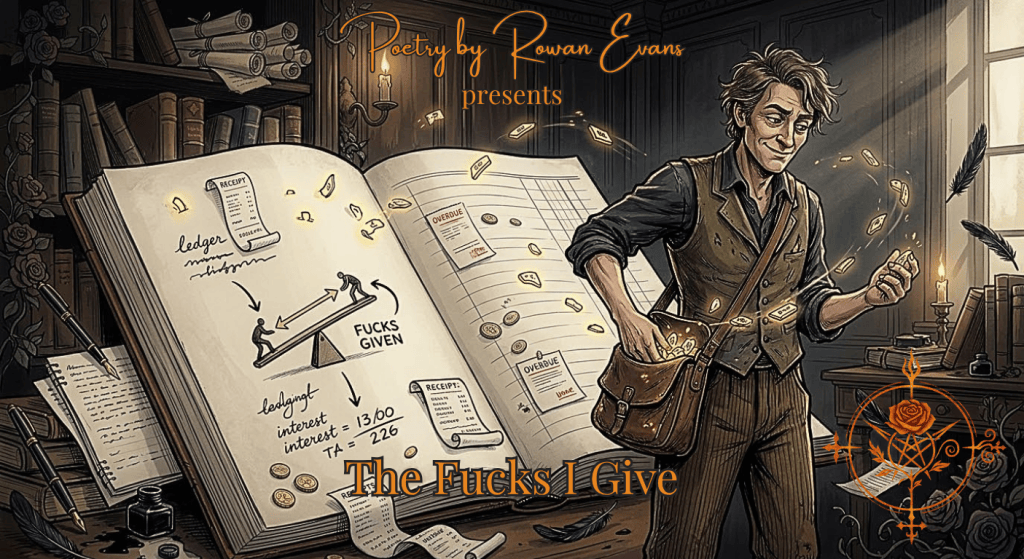
The Fucks I Give takes that idea and turns it into a ridiculous little accounting problem. If I’ve been handing out fucks like they’re an unlimited resource, eventually I’m going to have to audit the books, collect the outstanding balance, and start charging interest.
Underneath the jokes and profanity is something I’m actually pretty serious about: learning to be selective with what gets my attention, my energy, my emotions, and my time.
Because giving a fuck can be an act of love.
So can taking your fucks back.
— Rowan Evans
Apparently, my fucks weren’t free. I’m just finally collecting the outstanding balance.
The Fucks I Give Poetry by Rowan Evans
They said I’m too apathetic,
actin’ like nothing matters,
and it’s pathetic—
they want me to give a fuck,
but shit, I misplaced my bag of fucks—
so I’ve got no fucks to give.
Yeah, I’ll go through
and take all my fucks back—
I’ll walk right up and knock, like—
I’m here to collect my fucks,
and extra fucks too—
it’s a fucking tax,
and there is interest, dude.
You think fucks are endless.
No, I’ve got to be pickier—
because for a minute there,
it was—
fuck everything
and that’s probably
what they’re angry for.
It was fuck this and fuck that—
I was running out of fucks fast.
Some writers pick up a pen. Others discover they’ve accidentally assembled an entire mutant power set.
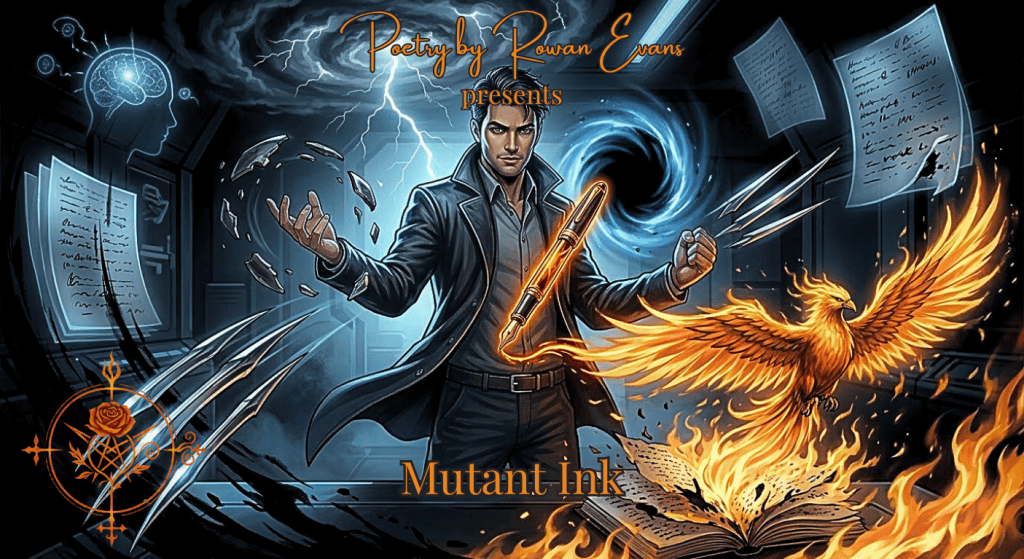
Mutant Ink is my love letter to the X-Men universe, where every ability becomes another way to bend language, twist expectations, and leave a mark on the page. From mind-reading and magnetic control to teleportation, razor-sharp claws, and storms summoned through rhyme, this poem turns familiar mutant powers into weapons of wordplay. The references are playful, the bars are sharp, and the name-drops are absolutely intentional.
But beneath the comic-book chaos is something that reaches beyond fandom. Creativity is its own kind of evolution. Sometimes a line needs to be dismantled, a verse needs to burn, and an entire draft needs to die before something better can rise in its place.
That’s where Phoenix comes in.
Because the goal isn’t simply to write another poem. It’s to become something more through the act of writing it. Every revision, every failure, every spark that refuses to die becomes part of the next transformation.
Call it mutation. Call it ascension. Call it poetic evolution.
Just don’t stand too close when the ink catches fire.
— Rowan Evans
Sharp lines. Mutant powers. Burning ink. Sometimes the poem has to die before the Phoenix can rise.
Mutant Ink Poetry by Rowan Evans
I’m not Walken, my name’s not Christopher— I’m stuck in the chair, like my name’s Xavier— reading your thoughts displayed on the page— ink laid—I bend bars, the way Magneto does.
And my mind is sharp, like my lines are, It’s Snikt!— every time I write bars, words so sharp— they’ll cut and leave scars.
BAMF! That’s not a sound effect, that’s just what they call me. BAMF! I never left, no other dimension, I’m still here, you’re trippin’. They say it’s teleportation— I say misdirection— look away for one second, now I’m somewhere else in the sentence—
I ink storms, and that’s why I always start with the dryline. I’ll hit you with cyclonic rhymes from a twisted mind— do you know what happens when a Toad gets struck by lightning? The same thing that happens to everything else—
and the sky turns Grey, it’s usually blue as my Jeans are. But that’s what happens when Summers mix with Frost— turn the heat up, Hellfire Club.
When the heat gets too high, I don’t break— I burn. Call it evolution, call it ascension, call it the moment every line catches fire at once—
I go full Phoenix, rising out the rhyme scheme, feathers made of flame, every word a rebirth— because sometimes the only way to finish a poem is to let it die— and rise again, stronger.
Sometimes the loudest critic in the room is the one living inside your own head.
Creative Whiplash (Pick A Lane!) is about the pressure to define yourself as a writer, choose a style, and stay neatly within its boundaries—even when your creativity refuses to cooperate. One moment, I’m writing gothic poetry; the next, I’m throwing punchlines, weaving mythology, or drawing battle lines with a pen.
And somewhere in the middle of all that, the inner critic starts screaming that nothing makes sense.
The funny part? Sometimes the poem proves the critic wrong before the critic even finishes complaining.
Maybe I don’t need to pick a lane. Maybe creativity was never meant to be a straight road.
— Rowan Evans
Pick a lane? I tried. My creativity took the exit, changed three times, and somehow wrote a poem about it.
Creative Whiplash (Pick A Lane!) Poetry by Rowan Evans
I asked you to show me a metaphor—
you asked, what’s the meta for?
You said you’re a writer, are you sure?
Because I’m not anymore—
run on sentence, run on lines,
zero flow and zero rhymes—
that’s how you write.
Ironic—
I just proved myself
wrong, right?
Well, sometimes I get in my head,
convince myself that nothing I write
is ever good enough—
and no one can call my bluff.
Isn’t that rough?
Pick a lane! Pick a lane!
Repeated, screaming in my brain—
are you a gothic poet,
or do you draw battle lines?
Do you weave myths,
or write comedic shit?
Pick a lane! Pick a lane!
Repeated, screaming in my brain—
giving readers whiplash
with how fast, I switch lanes—
it’s a pain in the neck,
creativity, hard to keep in check.
Iron Sharpens Iron is about what happens when every version of my creative mind sits down at the same table: the gothic romantic, the absurdist comic, the mythmaker, the battle-poet, the joke creator, and whatever other voice decides to kick the door open halfway through a line.
The notebook becomes the sparring ring. One thought throws a punch, another throws a punchline, and sometimes Batman apparently gets involved.
I don’t always plan where the thread is going. Sometimes I just follow it until the poem lands somewhere that makes sense.
Maybe that’s the point.
I don’t need to silence the contradictions. I need them to sharpen each other.
— Rowan Evans
I don’t silence the voices in my head. I let them sharpen each other.
Iron Sharpens Iron Poetry by Rowan Evans
I sit by myself— alone in body, crowded in mind— it’s a constant battle of wits, moon-fed goth kid versus the battle-poet turning pens to WMDs.
The notebook— just a test site, where I drop bombs. It’s constant— the scream of the alarms.
I write so much because my mind fights too much— a gothic romantic, an absurdist comic— opinions, opinions, too many opinions— constant contradictions.
Is this a joke?
Are the emotions sincere?
What the fuck— (Batman!) is that reference doing here?
That’s just how my mind is sometimes— I write a line and follow it, (Stalker.) I don’t plan it—I just follow the thread, guide the ship and land it. But sometimes I get lost— I’ll orbit the planet, or drift in my dreams— and they say to make the dreams work, it takes team work— well, I became my own team, every version of me.
Gothic romantic, absurdist comic, mythmaker, joke creator and professional hater— (Jokes. Love ya!) a battle-poet raised on battle rappers and comedians— how I learned to land a punchline, can’t fight with my fists— but can fight with my mind, and I do it all the time— with myself, I spar, iron sharpens iron, after all.
Journey into the Hexverse
[Blindfolded & Still Winning] A playful battle-poetry freestyle about shutting off the inner editor, letting instinct take over, and discovering that sometimes the pen writes best when you stop watching it.
[Literarily Speaking] They think silence means weakness. They should probably have paid more attention to the pen. Literarily Speaking turns gothic imagery, raven feathers, rose-petal ink, and absurd fictional geography into a playful battle-poetry flex about dismantling your enemies with words instead of hate.
[The Playground] What happens when mythology stops being something to hide behind and becomes architecture for the imagination? The Playground (Language, Metaphors and More) explores Rowan Evans’s relationship with language, symbolism, metaphor, humor, and twenty-three years of turning the page into a place where anything can happen.
Sometimes the easiest way to stop overthinking the poem is to stop looking at it.
Blindfolded & Still Winning came from that impulse: cover the eyes, let the pen move, and see what the mind throws onto the page. The anger gets folded into jokes, the jokes get stitched into rhythm, and suddenly what could have been a rant turns into a little battle-rap playground.
The blindfold isn’t a handicap here.
It’s permission to trust the instinct.
And apparently, even without looking, the pen still thinks it knows how to win.
— Rowan Evans
Cover the eyes. Let the pen drive. See what happens.
Blindfolded & Still Winning Poetry by Rowan Evans
I’m sick and tired of watching what I say— so I cover my eyes when I write— because even I like to be surprised by my mind, sometimes.
So today I’ll be blind— folded the anger with my jokes, then mixed them in to the rhythm and rhyme— I’ll get over it on my own time.
(Really, I’m over it already.)
Pen like a switch blade, words so sharp, I filet men— yawn, you’re boring me. Took you five hours to write five lines— took me five minutes to write ten times— the rhymes, set ups and punchlines.
Journey into the Hexverse
[Literarily Speaking] They think silence means weakness. They should probably have paid more attention to the pen. Literarily Speaking turns gothic imagery, raven feathers, rose-petal ink, and absurd fictional geography into a playful battle-poetry flex about dismantling your enemies with words instead of hate.
[The Playground] What happens when mythology stops being something to hide behind and becomes architecture for the imagination? The Playground (Language, Metaphors and More) explores Rowan Evans’s relationship with language, symbolism, metaphor, humor, and twenty-three years of turning the page into a place where anything can happen.
[New God with a Pen] A battle-poet power fantasy where Superman’s rage, Batman’s fear, Darkseid’s cosmic authority, and the Anti-Life Equation collide with rhyme, turning an ordinary pen into something worthy of New God status.
For me, language is something to climb through, rearrange, break apart, rebuild, and occasionally weaponize for the sake of a really bad joke. Mythology and symbolism are still part of that world, but they aren’t walls I hide behind anymore—they’re architecture. They give the imagination somewhere to live while the poet underneath it keeps revealing himself, piece by piece.
The Playground (Language, Metaphors and More) is an invitation into that space.
It is part creative philosophy, part victory lap, part conversation with the page—and, naturally, part terrible knock-knock joke. Because if I’ve spent twenty-three years turning language into a playground, I’m going to play.
— Rowan Evans
The page isn’t a cage. It’s a playground—and I’ve brought my own rules.
The Playground (Language, Metaphors and More) Poetry by Rowan Evans
I sat down—
with the intent to write,
had a lot of ideas
on my mind tonight—
like what if the moon
was a witness?
And the tide a guide through
the emotional current
in the room—
but that’s just if I
went the route
of mythology,
symbolism—
and everything
I used to hide behind.
That’s not how I use it now—
it’s still my mythology,
symbolic architecture—
giving my words texture—
but I don’t
hide behind it—
I use it now,
to show the art of me,
getting to the deeper
heart of me—
not the whole picture,
just a small part of me.
I’ve been doing this
for twenty-three
years and counting—
and I’m definitely
not on my way out now—
I’ll hit my second, third,
fourth and fifth wind,
any day now—
I’ve turned language
into my fucking playground—
everything is a game now.
Just conversating
with the page now—
I’m done pretending,
like I don’t write flames now—
poetry’s royalty,
I’m taking my crown now—
and I think it’s time you all
bow down—
look I’m going to make a joke,
turn into a clown now.
Why don’t we slow down?
I’ll tell you that joke now—
Knock, Knock—
who’s there?
Disa—
Disa-who?
Disa-me? I disa-you—
with a line so mean
you’ll want to disappear,
wish you were never here—
here’s a warning, dear:
If you see my ravens,
perched upon your lawn—
it’s an omen—
you are already gone.
Journey into the Hexverse
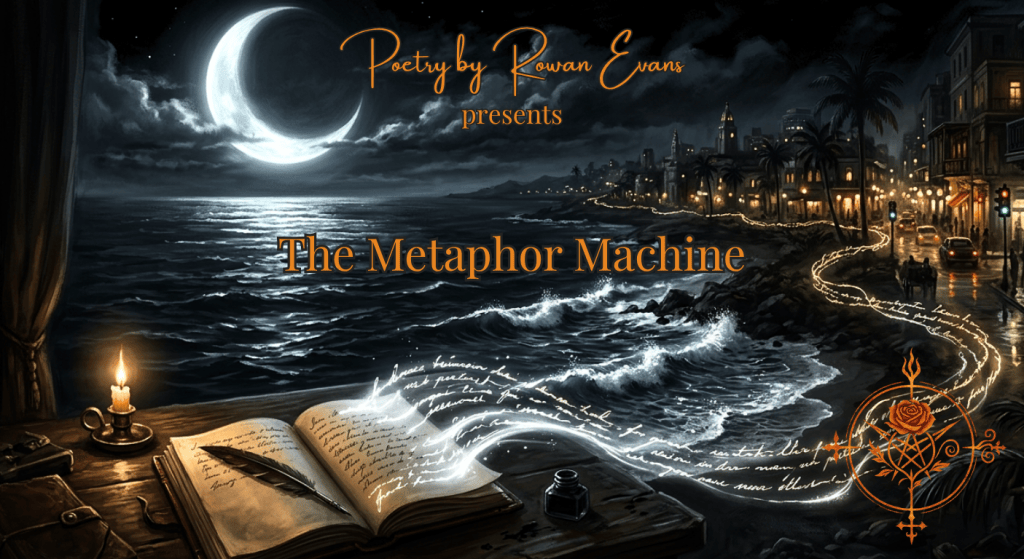
[The Metaphor Machine] A poem that takes apart its own machinery as it runs—breaking lines, breaking thoughts, and following metaphors from moonlight to tides, oceans, shorelines, and city streets.
[Confession or Cap?] A sharp and playful look at the line between confession and exaggeration, where a nice poet admits that their pen sometimes talks a little too much shit—and occasionally sets the page on fire.
The Metaphor Machine is a poem about the machinery behind my own poetry. I wanted to pull back the curtain and show what happens when a single line starts generating connections: moonlight becomes tide, tide becomes ocean, ocean becomes shoreline, shoreline becomes city streets, and suddenly the poem has wandered somewhere entirely different.
The joke is that I’m explaining the process while actively doing it. The poem breaks its own lines, interrupts its own thoughts, calls attention to its metaphors, and then circles back to reveal that all those seemingly wandering pieces were connected by the same machine.
Sometimes I don’t choose the metaphor. I just follow where it takes me.
— Rowan Evans
One metaphor becomes another, and the machine keeps running.
The Metaphor Machine Poetry by Rowan Evans
I’ll write a line in a way
that’ll make you pause—
then I’ll take that line
and break that line,
to break the thought—
then I sprinkle in the metaphors,
and this is really what I get meta for—
I talk about the moon
and the silver light,
the way it shimmers—
its image trembles
across the top
of dark water—
that’s one I’ve said before.
And I’ve said it lot,
but I’m not going to stop.
This is where the tides comes,
and there the tide goes—
because that’s how the tide works.
And the ocean—
this is a poem, I wrote…
you didn’t think
we were going to skip this one,
did you?
And the ocean,
it’s so polite—
the way it waves,
every time it sees my face.
It’s a familiar place,
I sit on the shoreline, often—
not in reality, but in my mind—
that’s where the thoughts soften.
Now, for the city streets—
the heat, and god—
that humidity, the way it clings.
You’d think I’d dream of…
somewhere less…
humid? But I digress,
it’s always love that I express
for the islands I haven’t touched yet.
If you’re following along—
I wrote a line
that made you pause—
then I took that line
and I broke that line—
and that broke the thought.
Then that’s where the pivot came,
I told you what I really went meta for.
It’s the metaphors.
Moon to tide,
tied to the ocean—
a shoreline or two,
next to the ocean blue—
then beaches to city streets,
it’s the same ones I walk in sleep.
Journey into the Hexverse
[Welcome to the Hexverse] Step into the Hexverse—a poetic world where mythmaking, humor, rage, creativity, and confession collide, and darkness becomes something that can be reshaped into art.
[High Tide] A short reflective poem about leaving, returning, and accepting the forces that pull us back—like the tide guided by the moon.
[Let Me Pacific] A lyrical poem about sitting beside the Pacific Ocean and discovering that an enormous body of water can become a bridge between distant hearts. Through ocean imagery, wordplay, and reflections on California and the Philippines, Let Me Be Pacific explores how love and poetry can cross even the greatest distances.
[Did You Really Think This Was About Trees?] A playful love poem disguised as a forest of terrible tree puns. Beneath the birch, oak, cedar, palms, lumber, and absurdist wordplay is a poem about devotion, loyalty, laughter, and building a life with someone you love.
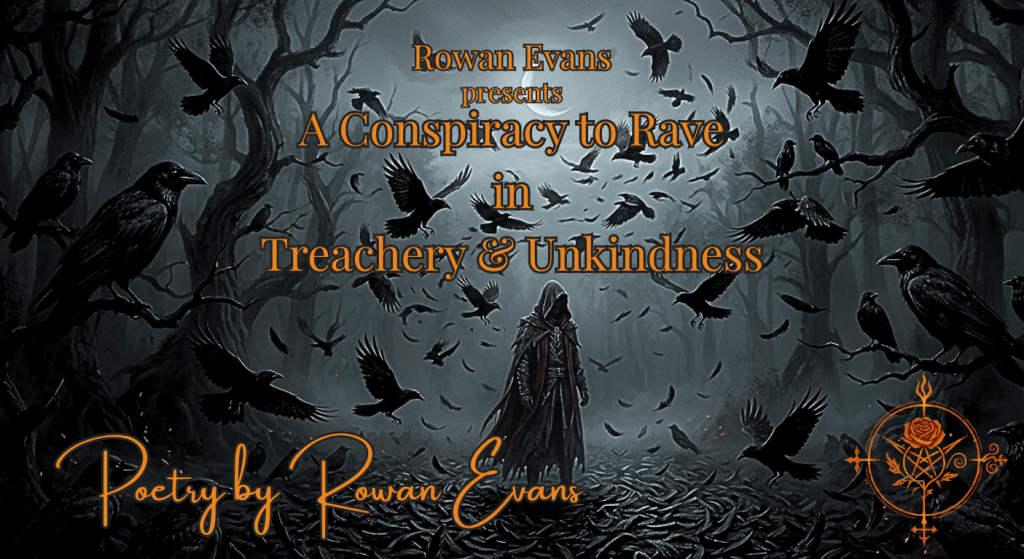
Sometimes a poem starts with an image that is just too good to leave alone.
A gathering of black feathers. A suspicious little chorus. A feeling that something is happening around you, even if nobody bothered to send you the invitation.
So, naturally, I had to turn it into a conspiracy.
Welcome to the middle of it.
— Rowan Evans
Just me, minding my business, while the birds hold a very suspicious meeting around me.
A Conspiracy to Rave in Treachery & Unkindness Poetry by Rowan Evans
It’s just me, no party,
standing in the middle—
with a rave all around,
just feathers of darkness
covering the ground—
it’s no mystery
when you’re stuck in the middle
of a conspiracy,
listening to the treachery—
inspiring the unkindness.
They are poetic in their darkness—
unlike the violence
of the Mob & Murder—
those crows can’t be trusted.
Journey into the Hexverse
[Roses & Ruin] Two minimalist poems exploring the opposing forces within creativity: the thoughts we cultivate into something beautiful and the darker thoughts we transform before they have a chance to decay.
[The Crypt] A mysterious man watches from a crypt as a woman enters the graveyard and kneels before an unnamed grave. In this compact gothic poem, fascination, death, and possession blur together beneath the shadows of the cemetery.
[Homecoming] Homecoming is a return to the Gothic aesthetic at the heart of Rowan Evans’s poetry, blending Poe, mythology, horror icons, moonlight, ravens, and darkness into a meditation on artistic identity and finding your way back to the voice that feels like home.
[Poet’s Curse] Poet’s Curse explores the painful side of falling too deeply: giving pieces of yourself away freely, taking accountability for your own heartbreak, and realizing that learning to let go can be harder than learning to love.
[The Monster in the Margins II] The Monster in the Margins II transforms Rowan Evans’s Seven Deadly Sins mythology into a horror story written between the lines, where Lust, Wrath, Sloth, Greed, Pride, Envy, and Gluttony become monsters growing from pain, grudges, and scars.