Tag: neurodivergent writing

  • Author’s Note

    This piece comes from the space where speech and writing don’t quite align.

    There has always been a kind of delay for me—between what I think, what I feel, and what I can actually say out loud. Spoken language has never felt like the most reliable place for truth to land. It slips. It fractures. It gets filtered through hesitation, timing, or silence.

    Writing became something different.

    Not a replacement for speech, but a translation of it.

    A second mouth.

    One that doesn’t hesitate in the same way.

    One that doesn’t need to arrive perfectly formed in real time.

    Over time, I’ve come to understand my writing less as expression and more as continuity—a way of carrying versions of myself forward that might otherwise get lost between changes, growth, or silence. When I talk about shedding “lives like shells,” it isn’t about abandoning who I was, but making space for who I’m becoming.

    Writing is where those versions remain visible.

    Where they don’t disappear just because I’ve outgrown them.

    In that sense, this isn’t just about communication—it’s about survival through articulation. Not in the dramatic sense, but in the quiet one: staying connected to myself through language when voice doesn’t fully bridge the gap.

    And if spoken language is the place where I sometimes fall short of myself, then writing is where I learn how to keep translating who I am anyway.

    Rowan Evans


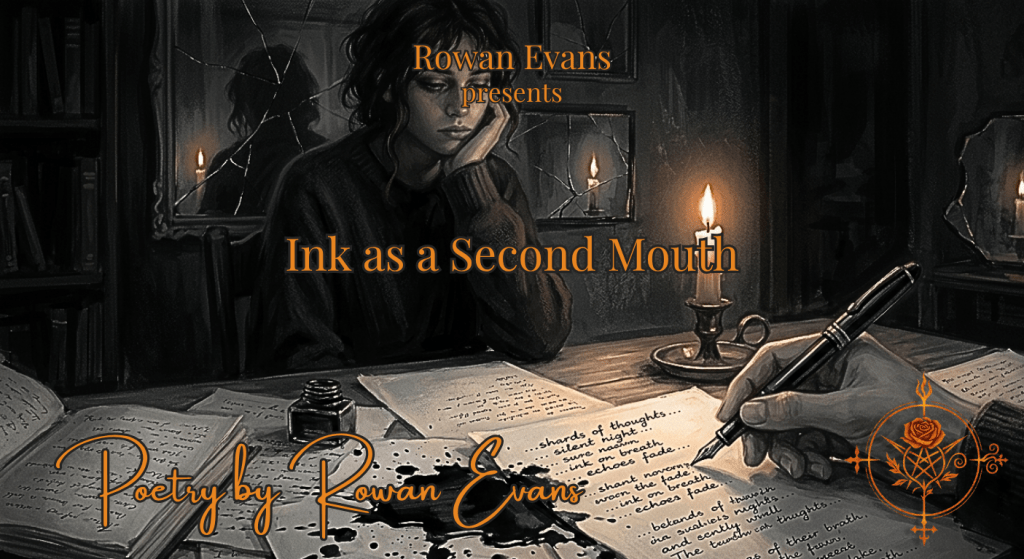
    A writer sitting beside scattered handwritten pages and spilled ink in a dimly lit room.
    If spoken language is where I fall short of myself, then writing is how I keep translating who I am anyway.

    Ink as a Second Mouth
    Poetry by Rowan Evans

    There is a delay
    between my mind
    and my mouth
    when I speak—

    that’s why I find
    it easier to talk in ink.

    I turned my pen
    into my mouth,
    so when I write
    it’s the only time—
    the truth spills through.

    When I open my mouth,
    my words won’t come out—

    but in ink, they run
    like the secrets slip
    from loose lips.

    I could write poem after poem,
    leaving piece after piece of me behind—
    scattered across the pages,
    like versions of me scattered
    across different lives.

    But do not mourn
    for what I’ve lost,
    because it’s simply the cost
    of me being me.

    I shed past lives,
    it leaves room for me to grow—

    just a hermit crab
    in human form.

    And I’ll continue
    to shed lives like shells until
    I find the version of myself—

    that can speak
    in more than ink.

    Until then I’ll continue to try,
    because growth comes slow.
    It’s gradual, it never comes clear.

    There are no definable lines—
    only slow becoming.


    If you’re interested in more poetry, you can find it here → [The Library of Ashes]
  • Author’s Note

    Some people can walk into a room and never notice the atmosphere change.

    I’ve never been one of them.

    I notice tone shifts, silence, tension, body language, eye contact, emotional static—sometimes before a word is even spoken. Rooms have always felt alive to me in that way, almost like weather systems with their own pressure and temperature.

    For a long time, I thought that sensitivity meant something was wrong with me.

    But over time, I realized I wasn’t imagining things. I was just noticing things other people either missed or ignored.

    This piece came from that feeling: walking into spaces and immediately sensing the emotional climate shift around you.

    Not because you’re dangerous. Not because you want attention.

    But because some people carry storms quietly, and other people instinctively react to the pressure.

    The important part is this:

    Not every storm is destructive.

    Sometimes thunder is just thunder. Sometimes lightning never comes.

    Rowan Evans


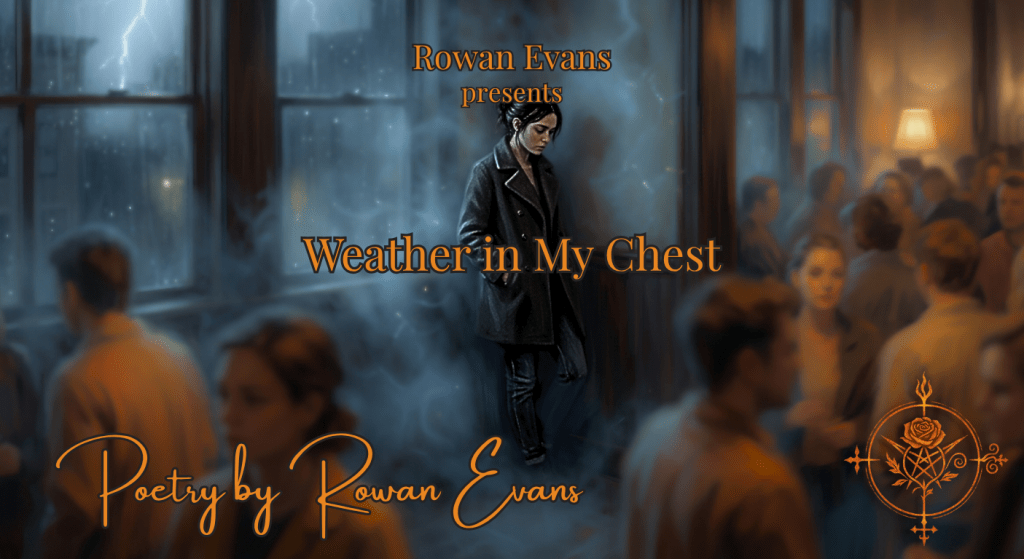
    A solitary figure stands quietly in a crowded room as storm clouds and atmospheric tension subtly gather around them.
    Some people don’t bring storms into rooms—they just notice the pressure before everyone else does.

    Weather in My Chest
    Poetry by Rowan Evans

    I enter rooms and I can feel
    the weather shift,
    the emotion gets thick
    like humidity—
    and the temperature
    begins to rise.

    And eyes
    move like clouds
    across the sky
    as they follow me.

    Drifting toward
    the horizon line,
    at the edge of the room.

    I can hear the whispers
    rumble like thunder,
    as the questions
    begin to spin.

    “What are they doing here?”
    “Who invited them?”

    I’ve learned
    to stand still
    in the middle of it,
    let the noise
    break around me
    like rain on concrete.

    “Why are they so quiet?”
    “Are they judging us?”

    They don’t know
    I’m not here
    to bring the storm—

    I just carry weather
    in my chest,
    and rooms react
    how they react.

    I’m not the danger
    they whisper about—

    I’m just the one
    who notices
    the temperature
    before anyone else does.

    They don’t realize
    I’ve felt this
    my whole life—
    rooms shifting,
    eyes gathering,
    like weather
    drawn to heat.

    I feel the pressure
    drop behind me,
    the way people tense
    like they’re waiting—

    for lightning
    that never comes.


    Journey into the Hexverse…

    [Sound as a Vessel]
    “Sound as a Vessel” is a free verse poem about music as emotional architecture, exploring how international artists and soundscapes shaped identity, creativity, memory, and poetic voice.

    [Just Knowing You Has Been Enough]
    “Just Knowing You Has Been Enough” is a deeply vulnerable free verse poem about unspoken love, emotional fear, coded confessions, and the quiet truth of caring for someone without needing perfection in return.

    [The Streets I Walk When I Sleep]
    “The Streets I Walk When I Sleep” is a deeply intimate free verse poem about recurring dreams, emotional connection, longing across distance, and the strange feeling of remembering places and moments that have never happened in waking life.

    [Memories From a Life Yet to Come]
    Some dreams feel less like fantasy and more like memory. “Memories From a Life Yet to Come” is a reflective free verse poem about longing, displacement, emotional alignment, and the strange comfort of recognizing yourself more clearly in dreams than in waking life

    [Separate Timelines]
    “Separate Timelines” is a surreal and deeply introspective free verse poem about emotional distance, time zones, vulnerability, and the fear of losing a connection that already feels meaningful before the words are ever spoken aloud.

    If you’re interested in more poetry, you can find it here → [The Library of Ashes]
  • Author’s Note

    There’s a specific kind of exhaustion that comes from constantly trying to explain why you feel disconnected from the place you’re supposed to belong to.

    Not disconnected from life.

    Not disconnected from people.

    Disconnected from alignment.

    Like your internal compass keeps pointing somewhere the world around you doesn’t understand.

    This piece came from that feeling.

    From being awake while everyone else sleeps. From feeling emotionally out of phase with your surroundings. From trying to explain, over and over again, that displacement is sometimes deeper than geography.

    Some people hear that and assume it’s escapism.

    But for me, it’s never been about fantasy.

    It’s about recognition.

    There are places, cultures, people, and ways of existing that resonate with something in me more naturally than the environment I was born into ever has.

    And after writing about that feeling for years, I’m finally starting to understand:

    maybe the repetition wasn’t obsession.

    Maybe it was direction.

    Rowan Evans


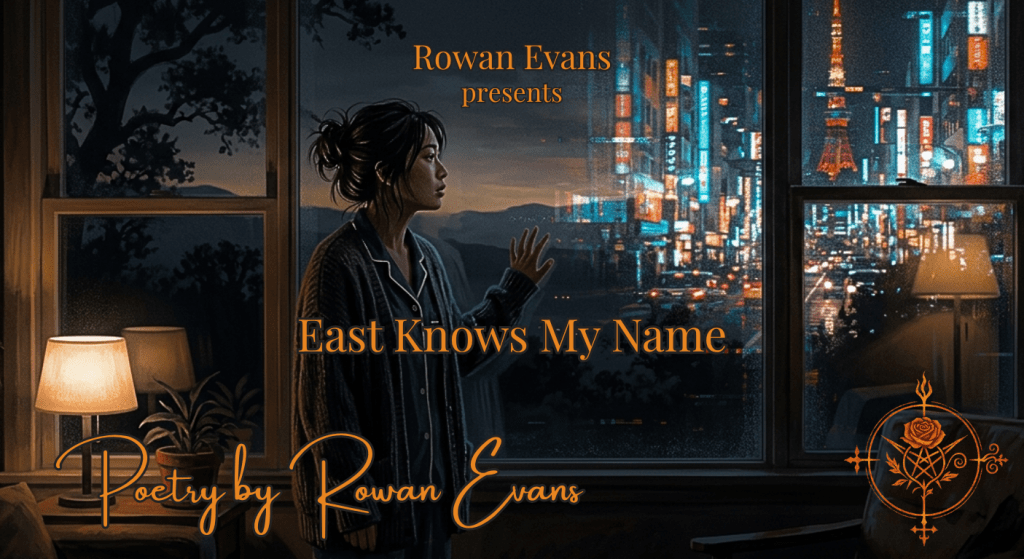
    Person awake before dawn feeling emotionally disconnected while staring eastward
    California in my blood. The east in my heart.

    East Knows My Name
    Poetry by Rowan Evans

    I sit awake again—
    disconnected
    from the world around me.
    The silence
    surrounding.

    It’s not fear
    I feel.

    It’s something else.

    Something deeper.

    Fear sits at the surface,
    I feel this in my bones.

    I look around
    at this house—

    supposed to be a home.

    I sit awake again—
    up since six AM.
    The disconnect
    sounds like static,
    a distorted hum.

    When I walk outside,
    I don’t feel like I belong.

    Do you know what it’s like—

    to feel one step
    to the left…

    all the time?

    It doesn’t feel right.

    I sit awake again—
    begging my words
    to come.
    I’m sick of only speaking
    in ink—

    I want to speak again.
    I have things to say.

    But my words…

    they don’t align.

    They are shifted,
    just like I am
    most of the time.
    It’s not my fault—
    I’m not the cause.

    It’s the world around me,
    the people surrounding.

    American mouth
    but my mind is not.

    Stuck in the west,
    but long for the east—
    it’s the way
    my heart beats.

    I try to explain it
    in piece after piece,
    poem after poem.

    I’ve written the disconnect,
    time and time again—

    I’ve written about being
    destined to leave
    since fourteen—

    felt disconnected,
    like the Wi-Fi dropped.
    Mind static, dramatic,
    screaming like…

    I won’t repeat myself—
    not for you,
    not for emphasis.

    Because that’s not
    what the rhythm is.

    It’s a compass
    with no magnetic north,
    so the needle drifts
    east of course.

    California in my blood,
    westside in my veins—

    but it’s the east
    that knows my name.


    Journey into the Hexverse…

    [Out of Sync]
    A reflective free verse poem about emotional displacement, shifting sleep cycles, and feeling spiritually drawn toward another side of the world.

    [Two Americans]
    What does it mean to share a country, a language, and still feel completely different? Two Americans explores identity, culture, and the quiet disconnect between people who should feel the same—but don’t.

    [None of It Means a Thing]
    Success, fame, and money don’t mean much without someone to share them with. None of It Means a Thing explores love, purpose, and what truly makes life feel complete.

    If you’re interested in more poetry, you can find it here → [The Library of Ashes]
  • Author’s Note

    For a long time, I assumed communication struggles were always my fault.

    That if I was misunderstood, I must have explained myself poorly. If conversations became complicated, I must have said something wrong. So I learned to over-explain, rephrase, soften, clarify—constantly translating myself into something easier for other people to process.

    Eventually, that becomes exhausting.

    This piece came from realizing communication is supposed to be mutual. Understanding someone shouldn’t rest entirely on one person carrying the weight of translation.

    Sometimes words fail. Sometimes meaning gets tangled. Sometimes people hear you without truly listening.

    And sometimes the healthiest thing you can do is stop apologizing for existing in your own language.

    Rowan Evans


    Person surrounded by fragmented floating words symbolizing miscommunication and emotional exhaustion
    I spent years thinking the problem was my voice.

    They Trip on Meaning
    Poetry by Rowan Evans

    I trip on words,
    like they come
    with two left feet.

    But is it me—
    or is it meaning?

    Maybe it’s just
    a misunderstanding.

    I trip on words—
    they never watch
    where they’re going,
    and I’m tired
    of being blamed
    for their bad coordination.

    They stumble
    out of my mouth,
    bumping into each other,
    apologizing
    on the way down.

    I trip on words,
    and every sentence bruises.

    I never learned
    how to speak
    without falling.

    But I’m starting to think
    maybe it isn’t me—

    maybe it’s them.

    I’m starting to think
    they hear me,
    but they don’t listen.

    Finding meaning
    in the in-between,
    where my mind hides.

    I trip on words,
    embarrassed at first—

    but I’ve grown sick
    of translating myself
    so much
    it hurts.

    I don’t trip on words.

    They trip on meaning,
    then expect me
    to apologize.

    No—
    that’s fine.

    The problem
    isn’t mine.

    I’ve already done
    the hard part.

    Slowed my mind
    so they could try
    to keep up.

    I’ve already done
    the hard part—
    learned myself,
    learned how to see
    someone else.

    I’ve already done the work,
    taken the steps
    to bridge the gaps,
    to close the space
    between us—

    but I can’t
    translate forever.

    Some meanings
    must meet me
    halfway.


    If you’re interested in more poetry, you can find it here → [The Library of Ashes]
  • Author’s Note

    This poem came from the space between impulse and consequence—the moment when truth is sharp enough to wound, and restraint becomes a form of survival. Etched in Memory is about knowing exactly how much damage your words can do, and choosing silence not because you are wrong, but because you are precise.

    Some of us learn early that a look can say too much, that honesty—when fully unleashed—doesn’t fade. It marks. It lingers. It becomes permanent.

    This piece is a quiet confession of power held back, of violence softened into poetry, of restraint learned the hard way. Not because the truth wasn’t there—but because it would have lasted.

    Rowan Evans


    A shadowed figure looking away as dark ink bleeds from their eyes, symbolizing restraint, silence, and words etched into memory.
    Some truths don’t need to be spoken to be permanent.

    Etched in Memory
    Poetry by Rowan Evans

    My eyes learned restraint—
    before my mouth ever did.
    So I wouldn’t betray myself
    when I talked my shit.

    It was all—
    facts (fax), no printer.
    I did not
    speak a lie.

    But I
    would try
    not to speak at all.

    Because my eyes
    learned restraint—
    before my mouth ever did.

    Yet, they would
    always
    push me.

    Until…

    I would
    poetically
    dissect them—

    methodically
    dismember,
    until they
    remember.
    My words
    etched
    in memory.

    But my eyes
    learned restraint—
    before my mouth ever did.

    So I look away…

    to stop this shit.


    If you’re interested in more poetry, you can find it here → [The Library of Ashes]