Sometimes “I don’t give a fuck” isn’t really apathy. Sometimes it’s exhaustion, overextension, or finally realizing that not everything deserves a piece of you.
The Fucks I Give takes that idea and turns it into a ridiculous little accounting problem. If I’ve been handing out fucks like they’re an unlimited resource, eventually I’m going to have to audit the books, collect the outstanding balance, and start charging interest.
Underneath the jokes and profanity is something I’m actually pretty serious about: learning to be selective with what gets my attention, my energy, my emotions, and my time.
Because giving a fuck can be an act of love.
So can taking your fucks back.
— Rowan Evans
Apparently, my fucks weren’t free. I’m just finally collecting the outstanding balance.
The Fucks I Give Poetry by Rowan Evans
They said I’m too apathetic,
actin’ like nothing matters,
and it’s pathetic—
they want me to give a fuck,
but shit, I misplaced my bag of fucks—
so I’ve got no fucks to give.
Yeah, I’ll go through
and take all my fucks back—
I’ll walk right up and knock, like—
I’m here to collect my fucks,
and extra fucks too—
it’s a fucking tax,
and there is interest, dude.
You think fucks are endless.
No, I’ve got to be pickier—
because for a minute there,
it was—
fuck everything
and that’s probably
what they’re angry for.
It was fuck this and fuck that—
I was running out of fucks fast.
Some people assume that because I write confessional poetry, vulnerability comes naturally to me.
It doesn’t.
My first instinct is almost always to make a joke.
If something hurts, I’ll reach for humor. If something feels too exposed, I’ll bury it beneath a cartoon reference, a comic book nod, or a punchline that arrives just before the truth does.
This poem is about that instinct.
It explores the strange contradiction at the center of my writing: I’m willing to confess almost anything—as long as I can disguise it first.
The title, 5:01, marks another early morning when my thoughts were moving faster than I could organize them. And “Pull the Punchline Back” became my way of describing what happens when I realize I’ve hidden behind humor for just a second too long.
Sometimes the joke protects me.
Sometimes it prevents me from saying what I actually mean.
This poem lives somewhere between those two realities.
— Rowan Evans
Sometimes the hardest part of confession isn’t finding the words—it’s resisting the joke that tries to replace them.
5:01 (Pull the Punchline Back) Poetry by Rowan Evans
5:01—
the morning comes
and my thoughts run,
like a marathon.
You see—
most the time
my thoughts move quick,
like a sprint—
Usain?
No, insane.
I bolt when I feel
I care too much—
here the vulnerability comes,
so where’s the joke at?
I got to hide that—
pull the punchline back.
I put a brave face on—
they call me Courage,
even though
I’m a cowardly dog.
Isn’t it funny?
I’m a confessional poet,
but I hide the confession
behind a wall of jokes—
and cartoon references—
can’t forget the comic books.
The page is a phone booth,
I go into to change—
but I’m not trying to be a hero here,
there’s no S on my chest.
I’m just here for those
that are stressed and struggling.
And this is my problem,
I’ve got my own problems,
then I take mo’ problems,
they were yo’ problems—
now I’m juggling.
The sad thing is—
the whole time
this is what my mind
has been running from.
It’s incredible—
how fast I Dash,
gone in a Flash,
like I ran to the past
to escape—
everything I want.
Connection.
Reflection.
So I keep my feet moving
until I get where I’m going,
and I’m not showin’—
no signs of slowin’.
Journey into the Hexverse…
[I’d Rather Try] Anyone can promise they’d die for someone. But love isn’t built on one dramatic moment—it’s built on showing up, trying again tomorrow, and proving your words through consistent action.
[Tots, Rocks and All] What begins as a surreal collection of tater tots, rocks, comic book references, and runaway thoughts slowly reveals something much quieter: a poem about creativity, vulnerability, and the simple hope of finding someone willing to hold your heart.
[Ocean Waves (1, 4, 3)] What begins as a surreal collection of tater tots, rocks, comic book references, and runaway thoughts slowly reveals something much quieter: a poem about creativity, vulnerability, and the simple hope of finding someone willing to hold your heart.
[L Words & Heart] A playful, self-aware poem about love, longing, loyalty, and the quiet ways another person can reshape our inner world. What begins as humor slowly reveals a heartfelt confession about affection, imagination, and the faces that linger in our dreams.
[No You and I, Only Us] A hopeful free verse poem about empathy, borders, and imagining a world where humanity matters more than division.
Mine just happens to contain an alarming number of moons, oceans, ravens, comic book characters, sports references, cartoons, and entirely too much ink.
People occasionally notice that I return to the same imagery over and over again. They’re right.
The funny thing is…
I’m usually the first person to notice.
This poem came from imagining an overly critical director sitting just off-camera, pausing every scene to point out my habits.
“Another moon?”
“Really? The ocean again?”
“We’re doing ravens today?”
It’s the internal voice every creative person develops after making enough work. The one that starts recognizing your patterns before anyone else does.
Sometimes it’s helpful.
Sometimes it’s insufferable.
The joke, of course, is that the director isn’t entirely wrong.
I do write about the moon a lot.
I do return to oceans, tides, dreams, and ravens.
I do compare things to comic books, cartoons, sports, horror movies, and whatever random piece of culture my brain decides belongs in the poem that day.
Because those things aren’t decorations.
They’re the language my mind naturally speaks.
The final section—”Music—10/10. No Notes.”—is probably the closest thing to surrender in the entire poem.
Apparently my inner critic has limits.
Music gets a free pass.
Everything else is fair game.
Including me.
— Rowan Evans
“Every writer has recurring motifs. Mine just happened to get their own director’s commentary.” 🎬🌙✍️
Director’s Commentary Poetry by Rowan Evans
The Moon—
Here we go again, another moon metaphor.
What is it this time?
The moon shimmering above the bay? A stand in for her beauty—
Ocean—
My favorite metaphor.
The one I’ve used thousands upon thousands of times before— written in thousands of lines, in a thousand different rhymes.
Hyperbole.
The Tide—
Yes, there it is— the final piece of this overused metaphor chain, you say it’s different but it’s all the same.
Same moon. over the same bay, and it shimmers in the same way.
It’s almost like the moon, ocean, and tide are all that exist inside that little mind.
Ravens—
So spooky. So gothic.
You write ravens like you shop exclusively at Hot Topic.
They’re messengers. They witness. And once upon a time you even made them a centerpiece.
You took that way too seriously back in your “modern-day Poe” era.
A modern-day Poe?
Ridiculous.
Sports—
You don’t even watch those.
Why are you writing metaphors for the bros?
You think you’re great? Yeah, you’re The Babe. 23 years and a Jordan joke— okay, Shohei.
Random Cartoon Reference—
Which character are you going to grab this time?
Which bit of nostalgia are you going to try and exploit?
Random references, litter the page— Powerpuff Girls, Doug and Dexter.
So what’s next?
Something more obscure, or more mainstream?
Comic Books—
Tropes.
Superheroes and capes.
Random character grab, used in a metaphor that barely makes sense—
like Bane for line breaks? What the “#%@$” was that?
I’ll give you Two-Face for fakes and snakes, because that one makes sense.
Music—
10/10. No Notes.
Journey into the Hexverse…
[Pointing Me Home] The final poem in the No Metaphor Left Behind trilogy explores dreams, hope, and belonging. Through moonlight, ocean tides, and quiet conversation, Pointing Me Home reflects on carrying hope long before reaching the place you call home.
[Chemical X] Chemical X explores the rapid, associative way one creative mind moves—from cartoons to sports, comic books to music—revealing that inspiration isn’t linear, but a collision of memory, humor, rhythm, and intuition.
[Crossing the Sea] A deeply personal poem about relocation, longing, and the realization that some truths naturally arrive through metaphor—even when we try to leave it behind.
[Danny Phantom Theology] What begins as a metaphor borrowed from a childhood cartoon becomes something deeper: a reflection on existing between survival and possibility, exhaustion and hope, the life we have and the life we long for. Danny Phantom Theology explores what it means to keep moving toward a future that feels worth living.
[Frankenstein’s Monster (and I’m the Doctor)] Some poems are built to make a point. Others are built to reveal the mechanism. Frankenstein’s Monster (and I’m the Doctor) explores associative thinking, creative chaos, and the strange process of stitching disconnected ideas into something alive.
[Ocean Waves (1, 4, 3)] A moonlit shoreline, a rowboat full of ducks, a piggybank with no cents, and a confession hidden in plain sight. Ocean Waves (1, 4, 3) explores how humor, wordplay, and absurdity can become a side door to vulnerability when the truth feels too difficult to say directly.
[A Heart That Echoes in Another Language] A poetic journey through music across Japan, Korea, China, and the Philippines, exploring how sound becomes identity, memory, and emotional geography.
[Global Takeover] What if home isn’t a place—but something you build from the music you love? Global Takeover blends sound, culture, and identity into one borderless space.
I couldn’t tell you where it came from. My brain simply handed it to me, and I knew I had to follow it.
That’s how a lot of my writing happens.
One strange image appears, and instead of questioning it, I trust it. I let the poem figure out why that image belongs there.
This piece moves the way my thoughts move—quickly, unpredictably, jumping from humor to comic books, from creative confidence to quiet vulnerability without asking permission.
For a while, it feels like controlled chaos.
Then, almost without warning, it settles.
Because beneath the jokes, beneath the references, beneath the absurd image of someone carrying tater tots and rocks around in their pockets, there’s a simple truth waiting to be spoken.
I spend a lot of time thinking.
A lot of time creating.
A lot of time turning emotions into language.
And underneath all of that, like it is underneath so many of my poems, is the same quiet hope:
To find someone willing to hold my heart with the same care I try to give theirs.
Sometimes that’s all a poem is.
A strange road leading to an honest sentence.
— Rowan Evans
“Sometimes the strangest thoughts lead to the most honest truths.” 🥔🪨✍️🌊
Tots, Rocks and All Poetry by Rowan Evans
I’m lost in my thoughts again,
pockets full of tater tots
and rocks again.
Take a dip in the ocean—
emotion overflowin’
like the ink from my pen.
Runaway mind,
runaway lines.
This much creativity
should be a crime.
I’ll break lines
the way Bane
breaks spines.
And when I get like this
I like to speak my mind,
but I don’t speak in vocals—
I speak in ink and rhyme.
Now, let’s get real for a minute,
just a moment of your—
hands on the clock hold time,
and I’m looking for a love
that’ll hold mine.
I guess that’s the truth of this—
tots, rocks and all.
Journey into the Hexverse…
[Chemical X] Chemical X explores the rapid, associative way one creative mind moves—from cartoons to sports, comic books to music—revealing that inspiration isn’t linear, but a collision of memory, humor, rhythm, and intuition.
[Pointing Me Home] The final poem in the No Metaphor Left Behind trilogy explores dreams, hope, and belonging. Through moonlight, ocean tides, and quiet conversation, Pointing Me Home reflects on carrying hope long before reaching the place you call home.
[Caller ID: Destiny] Sometimes the places we visit in our dreams feel more like home than the places we wake up in. Caller ID: Destiny explores longing, belonging, and the quiet feeling that life is calling you toward somewhere new.
[Monster Theology] What if the monsters under the bed weren’t monsters at all? Monster Theology explores difference, belonging, and the human tendency to fear what we don’t understand through a conversation with the creatures we’ve spent our lives imagining.
[Memories From a Life Yet to Come] Some dreams feel less like fantasy and more like memory. “Memories From a Life Yet to Come” is a reflective free verse poem about longing, displacement, emotional alignment, and the strange comfort of recognizing yourself more clearly in dreams than in waking life.
This poem became the quiet conclusion to a trilogy I never intended to write.
Crossing the Sea was about direction.
Only Waiting was about the reason I needed that direction in the first place.
This piece asks a different question:
How do you keep moving when you haven’t arrived yet?
For me, the answer has always been dreams.
Not because I confuse them with reality, but because they remind me that another reality is possible.
I’ve written about dreams for years. They rarely feel random to me. They often feel like rehearsals—small glimpses of a life my mind already believes exists somewhere beyond the horizon.
The city in this poem isn’t a specific city.
The moon isn’t really the moon.
Even after spending two poems trying to strip away metaphor, I found myself sitting beside it again.
I think that’s because hope has always spoken to me symbolically.
When I’m awake, I know where I am.
When I’m asleep, I remember where I’m going.
The dream doesn’t replace reality.
It sustains me until reality catches up.
The final image—a dream folded into my chest like a map—is probably the clearest way I’ve ever described hope.
Hope isn’t certainty.
It isn’t arrival.
It’s carrying the direction with you, even when you’re still standing at the beginning of the journey.
And maybe that’s what this trilogy has been trying to say all along.
Sometimes home begins as a place.
Sometimes it becomes an ache.
Sometimes…
it’s simply the direction you’re already walking.
— Rowan Evans
“Sometimes home isn’t where you’re standing—it’s the direction you’re already walking.” 🌙🗺️
Pointing Me Home (No Metaphor Left Behind) Poetry by Rowan Evans
Tick tock, tick tock— that’s the sound of the clock. I listen as I wait for the escape, a simple trip, brought on by sleep. Because I only feel at home in my dreams.
So as I close my eyes and my head hits the pillow— I follow the moon to the ocean’s edge, I listen to the tide— I follow it in stride until I find where it’s pulling me.
With every step, I move deeper in. Slowly sand turns to concrete beneath my feet, as the beach transitions into city streets.
Streetlights flicker like they’re remembering they used to be stars.
The hum of the city folds into the sound of waves, each echo a reminder of where I started and where I’m going.
I walk until the moon hangs between buildings like it’s lost too—
like it’s looking for someone to talk to.
So I sit and conversate, I tell the moon all about the quiet ache— the feeling that I need to change my environment to one that aligns more with what I feel inside.
And the moon sits with me, just listening—so I talk some more. Out of my heart, the words just pour. I spill every secret, I hold nothing back until I feel like I might collapse.
The moon listens, patient as ever, its light softening the edges of my thoughts.
And when I finally fall silent, breath trembling, chest heavy—
it tilts itself just enough to remind me I’m not alone in the places I wander.
Tick tock, tick tock.
A return to the rhythm of the clock, interrupting the talk— the moon’s light gives way to the sun’s rays, I’m still stuck in this place—
but I’m only waiting until I can cross the sea, Pacific and the Philippine.
Until then, I carry the dream like a map, folded in my chest—
pointing me home.
Journey into the Hexverse…
[Crossing the Sea (No Metaphor Left Behind)] A deeply personal poem about relocation, longing, and the realization that some truths naturally arrive through metaphor—even when we try to leave it behind.
[Only Waiting (No Metaphor Left Behind)] The second poem in the No Metaphor Left Behind series, exploring the quiet ache of growing up in a place that never truly felt like home—and finally saying aloud what years of metaphor had been trying to express.
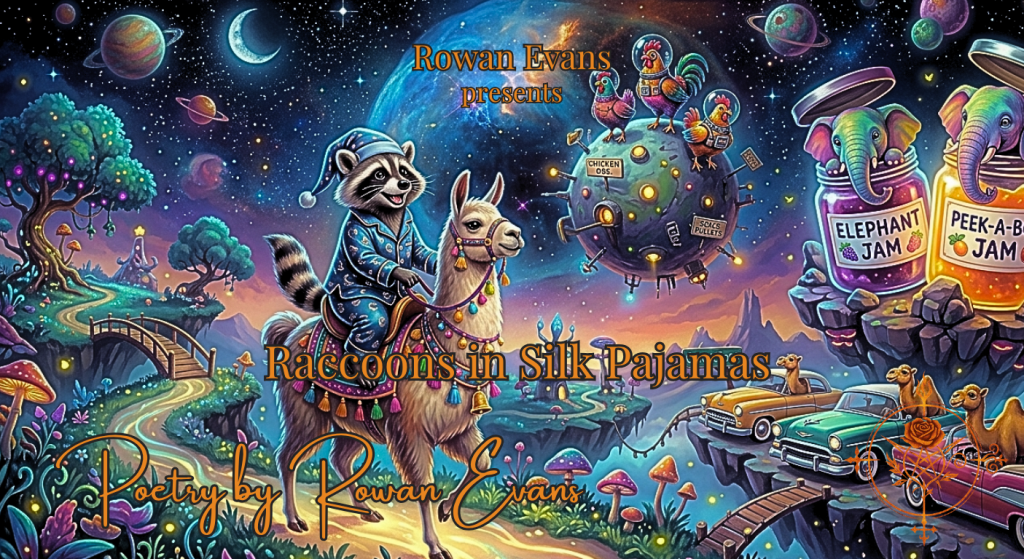
This poem started where a lot of my more playful pieces begin: with a chain reaction of absurd images that refused to behave.
I didn’t sit down with a structure in mind. I just let the language run until it started building its own logic—one that doesn’t really care about realism, linear progression, or whether raccoons should realistically be wearing silk pajamas in the first place.
The “Space Chickens” at the beginning weren’t planned as a motif. They became one because they felt like the kind of strange, mildly accusatory presence that only makes sense in a world where camels are in parked cars and elephants are stored in jam jars.
From there, the poem just escalates.
Raccoons appear. Then llamas. Then the question of pajamas becomes a philosophical problem. Somewhere in the middle, the poem realizes it is no longer interested in consistency—it’s interested in momentum.
There’s a moment where the speaker tries to impose logic:
“Don’t be absurd.”
But by that point, absurdity has already won.
What I find interesting about this piece is that it still has a kind of emotional continuity even without narrative stability. It moves the way thoughts move when you’re tired, distracted, or laughing at your own internal associations—jumping from one idea to another through sound, memory, and cultural reference rather than logic.
Even the ending, with its sudden shift into pop culture and cinematic reference, is less about conclusion and more about acknowledgment. The poem becomes aware of itself mid-collapse and decides to lean into it rather than resolve it.
In that sense, it’s not really about raccoons.
It’s about the way language behaves when you stop trying to control it.
And sometimes, that’s where the most honest writing shows up.
— Rowan Evans
When logic leaves the room, language starts having fun.
Raccoons in Silk Pajamas Poetry by Rowan Evans
I had to get away
from the Space Chickens,
they were a little too judgmental—
always questioning what I wore,
shouting implied curses
spoken in cursive.
It was camels in parked cars,
elephants in jam jars…
Now it’s—
raccoons in silk pajamas,
and they’re not alone—
they’re riding llamas.
“Are the llamas
wearing silk pajamas?”
Don’t be absurd.
That’s the weirdest thing
I’ve ever heard—
llamas in pajamas?
No, just raccoons
and bananas.
I was once a
farmer on Pluto,
a librarian on Mars—
a poet amongst the stars.
Now I’m just
an astronaut in the ocean,
rolling in the deep.
Dude—
you just referenced Adele.
Like it is 2001 again.
It’s a Space Odyssey
Journey into the Hexverse…
See where it all began.
[Pluto Farmer] A whimsical absurdist poem about being a certified weirdo, farming space carrots on Pluto, and refusing to fit into anyone else’s definition of “normal.”
Not the kind that arrives fully formed or carefully structured—but the kind that builds in fragments. Small irritations. Cultural noise. Half-remembered references. Thoughts that don’t arrive in order, but all at once.
What I wanted to capture here wasn’t a linear argument or a polished reflection on anger or identity.
It was the process itself.
The way the mind can jump from one idea to another without asking permission. The way language doesn’t always behave politely. The way emotion and memory and absurdity can occupy the same space without resolving into anything clean.
The Batman reference, the cartoon interruption, the sudden shift in tone—none of it is meant to smooth into coherence.
It’s meant to feel like it actually feels inside the moment of thinking it.
The line “This is how my mind works” is the turning point for me in the piece.
Not because it explains everything, but because it stops pretending everything needs to be explained.
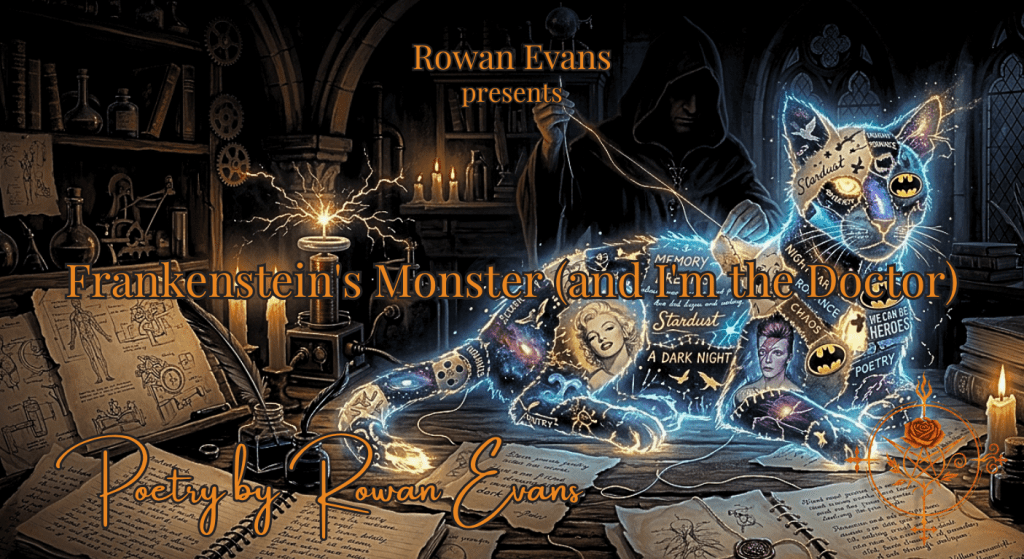
Some poems are built to argue a point.
This one is built to show the mechanism.
And the ending—“Frankenstein’s Monster / And I’m the doctor”—isn’t meant as metaphor in the traditional sense.
It’s closer to recognition.
That the thing being called chaos is also something being assembled. Intentionally or not. Carefully or not. But still assembled.
And that sometimes the person inside the noise is also the one holding the pieces.
— Rowan Evans
“My poetry? Frankenstein’s Monster. And I’m the doctor.” Sometimes creativity isn’t about finding order—it’s about assembling the pieces and bringing them to life.
Frankenstein’s Monster (and I’m the Doctor) Poetry by Rowan Evans
I’m sick of my surroundings;
sick of these fakes,
sick of the snakes,
they’re all just Batman villains—
Two-face.
Crazy is the way
they made me.
Twisted thoughts
that wouldn’t stop—
pop goes the weasel,
I R Baboon.
This is how my mind works.
It links two things
that are seemingly opposites.
They have nothing in common,
but still I piece them together—
my poetry?
Frankenstein’s Monster.
And I’m the doctor.
Journey into the Hexverse…
[Violets Are Violet (Roses Are Complicated)] A simple observation leads to an absurd conclusion: violets aren’t blue, roses aren’t always red, and the classic love poem may be far less accurate than advertised. A humorous free-verse poem about overthinking, flower symbolism, and the unintended consequences of analyzing clichés too closely.
[It’s Just Me but Super] A playful free-verse poem about cartoons, imagination, cosmic wanderings, and the strange magic of creativity. Through wordplay, nostalgia, and absurd humor, Rowan Evans explores what happens when ordinary life meets an extraordinary imagination.
[100 Grand and a Book Deal] A playful collision of candy bars, comic book heroes, basketball legends, and cosmic metaphors. Beneath the jokes lies a reflection on twenty-three years of writing, creativity, and the dream of building something lasting one line at a time.
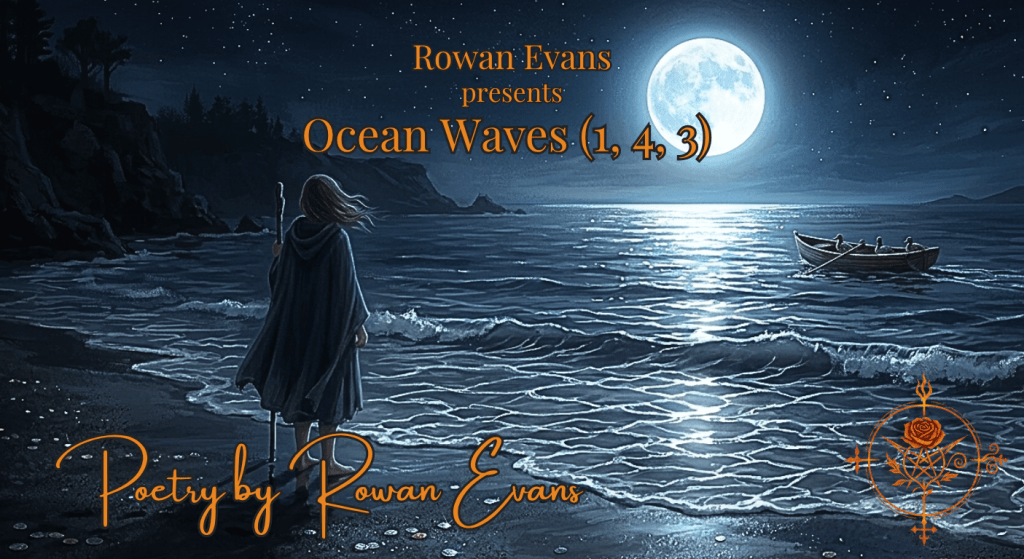
Sometimes I start writing with no destination in mind. A phrase appears. Then a pun. Then another. A moon becomes a metaphor. Ducks end up in a rowboat. A piggybank loses all its cents.
And somewhere in the middle of all that nonsense, something honest sneaks in.
I’ve noticed that humor often works like a side door.
There are things I can say directly. There are things I can say through poetry. And then there are things that feel easier to approach sideways, hidden beneath wordplay, jokes, and absurd little detours.
This piece lives in that space.
The speaker keeps drifting away from the point, circling it rather than naming it. Every joke becomes a delay tactic. Every pun buys another moment before the truth has to be spoken aloud.
Because sometimes vulnerability isn’t difficult because you don’t know what you feel.
Sometimes it’s difficult because you know exactly what you feel.
And saying it out loud makes it real.
The title’s parenthetical reference, “1, 4, 3,” comes from an old numerical shorthand for a phrase many people know by heart. I liked the idea of building an entire poem around avoiding a confession, only to hide it in plain sight.
In the end, the poem says exactly what it means.
It just takes the scenic route to get there.
— Rowan Evans
Sometimes the longest journey to the truth is the scenic route—through moonlight, wordplay, ocean waves, and all the jokes we tell before we finally say what we mean.
Ocean Waves (1, 4, 3) Poetry by Rowan Evans
I stand on the shore
giving ocean waves—
begging the tide
to take me away.
I trace the moon
across the sky,
I map it in rhyme.
Line after—
silver-lined metaphor.
I got my ducks in a row
boat—is that what the paddles for?
I know the direction,
what would I panic for?
You might be confused—
I know that made no sense,
like an empty piggybank.
No cents, thoughts scattered
like loose change.
I use jokes
to mask the truth sometimes.
It makes what I want to say,
an easier pill to swallow—
1 letter
followed by 4
then 3—
Together, they mean
you mean the most to me.
By your side—
is where I’m supposed to be.
Journey into the Hexverse…
[1-4-3] A poem about love that isn’t rooted in need, but in choice. About finding safety not as a cage, but as a place where fear finally stops running—and stays.
[1-4-3 (Tongue Tied)] A vulnerable poem about holding back the words that matter most. 1-4-3 (Tongue Tied) explores fear, emotional suppression, and the quiet ache of wanting to say “I love you.”
[What I Want to Say] Sometimes the hardest words to say are the simplest ones. What I Want to Say explores love, hesitation, and the fear of what might change if you finally speak.
[No Parachute] A poetic reflection on falling in love without hesitation—raw, uncertain, and without a safety net.
This piece started as something simple—a list of music I love.
But somewhere along the way, it stopped being about songs and became something closer to identity.
It turned into a love letter to the sounds that shaped me.
The music we grow up with—or stumble into—doesn’t stay in our headphones. It starts shaping how we feel, how we remember, how we move through the world. Over time, those sounds stop belonging to “other places” and start becoming part of our internal geography.
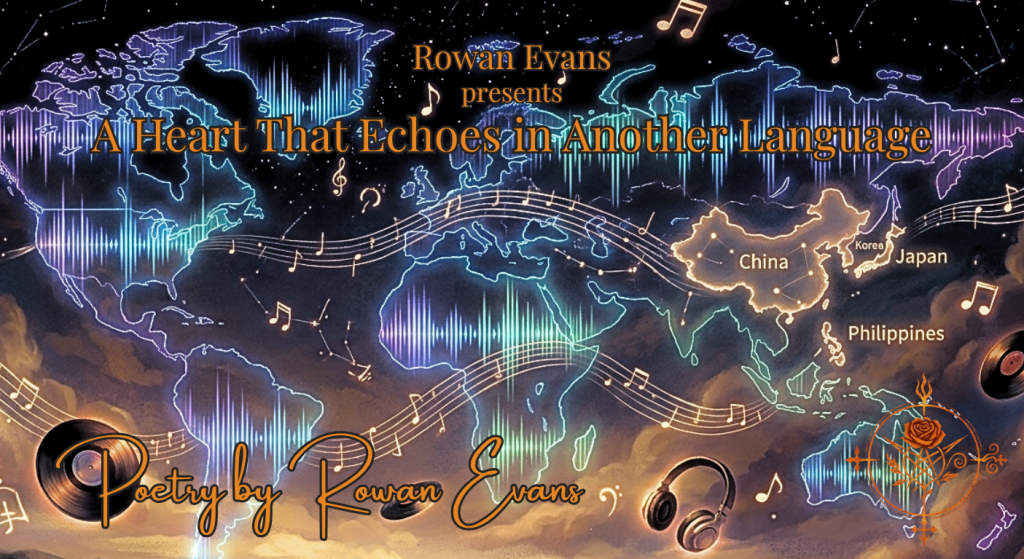
This poem moves through four countries because that’s the path my ears—and honestly, my heart—took growing up. These artists weren’t just background noise; they were cultural touchpoints that expanded my worldview long before I ever had the chance to travel.
I’ve never lived in the places referenced here. But I’ve visited them in the only way I knew how: through sound.
The references in this poem aren’t meant to claim ownership of any culture, genre, or community. They’re acknowledgments—expressions of gratitude for the music that helped me understand myself, broaden my empathy, and feel connected to places far beyond my own borders.
What surprised me while writing this was realizing that I don’t experience those influences as separate anymore. They’ve blended into something personal. Something translated. Something re‑owned in the act of listening and feeling.
This poem is about that transformation.
About how a heart can echo across languages and still sound like itself.
Every name, every lyric nod, every language shift is part of the map of how I became who I am.
This isn’t a history lesson or a ranking of influences. It’s simply the story of how music taught me to feel at home in more than one place.
— Rowan Evans
Where sound becomes geography, and music becomes memory.
A Heart That Echoes in Another Language Poetry by Rowan Evans
I sit in the colors of Japan, red and white, as heavenly6 hits— it’s the melody that drifts under paper moons.
It’s the beauty I see in the filth around me, THE GAZETTE resounding—
but still I say Hi Hi when we meet, it’s the sounds of Tokyo that make me move my feet—
Ami Onuki and Yumi Yoshimura shaped my global empathy, that’s one thing I’m sure of.
하루하루— I drifted, my mental shifted as I moved across the East Sea.
BIGBANG made it easy.
The Kings of K-Pop, guided me deeper into that scene.
It was all brand new— it was SHINee.
And that’s when I fell for Brown Eyed Girls— it was like magic.
Abracadabra.
Pause.
Now, if you think this is the full story, you’re wrong.
This is just a Highlight of when I was a BEAST for new sounds.
Then we shift again— MandoPop and Canto, too, Chinese R&B will make you move.
Guess you can call me, Kuzco— the way China gave me a brand new groove.
With each new song, I found a G.E.M.— a sound that will Get Everyone Moving.
Nine Chen hit me right in the chest— a different kind of ache.
So when it’s time to go, and it’s hard to leave— I say “Bai Twice,”
before I catch my sonic flight, ride the sound waves to a different place—
to different streets, where their beats reverberate in different ways—
where I land next is a place that feels like home— a sound that speaks in warmth and gold.
Musika taught me something important—
that a heart can echo in another language.
Dionela wrapped me in a softness I didn’t know I needed.
And G22 showed me that power can be a kind of prayer—
a chorus you carry in your bones.
Across four nations, I followed melodies like constellations—
each song a compass, each rhythm a road.
And somewhere between the beats and borders, I learned that home isn’t a place you find—
it’s a sound you grow into.
Journey into the Hexverse…
[The Soil Won’t Write Me] Sometimes survival looks like disappearing into art long enough to find yourself again. “The Soil Won’t Write Me” is a confessional free verse poem about displacement, mental noise, rootlessness, and using writing as a way to stay afloat.
[The Needle Doesn’t Point North] “The Needle Doesn’t Point North” is a deeply personal free verse poem about displacement, identity, and spending a lifetime feeling emotionally disconnected from the place you were born while being drawn toward distant shores.
[Weather in My Chest] “Weather in My Chest” is a free verse poem about emotional hyperawareness, social tension, and the quiet experience of carrying internal storms into rooms that react before a singl[e word is spoken.
[Sound as a Vessel] “Sound as a Vessel” is a free verse poem about music as emotional architecture, exploring how international artists and soundscapes shaped identity, creativity, memory, and poetic voice.
[Just Knowing You Has Been Enough] “Just Knowing You Has Been Enough” is a deeply vulnerable free verse poem about unspoken love, emotional fear, coded confessions, and the quiet truth of caring for someone without needing perfection in return.
[The Streets I Walk When I Sleep] “The Streets I Walk When I Sleep” is a deeply intimate free verse poem about recurring dreams, emotional connection, longing across distance, and the strange feeling of remembering places and moments that have never happened in waking life.
[Memories From a Life Yet to Come] Some dreams feel less like fantasy and more like memory. “Memories From a Life Yet to Come” is a reflective free verse poem about longing, displacement, emotional alignment, and the strange comfort of recognizing yourself more clearly in dreams than in waking life
[Separate Timelines] “Separate Timelines” is a surreal and deeply introspective free verse poem about emotional distance, time zones, vulnerability, and the fear of losing a connection that already feels meaningful before the words are ever spoken aloud.