Author’s Note
Sometimes I genuinely wonder what happens when I give my brain permission to write whatever it wants.
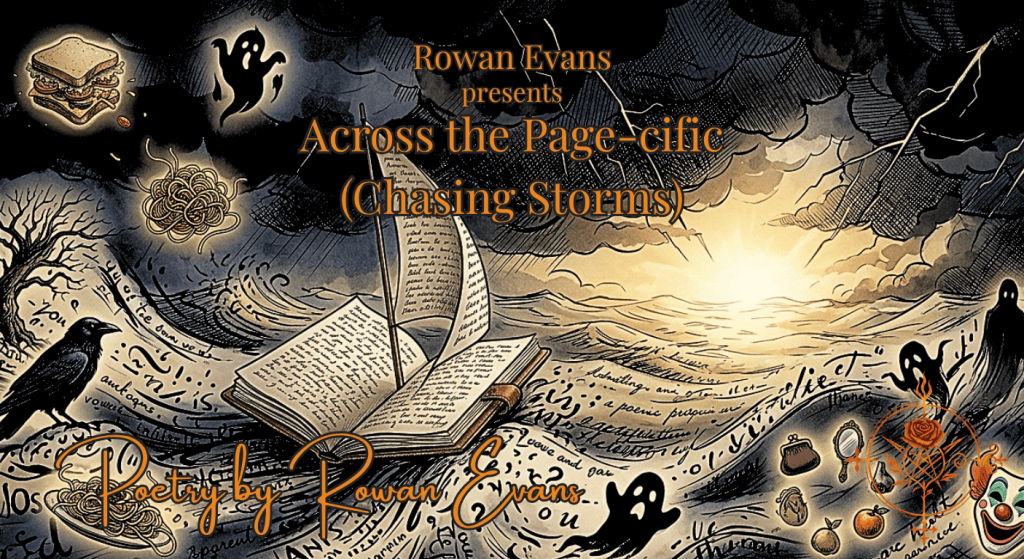
The answer, apparently, is sandwiches, pasta, farmers on Pluto, raccoons in silk pajamas, llamas, trees, cartoon ghosts, monsters, seven deadly sins, and a journey across an ocean that does not technically exist.
And honestly?
I love it.
Across the Page-cific (Chasing Storms) is a celebration of the strange places my writing can go when I stop trying to force it into a single shape.
This poem deliberately references several of my recent pieces and recurring worlds. The sandwich wordplay comes from Lost in the Sauce. The pasta-based literary assault comes from Impasta (A Diss in Pasta Form). The trees point back to my playful botanical wordplay, while Danny Phantom, the Monster in the Margins, the Seven Deadly Sonnets, ravens, spirits, and other imagery come from the larger mythology and vocabulary I’ve been building throughout my work.
The references aren’t just Easter eggs.
They’re evidence.
Evidence of how much my writing has changed—and how much more willing I am now to let different parts of my voice coexist.
For a long time, I thought I needed to choose what kind of writer I was supposed to be.
Gothic poet.
Confessional poet.
Love poet.
Dark poet.
Funny poet.
Experimental poet.
But the more I write, the less interested I am in choosing.
I want to write the heartbreak poem with sandwich ingredients.
I want Tony Stanza to write a pasta diss.
I want to turn mythology into autobiography.
I want to write about ghosts and gods, then turn around and make a terrible pun.
I want to chase a metaphor until it becomes absurd.
And then, underneath all of it, I want to find something honest.
That is what the storms in this poem represent.
The chaotic lines.
The sudden cadence changes.
The ideas that arrive from nowhere.
The parts of my mind that refuse to walk in a straight line.
I used to think I needed to calm those storms down.
Now?
I chase them.
Because writing has become a playground again.
And somewhere in that playground, I keep finding pieces of myself I hadn’t finished discovering.
“It was writing that saved me” is therefore not a throwaway line.
Writing gave me a language for experiences I couldn’t always explain directly. It gave me somewhere to put the contradictions, the humor, the darkness, the questions, the love, the anger, the absurdity, and everything else that makes up the person behind the pen.
Piece by piece.
Bit by bit.
I rebuilt myself in the art.
And apparently, sometimes that art looks like a sandwich, a bowl of pasta, and a storm on the Pacific.
I’ll take it.
— Rowan Evans
I started chasing them across the page.
Across the Page-cific (Chasing Storms)
Poetry by Rowan Evans
Let’s see, what other ridiculous thing
can we turn into poetry—
I’ve written a heartbreak poem
using sandwich ingredients,
and wrote a diss poem
using nothing but pasta noodles—
was a farmer on Pluto,
witnessed raccoons in silk pajamas
perched on the backs of llamas—
while I shaped love poems
out of the trees—
I’ve turned Danny Phantom
into religion—a whole faith
on “going ghost”—
but really it’s just me stuck
between worlds.
I’ve written as the monster in the margins
and the spirits in the room—
seven sins that act like tax on the soul.
Go against the monster, you won’t leave whole.
Feeling like Pennywise, grin wide,
’cause I’m a clown in my rhymes
sometimes—
I’ve taken trips
in ink-dipped ships
across the page-cific—
avoiding storms of chaotic lines
and jagged rhymes
with sudden cadence changes.
Just kidding—
I chased the storms across the page,
embraced the pace my brain gave.
It was writing that saved me—
it gave me a way to translate me,
piece by piece and bit by bit,
I rebuilt myself in the art of lit—
where a mind like mine appears rarely.
Journey into the Hexverse…
[Lost in the Sauce]
A playful heartbreak poem where sandwiches, ketchup, mustard, rye, lettuce, and sourdough become metaphors for emotional confusion. Beneath the food puns is a speaker trying to understand how everything went from “we’re okay” to suddenly feeling cold.
[Impasta]
Tony Stanza is back with another literary attack—and this time, he’s bringing pasta. Spaghetti, fettuccine, macaroni, ravioli, and angel hair become weapons in a ridiculous diss aimed at a poet whose rhymes are allegedly cheesy, fragile, and completely impasta.
[Pluto Farmer]
A whimsical absurdist poem about being a certified weirdo, farming space carrots on Pluto, and refusing to fit into anyone else’s definition of “normal.”
[Raccoons in Silk Pajamas]
What begins with judgmental Space Chickens quickly spirals into camels in parked cars, elephants in jam jars, raccoons in silk pajamas, and astronauts in the ocean. A playful absurdist poem about language, imagination, and what happens when you stop trying to control where the words go.
[Did You Really Think This Was About Trees?]
A playful love poem disguised as a forest of terrible tree puns. Beneath the birch, oak, cedar, palms, lumber, and absurdist wordplay is a poem about devotion, loyalty, laughter, and building a life with someone you love.
[Danny Phantom Theology]
What begins as a metaphor borrowed from a childhood cartoon becomes something deeper: a reflection on existing between survival and possibility, exhaustion and hope, the life we have and the life we long for. Danny Phantom Theology explores what it means to keep moving toward a future that feels worth living.
[The Monster in the Margins II]
The Monster in the Margins II transforms Rowan Evans’s Seven Deadly Sins mythology into a horror story written between the lines, where Lust, Wrath, Sloth, Greed, Pride, Envy, and Gluttony become monsters growing from pain, grudges, and scars.
If you’re interested in more poetry, you can find it here → [The Library of Ashes]