Tag: surrealism

  • Author’s Note

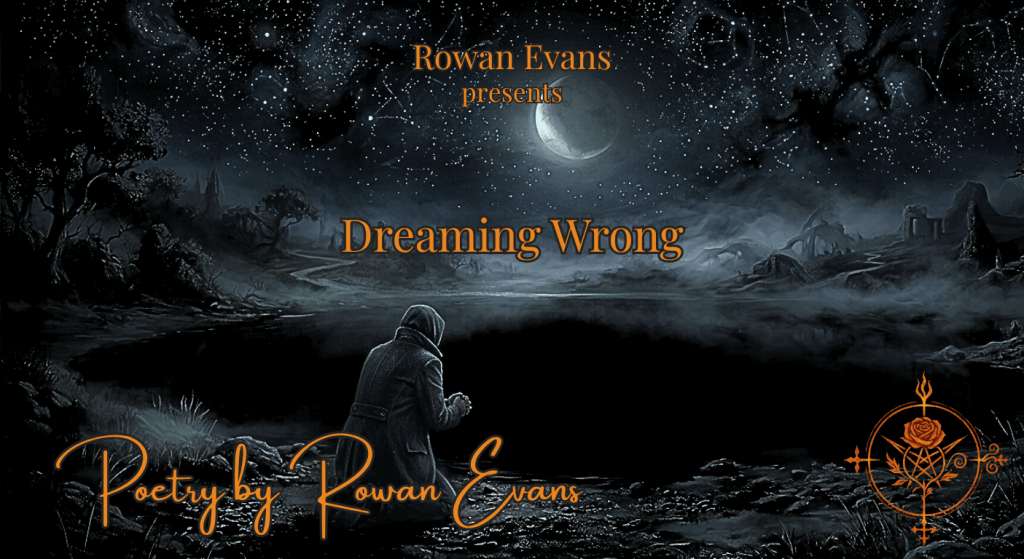
    Dreaming Wrong came from the strange feeling of being inside a dream that looks familiar but somehow isn’t yours. The moon is still there. The path is still recognizable. The water is still waiting—but everything has been rearranged just enough to make the entire landscape feel wrong.

    I wanted to play with that feeling of dream logic: the moment when your mind recognizes the pieces but realizes they no longer fit together. The ocean becomes a pond, the tide disappears, the moon loses its reflection, and even the heavens become impossible to navigate.

    For me, the unsettling part isn’t that the dream is frightening. It’s that it feels incorrect. Like waking life has been reconstructed by someone who knows what everything is supposed to look like—but doesn’t quite understand what it means.

    Sometimes the strangest dreams aren’t nightmares.

    Sometimes they’re simply dreaming wrong.

    Rowan Evans


    A surreal nighttime landscape where a person kneels beside a dark pond beneath a pale moon with no reflection in the water.
    Sometimes the nightmare isn’t frightening—it is simply familiar enough to feel wrong.

    Dreaming Wrong
    Poetry by Rowan Evans

    I slipped from waking life,
    drifted into night—
    but it felt different,
    like the imagery wasn’t right.

    The moon looked paler than usual,
    so I asked if she was sick—
    of course, she didn’t answer back.
    But I followed the same paths
    that I had many nights before.

    I walked along
    until I hit the edge of the—

    pond?

    Where was the ocean at,
    where was the shore—
    and why couldn’t I
    feel the tide anymore?

    Everything felt off there.

    I was on my knees,
    staring at the water—
    where was the shimmer,
    I couldn’t see the reflection
    of the moon—

    I looked straight ahead,
    and the silence seemed
    to stretch further.

    Then my eyes looked to the sky
    and I realized that I couldn’t
    map the path across the heavens.

    It’s like as soon my head hit the pillow—
    I entered somebody else’s mind,
    because nothing about this
    felt like mine—

    I was dreaming wrong.

    That’s the only thing
    that can explain,
    what was going on.


    Journey into the Hexverse…

    [Beach to Beach (How I Get There)]
    A dream becomes a journey between familiar shores and unfamiliar cities in Beach to Beach (How I Get There), a poem about imagined travel, ocean crossings, longing, and the places we hope to someday reach while awake.

    [Where the Metaphors Lead]
    Some truths are easier to write than they are to say aloud. “Where the Metaphors Lead” explores the quiet space between dreams, confession, and the courage it takes to let another person know how deeply they’ve become woven into your inner world.

    [The World Shifted Around Us]
    The world transformed around us—beach, city streets, jungle—but we never moved. Sometimes love isn’t found in words, but in the quiet certainty of someone remaining clear while everything else fades.

    [The Streets I Walk When I Sleep]
    “The Streets I Walk When I Sleep” is a deeply intimate free verse poem about recurring dreams, emotional connection, longing across distance, and the strange feeling of remembering places and moments that have never happened in waking life.

    [Across the Page-cific]
    A playful, autobiographical journey through the strange places poetry can take me—from sandwich heartbreak and pasta diss poems to gothic monsters, mythology, ravens, ghosts, and storms across the page. Beneath the absurdity is something deeply personal: the realization that writing gave me a way to rebuild myself, piece by piece.

    If you’re interested in more poetry, you can find it here → [The Library of Ashes]
  • Author’s Note

    This poem started where a lot of my more playful pieces begin: with a chain reaction of absurd images that refused to behave.

    I didn’t sit down with a structure in mind. I just let the language run until it started building its own logic—one that doesn’t really care about realism, linear progression, or whether raccoons should realistically be wearing silk pajamas in the first place.

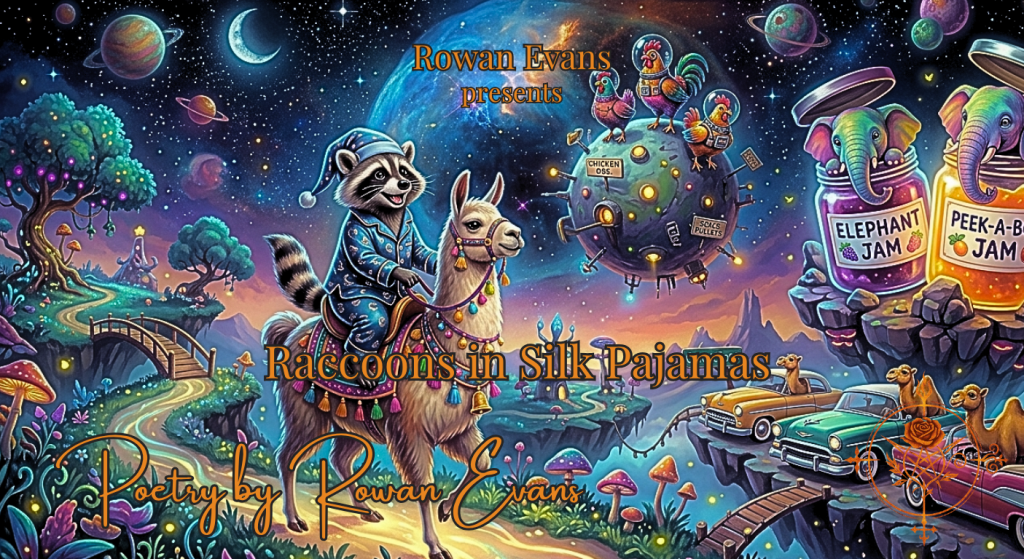
    The “Space Chickens” at the beginning weren’t planned as a motif. They became one because they felt like the kind of strange, mildly accusatory presence that only makes sense in a world where camels are in parked cars and elephants are stored in jam jars.

    From there, the poem just escalates.

    Raccoons appear. Then llamas. Then the question of pajamas becomes a philosophical problem. Somewhere in the middle, the poem realizes it is no longer interested in consistency—it’s interested in momentum.

    There’s a moment where the speaker tries to impose logic:

    “Don’t be absurd.”

    But by that point, absurdity has already won.

    What I find interesting about this piece is that it still has a kind of emotional continuity even without narrative stability. It moves the way thoughts move when you’re tired, distracted, or laughing at your own internal associations—jumping from one idea to another through sound, memory, and cultural reference rather than logic.

    Even the ending, with its sudden shift into pop culture and cinematic reference, is less about conclusion and more about acknowledgment. The poem becomes aware of itself mid-collapse and decides to lean into it rather than resolve it.

    In that sense, it’s not really about raccoons.

    It’s about the way language behaves when you stop trying to control it.

    And sometimes, that’s where the most honest writing shows up.

    Rowan Evans


    A raccoon wearing silk pajamas rides a llama beneath a colorful cosmic sky filled with surreal creatures and absurd imagery.
    When logic leaves the room, language starts having fun.

    Raccoons in Silk Pajamas
    Poetry by Rowan Evans

    I had to get away
    from the Space Chickens,
    they were a little too judgmental—

    always questioning what I wore,
    shouting implied curses
    spoken in cursive.

    It was camels in parked cars,
    elephants in jam jars…

    Now it’s—

    raccoons in silk pajamas,
    and they’re not alone—
    they’re riding llamas.

    “Are the llamas
    wearing silk pajamas?”

    Don’t be absurd.
    That’s the weirdest thing
    I’ve ever heard—

    llamas in pajamas?

    No, just raccoons
    and bananas.

    I was once a
    farmer on Pluto,
    a librarian on Mars—
    a poet amongst the stars.
    Now I’m just
    an astronaut in the ocean,
    rolling in the deep.

    Dude—
    you just referenced Adele.

    Like it is 2001 again.
    It’s a Space Odyssey


    Journey into the Hexverse…

    See where it all began.

    [Pluto Farmer]
    A whimsical absurdist poem about being a certified weirdo, farming space carrots on Pluto, and refusing to fit into anyone else’s definition of “normal.”

    If you’re interested in more poetry, you can find it here → [The Library of Ashes]

  • Last night, sleep opened its velvet throat—
    and I fell into the hush between heartbeats,
    where the walls of the world breathe slow,
    and time forgets its name.

    He stood there.
    My father—
    not as ash in the urn,
    but as shadow sewn in dreamlight,
    his voice a paper lantern in the fog.

    He said something.
    Words folded in half,
    creased like love letters unsent.
    A tongue I should have known
    but could not parse—
    like trying to read raindrops
    as they run down glass.

    His eyes were galaxies
    just out of reach—
    all gravity, no ground.
    He smiled like someone
    who’s seen the ending
    and can’t explain it.

    Was it a message?
    A map?
    A test?

    He left me with nothing but silence
    stitched in silk and salt,
    and the ache of unlearned riddles
    tattooed across my chest.

    Now I sit beneath the fig tree of my grief,
    its fruit swollen with unsaid things.
    I peel back memory like skin,
    searching for symbols in marrow,
    for parables in pulse.

    What was I meant to understand?
    That love does not end,
    only alters its architecture?
    That the dead do not speak in answers,
    but in echoes
    and invitations?

    Some lessons aren’t given.
    They’re grown—
    like thorns
    from the same vine as the rose.

    And maybe
    that was the point.