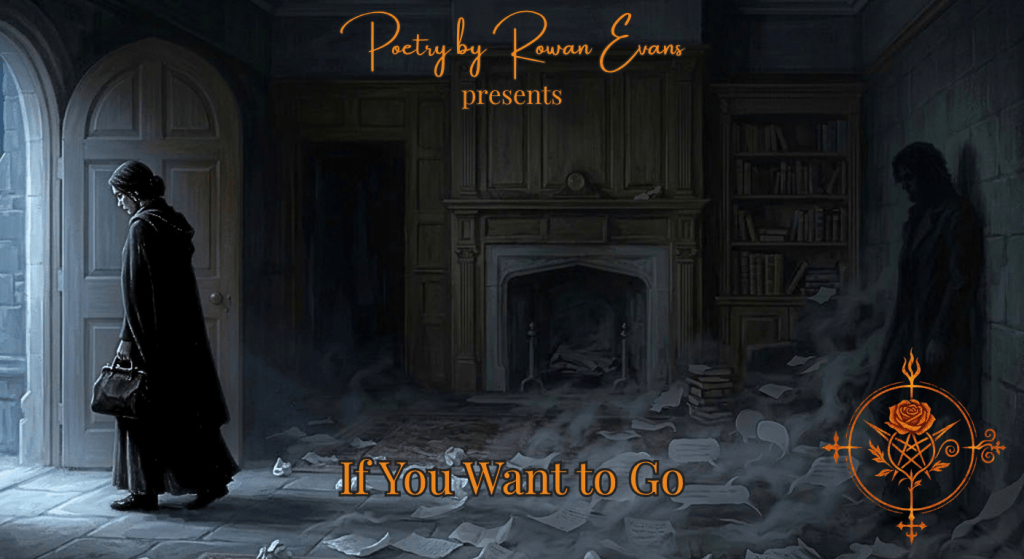
There comes a point in certain conversations when the words have already worn themselves thin. Promises become repetitions, explanations become excuses, and the silence between two people starts saying more than either of them can manage.
“If You Want to Go” steps into that moment—the moment when frustration stops begging to be understood and starts letting go. Its voice is blunt, impatient, and tired of pretending that another conversation will somehow change what has already been made clear.
Sometimes, the hardest part of walking away isn’t opening the door.
It’s finally refusing to stand in front of it, waiting for someone to decide.
— Rowan Evans
When the words become excuses, sometimes letting go says enough.
If You Want to Go Poetry by Rowan Evans
If you want walk—
then walk—
we don’t have to waste our time, we don’t have to talk— I don’t want to listen to another empty line, it’s just excuses—talking is useless—
What?
Now you’re mad?
Why— because I gave you what you wanted?
If you want to go, then go— what do we keep doing this for?
We don’t have pretend anymore—
Journey into the Hexverse
[You Still Pop Into My Brain] Sometimes, someone from your past still wanders into your thoughts—not because you want them back, but because they once held a place in your everyday life. A reflective poem about disappointment, growth, and the strange persistence of memory after moving on.
And sometimes my brain apparently looks at a sandwich and says, yes, this is how we’re processing emotional confusion today.
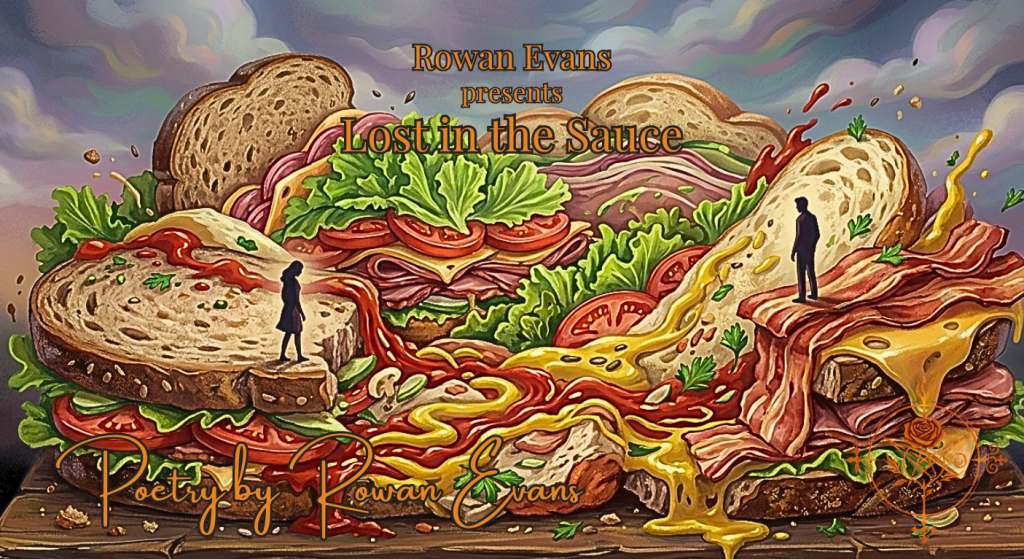
Lost in the Sauce is a deliberately playful poem built around food-related wordplay, particularly the language of sandwiches, condiments, bread, and the wonderfully terrible possibilities hidden inside them.
The jokes are intentionally stupid.
That is part of the point.
“Bread” becomes “rye.” “Ketchup” becomes “catch up.” “Mustard” becomes “must’ve.” “Sourdough” becomes an emotional description. Even “lettuce meat in the middle” is doing multiple jobs at once.
But beneath all of that nonsense is something much more familiar: the confusion of being told that everything is okay while someone’s behavior feels completely different.
The speaker is trying to understand the contradiction.
They were told the relationship was fine.
They were told the other person was happy.
So why does everything suddenly feel cold?
Why does affection feel sour?
Why does the speaker feel trapped in place, struggling to catch up to something they don’t fully understand?
The ridiculous wordplay gives me permission to approach that emotional confusion without making the poem overly solemn.
I’ve been rediscovering how much I enjoy treating language like a playground—taking ordinary words, twisting them until they become something else, and seeing how far I can push a joke before the emotional meaning underneath it starts showing through.
So yes, this poem is about sandwiches.
Sort of.
Mostly, it’s about being lost in the sauce when the person you’re trying to understand has already changed the recipe.
— Rowan Evans
Sometimes you don’t fall apart. Sometimes you just get lost in the sauce. 🥪
Lost in the Sauce Poetry by Rowan Evans
You sandwiched me in
with an all-tomato—
love you or leave,
but I couldn’t do it clean—
I was lost in the sauce,
begging lettuce
meat in the middle.
You said, “you lie.”
I said, “Nah, you rye.”
But do you know why?
I was stuck in place,
you wouldn’t wait—
I was struggling
to ketchup.
I thought you
mustard—
how could you not?
People talk.
Look—
I’m sorry.
I don’t want to fight.
But, you said—
you were happy.
We were okay.
So why you so cold,
why you actin’ sourdough?
Journey into the Hexverse…
[Did You Really Think This Was About Trees?] A playful love poem disguised as a forest of terrible tree puns. Beneath the birch, oak, cedar, palms, lumber, and absurdist wordplay is a poem about devotion, loyalty, laughter, and building a life with someone you love.
[Blended Hardware] A playful, absurdist poem where step-ladders, garden hoses, Star Wars, teenage memories, Gothic imagery, and the poet’s own self-interrupting commentary collide. Blended Hardware is a celebration of letting language wander.
Sometimes an old poem doesn’t need to be left in the past.
Sometimes you have to return to it after you’ve changed.
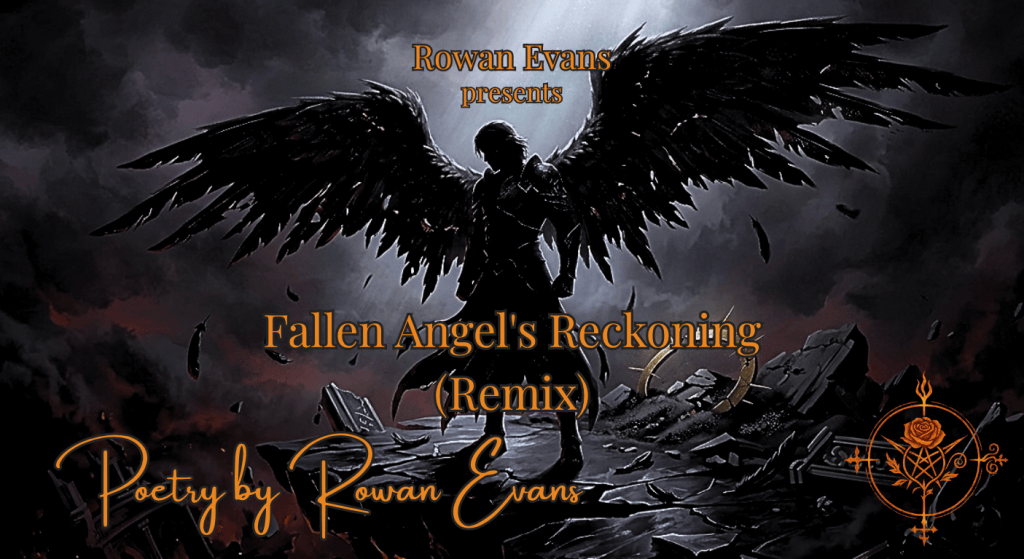
Fallen Angel’s Reckoning (Remix) revisits a poem I originally wrote on June 6, 2024. The original was already telling a story I understood well: love that promised forever, a fall from an imagined heaven, and the painful process of reclaiming yourself after the promise disappears.
But I was a different writer when I wrote it.
And, more importantly, I was a different person.
The 2026 version isn’t meant to erase the original. It is a conversation with it.
I kept the central imagery—the angel, Lucifer, the fall from heaven, the halo, the darkness, the broken vow—because those symbols still belong to the emotional architecture of the piece. But I wanted to push the mythology further this time. Icarus enters the story. The fall becomes more physical, more violent, more deliberate. The speaker isn’t simply descending from something that once felt like heaven; they are plummeting from it.
And then there is the ending.
In 2024, I wrote about newfound wings.
In 2026, I wrote about broken wings.
That change matters to me.
Because strength doesn’t always mean becoming untouched by what happened. Sometimes you keep the scars. Sometimes you keep the broken pieces. Sometimes you discover that you can still fly without first repairing everything that hurt you.
The angel doesn’t become an angel again.
They don’t return to the heaven they lost.
They don’t need the person who made them feel divine to give them their identity back.
They become something else.
A fallen angel who embraces the fallen.
The broken.
The free.
That is what this remix ultimately became: not a poem about getting back what was lost, but about discovering that losing it didn’t mean losing yourself.
I didn’t rewrite the 2024 version because it was wrong.
I rewrote it because I’ve had two more years to understand the fall.
And sometimes the person who wrote the first poem deserves to hear what the person you became has learned since then.
— Rowan Evans
I don’t need unbroken wings to fly. I just need to remember that they were mine before anyone promised me heaven.
Fallen Angel’s Reckoning (Remix) Poetry by Rowan Evans [written July 23th, 2026]
I remember when you said forever,
but forever never came,
so I fell like Lucifer,
from the heavens down I tumbled.
Returned your love,
played your game—
once an angel in your eyes,
now in darkness I crumbled.
Your promises were wings that lifted me high,
but they melted away, when I reached the sun—
just like Icarus, the light was my undoing.
It wasn’t just a fall, I was plummeting…
a fallen star,
cast from the sky,
now I walk in shadows,
where our love met its end.
Like Lucifer—I embraced the night,
wandering through realms of regret and pain,
I shed my halo,
lost my light,
no longer an angel,
in your eyes or in my name.
Yet in this darkness,
a new path unfurls—
I find strength in the ashes of our broken vow,
rising from the ruins of our shattered world.
I reclaim my soul,
I’m reborn here and now.
No longer bound by your empty decree—
I soar with broken wings,
embracing the fallen,
the broken, the free,
a fallen angel finding strength
I never knew I’d own.
Journey into the Hexverse…
[Homecoming] Homecoming is a return to the Gothic aesthetic at the heart of Rowan Evans’s poetry, blending Poe, mythology, horror icons, moonlight, ravens, and darkness into a meditation on artistic identity and finding your way back to the voice that feels like home.
[The Monster in the Margins] Drawing inspiration from horror icons like Michael Myers, Ghostface, Freddy Krueger, and Pennywise, this poem explores the darker side of creativity—where inspiration becomes an unstoppable force lurking just beyond the edge of the page.
[The Monster in the Margins II] The Monster in the Margins II transforms Rowan Evans’s Seven Deadly Sins mythology into a horror story written between the lines, where Lust, Wrath, Sloth, Greed, Pride, Envy, and Gluttony become monsters growing from pain, grudges, and scars.
[The Unkindness Descends] “The Unkindness Descends” is a Gothic symbolic poem exploring collapse, transformation, and the unsettling experience of being witnessed during moments of unraveling. Through raven imagery, ambiguity, and ritualistic atmosphere, the poem invites multiple interpretations—spiritual, psychological, ominous, or transformative.
[Gospel in Crimson] When writing becomes ritual and love becomes devotion, the line between creation and worship begins to blur. Gospel in Crimson explores obsession, artistry, and the sacred act of expression.
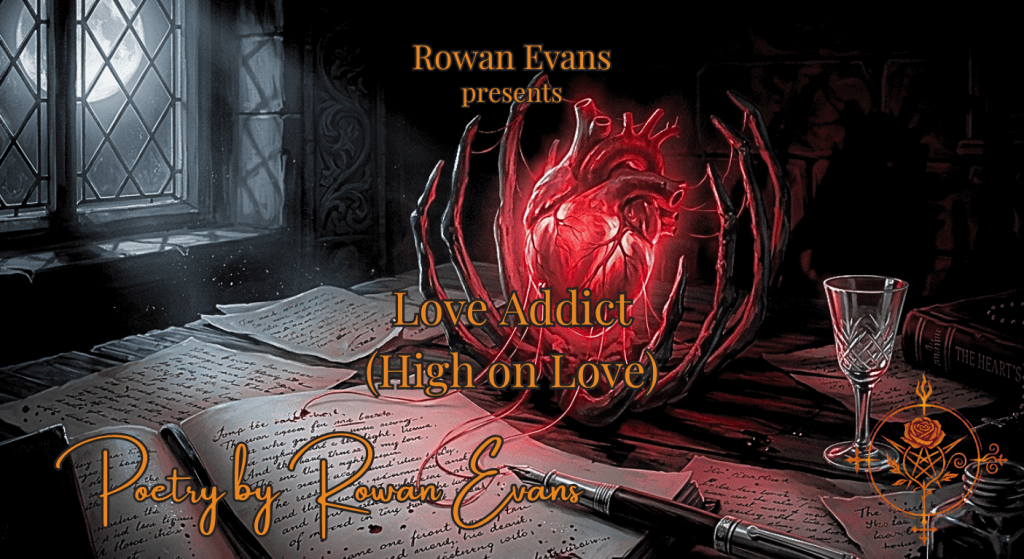
Love Addict (High on Love) is me taking one of my recurring themes—how intensely I experience love—and pushing the metaphor until it becomes impossible to ignore.
I’ve often written about love as something intoxicating. A rush. A chemical reaction. Something that can make the world feel brighter and the mind move faster. But this poem asks what happens when that metaphor is taken literally enough to become uncomfortable.
Because sometimes I don’t simply want love.
I crave it.
There is a difference.
The language of addiction works here because love can create its own strange cycle: anticipation, euphoria, uncertainty, withdrawal, craving, and the desperate desire for another hit of the feeling that made everything seem worthwhile.
And, naturally, my response to that craving is to write.
That’s one of the things I find fascinating about my relationship with poetry. I don’t merely write about what I’m feeling—I often metabolize the feeling through language. I take the emotion, push it through rhythm and metaphor, turn it over until I can see its shape, and then put it on the page.
So the final joke is also the truth.
I get high on love.
Then I get high on writing about getting high on love.
And apparently, the cycle continues.
Maybe that’s the real habit.
— Rowan Evans
Some people chase love. I apparently write it until the high wears off—and then write another poem.
Love Addict (High on Love) Poetry by Rowan Evans
I get high on love
like it’s a drug
and I’m an addict
with a habit,
fighting for every hit
that I can get—
if I could,
I would OD on it.
Inject it straight
to my chest,
in-between the ribs—
where the heart lives.
I’d take the risk,
the comedown, the crash,
just to feel one moment
where love doesn’t pass.
I get the shakes and quake,
knot in the stomach—cold sweats,
when love doesn’t sit in the chest—
it feels fake, not worth the weight.
Wait—
what was I saying?
I get high on love
like it’s a drug
and I’m an addict,
so I write lines
that expand the mind,
to feed the habit.
Journey into the Hexverse…
[Poet’s Curse] Poet’s Curse explores the painful side of falling too deeply: giving pieces of yourself away freely, taking accountability for your own heartbreak, and realizing that learning to let go can be harder than learning to love.
[When I Fall] When I Fall is a vulnerable poem about loving without reservation, feeling everything deeply, and refusing to make the heart smaller just because wholehearted love can sometimes lead to loneliness and pain.
There is a particular kind of heartbreak that doesn’t have a villain.
Sometimes nobody betrayed you.
Nobody lied.
Nobody promised you something they couldn’t give.
Sometimes someone simply exists, speaks to you, makes you feel something—and your heart decides to build an entire mythology around it.
That is where Poet’s Curse came from.
I’ve joked before about having a poet’s curse: the tendency to fall into feelings quickly, to hear a little beauty in someone’s voice and suddenly find myself wading into the waves after it. But beneath the joke is something I’ve had to become more honest about.
Sometimes my heartbreak is partly mine.
Not because I was wrong to feel what I felt, but because I have a habit of giving pieces of myself away before I’ve figured out whether there is somewhere safe for them to land.
The person in this poem didn’t necessarily do anything wrong. She didn’t promise me forever. She didn’t lead me somewhere just to abandon me. She talked—and I listened. I heard a siren’s song, and I chose to wade into the water.
So this isn’t a poem about blaming her.
It’s about looking at myself afterward and admitting something uncomfortable:
I learned how to hold on long before I learned how to let go.
And maybe that’s the real curse.
Not that I love too deeply.
Not that I feel too much.
But that once I give someone a piece of my heart, I don’t always know how to take my hands away from the fire.
Sometimes the only way forward is to stop calling that weakness a curse and start learning the skill I never had—
how to let go without becoming less capable of love.
— Rowan Evans
Sometimes the hardest thing to learn isn’t how to love—it’s how to let go of what you’ve already given away.
Poet’s Curse Poetry by Rowan Evans
Here we go again
it’s another season of sin,
the poet’s back
heartbroken with a pen.
Yeah, went and fuckin’
did it again—
it’s my fault
my heart is cracked,
with pieces missing.
You see, I give them away
too freely, it’s such a pain
to be me, I get hooked
too easily—
she did nothing wrong,
she didn’t lead me on, just talked
and I heard a siren’s song—
I waded into the waves,
prayed for things to change.
Pardon the moment of slowness,
give me a moment while I own this
and take accountability for my part
in breaking my heart.
It’s a poet’s curse—
I only learned how to hold on.
I never learned how to let go,
my feelings and emotion
like hot coals in my hands.
Journey into the Hexverse…
[When I Fall] When I Fall is a vulnerable poem about loving without reservation, feeling everything deeply, and refusing to make the heart smaller just because wholehearted love can sometimes lead to loneliness and pain.
This piece feels like a conversation with every version of myself that survived long enough to become this one.
The angry versions. The grieving versions. The lonely versions. The hopeful ones too.
For a long time, I thought pain would eventually turn me cold. That heartbreak, betrayal, abandonment—all of it—would harden me into someone bitter.
But somewhere along the way, I realized something:
I don’t want to become what hurt me.
So this poem became less about suffering, and more about what comes after it. About the kind of love I believe in now—not performative, not transactional, not built on fantasy.
Real love is presence. Attention. Safety. Memory. Patience.
It’s showing up.
And maybe that sounds simple. But I think simple things are often the hardest to do consistently.
— Rowan Evans
Love is not perfection. It’s presence.
The Poet Signing Off Poetry by Rowan Evans
Hello—
let me introduce myself.
I am Rowan
and no one else.
The fire in my eyes
may have faded—
but I never let the world
turn me jaded.
I’m not bitter,
even though
maybe I should be.
I’ve been through shit—
yeah,
I’ve really been through it.
I’ve seen friends
turn to strangers—
and worse,
turn to haters.
Friends
to enemies.
Lovers
to ghosts.
Raise your glass—
time for a toast.
I thank you
for the lessons,
the pleasure
and the pain.
I turned heartbreak
into ink,
and bled across
the page.
You taught me
what love is not.
It’s not grand gestures
or fancy gifts.
It’s time
and presence—
not just presents.
It’s stormy weather
and sunny days.
It’s seeing the weight
someone carries,
realizing
they’re being buried.
It’s listening
and learning
their stories.
It’s seeing beneath
the surface,
lifting them up—
that’s the purpose.
Remember
the little things.
How she likes her coffee.
The way she wakes up,
randomly.
And be there.
If she wakes
shaken,
and needs somewhere
safe—
be there.
That’s the rule
I try to live by.
I’ve been hurt before,
and I don’t want
to pass that hurt forward.
I want to ease the ache.
I know I can’t
fix the breaks—
but maybe
we can mend
the cracks with gold,
showing people
the beauty
damage makes.
Because cracks
are not flaws—
they’re stories written
in a language
older than spoken tongues.
It’s love—
older than empires,
older than cavemen
lighting the first fires.
Romantic or platonic,
it matters not.
Love is the cure
to the rot.
I scribble on the page
as the lights begin to fade.
Heartbreak doesn’t always roar—it often arrives softly, like dusk turning to night. This piece is my attempt to sanctify that quiet ache: the plea not to be left half-loved, half-alive. It’s a prayer whispered through bruised ribs and ink-stained fingers; an invocation, a psalm, and a benediction for those who still dare to love—even when love does not return.
loving you was never my ruin. It was my small rebellion against the cold.
✦ Invocation ✦
Read this not as plea, but as offering. A candle lit in trembling hands, not to guide you home— but to keep my own shadows gentle.
This is not a demand. It is a prayer whispered by ribs still aching, a softness that refuses to harden, even when hope burns to ash.
✦ Psalm of the Half-Loved ✦ (A Prayer for the Mercy of Goodbye)
If you must go, let it be as a mercy— not as a slow unraveling.
Tell me cleanly, so I can kneel beside the ruin and name it what it is.
I won’t beg you to stay. I won’t twist my love into chains. But gods—don’t leave me half-loved, half-alive.
Don’t leave your shadow behind to haunt my trembling ribs, or your silence to bloom like poison in my marrow.
If goodbye must come, let it come fully— let it burn, let it break, so I can gather the ash and call it sacred.
I have carried love like an unrepentant prayer, even when it bruised me. I have knelt before absence, offering devotion to a ghost.
But spare me the waiting— the quiet terror of not knowing if your heart still turns toward mine in the dark.
If you must go, leave nothing for hope to cling to. Let my ache be honest, my grief unchained.
And let me remember this: loving you was never my ruin. It was my small rebellion against the cold.
✦ Benediction ✦
Go softly, even if you must go. Leave me not with maybes, but with mercy.
May my love remain unrepentant, even as it mourns what could not stay.
And if heartbreak must come, let it come honest— so my ruin may become reverence, my ache, a quiet vow:
To keep loving, even when love does not return. To keep my softness alive, even when the world would rather see it buried.
Amen.
🖋 Author’s Note:
I wrote this piece as both confession and protection spell. It’s easier, sometimes, to live with grief than with the endless ache of “maybe.” For anyone who’s been left half-loved: may your goodbye come clean, and may your softness outlive the pain. Even heartbreak, when spoken honestly, can become a quiet kind of grace.
There are moments when silence feels like a slow erasure — when not speaking threatens to unravel the fragile threads holding us together. This poem is a whispered litany, a raw confession from the place where fear of losing someone collides with the need to keep the connection alive. It’s a prayer not to clutch or possess, but simply to ward off the darkness that looms in the quiet.
✦ Psalm of the Spiraling Tongue ✦ Poetry by Rowan Evans
i speak even when silence aches— because somewhere inside me lives the terror that stillness might become goodbye.
so i keep talking, spilling words like prayers— not to hold you closer, but to keep the dark from swallowing what’s left of us.
✦ Benediction ✦
May your words never falter when silence threatens. May your voice be the soft flame that holds back the dark. And if goodbyes must come, may they fall gently— leaving room for remembrance, not regret.
Carry this prayer in your marrow, a quiet rebellion against the fading light.
Go softly, beloved, and speak always, for even the trembling tongue is holy.