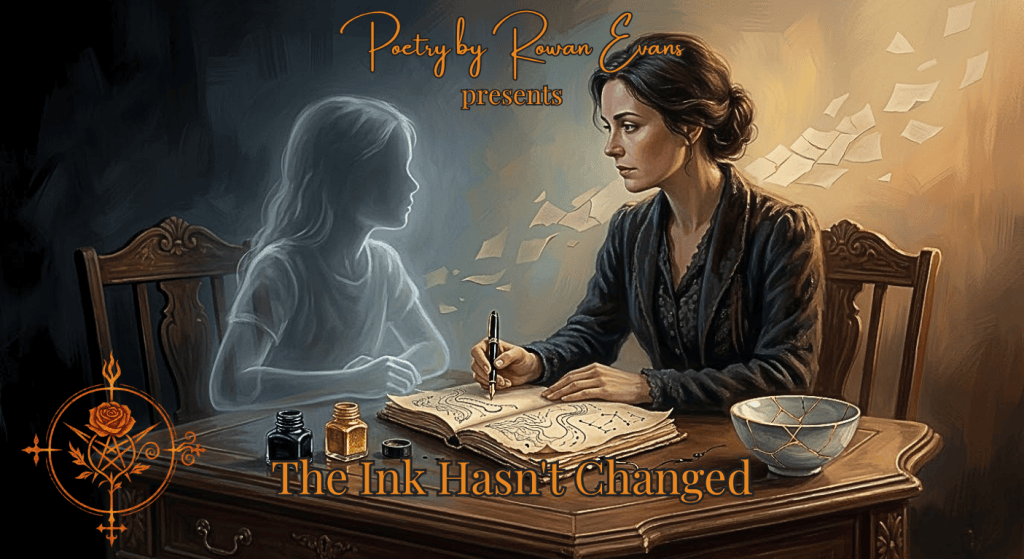
I sometimes look back at the person I was when I first started writing and wonder how much of that younger version of me is still sitting somewhere inside every poem I create. I started writing at thirteen, the same year I experienced my first heartbreak. Back then, ink wasn’t simply a creative outlet. It was a way to hold myself together, to give shape to feelings I didn’t know how to carry, and to leave a record of myself on the page when I was afraid of losing pieces of who I was.
The Ink Hasn’t Changed is about revisiting those beginnings without confusing familiarity with stagnation. The same emotions still find their way into my work: joy, grief, anger, tenderness, laughter, and pain. I’ve continued mapping my soul through poetry, stitching together broken pieces and filling the cracks with whatever gold I could find. The tools and materials may feel familiar, but the person doing the stitching is not the same.
There’s a difference between carrying the same weight and never moving forward. Sometimes, growth means discovering that the thing that once kept you alive can become something you choose to nurture, refine, and share.
My ink hasn’t changed because its purpose never needed to. I have changed. I’ve survived. And the words that once helped me hold myself together now help me understand who I’ve become.
— Rowan Evans
The ink that helped me survive at thirteen still carries my truth at thirty-six. The ink hasn’t changed. I have.
The Ink Hasn’t Changed Poetry by Rowan Evans
I’ve been stuck in the past a lot lately,
just thinking about who I was—
who I was trying to become
and how those early days
set the stage for who I became,
on and off the page.
The same year
I committed myself to ink,
I tasted my first heartbreak—
it was bitter sweet,
hated that it had to come,
but nothing could be done.
That was 2003, I was thirteen—
and she was made to leave.
I took the shattered pieces,
collected in a basket—
I took threads of silver
and sewed myself
back together again.
Cracks patched with gold and ink,
confessions penned in golden ink—
back then
I wrote for me—
I wrote to keep it together,
mentally—
afraid I’d disappear
if I didn’t map my soul in ink.
Turned poetry to cartography,
started mapping the whole of me.
I mapped my soul, wholly—
turned my pain holy.
I tried to translate all of me—
the joy, the pain,
laughter and grief—
and my ink hasn’t changed.
It’s still carrying the same things.
All the same weight, wait—
does that mean I’m stuck in place?
No, just because the ink
has stayed the same—
doesn’t mean I have—I’ve changed,
I’m not the same as I was at thirteen,
now that I’m thirty-six—
and I’m not the same as I was at sixteen,
that’s when I thought my ink was real mean—
but really it was too nice,
the only thing keeping me alive.
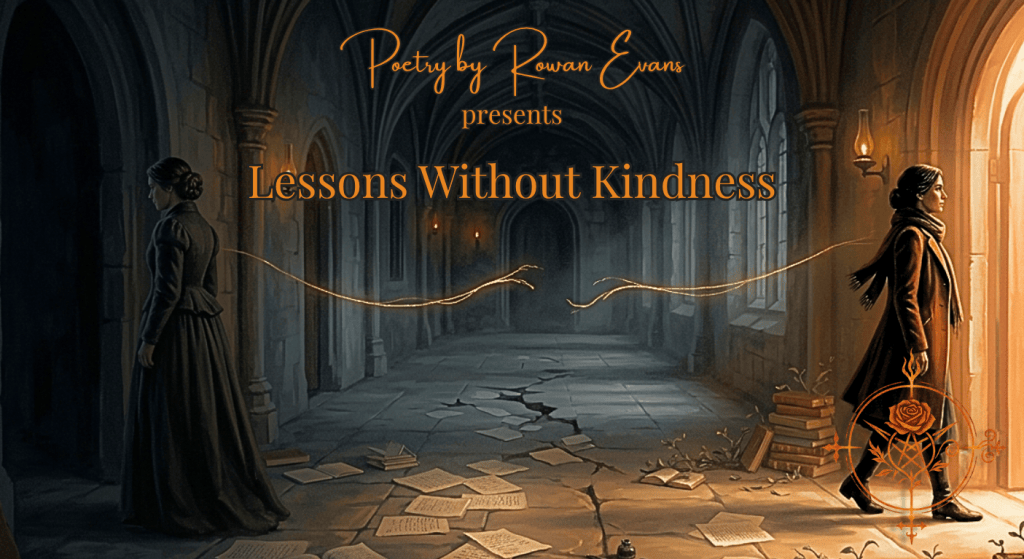
Lessons Without Kindness is about the strange education that can come from losing someone who once felt like your entire world.
This isn’t really a poem about getting even. It’s about looking back at a relationship that changed, recognizing the games, the silence, and the ways I allowed myself to become smaller just to keep someone else comfortable—and realizing that I don’t live that way anymore.
The person who taught me these lessons never intended to be my teacher. They didn’t sit me down and explain what I needed to learn. They simply gave me an experience harsh enough that I eventually learned it myself.
Sometimes the most important lessons don’t come from kindness, wisdom, or good intentions.
Sometimes they come from realizing what you will never allow yourself to become again.
— Rowan Evans
Not every teacher is kind. Not every lesson is wasted.
Lessons Without Kindness Poetry by Rowan Evans
There was a time when
you were my world,
everything was fine and
we really did love each other,
or so I thought—
yeah, we’d always talk—constantly,
I was always thinking of you,
and I thought
you thought about me too.
Maybe you did—once,
then you changed
and started playing games—
you tried to get under my skin,
pit me against him.
But here’s the thing—
he was never gonna win.
I mean, truly,
the only real loser was you—
because in doing what you did,
you lost me too.
And I’m not saying I was a prize,
but I really was a catch for you—
I put up with too much,
and spoke up too little.
But I don’t do that anymore.
I don’t shrink so someone else can feel tall.
I don’t bend so someone else can feel right.
I don’t stay quiet so someone else can stay comfortable.
You taught me that.
Not intentionally—
but lessons don’t need kindness
to be true,
just a student and a teacher—
that was me and you.
Journey into the Hexverse
[The Sacred Timeline] From childhood stories about Dragon Ball Z, Power Rangers, and Pokémon to gothic cathedrals, ravens, roses, identity, healing, and experimentation, The Sacred Timeline traces how Rowan Evans’s relationship with the pen evolved across thirty-six years—and how the ink remained while the writer kept changing.
[The Metaphor Machine] A poem that takes apart its own machinery as it runs—breaking lines, breaking thoughts, and following metaphors from moonlight to tides, oceans, shorelines, and city streets.
[Louder Than the Rain] A short confessional poem about the overwhelming noise of anxious thoughts, the strange silence of feeling alone in a crowded room, and finding a way to translate pain into words.
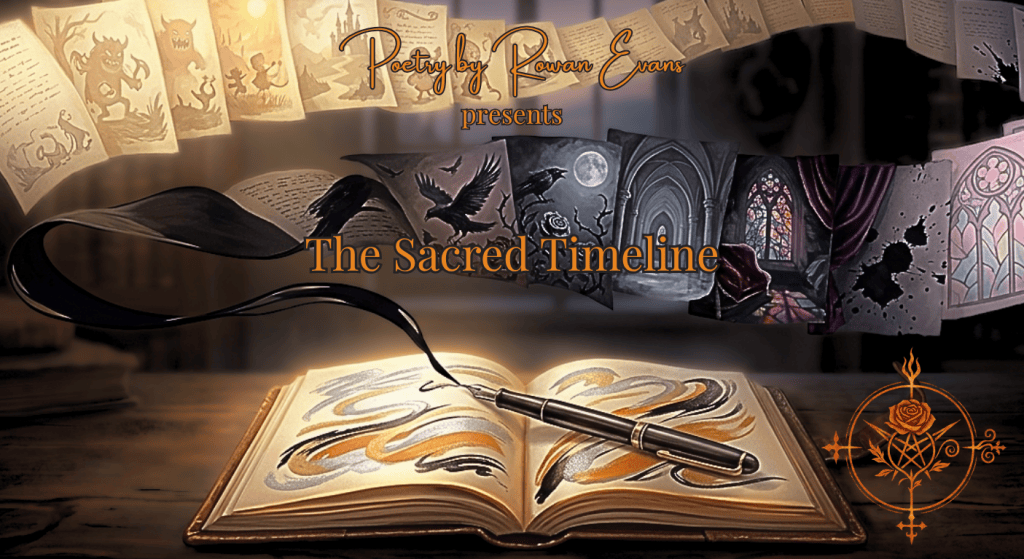
The Sacred Timeline is a map of how my relationship with the pen has changed over nearly three decades of my life.
I started with stories about worlds that already existed—Dragon Ball Z, Power Rangers, Pokémon—and slowly began building worlds of my own. Then the pen became a way to learn cadence, translate music, hide things I couldn’t say aloud, survive periods when writing itself became difficult, and eventually turn pain into something crafted enough to share.
Every era left something behind: the storyteller, the songwriter, the secret keeper, the gothic romantic, the heretic, the battle poet, the confessor, the mythmaker. Some symbols came and stayed. Some meanings changed. Some questions took decades to become clear enough to write down.
And the timeline is still moving.
At thirty-six, I don’t consider the pen mastered so much as understood differently. Writing is still an experiment. The boundaries keep moving. The imagery keeps evolving. The person holding the pen keeps changing.
Maybe that’s the most sacred part of the timeline: the ink stayed, but I didn’t.
— Rowan Evans
Thirty-six years, countless pages, one pen—and an identity still being written.
The Sacred Timeline Poetry by Rowan Evans
I picked up a pen for the first time at seven, I was just writing stories then— Dragonball Z, Power Rangers and Pokémon… that’s what I wrote about way back when—
it was much lighter out, the sun had yet to meet the clouds— I was a natural storyteller, a real lore keeper, weaving lore before I even knew what lore meant. It was like this for years, I created my own space in worlds provided by minds much older than mine.
Then at ten—I switched what the pen meant to me, my creativity shifted mentally— no longer was I just a storyteller, I was letting music be the teacher now. Translating thoughts to song, at least the words of it— I was writing to worship something. Something that in six short years, I would begin to question—
but the years between ten and then—were spent, using the pen to learn cadence. I was trying to learn to perform on the page— I couldn’t do it in body, but I could turn a notebook to a stage.
At twelve things began to shift again, but with me, not with the pen— I still felt the sun, I still saws its rays, but I also saw more cloudy days— that year was hard for me, I couldn’t talk about it with clarity— most people would react like, “you’re scaring me”— so I stopped talking about it really, I closed my lips, but still let the ink spill— the page became a secret keeper, keeping the secrets this storyteller was too afraid to say out loud.
Thirteen the skies went dark— this is when life really got hard. At the beginning of the year, it’s like the ink in my pen had begun to dry— I don’t know what was wrong, but I couldn’t write. I tried and I tried— pages ripped from notebooks, balled up and scattered.
No songs, no stories— I had lost interest in things that I used to find most interesting. Parents took me to the doctor, and the doctor said—
“This kid’s depressed— and anxious too, I’ll write a prescription that should do. A referral for therapy, they’ll get them to talk— they’ll find out what’s wrong.”
A week would go by— giving the medicine a try, it takes time— it has to build up in your system. In the meantime, here’s a therapist, someone to talk to— they’ll listen to your problems, they’ll help you.
And they did—a little bit, they got me to talk a little bit too. But still they saw I was holding back— so they recommended journaling, but that felt tedious and boring. I needed to find a way to make it play— bring a little joy to it, even if falsified.
I made it a game to translate my pain— how many ways could I say everything? Is it possible to flip it? Maybe change the script and shift the meaning? These were the questions I began to ask— even when my ink ran in all black—
back when my heart was all cracks, before I learned how to use the gold to patch— I struggled through, just writing purely what I felt— thirteen, fourteen and fifteen, often felt like hell.
Sixteen, I hit my stride— not in life but with a pen, things were hard still, but now I could translate with skill. Not much, if we’re being honest— just enough to keep the pain beautiful, in case someone else saw it—
Seventeen, I did it again— reinvented myself with the pen, more gothic in my intentions. Maybe I finally read Poe, who knows— but ravens became a part of my soul.
At eighteen, I went from church steeples and church people to writing cathedrals for outcasts and heretics— we hadn’t yet, become luminous. Shadows and lace, velvet and venom— but I also opened my eyes more, became more aware of the world around— outside the borders I’m confined in.
At twenty, I started to write for people more—to uplift, and let them know they’re not alone— whatever they were going through, there was somebody with them. Even from a distance—
I had friends across seas, in places with palm trees— and in places with Kangaroos, even scarier—Emu.
I don’t know what that means in this piece—but it’s true, so do with that, what you’re going to do.
At twenty-two, I got more serious about the ink— I started to write everything. Every thought and every half-formed idea— I just put it on a page, my brain would not be a cage.
Then came twenty-five, the lowest point in my life— it wasn’t a sudden crash, but a slow rot— it bled through every thought, a feeling I couldn’t translate, familiar but different, heavier somehow— so the ink slowed to a drip, I started to let thoughts slip.
Twenty-six, I got serious again— more aggressive with the time spent, my pieces became more crafted and the ink was shaped with intention. Ravens, the moon, and roses too— the symbols I began to use.
I ascend on the back of raven wings— the silver light of the moon pierced the canopy—rose petals drift in the shifting currents of the wind. Everything connects, pay more attention and you’ll become more aware—
At thirty— I really began to question everything— who I was, who I am, who I want to be— and that’s still a question I’m working on answering. But it went deeper than that— I was questioning who I was in a deeper sense, like had I been a façade in some sense. Was I playing the role I was assigned, or being true to who I thought I was becoming?
This became a recurring theme in my poetry— it’s an odd thing to discover so late in life, that the person you thought you were— isn’t who you’re supposed to be. So I chased answers in ink to questions I couldn’t fully ask yet.
There were two more years of this— and I’m still not finished.
Thirty-three hit with another shift— I mixed the light with the shadow, it was Easter in the cathedral— pastel colors lit up the stained glass. My imagery began to shift shades— roses in all colors, pastel hues, but the thorns were still there too. So even my softness had bite—
and it evolved more, by thirty-four— more teeth but more softness too. Brighter hues and deeper shadows— this is when I learned, you can’t have one without the other.
The shadow needs the light to cast— and you need the shade to dim the shine, because too much shine— you might go blind.
Then came thirty-five— the modern era, the current phase, one year before the current day— and I know this won’t age well, it’s too time specific—
Finally, we’ve reached thirty-six, and I feel like I’ve mastered this— but that doesn’t mean I’ve stopped learning, because every day is an experiment— really, it’s all about the experience— just learning new things and pushing it, finding where the boundary is and bending it, you gotta realize— you can’t always give a shit, who cares what they think— it’s your ink—shape it how you see fit.
Journey into the Hexverse
[The Metaphor Machine] A poem that takes apart its own machinery as it runs—breaking lines, breaking thoughts, and following metaphors from moonlight to tides, oceans, shorelines, and city streets.
[Exhibit A (The Evidence)] A quick-witted, unapologetically playful poem about writing fast, crossing lines, roasting the competition, and letting rhythm do the talking.
[Welcome to the Hexverse] Step into the Hexverse—a poetic world where mythmaking, humor, rage, creativity, and confession collide, and darkness becomes something that can be reshaped into art.
Some poems begin with an idea. Others begin with a feeling that refuses to leave.
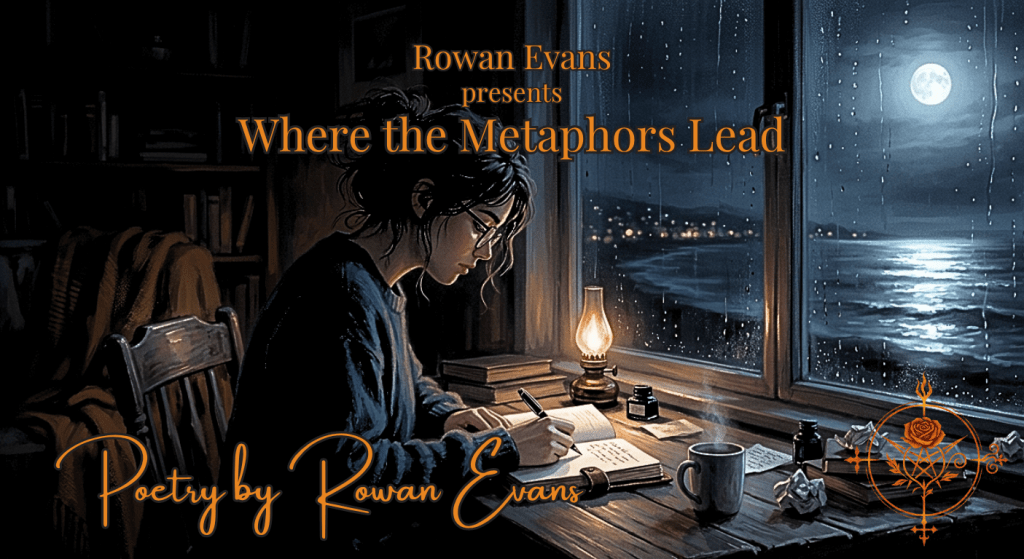
This one was written in the early hours of the morning, during that familiar stretch of time when the world grows quiet enough for my thoughts to become louder than everything else.
I’ve always found it easier to write than to speak. Conversations ask for immediate answers. Poetry allows me to sit with a feeling until I understand it well enough to translate it into language.
Many of the recurring images throughout my recent work—the moon, the tide, distant shores, dreams, and city streets—have become a personal symbolic language. They aren’t separate subjects anymore. They all point toward the same emotional center.
This poem finally acknowledges that.
Sometimes the metaphors aren’t hiding anything.
Sometimes they’re quietly leading us back to the truth we were trying not to say.
— Rowan Evans
Some feelings only find their voice after midnight, where dreams, memory, and metaphor become impossible to tell apart.
Where the Metaphors Lead Poetry by Rowan Evans
It’s funny how I find myself here again,
four AM—it’s just me, the music and my pen.
I’ve got so many thoughts with so much to say,
my lips move but no sound comes—
like I lost one voice, when I found the other.
And it’s not that I can’t speak—
it’s just that words don’t come easily,
when they try to come verbally.
But on the page,
everything lines up—
the thoughts, the feelings,
the things I never say out loud.
Ink doesn’t trip over itself
the way my voice does.
So here are a few
truths for you—
there is a woman
she is on my mind constantly,
yeah, she is simultaneously
the easiest and hardest to talk to.
She makes me feel like I can be me—
completely.
And honestly,
I’ve never really had that
with anybody else—
every beautiful line I write
about the moon in the sky,
the ocean and tide—
yeah, most of the time
it leads back to her
in my mind.
And every dream, I translate in ink—
the shores I walk in sleep,
secrets I try not to keep,
even when it’s hard to speak—
I lay them on the page and pray
that they’ll reach their destination one day.
So I sit here,
four AM again,
writing the things
I can’t say out loud—
hoping one day
I’ll find the courage
to speak them aloud.
Journey into the Hexverse…
[The World Shifted Around Us] The world transformed around us—beach, city streets, jungle—but we never moved. Sometimes love isn’t found in words, but in the quiet certainty of someone remaining clear while everything else fades.
[Every Night, The Same Flight] Every night begins with the same flight. Between wakefulness and sleep, an airport appears, a familiar shoreline waits beyond the journey, and the same dream asks whether some destinations find us before we’re ready to find them.
[Where I Belonged] A bedroom becomes an airport in the space between sleep and waking. Where I Belonged explores liminal consciousness, uncertainty, and the strange moments when reality feels suspended between two worlds
[Opposites Coasts of the Same Silence] What separates two people isn’t always an ocean. Sometimes it’s the silence between everything left unsaid. Opposite Coasts of the Same Silence explores longing, distance, dreams, and the quiet hope that even across impossible divides, someone might still hear your voice.
[Ocean Waves (1, 4, 3)] A moonlit shoreline, a rowboat full of ducks, a piggybank with no cents, and a confession hidden in plain sight. Ocean Waves (1, 4, 3) explores how humor, wordplay, and absurdity can become a side door to vulnerability when the truth feels too difficult to say directly.
[Call of the Tide] A poem about identity, displacement, and the quiet pull toward something beyond the shoreline you were born on. Sometimes the tide calls louder than the anthem.
This piece comes from the space where speech and writing don’t quite align.
There has always been a kind of delay for me—between what I think, what I feel, and what I can actually say out loud. Spoken language has never felt like the most reliable place for truth to land. It slips. It fractures. It gets filtered through hesitation, timing, or silence.
Writing became something different.
Not a replacement for speech, but a translation of it.
A second mouth.
One that doesn’t hesitate in the same way.
One that doesn’t need to arrive perfectly formed in real time.
Over time, I’ve come to understand my writing less as expression and more as continuity—a way of carrying versions of myself forward that might otherwise get lost between changes, growth, or silence. When I talk about shedding “lives like shells,” it isn’t about abandoning who I was, but making space for who I’m becoming.
Writing is where those versions remain visible.
Where they don’t disappear just because I’ve outgrown them.
In that sense, this isn’t just about communication—it’s about survival through articulation. Not in the dramatic sense, but in the quiet one: staying connected to myself through language when voice doesn’t fully bridge the gap.
And if spoken language is the place where I sometimes fall short of myself, then writing is where I learn how to keep translating who I am anyway.
— Rowan Evans
If spoken language is where I fall short of myself, then writing is how I keep translating who I am anyway.
Ink as a Second Mouth Poetry by Rowan Evans
There is a delay
between my mind
and my mouth
when I speak—
that’s why I find
it easier to talk in ink.
I turned my pen
into my mouth,
so when I write
it’s the only time—
the truth spills through.
When I open my mouth,
my words won’t come out—
but in ink, they run
like the secrets slip
from loose lips.
I could write poem after poem,
leaving piece after piece of me behind—
scattered across the pages,
like versions of me scattered
across different lives.
But do not mourn
for what I’ve lost,
because it’s simply the cost
of me being me.
I shed past lives,
it leaves room for me to grow—
just a hermit crab
in human form.
And I’ll continue
to shed lives like shells until
I find the version of myself—
that can speak
in more than ink.
Until then I’ll continue to try,
because growth comes slow.
It’s gradual, it never comes clear.
This piece feels like a conversation with every version of myself that survived long enough to become this one.
The angry versions. The grieving versions. The lonely versions. The hopeful ones too.
For a long time, I thought pain would eventually turn me cold. That heartbreak, betrayal, abandonment—all of it—would harden me into someone bitter.
But somewhere along the way, I realized something:
I don’t want to become what hurt me.
So this poem became less about suffering, and more about what comes after it. About the kind of love I believe in now—not performative, not transactional, not built on fantasy.
Real love is presence. Attention. Safety. Memory. Patience.
It’s showing up.
And maybe that sounds simple. But I think simple things are often the hardest to do consistently.
— Rowan Evans
Love is not perfection. It’s presence.
The Poet Signing Off Poetry by Rowan Evans
Hello—
let me introduce myself.
I am Rowan
and no one else.
The fire in my eyes
may have faded—
but I never let the world
turn me jaded.
I’m not bitter,
even though
maybe I should be.
I’ve been through shit—
yeah,
I’ve really been through it.
I’ve seen friends
turn to strangers—
and worse,
turn to haters.
Friends
to enemies.
Lovers
to ghosts.
Raise your glass—
time for a toast.
I thank you
for the lessons,
the pleasure
and the pain.
I turned heartbreak
into ink,
and bled across
the page.
You taught me
what love is not.
It’s not grand gestures
or fancy gifts.
It’s time
and presence—
not just presents.
It’s stormy weather
and sunny days.
It’s seeing the weight
someone carries,
realizing
they’re being buried.
It’s listening
and learning
their stories.
It’s seeing beneath
the surface,
lifting them up—
that’s the purpose.
Remember
the little things.
How she likes her coffee.
The way she wakes up,
randomly.
And be there.
If she wakes
shaken,
and needs somewhere
safe—
be there.
That’s the rule
I try to live by.
I’ve been hurt before,
and I don’t want
to pass that hurt forward.
I want to ease the ache.
I know I can’t
fix the breaks—
but maybe
we can mend
the cracks with gold,
showing people
the beauty
damage makes.
Because cracks
are not flaws—
they’re stories written
in a language
older than spoken tongues.
It’s love—
older than empires,
older than cavemen
lighting the first fires.
Romantic or platonic,
it matters not.
Love is the cure
to the rot.
I scribble on the page
as the lights begin to fade.
Sometimes the hardest thing to admit isn’t how much someone means to you – it’s how afraid you are of losing them.
This piece isn’t about drama or desperation. It’s about recognizing a reflex I developed a long time ago, and choosing to stay present instead of running.
— Rowan Evans
Staying is sometimes braver than running.
Learning Not to Run Poetry by Rowan Evans
I’ve been feeling this fear lately,
it’s a heavy weight in my chest
and it sometimes locks me down.
It keeps me trapped inside—
hidden away in my mind.
It’s not that I don’t want to reach out,
it’s like I honestly forget how.
I don’t talk about it really,
but I push people away
when I feel they mean too much.
When every thought
begins to center them,
and I see them in every dream.
I know what that means.
I got so used
to people walking away.
They’d hardly
ever stay.
So I learned
to protect myself.
When I felt
myself
getting too attached,
I’d pull back.
And that feeling?
It still lingers,
it’s a constant battle.
I don’t want to be like this.
But I struggle.
I’m still scared to show
too much.
I’m too weird,
I struggle to
bite my tongue.
I guess that’s why
the fear still lingers,
I’m afraid I’ll say too much.
Be too exposed
with nowhere to go,
stuck in the open.
What’s the worst that can happen?
That’s what they keep asking,
they say it’s rejection.
But for me? It’s the end of
the connection.
And I’m not like this
all the time.
Just when I slip
and trip
into the depths
of my mind.
Now with a breath taken,
no longer shaking—
I write to you.
Even knowing
you may never see it,
but I can only say this
because you make me brave.
You make me brave in ways,
I don’t know how to explain—
because you haven’t
done a thing.
But still, because of you
I’ve changed.
I’ve grown in ways
I didn’t know
I needed.
And I won’t say it,
even as it sits
on the tip
of my tongue—
but what I will say,
is this:
You mean more to me
than most,
and even when I struggle
to stay present
in the world outside
my mind—
you’re still in my thoughts
all the time.
These words spill like blood and ink. They explore fear, shame, and the weight of confession. Step forward only if you feel steady.
Your breath, your life, and your heart are sacred. If these words stir difficult feelings, pause, breathe, and reach for light, support, or care. You are never truly alone in the dark.
Where ink becomes confession and scars learn how to shine.
Sprawling Thoughts Poetry by Rowan Evans
I put the pen to paper
like a gun to my head.
Pull the trigger,
write the first line—
watch the ink splatter,
like brain matter—
as thoughts sprawl,
and crawl
across
the page.
This is what
confession feels like,
when I write.
I pour
my heart out
on the page.
The fear and shame,
I give it shape,
I give it a name.
I dance with my demons,
and map my scars
like astronomers
mapping stars.
There are nights when the weight feels unbearable. When the shadows whisper louder than hope. This poem isn’t a goodbye. It’s a warding spell. A ritual of naming pain so it doesn’t consume me in silence.
I offer it to anyone who’s ever stood on the edge and still found a reason to keep walking.
This is for you. For us. For all of us who burn—but refuse to burn out.
Standing at the edge with ink and ache, I return with poems instead of endings. This is how I flirt with oblivion—and choose to stay.
“Flirting with Oblivion” ☽ Poetry by Rowan Evans ☾
Mom, I know you’re reading this— But please don’t cry, ’cause the Kurt Cobain way crossed my mind last night.
And Dad, I know you’re watching over me— Wondering why, when I carry such a light, Do I still ache like I want to kiss the night, Spend forever in a pine box.
But here’s the truth, I always want to say— Goodbye, end the pain, but something in me… Something louder than the scream, It holds on tight to life, like I was living a dream.
I still walk, even when my feet feel heavy, I still talk, even when the words drip with ache— Soul deep, and searing. I still write, like it’s only way I’ll survive— But maybe, I won’t.
Maybe I’ll go— Just like my mother in poetry, I’ll leave on my terms. But before I do, I want to leave behind these words:
To the ones who feel like ghosts in daylight, Who smile while their ribs crack beneath the weight— I see you. I was you. Maybe I still am.
This ache you carry, it doesn’t make you broken— it makes you real. You bleed in verses. You cry in lowercase. But you live—oh gods, you live.
And if tonight is hard— If your heart is begging to be quiet— Let this be your lullaby:
You are not too much. You are not unworthy. You are not the scream you swallowed.
You are the flame fighting to stay lit in the storm. And that fight? That’s holy.
So if you’re tired, rest. If you’re hurting, speak. If you’re fading, reach.
Not because the pain doesn’t matter— But because you do. And even if I go, You’ll still have these words. You’ll still have this cathedral. You’ll still have you.
And you are enough…
And maybe I scared you with all this talk of endings. But hear me now— this is not my goodbye.
This is me naming the shadows so they don’t swallow me.
This is me pouring the poison into the chalice, not to drink— but to purge.
I am still here. Still burning. Still building cathedrals out of ache and ink.
And yes, some nights I flirt with oblivion— but I never take it home. I walk past the edge and come back with poems.
Because I am made not just to feel— but to witness.
Not just to ache— but to hold space.
So if you need me— if you’re standing on that same edge— look for the flame. I’ll be there. I always am.
💌 If this poem resonated with you, I would love to hear from you. Leave a comment, share it with someone navigating the dark, or subscribe for more softness in your inbox.
🔥 And if tonight is heavy: stay. Please. You are needed. Your survival is sacred.
🕯️ If you’re struggling, please read this:
You matter. Your pain is real. Your story is not over. Here are some resources—because your flame is worth protecting:
🇺🇲 United States
988 Suicide & Crisis Lifeline – Call or text 988 https://988lifeline.org Free, 24/7 support for emotional distress and mental health crises.
Lilith has mastered survival. Her world is built from ashes—walls forged in betrayal, silence, and scars that still whisper. To her, love has always meant vulnerability. And vulnerability has always meant pain.
Gabriel sees past the armor. He’s patient, steady, and everything she’s never dared believe in. Their connection is undeniable—burning hot, terrifyingly tender. But for Lilith, every touch is a test. Every kind word, a crack in her foundation.
As passion ignites and buried wounds resurface, both must confront the ghosts they carry. For Lilith, it means risking more than just her body—it means surrendering control, and trusting her heart. For Gabriel, it means holding on… without holding too tight.
A tale of trauma and tenderness, power and vulnerability, Of Ashes & Reverence is a darkly intimate journey through pain, healing, and the radical, luminous act of being truly seen.
—
Author’s Note: Welcome to Neo-Gothic Confessional Romanticism
—
This is more than a love story. It is a confession wrapped in shadows, a resurrection of softness from the ashes of pain.
Neo-Gothic Confessional Romanticism is a genre I created to hold space for the parts of us that ache and burn and bloom all at once. It is where gothic atmosphere meets emotional vulnerability, where romance is both sanctuary and storm. These stories are written with open wounds and hopeful hearts, where love doesn’t fix the broken—but chooses to stay anyway.
Here, you’ll find characters who carry trauma like sacred relics, who speak with trembling honesty, who ache for connection even as they fear it. The intimacy is raw, sometimes rough, but always reverent. These are tales of worship and reckoning, of shadows and survival. Of becoming known.
Of Ashes & Reverence is my first full offering in this genre. It is a story born of my own confessions, fears, and longings—an altar built from grief and devotion.
If you see yourself here—if you’ve ever felt too much, wanted too deeply, or survived too quietly—then this story is for you.