Author’s Note
This piece began with an image:
a ritual repeated so many times that the people performing it stopped questioning the structure around it.
At first, I thought I was writing horror.
Ancient gods. Sacred chants. A collapsing building.
But somewhere in the middle of the piece, the emotional center shifted.
The horror was no longer the gods returning.
It was what they returned to.
This poem is ultimately about separation—how humanity continuously divides itself into categories, tribes, borders, identities, ideologies, and opposing sides. Not because difference itself is wrong, but because we so often transform difference into distance.
Into hierarchy.
Into conflict.
Into “us” and “them.”
The gods in this piece are intentionally left undescribed because they are less important as individuals and more important as witnesses. They remember humanity before those divisions hardened into walls.
Before labels stopped being descriptive and started becoming weapons.
And importantly: this piece is not arguing against culture, identity, language, or individuality. Those differences are part of what make humanity beautiful. The tragedy is not diversity—it’s disconnection.
The collapse in this poem is symbolic.
Not the destruction of difference, but the destruction of the structures that keep people separated from one another.
And beneath all the mythology, rituals, and ancient imagery, there is a quieter question lingering underneath it all:
What would humanity look like if we learned to see each other before the labels again?
— Rowan Evans
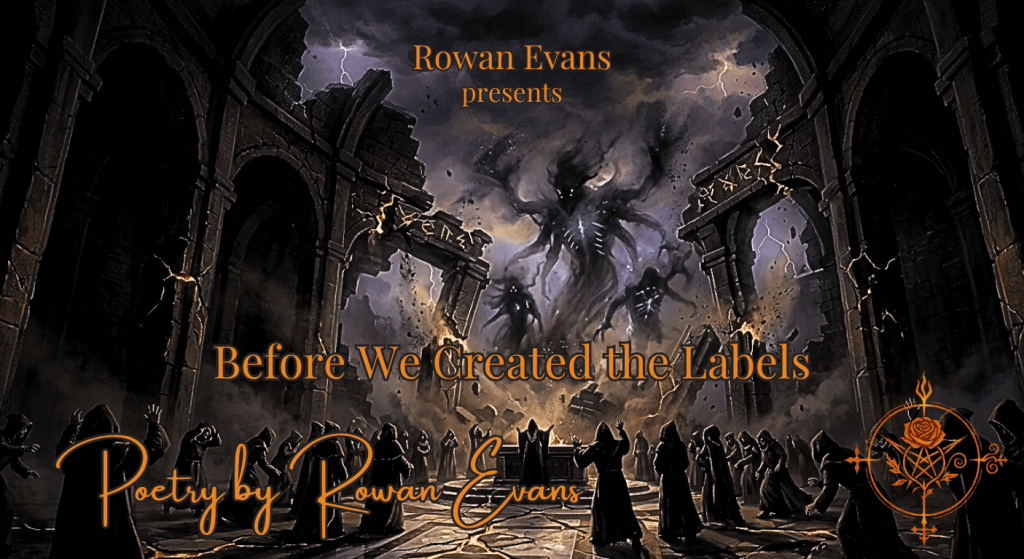
Before We Created the Labels
Poetry by Rowan Evans
Each footstep
echoed through the dark,
the only sound
to pierce the veil of silence.
One by one,
they filed into the room—
each taking their place,
as though they’d done this
a thousand times.
As the final of the covenant
found their mark—
they began to chant
in ancient tongues.
Languages of old,
long forgotten to the world.
The air in the room
began to change—
and it wasn’t humidity’s game.
A presence became clear,
even with no form to see.
Their chants continue
in a sacred chorus,
as they call
ancient gods forth.
Air shimmered
and walls shook,
foundation cracks—
and the air
grew thicker still.
Voices grew quiet,
the chanting fading low—
wood creaks,
cracks expand.
The room filled
with whispers,
voices from everywhere
and nowhere—
all at one time.
As the whispers
grew in volume,
becoming booming
shouts.
Buildings shook,
foundations shifted
and the ground
gives out.
Fear filled—
eyes of the covenant.
A ritual done
a thousand times,
and a thousand times
the gods would come—
a sacrifice would be made,
but the rules had changed.
The building
begins to come down,
as the covenant runs out.
Now, the gods unconfined—
can see the world
they left behind,
for the first time.
It wasn’t with judgement—
it was grief,
because they saw the cracks
and fractures,
the tragic divides.
They remember a time,
when their creation—
was all one.
Before we created
the labels to divide.
As they looked around
at what the world
had become—
a series of lines
separating sides.
Journey into the Hexverse…
[The Unkindness Descends]
“The Unkindness Descends” is a Gothic symbolic poem exploring collapse, transformation, and the unsettling experience of being witnessed during moments of unraveling. Through raven imagery, ambiguity, and ritualistic atmosphere, the poem invites multiple interpretations—spiritual, psychological, ominous, or transformative.
[I Write Cathedrals]
“I Write Cathedrals” explores faith, doubt, belonging, and the search for meaning beyond certainty. Through Gothic spiritual imagery and confessional reflection, the poem examines how writing can become a sacred space for questioning, wonder, and the people who feel displaced by traditional structures of belief.
[Drought Resistant]
“Drought Resistant” is a confessional poem about growing up poor in California’s Central Valley—where triple-digit heat, EBT cycles, dry ramen, and hard landscapes become part of emotional memory. Blending humor, slang, and working-class reflection, the poem explores survival, regional identity, and complicated love for the place that shaped you.
[Escaped to the Page]
“Escaped to the Page” is a confessional meta-poem about individuality, artistic identity, and surviving through writing. Blending sharp confidence with emotional vulnerability, the poem explores the difference between shared labels and lived experience—and the ways art becomes inseparable from the life behind it.
[Ink as a Second Mouth]
“Ink as a Second Mouth” explores the distance between thought and speech, and the ways writing can become a form of survival, continuity, and self-translation. Through confessional imagery and reflections on growth, identity, and articulation, the poem examines what it means to keep becoming through language.
If you’re interested in more poetry, you can find it here → [The Library of Ashes]