Some poems arrive carrying trauma, existential questions, complicated metaphors, and enough symbolism to fill a cathedral.
This one showed up carrying a fucking pun.
Hedge Funds (Not My Fun) is deliberately stupid. I wanted to play with sound, names, word associations, and the increasingly questionable logic of a joke that refuses to die. Sometimes the page doesn’t need another emotional excavation—it just needs to have a little fun.
So yes, this is a poem about hedge funds.
No, I don’t actually have any.
And apparently, neither does my fun.
— Rowan Evans
The hedge has funds. The funds aren’t mine. Therefore, the fun remains tragically unfunded.
Hedge Funds (Not My Fun) Poetry by Rowan Evans
I think I’m so fucking funny—
I’ll make a Big Pun,
while lookin’ like a Pimp
C—but you can’t see me,
like my name is John
and my time is now—
or at least, I hope it is.
Because I’m trying to get my funds up,
yeah, I want to get my fun up—
so I stack my funds
as high as my hedges—
get it?
Hedge Fund.
That means the money isn’t mine—
so I’m stacking some funds high,
they’re just not my funds, and—
because they’re not my funds,
they do not fund my fun, man.
Sometimes the loudest hater in the room is the one you brought with you.
Walk-A-Block in Flames started with the idea of imaginary critics—the voices that somehow manage to find fault with everything you do, even when nobody else is actually saying a damn thing. Naturally, my brain decided the appropriate response was to turn that internal conflict into a ridiculous walk around the block, throw in some wordplay, and see how many times I could make the joke work before the poem eventually turned the joke back on me.
Because beneath all the flames, bravado, and fake enemies, there’s a much simpler realization:
Sometimes the person I’m arguing with is me.
And honestly?
That’s probably the funniest part.
— Rowan Evans
Plot twist: the haters were imaginary, and unfortunately, they had my voice.
Walk-A-Block in Flames Poetry by Rowan Evans
They tell me,
these imaginary haters,
that I’ve fuckin’ created—
they live inside my head,
feeding on my self-doubt—
obsessed with burning the self-down.
They make me take a walk,
a walk around a block
and it’s fucking hot—
I guess you could say,
these imaginary haters made me,
Waka Flocka Flame.
Wait—
I meant to say—
these haters made me
Walk-A-Block In Flames.
Honestly though,
I don’t know
what the fuck
they hate me for—
Is it because my wrist froze?
Nope, I’m broke—
Because I’m the best to ever do it?
Nope, that’s a joke—
Is it because they say
the things I think about me?
Couldn’t be—
because I think I’m great,
and these haters are fake.
I mean literally fake,
figments—
they don’t exist,
it’s just me in this bitch.
Sometimes, the quietest person in the room has the loudest mind. Sometimes, the person who seems to have nothing to say is trying to sort through a thousand thoughts that never quite finish forming. And sometimes, when someone asks what’s wrong, the honest answer is both everything and nothing.
Everything and Nothing explores the contradictions that can exist within one person: being observant enough to notice everything while struggling to explain what’s happening inside, feeling surrounded by beauty yet sometimes seeing only the rot, and having the spark to create without always having the fuel to keep the fire burning.
But this isn’t a poem that wants to stay solemn. There’s a paradox wearing socks and Crocs, checking a five-dollar wristwatch, and wobbling through life with questionable coordination. Because humor has always had a place beside the heavier truths, and sometimes the absurdity is part of what makes those truths bearable.
I may wobble. I may lose my train of thought before it reaches the station. I may have days when everything feels wrong and days when I can’t explain why nothing seems wrong at all. But falling and wobbling aren’t the same thing.
And if there’s one thing this paradox knows, it’s how to keep wobbling.
— Rowan Evans
Everything is wrong. Nothing is wrong. The thoughts won’t land, the fire won’t always burn, and somehow this paradox keeps wobbling.
Everything and Nothing Poetry by Rowan Evans
When you meet me—
you’ll think I’m quiet.
I don’t say much,
I sit in silence,
with my mouth shut,
but my eyes are open—
watching, closely.
And when you talk to me—
you’ll wish I was quiet.
I’m way too observant—
I see too damn much,
and I hear just the same—
so don’t get mad at me,
when you get flamed.
But once you get to know me—
you’ll get scared when I’m quiet,
you’re suddenly afraid of my silence.
Because It carries weight,
everything I don’t say—
what’s wrong? You’ll wonder,
what’s on your mind?
You’ll find that it’s nothing—
mind’s blank, no thoughts in it.
But what’s wrong?
A lot.
It would take too long
to list every problem I’ve got.
I’m surrounded by beauty,
but sometimes all I see is rot—
lost my mind, where’d I put it?
I forgot—thoughts jammed,
so I missed the shot.
Thoughts move
but never get where they’re—
before another thought
cuts it off—
so it lands short,
missed the runway by a mile.
And that’s the part
that hurts the most—
when the spark is there,
but the fire is quiet.
The fuel is gone,
so you hope you don’t
have to reignite it.
So to answer your question,
what’s wrong?
Everything and nothing—
it’s in constant contradiction,
my existence—
I guess I’m just a paradox
in a pair of socks and crocs,
with a five dollar
Wal-Mart wristwatch.
But don’t worry—
I’m a weeble,
I wobble—
but I don’t fall down.
Journey into the Hexverse
[Through the Page] A heartfelt thank-you to everyone who has journeyed through the pages of Rowan Evans’s poetry. From ravens and monsters to raccoons in silk pajamas, this playful, multilingual poem celebrates the connection between poet and reader—and the meaning found in sharing one’s art.
[Thoughts of You Have Prime Real Estate] A playful romantic poem that turns the idea of someone “living rent-free in your head” into an entire neighborhood, where thoughts become homes—and one special thought gets the best property in town.
[A Person First] A poem about the difference between loving a woman and loving the role someone expects her to play—because partnership requires respect, autonomy, and room to remain a person first.
Sometimes the loudest critic in the room is the one living inside your own head.
Creative Whiplash (Pick A Lane!) is about the pressure to define yourself as a writer, choose a style, and stay neatly within its boundaries—even when your creativity refuses to cooperate. One moment, I’m writing gothic poetry; the next, I’m throwing punchlines, weaving mythology, or drawing battle lines with a pen.
And somewhere in the middle of all that, the inner critic starts screaming that nothing makes sense.
The funny part? Sometimes the poem proves the critic wrong before the critic even finishes complaining.
Maybe I don’t need to pick a lane. Maybe creativity was never meant to be a straight road.
— Rowan Evans
Pick a lane? I tried. My creativity took the exit, changed three times, and somehow wrote a poem about it.
Creative Whiplash (Pick A Lane!) Poetry by Rowan Evans
I asked you to show me a metaphor—
you asked, what’s the meta for?
You said you’re a writer, are you sure?
Because I’m not anymore—
run on sentence, run on lines,
zero flow and zero rhymes—
that’s how you write.
Ironic—
I just proved myself
wrong, right?
Well, sometimes I get in my head,
convince myself that nothing I write
is ever good enough—
and no one can call my bluff.
Isn’t that rough?
Pick a lane! Pick a lane!
Repeated, screaming in my brain—
are you a gothic poet,
or do you draw battle lines?
Do you weave myths,
or write comedic shit?
Pick a lane! Pick a lane!
Repeated, screaming in my brain—
giving readers whiplash
with how fast, I switch lanes—
it’s a pain in the neck,
creativity, hard to keep in check.
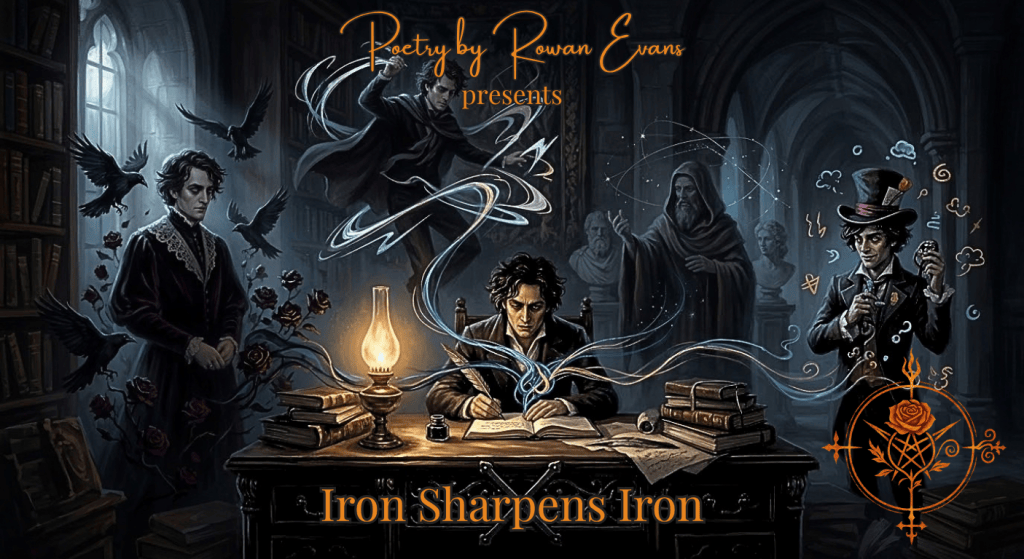
Iron Sharpens Iron is about what happens when every version of my creative mind sits down at the same table: the gothic romantic, the absurdist comic, the mythmaker, the battle-poet, the joke creator, and whatever other voice decides to kick the door open halfway through a line.
The notebook becomes the sparring ring. One thought throws a punch, another throws a punchline, and sometimes Batman apparently gets involved.
I don’t always plan where the thread is going. Sometimes I just follow it until the poem lands somewhere that makes sense.
Maybe that’s the point.
I don’t need to silence the contradictions. I need them to sharpen each other.
— Rowan Evans
I don’t silence the voices in my head. I let them sharpen each other.
Iron Sharpens Iron Poetry by Rowan Evans
I sit by myself— alone in body, crowded in mind— it’s a constant battle of wits, moon-fed goth kid versus the battle-poet turning pens to WMDs.
The notebook— just a test site, where I drop bombs. It’s constant— the scream of the alarms.
I write so much because my mind fights too much— a gothic romantic, an absurdist comic— opinions, opinions, too many opinions— constant contradictions.
Is this a joke?
Are the emotions sincere?
What the fuck— (Batman!) is that reference doing here?
That’s just how my mind is sometimes— I write a line and follow it, (Stalker.) I don’t plan it—I just follow the thread, guide the ship and land it. But sometimes I get lost— I’ll orbit the planet, or drift in my dreams— and they say to make the dreams work, it takes team work— well, I became my own team, every version of me.
Gothic romantic, absurdist comic, mythmaker, joke creator and professional hater— (Jokes. Love ya!) a battle-poet raised on battle rappers and comedians— how I learned to land a punchline, can’t fight with my fists— but can fight with my mind, and I do it all the time— with myself, I spar, iron sharpens iron, after all.
Journey into the Hexverse
[Blindfolded & Still Winning] A playful battle-poetry freestyle about shutting off the inner editor, letting instinct take over, and discovering that sometimes the pen writes best when you stop watching it.
[Literarily Speaking] They think silence means weakness. They should probably have paid more attention to the pen. Literarily Speaking turns gothic imagery, raven feathers, rose-petal ink, and absurd fictional geography into a playful battle-poetry flex about dismantling your enemies with words instead of hate.
[The Playground] What happens when mythology stops being something to hide behind and becomes architecture for the imagination? The Playground (Language, Metaphors and More) explores Rowan Evans’s relationship with language, symbolism, metaphor, humor, and twenty-three years of turning the page into a place where anything can happen.
What happens when you stop questioning the big questions and start questioning the stupid ones?
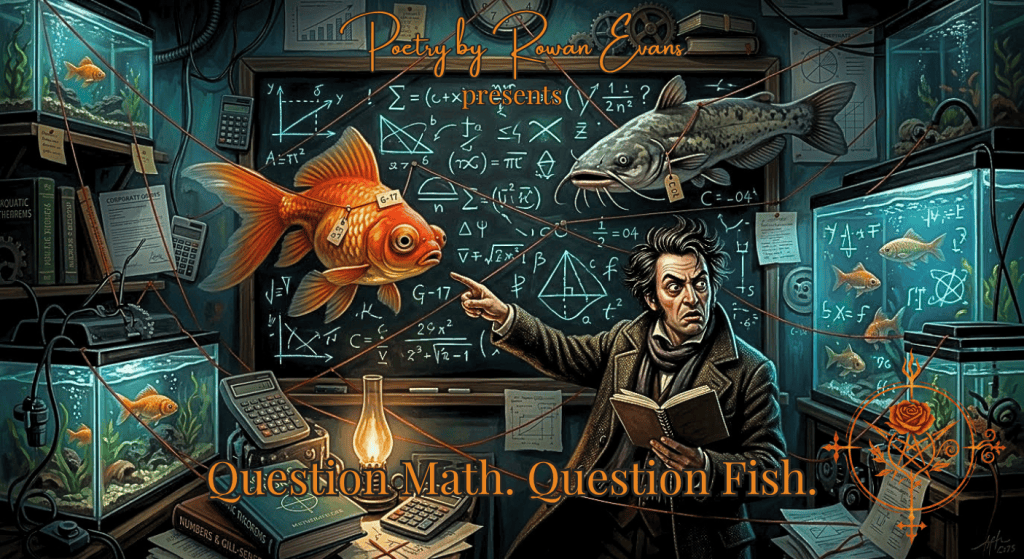
Question Math. Question Fish. takes a perfectly ordinary equation and refuses to leave it alone. Two plus two should be simple—but apparently we’ve got corporations, aquatic conspiracies, suspicious fish classifications, and an entire Aquarium Industrial Complex to investigate.
This piece is deliberately ridiculous. It borrows the language of conspiracy theories, institutional distrust, and “wake up, sheeple” rhetoric and points it directly at things that absolutely do not need a conspiracy theory.
Because maybe the joke isn’t whether two plus two equals four.
Maybe the joke is how quickly we can convince ourselves that anything deserves suspicion if we stare at it long enough.
So question the math.
Question the fish.
Question the catfish.
And, obviously, question everything.
— Rowan Evans
Two plus two equals four. The fish, however, remain under investigation.
Question Math. Question Fish. Poetry by Rowan Evans
Two plus two
equals four,
or does it?
You see—
Big Math
would have you
believe—
numbers mean something—
they don’t…
numbers are a joke.
A figment, imaginary at best—
two plus two might as well
equal goldfish.
And what’s a goldfish anyway?
Fish or gold, make up your mind—
and don’t get me started on catfish,
’cause what is this shit?
Cats don’t even like water.
Now one is a fish?
Get real, bitch.
Don’t listen to this shit—
Big Aquarium just tryin’ to get slick.
One fish, two fish—
red fish, blue fish—
these companies
are lying
to you, bitch.
And how does one fish—
become two fish?
And a red fish—
into a blue fish?
You wish.
It’s Big Math
and the Aquarium Industrial Complex
working together
to warp reality—
a fish isn’t gold,
a fish isn’t a cat—
but these people think that
we’re stupid,
we don’t see what they’re doing—
two plus two
equals four,
are you sure?
Open your eyes.
Wake up.
Think for yourself.
Question Math.
Question Fish.
Question.
Everything.
Journey into the Hexverse
[The Playground] What happens when mythology stops being something to hide behind and becomes architecture for the imagination? The Playground (Language, Metaphors and More) explores Rowan Evans’s relationship with language, symbolism, metaphor, humor, and twenty-three years of turning the page into a place where anything can happen.
[All for Me] When thunder becomes applause, lightning turns into paparazzi, and rain rolls out a flooded red carpet, one poet starts wondering whether nature’s celebration has gone a little too far.
[Love Me From Over There] A sharp and humorous poem about the strange contradiction of wanting someone close while simultaneously needing them to stay several feet away from your face.
[It’s Almost Like I Know What I’m Doing] A self-aware reflection on nearly three decades of writing, discovering how rage became rhythm, pain became poetry, and comedic timing became another tool in the poet’s arsenal.
Sometimes a poem arrives dressed like science fiction and refuses to stay in its genre.
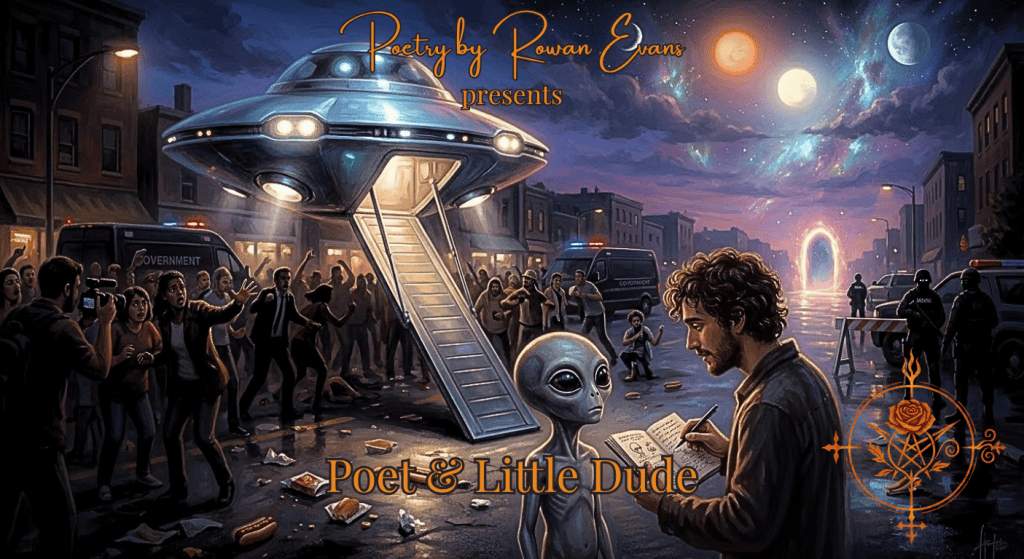
Poet & Little Dude began with the kind of ridiculous premise that feels perfectly reasonable at the time: an alien lands in an ordinary American city, everyone panics, and the poet is mostly annoyed by how long the spaceship ramp takes to come down. From there, Little Dude wandered into the story with jokes, questions, a questionable understanding of human customs, and absolutely no respect for the study guide.
But beneath the absurdity, something quieter started taking shape.
This is a story about being seen by someone who doesn’t need the entire explanation first. About two homes, two dusks, two dawns—and the strange ache of knowing that the place you’re standing in isn’t necessarily the place that feels like home.
So yes, there are aliens, government agents, hotdogs, Admiral Ackbar, an extended-warranty joke, and a very important distinction between a rabbit hole and a bunny void.
But somewhere underneath all that nonsense is Little Dude asking the poet the question that matters:
Do you want to go home?
— Rowan Evans
Sometimes the strangest visitor is the one who finally asks where you want to call home.
Poet & Little Dude Poetry by Rowan Evans
A silent hum in the sky above, a non-descript American city.
The kind of hum that settles in your bones before your mind catches up, the kind that says pay attention without making a sound.
Everyone looked up. I looked down at my notes. I’d seen enough movies to know this was either the beginning or the end.
Probably both.
People screamed. Cars stopped. Someone dropped a hotdog.
And me?
I sighed, closed my notebook, and muttered, “Well… guess it’s my turn again.”
I stopped at the edge of the crowd as the craft touched down.
A low buzzing cut through the air, and a ramp began to lower.
Slowly.
Excruciatingly slow.
I checked my watch. I tapped my foot. I wrote four stanzas, two sonnets—
and finished season one of Breaking Bad…
and the ramp was still lowering.
Hit the power button on my phone and locked it.
Slipped it back in my pocket— where my hands stayed.
A silent thud as the ramp FINALLY— hit the ground. The hollow echo of footsteps rang out.
A shadow stretched long— cascading down the ramp until it touched the dirt.
The crowd began to murmur before a voice rang out— “Take me to your leader!”
The crowd went silent. Only the footsteps echoing could be heard— nobody could see a thing at first—
“No, I’m just kidding. I’ve always want to say that.” The tiny grey alien stopped at the bottom of the ramp, slowly looking up—
Its large black eyes landing on mine.
“Sup?” I said with a slight nod of my head.
Its eyes closed for a moment—
“I’ve been trying to reach you about your cars extended warranty.” The alien’s mouth thins to a line as it tried to contain the giggles.
Pinching the bridge of my nose— I sighed.
“You didn’t follow the study guide—” I started, before little dude cut me off.
“I went down the bunny void.”
“Rabbit hole—” I corrected.
“What?” they asked confused.
I slowly get down on one knee, just like I had before—
“It’s a rabbit hole, when you follow a thread through seemingly unrelated topics.”
Little dude nodded. “I think I got it. But what about you, did you study the guide I gave too?”
I cleared my throat, tried to hide the choke. Should I lie— or hide it with a joke?
Nope.
“I did not.” I said, looking away.
Shaking their head, little dude laughs. “It’s okay, poet. You should read it though, you’ll love it, I know it.”
Stepping closer. Hand on mine.
“You’ll learn of green skies and purple lakes, twin suns and sister moons—
we get six hours of light, six hours of night. Twice.”
“Twin suns and sister moons?” I asked. “I can relate to that. That’s how my life has been, living under two suns— they’re really one. It’s two days in different places.”
Little dude tilted their head, then they said:
“No.”
A pause.
“Not two suns. It’s two homes. Two dusks, two dawns— one feels right, the other wrong.”
I turned my head, eyes glassy, tears steaming, as I opened my mouth to speak.
But the words evaded me. Little dude noticed quick.
“You’re leaking.” They said with concern.
“It’s human emotion, you’ll learn.” I said with a quivering lip, trying to hold it all in.
Our moment is interrupted by a scream from the forgotten crowd.
“Whoa,” little dude flinches in surprise. “Have they been here this whole time?”
Looking around— I saw the faces in the crowd. Some were scared, terrified— others confused and paranoid.
“It’s a trap!” a voice cut through the thick silence.
I sighed, not surprised— “calm down, Admiral Ackbar.”
The crowd lets out a collective scream— someone throws a shoe. It barely misses my head.
“What the hell?! Who threw that?” I yell.
“Was it you—” little dude pauses dramatically, their eyes focusing. “Admiral?”
Admiral Ackbar shakes his head. “N-no.” he stammers, as his heart hammers in his chest.
“The government…” the crowd began, the murmurs spread quick. “we’ve got to call the government. They’ll handle this— they’ll know what to do.”
Little Dude and I blink.
“Since when?” I asked, confused.
“Okay, okay— wait, let me introduce you. They’re not scary. They can show you.” I say, addressing the crowd.
The crowd begins to quiet down, their murmurs becoming a softer sound.
“This…” I gesture to the little dude beside me. “This is Little Dude. They’re not… from around here.”
“That’s one way to put it.” Little dude adds. “I’m from a little place called… another planet.” They make a vague gesture with their hands.
“Just another planet?” a voice from the crowd asks, shaking with fear. “No… no name?”
“Name’s pending. It’s actually been pending for a long time… a really long time. But that’s the government, right?” Little dude responds with a smile. “They’re slow.”
“Why are you naked?” another question from the crowd.
“Naked?” Little dude tilts their head. “Do you mean— why am I not wearing a second skin, like you?”
The crowd recoiled like Little Dude had just confessed to a federal crime.
“Second skin?” someone whispered, horrified.
Little Dude nodded earnestly.
“Yes. The fabric layer you all wear to hide your emotional temperature.”
I blinked.
“That’s… not why we wear clothes.”
Little Dude tilted their head, eyes wide.
“Then why do you wear them?”
A hundred humans froze, suddenly realizing they did not have a unified answer.
“We just like them.” I said, my voice lacking confidence.
Little dude shakes their head, “not important.” they said, “I’m not here for that,” they gesture to the crowd. “I’m not here for the them.”
Their big eyes, land on mine— “I’m here for you.”
Little Dude’s words hung in the air, heavy enough to silence a hundred humans, light enough to lift something in my chest.
The crowd didn’t know what to do with it. A few gasped. Someone dropped another hotdog.
(Why were there so many hotdogs?)
A woman near the front whispered, “Why him?” like I was a questionable menu item.
Little Dude squeezed my hand, their skin warm— warmer than I expected.
“Because you listened,” they said softly. “You always listen.”
I opened my mouth to respond— to say something clever, something deflective, something safe—
but the sky split open with the sound of sirens.
Government vans rolled in, black and boxy, like someone ordered “paranoia” on Amazon and selected same‑day delivery.
Agents poured out, all sunglasses and shouting, pointing weapons that hummed with the kind of energy that makes your bones nervous.
Little Dude blinked at them.
“Are these your leaders?”
I snorted. “God, no.”
The nearest agent yelled, “Step away from the entity!”
Little Dude tilted their head. “Entity?” They looked at me. “Is that a compliment?”
“Not really,” I whispered.
The agent repeated the command, louder this time, as if volume could fix confusion.
Little Dude stepped closer to me, their voice steady.
“I’m not here to harm. I’m not here to conquer. I’m not here to be studied.”
Their eyes locked on mine.
“I’m here because you’re lonely.”
My breath caught.
The crowd fell silent again, but this time for a different reason.
Little Dude continued, voice soft enough to feel like a hand on my cheek.
“You look at the sky like it’s a door. You write worlds you wish you could walk into. You build cathedrals for people who never stayed.”
They squeezed my hand.
“I came to stay.”
The agents shouted again, but their voices felt far away— like background noise in a movie I’d already seen.
Little Dude leaned in, their forehead touching mine.
“Poet,” they whispered, “do you want to go home?”
I swallowed hard.
“Which one?”
Little Dude smiled, eyes glowing faintly.
“The one you haven’t found yet.”
Journey into the Hexverse
[Beings from Beyond (Remix)] A 2026 remix of a poem first written in 2024, Beings from Beyond (Remix) returns to the mystery of unexplained lights, extraterrestrial possibilities, and humanity’s hunger for answers. The wonder remains—but the poet’s voice has become more focused on the search for truth itself.
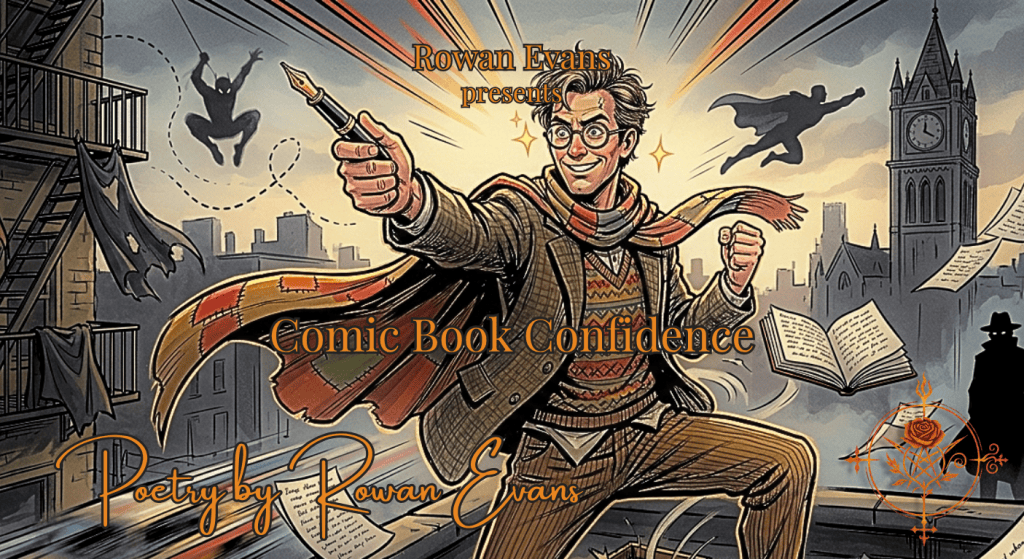
Comic Book Confidence is me asking a very important question:
What if I had superhero confidence without actually having superhero powers?
The answer, apparently, is several increasingly terrible decisions.
I wanted to play with the mythology of comic-book heroes—the wall-crawling, flying, super-speed, impossible confidence—and translate that into a deliberately ridiculous poetic narrative. Every time the speaker decides they must have discovered a new power, reality immediately provides a correction.
That’s what makes the piece fun for me. It’s not really about superheroes; it’s about confidence outrunning competence.
And maybe that’s something worth laughing at in ourselves sometimes. We imagine ourselves as Spider-Man, Superman, The Flash, Batman—and then gravity reminds us that we’re still just people.
So this is Battle Rowan in a different form:
No superpowers. No safety net. Just confidence, bad decisions, and a pen.
— Rowan Evans
Turns out confidence is a superpower. Unfortunately, gravity isn’t impressed.
Comic Book Confidence Poetry by Rowan Evans
Put glue on my hands,
and try to climb the walls—
yeah, tried to Spider-Man it.
Fell, got hurt, it was a curse—
goddamnit!
Okay, so that’s not the power I got
and honestly, I’m shocked—
Maybe I can fly? Maybe I’ll try,
sheet tied and I climbed, high—
from this vantage point I could see,
everyone looking like ants to me.
Took one step then up, up and away.
I jumped toward the summit—I Superman’d it.
For a second, thought I made it—
but really, I just—plummet.
Yes, there I was hurtling—
quick as shit toward the Earth,
oh man, this is gonna hurt,
just as soon as I hit the dirt.
Oof, cough, wheeze—
that was me trying to breathe.
I had hit chest first,
knocked the air out of me—
I struggled to my feet,
stumbling into a jog—
like I had somewhere to be,
and someone to meet—
but I just had to run it off,
Barry Allen, vibrating through a wall—
or nah—
smashed my head, I’m wobblin’—
vision blurred, words slurred,
delusion settin’ in—now I think I’m Batman
and I’m Robin.
Journey into the Hexverse…
[Kaio-ken with a Pen/Zenkai] Two Dragon Ball-inspired battle poems about creative power, survival, and coming back stronger. Kaio-ken with a Pen brings the attack, while Zenkai (Stronger Now) delivers the aftermath: push me to the edge, and I’ll return stronger than before.
[The Inkbender] What if poetry was another form of bending? The Inkbender transforms the philosophies of Avatar: The Last Airbender into a celebration of language, creativity, rage, healing, and the power of the written word.
Sometimes I genuinely wonder what happens when I give my brain permission to write whatever it wants.
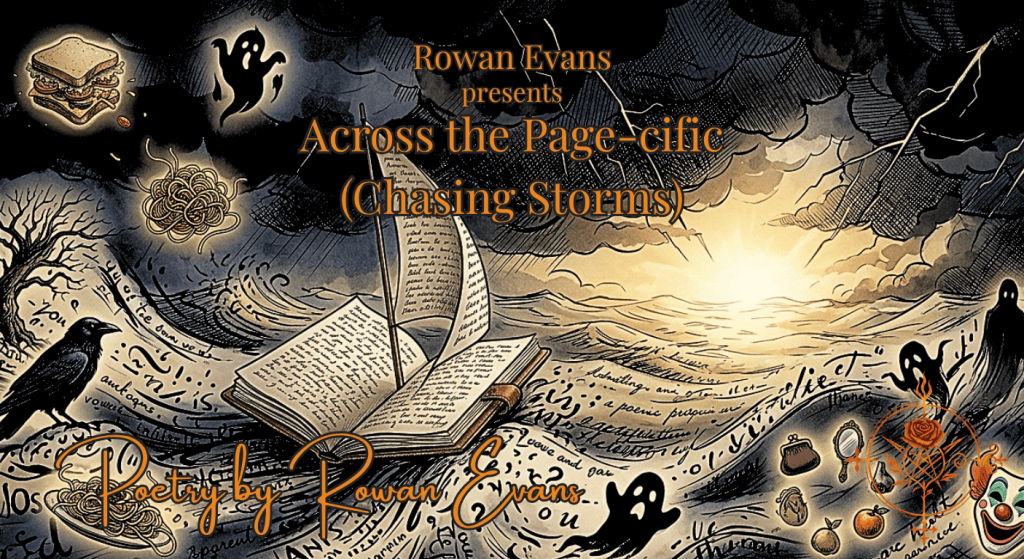
The answer, apparently, is sandwiches, pasta, farmers on Pluto, raccoons in silk pajamas, llamas, trees, cartoon ghosts, monsters, seven deadly sins, and a journey across an ocean that does not technically exist.
And honestly?
I love it.
Across the Page-cific (Chasing Storms) is a celebration of the strange places my writing can go when I stop trying to force it into a single shape.
This poem deliberately references several of my recent pieces and recurring worlds. The sandwich wordplay comes from Lost in the Sauce. The pasta-based literary assault comes from Impasta (A Diss in Pasta Form). The trees point back to my playful botanical wordplay, while Danny Phantom, the Monster in the Margins, the Seven Deadly Sonnets, ravens, spirits, and other imagery come from the larger mythology and vocabulary I’ve been building throughout my work.
The references aren’t just Easter eggs.
They’re evidence.
Evidence of how much my writing has changed—and how much more willing I am now to let different parts of my voice coexist.
For a long time, I thought I needed to choose what kind of writer I was supposed to be.
Gothic poet.
Confessional poet.
Love poet.
Dark poet.
Funny poet.
Experimental poet.
But the more I write, the less interested I am in choosing.
I want to write the heartbreak poem with sandwich ingredients.
I want Tony Stanza to write a pasta diss.
I want to turn mythology into autobiography.
I want to write about ghosts and gods, then turn around and make a terrible pun.
I want to chase a metaphor until it becomes absurd.
And then, underneath all of it, I want to find something honest.
That is what the storms in this poem represent.
The chaotic lines.
The sudden cadence changes.
The ideas that arrive from nowhere.
The parts of my mind that refuse to walk in a straight line.
I used to think I needed to calm those storms down.
Now?
I chase them.
Because writing has become a playground again.
And somewhere in that playground, I keep finding pieces of myself I hadn’t finished discovering.
“It was writing that saved me” is therefore not a throwaway line.
Writing gave me a language for experiences I couldn’t always explain directly. It gave me somewhere to put the contradictions, the humor, the darkness, the questions, the love, the anger, the absurdity, and everything else that makes up the person behind the pen.
Piece by piece.
Bit by bit.
I rebuilt myself in the art.
And apparently, sometimes that art looks like a sandwich, a bowl of pasta, and a storm on the Pacific.
I’ll take it.
— Rowan Evans
I stopped trying to avoid the storms. I started chasing them across the page.
Across the Page-cific (Chasing Storms) Poetry by Rowan Evans
Let’s see, what other ridiculous thing
can we turn into poetry—
I’ve written a heartbreak poem
using sandwich ingredients,
and wrote a diss poem
using nothing but pasta noodles—
was a farmer on Pluto,
witnessed raccoons in silk pajamas
perched on the backs of llamas—
while I shaped love poems
out of the trees—
I’ve turned Danny Phantom
into religion—a whole faith
on “going ghost”—
but really it’s just me stuck
between worlds.
I’ve written as the monster in the margins
and the spirits in the room—
seven sins that act like tax on the soul.
Go against the monster, you won’t leave whole.
Feeling like Pennywise, grin wide,
’cause I’m a clown in my rhymes
sometimes—
I’ve taken trips
in ink-dipped ships
across the page-cific—
avoiding storms of chaotic lines
and jagged rhymes
with sudden cadence changes.
Just kidding—
I chased the storms across the page,
embraced the pace my brain gave.
It was writing that saved me—
it gave me a way to translate me,
piece by piece and bit by bit,
I rebuilt myself in the art of lit—
where a mind like mine appears rarely.
Journey into the Hexverse…
[Lost in the Sauce] A playful heartbreak poem where sandwiches, ketchup, mustard, rye, lettuce, and sourdough become metaphors for emotional confusion. Beneath the food puns is a speaker trying to understand how everything went from “we’re okay” to suddenly feeling cold.
[Impasta] Tony Stanza is back with another literary attack—and this time, he’s bringing pasta. Spaghetti, fettuccine, macaroni, ravioli, and angel hair become weapons in a ridiculous diss aimed at a poet whose rhymes are allegedly cheesy, fragile, and completely impasta.
[Pluto Farmer] A whimsical absurdist poem about being a certified weirdo, farming space carrots on Pluto, and refusing to fit into anyone else’s definition of “normal.”
[Raccoons in Silk Pajamas] What begins with judgmental Space Chickens quickly spirals into camels in parked cars, elephants in jam jars, raccoons in silk pajamas, and astronauts in the ocean. A playful absurdist poem about language, imagination, and what happens when you stop trying to control where the words go.
[Did You Really Think This Was About Trees?] A playful love poem disguised as a forest of terrible tree puns. Beneath the birch, oak, cedar, palms, lumber, and absurdist wordplay is a poem about devotion, loyalty, laughter, and building a life with someone you love.
[Danny Phantom Theology] What begins as a metaphor borrowed from a childhood cartoon becomes something deeper: a reflection on existing between survival and possibility, exhaustion and hope, the life we have and the life we long for. Danny Phantom Theology explores what it means to keep moving toward a future that feels worth living.
[The Monster in the Margins II] The Monster in the Margins II transforms Rowan Evans’s Seven Deadly Sins mythology into a horror story written between the lines, where Lust, Wrath, Sloth, Greed, Pride, Envy, and Gluttony become monsters growing from pain, grudges, and scars.
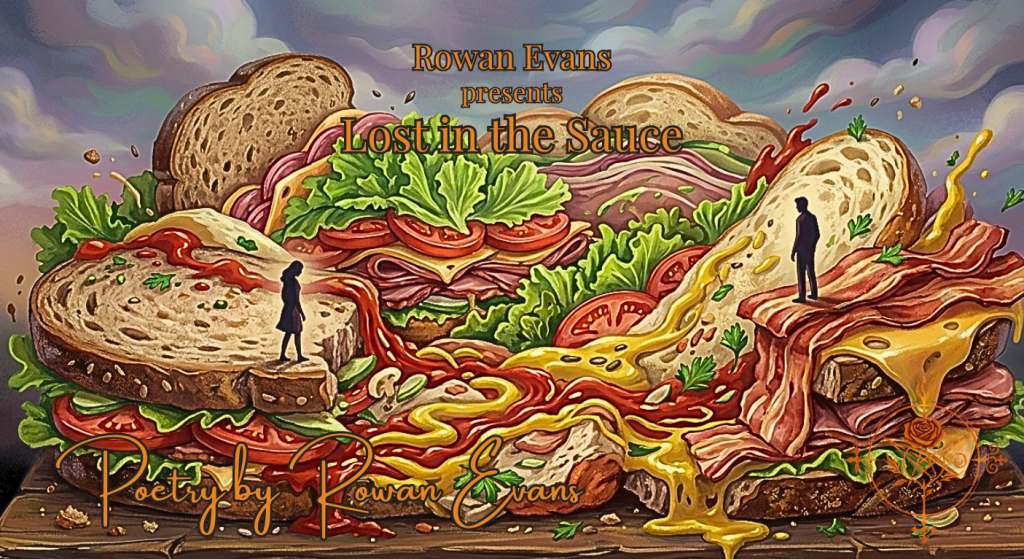
And sometimes my brain apparently looks at a sandwich and says, yes, this is how we’re processing emotional confusion today.
Lost in the Sauce is a deliberately playful poem built around food-related wordplay, particularly the language of sandwiches, condiments, bread, and the wonderfully terrible possibilities hidden inside them.
The jokes are intentionally stupid.
That is part of the point.
“Bread” becomes “rye.” “Ketchup” becomes “catch up.” “Mustard” becomes “must’ve.” “Sourdough” becomes an emotional description. Even “lettuce meat in the middle” is doing multiple jobs at once.
But beneath all of that nonsense is something much more familiar: the confusion of being told that everything is okay while someone’s behavior feels completely different.
The speaker is trying to understand the contradiction.
They were told the relationship was fine.
They were told the other person was happy.
So why does everything suddenly feel cold?
Why does affection feel sour?
Why does the speaker feel trapped in place, struggling to catch up to something they don’t fully understand?
The ridiculous wordplay gives me permission to approach that emotional confusion without making the poem overly solemn.
I’ve been rediscovering how much I enjoy treating language like a playground—taking ordinary words, twisting them until they become something else, and seeing how far I can push a joke before the emotional meaning underneath it starts showing through.
So yes, this poem is about sandwiches.
Sort of.
Mostly, it’s about being lost in the sauce when the person you’re trying to understand has already changed the recipe.
— Rowan Evans
Sometimes you don’t fall apart. Sometimes you just get lost in the sauce. 🥪
Lost in the Sauce Poetry by Rowan Evans
You sandwiched me in
with an all-tomato—
love you or leave,
but I couldn’t do it clean—
I was lost in the sauce,
begging lettuce
meat in the middle.
You said, “you lie.”
I said, “Nah, you rye.”
But do you know why?
I was stuck in place,
you wouldn’t wait—
I was struggling
to ketchup.
I thought you
mustard—
how could you not?
People talk.
Look—
I’m sorry.
I don’t want to fight.
But, you said—
you were happy.
We were okay.
So why you so cold,
why you actin’ sourdough?
Journey into the Hexverse…
[Did You Really Think This Was About Trees?] A playful love poem disguised as a forest of terrible tree puns. Beneath the birch, oak, cedar, palms, lumber, and absurdist wordplay is a poem about devotion, loyalty, laughter, and building a life with someone you love.
[Blended Hardware] A playful, absurdist poem where step-ladders, garden hoses, Star Wars, teenage memories, Gothic imagery, and the poet’s own self-interrupting commentary collide. Blended Hardware is a celebration of letting language wander.