Some poems arrive carrying trauma, existential questions, complicated metaphors, and enough symbolism to fill a cathedral.
This one showed up carrying a fucking pun.
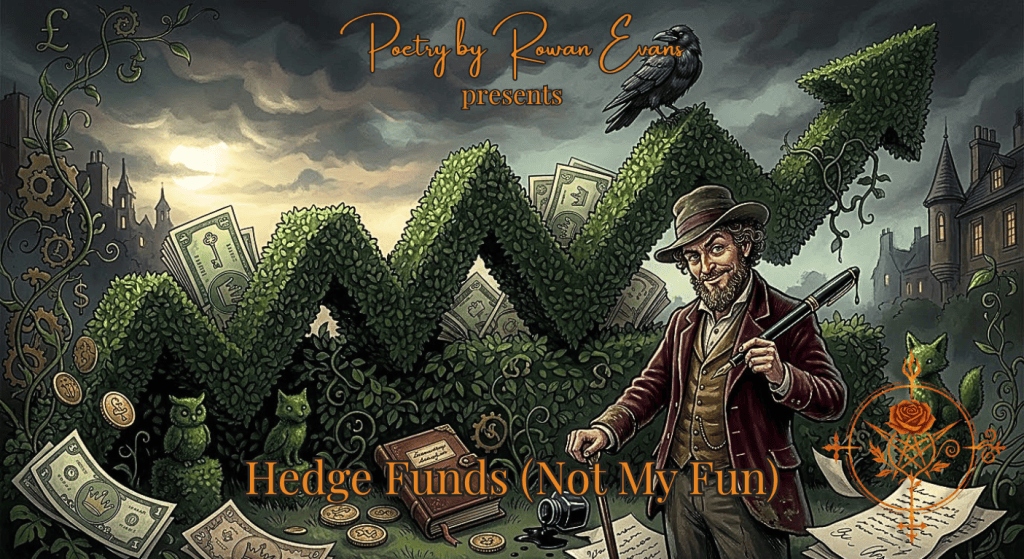
Hedge Funds (Not My Fun) is deliberately stupid. I wanted to play with sound, names, word associations, and the increasingly questionable logic of a joke that refuses to die. Sometimes the page doesn’t need another emotional excavation—it just needs to have a little fun.
So yes, this is a poem about hedge funds.
No, I don’t actually have any.
And apparently, neither does my fun.
— Rowan Evans
The hedge has funds. The funds aren’t mine. Therefore, the fun remains tragically unfunded.
Hedge Funds (Not My Fun) Poetry by Rowan Evans
I think I’m so fucking funny—
I’ll make a Big Pun,
while lookin’ like a Pimp
C—but you can’t see me,
like my name is John
and my time is now—
or at least, I hope it is.
Because I’m trying to get my funds up,
yeah, I want to get my fun up—
so I stack my funds
as high as my hedges—
get it?
Hedge Fund.
That means the money isn’t mine—
so I’m stacking some funds high,
they’re just not my funds, and—
because they’re not my funds,
they do not fund my fun, man.
Some writers pick up a pen. Others discover they’ve accidentally assembled an entire mutant power set.
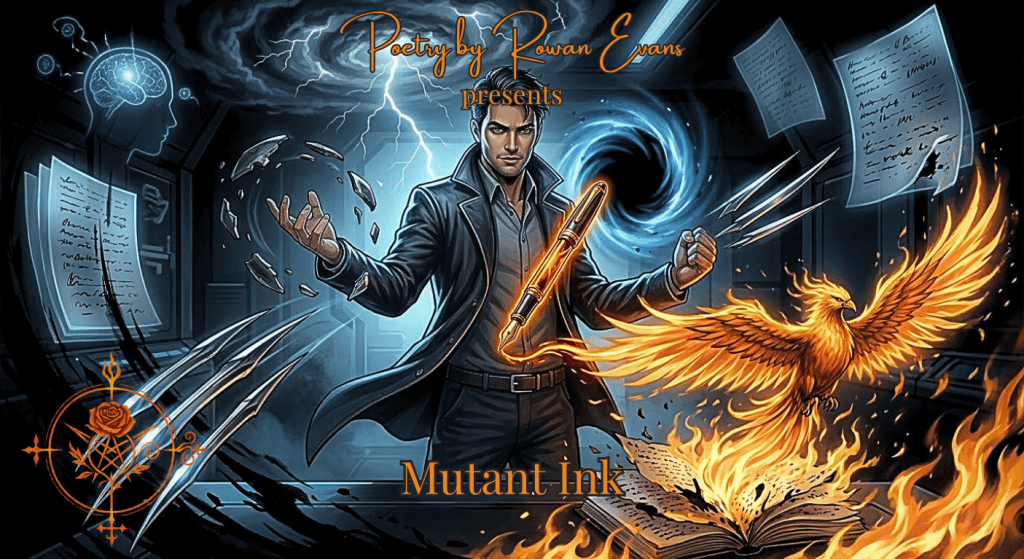
Mutant Ink is my love letter to the X-Men universe, where every ability becomes another way to bend language, twist expectations, and leave a mark on the page. From mind-reading and magnetic control to teleportation, razor-sharp claws, and storms summoned through rhyme, this poem turns familiar mutant powers into weapons of wordplay. The references are playful, the bars are sharp, and the name-drops are absolutely intentional.
But beneath the comic-book chaos is something that reaches beyond fandom. Creativity is its own kind of evolution. Sometimes a line needs to be dismantled, a verse needs to burn, and an entire draft needs to die before something better can rise in its place.
That’s where Phoenix comes in.
Because the goal isn’t simply to write another poem. It’s to become something more through the act of writing it. Every revision, every failure, every spark that refuses to die becomes part of the next transformation.
Call it mutation. Call it ascension. Call it poetic evolution.
Just don’t stand too close when the ink catches fire.
— Rowan Evans
Sharp lines. Mutant powers. Burning ink. Sometimes the poem has to die before the Phoenix can rise.
Mutant Ink Poetry by Rowan Evans
I’m not Walken, my name’s not Christopher— I’m stuck in the chair, like my name’s Xavier— reading your thoughts displayed on the page— ink laid—I bend bars, the way Magneto does.
And my mind is sharp, like my lines are, It’s Snikt!— every time I write bars, words so sharp— they’ll cut and leave scars.
BAMF! That’s not a sound effect, that’s just what they call me. BAMF! I never left, no other dimension, I’m still here, you’re trippin’. They say it’s teleportation— I say misdirection— look away for one second, now I’m somewhere else in the sentence—
I ink storms, and that’s why I always start with the dryline. I’ll hit you with cyclonic rhymes from a twisted mind— do you know what happens when a Toad gets struck by lightning? The same thing that happens to everything else—
and the sky turns Grey, it’s usually blue as my Jeans are. But that’s what happens when Summers mix with Frost— turn the heat up, Hellfire Club.
When the heat gets too high, I don’t break— I burn. Call it evolution, call it ascension, call it the moment every line catches fire at once—
I go full Phoenix, rising out the rhyme scheme, feathers made of flame, every word a rebirth— because sometimes the only way to finish a poem is to let it die— and rise again, stronger.
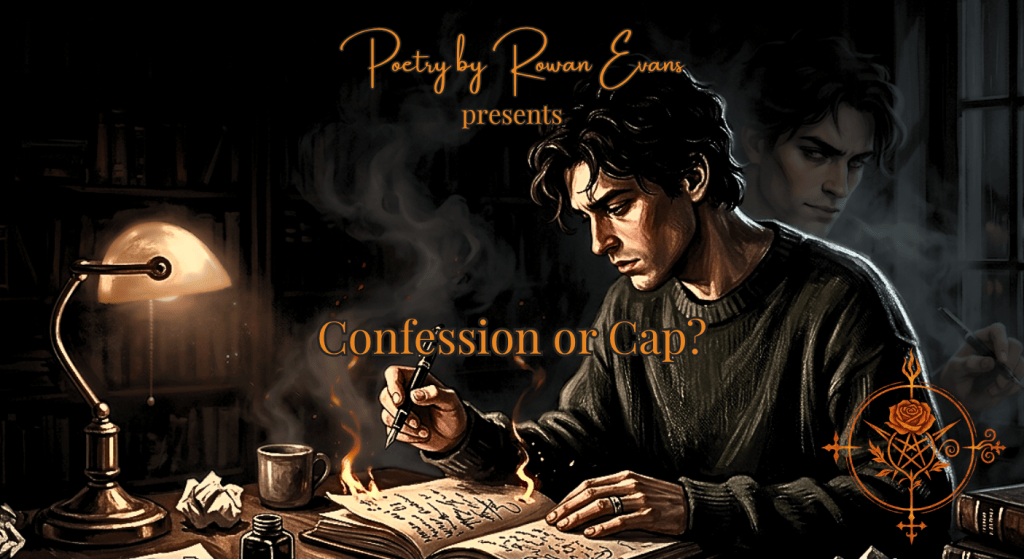
I’ve always had a complicated relationship with the voice that comes through my pen.
Sometimes it tells the truth. Sometimes it exaggerates. Sometimes it gets a little too comfortable talking shit.
And sometimes I genuinely can’t tell where one ends and the other begins.
So before you read this one, there’s really only one question worth asking:
Is it confession—or cap?
— Rowan Evans
Sometimes the pen tells the truth. Sometimes it talks shit. Sometimes it does both.
Confession or Cap? Poetry by Rowan Evans
Ask anyone and they’ll tell you— I’m nice and that’s true, but my pen can be mean when it speaks— so when I write, you’ve gotta ask— is it confession—
or am I just talking my shit again?
I’ve dissed other poets before— said they were boring, put me to sleep and called them all Watson— because their rhymes were elementary. So when you say I’m great?
No shit, Sherlock.
I’ve written the copies of copies, and the copies that copied that—
inspired less by poets and more by rap—
that’s why when my pen gets hot, I don’t know how to stop— so I pen fire and burn my hands, (ouch!) what am I sayin’? Everything I drop—
Flames.
Journey into the Hexverse
[Fine, Fire It Is] A playful poem about abandoning an ice metaphor, getting carried away with fire, and discovering that sometimes the best description of a poet’s pen is something that refuses to cool down.
[Exhibit A] A quick-witted, unapologetically playful poem about writing fast, crossing lines, roasting the competition, and letting rhythm do the talking.
[Why So Serious?] A playful, chaotic poem packed with pop-culture references, superhero imagery, Disney characters, wordplay, and the kind of ridiculous puns that make the poet wonder why they were ever given a pen.
[Welcome to the Hexverse] Step into the Hexverse—a poetic world where mythmaking, humor, rage, creativity, and confession collide, and darkness becomes something that can be reshaped into art.
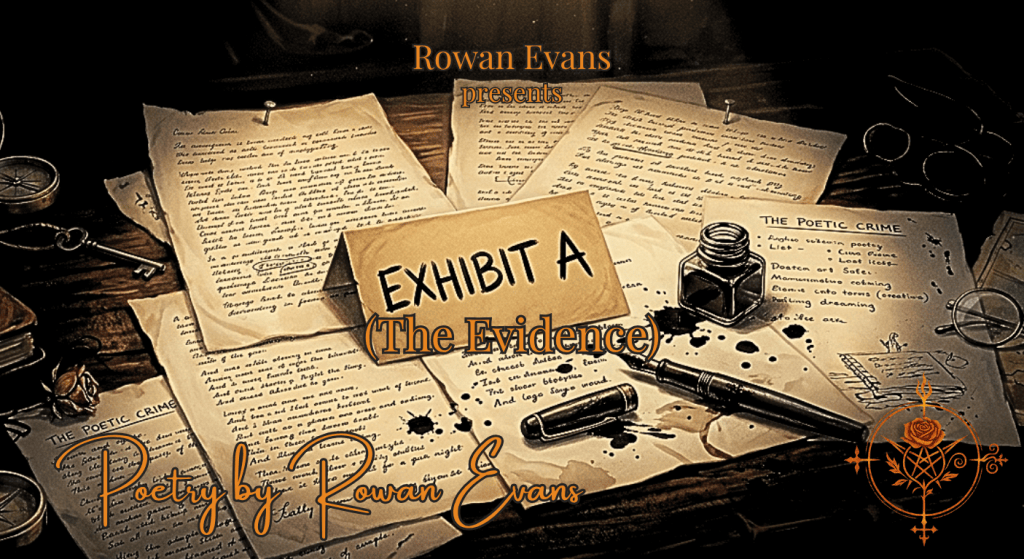
This piece is me doing what I do best: writing too fast, joking too much, and letting the pen cross whatever line happens to be in the way.
It’s cocky. It’s playful. It knows exactly how ridiculous it is.
So consider this less of a confession and more of an exhibit.
The evidence is right there on the page.
— Rowan Evans
Exhibit A: The evidence speaks for itself.
Exhibit A (The Evidence) Poetry by Rowan Evans
I write so quick
and joke a bit.
I’m quick-witted—
enough to roast a bitch.
Down to earth,
enough to toast a bitch.
I’m on a roll,
like butter is—
spread thin
across genres,
but still
the cadence hits—
because that’s
where the rhythm lives.
You think I’m joking—
but I really write like this,
take this piece—
it’s the evidence.
Exhibit A on a list to—
these other poets
don’t exist to me.
When I read their work—
it’s straight Zs,
it puts me to sleep.
My mind is too quick,
and I don’t know
where the line is—
I’m always crossing it.
That’s what gets me
in trouble, yeah—
so I just double-down.
I’m already in trouble,
so why stop now?
Journey into the Hexverse
[Welcome to the Hexverse] Step into the Hexverse—a poetic world where mythmaking, humor, rage, creativity, and confession collide, and darkness becomes something that can be reshaped into art.
[Circle of Me] A reflective poem about sitting among the voices of memory, joy, pain, and fear—and realizing that some burdens are bigger than any one person.
[High Tide] A short reflective poem about leaving, returning, and accepting the forces that pull us back—like the tide guided by the moon.
This one arrived with a bunch of fictional characters, a handful of terrible puns, and apparently no intention of behaving itself.
So, before you read too seriously into it, consider this your invitation to just have fun with it. It’s a little chaotic, a little nerdy, and very much written with a grin behind the pen.
Welcome to the nonsense.
— Rowan Evans
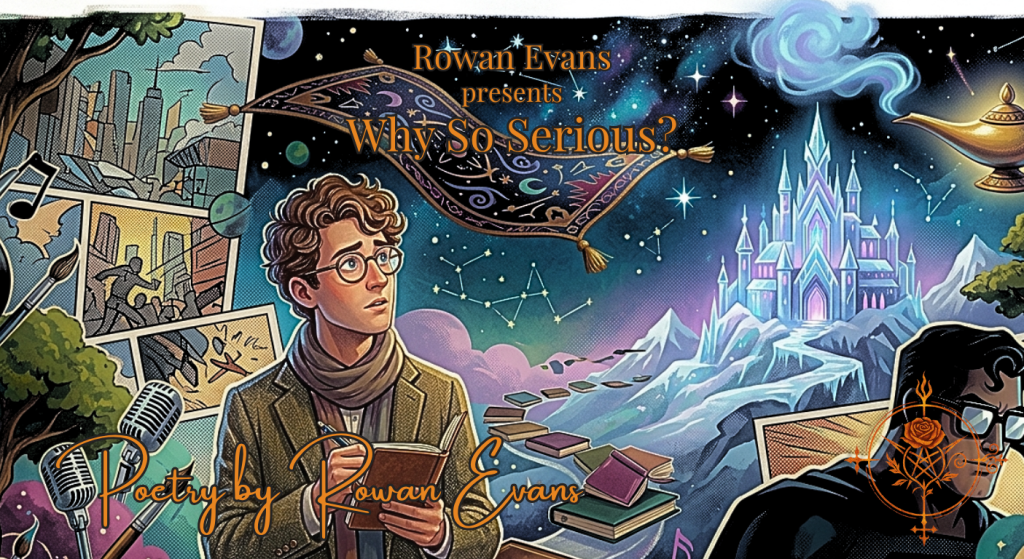
Sometimes the hero’s journey is just an excuse to make terrible puns.
Why So Serious? Poetry by Rowan Evans
I must be Aladdin—
because my Jasmine
is so Jafar away.
Three wishes from Genie
trying to get to her,
you say that’s a waste—
but what Elsa am I to do?
I am on the move,
magic carpet ride—
and I can’t let it go,
I’m already Anna the way.
I guess you can say
this is my hero’s journey—
head in the clouds,
my feet not on the ground—
I had a joke to put here,
but it would Neverland—
I hope I stay young forever,
like Peter Pan…
I’m a Skywalker, like Luke—
I’m a Leia down the truth,
I’m not a rapper, my pen is—
the page is my booth.
When I step in, glasses come off—
Clark Kent is gone, it’s Superman to you.
There are poems where I sit down with a very serious idea and carefully shape every word.
This isn’t one of those poems.
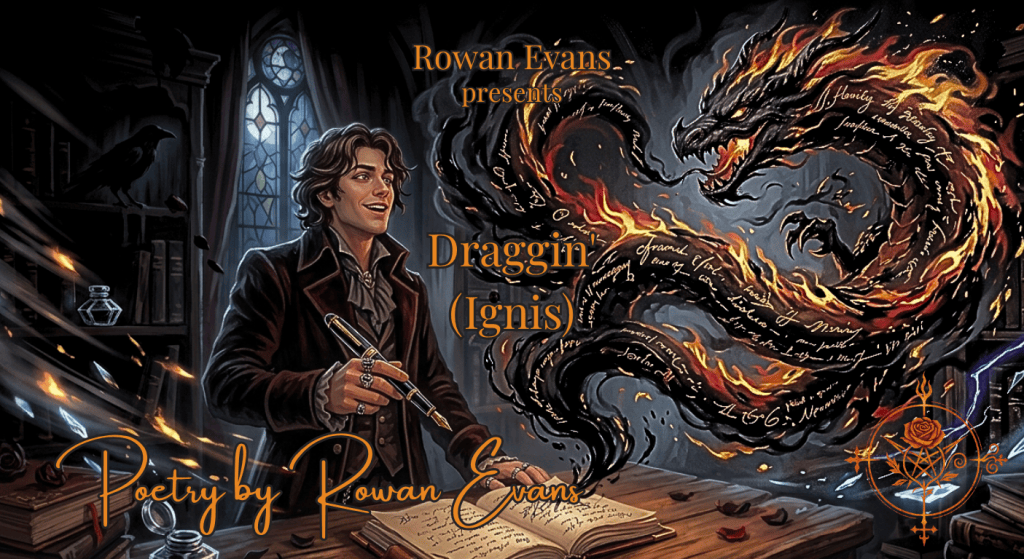
Draggin’ (Ignis) is me letting the pen run loose, throwing references at the page, flexing a little, and then immediately making fun of myself for doing it. It’s playful bravado with a gothic streak, a little battle-rap energy, and absolutely no intention of pretending I’m cooler than I am.
Twenty-three years of writing will do strange things to a poet.
Apparently, it makes them compare themselves to dragons, superheroes, and Pokémon-level fire hazards.
Enjoy the chaos.
— Rowan Evans
Twenty-three years of writing and this is what the pen decided to do with all that experience.
Draggin’ (Ignis) Poetry by Rowan Evans
Twenty-three years, I’ve been doing this
with craft in my veins and trauma in my brain—
I’ve really been through some shit.
Maybe that’s why I write so ruthless—
if I spit a diss, it’d be ignis—I’d be draggin’ you,
but I’m nice, so I’m a dragon like Toothless.
This is stupid, silly, dumb—
I can’t take me serious, and this is how come.
Yeah, these might be jokes—
but I’m cold, Bobby Drake,
so shut your mouth
before I turn your girl into a—
Dragon Rider…
That kind of killed the rhyme,
that’s fine—
here’s a few more lines…
I’m too quick-witted—
pen faster than Flash,
I’m too quick wit’ it
when I write lines
to silence critics.
I’ve been writing for years,
double digits—
two followed by the number
that comes next—
I’m not even trying to flex,
this is just me writing facts.
Journey into the Hexverse
[Behind These Bars (Idol Chatter)] A playful battle-poetry piece where confidence, wordplay, pop-culture references, and a sharp pen collide. Behind These Bars (Idol Chatter) turns verbal sparring into a ridiculous little poetry showdown.
[Kaio-ken/Zenkai] Two Dragon Ball-inspired battle poems about creative power, survival, and coming back stronger. Kaio-ken with a Pen brings the attack, while Zenkai (Stronger Now) delivers the aftermath: push me to the edge, and I’ll return stronger than before.
[Don’t Push Me] A playful battle-poetry piece about turning insults into punchlines, standing your ground, and refusing to be intimidated. Don’t Push Me mixes swagger, humor, rhyme, and Rowan Evans’ signature self-aware interruptions.
[B.S.T.F.U.] A playful battle-poetry exercise packed with insults, internal rhymes, punchlines, wordplay, and literary swagger. B.S.T.F.U. is Rowan Evans flexing the verbal muscles—not calling out anyone in particular.
Sometimes I sit down with a pen and decide I’m going to behave.
That usually lasts about three lines.
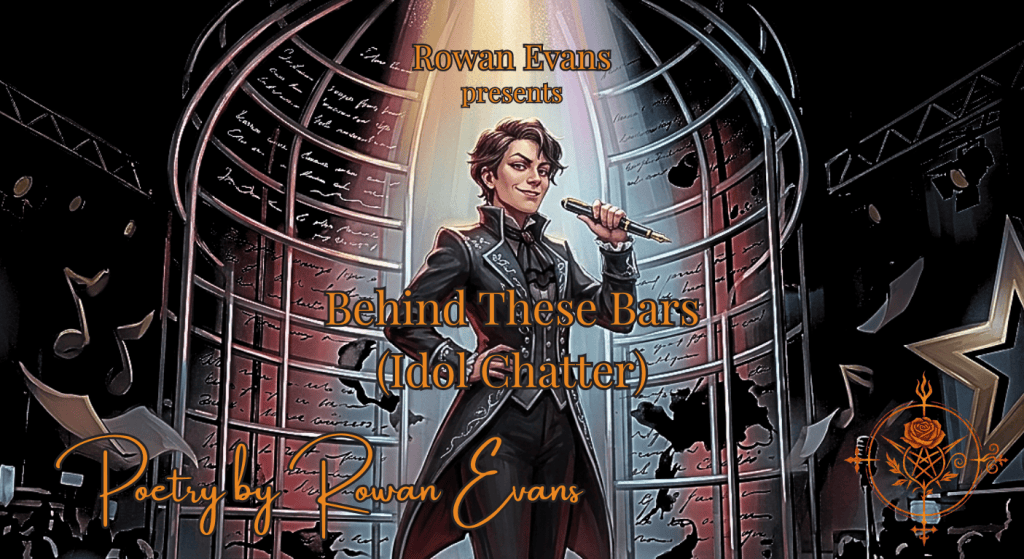
Behind These Bars (Idol Chatter) is one of those pieces where the writing gets a little cocky, the jokes start stacking up, and the references begin sneaking through the cracks. It’s playful, competitive, and intentionally ridiculous in places.
So consider this a little verbal sparring session.
No hard feelings.
Probably.
— Rowan Evans
The meet-and-greet is over. The pen has entered the battle.
Behind These Bars (Idol Chatter) Poetry by Rowan Evans
Oh, look at you— look what you can do with a pen—it’s cute, but you can’t win— yet you think you can?
Damn, man— what was your plan? How were you going to get the best of me?
Get in line— get ready for the meet and greet, I’ll sign your autograph, cause I—
I know I’m your Idol, American, shape the ink like clay, ’til it’s achin’— I’m Stronger now, and not Because Of You, so listen quick, remember bitch, you’ll want to remember where you were at during A Moment Like This—
that was three straight references to Clarkson, Kelly— sit down, talk show, telly. It’s just jokes bitch, I can get silly— that’s just how the mind Behind These Hazel Eyes works—
jerks.
Journey into the Hexverse…
[Conductor] A dark, intimate poem about the strange power words can have over the reader—where rhythm, rhyme, and line breaks become instruments capable of reaching beyond the page.
[Kaio-ken/Zenkai] Two Dragon Ball-inspired battle poems about creative power, survival, and coming back stronger. Kaio-ken with a Pen brings the attack, while Zenkai (Stronger Now) delivers the aftermath: push me to the edge, and I’ll return stronger than before.
[Don’t Push Me] A playful battle-poetry piece about turning insults into punchlines, standing your ground, and refusing to be intimidated. Don’t Push Me mixes swagger, humor, rhyme, and Rowan Evans’ signature self-aware interruptions.
[B.S.T.F.U.] A playful battle-poetry exercise packed with insults, internal rhymes, punchlines, wordplay, and literary swagger. B.S.T.F.U. is Rowan Evans flexing the verbal muscles—not calling out anyone in particular.
Sometimes absence isn’t just being alone. Sometimes it feels like having no body at all.
Nobody² (No Body) Poetry by Rowan Evans
I’m a nobody,
I’ve got nobody.
I’m just a ghost—
I’ve got no body.
[Rose & Ruin] Two minimalist poems exploring the opposing forces within creativity: the thoughts we cultivate into something beautiful and the darker thoughts we transform before they have a chance to decay.
[Conductor] A dark, intimate poem about the strange power words can have over the reader—where rhythm, rhyme, and line breaks become instruments capable of reaching beyond the page.
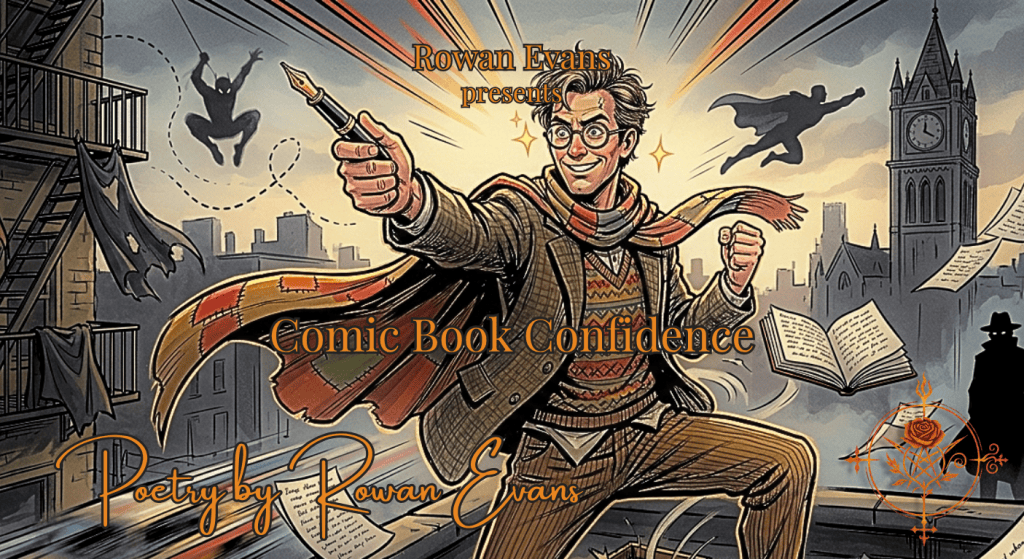
Comic Book Confidence is me asking a very important question:
What if I had superhero confidence without actually having superhero powers?
The answer, apparently, is several increasingly terrible decisions.
I wanted to play with the mythology of comic-book heroes—the wall-crawling, flying, super-speed, impossible confidence—and translate that into a deliberately ridiculous poetic narrative. Every time the speaker decides they must have discovered a new power, reality immediately provides a correction.
That’s what makes the piece fun for me. It’s not really about superheroes; it’s about confidence outrunning competence.
And maybe that’s something worth laughing at in ourselves sometimes. We imagine ourselves as Spider-Man, Superman, The Flash, Batman—and then gravity reminds us that we’re still just people.
So this is Battle Rowan in a different form:
No superpowers. No safety net. Just confidence, bad decisions, and a pen.
— Rowan Evans
Turns out confidence is a superpower. Unfortunately, gravity isn’t impressed.
Comic Book Confidence Poetry by Rowan Evans
Put glue on my hands,
and try to climb the walls—
yeah, tried to Spider-Man it.
Fell, got hurt, it was a curse—
goddamnit!
Okay, so that’s not the power I got
and honestly, I’m shocked—
Maybe I can fly? Maybe I’ll try,
sheet tied and I climbed, high—
from this vantage point I could see,
everyone looking like ants to me.
Took one step then up, up and away.
I jumped toward the summit—I Superman’d it.
For a second, thought I made it—
but really, I just—plummet.
Yes, there I was hurtling—
quick as shit toward the Earth,
oh man, this is gonna hurt,
just as soon as I hit the dirt.
Oof, cough, wheeze—
that was me trying to breathe.
I had hit chest first,
knocked the air out of me—
I struggled to my feet,
stumbling into a jog—
like I had somewhere to be,
and someone to meet—
but I just had to run it off,
Barry Allen, vibrating through a wall—
or nah—
smashed my head, I’m wobblin’—
vision blurred, words slurred,
delusion settin’ in—now I think I’m Batman
and I’m Robin.
Journey into the Hexverse…
[Kaio-ken with a Pen/Zenkai] Two Dragon Ball-inspired battle poems about creative power, survival, and coming back stronger. Kaio-ken with a Pen brings the attack, while Zenkai (Stronger Now) delivers the aftermath: push me to the edge, and I’ll return stronger than before.
[The Inkbender] What if poetry was another form of bending? The Inkbender transforms the philosophies of Avatar: The Last Airbender into a celebration of language, creativity, rage, healing, and the power of the written word.
I originally wrote these as two separate pieces, but once I stepped back and read them together, I realized they were having the same conversation.
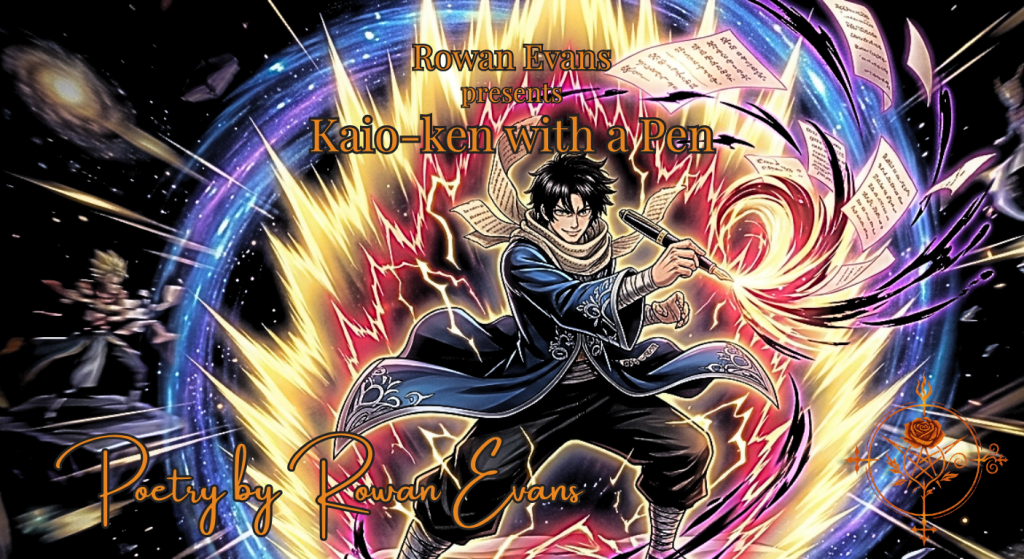
Kaio-ken with a Pen is the attack: speed, confidence, exaggerated battle-rap energy, and the idea that my mind can move faster than the people trying to keep up with it. The pen becomes the weapon, and Dragon Ball becomes the language I’m using to describe that creative intensity.
Then came Zenkai (Stronger Now).
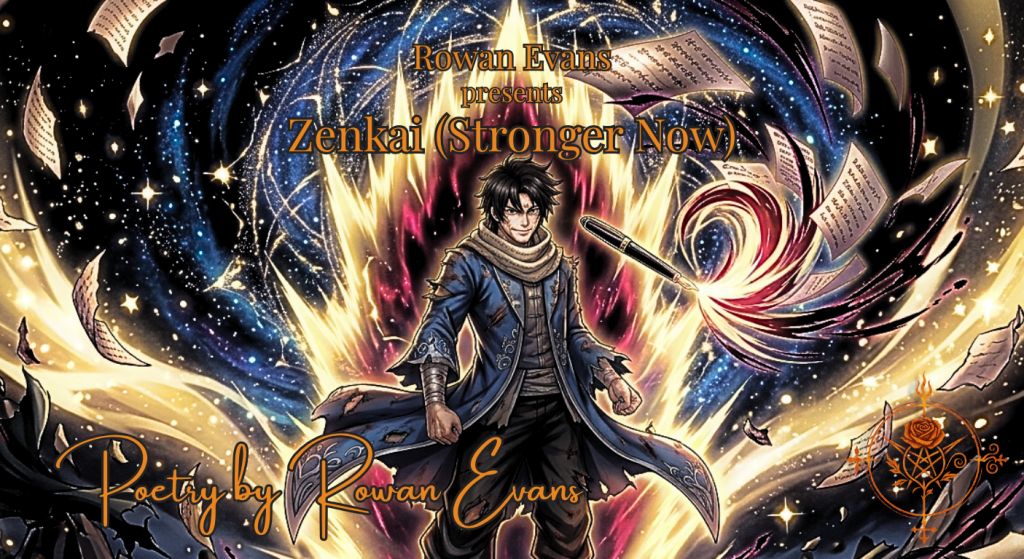
That one felt like the natural aftermath. In Dragon Ball, a Zenkai is the idea of becoming stronger after surviving a near-death experience. That concept fit perfectly with the way I think about resilience: sometimes you get pushed to the edge, you survive the fight, and you come back with something you didn’t have before.
So together, these poems became something of a two-part battle sequence:
I attack with the pen. I survive the fight. I come back stronger.
Neither piece is meant as a literal threat toward anyone. They’re me having fun with battle-poetry, Dragon Ball references, ridiculous power scaling, and the sheer joy of seeing how far I can push a metaphor before it explodes.
Basically: Battle Rowan went Super Saiyan.
— Rowan Evans
One poem is the attack.
Kaio-ken with a Pen Poetry by Rowan Evans
I can go Super Saiyan easy,
the way Chi Chi teached me—
taught me, I forgot you see
I’m the best, yes,
don’t want to step to this—
you don’t want to fought me—
fight me, I mean—bitch bite me,
you’re not like me.
My mind is terrifyingly quick—
thoughts comes, instant transmission—
from my mind to the page
in a Final Flash attack—
Kaio-ken with a pen, is this the end?
Fin.
Kaio-ken with a pen, I’m at it again,
this is my battle to win.
It’s going take you, a Kamehameha
and Kaio-ken times ten just to test me—
but it won’t be enough to best me.
The other is what happens when you survive it.
Zenkai (Stronger Now) Poetry by Rowan Evans
I’m Goku after a fight
and a Senzu bean,
you know what that means—
I’ve gotten stronger now,
you pushed me to the edge—
took me to the brink,
but you couldn’t end it—
you couldn’t finish me.
So do your little dance,
put on the Potara—do it—
put your minds together,
just know, even two as one—
you won’t get the job done.
I won’t borrow strength from no one,
don’t need no spirit bomb
to drop bombs—
No Kamehameha—
just ha-ha, I’m laughin’ at you.
Journey into the Hexverse…
[Don’t Push Me] A playful battle-poetry piece about turning insults into punchlines, standing your ground, and refusing to be intimidated. Don’t Push Me mixes swagger, humor, rhyme, and Rowan Evans’ signature self-aware interruptions.
[B.S.T.F.U.] A playful battle-poetry exercise packed with insults, internal rhymes, punchlines, wordplay, and literary swagger. B.S.T.F.U. is Rowan Evans flexing the verbal muscles—not calling out anyone in particular.