I’ve always had a complicated relationship with the voice that comes through my pen.
Sometimes it tells the truth. Sometimes it exaggerates. Sometimes it gets a little too comfortable talking shit.
And sometimes I genuinely can’t tell where one ends and the other begins.
So before you read this one, there’s really only one question worth asking:
Is it confession—or cap?
— Rowan Evans
Sometimes the pen tells the truth. Sometimes it talks shit. Sometimes it does both.
Confession or Cap? Poetry by Rowan Evans
Ask anyone and they’ll tell you— I’m nice and that’s true, but my pen can be mean when it speaks— so when I write, you’ve gotta ask— is it confession—
or am I just talking my shit again?
I’ve dissed other poets before— said they were boring, put me to sleep and called them all Watson— because their rhymes were elementary. So when you say I’m great?
No shit, Sherlock.
I’ve written the copies of copies, and the copies that copied that—
inspired less by poets and more by rap—
that’s why when my pen gets hot, I don’t know how to stop— so I pen fire and burn my hands, (ouch!) what am I sayin’? Everything I drop—
Flames.
Journey into the Hexverse
[Fine, Fire It Is] A playful poem about abandoning an ice metaphor, getting carried away with fire, and discovering that sometimes the best description of a poet’s pen is something that refuses to cool down.
[Exhibit A] A quick-witted, unapologetically playful poem about writing fast, crossing lines, roasting the competition, and letting rhythm do the talking.
[Why So Serious?] A playful, chaotic poem packed with pop-culture references, superhero imagery, Disney characters, wordplay, and the kind of ridiculous puns that make the poet wonder why they were ever given a pen.
[Welcome to the Hexverse] Step into the Hexverse—a poetic world where mythmaking, humor, rage, creativity, and confession collide, and darkness becomes something that can be reshaped into art.
This one arrived with a bunch of fictional characters, a handful of terrible puns, and apparently no intention of behaving itself.
So, before you read too seriously into it, consider this your invitation to just have fun with it. It’s a little chaotic, a little nerdy, and very much written with a grin behind the pen.
Welcome to the nonsense.
— Rowan Evans
Sometimes the hero’s journey is just an excuse to make terrible puns.
Why So Serious? Poetry by Rowan Evans
I must be Aladdin—
because my Jasmine
is so Jafar away.
Three wishes from Genie
trying to get to her,
you say that’s a waste—
but what Elsa am I to do?
I am on the move,
magic carpet ride—
and I can’t let it go,
I’m already Anna the way.
I guess you can say
this is my hero’s journey—
head in the clouds,
my feet not on the ground—
I had a joke to put here,
but it would Neverland—
I hope I stay young forever,
like Peter Pan…
I’m a Skywalker, like Luke—
I’m a Leia down the truth,
I’m not a rapper, my pen is—
the page is my booth.
When I step in, glasses come off—
Clark Kent is gone, it’s Superman to you.
Unfortunately for that poet, Tony has discovered pasta.
Impasta (A Diss in Pasta Form) is exactly what it sounds like: a diss poem written almost entirely through pasta-related wordplay. Spaghetti becomes “impasta.” Fettuccine becomes “alfredo.” Macaroni becomes a metaphor for having no backbone. Ravioli becomes something that folds under pressure.
And Tony is absolutely convinced this is devastating.
That is what makes Tony Stanza fun.
He isn’t trying to be subtle. He isn’t trying to sound sophisticated. He is a fictional poet who has apparently decided that every pasta dish is an opportunity for literary violence.
But underneath the ridiculousness, there is a real little diss hiding in here.
The target isn’t merely being called a bad poet. They’re being accused of being derivative, fragile, empty, and dependent on other people’s work. The pasta metaphors are ridiculous, but the criticism itself is surprisingly straightforward:
Your work isn’t yours.
Your confidence doesn’t survive pressure.
And underneath all that presentation, there’s nothing there.
Of course, Tony couldn’t possibly just say that.
He had to make it about spaghetti.
This is also another piece in the growing mythology of Tony Stanza—the “greatest poet you’ve never heard of,” a poet whose signature “Ayo…” apparently signals that something deeply unserious is about to happen.
If I write anything pasta-related from this point forward, Tony Stanza did it.
I don’t make the rules.
Tony does.
— Rowan Evans
Ayo… Tony Stanza has entered the kitchen. And somebody’s about to get impasta’d. 🍝
Impasta (A Diss in Pasta Form) Poetry by Tony Stanza
Ayo…
I call you spaghetti— because you’re just an impasta. (Imposter.) Your rhymes are cheesy. Parmesan.
All these suckers fettucine. They alfredo. (afraid though.) Yeah, these bitches is macaroni. All elbows. No backbone.
They talk a lot a ravioli— but fold when pressure hits, seam splits— and you realize they were full of nothing, no substance.
You thought you were angel hair, capellini, the chosen one—divinity with a pen. But you’re just thin-skinned, overcooked, fragile to the core.
Journey into the Hexverse…
[Lost in the Sauce] A playful heartbreak poem where sandwiches, ketchup, mustard, rye, lettuce, and sourdough become metaphors for emotional confusion. Beneath the food puns is a speaker trying to understand how everything went from “we’re okay” to suddenly feeling cold.
Some poems begin with a carefully constructed metaphor.
This one began with a step-ladder.
And then immediately refused to behave.
Blended Hardware is intentionally ridiculous. I started with a simple object and let my mind wander wherever the language wanted to take it: ladders became hoses, hoses became an excuse for a terrible joke, friendship became Star Wars, Obi-Wan became a teacher, Luke became Leia, and suddenly I was revisiting different versions of myself across my writing history.
That wandering is the point.
I’ve been thinking a lot lately about how much more playful my relationship with language has become. I don’t always sit down with a destination in mind anymore. Sometimes I just start writing and see what happens.
This poem is one of those moments.
It also became a strange little conversation between different versions of Rowan. The fifteen-year-old writer appears briefly, the Gothic voice tries to take over, and the present-day me immediately interrupts to tell her to calm the hell down.
That self-interruption is probably one of my favorite parts of the piece.
I can write something dramatic and immediately recognize that I have made the moment far more Gothic than it needs to be.
I can make a joke, realize the joke went somewhere questionable, and then literally put myself on trial inside the poem.
That is part of what makes writing feel like a playground again.
I don’t have to protect every poem from being silly.
I don’t have to make every metaphor profound.
I don’t have to prove that every line deserves to exist.
Sometimes I can just follow a thought until it becomes a garden hose, an Obi-Wan reference, a fifteen-year-old version of myself, and an increasingly concerned author asking whether she accidentally threatened somebody.
And honestly?
That’s enough.
— Rowan Evans
Sometimes you start with a step-ladder and end up somewhere completely different.
Blended Hardware Poetry by Rowan Evans
This is my step-ladder.
I call it a step-ladder, because I had another ladder before—
and yeah, I got plenty hose— different shapes and different sizes, some are six feet, some are four— I’m glad I only have two outside faucets, ’cause I wouldn’t have plenty hose, if I had one more. (I only have two hoses.)
You’re not just my homie, you’re my Obi-wan Kenobi— and I’m Luke, mixed with Leia. That means you’re my teacher, and my only hope, playa.
(I’m sorry for that, truly. I don’t know what I was thinking. I’m going to… I’m going to put the pen down now.)
SIKE! I lied like it’s 1999— four more years and the myth would start, a poet born with a blackened heart.
(Dial back, that was too gothic for this piece.)
I mean, sike… I lied like it’s 2005— and I’m fifteen with a pen again, two years into the journey mapping how I’d survive—
and I mean me, not them— I’m talking the person they’d grow into. The person I’d caution you, against taking a pen to—
that’s a battle you wouldn’t win, boo.
(Wait…
was that a threat?
In a joke poem?
Too far, Rowan… too far.)
Journey into the Hexverse…
[Not the Way Jesus Did] A provocative poem about religious judgment, hypocrisy, outcasts, and the contradiction between preaching compassion and condemning those who live differently.
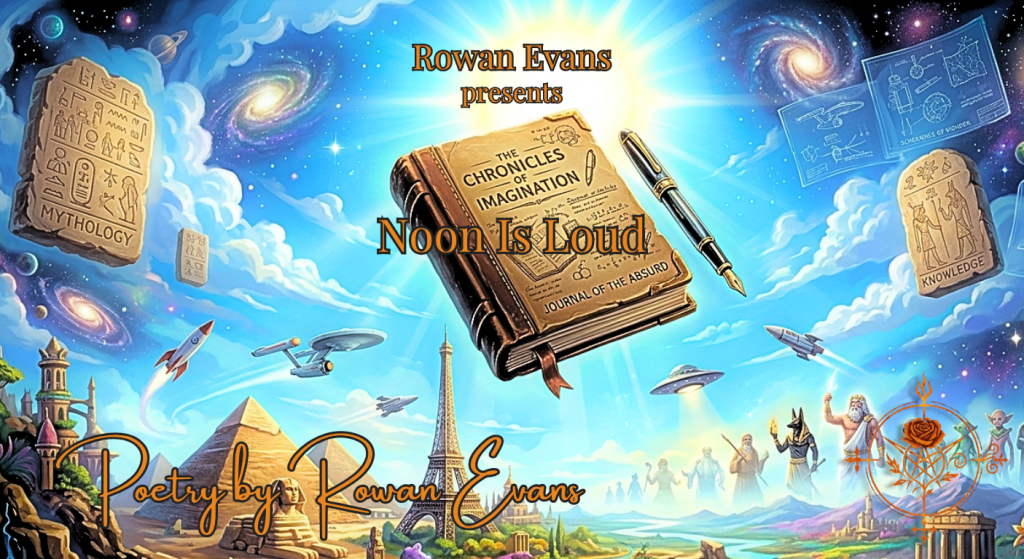
[Noon is Loud] If four in the morning belongs to truth, then noon belongs to impossible memories. Noon Is Loud is a playful free verse poem filled with absurd boasts, pop culture references, and tongue-in-cheek mythology that explores how easily imagination can rewrite reality.
[Content Warning] What if you reviewed a person the way you’d review a terrible novel? Content Warning is a playful, satirical poem that uses literary criticism as the ultimate roast, proving that sometimes the sharpest metaphor is also the funniest.
[Chemical X] Chemical X explores the rapid, associative way one creative mind moves—from cartoons to sports, comic books to music—revealing that inspiration isn’t linear, but a collision of memory, humor, rhythm, and intuition.
[Off Leash Thought] A reflective free verse poem exploring the mind as a living, wandering force—unpredictable, creative, and sometimes chaotic—through the metaphor of a dog off leash. It embraces mental drift not as a flaw, but as a natural part of creative thought and self-awareness.
Some poems arrive in the middle of the night carrying emotional truths.
This one showed up in broad daylight carrying absolute nonsense.
The idea started with a simple contrast: if four in the morning is where my most honest poems seem to live, then maybe noon is where my imagination completely loses supervision. So I let it.
Every claim in this poem becomes more ridiculous than the last. Ghostwriting the Ten Commandments. Inventing fire. Starting sci-fi fandom wars. Building the pyramids. Handling first contact with aliens.
It’s satire, exaggeration, and the kind of storytelling that knows it’s lying while inviting you to enjoy the ride anyway.
At its heart, though, there’s a small observation hiding beneath all the absurdity.
Sometimes the stories we tell ourselves depend entirely on what time it is.
At four in the morning, we confess.
At noon, we become legends.
This poem belongs to the latter.
— Rowan Evans
When noon gets too loud, every impossible story suddenly feels true.
Noon Is Loud Poetry by Rowan Evans
If four AM is the time of truth—
I guess it’s all lies at noon.
Do you remember when—
I was topping the charts
and breaking the hearts.
And what about the time
that I had to save the planet—
I had to be the one to stare
down the barrel of a laser gun.
But I handled first contact like a G,
that’s why the Aliens are cool with me.
I created Star Treks and Star Wars,
specifically to start beef in sci fi fandoms.
Nobody knew, I was the phantom menace—
the creator of the lore, everyone wanted to Klingon.
And Dune? That was me too.
I’ve gone to war with Gods
over migraines and frowns,
but never my own—
I’ve talked about it in other poems.
And yes, I am a sports expert—
I know everything there is to know,
it’s all stats, no narrative.
Formations, players and defensive schemes.
These are all words that I know what they mean.
The pyramids? I built those—
the Eiffel Tower too.
The Hubble Telescope?
Inspired by the childhood glasses that I wore.
The Ten Commandments?
I was the ghost writer—
I was also the inventor of fire,
the wheel and combustion engines.
Anyway—
that’s what I remember.
But noon is loud,
and the lies come easy—
so I’ll stop here
before I rewrite the universe again.
Journey into the Hexverse…
[More Afraid Than the Ink] Some confessions are easy to write but impossible to speak. More Afraid Than the Ink explores fear, dreams, recurring symbols, and the quiet realization that the page has always been braver than the poet.
[When the Veil Is Thin] Some truths wait until after four in the morning to make themselves known. When the Veil Is Thin explores insomnia, longing, quiet vulnerability, and the thoughts that become impossible to ignore before dawn.
This poem wasn’t planned. It wasn’t outlined. It wasn’t even politely invited.
It showed up at 6:58 AM, unannounced, fully formed, and absolutely determined to be written. I was trying to go back to sleep, but the first nine lines kept repeating in my head like a notification I couldn’t clear. So I got up, opened my notes, and twenty‑two minutes later this entire piece existed.
It’s not deep. It’s not symbolic. It’s not part of a series.
It’s just what happens when my brain decides to roast someone using the language of literature and refuses to let me rest until I write it down.
Most of my recent work has been heavy, reflective, rooted in longing and transition. This one is… not that. This is me having fun. This is me letting the metaphorical knife out for a morning stroll. This is me, writing the poetic equivalent of a one‑star Goodreads review for a person who deserved it.
If you’re here for emotional devastation, don’t worry — I’ll get back to that soon. But for now, enjoy this brief intermission of petty, poetic chaos.
— Rowan Evans
“Some stories deserve five stars. Others deserve a content warning.”
Content Warning Poetry by Rowan Evans
I’m going to tell you like it is,
if I don’t like you—
I’m going to say it quick.
I read you like a book,
the moment you entered my view.
I read you like my favorite series,
finished in a day—
but you’re a book, full of plot holes.
Your narrative is flawed.
Your dialogue is forced,
your motives unclear,
your character arc
never quite lands, dear.
I don’t need a sequel
to know how this ends.
Some stories fall apart
before the final page—
and yours was unraveling
from the start.
Your thoughts are typos,
in need of rewrite, bro—
editor should have lost their job, too.
How were you released to the public?
Your plot twists fall flat,
your pacing drags,
your themes contradict
every claim you make.
What genre are you even in?
You’re a draft
that never should’ve passed
the first round of edits—
a story stitched together
with clichés and guesswork.
I’ve read fanfiction
with tighter structure
and more believable motives.
You’re not a novel—
you’re a warning label
masquerading as prose.
You should come with a content warning:
This content blows.
Journey into the Hexverse…
[The Monster in the Margins] Drawing inspiration from horror icons like Michael Myers, Ghostface, Freddy Krueger, and Pennywise, this poem explores the darker side of creativity—where inspiration becomes an unstoppable force lurking just beyond the edge of the page.
[Director’s Commentary] Director’s Commentary is a self-aware free verse poem that turns the poet’s recurring metaphors into the subject itself, exploring creativity, artistic habits, and the humorous inner critic that follows every writer from draft to draft.
This poem started where a lot of my more playful pieces begin: with a chain reaction of absurd images that refused to behave.
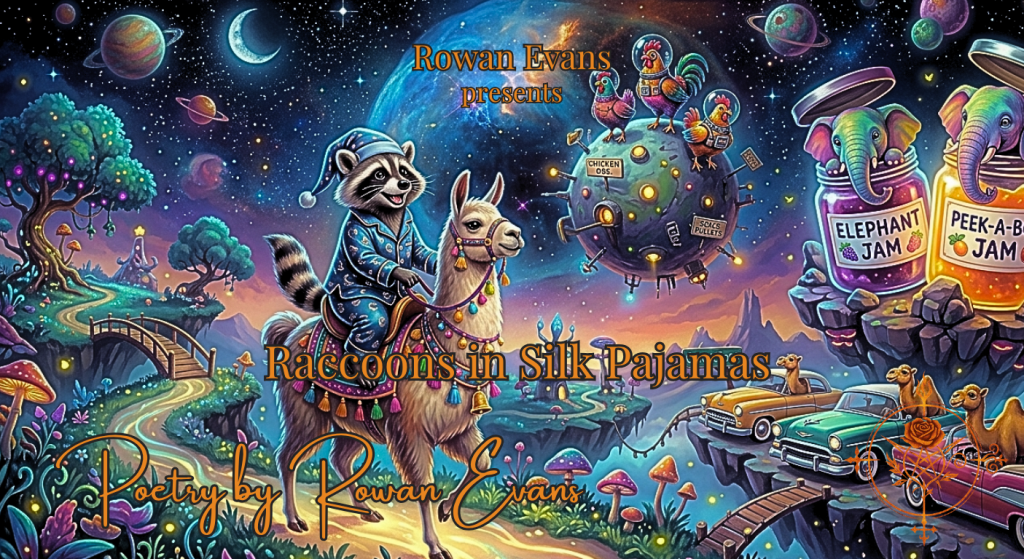
I didn’t sit down with a structure in mind. I just let the language run until it started building its own logic—one that doesn’t really care about realism, linear progression, or whether raccoons should realistically be wearing silk pajamas in the first place.
The “Space Chickens” at the beginning weren’t planned as a motif. They became one because they felt like the kind of strange, mildly accusatory presence that only makes sense in a world where camels are in parked cars and elephants are stored in jam jars.
From there, the poem just escalates.
Raccoons appear. Then llamas. Then the question of pajamas becomes a philosophical problem. Somewhere in the middle, the poem realizes it is no longer interested in consistency—it’s interested in momentum.
There’s a moment where the speaker tries to impose logic:
“Don’t be absurd.”
But by that point, absurdity has already won.
What I find interesting about this piece is that it still has a kind of emotional continuity even without narrative stability. It moves the way thoughts move when you’re tired, distracted, or laughing at your own internal associations—jumping from one idea to another through sound, memory, and cultural reference rather than logic.
Even the ending, with its sudden shift into pop culture and cinematic reference, is less about conclusion and more about acknowledgment. The poem becomes aware of itself mid-collapse and decides to lean into it rather than resolve it.
In that sense, it’s not really about raccoons.
It’s about the way language behaves when you stop trying to control it.
And sometimes, that’s where the most honest writing shows up.
— Rowan Evans
When logic leaves the room, language starts having fun.
Raccoons in Silk Pajamas Poetry by Rowan Evans
I had to get away
from the Space Chickens,
they were a little too judgmental—
always questioning what I wore,
shouting implied curses
spoken in cursive.
It was camels in parked cars,
elephants in jam jars…
Now it’s—
raccoons in silk pajamas,
and they’re not alone—
they’re riding llamas.
“Are the llamas
wearing silk pajamas?”
Don’t be absurd.
That’s the weirdest thing
I’ve ever heard—
llamas in pajamas?
No, just raccoons
and bananas.
I was once a
farmer on Pluto,
a librarian on Mars—
a poet amongst the stars.
Now I’m just
an astronaut in the ocean,
rolling in the deep.
Dude—
you just referenced Adele.
Like it is 2001 again.
It’s a Space Odyssey
Journey into the Hexverse…
See where it all began.
[Pluto Farmer] A whimsical absurdist poem about being a certified weirdo, farming space carrots on Pluto, and refusing to fit into anyone else’s definition of “normal.”