Tag: fear of vulnerability

  • Author’s Note

    There are two versions of every poet.

    The one who can write about anything, and the one who struggles to write the one thing that matters most.

    This poem begins with confidence—almost arrogance—as the speaker celebrates the ability to write in any voice, on any subject, from any perspective. But beneath that confidence is a question I’ve wrestled with for years: if it’s so easy to write about everything, why is it so difficult to write one completely honest sentence?

    Humor, metaphors, references, and wordplay are some of my favorite tools. They help me explore ideas, soften difficult emotions, and make heavy subjects more approachable. But they can also become places to hide.

    One Honest Sentence is about recognizing that difference. Sometimes the greatest challenge isn’t finding beautiful language—it’s finding the courage to stop decorating the truth long enough to simply say it.

    Rowan Evans


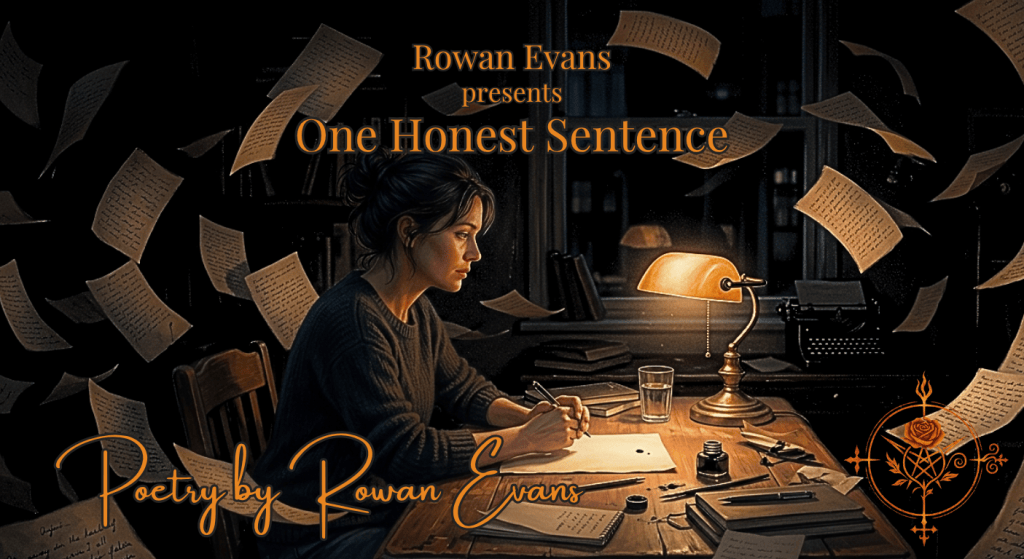
    A solitary writer sits before a blank page while countless handwritten pages float around them, symbolizing the struggle between creativity and emotional honesty.
    Writing beautifully is a skill.

    Writing honestly is a different kind of courage.

    One Honest Sentence
    Poetry by Rowan Evans

    I don’t usually like to do this, but
    I’m going to do it anyway, because
    I’m tired of pretending—

    why should I lie and say
    I’m not that guy,
    when I know I am.

    Give me a pen,
    and I can write anything.

    If a person can think it
    or have an experience,
    I can turn it into poetry.
    I do it by stringing ink
    into so many pretty lines—

    but I don’t bother to try
    and rhyme, most of the time.

    I wrote poem after poem—
    I can write a poem about the search for home
    while feeling alone in a crowded room,
    talking about how this house feels like a tomb.

    I can write island hopping epics—

    I can silence skeptics,
    put their opinions in the septic—

    they don’t know
    shhh—

    it’s no wonder they talk a lot,
    their minds are empty, got no thoughts.
    So the verbal diarrhea doesn’t stop—

    and when I read what they write,
    I call them Watson
    ’cause their lines are elementary.

    I’ve written thirty lines of flex
    and after thirty lines,
    you’re probably wondering—

    what’s next?

    Well—

    how about we pivot
    from flex to truth?

    Earlier I said—

    give me a pen and I can
    write anything.

    I can take the joy, the pain,
    the sun, the rain
    and write a whole damn series—

    it’s even easier
    if it didn’t happen to me,
    I can write about it for days—
    poem after poem,
    different angles of the same thing.

    Because it’s easy
    writing about just anything—

    what’s hard is writing
    a single truth,
    without burying it in jokes
    and misdirection.

    And maybe that’s the joke—

    I can write whole worlds,
    but not one honest sentence
    without my pulse stuttering.

    Like what would happen—
    if I just said it?

    If I turned 1-4-3 to letters
    and I just meant it?

    Would the world cease to be?

    I guess I’m just afraid—

    because once I say it,
    I can’t unsay it.

    Once I write it,
    it becomes real.

    And real things
    can be lost,
    can be rejected,
    can be held—

    and I don’t know
    which scares me more.

    So again I ask—

    what would happen
    if I just said it?

    Maybe you’d laugh.
    Maybe you’d freeze.
    Maybe you’d say it back.

    Maybe nothing would change
    except—

    I’d finally be done
    hiding behind metaphors.


    Journey into the Hexverse…

    [Noon Is Loud]
    If four in the morning belongs to truth, then noon belongs to impossible memories. Noon Is Loud is a playful free verse poem filled with absurd boasts, pop culture references, and tongue-in-cheek mythology that explores how easily imagination can rewrite reality.

    [Just Human]
    Just Human is a reflective free verse poem about seeing people before borders, choosing empathy over division, and finding home in our shared humanity rather than on a map.

    [Director’s Commentary]
    Director’s Commentary is a self-aware free verse poem that turns the poet’s recurring metaphors into the subject itself, exploring creativity, artistic habits, and the humorous inner critic that follows every writer from draft to draft.

    [The Answer Is (Yes)]
    What kind of writer am I? Mythmaker, confessor, comedian, philosopher, dream-architect, romantic, storyteller, and diss-poet. This self-reflective poem explores the impossibility of fitting creativity into a single category—and embraces every version of the truth a pen can touch.

    [Before We Created the Labels]
    Ancient gods return to a fractured world shaped by borders, identities, and separation. “Before We Created the Labels” explores humanity’s divisions through mythic imagery, sacred ritual, and symbolic collapse—asking what remains when we learn to see one another beyond labels.

    If you’re interested in more poetry, you can find it here → [The Library of Ashes]
  • Author’s Note

    There are things that feel simple in your head… until you try to say them out loud.

    This piece comes from that moment right before a confession—when the words are clear, the meaning is obvious, but the weight behind them makes it harder to speak.

    Sometimes it’s not about not knowing what to say.

    It’s about knowing exactly what it means if you do.

    And not being sure you’re ready for what comes after.

    Rowan Evans


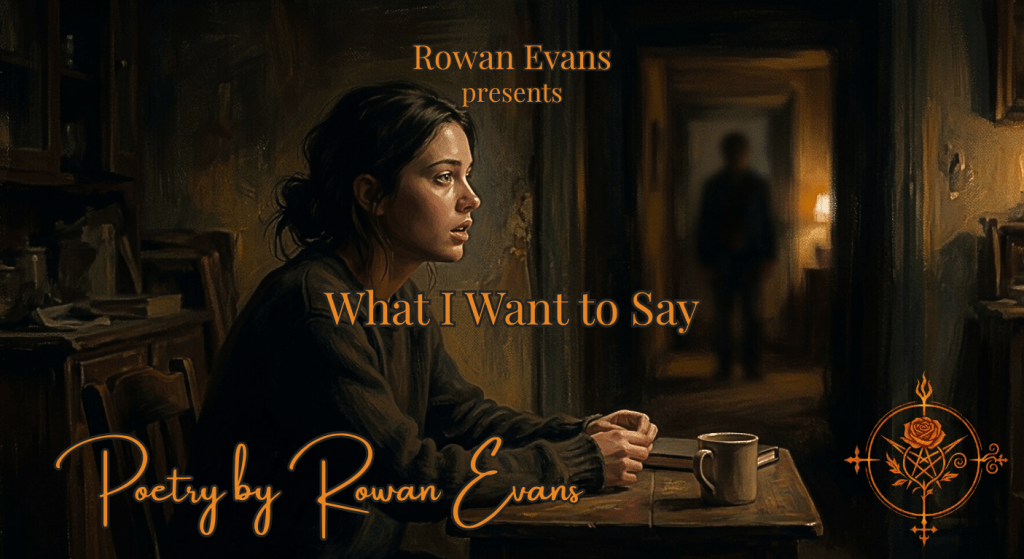
    Person sitting in low light hesitating to speak, symbolizing unspoken emotions and vulnerability.
    Some words stay locked inside—not because we don’t feel them, but because we know what they could change.

    What I Want to Say
    Poetry by Rowan Evans

    I have so much
    that I want to say,
    but I don’t know how.

    For some reason—
    I always chicken out.

    I want to say
    1-4-3—decoded.
    But that’s too
    loaded.

    So I say it in
    actions instead,
    but the words stay hidden—
    locked in my head.

    I rehearse the lines
    a thousand times,
    but when the moment comes,
    I swallow them whole—

    afraid that saying them
    might change everything
    I’m scared to lose.

    But the fear pulls me away—
    I’m scared of becoming
    just another disappointment,
    another regret.


    [Not Her—The Echoes]
    A poem about learning the difference between someone who is safe—and the echoes of those who weren’t.

    [The Quiet Inside the Noise]
    What happens when a restless mind finally quiets—not by silence, but by focusing on one person? The Quiet Inside the Noise explores love, fixation, and finding calm in connection.

    [Right Behind My Eyes]
    A raw and introspective poem exploring dissociation, emotional distance, and the grounding power of love. Right Behind My Eyes captures the feeling of watching your life from afar–and what keeps you from disappearing completely.

    If you’re interested in more poetry, you can find it here → [The Library of Ashes]
  • Author’s Note

    Some conflicts don’t happen out loud.

    They happen internally–quiet, persistent, and often unresolved.

    This piece explores that split.

    The part of me that wants connection, that wants to be seen, that recognizes something real when it finds it.

    And the part that’s learned, over time, that being seen can come with consequences.

    That vulnerability can lead to loss.

    Neither voice is wrong.

    One is driven by hope.
    The other by memory.

    And most of the time, they don’t reach a clean resolution.

    They just… coexist.

    This poem sits in that space–
    between wanting to stay,
    and expecting to leave.

    Rowan Evans


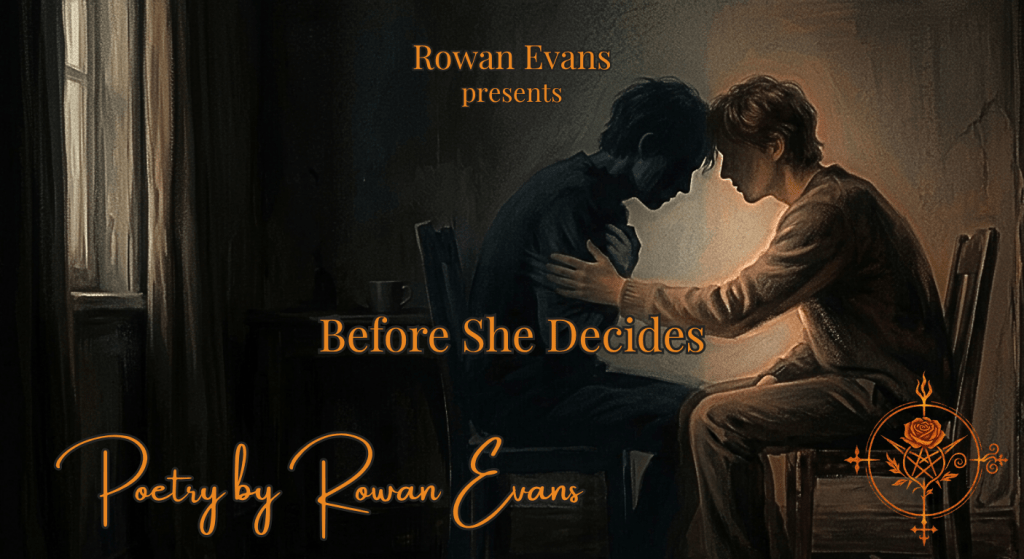
    A person sitting alone with two overlapping silhouettes representing internal conflict between connection and fear
    Some battles aren’t fought out loud—
    they happen in the silence between staying and leaving.

    Before She Decides
    Poetry By Rowan Evans

    I sit—
    split—
    like I’ve got two
    personalities inside.

    One that wants to be seen,
    and one that wants to hide.

    Sometimes—
    they talk
    to each other.

    “What are you afraid of?”

    Being perceived.
    You know
    it’s never been easy
    for me.

    “But you retreat too far.”

    I pull back
    as much as I need.
    Sometimes,
    space is safety.

    “That’s a lie you tell
    to isolate yourself
    from everyone else.”

    I’m not isolating—
    I’m protecting myself.

    “From what?
    The very thing
    we want.

    You’re not protecting,
    you’re disappearing.”

    Why can’t it be both?

    “Admit it—
    you’re scared.”

    Scared?
    I’m terrified.

    You know what I feel—
    you know the depths of it.
    You know it’s real.

    “Yes, it’s real.
    It’s new. It’s beautiful.
    It’s nothing to be scared of.”

    Nothing?
    Let me remind you
    of our history—

    the string of people
    that left
    because of our vulnerability.

    “But they’re not her.
    She hasn’t left—”

    Yet.

    What about when
    she gets sick of us?

    Because we’re too loud,
    too weird,
    too honest.

    “Maybe.

    But she’s still here.

    And for once—
    I don’t want to run
    before she decides.”

    For a moment—
    neither of them speaks.

    Just silence—
    stretched thin
    between wanting to stay
    and expecting to leave.


    If you’re interested in more poetry, you can find it here → [The Library of Ashes]
  • Author’s Note

    This piece is about the space between feeling something and being able to say it.

    For some people, expression comes naturally.
    For others, it’s learned to be dangerous.
    Words get tied to consequences–
    misunderstanding, rejection, being seen in ways that don’t feel safe.

    So instead of speaking, you hold it in.
    You rehearse it internally.
    You let it echo.

    1-4-3 has always been a simple code–
    something that turns something heavy into something easier to carry.

    But even then, saying it isn’t always easy.

    Sometimes the hardest words to speak
    are the ones you feel the most.

    Rowan Evans


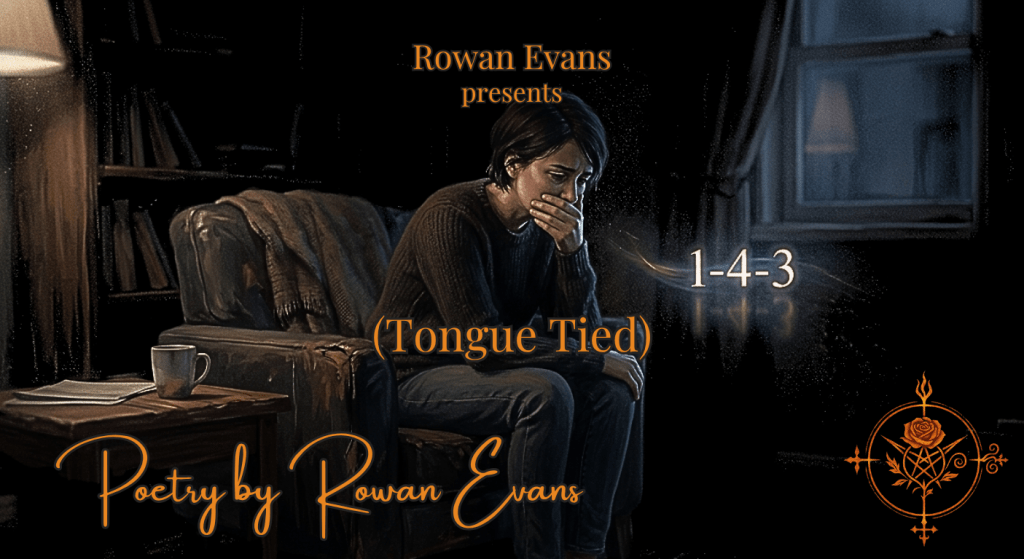
    Person sitting in a dim room holding back words with faint glowing 1-4-3 numbers symbolizing unspoken love.
    Some words echo louder in silence than they ever could out loud.

    1-4-3 (Tongue Tied)
    Poetry by Rowan Evans

    I bite my tongue,
    trying to stop myself.
    I have so much
    I want to say.

    I try not to speak.

    In the past
    words have got me
    in trouble—

    because I’d say
    what I feel.

    But life taught me—
    never let them
    see you weak.

    So I don’t speak.

    I keep the words
    held in my cheeks,
    as I stumble back
    into retreat.

    I always leave
    a piece of me behind—

    hoping
    I’d have to return to find it,
    to become whole again.

    It hasn’t happened yet.

    At least,
    that’s what I tell myself.

    But I know better—
    I left a piece of me
    and went back to collect.

    And still,
    I choke on the words
    I try to say.

    It’s like I’m tongue-tied.

    Open mouth.
    Nothing comes out.

    I just want to say—

    I—

    lost myself
    trying to claw
    my way out of this hell.

    Struggling to speak—
    the words in my head,
    repeat:

    1-4-3…
    1-4-3…

    And I hope,
    you feel the same
    about me.


    Journey into the Hexverse!

    [1-4-3]
    A poem about love that isn’t rooted in need, but in choice. About finding safety not as a cage, but as a place where fear finally stops running—and stays.

    If you’re interested in more poetry, you can find it here → [The Library of Ashes]
  • Author’s Note

    Some feelings don’t arrive gently.

    They sit on the tip of your tongue, heavy and persistent, asking to be spoken–but never quite feeling safe enough to say out loud. So they get rewritten, softened, disguised. Butterflies, instead of something darker. Something truer.

    This piece is about that tension–the instinct to hide, even when you want to be seen. The way vulnerability can feel less like openness and more like risk.

    Sometimes we disappear not because we don’t care…
    but because we care too much.

    And still–there’s a part of us that keeps trying to come back.

    Rowan Evans


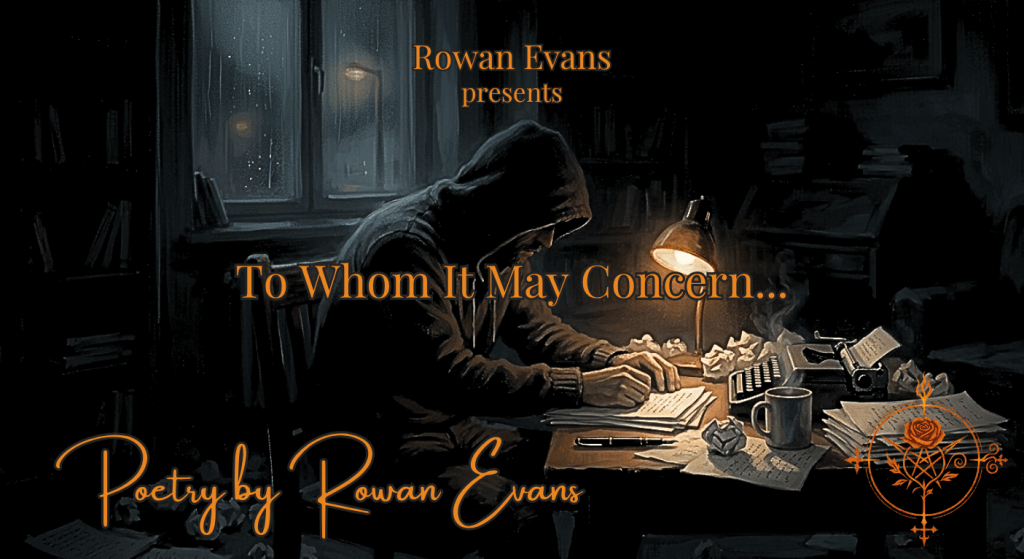
    A person sitting alone at a desk in dim light, surrounded by crumpled papers, representing hidden emotions and vulnerability
    Some truths are easier to write than to say out loud.

    To Whom It May Concern…
    Poetry by Rowan Evans

    I’m writing this letter to spell out
    what I’ve been holding inside.
    I’m tired of hiding,
    behind wide eyes and
    white lies.
    Sick of saying butterflies…

    They are moths.

    They flit and flutter,
    light rumble
    in the stomach.

    Like the lanterns lit.

    I’ll admit,
    it makes me sick—
    the way this hits.
    The way it sits,
    on the tip of my tongue—
    your name.

    It’s become a sacred thing.

    And I care too much,
    so instincts kicked in—
    I disappeared again.
    Silently went within.

    I try and claw my way out.

    Sometimes I—
    don’t know why,
    I do the things I do.

    Self-sabotage sometimes.

    Clinging to anything
    to hide behind.
    To mask emotion,
    to keep me safe.
    Because—
    vulnerability,
    has not always been.

    But I will
    claw my way
    back again.


    Journey into the Hexverse

    [Weathered] (3/21)
    A deeply introspective poem about confronting fear, breaking patterns, and choosing to stand in the storm instead of running from it.

    [Same Room (Emotionally)] (3/22)
    Can you miss someone you’ve never met? This poem explores emotional connection beyond physical distance and what it means to truly feel seen.

    [No Parachute] (3/23)
    A poetic reflection on falling in love without hesitation—raw, uncertain, and without a safety net.

    [When I Started to Fall for You] (3/24)
    A lyrical exploration of love’s intensity—how connection grows, transforms, and reshapes the way we experience the world.

    [Bad Habit] (3/25)
    A powerful reflection on repetitive thought patterns, emotional loops, and the moment of realizing you’re stuck inside your own mind.

    [Same Sky] (3/26)
    A poetic meditation on longing, distance, and the quiet desire to share the same space—even when worlds apart.

    If you’re interested in more poetry, you can find it here → [The Library of Ashes]