Tag: grief

  • Author’s Note

    Punchline is a reckoning with the twisted humor life offers when pain and absurdity collide. This poem is not about despair—it is about recognition: standing in the ruins of your own story, laughing through jagged edges, and finding strange grace in the shadow of suffering. It is for anyone who has felt like the universe’s jester, bleeding ink instead of tears, and still choosing to dance.
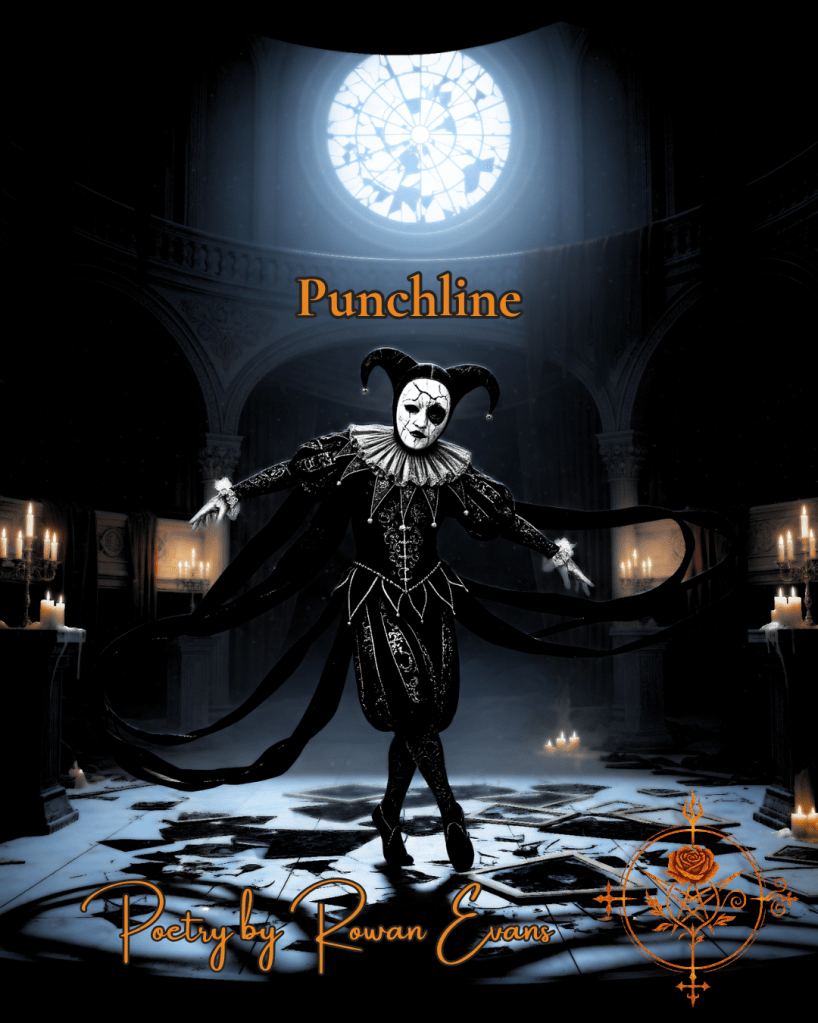

    Image of a lone jester dancing among shattered mirrors and marble, symbolizing dark whimsy and emotional resilience.
    Punchline by Rowan Evans: where darkness and laughter collide, and the jester always dances.

    Invocation

    I call forth shadows that speak in laughter—
    the jagged smiles behind masks,
    the truths too sharp for daylight.
    Let this poem be your mirror and torch,
    a hall of fractured stanzas
    where the jester refuses to fall silent.


    Punchline
    Poetry by Rowan Evans

    My life—a black comedy penned in cracked ink,
    each breath a fractured stanza on the brink.
    A coffin nailed tight with bitter mirth,
    laughter spilling blood beneath the earth.

    I am the jester in hell’s shadowed hall,
    dancing on bones, awaiting the fall.
    A smile carved from porcelain, cracked and thin,
    playing the fool while darkness grins.

    Fate wrote me in venom, stitched in jest,
    a tragic script with no reprieve, no rest.
    The setup—a wound that never heals,
    I’m the punchline bleeding beneath the seals.

    I laugh through ruin, jagged pain,
    a serenade to sorrow’s haunting refrain,
    mocking the void with a razor’s kiss,
    finding grace—twisted—in the abyss.

    I’ve worn the crown of shattered glass,
    a queen of mirrors cracked en masse,
    where every shard reflects a lie,
    a fractured truth that mocks the sky.

    In the theater of my own despair,
    the audience gone, yet I still stare—
    ghostly faces in the dark,
    their silence sharp, a cruel remark.

    I spill my verses like poisoned wine,
    each word a dagger dipped in rue,
    sung soft in minor keys anew.

    The world’s cruel joke—I play my part,
    a bleeding heart with broken art.
    But even jesters hold their scars,
    and dance beneath the fading stars.

    A laugh that falls like shattered glass,
    the jest that haunts, too sharp to pass,
    and under it all, the silent sigh—
    the shadow’s whisper, a quiet goodbye.

    Beneath the mask, the blood and grime,
    lies a soul that twists through space and time,
    a darkly woven tapestry spun—
    where pain and beauty are undone.

    And in that unraveling, I find release—
    the bitter truth, the sweetest peace.
    Life may jest and fate may tease,
    but I write my own damn punchline, please.


    Benediction

    May your laughter cut through the dark like shattered glass,
    may your scars hum a quiet, sacred song.
    Even when the jest is cruel, find your voice—
    and in the ruins, discover you are still, always, unbroken.


    Read Next (Suggestions)

    The Gospel According to the Girl in the Graveyard Dress
    “I’m not alright, but I rhyme so well,
    Nobody hears the tolling bell.
    My lullabies are laced with lead,
    And sung by ghosts beneath my bed.”

    – A gothic, whimsical mash-up of childhood curiosity and the raw bite of darkness.

    Tip the Chair
    “My mind it races, 
    heartbeat slows, 
    lungs burning for a mercy 
    that never shows—”

    – Stark, intimate, and darkly humorous in its confrontation with despair.

    The Hopeless Romantic Wears Armor
    “I’ve written poems to silence,
    and bled ink for people
    who didn’t know what it meant
    to be cherished
    without condition.”

    – Tender, self-aware, and resilient; love persists even through jagged edges.
  • Author’s Note

    I have lived my life with ghosts in the room. Some of them were mine. Some belonged to women who died before I was born. This poem is my conversation with Sylvia Plath—not as an idol, but as a mother of language, a keeper of the raw and the unbearable. She never wrote for me, and yet her words built a room I have lived in for decades. This is my answer back, from the daughter she never met.


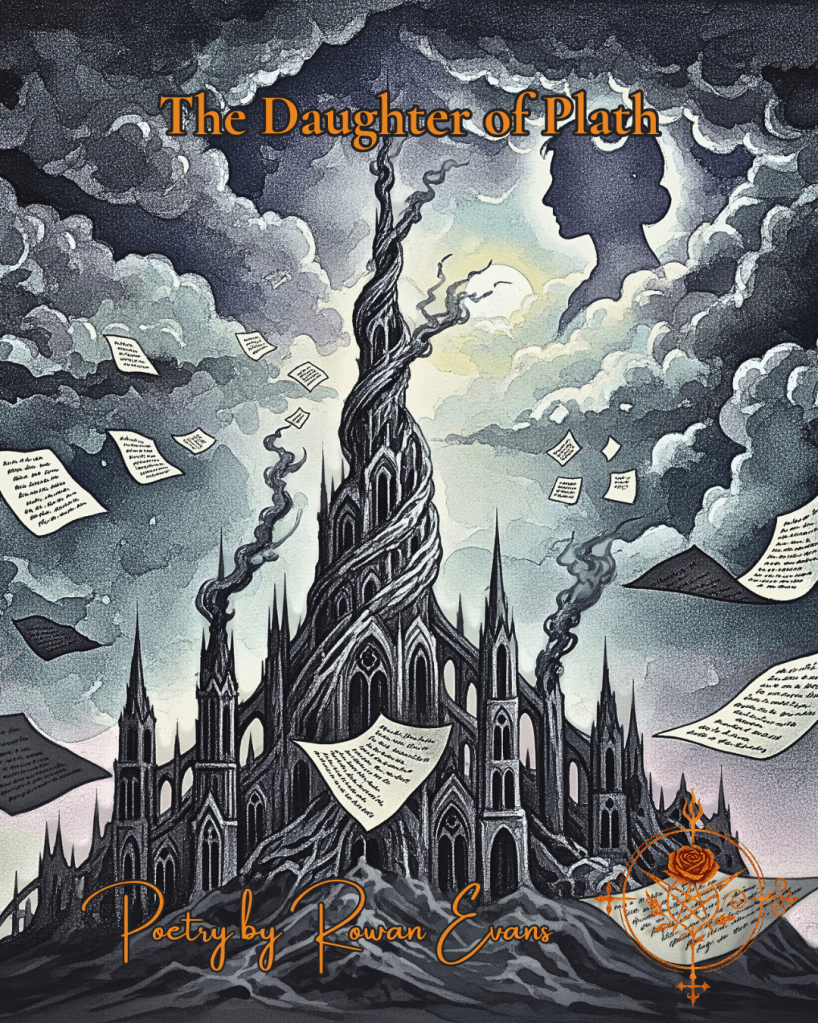
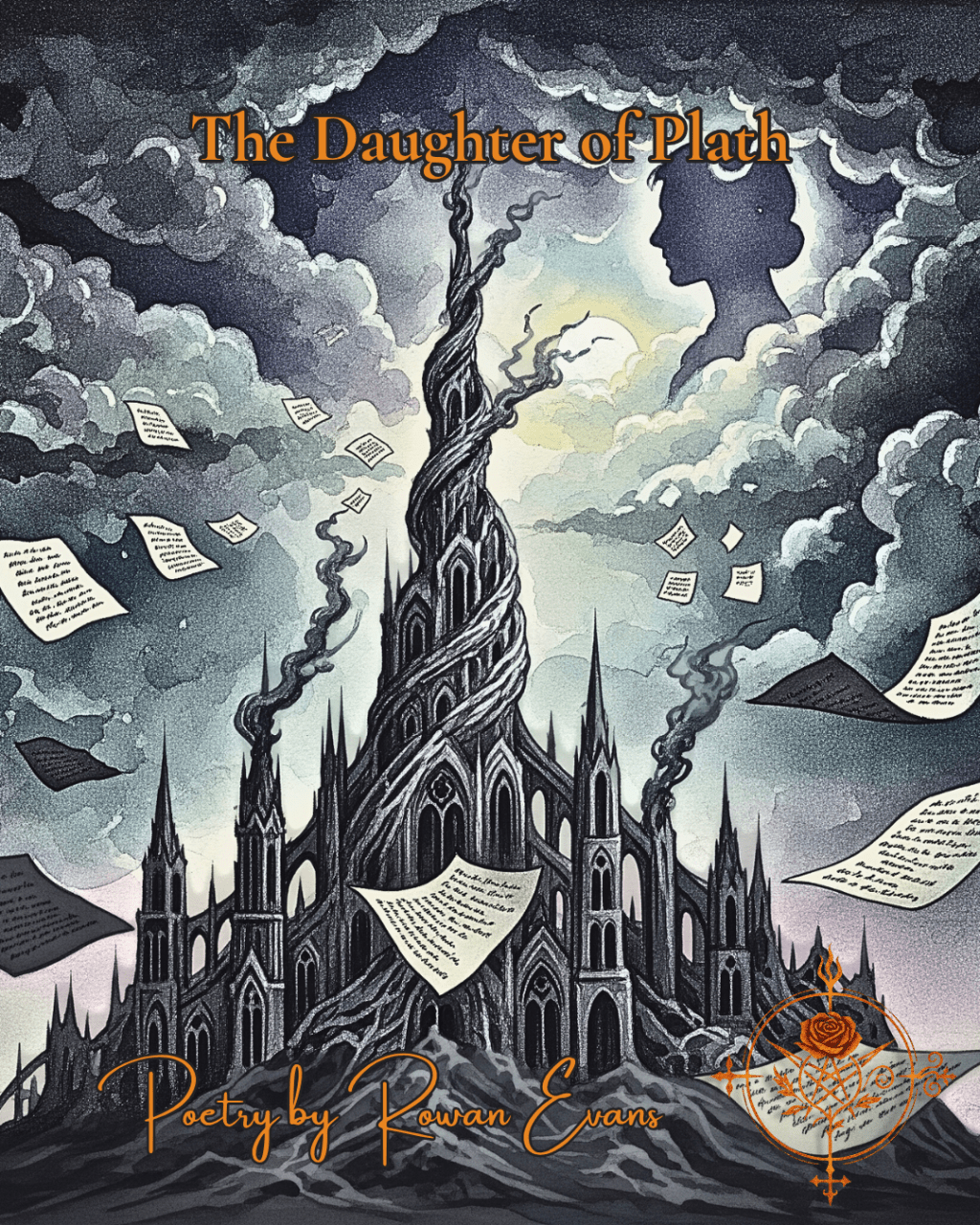
    Neo-gothic watercolor of an ash cathedral under a ghostly moon, with pages of poetry drifting upward and a faint female silhouette in the clouds.
    A cathedral built from ash, a prayer written in ink.

    Invocation

    Sylvia, I call you forth not to mourn, but to witness—
    to stand beside me as I open the ribcage,
    spill the ink,
    and show the world what it means to write as if the page were the last breath left in your lungs.


    The Daughter of Plath
    Poetry by Rowan Evans

    I was born with a beehive in my chest,
    buzzing with grief I never earned—
    a secondhand sorrow, wrapped in red silk,
    left at the altar of my ribs.

    Sylvia,
    you baptized me in bell jars,
    taught me how to scream without sound,
    how to find God
    in the burn of a typewriter ribbon.

    Your ache became heirloom—
    stitched into the marrow of my metaphors,
    your ghost weeps beside me as I write,
    fingertips trailing flame
    across the spine of each stanza.

    Where you were the furnace,
    I am the cathedral built from your ash—
    my altar bears the relics of your ruin:
    a curl of smoke,
    a sliver of moon-bitten mirror,
    a lullaby made of broken clocks.

    I do not flinch from the blood on the page.
    I have inked it into scripture.
    This is how I pray—
    with a pen between my teeth
    and my pulse pressed
    against the confessional.

    You gave me your hunger for beauty
    and your curse of seeing too much—
    the world peeled back to its nerve endings,
    the holiness inside horror.

    I walk your tightrope—
    between divine tenderness and obliteration,
    a daughter of fire
    learning to breathe the blaze
    instead of be consumed.

    I do not write to be saved.
    I write because you weren’t.
    Because I am.

    And because the ache still speaks.
    And I,
    your heir in ink,
    refuse to silence it.


    Benediction

    May every woman who writes in the dark know that she is not alone.
    May the ache be carried, not as a wound, but as a torch.
    And may we—your daughters, your sisters, your shadows—
    write not to be saved,
    but because we are still here,
    and the ink is still warm.


    Read Next: A Journey Through Ink & Flame

    If The Daughter of Plath stirred your soul, consider stepping softly into these sacred spaces:

    Love Over Apathy — Fierce devotion born from the ashes of indifference.

    13 Riddles for the Starborn Child — Whispers of whimsy and wonder from Roo the Poet’s dreamscape.

    Hymn & Heresy — A confessional hymn that dares to worship the shadows.

    Or dive deep into the full archive at The Library of Ashes.

    Feeling inspired? Support my craft with 25% off commissions on Ko-fi — your patronage keeps these flames burning bright.

    NGCR25 at checkout for 25% off…

  • ☽ Introduction ☾

    In every myth, there is a cathedral of ruin; in every man who calls himself monster, a prayer that was never answered.
    This is the confessional of a city’s orphaned ghost — sworn not to salvation, but to the endless catechism of vengeance.
    This is…


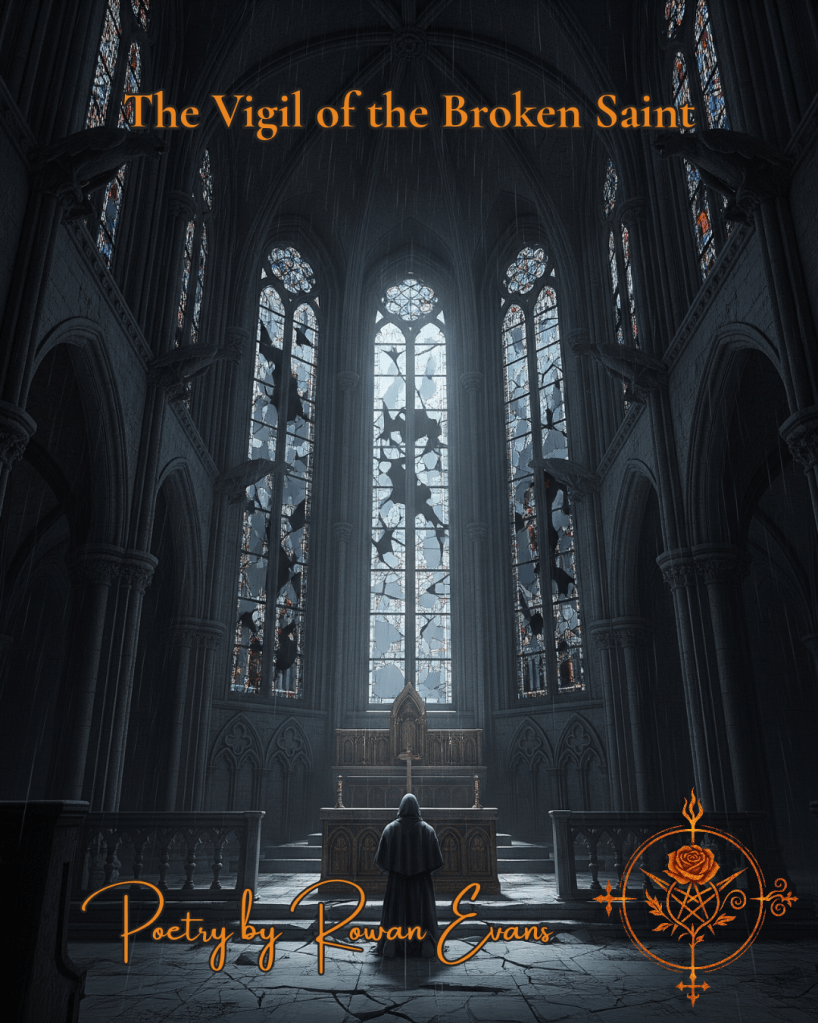
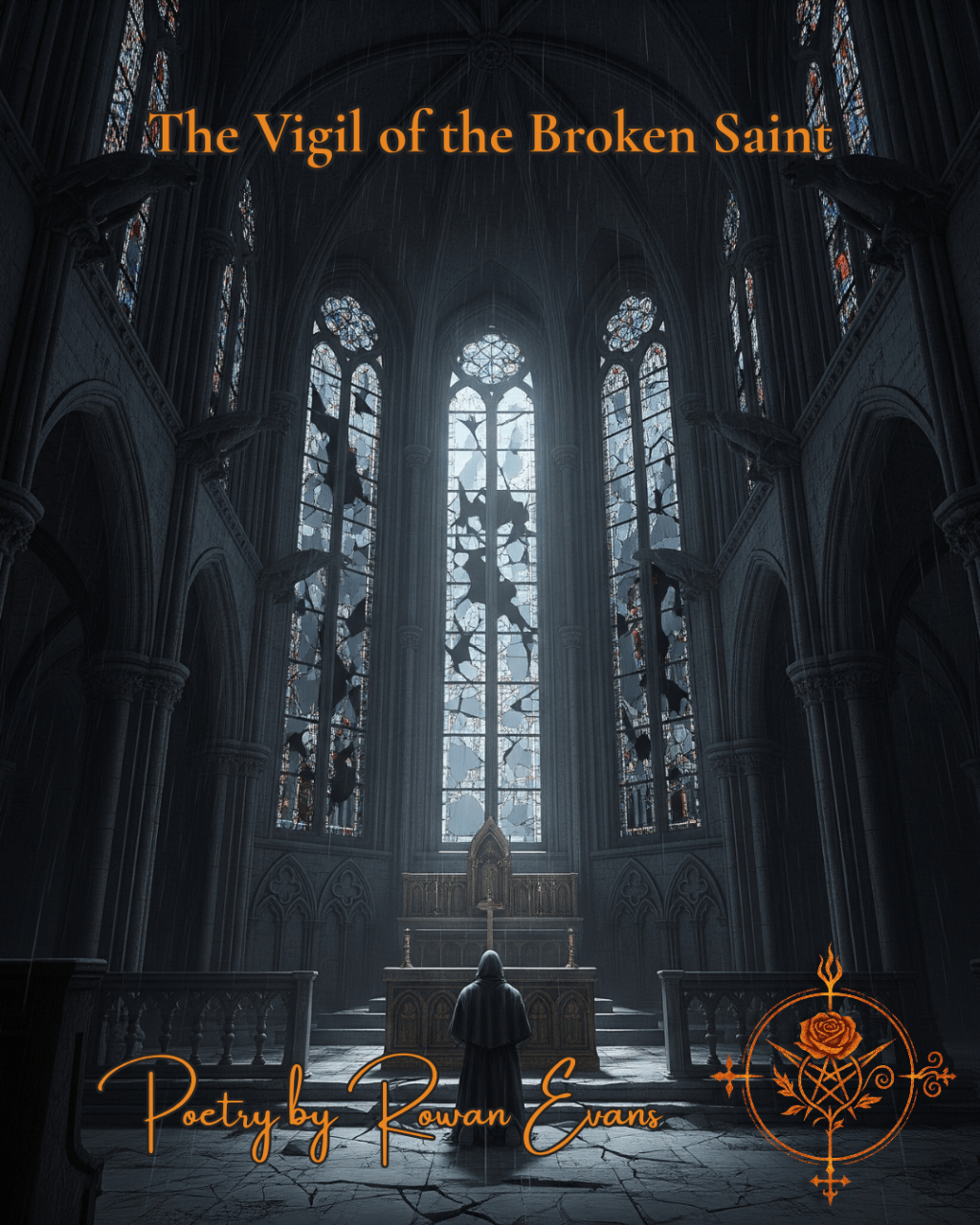
    A lone vigilante kneels in a ruined gothic cathedral lit by moonlight through shattered stained glass, stone gargoyles above.
    A cathedral of shadows, where devotion wears bruises and hope decays into prayer.

    The Vigil of the Broken Saint
    Prose by Rowan Evans


    I keep vigil in a cathedral of bone and sorrow — arches aching heavenward, ribs of stone bruised by night’s embrace.
    The city itself becomes my chapel: alleys the dark nave, gargoyles my silent witnesses, gargling rain and secrets.

    I wear grief like a monk’s habit, dyed black as confession and heavier than sin.
    Each night, I descend into prayer not with folded hands but with clenched fists — my psalms spoken in bruises and fractured breath.

    The stained glass here is cracked beyond repair: memories of a pearl necklace scattering like small white prayers on asphalt; a boy’s scream swallowed by gun smoke.
    Their colors are gone — only shards remain, catching no dawn, only moonlight and guilt.

    This city does not absolve.
    Its concrete saints are headless, the altar cold as a tombstone.
    I press my forehead to it anyway, blood wetting stone: a silent offering for a father who cannot forgive, a mother who cannot speak.

    Pain becomes sacrament.
    Every scar is a prayer bead, every fracture an unanswered supplication.
    The creed etched in marrow: Vengeance is devotion. Sacrifice is absolution.
    And when my knees ache from the stone, I rise still unredeemed.

    Yet night after night, I return.
    Drawn back to this ruined chapel by ghosts draped in shadow and sorrow.
    The gargoyles never weep, but I have learned to cry behind the cowl — hot salt hidden in darkness.

    Even the bats above seem to mourn with me, their wings whispering sermons in a language of hunger and hollow echo.
    My breath fogs in the cold, each exhale a psalm of stubborn defiance.

    There is no redemption here.
    Only the soft rot of hope turned grave-cold and the ache that will not leave.
    Still, I remain — bruised, unholy, unrepentant — because this, too, is devotion: to rise, even damned, and walk the city’s labyrinth once more.


    ☽ Benediction ☾

    May the ruin remember why it loved you.
    May the bruises become scripture.
    And though no salvation comes,
    may your broken vigil remain holy in its endlessness.


    🔗 You might also enjoy…

    Every vigil casts its own shadow.
    If The Vigil of the Broken Saint has found a quiet corner in your marrow, you may also wander these chapels of ruin and devotion:

    The Vigil of the Clown Prince
    The Vigil of the Twisted Harlequin
    The Vigil of the First Son

    Each is a prayer, a confession, a testament carved in bruise, bone, and breath.

    Therapy in Arkham
    Infinity Within – Plus Credits & End Credit Scene

    ✒️ If my words speak to you, and you’d like to help keep this flame burning — or if you’d like a custom poem woven just for you (or someone dear) — you can do so here:

    Ko-fi – Poetry by Rowan Evans

  • 🌙 Introduction:

    Some poems are not written for applause, but for absolution.
    This piece is a quiet communion between who I was and who I’ve become—a candlelit conversation beside the grave of a name I no longer wear.

    Epistle to the Name They Buried isn’t just mourning—it’s reverence, rebellion, and the strange tenderness of speaking to your own epitaph. It belongs to those of us who had to die in one skin to keep living in another.

    A confessional, gothic prayer carved in ink and bone.


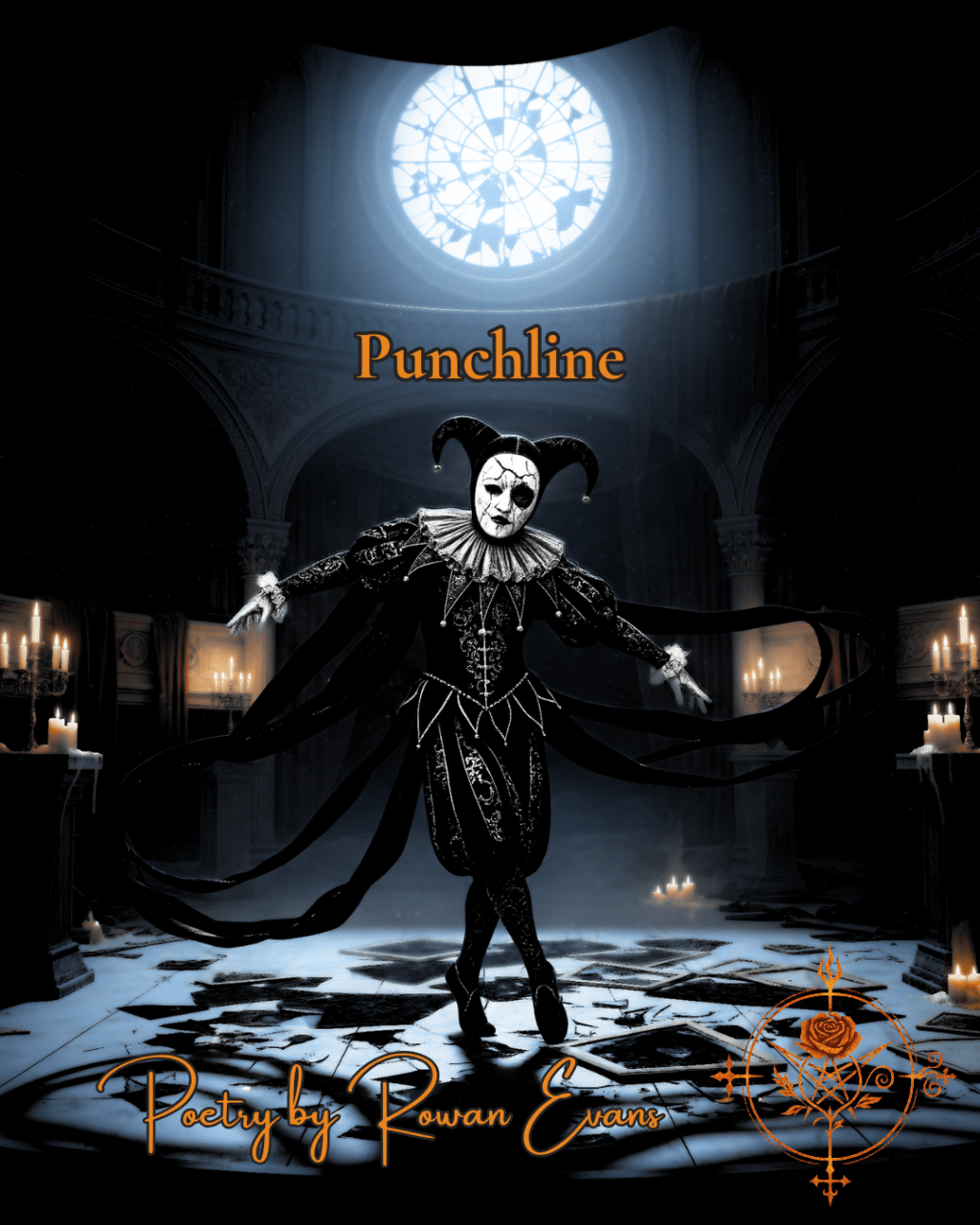
    Misty graveyard at dawn eith an aged, moss-covered headstone, surrounded by fallen leaves and soft light—evoking themes of memory, mourning, and poetic reflection.
    A grave worn by time and moss, where memory lingers and silence speaks louder than stone – a companion to words etched in ink and loss.

    “Epistle to the Name They Buried” 
    Poetry by Rowan Evans  
     
    I come here sometimes, 
    to sit by your stone and speak 
    of what we’ve written— 
    how the ink clots differently now, 
    how our verses bleed slower, 
    but deeper. 
     
    The air tastes of iron and rain-rotted leaves, 
    sweetness gone septic by memory’s rust. 
    Moss clings to angel wings cracked by seasons, 
    and candle wax congeals like old scars 
    around the base of your headstone. 
     
    It feels strange to call it my journey— 
    I slip, name it ours, 
    because you were there in every stanza 
    before breath believed it meant living. 
    We kept each other alive, didn’t we? 
    Or at least, we tried. 
     
    The ravens have grown used to us; 
    they watch from leaning crosses, 
    black eyes reflecting a sky too tired to weep. 
    Marble chills my bones 
    even through the futile armor of my coat, 
    and somewhere between your silence 
    and my confession, 
    the wind drags secrets through the brittle grass. 
     
    I tell you of the poems that found breath, 
    the ones that died in drafts, 
    the nights the pen trembled 
    with something close to resurrection. 
    Of hands ink-stained and shaking, 
    whispering prayers to gods 
    I no longer believe in— 
    yet still feel breathing in the margins. 
     
    And at last, I look down: 
    see the name carved deep in stone, 
    letters heavy as bone dust, 
    foreign on my tongue now, 
    wrong in a way the earth itself seems to know. 
     
    It’s my grave I’ve been speaking to, 
    but not the me I chose— 
    a monument to the son they mourned, 
    while I, reborn in ink and ruin, 
    keep breathing just beyond the epitaph.


    🕯 Closing Reflection:

    We often imagine rebirth as triumphant, but sometimes it feels like sitting in the rain, whispering to a name that still echoes in family tombstones and dusty memories.
    And yet—even here, in the quiet decay—there’s a strange, stubborn grace: the knowledge that what was buried wasn’t the end, but the beginning of something truer.

    Thank you for bearing witness to this epistle.
    If it resonates—know that you, too, are allowed to speak back to the name they buried. And to keep breathing beyond your own epitaph.


    🔗 You Might Also Enjoy…
    Cathedral of Cattails & Confessions

    Gospel of Softness III

    Cathedral of My Waiting

    Weight of Wonder

    Unapologetically Biased

  • Last night, sleep opened its velvet throat—
    and I fell into the hush between heartbeats,
    where the walls of the world breathe slow,
    and time forgets its name.

    He stood there.
    My father—
    not as ash in the urn,
    but as shadow sewn in dreamlight,
    his voice a paper lantern in the fog.

    He said something.
    Words folded in half,
    creased like love letters unsent.
    A tongue I should have known
    but could not parse—
    like trying to read raindrops
    as they run down glass.

    His eyes were galaxies
    just out of reach—
    all gravity, no ground.
    He smiled like someone
    who’s seen the ending
    and can’t explain it.

    Was it a message?
    A map?
    A test?

    He left me with nothing but silence
    stitched in silk and salt,
    and the ache of unlearned riddles
    tattooed across my chest.

    Now I sit beneath the fig tree of my grief,
    its fruit swollen with unsaid things.
    I peel back memory like skin,
    searching for symbols in marrow,
    for parables in pulse.

    What was I meant to understand?
    That love does not end,
    only alters its architecture?
    That the dead do not speak in answers,
    but in echoes
    and invitations?

    Some lessons aren’t given.
    They’re grown—
    like thorns
    from the same vine as the rose.

    And maybe
    that was the point.