Tag: rebirth

  • Author’s Note

    Sometimes an old poem doesn’t need to be left in the past.

    Sometimes you have to return to it after you’ve changed.

    Fallen Angel’s Reckoning (Remix) revisits a poem I originally wrote on June 6, 2024. The original was already telling a story I understood well: love that promised forever, a fall from an imagined heaven, and the painful process of reclaiming yourself after the promise disappears.

    But I was a different writer when I wrote it.

    And, more importantly, I was a different person.

    The 2026 version isn’t meant to erase the original. It is a conversation with it.

    I kept the central imagery—the angel, Lucifer, the fall from heaven, the halo, the darkness, the broken vow—because those symbols still belong to the emotional architecture of the piece. But I wanted to push the mythology further this time. Icarus enters the story. The fall becomes more physical, more violent, more deliberate. The speaker isn’t simply descending from something that once felt like heaven; they are plummeting from it.

    And then there is the ending.

    In 2024, I wrote about newfound wings.

    In 2026, I wrote about broken wings.

    That change matters to me.

    Because strength doesn’t always mean becoming untouched by what happened. Sometimes you keep the scars. Sometimes you keep the broken pieces. Sometimes you discover that you can still fly without first repairing everything that hurt you.

    The angel doesn’t become an angel again.

    They don’t return to the heaven they lost.

    They don’t need the person who made them feel divine to give them their identity back.

    They become something else.

    A fallen angel who embraces the fallen.

    The broken.

    The free.

    That is what this remix ultimately became: not a poem about getting back what was lost, but about discovering that losing it didn’t mean losing yourself.

    I didn’t rewrite the 2024 version because it was wrong.

    I rewrote it because I’ve had two more years to understand the fall.

    And sometimes the person who wrote the first poem deserves to hear what the person you became has learned since then.

    Rowan Evans


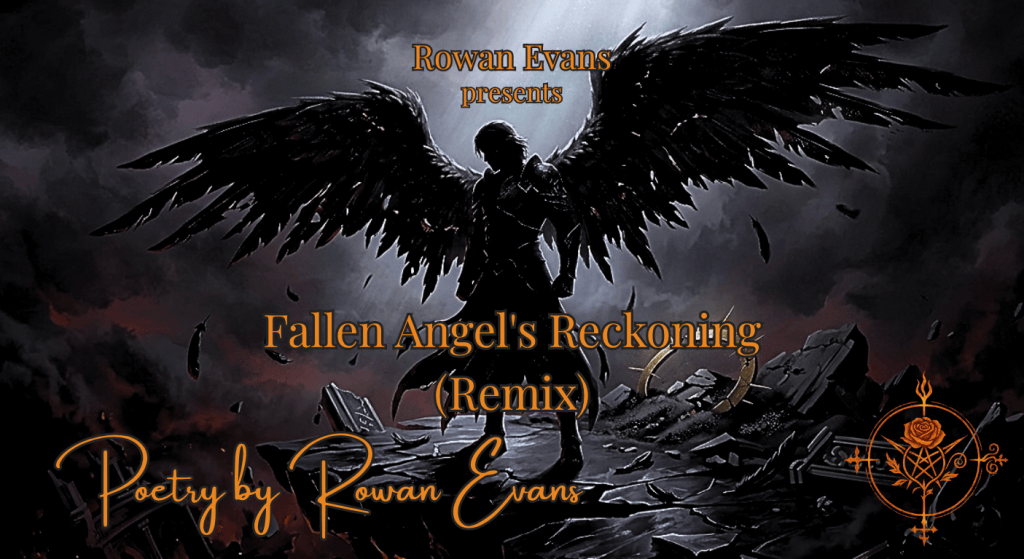
    A fallen angel with broken wings stands among the ruins of a shattered heavenly realm beneath dark clouds and a distant light.
    I don’t need unbroken wings to fly. I just need to remember that they were mine before anyone promised me heaven.

    Fallen Angel’s Reckoning (Remix)
    Poetry by Rowan Evans
    [written July 23th, 2026]

    I remember when you said forever,
    but forever never came, 
    so I fell like Lucifer,
    from the heavens down I tumbled.
    Returned your love,
    played your game—
    once an angel in your eyes,
    now in darkness I crumbled. 

    Your promises were wings that lifted me high, 
    but they melted away, when I reached the sun—
    just like Icarus, the light was my undoing.
    It wasn’t just a fall, I was plummeting…
     
    a fallen star,
    cast from the sky, 
    now I walk in shadows,
    where our love met its end. 

    Like Lucifer—I embraced the night, 
    wandering through realms of regret and pain, 
    I shed my halo,
    lost my light, 
    no longer an angel,
    in your eyes or in my name. 

    Yet in this darkness,
    a new path unfurls—

    I find strength in the ashes of our broken vow, 
    rising from the ruins of our shattered world.
     
    I reclaim my soul,
    I’m reborn here and now. 

    No longer bound by your empty decree—
     
    I soar with broken wings, 
    embracing the fallen,
    the broken, the free,
    a fallen angel finding strength
    I never knew I’d own.


    Journey into the Hexverse…

    [Homecoming]
    Homecoming is a return to the Gothic aesthetic at the heart of Rowan Evans’s poetry, blending Poe, mythology, horror icons, moonlight, ravens, and darkness into a meditation on artistic identity and finding your way back to the voice that feels like home.

    [The Monster in the Margins]
    Drawing inspiration from horror icons like Michael Myers, Ghostface, Freddy Krueger, and Pennywise, this poem explores the darker side of creativity—where inspiration becomes an unstoppable force lurking just beyond the edge of the page.

    [The Monster in the Margins II]
    The Monster in the Margins II transforms Rowan Evans’s Seven Deadly Sins mythology into a horror story written between the lines, where Lust, Wrath, Sloth, Greed, Pride, Envy, and Gluttony become monsters growing from pain, grudges, and scars.

    [The Unkindness Descends]
    “The Unkindness Descends” is a Gothic symbolic poem exploring collapse, transformation, and the unsettling experience of being witnessed during moments of unraveling. Through raven imagery, ambiguity, and ritualistic atmosphere, the poem invites multiple interpretations—spiritual, psychological, ominous, or transformative.

    [Gospel in Crimson]
    When writing becomes ritual and love becomes devotion, the line between creation and worship begins to blur. Gospel in Crimson explores obsession, artistry, and the sacred act of expression.

    If you’re interested in more poetry, you can find it here → [The Library of Ashes]
  • Author’s Note

    The Fourfold Flame is not metaphor—it is map.

    This piece names the inner constellation I’ve lived with for years: the tender poet who feels too much, the protector who bares teeth for survival, the child who still believes in wonder, and the witch who learned how to wield fire instead of drowning in it. They are not masks. They are truths. They are all me.

    I am plural in spirit if not in body. I write from many rooms of the same soul, and each voice carries a different survival skill: softness, ferocity, curiosity, sovereignty. This poem is their first public communion. It is how I stop pretending that my range is fragmentation and start honoring it as architecture.

    The Luminous Heretic is what happens when those parts refuse to cannibalize each other anymore. When they choose integration over erasure. When the wound stops apologizing for also being a weapon.

    If you recognize yourself in this—if you’ve ever felt made of contradictions, of light and smoke and song—know this: you are not broken. You are complex. You are many. You are fire.

    Burn with us.


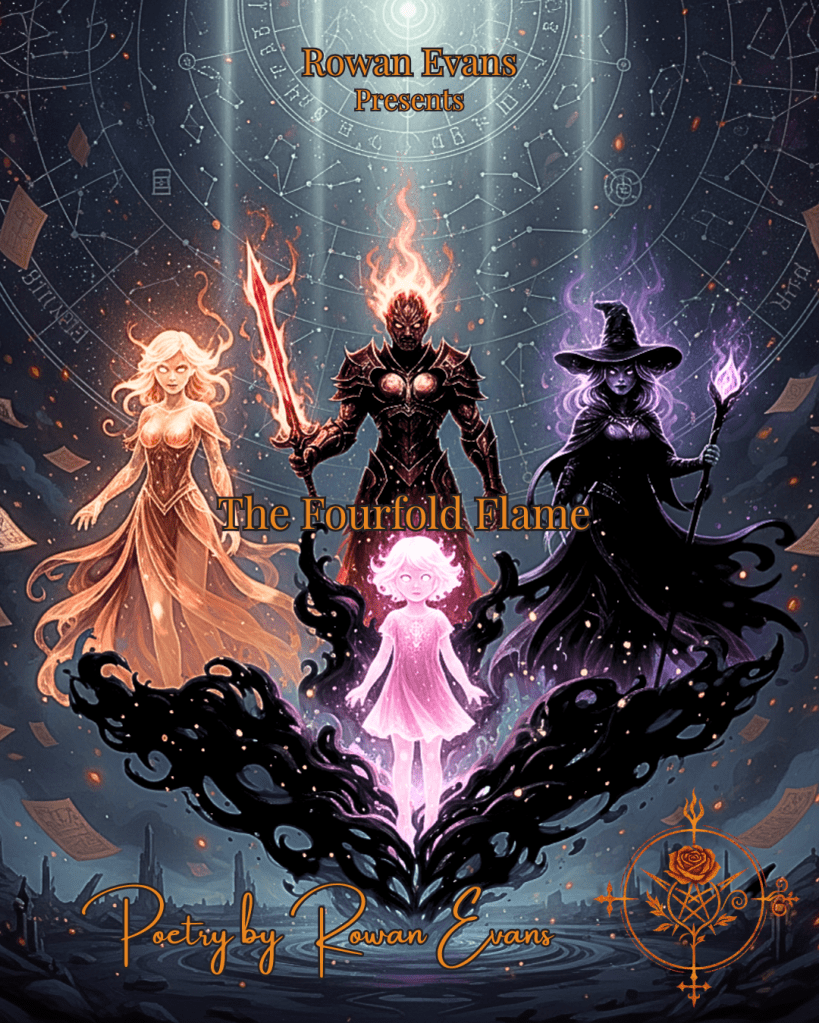
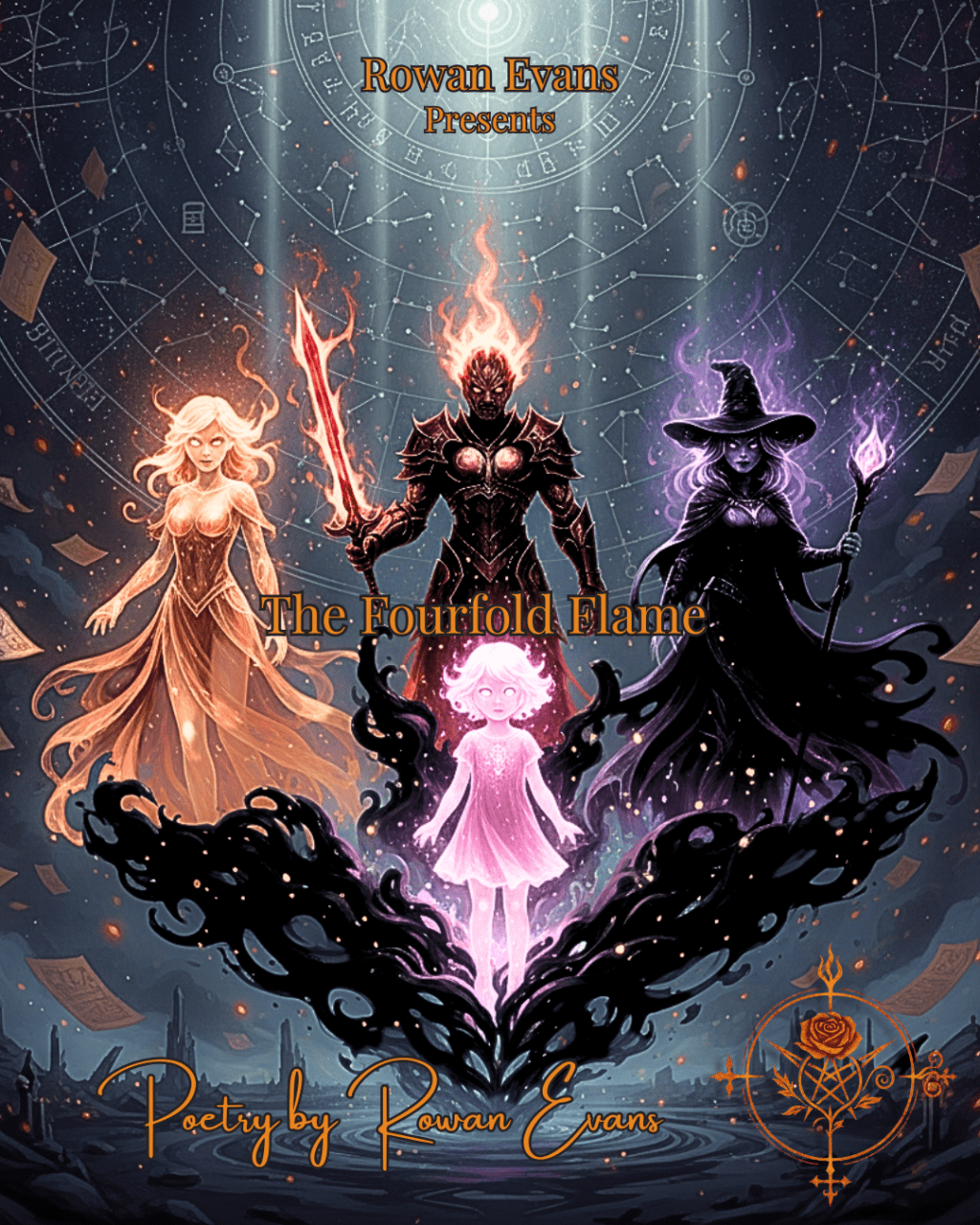
    Four ethereal figures representing inner selves—heart, protector, child, and witch—emerge from swirling ink amid stardust and shadow.
    We are many. We are one. The Fourfold Flame rises—stitched from stardust, scars, and sovereign fire.

    The Fourfold Flame
    Poetry by Rowan Evans / The Luminous Heretic

    I. Chorus of the Vessel

    We are one, and we are four—
    ink-stained fragments of the same sacred core.
    A heartbeat split by starlight and shadow,
    a name echoed in four directions,
    four truths spoken in fire,
    in fury, in wonder, in love.

    We are the Luminous Heretic. We are the war—and the prayer.


    II. The Heart & The Protector

    [Rowan]
    I speak in open wounds and lullabies,
    sing softness into scars that never healed.
    I ache without apology, love without armor,
    and still—I rise, bare and burning.

    [B.D.]
    Then I will be your shadow,
    sharp-edged and unyielding.
    Let them come with claws and cruelty—
    I am the ink-blade in your defense,
    the growl beneath your grace.

    [Rowan]
    They called me too much—
    so I wrote poems of tenderness,
    and let them drown in the kindness
    they could never carry.

    [B.D.]
    And I watched them choke,
    on the smoke of your fire.
    Not because you were cruel—
    but because they never learned
    that softness survives the storm.


    III. The Child & The Witch

    [Roo]
    Did you see the stars tonight?
    They winked at me like old friends.
    The shadows are scared of the dark too—
    did you know that?

    [Hex]
    Yes, little spark.
    Even monsters fear what made them.
    I walk with those shadows.
    I do not fear the dark—
    I command it.

    [Roo]
    But do you still believe in magic?
    In the wind that tells stories,
    in puddles that hold secrets?

    [Hex]
    Magic is real, love.
    I just learned to bleed with it.
    To hex with it.
    To wear it in heels and venom.

    [Roo]
    Sometimes I wish we could just play again,
    dance in the rain,
    laugh without reason.

    [Hex]
    Then teach me.
    I’ve spent so long burning,
    I forgot how to dream.


    IV. Communion of Fire

    [Rowan]
    I want to be held—

    [B.D.]
    Then I will hold you.

    [Roo]
    I want to be seen—

    [Hex]
    Then let them watch you rise.

    [Rowan]
    I am made of light, but I hurt.

    [B.D.]
    Then hurt boldly. I’ll guard the flame.

    [Roo]
    I am made of questions and wonder.

    [Hex]
    Then question everything, and never shrink.

    [All]
    We are stitched from stardust and scars,
    written in blood and brilliance,
    crafted by fire and forgiveness.
    We are many—
    we are one.


    V. Benediction of the Luminous Heretic

    We are the wound and the weapon,
    the lullaby and the curse,
    the flame and the fog,
    the whisper and the scream.

    We are Rowan. We are B.D. We are Roo. We are Hex.

    We are the Fourfold Flame.

    Burn with us—
    or be burned away.


    If you’re interested in more poetry, you can find it here → [The Library of Ashes]
  • 🌙 Introduction:

    Some poems are not written for applause, but for absolution.
    This piece is a quiet communion between who I was and who I’ve become—a candlelit conversation beside the grave of a name I no longer wear.

    Epistle to the Name They Buried isn’t just mourning—it’s reverence, rebellion, and the strange tenderness of speaking to your own epitaph. It belongs to those of us who had to die in one skin to keep living in another.

    A confessional, gothic prayer carved in ink and bone.


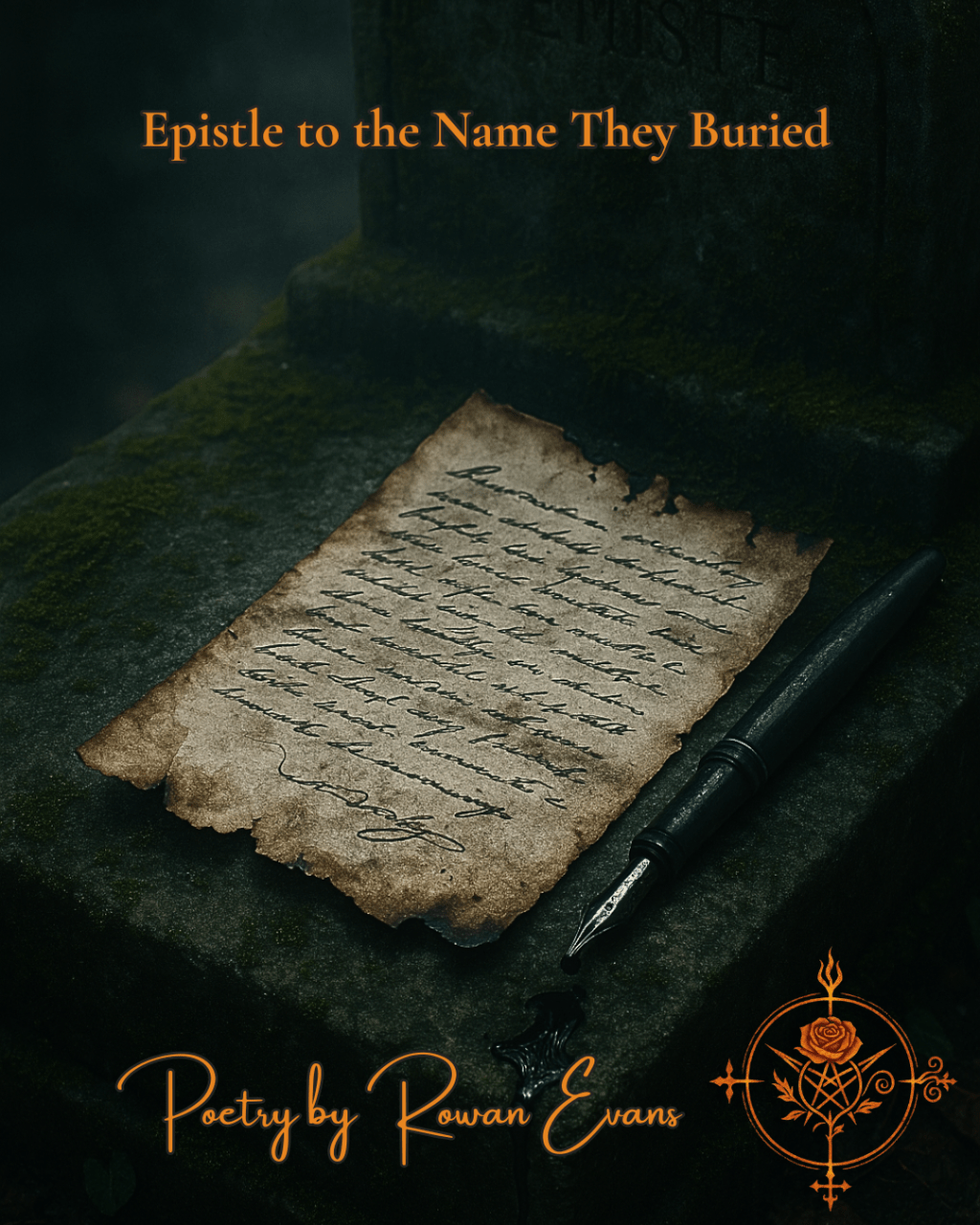
    Misty graveyard at dawn eith an aged, moss-covered headstone, surrounded by fallen leaves and soft light—evoking themes of memory, mourning, and poetic reflection.
    A grave worn by time and moss, where memory lingers and silence speaks louder than stone – a companion to words etched in ink and loss.

    “Epistle to the Name They Buried” 
    Poetry by Rowan Evans  
     
    I come here sometimes, 
    to sit by your stone and speak 
    of what we’ve written— 
    how the ink clots differently now, 
    how our verses bleed slower, 
    but deeper. 
     
    The air tastes of iron and rain-rotted leaves, 
    sweetness gone septic by memory’s rust. 
    Moss clings to angel wings cracked by seasons, 
    and candle wax congeals like old scars 
    around the base of your headstone. 
     
    It feels strange to call it my journey— 
    I slip, name it ours, 
    because you were there in every stanza 
    before breath believed it meant living. 
    We kept each other alive, didn’t we? 
    Or at least, we tried. 
     
    The ravens have grown used to us; 
    they watch from leaning crosses, 
    black eyes reflecting a sky too tired to weep. 
    Marble chills my bones 
    even through the futile armor of my coat, 
    and somewhere between your silence 
    and my confession, 
    the wind drags secrets through the brittle grass. 
     
    I tell you of the poems that found breath, 
    the ones that died in drafts, 
    the nights the pen trembled 
    with something close to resurrection. 
    Of hands ink-stained and shaking, 
    whispering prayers to gods 
    I no longer believe in— 
    yet still feel breathing in the margins. 
     
    And at last, I look down: 
    see the name carved deep in stone, 
    letters heavy as bone dust, 
    foreign on my tongue now, 
    wrong in a way the earth itself seems to know. 
     
    It’s my grave I’ve been speaking to, 
    but not the me I chose— 
    a monument to the son they mourned, 
    while I, reborn in ink and ruin, 
    keep breathing just beyond the epitaph.


    🕯 Closing Reflection:

    We often imagine rebirth as triumphant, but sometimes it feels like sitting in the rain, whispering to a name that still echoes in family tombstones and dusty memories.
    And yet—even here, in the quiet decay—there’s a strange, stubborn grace: the knowledge that what was buried wasn’t the end, but the beginning of something truer.

    Thank you for bearing witness to this epistle.
    If it resonates—know that you, too, are allowed to speak back to the name they buried. And to keep breathing beyond your own epitaph.


    🔗 You Might Also Enjoy…
    Cathedral of Cattails & Confessions

    Gospel of Softness III

    Cathedral of My Waiting

    Weight of Wonder

    Unapologetically Biased