Author’s Note
This poem is the second part of an experiment I started in Crossing the Sea—an attempt to write without leaning on metaphor, or at least to notice when metaphor appears even when I’m trying not to use it.
The first piece focused on direction: the place I’m moving toward, the literal ocean I have to cross to get there. But I realized that before I could talk honestly about where I’m going, I needed to talk honestly about why I’m leaving.
That’s what this poem is.
It’s the part I’ve always written around instead of through.
The part I’ve buried under tides, distance, storms, and moonlight.
The part I’ve hinted at for years without ever saying plainly.
The truth is simple, even if it took me a long time to say it:
I’ve never felt at home in the country where I grew up.
Not in childhood.
Not in adulthood.
Not in all the years in between.
It’s a quiet ache—persistent, steady, familiar.
Not dramatic, not catastrophic, just a sense of misalignment I’ve carried since I was fourteen. A feeling of being held in a place I never belonged to, waiting for a life that didn’t start here.
I’ve called it restlessness.
I’ve called it longing.
I’ve called it distance.
Eventually, I called it the ocean.
But naming it directly felt necessary.
Not to erase the metaphors, but to understand what they were protecting.
This poem is that attempt.
Not a rejection of metaphor, but a recognition of the truth beneath it.
— Rowan Evans
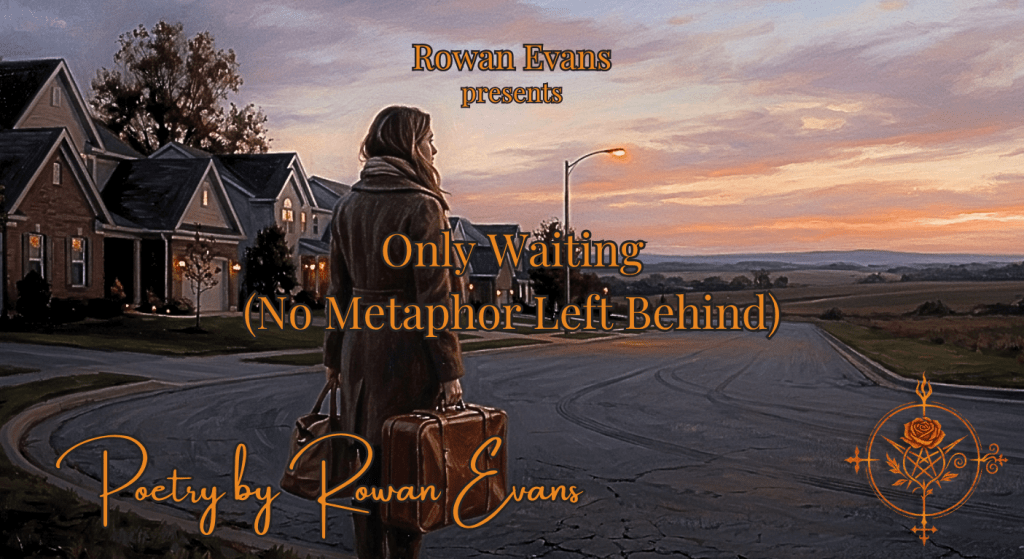
Only Waiting (No Metaphor Left Behind)
Poetry by Rowan Evans
Turn the page,
I’ve got more to say.
I’ll try again
not to hide behind
metaphors
and coded lines.
Last time—
I talked about the destination,
the place I’m moving toward.
This time—
I’m going to talk about the ache.
The persistent empty feeling
that I’ve been feeling since I was fourteen.
I’ve written about it before
woven in metaphors.
But this time I’m going to try
and say it plain.
It’s the ache of living in a place
that never felt like mine.
Not once.
Not in childhood,
not in adulthood,
not in all the years in between.
People talk about home
like it’s a given—
a birthplace,
a neighborhood,
a country that shaped them.
But I never felt shaped by this place.
Only held in it.
Only waiting.
I learned early
that you can grow up somewhere
and still feel like a visitor.
You can know every street
and still feel lost.
You can speak the language
and still feel unheard.
Since fourteen,
I’ve carried this quiet emptiness—
not dramatic,
not catastrophic,
just a steady sense
that I was meant to be somewhere else,
and somehow ended up here instead.
I used to call it restlessness.
Then longing.
Then distance.
Then the ocean.
But the truth is simpler:
I’ve never felt at home
in the country that raised me.
Journey into the Hexverse…
[Crossing the Sea (No Metaphor Left Behind)]
A deeply personal poem about relocation, longing, and the realization that some truths naturally arrive through metaphor—even when we try to leave it behind.
[Translating What I Feel]
A poem about the invisible process of turning emotion into imagery, imagery into language, and language into poetry. An intimate reflection on creativity, loneliness, and twenty-three years of learning to translate what the heart feels.
[Maybe You’ll Want Me Too]
A poem about the subtle shift from knowing someone to constantly thinking about them. Through humor, metaphor, and confession, Maybe You’ll Want Me Too explores affection, attachment, and the fragile hope that being wanted might matter more than being needed.
[Recognizes Home]
A free-verse poem exploring the difference between love as dependency and love as choice. It challenges the idea that love must be need-based, instead centering the quiet strength of choosing someone while still remaining whole on your own.
[Not Rebuilding You]
A poem about love as an act of presence rather than rescue. Through construction imagery, Not Rebuilding You explores trust, devotion, emotional safety, and the quiet work of building a foundation strong enough for healing to grow.
If you’re interested in more poetry, you can find it here → [The Library of Ashes]


Leave a Reply