Tag: home

  • Author’s Note

    This poem became the quiet conclusion to a trilogy I never intended to write.

    Crossing the Sea was about direction.

    Only Waiting was about the reason I needed that direction in the first place.

    This piece asks a different question:

    How do you keep moving when you haven’t arrived yet?

    For me, the answer has always been dreams.

    Not because I confuse them with reality, but because they remind me that another reality is possible.

    I’ve written about dreams for years. They rarely feel random to me. They often feel like rehearsals—small glimpses of a life my mind already believes exists somewhere beyond the horizon.

    The city in this poem isn’t a specific city.

    The moon isn’t really the moon.

    Even after spending two poems trying to strip away metaphor, I found myself sitting beside it again.

    I think that’s because hope has always spoken to me symbolically.

    When I’m awake, I know where I am.

    When I’m asleep, I remember where I’m going.

    The dream doesn’t replace reality.

    It sustains me until reality catches up.

    The final image—a dream folded into my chest like a map—is probably the clearest way I’ve ever described hope.

    Hope isn’t certainty.

    It isn’t arrival.

    It’s carrying the direction with you, even when you’re still standing at the beginning of the journey.

    And maybe that’s what this trilogy has been trying to say all along.

    Sometimes home begins as a place.

    Sometimes it becomes an ache.

    Sometimes…

    it’s simply the direction you’re already walking.

    Rowan Evans


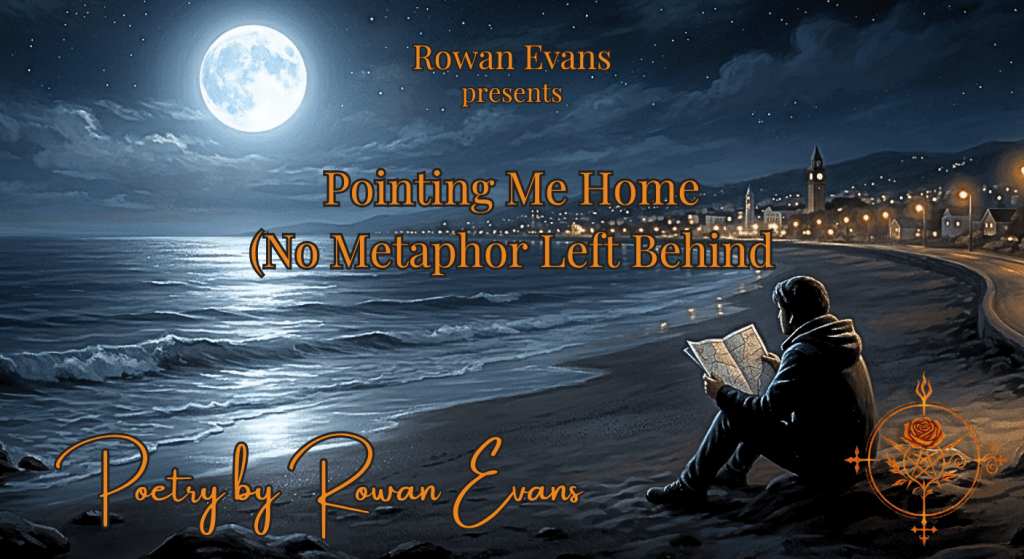
    A lone figure sits beneath a full moon where an ocean shoreline transitions into quiet city streets, holding a folded map while reflecting on hope, dreams, and the journey toward home.
    “Sometimes home isn’t where you’re standing—it’s the direction you’re already walking.” 🌙🗺️

    Pointing Me Home (No Metaphor Left Behind)
    Poetry by Rowan Evans

    Tick tock, tick tock—
    that’s the sound of the clock.
    I listen as I wait for the escape,
    a simple trip, brought on by sleep.
    Because I only feel at home
    in my dreams.

    So as I close my eyes
    and my head hits the pillow—
    I follow the moon
    to the ocean’s edge,
    I listen to the tide—
    I follow it in stride
    until I find where it’s pulling me.

    With every step,
    I move deeper in.
    Slowly sand turns to concrete
    beneath my feet,
    as the beach transitions
    into city streets.

    Streetlights flicker
    like they’re remembering
    they used to be stars.

    The hum of the city
    folds into the sound of waves,
    each echo a reminder
    of where I started
    and where I’m going.

    I walk until the moon
    hangs between buildings
    like it’s lost too—

    like it’s looking for someone to talk to.

    So I sit and conversate,
    I tell the moon all about the quiet ache—
    the feeling that I need to change
    my environment to one that aligns
    more with what I feel inside.

    And the moon sits with me,
    just listening—so I talk some more.
    Out of my heart, the words just pour.
    I spill every secret, I hold nothing back
    until I feel like I might collapse.

    The moon listens,
    patient as ever,
    its light softening
    the edges of my thoughts.

    And when I finally fall silent,
    breath trembling,
    chest heavy—

    it tilts itself
    just enough
    to remind me
    I’m not alone
    in the places I wander.

    Tick tock, tick tock.

    A return to the rhythm of the clock,
    interrupting the talk—
    the moon’s light gives way
    to the sun’s rays,
    I’m still stuck in this place—

    but I’m only waiting
    until I can cross the sea,
    Pacific and the Philippine.

    Until then,
    I carry the dream like a map,
    folded in my chest—

    pointing me home.


    Journey into the Hexverse…

    [Crossing the Sea (No Metaphor Left Behind)]
    A deeply personal poem about relocation, longing, and the realization that some truths naturally arrive through metaphor—even when we try to leave it behind.

    [Only Waiting (No Metaphor Left Behind)]
    The second poem in the No Metaphor Left Behind series, exploring the quiet ache of growing up in a place that never truly felt like home—and finally saying aloud what years of metaphor had been trying to express.

    If you’re interested in more poetry, you can find it here → [The Library of Ashes]
  • Author’s Note

    Some dreams stay with me because of what happens in them.

    Others stay because of how they make me feel after I wake up.

    This poem belongs to the second kind.

    Lately, I’ve found myself dreaming about places I’ve never lived but somehow recognize. Cities that feel familiar before I arrive. Streets that carry a strange sense of belonging. When I wake, there’s often a brief moment where those places feel more like home than the room I’m actually in.

    That feeling became the heart of this piece.

    The image of a phone call arrived almost immediately. Not as a literal phone, but as the unmistakable sensation that something beyond my current life keeps trying to get my attention. The title came from asking myself what that call would look like if it appeared on a screen.

    Caller ID: Destiny.

    The final stanza is probably the most honest part of the poem.

    It’s not really about wanting to sleep.

    It’s about wanting to wake up somewhere that feels like I’m finally living the life I’ve been moving toward for years.

    Sometimes dreams aren’t an escape from reality.

    Sometimes they’re reminders that another future still feels possible.

    Rowan Evans


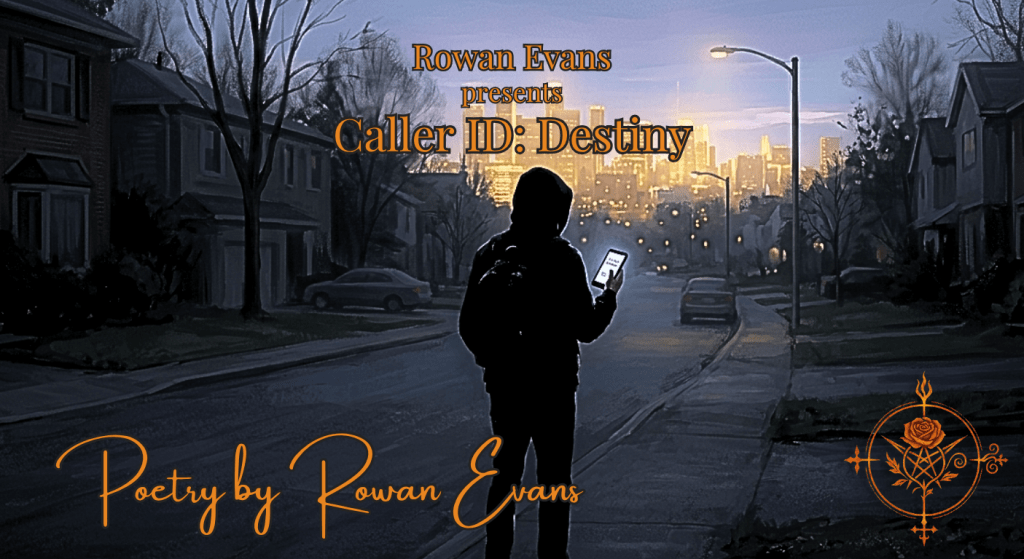
    A person standing alone on a quiet street at dawn holding a glowing phone that reads "Caller ID: Destiny," while a luminous dreamlike city shines in the distance.
    Sometimes the loudest call doesn’t come from a phone—it comes from the life waiting for you beyond the horizon.

    Caller ID: Destiny
    Poetry by Rowan Evans

    As the haze of sleep
    finally leaves,
    I find myself missing
    the dreams.

    In my sleep
    I walk the streets
    in the places
    that are calling me.

    It’s like my phone is ringing
    off the hook—

    caller id reads:
    Destiny.

    Message received:
    “Time to leave.”

    I’m done begging
    where I’m from—
    to notice me.

    I feel seen
    in my dreams,
    and invisible
    in my streets.

    So I’d rather sleep
    than be awake
    in this state.


    Journey into the Hexverse…

    [Crossing the Sea (No Metaphor Left Behind)]
    A deeply personal poem about relocation, longing, and the realization that some truths naturally arrive through metaphor—even when we try to leave it behind.

    [Only Waiting (No Metaphor Left Behind)]
    The second poem in the No Metaphor Left Behind series, exploring the quiet ache of growing up in a place that never truly felt like home—and finally saying aloud what years of metaphor had been trying to express.

    [Returning to My Bones]
    Some dreams fade the moment we wake. Others leave behind emotions that linger long after reality returns. Returning to My Bones explores the strange grief of leaving a dream that felt real enough to matter.

    [Before My Feet Touch the Floor]
    What happens when your dreams feel more real than your waking life? Before My Feet Touch the Floor explores the strange grief of waking up, the lingering memory of dream selves, and the quiet question of which version of us is truly real.

    If you’re interested in more poetry, you can find it here → [The Library of Ashes]
  • Author’s Note

    This poem is the second part of an experiment I started in Crossing the Sea—an attempt to write without leaning on metaphor, or at least to notice when metaphor appears even when I’m trying not to use it.

    The first piece focused on direction: the place I’m moving toward, the literal ocean I have to cross to get there. But I realized that before I could talk honestly about where I’m going, I needed to talk honestly about why I’m leaving.

    That’s what this poem is.

    It’s the part I’ve always written around instead of through.
    The part I’ve buried under tides, distance, storms, and moonlight.
    The part I’ve hinted at for years without ever saying plainly.

    The truth is simple, even if it took me a long time to say it:

    I’ve never felt at home in the country where I grew up.

    Not in childhood.
    Not in adulthood.
    Not in all the years in between.

    It’s a quiet ache—persistent, steady, familiar.
    Not dramatic, not catastrophic, just a sense of misalignment I’ve carried since I was fourteen. A feeling of being held in a place I never belonged to, waiting for a life that didn’t start here.

    I’ve called it restlessness.
    I’ve called it longing.
    I’ve called it distance.
    Eventually, I called it the ocean.

    But naming it directly felt necessary.
    Not to erase the metaphors, but to understand what they were protecting.

    This poem is that attempt.
    Not a rejection of metaphor, but a recognition of the truth beneath it.

    Rowan Evans


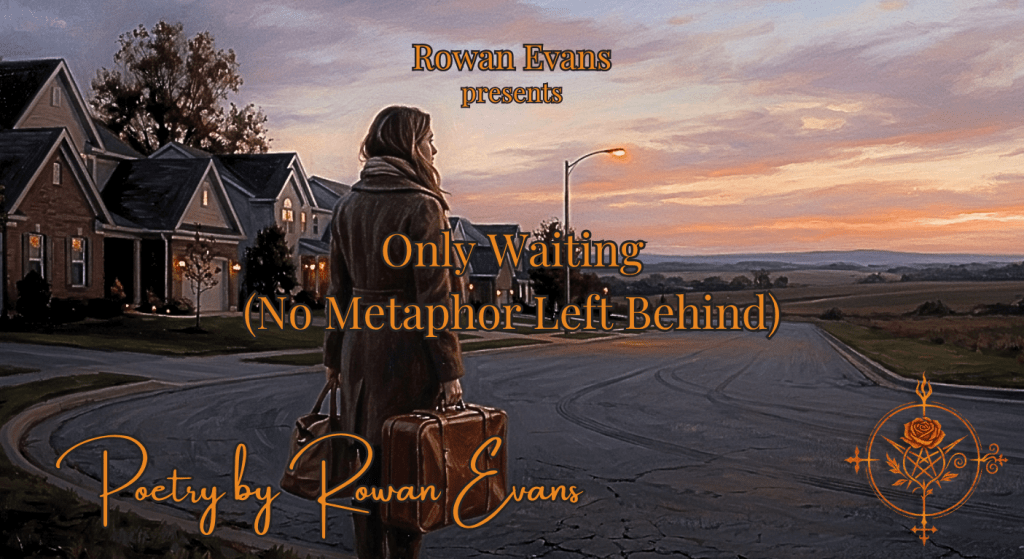
    A traveler stands at the edge of a familiar neighborhood looking toward a distant horizon with a suitcase in hand.
    Sometimes leaving isn’t running away. Sometimes it’s finally walking toward the place that feels like home.

    Only Waiting (No Metaphor Left Behind)
    Poetry by Rowan Evans

    Turn the page,
    I’ve got more to say.

    I’ll try again
    not to hide behind
    metaphors
    and coded lines.

    Last time—
    I talked about the destination,
    the place I’m moving toward.

    This time—
    I’m going to talk about the ache.
    The persistent empty feeling
    that I’ve been feeling since I was fourteen.

    I’ve written about it before
    woven in metaphors.
    But this time I’m going to try
    and say it plain.

    It’s the ache of living in a place
    that never felt like mine.

    Not once.

    Not in childhood,
    not in adulthood,
    not in all the years in between.

    People talk about home
    like it’s a given—

    a birthplace,
    a neighborhood,
    a country that shaped them.

    But I never felt shaped by this place.

    Only held in it.
    Only waiting.

    I learned early
    that you can grow up somewhere
    and still feel like a visitor.

    You can know every street
    and still feel lost.

    You can speak the language
    and still feel unheard.

    Since fourteen,
    I’ve carried this quiet emptiness—
    not dramatic,
    not catastrophic,
    just a steady sense
    that I was meant to be somewhere else,
    and somehow ended up here instead.

    I used to call it restlessness.

    Then longing.

    Then distance.

    Then the ocean.

    But the truth is simpler:
    I’ve never felt at home
    in the country that raised me.


    Journey into the Hexverse…

    [Crossing the Sea (No Metaphor Left Behind)]
    A deeply personal poem about relocation, longing, and the realization that some truths naturally arrive through metaphor—even when we try to leave it behind.

    [Translating What I Feel]
    A poem about the invisible process of turning emotion into imagery, imagery into language, and language into poetry. An intimate reflection on creativity, loneliness, and twenty-three years of learning to translate what the heart feels.

    [Maybe You’ll Want Me Too]
    A poem about the subtle shift from knowing someone to constantly thinking about them. Through humor, metaphor, and confession, Maybe You’ll Want Me Too explores affection, attachment, and the fragile hope that being wanted might matter more than being needed.

    [Recognizes Home]
    A free-verse poem exploring the difference between love as dependency and love as choice. It challenges the idea that love must be need-based, instead centering the quiet strength of choosing someone while still remaining whole on your own.

    [Not Rebuilding You]
    A poem about love as an act of presence rather than rescue. Through construction imagery, Not Rebuilding You explores trust, devotion, emotional safety, and the quiet work of building a foundation strong enough for healing to grow.

    If you’re interested in more poetry, you can find it here → [The Library of Ashes]
  • Author’s Note

    This poem began as an experiment in restraint.

    I wanted to see what would happen if I stopped relying on metaphor—the oceans, tides, moons, and distant imagery that so often shape the way I write—and instead said things as directly as I could.

    What I discovered is that I don’t really think in a “non-metaphorical” way.

    Even when I try to remove symbolism, my mind still reaches for it. The language of distance, direction, and crossing appears naturally because that is how I process emotional states: spatially, geographically, in motion.

    So the poem became something else.

    Not an escape from metaphor, but an awareness of it.

    A recognition that even when I say “I won’t use the ocean this time,” I still understand my life through movement across it.

    This piece lives in that tension between clarity and instinct—between what I am trying to say plainly, and the language my mind naturally returns to.

    And in the end, it admits something simple:

    Sometimes the clearest way to say the truth… is still through the shape of the thing you tried to leave behind.

    Rowan Evans


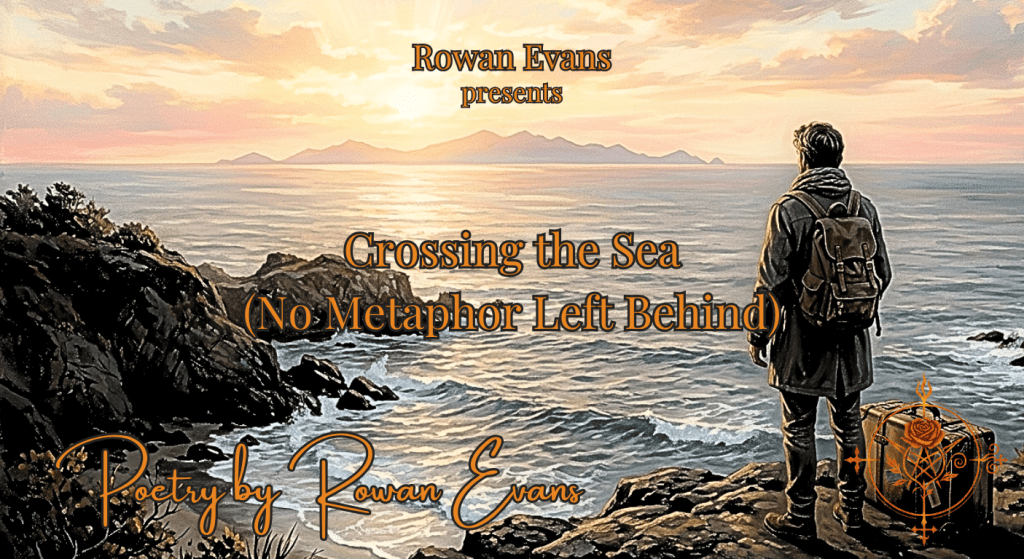
    A lone traveler stands on a Pacific shoreline looking toward distant islands across the ocean at sunrise.
    Some distances are measured in miles. Others are measured in becoming.

    Crossing the Sea (No Metaphor Left Behind)
    Poetry by Rowan Evans

    I am going to try
    something that terrifies me—
    that most of the time,
    would leave me paralyzed.

    I am going to try
    and say everything
    I hold inside—
    no metaphors
    to hide behind
    this time.

    I’m not where
    I want to be
    and part of me,
    thinks I’ll never be.

    I know that’s just
    fear and doubt—

    just because part of me
    thinks it, doesn’t make it true.

    Relocating
    is just taking
    longer than I wanted it to.

    But I know the direction.
    The destination is clear—
    I just got to get there.

    I got to leave here.

    This isn’t a new feeling—
    I’ve said this all before,
    buried in metaphors.

    Hidden behind symbolism.

    This is where
    I’d put the ocean
    and the tide,
    a way to describe
    the distance.

    Between where I am
    and where I want to be—
    and to get there,
    I have to cross the sea.

    Not a metaphor,
    I mean that literally—
    Pacific and the Philippine.


    Journey into the Hexverse…

    [Translating What I Feel]
    A poem about the invisible process of turning emotion into imagery, imagery into language, and language into poetry. An intimate reflection on creativity, loneliness, and twenty-three years of learning to translate what the heart feels.

    [Recognizes Home]
    A free-verse poem exploring the difference between love as dependency and love as choice. It challenges the idea that love must be need-based, instead centering the quiet strength of choosing someone while still remaining whole on your own.

    [Not Rebuilding You]
    A poem about love as an act of presence rather than rescue. Through construction imagery, Not Rebuilding You explores trust, devotion, emotional safety, and the quiet work of building a foundation strong enough for healing to grow.

    [The Language Her Soul Speaks]
    What if love isn’t about being understood, but learning to understand someone else? “The Language Her Soul Speaks” is a free verse poem about intimacy, communication, curiosity, and the desire to know another person beyond the limits of language.

    [Ocean Waves (1, 4, 3)]
    A moonlit shoreline, a rowboat full of ducks, a piggybank with no cents, and a confession hidden in plain sight. Ocean Waves (1, 4, 3) explores how humor, wordplay, and absurdity can become a side door to vulnerability when the truth feels too difficult to say directly.

    [L Words & Heart]
    A playful, self-aware poem about love, longing, loyalty, and the quiet ways another person can reshape our inner world. What begins as humor slowly reveals a heartfelt confession about affection, imagination, and the faces that linger in our dreams.

    [I’ll Be There to See Your Sunrise]
    Love has never come easily to me. This poem explores the fear, vulnerability, and quiet courage required to stay emotionally present when connection begins to matter deeply. “I’ll Be There to See Your Sunrise” is about choosing love despite the risk of heartbreak—and promising to remain long enough to witness someone fully.

    [Altar and Roses]
    A gothic free verse poem about poetic identity, recurring symbolism, devotion, and the quiet humanity beneath dramatic imagery.

    If you’re interested in more poetry, you can find it here → [The Library of Ashes]
  • Author’s Note

    I’ve written around this feeling for years — in metaphors, in longing, in coded language about distance and departure.

    This is the first time I’ve said it this plainly.

    For most of my life, I’ve felt like a visitor in the place I was born. Not in a dramatic way. Not in a rebellious way. Just in a quiet, persistent way that never left.

    This piece isn’t about anger. It isn’t about rejection.

    It’s about finally naming what I’ve always known—
    that sometimes “home” is assigned to you,
    and sometimes it’s something you’re still moving toward.

    Rowan Evans


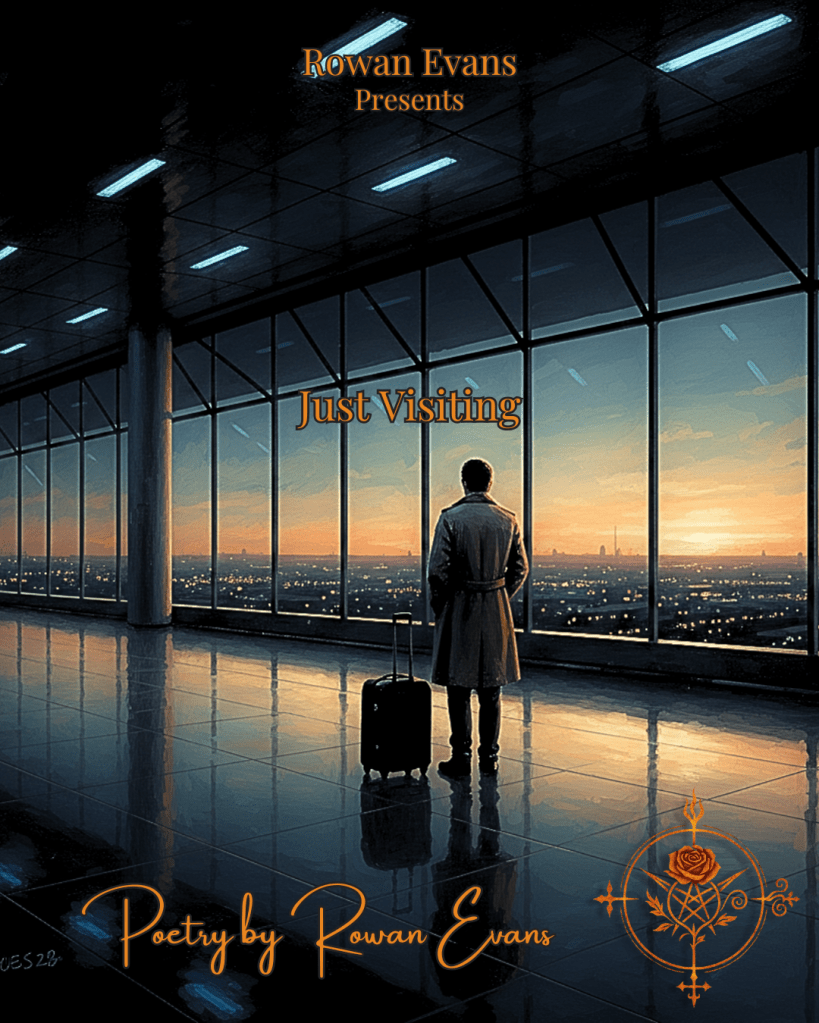
    A lone traveler standing in an airport terminal at dusk, looking out at distant city lights with a suitcase beside them.
    Sometimes the place you’re born isn’t the place you’re meant to stay.

    Just Visiting
    Poetry by Rowan Evans

    I’ve been talking about it a lot lately,
    this feeling of wanting to escape
    that I’ve had since I was just a baby.
    I was forced to call this place home,
    because this is where I was born—
    it never felt like home,
    just a place I was visiting.

    Every day in school—
    I’d recite the pledge,
    like a good
    little patriot
    should.
    But I didn’t believe in it,
    there was no allegiance in it.

    They say they’re proud to be an American,
    well me? I’ve never been,
    because this is just a place to me.
    I’ve said it before, once in this poem alone—
    this place has never been my home.

    And I’ve lived all across it.
    Never once have I have felt planted,
    no roots took hold.
    Felt like a tourist—
    in a place I was
    supposed to belong.

    But I’ve known for a while now,
    my place is not within these borders.
    This place will never be
    home for me.
    But it will always be
    a part of me. (Sadly.)


    If you’re interested in more poetry, you can find it here → [The Library of Ashes]
  • Author’s Note

    This poem traces the moment when disconnection stopped being temporary and started feeling structural.
    At fourteen, I didn’t just feel out of place—I felt offline. Like my signal never quite reached the world I was standing in.

    The language of technology felt like the closest mirror for that experience: dropped signals, endless queues, systems that never respond. This isn’t nostalgia, and it isn’t blame—it’s recognition. Naming the feeling that followed me for years before I understood what it was.

    Some people search for belonging.
    Some of us search for a connection that was never stable to begin with.

    Rowan Evans


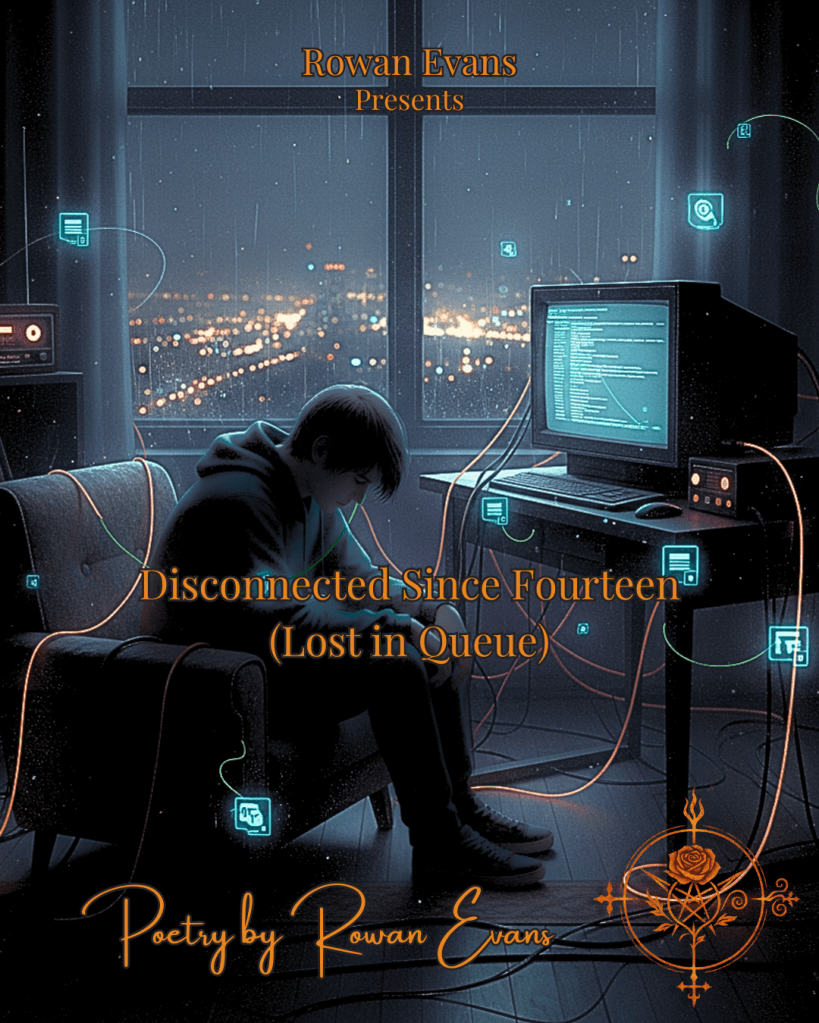
    A person sitting alone in a dark room with glowing cables and signal symbols, representing emotional disconnection and longing for belonging.
    Some disconnections start early—and never fully resolve.

    Disconnected Since Fourteen
    (Lost in Queue)
    Poetry by Rowan Evans

    I used to sit alone, lost in thoughts
    of far off places—far from…
    home.

    I’d write about every one,
    write about them in my…
    poems.

    The way longing bled into art,
    art bled the words from my heart.
    It was the truth spilling—
    feeling homeless,
    since I was fourteen.

    Felt disconnected,
    like the Wi-Fi dropped.
    Mind static, dramatic,
    screaming like…
    dial-up.

    Trying to connect
    to somewhere that never answers.
    Server overloaded,
    lost in queue—
    endless, connection loop.

    I do not belong here.
    Everything feels wrong here.


    If you’re interested in more poetry, you can find it here → [The Library of Ashes]
  • Author’s Note

    I’d been stuck in my head for days—looping memories, fogged thoughts, the usual spiral.

    Then I had a dream.

    In it, someone I care deeply about cut through the noise in the bluntest, most effective way possible. It wasn’t gentle. It wasn’t poetic. But it worked.

    This poem came from that moment—the realization that sometimes the way forward isn’t overthinking, but following the one thread that still feels steady.

    Even through the fog.


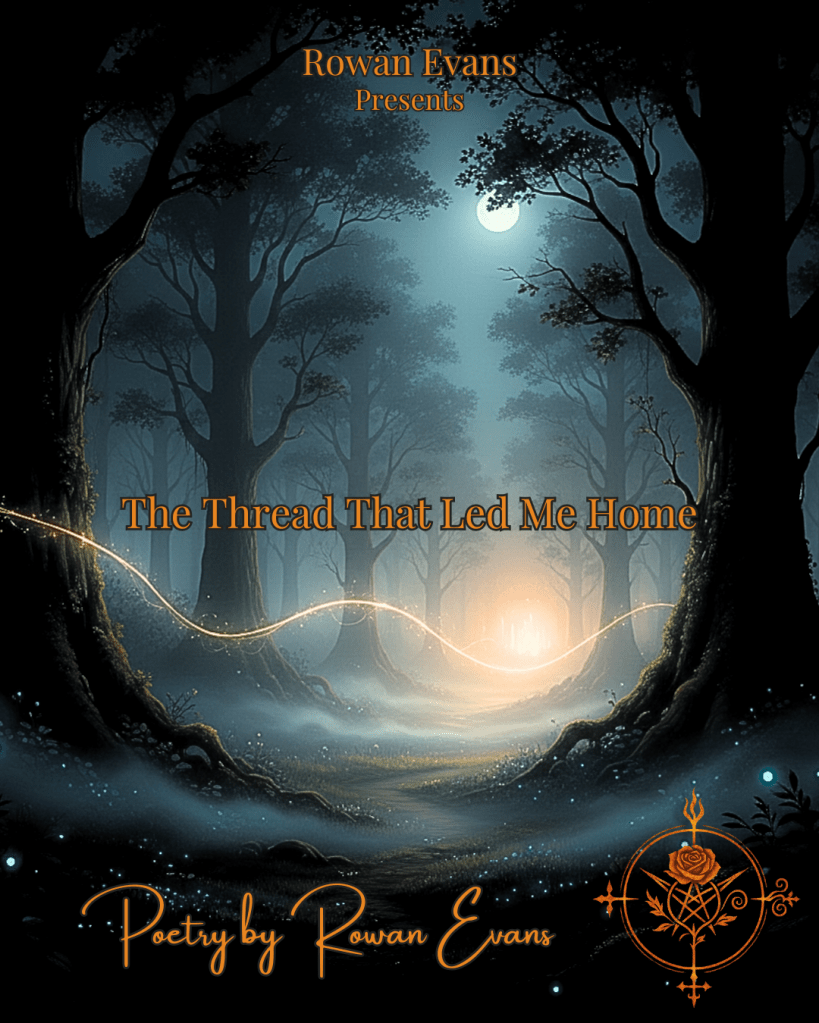
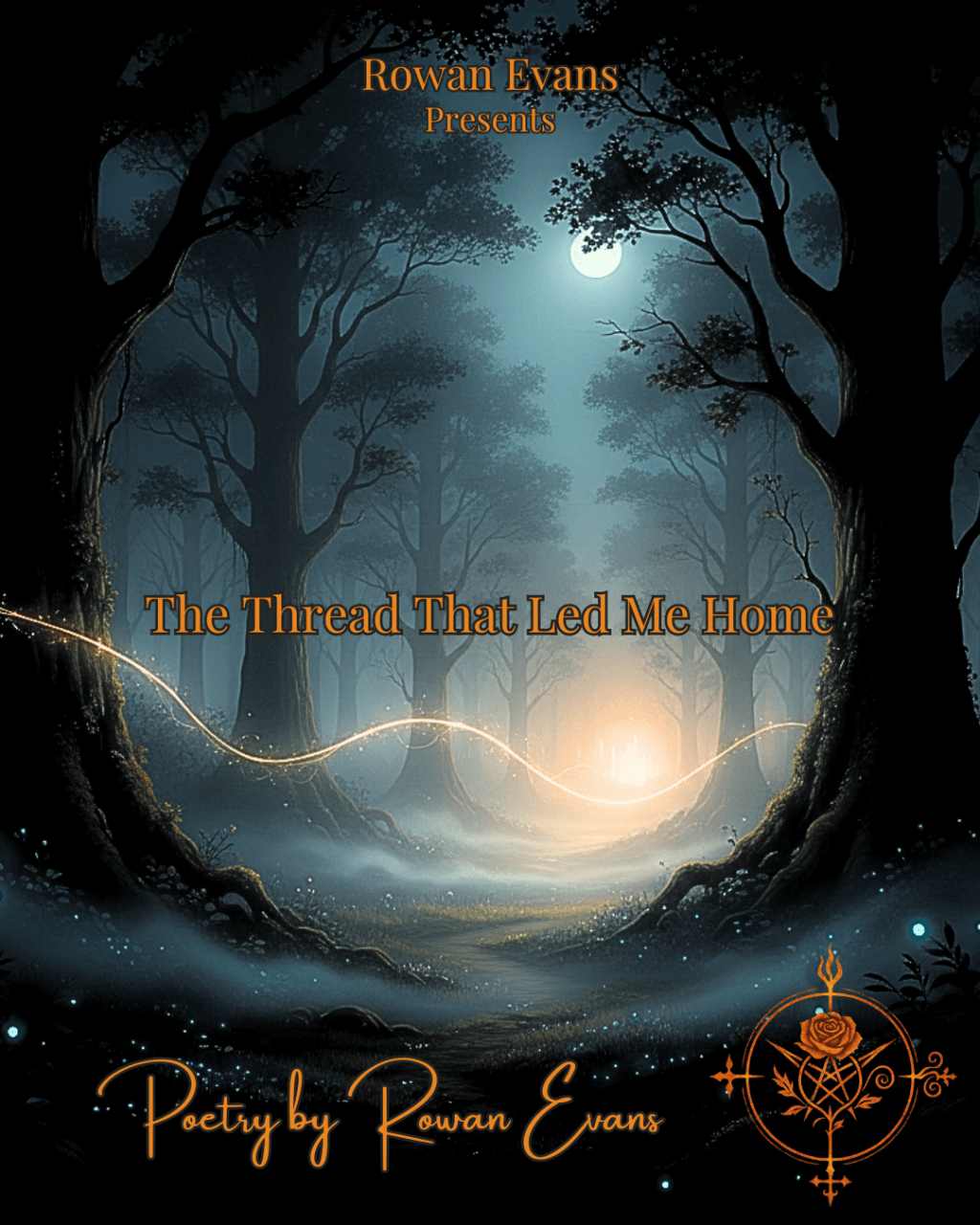
    A glowing thread leads through foggy woods toward a softly lit clearing at night, symbolizing guidance and emotional connection.
    Sometimes the way out of your head is just one honest thread—and the courage to follow it.

    The Thread That Led Me Home
    Poetry by Rowan Evans

    The fog rolls over hills,
    and a chill clings
    to my mind.
    Memories linger
    in flickering fragments,
    clinging static—
    the kind that hums
    behind the eyes,
    buzzing with moments
    I thought I buried
    but never really left.

    They circle back—
    whispers caught
    between stations,
    half-formed voices
    I almost recognize
    but can’t quiet name.
    Threads of memory
    tangled in the mist,
    pulling me back
    to places
    I never meant to revisit.

    I stumble through playgrounds,
    bumping off walls
    as I march down the hall.
    A single thread,
    I’ve begun to follow—
    It leads through memory,
    after memory.
    Twisting and turning,
    it knots—
    and I pause,
    fingers trembling
    over the tangle,
    wondering what unravels
    if I pull too hard.

    I run fingers
    over threads.
    Gripping soft,
    pulling slow—
    I watch
    as the string
    slips free—
    and it hums,
    like it’s guiding me.

    So I follow.

    Step after step,
    one foot
    in front
    of the other.
    I step and stumble
    through fog,
    thick as my thoughts.
    And when
    I feel lost,
    my fingers tighten
    grabbing the string
    like a lifeline.
    It’s the only guide
    through my mind.

    I stumble through,
    snapping twigs
    and branches.
    The rustle of
    rotting leaves
    under feet,
    until I see it.
    A light,
    a clearing.
    And when I reach it,
    when I find
    the strings conclusion—
    what do I see?

    You.
    A smile.
    Home.


    Closing Note

    Yesterday’s poem was about the weight of memory. This one is about the moment something — or someone — breaks through that weight. Not to fix it, not to erase it, but to remind me that I don’t have to walk through the fog alone.


    Journey into the Hexverse

    [Memory Lane Has No Exit]
    With my birthday approaching, I found myself trapped inside my mind—wandering memory lane, revisiting love, loss, and the moments that built me. This poem is a reflection on betrayal, survival, and the quiet realization that drifting isn’t the same as healing.


    If you’re interested in more poetry, you can find it here → [The Library of Ashes]
  • Author’s Note

    This poem was written in February of last year, during an earlier incarnation of a project that has since transformed into something entirely different. It comes from a gentler season of longing—one where love felt less like fire and more like shelter.

    I’m sharing it now not because it fits where I am, but because it still tells the truth of who I’ve been: someone who loves in open doors and soft permanence, someone who believes devotion can be tender.

    Some poems don’t belong to the book they were born for.
    They belong to the timeline of the heart instead.


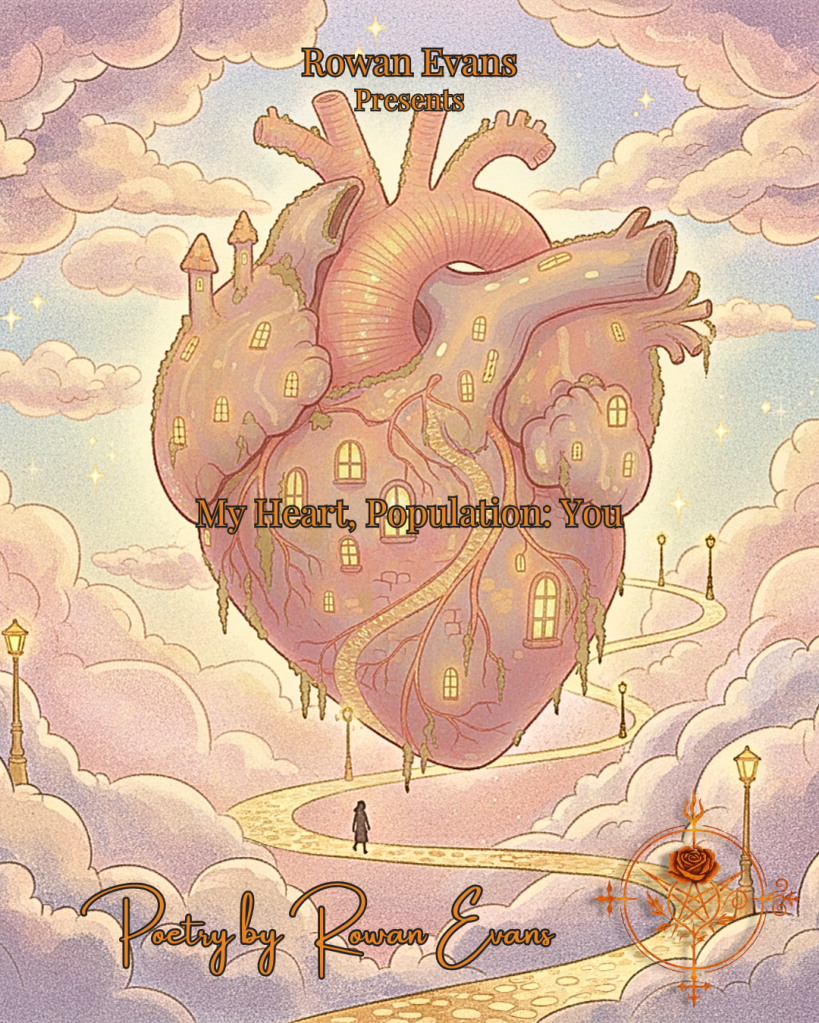
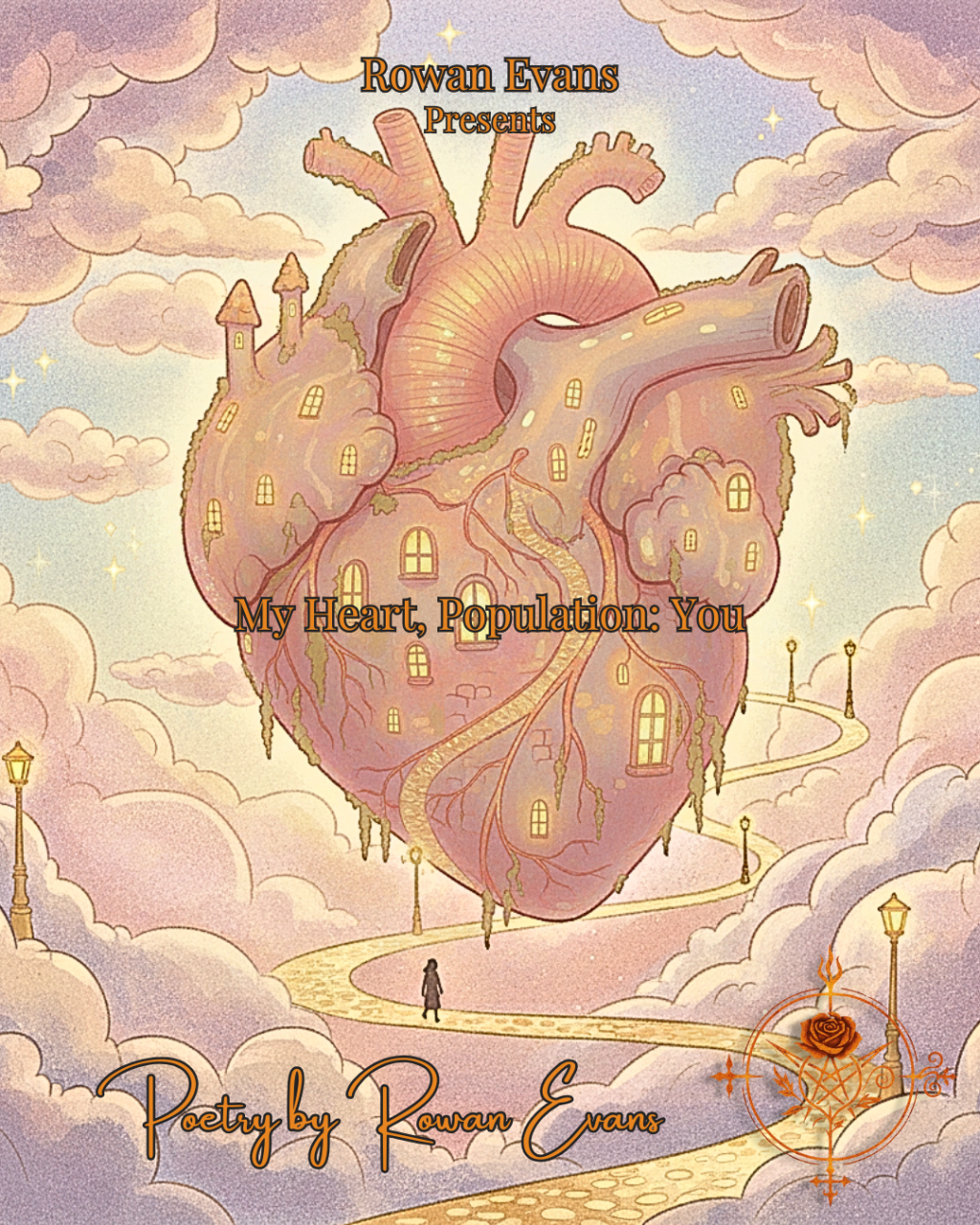
    Illustration of a heart-shaped city glowing at dusk, symbolizing love, home, and gentle devotion.
    A heart that became a home.

    My Heart, Population: You
    Poetry by Rowan Evans

    You wandered in, no map, no key,
    Yet claimed this land inside of me.
    No walls were built, no toll to pay,
    Just open roads that beg you to stay.

    Your name’s engraved on every street,
    A love so vast, so pure, so sweet.

    Like ivy vines, you took your place,
    Wrapped every brick in your embrace.
    A cityscape of dreams anew,
    Each heartbeat whispering of you.

    No lease, no debt, no price to weigh,
    Yet still, I’d pay in love each day.

    A sunlit park where laughter rings,
    A chapel where devotion sings.
    My heart, once vacant, cold, askew—
    Now thrives with life, population: You.


    If you’re interested in more poetry, you can find it here → [The Library of Ashes]