Tag: introspection

  • Author’s Note

    People often ask what inspires my writing, or how my mind moves from one idea to another so quickly.

    The honest answer is that I don’t think in straight lines.

    I think in association, in rhythm, in collision. One idea reminds me of another, not because they are logically connected, but because they feel connected in the moment they appear.

    This poem is built from that process.

    It began with something simple—the familiar phrase “sugar, spice, and everything nice.” But as I wrote, my mind immediately followed the same pattern it always does: connection, exaggeration, humor, memory, and cultural reference all colliding at once. What starts as something familiar quickly becomes something unpredictable.

    The title, Chemical X, comes from that idea.

    In The Powerpuff Girls, Chemical X is the unknown element that transforms something ordinary into something entirely different. For me, that “unknown element” is the way my mind blends thoughts, images, and meanings together in real time.

    This poem is not meant to be linear. It is meant to mirror the way my thoughts actually arrive: rapid, associative, sometimes chaotic, but always connected by feeling and intuition rather than structure.

    If it feels like a mix of humor, storytelling, sports commentary, and surreal imagery all at once—that’s intentional. That is the point.

    This is what happens when everything gets mixed together.

    This is Chemical X.

    Rowan Evans


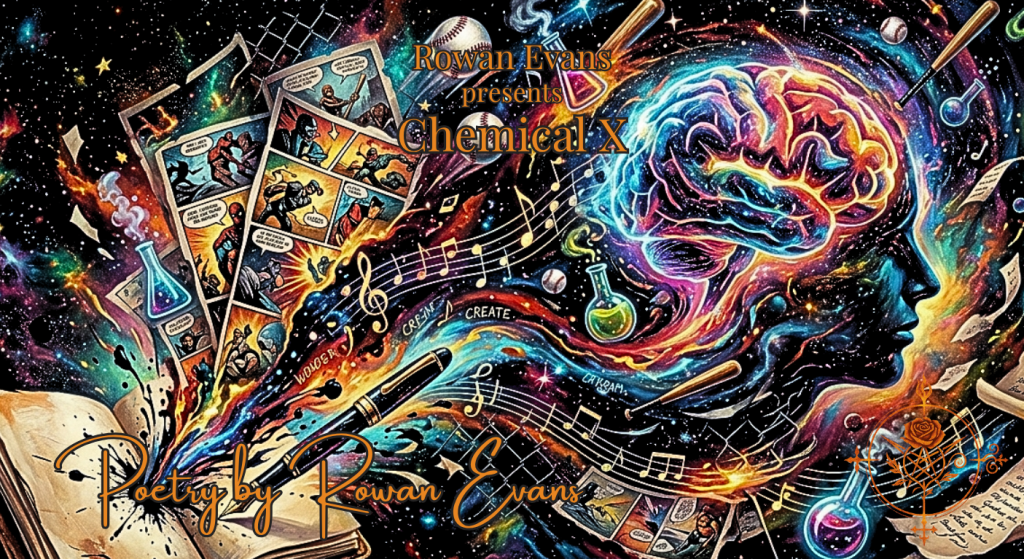
    A notebook and pen burst into colorful images of comics, sports, music, stars, and cartoons, symbolizing an imaginative mind making rapid connections.
    Some minds move in straight lines. Mine mixes everything together—and somehow, it all makes sense.

    Chemical X
    Poetry by Rowan Evans

    They say “penny for your thoughts,”
    but it takes—two cents to talk.
    Go for a walk, a mile long, in my shoes—
    use my eyes, see the world through my view.

    I’ll etch it across the page,
    world view and all—
    because I’m the on the ball
    point pen, in an ink sprint.
    Usain Bolt, the way my mind went.

    To understand the rhythm,
    you’ve got to understand the mechanism.
    You’ve got to understand the mind
    behind the rhyme—

    my thoughts are rapid fire.

    Thirty round magazine,
    three-round burst—
    that’s the way my mind works.

    I can jump from cartoons
    to comic books,
    music to sports—

    sugar, spice,
    and everything nice.

    A round of applause, Johnny—
    Bravo, you completed the Quest.
    You gained experience and leveled up.
    Still, it wasn’t enough—

    because I’m a two-way threat—
    like my name is Shohei.

    Bitch, I’m the Babe.

    At four years old,
    I was almost tossed
    out of the game.

    I was a menace—
    call me, Dennis.

    Two Hubbles
    strapped to my face,
    look up—see space.

    Fingers curled
    gripping the chain link—
    a bad call, a blind ump,
    a small child
    blind as I was,
    offering their eyes up
    like I was—

    trying to help?
    Maybe.

    Trying to insult?

    Of course…

    it’s sports…

    I was Dexter
    in the lab again,
    pen to pad again,
    and I gave
    all I had to give—

    Victor Frankenstein
    is at it again,
    patchwork metaphors
    and images galore—

    villagers are going
    to be afraid for sure.


    Journey into the Hexverse…

    [Crossing the Sea (No Metaphor Left Behind)]
    A deeply personal poem about relocation, longing, and the realization that some truths naturally arrive through metaphor—even when we try to leave it behind.

    [Only Waiting (No Metaphor Left Behind)]
    The second poem in the No Metaphor Left Behind series, exploring the quiet ache of growing up in a place that never truly felt like home—and finally saying aloud what years of metaphor had been trying to express.

    [Translating What I Feel]
    A poem about the invisible process of turning emotion into imagery, imagery into language, and language into poetry. An intimate reflection on creativity, loneliness, and twenty-three years of learning to translate what the heart feels.

    [Monster Theology]
    What if the monsters under the bed weren’t monsters at all? Monster Theology explores difference, belonging, and the human tendency to fear what we don’t understand through a conversation with the creatures we’ve spent our lives imagining.

    [Frankenstein’s Monster (and I’m the Doctor)]
    Some poems are built to make a point. Others are built to reveal the mechanism. Frankenstein’s Monster (and I’m the Doctor) explores associative thinking, creative chaos, and the strange process of stitching disconnected ideas into something alive.

    If you’re interested in more poetry, you can find it here → [The Library of Ashes]
  • Author’s Note

    This poem is the second part of an experiment I started in Crossing the Sea—an attempt to write without leaning on metaphor, or at least to notice when metaphor appears even when I’m trying not to use it.

    The first piece focused on direction: the place I’m moving toward, the literal ocean I have to cross to get there. But I realized that before I could talk honestly about where I’m going, I needed to talk honestly about why I’m leaving.

    That’s what this poem is.

    It’s the part I’ve always written around instead of through.
    The part I’ve buried under tides, distance, storms, and moonlight.
    The part I’ve hinted at for years without ever saying plainly.

    The truth is simple, even if it took me a long time to say it:

    I’ve never felt at home in the country where I grew up.

    Not in childhood.
    Not in adulthood.
    Not in all the years in between.

    It’s a quiet ache—persistent, steady, familiar.
    Not dramatic, not catastrophic, just a sense of misalignment I’ve carried since I was fourteen. A feeling of being held in a place I never belonged to, waiting for a life that didn’t start here.

    I’ve called it restlessness.
    I’ve called it longing.
    I’ve called it distance.
    Eventually, I called it the ocean.

    But naming it directly felt necessary.
    Not to erase the metaphors, but to understand what they were protecting.

    This poem is that attempt.
    Not a rejection of metaphor, but a recognition of the truth beneath it.

    Rowan Evans


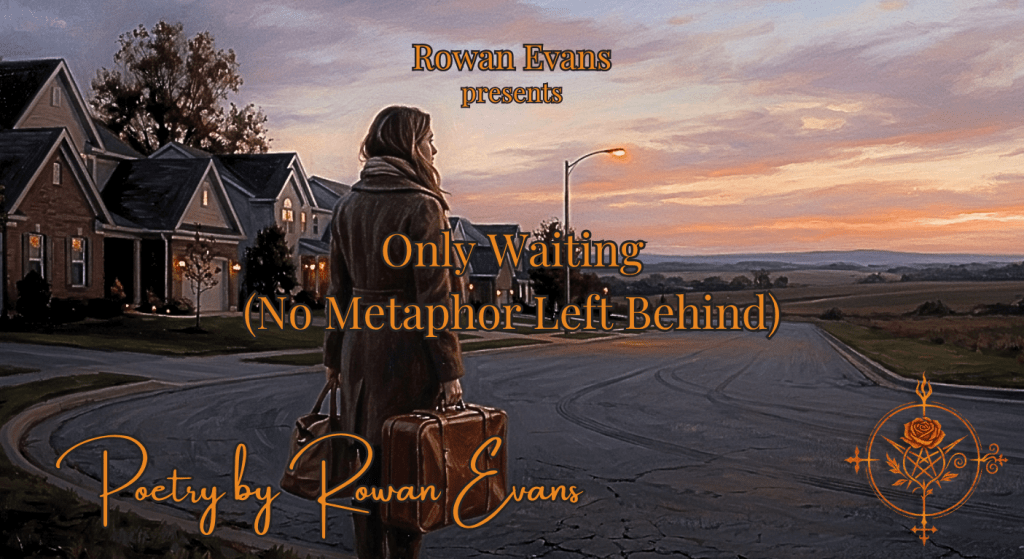
    A traveler stands at the edge of a familiar neighborhood looking toward a distant horizon with a suitcase in hand.
    Sometimes leaving isn’t running away. Sometimes it’s finally walking toward the place that feels like home.

    Only Waiting (No Metaphor Left Behind)
    Poetry by Rowan Evans

    Turn the page,
    I’ve got more to say.

    I’ll try again
    not to hide behind
    metaphors
    and coded lines.

    Last time—
    I talked about the destination,
    the place I’m moving toward.

    This time—
    I’m going to talk about the ache.
    The persistent empty feeling
    that I’ve been feeling since I was fourteen.

    I’ve written about it before
    woven in metaphors.
    But this time I’m going to try
    and say it plain.

    It’s the ache of living in a place
    that never felt like mine.

    Not once.

    Not in childhood,
    not in adulthood,
    not in all the years in between.

    People talk about home
    like it’s a given—

    a birthplace,
    a neighborhood,
    a country that shaped them.

    But I never felt shaped by this place.

    Only held in it.
    Only waiting.

    I learned early
    that you can grow up somewhere
    and still feel like a visitor.

    You can know every street
    and still feel lost.

    You can speak the language
    and still feel unheard.

    Since fourteen,
    I’ve carried this quiet emptiness—
    not dramatic,
    not catastrophic,
    just a steady sense
    that I was meant to be somewhere else,
    and somehow ended up here instead.

    I used to call it restlessness.

    Then longing.

    Then distance.

    Then the ocean.

    But the truth is simpler:
    I’ve never felt at home
    in the country that raised me.


    Journey into the Hexverse…

    [Crossing the Sea (No Metaphor Left Behind)]
    A deeply personal poem about relocation, longing, and the realization that some truths naturally arrive through metaphor—even when we try to leave it behind.

    [Translating What I Feel]
    A poem about the invisible process of turning emotion into imagery, imagery into language, and language into poetry. An intimate reflection on creativity, loneliness, and twenty-three years of learning to translate what the heart feels.

    [Maybe You’ll Want Me Too]
    A poem about the subtle shift from knowing someone to constantly thinking about them. Through humor, metaphor, and confession, Maybe You’ll Want Me Too explores affection, attachment, and the fragile hope that being wanted might matter more than being needed.

    [Recognizes Home]
    A free-verse poem exploring the difference between love as dependency and love as choice. It challenges the idea that love must be need-based, instead centering the quiet strength of choosing someone while still remaining whole on your own.

    [Not Rebuilding You]
    A poem about love as an act of presence rather than rescue. Through construction imagery, Not Rebuilding You explores trust, devotion, emotional safety, and the quiet work of building a foundation strong enough for healing to grow.

    If you’re interested in more poetry, you can find it here → [The Library of Ashes]
  • Author’s Note

    This poem began as an experiment in restraint.

    I wanted to see what would happen if I stopped relying on metaphor—the oceans, tides, moons, and distant imagery that so often shape the way I write—and instead said things as directly as I could.

    What I discovered is that I don’t really think in a “non-metaphorical” way.

    Even when I try to remove symbolism, my mind still reaches for it. The language of distance, direction, and crossing appears naturally because that is how I process emotional states: spatially, geographically, in motion.

    So the poem became something else.

    Not an escape from metaphor, but an awareness of it.

    A recognition that even when I say “I won’t use the ocean this time,” I still understand my life through movement across it.

    This piece lives in that tension between clarity and instinct—between what I am trying to say plainly, and the language my mind naturally returns to.

    And in the end, it admits something simple:

    Sometimes the clearest way to say the truth… is still through the shape of the thing you tried to leave behind.

    Rowan Evans


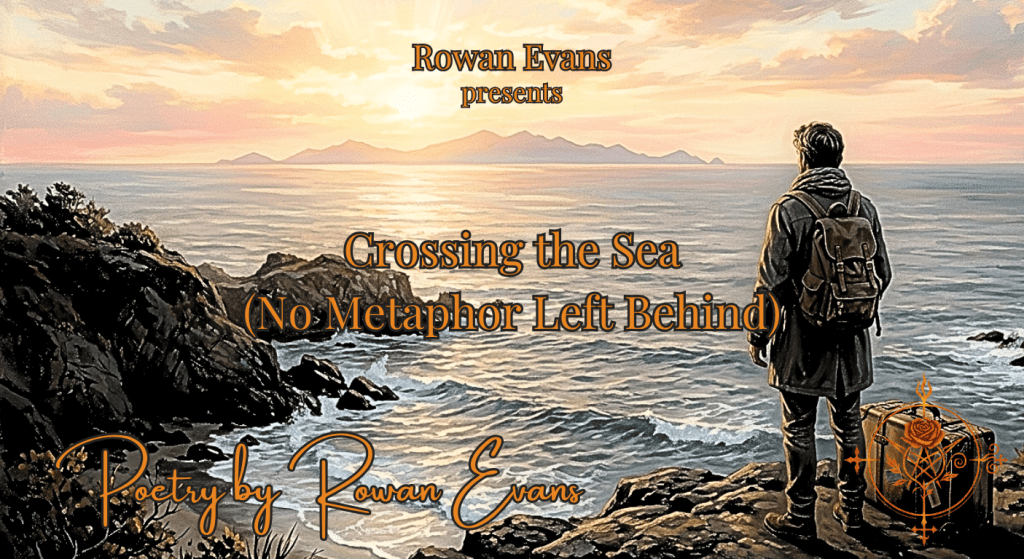
    A lone traveler stands on a Pacific shoreline looking toward distant islands across the ocean at sunrise.
    Some distances are measured in miles. Others are measured in becoming.

    Crossing the Sea (No Metaphor Left Behind)
    Poetry by Rowan Evans

    I am going to try
    something that terrifies me—
    that most of the time,
    would leave me paralyzed.

    I am going to try
    and say everything
    I hold inside—
    no metaphors
    to hide behind
    this time.

    I’m not where
    I want to be
    and part of me,
    thinks I’ll never be.

    I know that’s just
    fear and doubt—

    just because part of me
    thinks it, doesn’t make it true.

    Relocating
    is just taking
    longer than I wanted it to.

    But I know the direction.
    The destination is clear—
    I just got to get there.

    I got to leave here.

    This isn’t a new feeling—
    I’ve said this all before,
    buried in metaphors.

    Hidden behind symbolism.

    This is where
    I’d put the ocean
    and the tide,
    a way to describe
    the distance.

    Between where I am
    and where I want to be—
    and to get there,
    I have to cross the sea.

    Not a metaphor,
    I mean that literally—
    Pacific and the Philippine.


    Journey into the Hexverse…

    [Translating What I Feel]
    A poem about the invisible process of turning emotion into imagery, imagery into language, and language into poetry. An intimate reflection on creativity, loneliness, and twenty-three years of learning to translate what the heart feels.

    [Recognizes Home]
    A free-verse poem exploring the difference between love as dependency and love as choice. It challenges the idea that love must be need-based, instead centering the quiet strength of choosing someone while still remaining whole on your own.

    [Not Rebuilding You]
    A poem about love as an act of presence rather than rescue. Through construction imagery, Not Rebuilding You explores trust, devotion, emotional safety, and the quiet work of building a foundation strong enough for healing to grow.

    [The Language Her Soul Speaks]
    What if love isn’t about being understood, but learning to understand someone else? “The Language Her Soul Speaks” is a free verse poem about intimacy, communication, curiosity, and the desire to know another person beyond the limits of language.

    [Ocean Waves (1, 4, 3)]
    A moonlit shoreline, a rowboat full of ducks, a piggybank with no cents, and a confession hidden in plain sight. Ocean Waves (1, 4, 3) explores how humor, wordplay, and absurdity can become a side door to vulnerability when the truth feels too difficult to say directly.

    [L Words & Heart]
    A playful, self-aware poem about love, longing, loyalty, and the quiet ways another person can reshape our inner world. What begins as humor slowly reveals a heartfelt confession about affection, imagination, and the faces that linger in our dreams.

    [I’ll Be There to See Your Sunrise]
    Love has never come easily to me. This poem explores the fear, vulnerability, and quiet courage required to stay emotionally present when connection begins to matter deeply. “I’ll Be There to See Your Sunrise” is about choosing love despite the risk of heartbreak—and promising to remain long enough to witness someone fully.

    [Altar and Roses]
    A gothic free verse poem about poetic identity, recurring symbolism, devotion, and the quiet humanity beneath dramatic imagery.

    If you’re interested in more poetry, you can find it here → [The Library of Ashes]

  • Author’s Note

    This poem began with a phrase.

    “Schrödinger’s Person.”

    The moment it entered my mind, I laughed.

    Then I realized it wasn’t really a joke.

    I’ve always been fascinated by the spaces between things.

    Between sleeping and waking.

    Between leaving and arriving.

    Between being understood and merely being seen.

    The famous thought experiment gave me a metaphor, but the poem isn’t really about quantum mechanics.

    It’s about perception.

    There are moments when I feel as though I exist in two places at once.

    One version of me is moving through the ordinary world.

    The other exists inside the minds of the people who know me, read my work, remember me, or think about me.

    Neither version is false.

    They’re simply different ways of existing.

    I think writers become especially aware of this.

    Our words continue living in places we’ll never visit, meeting people we’ll never meet.

    A poem can be read years after it’s written.

    A thought can continue existing long after the thinker has moved on.

    That creates a strange feeling.

    Part of you is always somewhere else.

    The final lines carry the emotional truth of the piece.

    Not that I cease to exist when no one is looking.

    Only that being perceived is one of the ways we feel most alive.

    Maybe that’s true for all of us.

    Maybe every human being exists in more than one state at once.

    The self we know.

    And the self that lives in someone else’s memory.

    Rowan Evans


    A solitary figure appears between two overlapping realities, symbolizing existing in multiple states at once.
    Sometimes existence feels less like certainty and more like possibility.

    Schrödinger’s Person
    Poetry by Rowan Evans

    I’m drifting somewhere
    in the in-between—
    space is liminal here.
    This is where people go
    to disappear—
    you must exist
    with the fear.

    It’s like I’m here
    but I’m not—
    I’m somewhere else too.
    It’s like I exist—
    in two states
    at the same time.

    I am Schrödinger’s Person.

    You see—
    that sounds more dramatic
    than it is,
    I just mean—
    when you perceive me
    is when I live.

    Not that I don’t
    without you—
    because I do,
    but I really don’t want to.

    You see—
    the two states
    I exist in,
    here…

    and there.


    Journey into the Hexverse…

    [Returning to My Bones]
    Some dreams fade the moment we wake. Others leave behind emotions that linger long after reality returns. Returning to My Bones explores the strange grief of leaving a dream that felt real enough to matter.

    [Before My Feet Touch the Floor]
    What happens when your dreams feel more real than your waking life? Before My Feet Touch the Floor explores the strange grief of waking up, the lingering memory of dream selves, and the quiet question of which version of us is truly real.

    [Just Beyond Waking]
    A street that feels familiar. A life that hasn’t happened yet. Just Beyond Waking explores the fragile space between dreams, memory, longing, and the quiet feeling that some futures are already waiting for us.

    [The Needle Doesn’t Point North]
    “The Needle Doesn’t Point North” is a deeply personal free verse poem about displacement, identity, and spending a lifetime feeling emotionally disconnected from the place you were born while being drawn toward distant shores.

    [The Streets I Walk When I Sleep]
    “The Streets I Walk When I Sleep” is a deeply intimate free verse poem about recurring dreams, emotional connection, longing across distance, and the strange feeling of remembering places and moments that have never happened in waking life.

    [Separate Timelines]
    “Separate Timelines” is a surreal and deeply introspective free verse poem about emotional distance, time zones, vulnerability, and the fear of losing a connection that already feels meaningful before the words are ever spoken aloud.

    If you’re interested in more poetry, you can find it here → [The Library of Ashes]
  • Author’s Note

    This poem began with an image.

    Not a line. Not a metaphor.

    An image.

    A single figure standing alone, staring into the distance like the opening shot of a film.

    At first, the poem exists entirely outside the body. The speaker is observed rather than understood. We see the wind. The trees. The dirt beneath their feet. We hear a voice describing loneliness from a distance.

    Then the question arrives:

    “Is that the truth or the depression talking?”

    For me, that’s the moment the camera moves.

    The poem stops observing the speaker and starts inhabiting them.

    Everything before that question is external.

    Everything after it is internal.

    The scenery gives way to self-examination. The loneliness becomes less important than the act of interrogating it. The poem begins pulling apart its own construction, examining how emotions become images and how images eventually become language.

    In many ways, this piece accidentally became a poem about my entire creative process.

    I’ve spent twenty-three years translating feelings into words.

    Not just the dramatic emotions. Not just love, grief, or heartbreak.

    Everything.

    The strange moments. The passing thoughts. The questions that linger longer than they should.

    The title came from that realization.

    Because that’s what poetry has always felt like to me.

    Translation.

    An emotion enters one side of the mind.

    An image emerges from the other.

    And somewhere in between, a poem happens.

    Rowan Evans


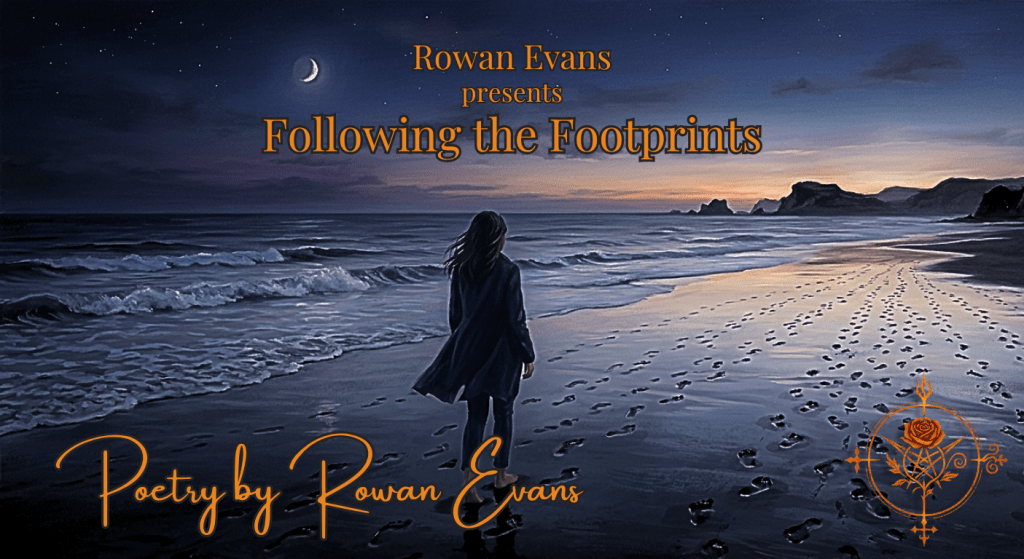
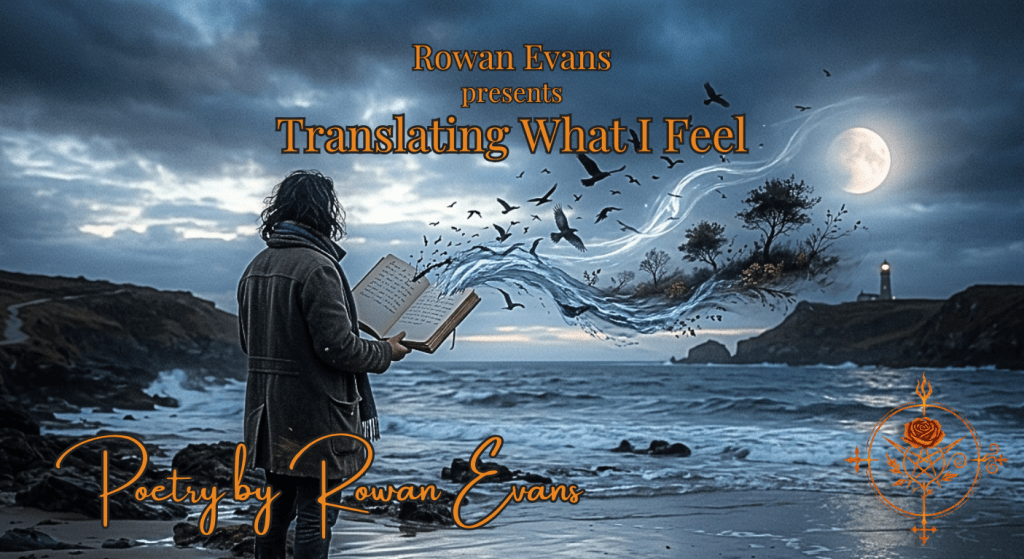
    A solitary poet stands by the shoreline at dusk as ink transforms into waves and moonlight, symbolizing emotions becoming poetry.
    Every poem begins as a feeling before it becomes a language.

    Translating What I Feel
    Poetry by Rowan Evans

    I stand, staring into the distance,
    alone in this instance—
    it’s just me and the breeze,
    running through the trees.

    I can feel cold dirt and stone
    beneath my feet.

    Wind brushes skin,
    feather-light
    like finger tips—
    it reminds me
    of how alone I am.

    Is that the truth
    or the depression talking?

    Because sometimes
    I feel alone
    when there are people
    around me.

    That last stanza
    moved like the tide.

    A long line—
    followed by one shorter,
    then longer again.

    Even when I don’t say it,
    the ocean imagery arrives.
    I don’t even have to try—
    it just pours out of me,
    like a dam breaking.

    Everything held back,
    rushes forth as the pen
    hits the page.

    You get the opening lines,
    that’s where the truth slips.
    Mid-stanza
    is where the truth sits.
    Then one or two lines
    to really make the truth hit.

    You see—
    this is the creative side of me.
    I feel something then translate it
    inside of me,
    from data to image
    then I spit it in ink on the page.

    I’ve spent 23 years
    translating what I feel—
    love, loneliness and rage…

    happiness and pain.

    Two sides of the coin,
    they’re different
    but the same.

    So there I stood…

    staring into the distance,
    unsure if I was alone in that instance—
    it was just me and the thoughts
    running through my mind.

    Slowly being translated
    into poetic lines.


    Journey into the Hexverse…

    [Where Music Becomes Weather]
    Some songs feel like storms. Others feel like shelter. Where Music Becomes Weather explores how music shapes emotion, memory, and the landscapes we carry within us.

    [Returning to My Bones]
    Some dreams fade the moment we wake. Others leave behind emotions that linger long after reality returns. Returning to My Bones explores the strange grief of leaving a dream that felt real enough to matter.

    [Recognizes Home]
    A free-verse poem exploring the difference between love as dependency and love as choice. It challenges the idea that love must be need-based, instead centering the quiet strength of choosing someone while still remaining whole on your own.

    If you’re interested in more poetry, you can find it here → [The Library of Ashes]
  • Author’s Note

    I’ve always had a difficult time describing what music actually does to me.

    People often say a song makes them feel happy, sad, nostalgic, or energized.

    That has never felt quite specific enough.

    Music feels physical.

    Some songs settle over me like fog.

    Some arrive like thunderstorms.

    Some feel like walking outside after rain when the air still smells different.

    And then there are the songs that somehow collapse time.

    They don’t simply remind me of childhood.

    They return me to it.

    Not through memory alone, but through sensation.

    The warmth of pavement beneath bare feet.

    The way summer evenings seemed endless.

    The strange certainty that tomorrow would always have enough time.

    That’s what fascinated me while writing this piece.

    Not the songs themselves, but the environments they create inside us.

    The weather of memory.

    The emotional climates we revisit every time a familiar melody begins.

    I’ve always believed that poetry and music are close relatives.

    One speaks through rhythm.

    The other through silence between the notes.

    Both have the remarkable ability to transport us somewhere we cannot physically return to.

    This poem is my attempt to describe that journey.

    Not through genres or artists.

    Through atmosphere.

    Because sometimes music doesn’t just soundtrack our lives.

    Sometimes it changes the forecast within them.

    Rowan Evans


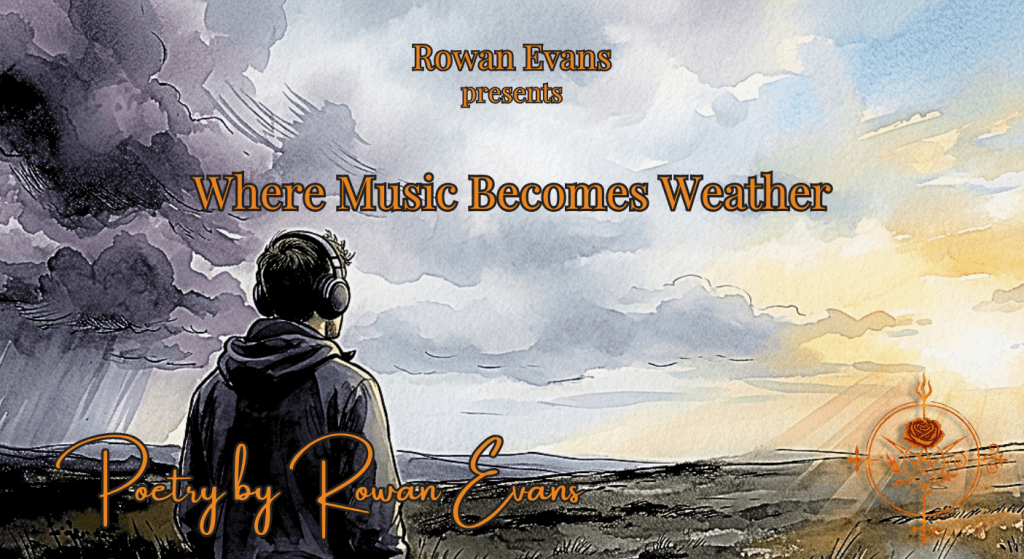
    A person wearing headphones stands beneath a sky shifting from storm clouds to warm sunlight, symbolizing how music changes emotions and memories.
    Some songs don’t just play. They change the weather inside us.

    Where Music Becomes Weather
    Poetry by Rowan Evans

    I put my headphones on,
    hit the button—
    noise cancelling.
    Then I let the music play,
    let it lead my emotions
    whatever which way.

    I drift through different soundscapes—
    crossing borders in sound,
    watching emotion mix with ink
    like paint on the canvas.

    Certain songs
    feel like humidity.
    They put a heavy feeling
    in your chest,
    it almost makes it hard
    to catch your breath.

    Other songs
    feel like clouds.
    The way they hold me
    in soft hands.
    And I feel safe,
    because they hold me close
    but in motion—
    like a slow dance.

    But then
    there are those songs—
    the ones that feel
    like warm concrete
    on bare feet.
    Like time travel,
    I’m back in my childhood.

    Back when summer felt endless,
    and every day was measured
    by the position of the sun.

    Before I knew what nostalgia was—
    only that certain songs
    felt familiar before I’d ever heard them.


    Journey into the Hexverse…

    [A Heart That Echoes in Another Language]
    A poetic journey through music across Japan, Korea, China, and the Philippines, exploring how sound becomes identity, memory, and emotional geography.

    [Sound as a Vessel]
    “Sound as a Vessel” is a free verse poem about music as emotional architecture, exploring how international artists and soundscapes shaped identity, creativity, memory, and poetic voice.

    [The Music Holds Me Upright]
    A reflective free verse poem about using music, writing, and rhythm to navigate anxiety, depression, and emotional overwhelm.

    [Global Takeover]
    What if home isn’t a place—but something you build from the music you love? Global Takeover blends sound, culture, and identity into one borderless space.

    [I’ll Be There to See Your Sunrise]
    Love has never come easily to me. This poem explores the fear, vulnerability, and quiet courage required to stay emotionally present when connection begins to matter deeply. “I’ll Be There to See Your Sunrise” is about choosing love despite the risk of heartbreak—and promising to remain long enough to witness someone fully.

    If you’re interested in more poetry, you can find it here → [The Library of Ashes]
  • Author’s Note

    I’ve written a lot of poems about dreams.

    At this point, it’s probably one of the most consistent threads running through my work.

    The reason is simple:

    Dreams don’t feel imaginary to me.

    They feel remembered.

    Not while I’m fully awake. Not after I’ve had time to process them. But in those first moments between sleeping and waking, there’s often a strange overlap where the emotions arrive before reality does.

    For a brief moment, everything feels true.

    The conversation happened. The place existed. The person was there.

    Then awareness returns.

    The room comes back. The walls come back. The weight of the body comes back.

    And with it comes the realization that none of it happened.

    That’s the feeling this poem is trying to capture.

    Not the dream itself, but the return from it.

    The title became the key.

    Because waking up doesn’t feel like opening my eyes.

    It feels like returning to my bones.

    Returning to gravity. Returning to limitation. Returning to the version of reality that can be touched and verified.

    The strange thing is that the emotions don’t disappear when the dream does.

    The dream fades.

    The feelings stay.

    And sometimes that lingering feeling creates a kind of grief that is difficult to explain to people who don’t experience dreams this way.

    A quiet grief.

    Not because something real was lost.

    But because, for a moment, it felt real enough to matter.

    Rowan Evans


    A solitary figure sits beside a moonlit bay as the dreamlike shoreline gradually fades into a quiet bedroom, symbolizing the emotional transition from dreaming to waking.
    Some dreams disappear with the sunrise. Others stay with us long after we’ve returned to our bones.

    Returning to My Bones
    Poetry by Rowan Evans

    The moon shimmers over the bay,
    suspended in the sky—
    the way I feel suspended in her eyes.

    And it makes me feel crazy,
    because she’s never looked at me—
    not really, not in reality.

    It’s only happened in dreams.

    That’s when I drift
    between awake—
    and asleep.

    This is when
    my mind
    starts to
    wander.

    Then it snaps.

    I’m back in my room again.

    The moon loses its shimmer,
    the bay fades from view.
    My body tenses as I become
    aware again,
    of the mattress beneath me—

    of the walls that enclose me.

    I feel the weight pressing in.
    The reality of returning
    to my bones.
    It’s a quiet grief—
    realizing that the emotions
    will linger,
    but the truth is
    it never happened.

    And somehow,
    that hurts the most.


    Journey into the Hexverse…

    [Maybe You’ll Want Me Too]
    A poem about the subtle shift from knowing someone to constantly thinking about them. Through humor, metaphor, and confession, Maybe You’ll Want Me Too explores affection, attachment, and the fragile hope that being wanted might matter more than being needed.

    [Before My Feet Touch the Floor]
    What happens when your dreams feel more real than your waking life? Before My Feet Touch the Floor explores the strange grief of waking up, the lingering memory of dream selves, and the quiet question of which version of us is truly real.

    [Recognizes Home]
    A free-verse poem exploring the difference between love as dependency and love as choice. It challenges the idea that love must be need-based, instead centering the quiet strength of choosing someone while still remaining whole on your own.

    [Ocean Waves (1, 4, 3)]
    A moonlit shoreline, a rowboat full of ducks, a piggybank with no cents, and a confession hidden in plain sight. Ocean Waves (1, 4, 3) explores how humor, wordplay, and absurdity can become a side door to vulnerability when the truth feels too difficult to say directly.

    [L Words & Heart]
    A playful, self-aware poem about love, longing, loyalty, and the quiet ways another person can reshape our inner world. What begins as humor slowly reveals a heartfelt confession about affection, imagination, and the faces that linger in our dreams.

    [Just Before Waking]
    A street that feels familiar. A life that hasn’t happened yet. Just Beyond Waking explores the fragile space between dreams, memory, longing, and the quiet feeling that some futures are already waiting for us.

    If you’re interested in more poetry, you can find it here → [The Library of Ashes]
  • Author’s Note

    I’ve written about dreams for years.

    Not because I think they predict the future. Not because I think they’re magical.

    Because they feel real.

    Real enough that sometimes waking up feels stranger than the dream itself.

    I don’t think people talk enough about that moment between sleeping and waking—the brief period where both realities still exist at the same time.

    The dream is fading.

    The room is returning.

    And for a few seconds, you’re caught between them.

    That’s where this poem lives.

    I’ve had dreams that felt so vivid, so emotionally complete, that waking up felt like losing something. Not a person. Not a place. A version of myself.

    A self that existed somewhere else.

    The older I get, the more fascinated I become by that feeling.

    Why do some dreams linger for hours while entire days disappear from memory?

    Why do imaginary places sometimes feel more familiar than real ones?

    Why does waking occasionally feel like arriving somewhere instead of returning?

    This piece doesn’t try to answer those questions.

    It simply sits with them.

    Because there are mornings when the first thing I feel isn’t relief that the dream is over.

    It’s grief that it ended.

    And I suspect I’m not the only one.

    Rowan Evans


    A woman sits on the edge of her bed between waking and dreaming as a surreal dream-world fades around her.
    Some mornings feel less like waking up and more like saying goodbye to a life that only existed while you were asleep.

    Before My Feet Touch the Floor
    Poetry by Rowan Evans

    Dreams—
    a common topic
    in my poetry.

    It’s because
    they don’t feel fake to me.
    They feel like memories.

    Do know what it’s like
    to wake up confused—
    because you’re in your own room?

    How do you live—
    when your dreams are more alive
    than your waking life?

    It’s as if the person I was
    a moment ago
    is still out there,
    waiting for me
    to return.

    So I lie there,
    trying to remember
    which version of me
    is the imposter—
    the one who wakes,
    or the one who wanders.

    Sometimes I think
    the dream‑me
    is the one who remembers,
    and I’m the one
    who forgets.

    Because if I feel more alive
    in the places I can’t stay,
    what does that make
    the life I return to?

    There’s a mourning
    no one talks about—
    the kind that happens
    before your feet
    touch the floor.


    Journey into the Hexverse…

    [The Streets I Walk When I Sleep]
    “The Streets I Walk When I Sleep” is a deeply intimate free verse poem about recurring dreams, emotional connection, longing across distance, and the strange feeling of remembering places and moments that have never happened in waking life.

    [Memories From a Life Yet to Come]
    Some dreams feel less like fantasy and more like memory. “Memories From a Life Yet to Come” is a reflective free verse poem about longing, displacement, emotional alignment, and the strange comfort of recognizing yourself more clearly in dreams than in waking life.

    If you’re interested in more poetry, you can find it here → [The Library of Ashes]

  • This wasn’t planned as part of the current sequence.
    Some things just need to be written–and shared–when they happen.

    Author’s Note

    There are patterns we don’t always notice until we’ve lived them more than once.

    The same thoughts.
    The same timing.
    The same quiet retreat inward.

    The Mind’s Winter comes from recognizing one of those cycles in real time–watching myself disappear into my own head, knowing it’s happening, and not always knowing how to stop it.

    It’s strange, being both the one experiencing something and the one observing it. To understand the “why,” but still feel pulled into it anyway.

    This piece isn’t about solving that pattern.

    It’s about naming it.

    About acknowledging the way overwhelm can turn inward, how distance can grow even when you don’t want it to, and how sometimes the things that matter most are the very things that scare us into retreat.

    And maybe, in recognizing the cycle…

    there’s a chance to break it.

    Rowan Evans


    A lone figure stands in a quiet winter landscape, surrounded by bare trees and falling snow, symbolizing emotional withdrawal and introspection.
    Sometimes the cold isn’t outside—it’s the space we retreat into when everything becomes too much.

    The Mind’s Winter
    Poetry by Rowan Evans

    February 8th, 2026—
    I got sick again.
    It happens every year
    like clockwork.
    It starts with the headache,
    caused by being overwhelmed.

    It starts slowly,
    then snowballs
    into more.

    You see, this period of time—
    it usually comes after
    what I tend to call
    the mind’s winter.

    I slip into a deep void
    of thought.

    January 8th…
    that’s the date.

    That’s when I drift inside.
    I get lost in my mind,
    and I stay there—
    one month—I’m gone.
    Lost in thought.

    One month
    leading up to my “big day,”
    the one they say
    should celebrate me.

    But I don’t see it that way.
    It’s just another day.

    And usually,
    I bounce back.
    It’s quick…

    but this?

    This feels like an attack—
    one month in my head,
    two weeks sick and then?

    I broke my glasses—
    vision—
    I lost access.

    And the longer I’m gone,
    the more I pull away,
    even as I—

    want to stay.

    You know what
    the worst part is?

    The worst part is—
    that I know why.

    I know why I do it…
    why I pull away.

    I’ve said the reason
    a hundred times,
    in nearly as many rhymes.
    It’s because you meant
    too much to me.
    I got scared and retreated
    into me.

    So here it is—
    March 21st,
    and I—

    I haven’t spoken to you
    since February 6th,
    and if I’m honest—

    I miss you.


    If you’re interested in more poetry, you can find it here → [The Library of Ashes]
  • Author’s Note

    This poem was written on February 19th as a quiet reflection on duality within the self. We are often told to choose between parts of who we are – light or shadow, reason or imagination, strength or softness. But real wholeness comes from learning both can exist at once.

    A Balance Found is about accepting the full spectrum of who we are. The dreamer and the observer. The light and the shade. Not as opposing forces, but as pieces of the same soul that finally learns to stand whole.

    Rowan Evans


    A symbolic image of a person standing between light and shadow, representing balance between different parts of the self.
    Finding harmony between light and shadow within the self.

    A Balance Found
    Poetry by Rowan Evans
    (written February 19th, 2025)

    Ink and shadow, light and shade,
    Both have their place, both were made.
    One to dream, one to see,
    And I stand whole—both parts of me.


    If you’re interested in more poetry, you can find it here → [The Library of Ashes]