Author’s Note
Sometimes an old poem doesn’t need to be left in the past.
Sometimes you have to return to it after you’ve changed.
Fallen Angel’s Reckoning (Remix) revisits a poem I originally wrote on June 6, 2024. The original was already telling a story I understood well: love that promised forever, a fall from an imagined heaven, and the painful process of reclaiming yourself after the promise disappears.
But I was a different writer when I wrote it.
And, more importantly, I was a different person.
The 2026 version isn’t meant to erase the original. It is a conversation with it.
I kept the central imagery—the angel, Lucifer, the fall from heaven, the halo, the darkness, the broken vow—because those symbols still belong to the emotional architecture of the piece. But I wanted to push the mythology further this time. Icarus enters the story. The fall becomes more physical, more violent, more deliberate. The speaker isn’t simply descending from something that once felt like heaven; they are plummeting from it.
And then there is the ending.
In 2024, I wrote about newfound wings.
In 2026, I wrote about broken wings.
That change matters to me.
Because strength doesn’t always mean becoming untouched by what happened. Sometimes you keep the scars. Sometimes you keep the broken pieces. Sometimes you discover that you can still fly without first repairing everything that hurt you.
The angel doesn’t become an angel again.
They don’t return to the heaven they lost.
They don’t need the person who made them feel divine to give them their identity back.
They become something else.
A fallen angel who embraces the fallen.
The broken.
The free.
That is what this remix ultimately became: not a poem about getting back what was lost, but about discovering that losing it didn’t mean losing yourself.
I didn’t rewrite the 2024 version because it was wrong.
I rewrote it because I’ve had two more years to understand the fall.
And sometimes the person who wrote the first poem deserves to hear what the person you became has learned since then.
— Rowan Evans
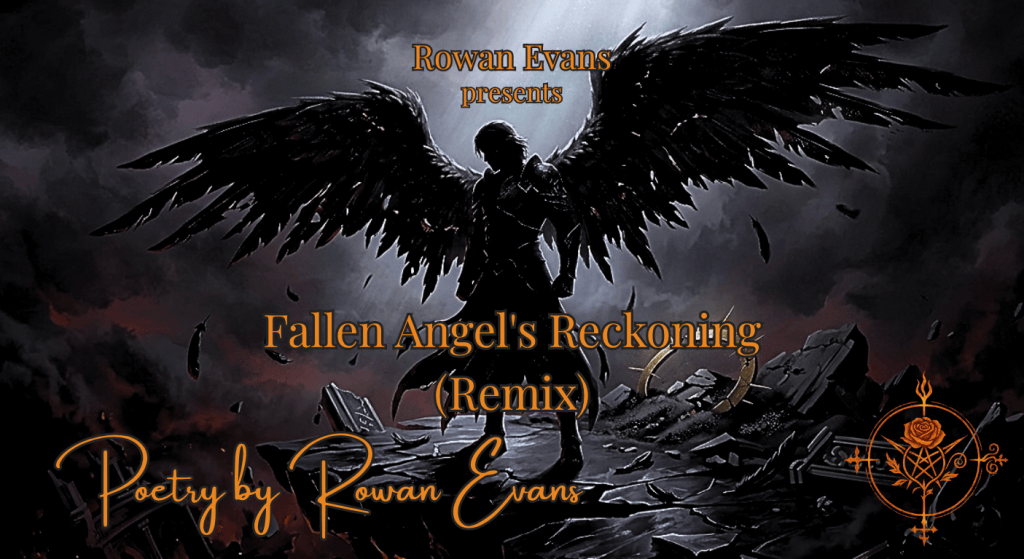
Fallen Angel’s Reckoning (Remix)
Poetry by Rowan Evans
[written July 23th, 2026]
I remember when you said forever,
but forever never came,
so I fell like Lucifer,
from the heavens down I tumbled.
Returned your love,
played your game—
once an angel in your eyes,
now in darkness I crumbled.
Your promises were wings that lifted me high,
but they melted away, when I reached the sun—
just like Icarus, the light was my undoing.
It wasn’t just a fall, I was plummeting…
a fallen star,
cast from the sky,
now I walk in shadows,
where our love met its end.
Like Lucifer—I embraced the night,
wandering through realms of regret and pain,
I shed my halo,
lost my light,
no longer an angel,
in your eyes or in my name.
Yet in this darkness,
a new path unfurls—
I find strength in the ashes of our broken vow,
rising from the ruins of our shattered world.
I reclaim my soul,
I’m reborn here and now.
No longer bound by your empty decree—
I soar with broken wings,
embracing the fallen,
the broken, the free,
a fallen angel finding strength
I never knew I’d own.
Journey into the Hexverse…
[Homecoming]
Homecoming is a return to the Gothic aesthetic at the heart of Rowan Evans’s poetry, blending Poe, mythology, horror icons, moonlight, ravens, and darkness into a meditation on artistic identity and finding your way back to the voice that feels like home.
[The Monster in the Margins]
Drawing inspiration from horror icons like Michael Myers, Ghostface, Freddy Krueger, and Pennywise, this poem explores the darker side of creativity—where inspiration becomes an unstoppable force lurking just beyond the edge of the page.
[The Monster in the Margins II]
The Monster in the Margins II transforms Rowan Evans’s Seven Deadly Sins mythology into a horror story written between the lines, where Lust, Wrath, Sloth, Greed, Pride, Envy, and Gluttony become monsters growing from pain, grudges, and scars.
[The Unkindness Descends]
“The Unkindness Descends” is a Gothic symbolic poem exploring collapse, transformation, and the unsettling experience of being witnessed during moments of unraveling. Through raven imagery, ambiguity, and ritualistic atmosphere, the poem invites multiple interpretations—spiritual, psychological, ominous, or transformative.
[Gospel in Crimson]
When writing becomes ritual and love becomes devotion, the line between creation and worship begins to blur. Gospel in Crimson explores obsession, artistry, and the sacred act of expression.
If you’re interested in more poetry, you can find it here → [The Library of Ashes]

