There comes a point in certain conversations when the words have already worn themselves thin. Promises become repetitions, explanations become excuses, and the silence between two people starts saying more than either of them can manage.
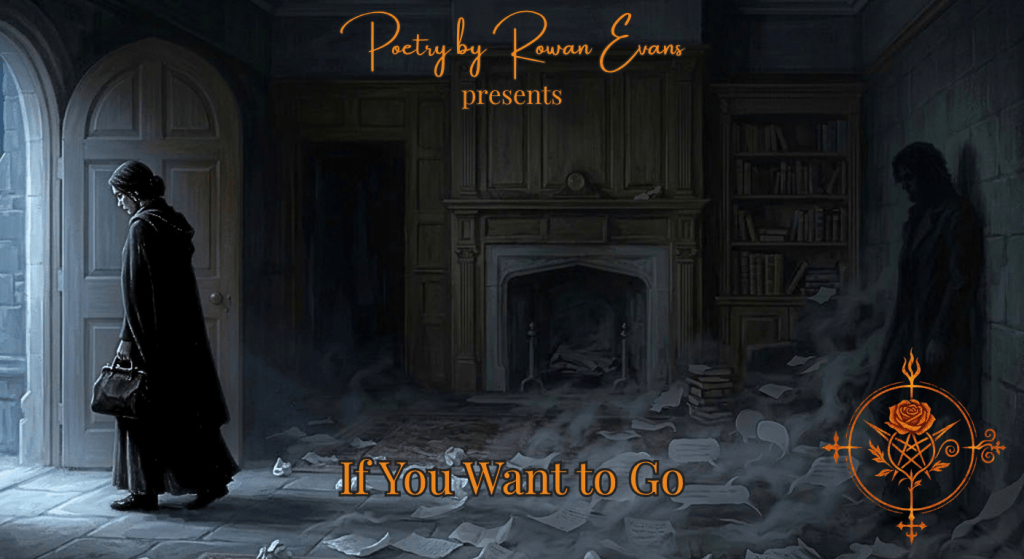
“If You Want to Go” steps into that moment—the moment when frustration stops begging to be understood and starts letting go. Its voice is blunt, impatient, and tired of pretending that another conversation will somehow change what has already been made clear.
Sometimes, the hardest part of walking away isn’t opening the door.
It’s finally refusing to stand in front of it, waiting for someone to decide.
— Rowan Evans
When the words become excuses, sometimes letting go says enough.
If You Want to Go Poetry by Rowan Evans
If you want walk—
then walk—
we don’t have to waste our time, we don’t have to talk— I don’t want to listen to another empty line, it’s just excuses—talking is useless—
What?
Now you’re mad?
Why— because I gave you what you wanted?
If you want to go, then go— what do we keep doing this for?
We don’t have pretend anymore—
Journey into the Hexverse
[You Still Pop Into My Brain] Sometimes, someone from your past still wanders into your thoughts—not because you want them back, but because they once held a place in your everyday life. A reflective poem about disappointment, growth, and the strange persistence of memory after moving on.
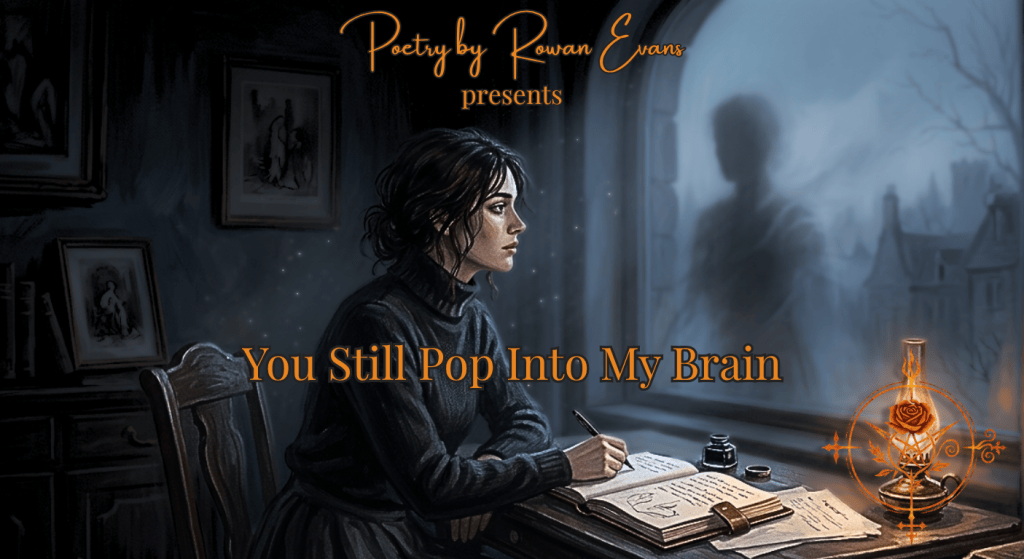
Some people leave your life in a single, dramatic moment. Others fade through a series of small decisions, subtle disappointments, and lessons you never asked to learn. And sometimes, long after you’ve moved forward, a familiar name still wanders through your thoughts—not because you want them back, but because they once occupied a place in your everyday life.
This piece sits in that strange space between moving on and remembering. It doesn’t reach backward with longing or anger. It simply acknowledges that even when someone no longer belongs in your life, the mind may occasionally forget to stop looking for them.
— Rowan Evans
Some memories still visit. They just don’t feel like home anymore.
You Still Pop Into My Brain Poetry by Rowan Evans
You look at me now,
and see—
someone better than
who I used to be—
but that’s all
thanks to you—
if I hadn’t learned the lessons,
if you hadn’t switched up
and made me see—
you were never the one for me.
It didn’t come all at once,
it came in steps for me,
you began to pull away, gradually—
it was little things at first,
you’d do things you thought would hurt—
introduced me to him,
just so you could flirt—
thinking I’d see it,
and feel like dirt—
but it didn’t work.
Because for me,
it was whatever—
we weren’t officially together.
We never talked, exclusive—
so who would I be
to be mad to begin with?
No, I wasn’t mad—
I was more like your parents,
just disappointed
in who you had become.
You used to be someone
in my life—
I used to reach for my phone
every time something happened—
wanting to tell you,
and sometimes I still do.
It’s a strange feeling
because it’s been so long—
and it feels so wrong,
that you sometimes—
still pop into my brain.
But it’s not the same—
it’s not how it used to be.
Journey into the Hexverse
[Lessons Without Kindness] A reflection on learning self-respect from a relationship that changed—the lessons hidden in manipulation, silence, and loss, and the realization that you don’t have to shrink yourself to make someone else feel tall.
[Circle of Me] A reflective poem about sitting among the voices of memory, joy, pain, and fear—and realizing that some burdens are bigger than any one person.
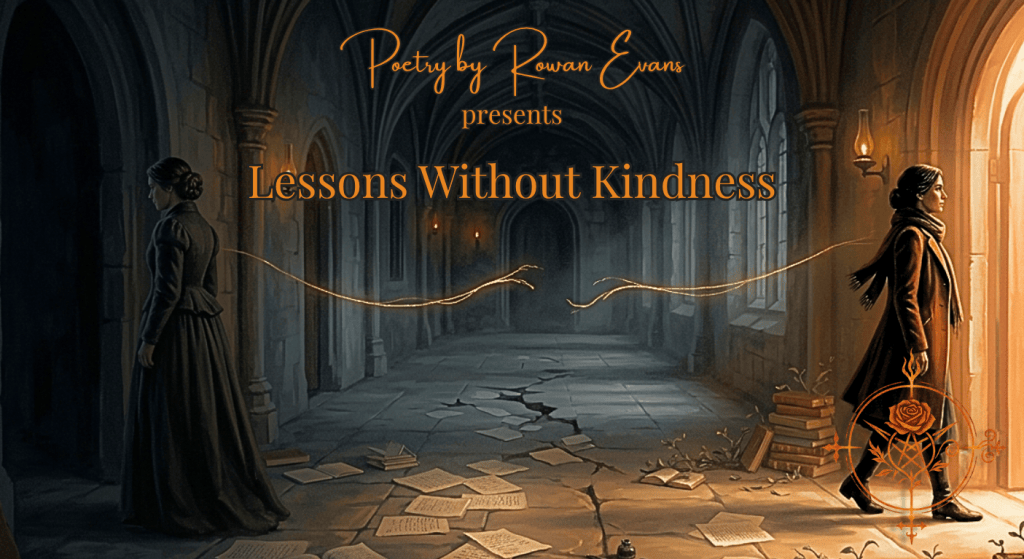
Lessons Without Kindness is about the strange education that can come from losing someone who once felt like your entire world.
This isn’t really a poem about getting even. It’s about looking back at a relationship that changed, recognizing the games, the silence, and the ways I allowed myself to become smaller just to keep someone else comfortable—and realizing that I don’t live that way anymore.
The person who taught me these lessons never intended to be my teacher. They didn’t sit me down and explain what I needed to learn. They simply gave me an experience harsh enough that I eventually learned it myself.
Sometimes the most important lessons don’t come from kindness, wisdom, or good intentions.
Sometimes they come from realizing what you will never allow yourself to become again.
— Rowan Evans
Not every teacher is kind. Not every lesson is wasted.
Lessons Without Kindness Poetry by Rowan Evans
There was a time when
you were my world,
everything was fine and
we really did love each other,
or so I thought—
yeah, we’d always talk—constantly,
I was always thinking of you,
and I thought
you thought about me too.
Maybe you did—once,
then you changed
and started playing games—
you tried to get under my skin,
pit me against him.
But here’s the thing—
he was never gonna win.
I mean, truly,
the only real loser was you—
because in doing what you did,
you lost me too.
And I’m not saying I was a prize,
but I really was a catch for you—
I put up with too much,
and spoke up too little.
But I don’t do that anymore.
I don’t shrink so someone else can feel tall.
I don’t bend so someone else can feel right.
I don’t stay quiet so someone else can stay comfortable.
You taught me that.
Not intentionally—
but lessons don’t need kindness
to be true,
just a student and a teacher—
that was me and you.
Journey into the Hexverse
[The Sacred Timeline] From childhood stories about Dragon Ball Z, Power Rangers, and Pokémon to gothic cathedrals, ravens, roses, identity, healing, and experimentation, The Sacred Timeline traces how Rowan Evans’s relationship with the pen evolved across thirty-six years—and how the ink remained while the writer kept changing.
[The Metaphor Machine] A poem that takes apart its own machinery as it runs—breaking lines, breaking thoughts, and following metaphors from moonlight to tides, oceans, shorelines, and city streets.
[Louder Than the Rain] A short confessional poem about the overwhelming noise of anxious thoughts, the strange silence of feeling alone in a crowded room, and finding a way to translate pain into words.
Sometimes an old poem doesn’t need to be left in the past.
Sometimes you have to return to it after you’ve changed.
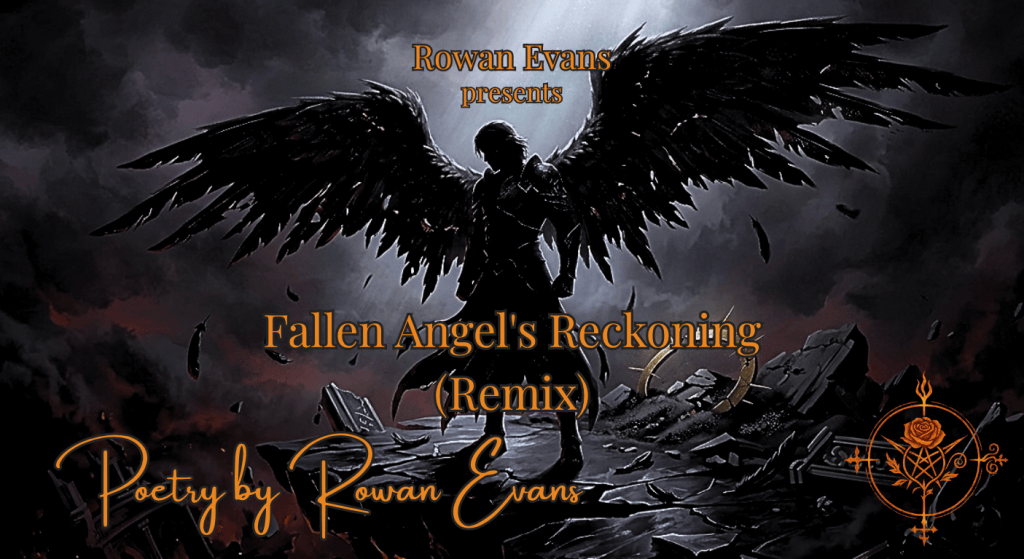
Fallen Angel’s Reckoning (Remix) revisits a poem I originally wrote on June 6, 2024. The original was already telling a story I understood well: love that promised forever, a fall from an imagined heaven, and the painful process of reclaiming yourself after the promise disappears.
But I was a different writer when I wrote it.
And, more importantly, I was a different person.
The 2026 version isn’t meant to erase the original. It is a conversation with it.
I kept the central imagery—the angel, Lucifer, the fall from heaven, the halo, the darkness, the broken vow—because those symbols still belong to the emotional architecture of the piece. But I wanted to push the mythology further this time. Icarus enters the story. The fall becomes more physical, more violent, more deliberate. The speaker isn’t simply descending from something that once felt like heaven; they are plummeting from it.
And then there is the ending.
In 2024, I wrote about newfound wings.
In 2026, I wrote about broken wings.
That change matters to me.
Because strength doesn’t always mean becoming untouched by what happened. Sometimes you keep the scars. Sometimes you keep the broken pieces. Sometimes you discover that you can still fly without first repairing everything that hurt you.
The angel doesn’t become an angel again.
They don’t return to the heaven they lost.
They don’t need the person who made them feel divine to give them their identity back.
They become something else.
A fallen angel who embraces the fallen.
The broken.
The free.
That is what this remix ultimately became: not a poem about getting back what was lost, but about discovering that losing it didn’t mean losing yourself.
I didn’t rewrite the 2024 version because it was wrong.
I rewrote it because I’ve had two more years to understand the fall.
And sometimes the person who wrote the first poem deserves to hear what the person you became has learned since then.
— Rowan Evans
I don’t need unbroken wings to fly. I just need to remember that they were mine before anyone promised me heaven.
Fallen Angel’s Reckoning (Remix) Poetry by Rowan Evans [written July 23th, 2026]
I remember when you said forever,
but forever never came,
so I fell like Lucifer,
from the heavens down I tumbled.
Returned your love,
played your game—
once an angel in your eyes,
now in darkness I crumbled.
Your promises were wings that lifted me high,
but they melted away, when I reached the sun—
just like Icarus, the light was my undoing.
It wasn’t just a fall, I was plummeting…
a fallen star,
cast from the sky,
now I walk in shadows,
where our love met its end.
Like Lucifer—I embraced the night,
wandering through realms of regret and pain,
I shed my halo,
lost my light,
no longer an angel,
in your eyes or in my name.
Yet in this darkness,
a new path unfurls—
I find strength in the ashes of our broken vow,
rising from the ruins of our shattered world.
I reclaim my soul,
I’m reborn here and now.
No longer bound by your empty decree—
I soar with broken wings,
embracing the fallen,
the broken, the free,
a fallen angel finding strength
I never knew I’d own.
Journey into the Hexverse…
[Homecoming] Homecoming is a return to the Gothic aesthetic at the heart of Rowan Evans’s poetry, blending Poe, mythology, horror icons, moonlight, ravens, and darkness into a meditation on artistic identity and finding your way back to the voice that feels like home.
[The Monster in the Margins] Drawing inspiration from horror icons like Michael Myers, Ghostface, Freddy Krueger, and Pennywise, this poem explores the darker side of creativity—where inspiration becomes an unstoppable force lurking just beyond the edge of the page.
[The Monster in the Margins II] The Monster in the Margins II transforms Rowan Evans’s Seven Deadly Sins mythology into a horror story written between the lines, where Lust, Wrath, Sloth, Greed, Pride, Envy, and Gluttony become monsters growing from pain, grudges, and scars.
[The Unkindness Descends] “The Unkindness Descends” is a Gothic symbolic poem exploring collapse, transformation, and the unsettling experience of being witnessed during moments of unraveling. Through raven imagery, ambiguity, and ritualistic atmosphere, the poem invites multiple interpretations—spiritual, psychological, ominous, or transformative.
[Gospel in Crimson] When writing becomes ritual and love becomes devotion, the line between creation and worship begins to blur. Gospel in Crimson explores obsession, artistry, and the sacred act of expression.
There is a particular kind of heartbreak that doesn’t have a villain.
Sometimes nobody betrayed you.
Nobody lied.
Nobody promised you something they couldn’t give.
Sometimes someone simply exists, speaks to you, makes you feel something—and your heart decides to build an entire mythology around it.
That is where Poet’s Curse came from.
I’ve joked before about having a poet’s curse: the tendency to fall into feelings quickly, to hear a little beauty in someone’s voice and suddenly find myself wading into the waves after it. But beneath the joke is something I’ve had to become more honest about.
Sometimes my heartbreak is partly mine.
Not because I was wrong to feel what I felt, but because I have a habit of giving pieces of myself away before I’ve figured out whether there is somewhere safe for them to land.
The person in this poem didn’t necessarily do anything wrong. She didn’t promise me forever. She didn’t lead me somewhere just to abandon me. She talked—and I listened. I heard a siren’s song, and I chose to wade into the water.
So this isn’t a poem about blaming her.
It’s about looking at myself afterward and admitting something uncomfortable:
I learned how to hold on long before I learned how to let go.
And maybe that’s the real curse.
Not that I love too deeply.
Not that I feel too much.
But that once I give someone a piece of my heart, I don’t always know how to take my hands away from the fire.
Sometimes the only way forward is to stop calling that weakness a curse and start learning the skill I never had—
how to let go without becoming less capable of love.
— Rowan Evans
Sometimes the hardest thing to learn isn’t how to love—it’s how to let go of what you’ve already given away.
Poet’s Curse Poetry by Rowan Evans
Here we go again
it’s another season of sin,
the poet’s back
heartbroken with a pen.
Yeah, went and fuckin’
did it again—
it’s my fault
my heart is cracked,
with pieces missing.
You see, I give them away
too freely, it’s such a pain
to be me, I get hooked
too easily—
she did nothing wrong,
she didn’t lead me on, just talked
and I heard a siren’s song—
I waded into the waves,
prayed for things to change.
Pardon the moment of slowness,
give me a moment while I own this
and take accountability for my part
in breaking my heart.
It’s a poet’s curse—
I only learned how to hold on.
I never learned how to let go,
my feelings and emotion
like hot coals in my hands.
Journey into the Hexverse…
[When I Fall] When I Fall is a vulnerable poem about loving without reservation, feeling everything deeply, and refusing to make the heart smaller just because wholehearted love can sometimes lead to loneliness and pain.
I wrote Hot Coals for the men who’ve been told that strength is silence, and that showing emotion makes you weak. As someone who has carried fire inside themselves for a long time, I know firsthand how heavy it can be to hold anger and pain alone. Holding it like hot coals doesn’t make you stronger—it only burns you from within. Vulnerability is not weakness. It is courage. And letting yourself feel, fully, is the bravest thing you can do.
Holding anger like hot coals scars the heart.Hot Coals by Rowan Evans explores the courage in vulnerability and the liberation of letting go.
Hot Coals Poetry by Rowan Evans
They tell you to clench your fists, hold tight— Let the fire burn bright, don’t let in the light. Anger, rage—your only currency, The world’s measure of your masculinity.
But no one warned you of the burn, The searing pain you never learn, That holding anger like hot coals in hand Scars the heart in ways you can’t withstand.
They say to stand tall, to never cry, Keep your voice low, don’t ask why. But the flames flicker and twist inside, A storm of feelings you try to hide.
Each coal a bitter word unsaid, A wound you carry in your head. It singes, it smolders, beneath your skin, A quiet battle you’ll never win.
Let go, I whisper, of this deadly fire— There’s more to feel, more to aspire. Rage will only leave you burned, A lesson you’ve yet to learn.
There’s beauty in tears, in the gentle sigh, In love’s soft touch and the freedom to cry. To release the coals, let your heart unfold, Is the bravest thing, not a story untold.
Feel the coolness of the rain on your face, The warmth of peace, of a softer grace. Embrace the spectrum, let it flow— You’re not just a vessel for anger’s glow.
For holding on to fire won’t make you strong; It only burns, and for far too long. Set down the coals, let them fade to ash, And rise from the flames, free at last.
If you’d like to explore more of my work, you can find it inThe Library of Ashes.