Tag: resilience

  • Author’s Note

    I originally wrote these as two separate pieces, but once I stepped back and read them together, I realized they were having the same conversation.

    Kaio-ken with a Pen is the attack: speed, confidence, exaggerated battle-rap energy, and the idea that my mind can move faster than the people trying to keep up with it. The pen becomes the weapon, and Dragon Ball becomes the language I’m using to describe that creative intensity.

    Then came Zenkai (Stronger Now).

    That one felt like the natural aftermath. In Dragon Ball, a Zenkai is the idea of becoming stronger after surviving a near-death experience. That concept fit perfectly with the way I think about resilience: sometimes you get pushed to the edge, you survive the fight, and you come back with something you didn’t have before.

    So together, these poems became something of a two-part battle sequence:

    I attack with the pen.
    I survive the fight.
    I come back stronger.

    Neither piece is meant as a literal threat toward anyone. They’re me having fun with battle-poetry, Dragon Ball references, ridiculous power scaling, and the sheer joy of seeing how far I can push a metaphor before it explodes.

    Basically: Battle Rowan went Super Saiyan.

    Rowan Evans


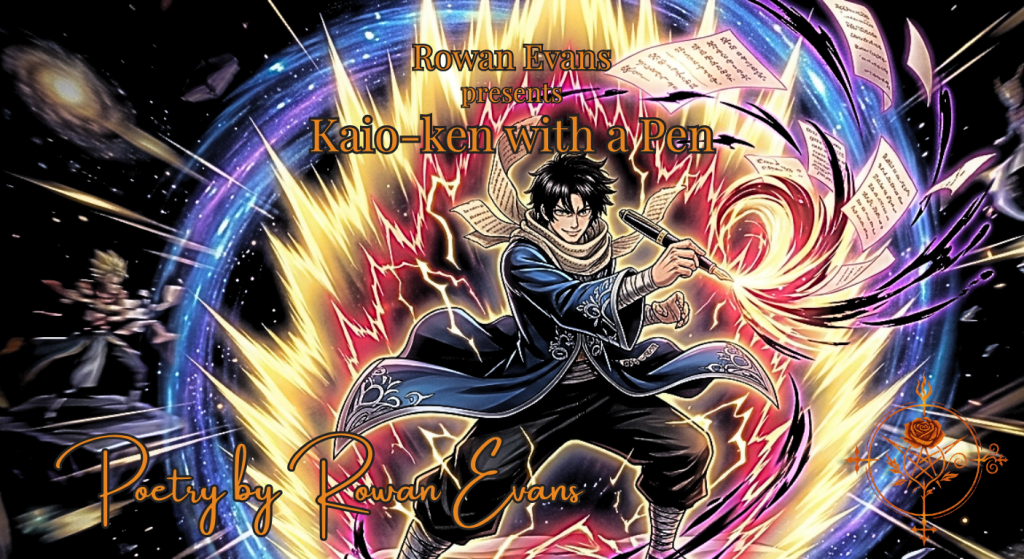
    A poet holding a pen stands surrounded by explosive golden and crimson energy, symbolizing creative power, battle, and becoming stronger after adversity.
    One poem is the attack.

    Kaio-ken with a Pen
    Poetry by Rowan Evans

    I can go Super Saiyan easy,
    the way Chi Chi teached me—
    taught me, I forgot you see
    I’m the best, yes,
    don’t want to step to this—
    you don’t want to fought me—
    fight me, I mean—bitch bite me,
    you’re not like me.

    My mind is terrifyingly quick—
    thoughts comes, instant transmission—
    from my mind to the page
    in a Final Flash attack—
    Kaio-ken with a pen, is this the end?

    Fin.

    Kaio-ken with a pen, I’m at it again,
    this is my battle to win.
    It’s going take you, a Kamehameha
    and Kaio-ken times ten just to test me—
    but it won’t be enough to best me.


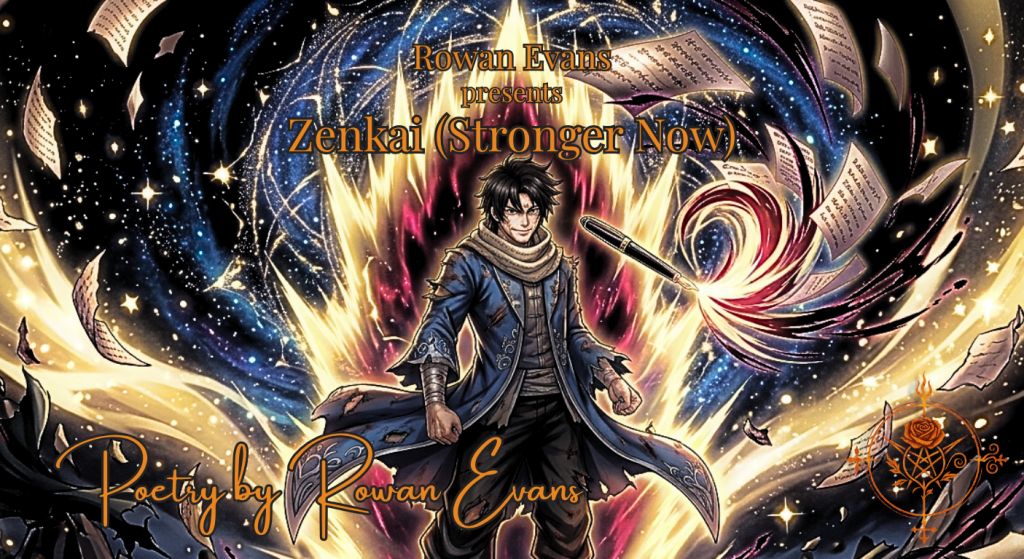
    A poet holding a pen stands surrounded by explosive golden and crimson energy, symbolizing creative power, battle, and becoming stronger after adversity.
    The other is what happens when you survive it.

    Zenkai (Stronger Now)
    Poetry by Rowan Evans

    I’m Goku after a fight
    and a Senzu bean,
    you know what that means—
    I’ve gotten stronger now,
    you pushed me to the edge—
    took me to the brink,
    but you couldn’t end it—
    you couldn’t finish me.

    So do your little dance,
    put on the Potara—do it—
    put your minds together,
    just know, even two as one—
    you won’t get the job done.
    I won’t borrow strength from no one,
    don’t need no spirit bomb
    to drop bombs—

    No Kamehameha—
    just ha-ha, I’m laughin’ at you.


    Journey into the Hexverse…

    [Don’t Push Me]
    A playful battle-poetry piece about turning insults into punchlines, standing your ground, and refusing to be intimidated. Don’t Push Me mixes swagger, humor, rhyme, and Rowan Evans’ signature self-aware interruptions.

    [B.S.T.F.U.]
    A playful battle-poetry exercise packed with insults, internal rhymes, punchlines, wordplay, and literary swagger. B.S.T.F.U. is Rowan Evans flexing the verbal muscles—not calling out anyone in particular.

    If you’re interested in more poetry, you can find it here → [The Library of Ashes]
  • Author’s Note

    Don’t Push Me is another exercise in letting my battle-poet voice stretch its legs.

    This isn’t meant as a literal threat or a callout toward any particular person. It’s playful bravado—the kind of exaggerated, cartoonish toughness that happens when I take an ordinary insult, run it through my sense of humor, and see how far I can push the rhyme.

    The opening starts with something I’ve genuinely heard for most of my life: being called “four-eyes.” From there, the poem turns that insult into ammunition. If you’re going to give me material, I’m going to make something out of it.

    And then, naturally, my brain couldn’t resist sabotaging the intimidation.

    I’m not— (shhh, nice kitty)

    Because apparently even Battle Rowan has an editor.
    Sometimes the strongest thing you can do with anger isn’t explode.
    Sometimes it’s turn it into a punchline.

    Rowan Evans


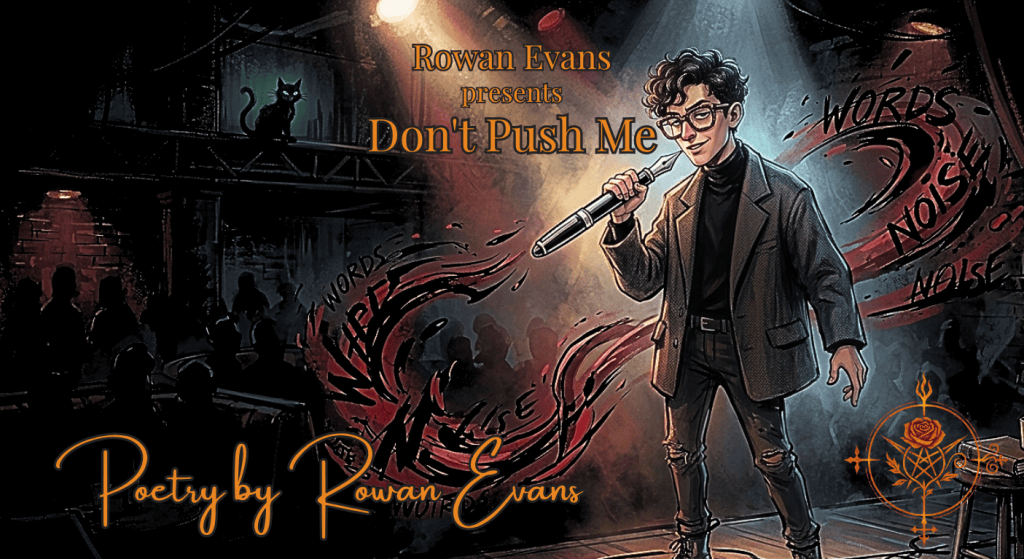
    A confident poet wearing glasses stands on a dark stage with swirling ink and a mischievous cat silhouette behind them.
    Sometimes you don’t have to throw the first punch—you just have to know what to do with the material they give you.

    Don’t Push Me
    Poetry by Rowan Evans

    You called me four-eyes?
    And you want me
    to react to that?
    I’ve had glasses since I was two,
    bifocals since five—
    I’ve had four eyes,
    longer than you’ve been alive.

    What’s next?
    You gonna call me slow?

    (I’m fast as fuck, boi.)

    Physically or mentally?
    Doesn’t matter though,
    there’s something
    you should know.

    I don’t back down,
    I stand my ground—
    because every fight I’m in,
    is like a fight for my life—
    I’m scrawny as fuck, man,
    still use no weapons—
    just fists, no knife.

    So trust me—

    you don’t want the jokes to stop,
    you don’t want to know
    what it’s like, when I really talk—

    so please don’t push me,
    ’cause I’m not— (shhh, nice kitty)


    Journey into the Hexverse…

    [B.S.T.F.U.]
    A playful battle-poetry exercise packed with insults, internal rhymes, punchlines, wordplay, and literary swagger. B.S.T.F.U. is Rowan Evans flexing the verbal muscles—not calling out anyone in particular.

    If you’re interested in more poetry, you can find it here → [The Library of Ashes]
  • Author’s Note

    Some poems don’t need to be abandoned when we outgrow the person who originally wrote them.

    Sometimes they need to be revisited.

    Undead Symphony (Remix) returns to a poem I originally wrote on June 13, 2024. The original was written from a place I understood intimately: feeling perpetually misplaced, overlooked, and emotionally exhausted while still carrying an enormous capacity for empathy underneath the numbness.

    The title came from that contradiction.

    An undead thing is neither fully alive nor truly dead. A symphony, meanwhile, is full of movement, emotion, tension, and sound. Put those ideas together and you get something that feels very close to the emotional state I was trying to describe: a person who can feel deeply while simultaneously becoming distant from the world around them.

    That contradiction is still here in 2026.

    What changed is the way I approach it.

    The remix gives the poem more room to breathe. I broke apart lines that had previously been compressed together, allowing certain thoughts to linger rather than rushing past them. I also sharpened some of the imagery and cadence, particularly around the relationship between solitude, apathy, and empathy.

    The original poem said what I was feeling.

    The remix feels more like I understand why I was saying it.

    And that distinction matters.

    I have spent a lot of time in my writing exploring darkness—not because darkness is all I have, but because I have always been fascinated by the strange things that can survive inside it. Undead Symphony is one of those pieces.

    Apathy and empathy shouldn’t fit together.

    Yet somehow, they do.

    One protects the heart by making the world feel distant.

    The other keeps reaching toward it anyway.

    That tension is the symphony.

    The speaker may feel undead, but the music never actually stops.

    Rowan Evans


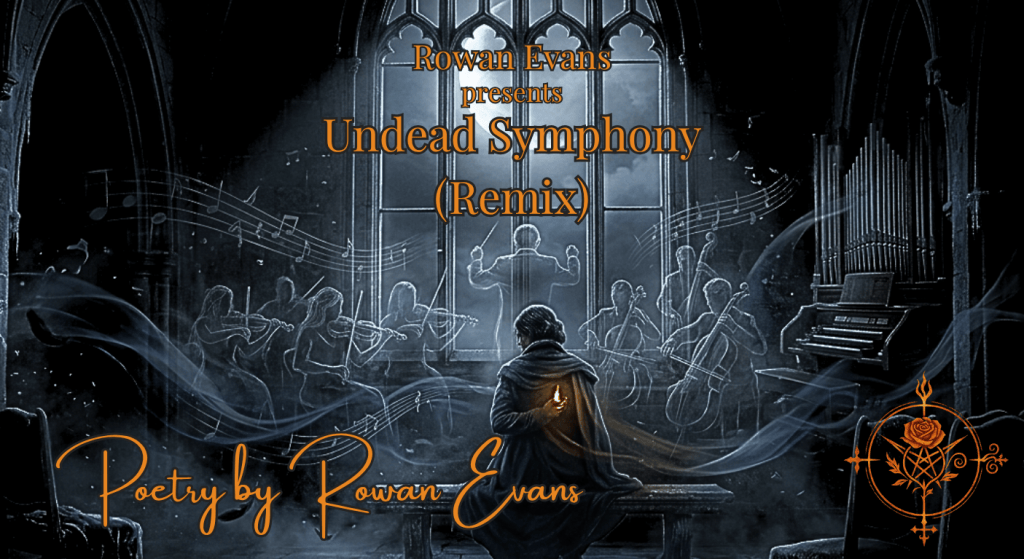
    A solitary figure sits beneath a moonlit window as ghostly music and shadows surround a small warm light.
    Somewhere between apathy and empathy, something inside me keeps making music.

    Undead Symphony (Remix)
    Poetry by Rowan Evans
    [written on July 23, 2026]

    It was always the wrong place,
    wrong time—

    I was always second best,
    never first place—

    Never the one to win the race,
    I was always the one they laughed at,
    never with—

    always the one that
    when they were gone—

    never missed.

    So I grew cold and distant
    like far-off summer nights,
    yearned for on cold winter mornings.

    And sometimes—

    it still feels hard to breathe,
    like a shadow in the light,
    fading beneath.

    I never was one for faith,
    I never believed,
    no thoughts and no prayers—

    because why should anybody care?

    In a crowd I felt alone,
    a silent voice,
    an empty phone.

    It’s apathy—
    and I pair it with my empathy.
    An odd dance of light and dark,
    within me.

    It’s beauty in the darkness,
    an undead symphony.

    But still—I dream of a place,
    where I’m more than just a face.
    A spark in the night,
    a fleeting glimpse
    of warmth in the cold,
    and strength in the struggle.

    I remember moments—
    fleeting and rare,
    of laughter shared,
    of someone who cared.

    Brief as they were,
    they lit up my sky,

    A reminder that even shadows can try.

    Yet—
    I return to the solitude I know,
    where apathy is my only show.

    But my empathy,
    a hidden grace—

    whispers of a longing for a different place.

    It’s a contradiction,
    a twisted art—
    to feel so much,
    with a guarded heart.

    An undead symphony,
    a haunting tune—

    a dance of shadows beneath the moon.


    Journey into the Hexverse…

    [Fallen Angel’s Reckoning (Remix)]
    Fallen Angel’s Reckoning (Remix) revisits a 2024 poem about heartbreak, broken promises, and falling from an imagined heaven, transforming its original ending into a darker meditation on resilience, self-reclamation, and learning to fly with broken wings.

    If you’re interested in more poetry, you can find it here → [The Library of Ashes]
  • Author’s Note

    Sometimes an old poem doesn’t need to be left in the past.

    Sometimes you have to return to it after you’ve changed.

    Fallen Angel’s Reckoning (Remix) revisits a poem I originally wrote on June 6, 2024. The original was already telling a story I understood well: love that promised forever, a fall from an imagined heaven, and the painful process of reclaiming yourself after the promise disappears.

    But I was a different writer when I wrote it.

    And, more importantly, I was a different person.

    The 2026 version isn’t meant to erase the original. It is a conversation with it.

    I kept the central imagery—the angel, Lucifer, the fall from heaven, the halo, the darkness, the broken vow—because those symbols still belong to the emotional architecture of the piece. But I wanted to push the mythology further this time. Icarus enters the story. The fall becomes more physical, more violent, more deliberate. The speaker isn’t simply descending from something that once felt like heaven; they are plummeting from it.

    And then there is the ending.

    In 2024, I wrote about newfound wings.

    In 2026, I wrote about broken wings.

    That change matters to me.

    Because strength doesn’t always mean becoming untouched by what happened. Sometimes you keep the scars. Sometimes you keep the broken pieces. Sometimes you discover that you can still fly without first repairing everything that hurt you.

    The angel doesn’t become an angel again.

    They don’t return to the heaven they lost.

    They don’t need the person who made them feel divine to give them their identity back.

    They become something else.

    A fallen angel who embraces the fallen.

    The broken.

    The free.

    That is what this remix ultimately became: not a poem about getting back what was lost, but about discovering that losing it didn’t mean losing yourself.

    I didn’t rewrite the 2024 version because it was wrong.

    I rewrote it because I’ve had two more years to understand the fall.

    And sometimes the person who wrote the first poem deserves to hear what the person you became has learned since then.

    Rowan Evans


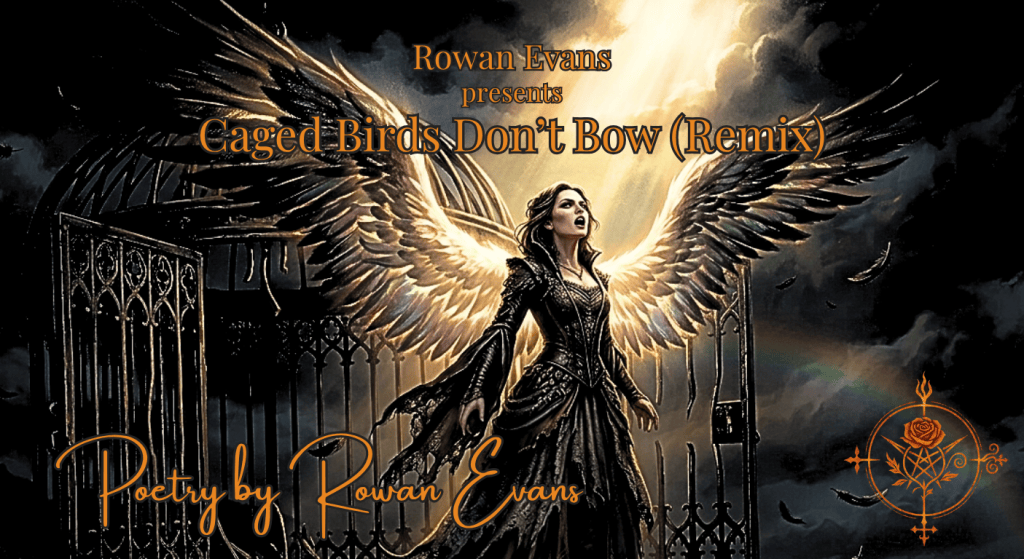
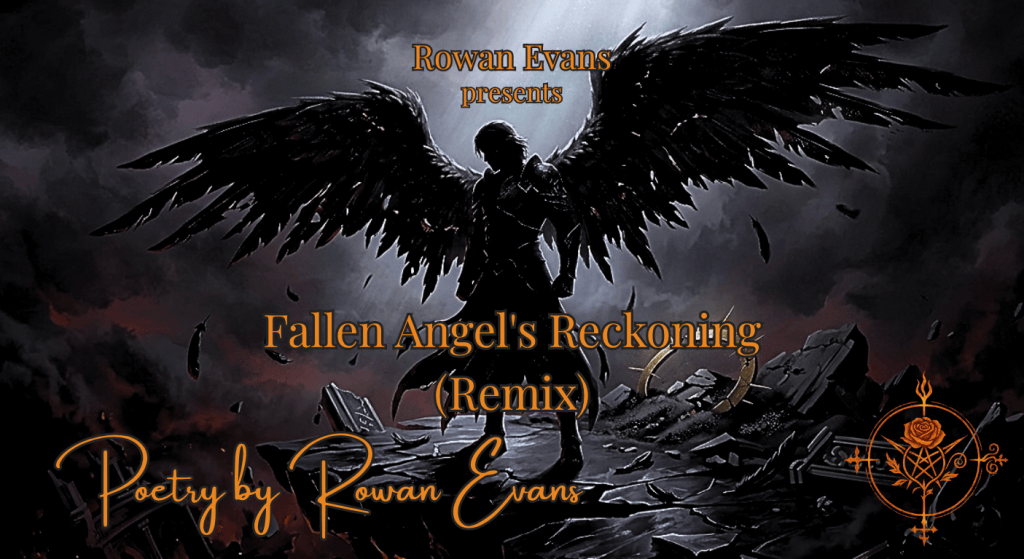
    A fallen angel with broken wings stands among the ruins of a shattered heavenly realm beneath dark clouds and a distant light.
    I don’t need unbroken wings to fly. I just need to remember that they were mine before anyone promised me heaven.

    Fallen Angel’s Reckoning (Remix)
    Poetry by Rowan Evans
    [written July 23th, 2026]

    I remember when you said forever,
    but forever never came, 
    so I fell like Lucifer,
    from the heavens down I tumbled.
    Returned your love,
    played your game—
    once an angel in your eyes,
    now in darkness I crumbled. 

    Your promises were wings that lifted me high, 
    but they melted away, when I reached the sun—
    just like Icarus, the light was my undoing.
    It wasn’t just a fall, I was plummeting…
     
    a fallen star,
    cast from the sky, 
    now I walk in shadows,
    where our love met its end. 

    Like Lucifer—I embraced the night, 
    wandering through realms of regret and pain, 
    I shed my halo,
    lost my light, 
    no longer an angel,
    in your eyes or in my name. 

    Yet in this darkness,
    a new path unfurls—

    I find strength in the ashes of our broken vow, 
    rising from the ruins of our shattered world.
     
    I reclaim my soul,
    I’m reborn here and now. 

    No longer bound by your empty decree—
     
    I soar with broken wings, 
    embracing the fallen,
    the broken, the free,
    a fallen angel finding strength
    I never knew I’d own.


    Journey into the Hexverse…

    [Homecoming]
    Homecoming is a return to the Gothic aesthetic at the heart of Rowan Evans’s poetry, blending Poe, mythology, horror icons, moonlight, ravens, and darkness into a meditation on artistic identity and finding your way back to the voice that feels like home.

    [The Monster in the Margins]
    Drawing inspiration from horror icons like Michael Myers, Ghostface, Freddy Krueger, and Pennywise, this poem explores the darker side of creativity—where inspiration becomes an unstoppable force lurking just beyond the edge of the page.

    [The Monster in the Margins II]
    The Monster in the Margins II transforms Rowan Evans’s Seven Deadly Sins mythology into a horror story written between the lines, where Lust, Wrath, Sloth, Greed, Pride, Envy, and Gluttony become monsters growing from pain, grudges, and scars.

    [The Unkindness Descends]
    “The Unkindness Descends” is a Gothic symbolic poem exploring collapse, transformation, and the unsettling experience of being witnessed during moments of unraveling. Through raven imagery, ambiguity, and ritualistic atmosphere, the poem invites multiple interpretations—spiritual, psychological, ominous, or transformative.

    [Gospel in Crimson]
    When writing becomes ritual and love becomes devotion, the line between creation and worship begins to blur. Gospel in Crimson explores obsession, artistry, and the sacred act of expression.

    If you’re interested in more poetry, you can find it here → [The Library of Ashes]
  • Author’s Note

    Some poems are meant to be complicated. This isn’t one of them.

    I wrote You Are Perfect as a reminder that our flaws don’t cancel our worth. We spend so much time measuring ourselves against impossible standards or letting other people decide what we’re worth that we forget something simple: being imperfect is part of being human.

    This poem isn’t saying you’ll never struggle or never doubt yourself. It’s saying those struggles don’t make you less deserving of love, respect, or compassion.

    If these words found you on a difficult day, I hope you borrow them until you can believe them for yourself.

    Rowan Evans


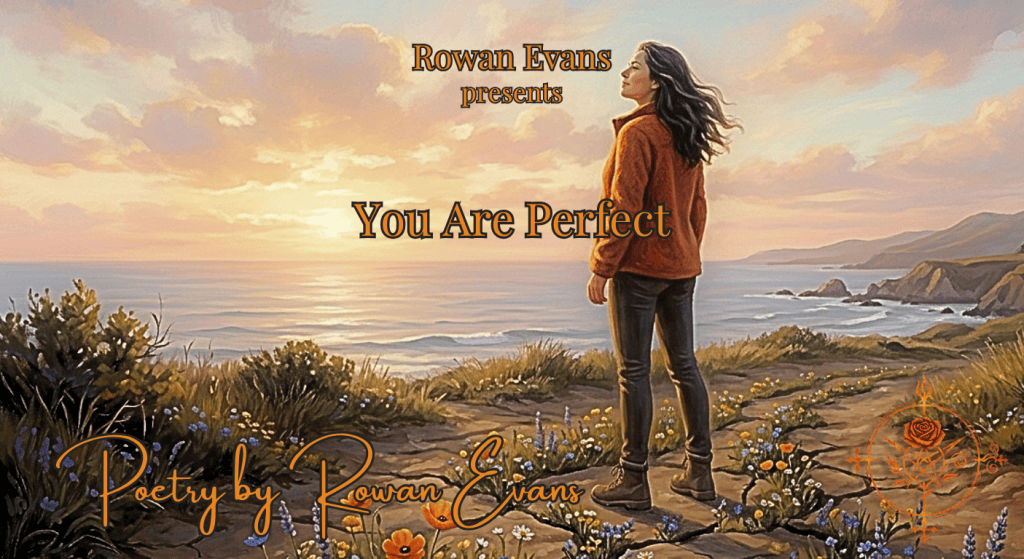
    A person standing confidently at sunrise as flowers bloom around them, symbolizing self-worth and resilience.
    Your flaws don’t diminish your worth—they’re part of the story that makes you uniquely you.

    You Are Perfect
    Poetry by Rowan Evans

    Dear,
    whoever needs
    to hear this—

    you’re worth it,
    flaws and all—
    you’re perfect.

    So don’t let others
    tear you down,
    and tell you
    what your worth is.

    Keep your chin up—
    even when it’s hard.

    Don’t let the spectators
    see you sweat.
    Don’t let them see the tears,
    or the weight on your neck.

    Because not everyone
    knows how to be a witness—
    sometimes they don’t
    have your best in mind.

    They want to see you fail,
    they want to see you small.
    So keep your chin up,
    and stand tall—

    because it’s like I said
    in lines three through six:

    Hear this—

    you are worth it,
    with your flaws and all—


    Journey into the Hexverse…

    [Human Rorschach]
    Sometimes we’re less a fixed person than an inkblot—our meaning changing with every set of eyes that looks at us. Human Rorschach explores perception, identity, and the ways our own experiences shape what we believe we see in others.

    [A Rose in the Ashes]
    Lost within a forest where every leaf becomes a memory, the speaker follows darkness instead of fleeing from it, discovering that healing isn’t found at the end of the tunnel—but in facing the past long enough to notice a single rose blooming through the ashes.

    [Where the Metaphors Lead]
    Some truths are easier to write than they are to say aloud. “Where the Metaphors Lead” explores the quiet space between dreams, confession, and the courage it takes to let another person know how deeply they’ve become woven into your inner world.

    [Through My View]
    No two people experience the world the same way. Through My View is a reflective free verse poem exploring perspective, imagination, and the impossibility of fully seeing through another person’s eyes.

    [Just Human]
    Just Human is a reflective free verse poem about seeing people before borders, choosing empathy over division, and finding home in our shared humanity rather than on a map.

    If you’re interested in more poetry, you can find it here → [The Library of Ashes]
  • Author’s Note

    Some poems feel less like they’re written and more like they’re discovered.

    A Rose in the Ashes came from following an image rather than an outline. One symbol led to another until the poem became a journey through memory itself—through forgotten moments, lingering wounds, recurring dreams, and the quiet realization that healing doesn’t happen by avoiding the past.

    The forest in this poem isn’t meant to be a literal place. It’s the landscape of memory, where some experiences remain vivid while others decay with time. The trees, the tunnel, the moon, the bay, and finally the rose all became landmarks within that emotional terrain.

    The final image—a single rose blooming through ashes—reminded me that even after devastation, beauty doesn’t disappear forever. Sometimes it simply waits beneath the surface until we’re ready to notice it.

    Rowan Evans


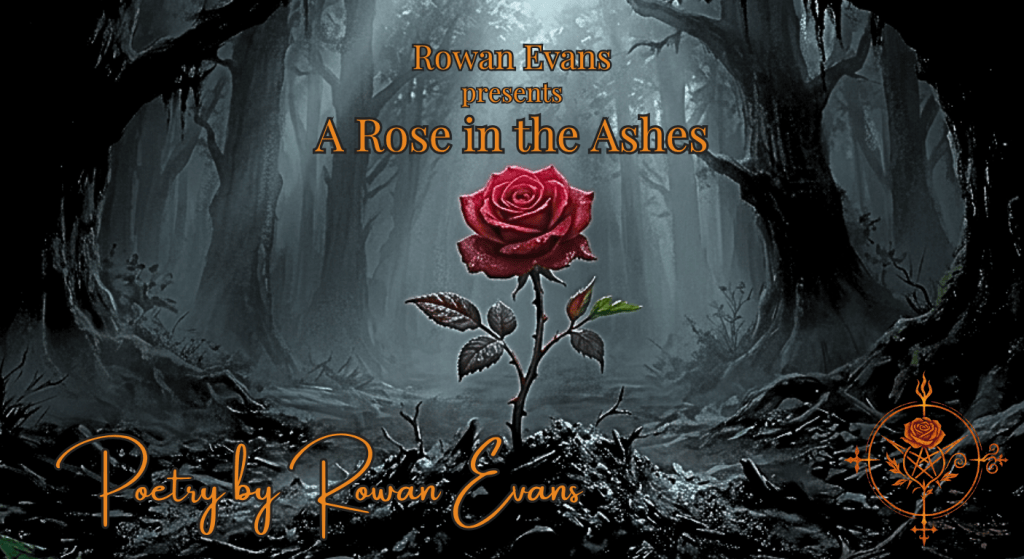
    A single red rose grows through gray ashes beneath a misty forest illuminated by moonlight, symbolizing hope emerging from painful memories.
    Sometimes healing doesn’t appear as a blazing light at the end of the tunnel.

    Sometimes it’s a single rose, quietly blooming where you thought only ashes remained.

    A Rose in the Ashes
    Poetry by Rowan Evans

    I wander through the mist and fog,
    wondering if I’ve gotten myself lost.
    The trees are thick with sickly green leaves,
    and the air is too thick, it’s hard to breathe.
    Every step feels borrowed,
    like the ground isn’t sure
    it wants to hold me.

    It’s like with every step
    the ground shifts a little to the left,
    until nothing feels right.

    It’s like I’ve walked
    to the end of the tunnel,
    but I didn’t find the light.

    I keep walking, stumbling along—
    the dark swallows me whole
    and then spits me out.
    I hit the ground and roll to a stop
    on the edge of a fifty foot drop.

    That’s when I see it,
    something moving between the trees—

    not a creature,
    but a feeling—

    the sense that I’m being asked
    to keep going
    even when I don’t know why.

    Maybe it’s because
    I didn’t find the light
    at the end of the tunnel,
    not because I failed—
    but because the journey isn’t done.

    The light signifies the end.

    No light means the journey continues,
    so I keep moving through—
    the streets that I walk in sleep,
    the moment I return to my bones,
    or a war with gods to ease the pain.

    Yeah, I followed the footprints
    to the water’s edge,
    I stared across at the coast
    on the other side of silence.

    And even from a distance,
    I was able to trace
    the moon across the heavens,
    before it became suspended over the bay—
    its reflection trembling across the dark water,
    a mirror to the tremor in my chest.

    But I couldn’t stay still for long—
    I had to keep moving on.

    So I ran—

    bolted for the tree line,
    tripped and stumbled in
    and my eyes caught the way the light
    pierced the canopy—

    the light—

    that’s what I’d been chasing
    this whole time,
    not at the end of the tunnel—
    but above my head,
    an idea—

    my eyes drift toward the sky,
    and that’s when I see—

    the leaves on these trees
    are not leaves,
    they are memories—
    some bright and vivid,
    others a sickly shade of green.

    Those are memories forgot,
    memories left to rot.
    But here’s the truth of this plot:

    some memories fade—
    whether you hold on or not,
    and some become rooted
    through pain, an environment
    permanently changed.

    And that’s what I saw…

    trees with leaves
    showing things—
    I thought long forgotten.
    I was more surprised by that,
    than the fact that so many trees
    looked rotten.

    I could feel the tears
    touch the corners of my eyes—
    the air was thick again,
    humid and suffocating.
    There was a tremor in my chest,
    and knees were weak—
    with every step my bones were quaking,
    like the earth was shaking.

    I stumbled and fell to my knees,
    head bowed—
    in shame or respect,
    who knows, now?
    I opened my mouth,
    but no jokes came out—
    I couldn’t misdirect from this,
    no sleight of hand.

    I had to face this—
    whatever it is,
    whatever these leaves
    show me,
    I’ve got to take it seriously—
    because maybe it is these memories
    that are keeping me stuck here.

    Maybe they are the memories
    that drive the fear,
    that keeps me from acting—
    that keeps me dragging feet
    and self-sabotaging.

    Slowly I rise—
    like the sun over the horizon.
    Knees shaking from the weight of me,
    I struggle to take one step
    and then another.

    I stumble through the ruins
    of thoughts, dreams and memories—
    my chest rises and falls,
    like oxygen is in short supply.

    Then I see it—
    a single rose in bloom,
    poking through the ashes
    of nights only remembered
    in the spilled ink on silent pages.


    Journey into the Hexverse…

    [One Honest Sentence]
    It’s easy to write about anything. What’s difficult is writing one completely honest sentence without hiding behind humor, references, or metaphor. One Honest Sentence explores the distance between poetic confidence and emotional vulnerability.

    [Leave No Self Behind]
    What if finding yourself isn’t about discovering someone new, but learning to walk beside every version you’ve ever been? “Leave No Self Behind” is a meditation on memory, healing, and embracing the selves we once abandoned.

    [More Afraid Than the Ink]
    Some confessions are easy to write but impossible to speak. More Afraid Than the Ink explores fear, dreams, recurring symbols, and the quiet realization that the page has always been braver than the poet.

    [Just Human]
    Just Human is a reflective free verse poem about seeing people before borders, choosing empathy over division, and finding home in our shared humanity rather than on a map.

    [Translating What I Feel]
    A poem about the invisible process of turning emotion into imagery, imagery into language, and language into poetry. An intimate reflection on creativity, loneliness, and twenty-three years of learning to translate what the heart feels.

    If you’re interested in more poetry, you can find it here → [The Library of Ashes]
  • Author’s Note

    Some poems arrive all at once.

    This one arrived in pieces.

    The opening came first—a joke, a banana peel, a little bit of wordplay and self-awareness. The speaker trips over their own feelings and tries to laugh about it before anyone notices.

    That’s fairly normal for me.

    Humor has always been one of the ways I approach vulnerability. Not because the feelings aren’t real, but because sometimes honesty becomes easier to hold when it’s carrying a joke.

    But somewhere during the writing process, the poem shifted.

    The focus stopped being the speaker’s feelings and became the person receiving them.

    Because love, at least the kind I’m interested in writing about, isn’t ownership.

    It isn’t rescue.

    It isn’t fixing someone.

    It’s creating safety.

    The construction imagery in the second half comes from that idea. The speaker isn’t trying to rebuild another person or erase their past. They’re trying to create something steady. Something reliable. A place where another person can set down their fears for a while and rest.

    That distinction matters to me.

    Too many love stories focus on saving someone.

    I’m more interested in what happens when you simply show up, consistently, and help build conditions where healing becomes possible.

    Brick by brick.

    Choice by choice.

    Day by day.

    The final lines grew from a belief I’ve carried for a long time:

    Everyone deserves a future that feels safe to stand inside.

    Everyone deserves foundations that don’t shake beneath them.

    And sometimes the greatest gift we can offer another person isn’t a promise to save them.

    It’s a promise to help build something that lasts.

    Rowan Evans


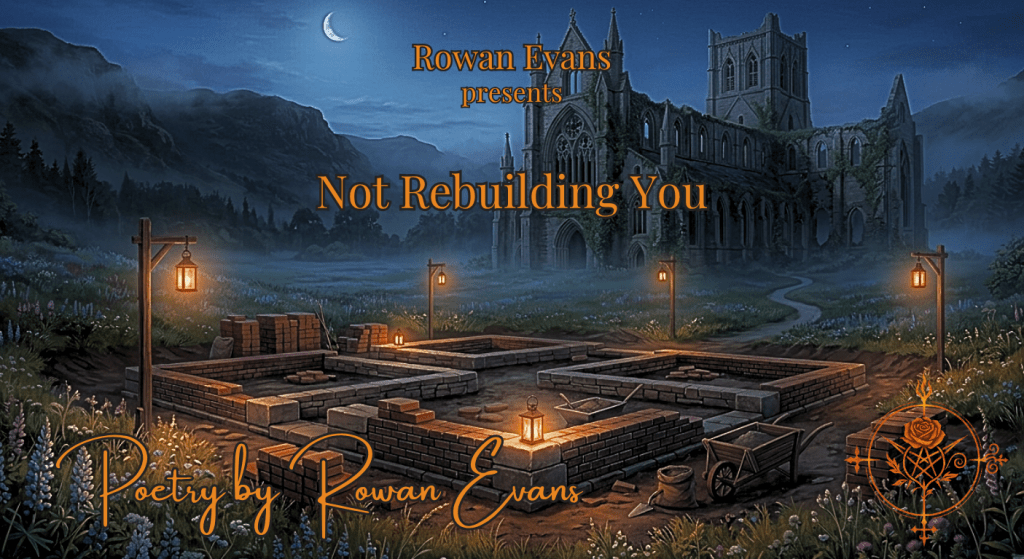
    A new foundation being built beside old ruins at twilight, symbolizing healing, trust, and creating a safe future through love.
    Sometimes love isn’t about fixing what’s broken. Sometimes it’s about laying a foundation strong enough for someone to finally rest without fear of collapse. 🖤🧱✨

    Not Rebuilding You
    Poetry by Rowan Evans

    It happened quick.
    I slipped—
    banana peel.
    But you can trust me,
    I think I’ve proven that, (huh?)
    so you know
    you can trust
    what I feel is real.

    From the fear
    to devotion,
    loyalty in motion—
    I try to give you no reason
    to question.

    And you don’t need
    to return this.
    This isn’t a library,
    no overdue charge—
    just a gift straight from my heart,
    that I give with purpose.

    And if you’re wondering
    why I give like this…

    You’re worth it.

    I’d move earth,
    shift dirt—
    excavate
    to stop the hurt.
    Prepare the land
    for a new foundation.

    So let me lay brick after brick,
    patience in every layer,
    hope in every line.
    Not rebuilding you—
    just building a place
    where you can finally rest
    without fear of collapse.

    And if it takes time,
    I’m not afraid of slow miracles—

    because love like this
    isn’t renovation—
    it’s resurrection.

    A clearing of old ruins,
    a promise carved into the earth:
    you deserve a future
    that doesn’t hurt to stand on.


    Journey into the Hexverse…

    [The Language Her Soul Speaks]
    What if love isn’t about being understood, but learning to understand someone else? “The Language Her Soul Speaks” is a free verse poem about intimacy, communication, curiosity, and the desire to know another person beyond the limits of language.

    [Ocean Waves (1, 4, 3)]
    A moonlit shoreline, a rowboat full of ducks, a piggybank with no cents, and a confession hidden in plain sight. Ocean Waves (1, 4, 3) explores how humor, wordplay, and absurdity can become a side door to vulnerability when the truth feels too difficult to say directly.

    [L Words & Heart]
    A playful, self-aware poem about love, longing, loyalty, and the quiet ways another person can reshape our inner world. What begins as humor slowly reveals a heartfelt confession about affection, imagination, and the faces that linger in our dreams.

    If you’re interested in more poetry, you can find it here → [The Library of Ashes]
  • Author’s Note

    This piece came from a quiet moment of doubt. Not the kind that makes you quit – the kind that makes you question the cost of what you’re chasing.

    Sometimes ambition feels heavy. Sometimes the version of yourself you have to become feels unfamiliar. This poem is less bout certainty and more about motion.

    I didn’t write it to motivate anyone else. I wrote it because I needed to remember that progress doesn’t require a map – just movement.

    Rowan Evans


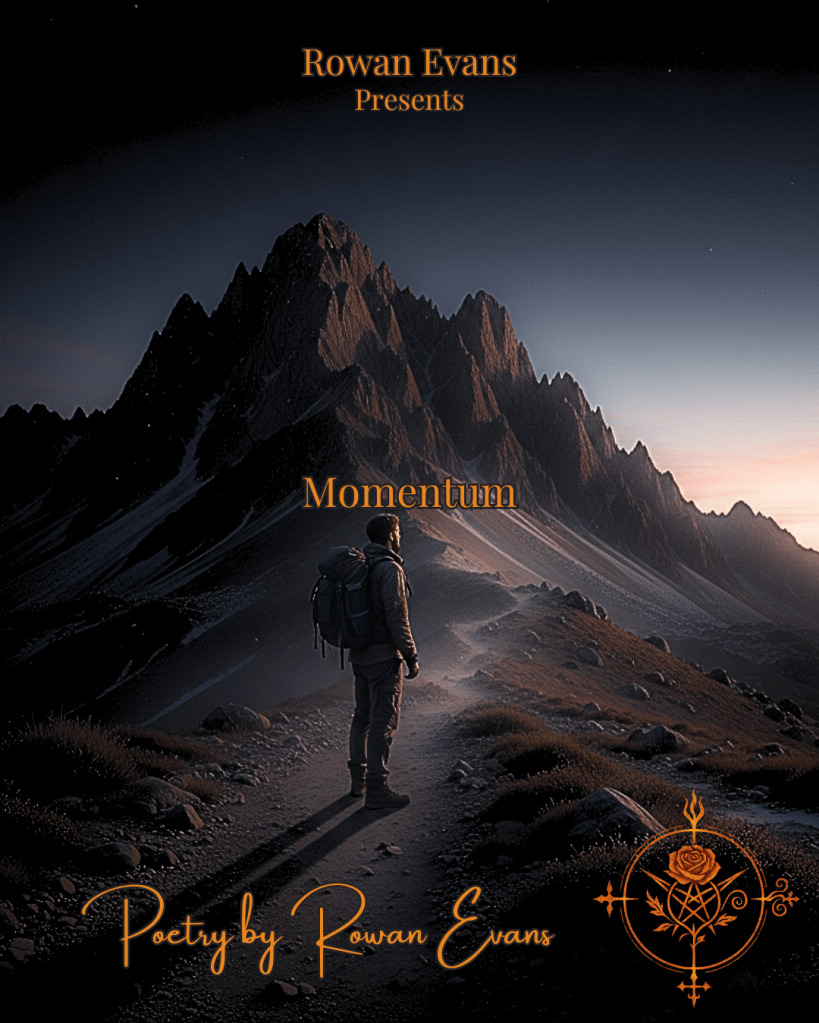
    A person standing at the base of a mountain at dusk, looking toward a faint path upward, symbolizing growth and momentum.
    You don’t need a map. You just need momentum.

    Momentum
    Poetry by Rowan Evans

    When every thought
    is focused on
    the goals you’ve got,
    but they come
    with tremendous cost.
    What do you do
    when you feel lost?

    You breathe.
    You stall.
    You stare at the ceiling
    like it owes you answers.

    You hold your goals
    like they’re burning in your hands—
    beautiful,
    but blistering.

    You wonder
    if the cost is worth the climb,
    if the climb is worth the view,
    if the view is worth the version of you
    you’ll have to become
    to reach it.

    And still—
    you keep going.
    Not because you’re certain,
    but because something in you refuses
    to stay small.

    What do you do?
    You take one step.
    Then another.
    And another.

    You don’t need a map.
    You just need momentum.


    If you’re interested in more poetry, you can find it here → [The Library of Ashes]
  • Author’s Note

    Some poems are confessions.
    Some are exorcisms.

    This one is alchemy.

    Alchemist of Ink (All Sixes) came from that familiar edge—when the weight presses in, when the mind contracts, when the darkness feels like it might finally win. But instead of letting it consume me, I let it become something. I let it turn into ink.

    This poem is about that moment of reclamation.
    About taking what hurts and making it mine.
    About refusing to be only what the darkness names me.

    If you’ve ever felt yourself folding inward—this is for you.
    If you’ve ever made art out of survival—this is yours too.


    A shadowed poet with glowing eyes as black ink pours from their hands, transforming into swirling symbols of power in a dark, gothic setting.
    Turning darkness into language. Pain into power. Ink into alchemy.

    Alchemist of Ink (All Sixes)
    Poetry by Rowan Evans

    I am all sixes when its needed,
    this darkness,
    your hatred feeds it.

    I can feel it—
    crawling up my spine,
    that creeping feeling.
    It twists around my mind,
    contracting.

    I can feel it squeeze,
    as I fall to knees.

    My eyes flicker and flash,
    fade to black—
    as you see
    my face distort.
    Twisted reflection.
    Personified depression.

    Can you see—
    as I begin to bleed ink?
    It pours from me,
    covering fingers,
    hands and arms.

    It twists,
    never relents.


    I’m a motherfucking
    alchemist,
    the way I take my pain
    and change it.
    I’ll write like hell,
    to subtly rearrange it.


    If you’re interested in more poetry, you can find it here → [The Library of Ashes]
  • Introduction

    Sometimes, the quiet isn’t empty. 
    Sometimes, it carries you, like a pulse behind the walls. 
    Here, in the hush, I watch. 
    Here, in the stillness, I breathe. 
    Here, I am seen, even when no else is. 
     
    Rᵒᵒ ᵗʰᵉ Pᵒᵉᵗ


    Ethereal figure standing in a dim room, light streaming through cracks, evoking quiet and introspection.
    “Surrounded in silence, both ghost and witness.” – Rᵒᵒ ᵗʰᵉ Pᵒᵉᵗ

    Between Walls and Whispers (Ghost and Witness)
    Pᵒᵉᵗʳʸ bʸ Rᵒᵒ ᵗʰᵉ Pᵒᵉᵗ

    Sometimes, I find myself 
    surrounded in silence— 
    not absence, 
    but a quiet hum behind the walls. 
    The room feels full, 
    but nobody’s really there, 
    and I am both ghost 
    and witness— 
     
    drifting, endless, 
    caught in this forced flow 
    of normalcy. 
     
    A weirdo, 
    misfit, outcast— 
    purposeful outsider, 
    rejector of the machine. 
     
    I don’t want to be another cog. 
    Sometimes, I long for silence— 
    not the absence, 
    but that gentle presence, 
    a pulse softer 
    than the endless hum. 
     
    And in that silence, I breathe. 
    I am seen, 
    I am held, 
    not by voices or eyes, 
    but by the quiet 
    that understands 
    what the hum 
    cannot touch.


    If you’re looking for more poetry, you can find it here → [The Library of Ashes]