Author’s Note
What would happen if every version of yourself could sit in the same room?
Would you recognize them? Would they recognize you? And, perhaps most importantly, what would you say to the version of yourself who needed someone to listen?
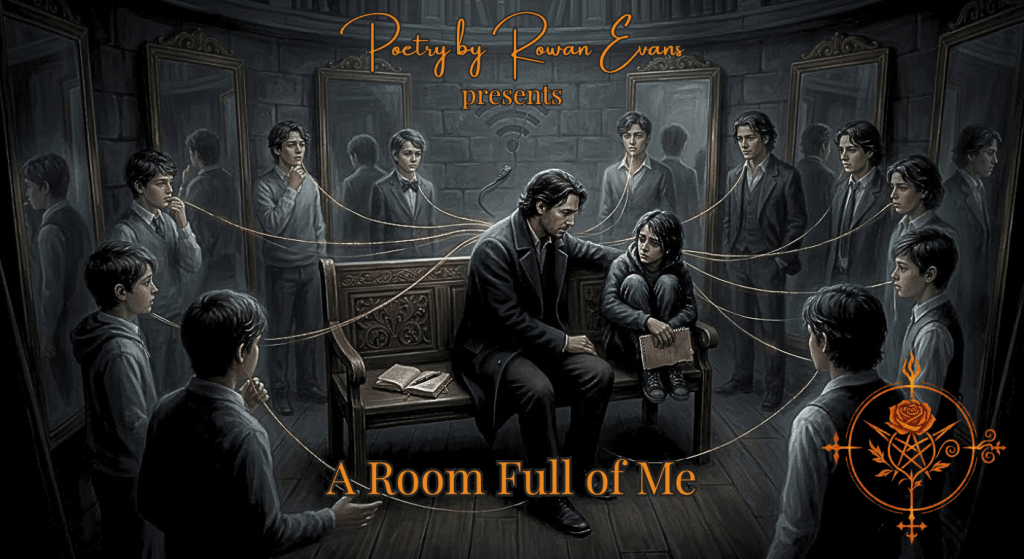
A Room Full of Me is an imagined conversation across time, bringing together the different ages and experiences that have shaped who I am. At thirty-six, I find myself looking back at the younger versions of me—not simply to remember what happened, but to understand what those experiences meant and how much of them I still carry.
Seventeen sits in the corner because some things take longer to understand than others. There are experiences we survive before we have the language to explain them, feelings we bury because nobody seems willing to hear them, and parts of ourselves that remain waiting for the acknowledgment they never received.
The conversation between seventeen, twenty-four, and thirty-six is particularly important to me. It’s about recognizing that younger self without dismissing their pain, offering reassurance without pretending everything eventually becomes easy, and understanding that the person we become is often built from lessons we never wanted to learn.
There’s also something meaningful about the idea that it took nineteen years for the light to reach my eyes. Sometimes perspective really does take time. We can spend years examining ourselves, mapping every curve of our minds, trying to understand why we feel the way we do. And even then, understanding doesn’t necessarily mean we’ve found all the answers.
But perhaps one of the most important things we can become is the person our younger selves needed.
Someone who listens.
Someone who believes them.
Someone who doesn’t tell them they’re going through a phase or that they’ll eventually grow out of who they are.
And then there’s that final line.
After all the reflection, all the conversations, and all the reassurance, every version of me still wants to leave. That desire hasn’t disappeared simply because I’ve learned to understand myself better. In some ways, it has become clearer.
This poem isn’t about rejecting every version of the person I’ve been. It’s about acknowledging them, making space for them, and recognizing that survival doesn’t mean every part of us has found peace.
Sometimes healing isn’t a room where everyone agrees.
Sometimes it’s a room where, for the first time, everyone gets heard.
— Rowan Evans
A Room Full of Me
Poetry by Rowan Evans
I sat in a room full of me—
it was just me as far as the eye could see,
and I could see me at thirteen,
fourteen and fifteen—
sixteen was standing there, too.
Then I saw another me,
and I was there with other me—
with two more standing beside,
it was me at eighteen through twenty-one—
seventeen was in the corner all alone.
It was like—
looking into a mirror,
but light reflected—
took nineteen years to reach my eyes.
Because at thirty-six
I still sit—
all alone.
Even in a room full of people,
I feel I’m by myself—
it’s not their fault though.
I just feel disconnected—
ethernet unplugged.
I’m wi-fi with no connection—
so I learned the shape of me,
every curve of my mind—
I followed and mapped every line,
I bent and broke them,
squeezed them dry, took all the hope from—
these were lessons learned at seventeen,
with eyes open-wide—
back when I took it all to heart,
then took it all apart—
I wasn’t ready, it was a false start.
So thirty-six went to sit
with seventeen—
twenty-two watched close,
as twenty-four approached
with eyes full of broken hope—
“seventeen,
I know what it’s like to go quiet—
when your mind feels like a riot,
and nobody will listen, so you go silent—”
twenty-four’s words came soft-spoken but sure,
“so you sit inside your mind and write,
until everything feels right—
but nothing ever feels right, does it?”
“It doesn’t,”
seventeen replied
with tears in their eyes.
“I feel like I’ve been fighting all night,
or like I’ve been fighting my whole life.”
With shaking hands
seventeen wiped their eyes.
“I’ve been fighting to be normal,
to be seen, been fighting just to be me.”
For the first time thirty-six spoke,
a sure voice full of hope—
“seventeen, we recognize the fight,
we recognize we’ve been fighting our whole life.
We’ve survived off lessons you taught,
from things learned back when you thought
you weren’t going to make it.
Back when you wanted someone to listen,
but nobody would—
so we became someone who could.”
So thirty-six sat and listened—
as every past version of me
reassured seventeen—
it wasn’t a phase, please,
every version of me—
still wants to leave.
Journey into the Hexverse
If you’re interested in more poetry, you can find it here → [The Library of Ashes]


Leave a Reply