Tag: humanity

  • Author’s Note

    I’ve never been particularly good at thinking in borders.

    When I look at a map, I see countries.

    When I look at people, I don’t.

    I’ve always found it easier to connect with someone’s story than with the place they happened to be born. A passport can tell you where someone came from, but it can’t tell you what keeps them awake at night, what they dream about, or what they’ve survived.

    That’s the part that interests me.

    This poem isn’t political.

    It’s personal.

    It’s an attempt to describe the way I’ve always experienced humanity—as something far larger than geography.

    I don’t believe compassion should stop at a border.

    I don’t believe kindness needs a nationality.

    Maybe that’s why so much of my writing wanders across oceans and continents, chasing people I’ll probably never meet, writing about places I’ve only visited through dreams, conversations, photographs, and stories.

    To me, humanity has always felt like one conversation happening in countless languages.

    Different histories.

    Different landscapes.

    The same heartbeat.

    That’s all this poem is trying to say.

    We’re all just human.

    Rowan Evans


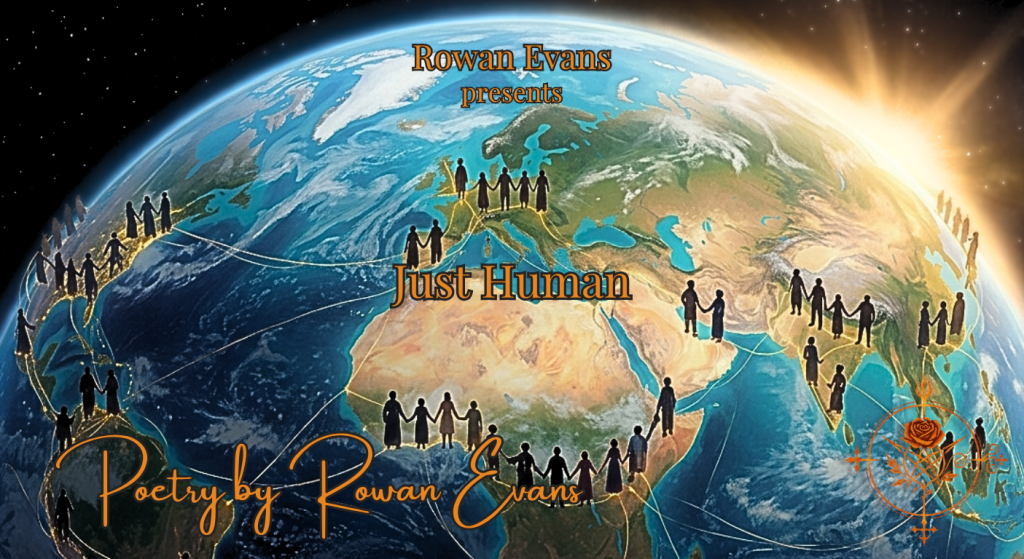
    The Earth at sunrise with diverse people connected across continents by glowing threads of light, symbolizing shared humanity.
    Before we’re anything else, we’re human.

    Just Human
    Poetry by Rowan Evans

    With my eyes wide—
    I see the world.
    Not one corner.
    The whole globe,
    and I’ve got love for it.

    Every person,
    every soul—
    not divided by borders,
    not separated by flags,
    just human.

    Just here.

    Trying to make it
    through the same sunrise
    and the same storms.

    Not because I know them,
    but because I recognize them—
    the way a heartbeat
    recognizes another heartbeat
    anywhere on Earth.

    I don’t split the map
    into colors or countries.
    I don’t measure worth
    by lines drawn long before I was born.
    I just see people—
    living, trying, hoping.

    Maybe it’s the way I grew up
    feeling like I belonged everywhere
    and nowhere at once.

    Maybe it’s the way strangers
    always felt more familiar
    than the places I called home.

    Because home, to me,
    was never a location—

    it was a feeling,
    a recognition,
    a quiet knowing
    that we’re all carrying
    the same fragile humanity
    through different landscapes.

    And when I say
    I love the world,
    I mean I love its people—

    the way they rise,
    the way they break,
    the way they keep going
    even when the map
    forgets their names.


    Journey into the Hexverse…

    [Another Fire]
    A powerful poem exploring global chaos, systemic inequality, and emotional exhaustion in a world where conflict grows faster than it can be understood.

    [Raising Governments]
    A sharp, satirical poem that reframes global leadership as misbehaving children, Raising Governments blends humor with frustration to highlight the immaturity and contradictions often seen in power structures.

    [Government Time-Out]
    A direct and controlled follow-up to Raising Governments, this poem strips away humor to confront power with accountability—demanding reflection, responsibility, and change.

    [Calculating Profits (Ledger of Lives)]
    Calculating Profits (Ledger of Lives) is a raw anti-war poem confronting how modern conflict is often reduced to statistics, strategy, and spectacle. Through stark imagery and direct language, Rowan Evans challenges the “us vs. them” narrative and reminds readers that behind every number in war’s ledger is a human life.

    [Crash Landed]
    A reflective poem about feeling like an outsider in a world shaped by tribalism, selective compassion, and identity-driven thinking.

    If you’re interested in more poetry, you can find it here → [The Library of Ashes]
  • Author’s Note

    There’s a particular kind of exhaustion that comes from paying attention.

    Not just to your own life–but to the world as a whole. The patterns. The repetition. The way the same problems resurface, louder each time, while the people most affected are the ones with the least control over any of it.

    Another Fire comes from that place.

    It’s not a solution. It’s not even an attempt to be balanced.

    It’s a reaction–to the feeling that everything is happening all at once, that crises stack faster than they can be addressed, and that somewhere along the way, empathy gets lost in the noise.

    At its core, this piece questions something simple, but uncomfortable:

    How did we get to a point where it’s easier to see each other as enemies… than to question the systems that put us in conflict to begin with?

    This isn’t about having all the answers.

    It’s about refusing to look away.

    Rowan Evans


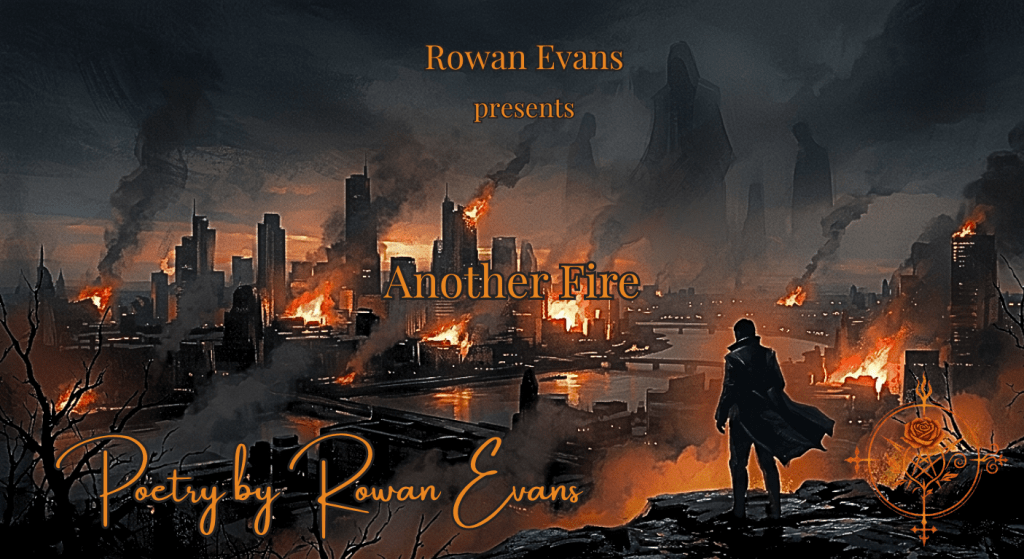
    Person watching a city with multiple fires burning, symbolizing global chaos and systemic conflict
    While we burn, someone else decides where the fire spreads.

    Another Fire
    Poetry by Rowan Evans

    I’ve been lost
    for a while now—
    eyes locked on the world.

    I’m just wondering how…
    how did we let it
    get like this?

    It’s a mess,
    everyone’s stressed—
    except the billionaires.

    Stacking money,
    sitting higher than fear.

    Profits rise
    as civilians die.

    And everywhere we look…
    another fire.

    We can’t tackle one problem,
    before five more pop up.
    It’s like we’re frozen—stuck.

    Half the population seems fine with it,
    the rest of us screaming,
    what the fuck?

    The whole world’s running out of luck.

    It’s like it’s designed
    to slowly chip away—
    grip, rip, strip away
    your humanity.

    Driving us straight
    into insanity.

    Because it’s insane to me—
    how we can look
    at another human being
    and see an enemy.

    When the only real enemy
    isn’t standing across from us—

    but above us.

    Deciding
    who fights,
    and who dies.


    If you’re interested in more poetry, you can find it here → [The Library of Ashes]
  • Author’s Note

    Fragile Pulse came from watching the world move on autopilot—how easily people slip into routines, expectations, and identities that aren’t truly their own. It’s a poem about alienation, yes, but also about the quiet, stubborn spark that still lives beneath all that machinery.

    This piece is my reminder that even in places that feel lifeless or mechanical, there are moments of real humanity—small flickers of authenticity that reach back when we reach out. It’s about connection in a world that often forgets how to feel, and about what it means to notice the spark in someone who thought theirs had gone out.

    A fragile pulse is still a pulse. And sometimes, that’s enough to change everything.


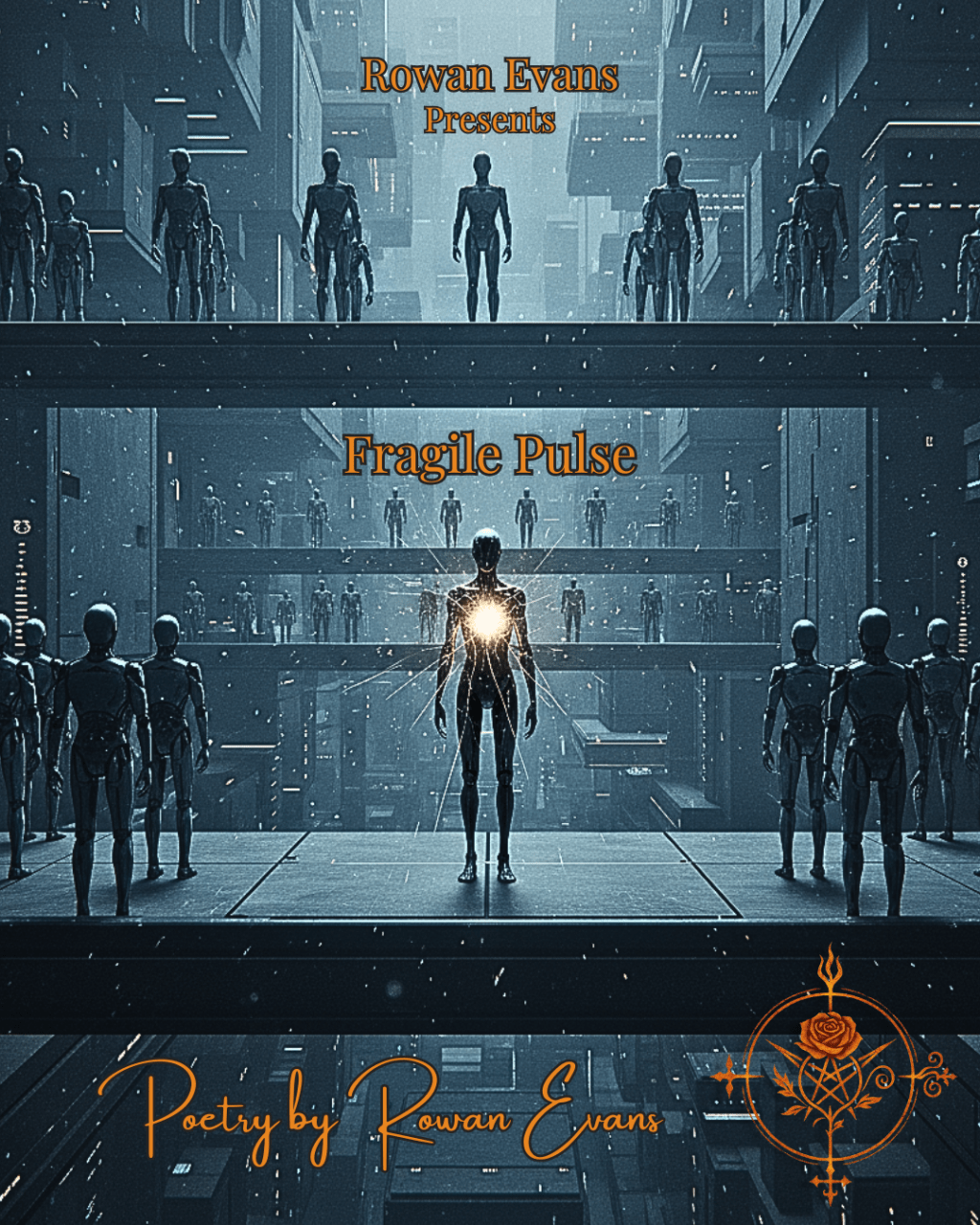
    Illustration of a single glowing human figure surrounded by robotic, mechanical figures moving in a cold, dystopian cityscape.
    A fragile spark in a mechanical world — the pulse that refuses to fade.

    Fragile Pulse
    Poetry by Rowan Evans

    Oh, you’re here?

    Do you hear that?

    Listen—
    the hum of motors,
    the whir of gears.
    You see a land of people;
    I see a land of robots—
    not thinking,
    only following programs.

    They walk past you,
    faces blank,
    eyes fixed,
    hands moving in repetition,
    hearts forgotten in the chest,
    souls traded for schedules.

    And I watch—
    not with hope,
    not with judgment,
    but with quiet fascination
    at how easily the mind bends
    when freedom is a stranger.

    Do you hear it too?
    The faint pulse beneath the circuits,
    the tiny spark of something
    that refuses to be programmed.
    It’s fragile—
    like a candle in a storm,
    but it exists.
    I can feel it,
    even if the rest cannot.

    I reach out—
    not with force,
    not with commands,
    but with a touch gentle enough
    to tremble against wires and bone.

    Some notice;
    some do not,
    but the ones who do
    flicker for a moment—
    a shadow of thought
    breaking through the rhythm
    of their programming.

    And in that flicker,
    I see the impossible:
    a memory, a desire,
    a pulse that answers mine.
    A whisper shared
    between what is alive
    and what has almost forgotten how.

    Maybe it’s nothing,
    just a flicker in the dark,
    but even a single spark
    can set a world alight.
    I hold it close—
    this fragile pulse—
    and for a heartbeat,
    the land of robots
    becomes a land of us.


    If you enjoyed this piece, check out my full archive here: [The Library of Ashes]