Tag: social commentary poetry

  • Author’s Note

    “Money can’t buy happiness” has always sounded a little too tidy to me.

    Money can absolutely buy comfort, convenience, security, experiences, and a whole lot of things that can make life easier. Pretending otherwise misses the point. But there’s a difference between making life more comfortable and making yourself happy.

    Money Can’t Buy Happiness—If You’re a Miserable Bitch takes that familiar saying, argues with it, insults it a little, and then lands somewhere in the middle: money might change your circumstances, but it can’t do the internal work for you.

    If you’re miserable before the money arrives, there’s a decent chance you’ll just become a wealthier miserable person.

    So, yeah.

    Bitch, please.

    — Rowan Evans
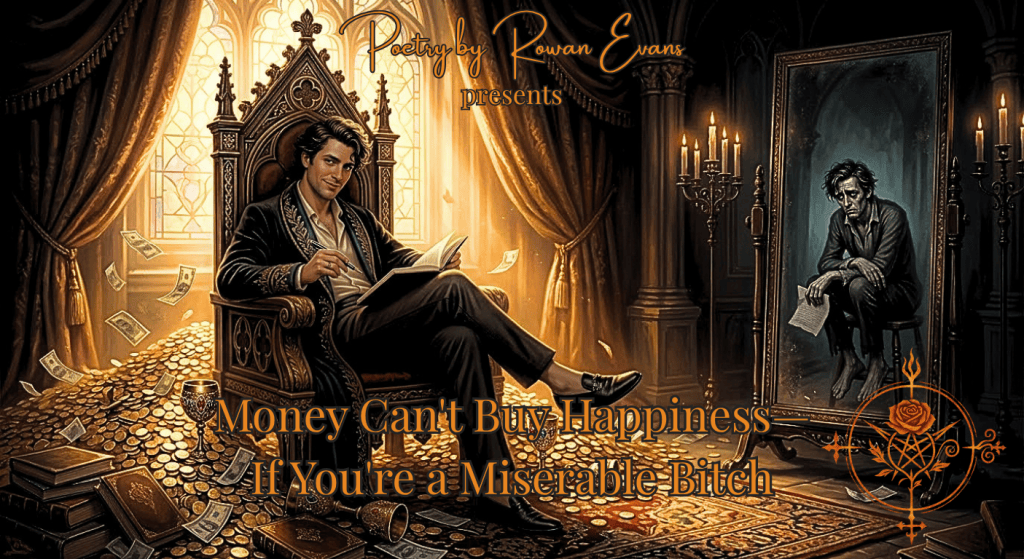

    A poet surrounded by wealth and luxury while a dark reflection suggests that money cannot create inner happiness.
    Money can buy the room. It can’t decide what happens inside your head.

    Money Can’t Buy Happiness—If You’re a Miserable Bitch
    Poetry by Rowan Evans

    They say money can’t buy happiness—
    and honestly, that’s half true.
    Money doesn’t buy happiness,
    money buys things—
    and things bring happiness
    for a minute it seems—
    but money can’t buy happiness?

    Bitch, please—
    that sounds like something
    somebody with money
    would say—

    because it’s not the cash
    that brings the smile,
    it’s the ease
    the cash brings—

    so they say
    money can’t buy happiness,
    but they’re only half right—

    money can’t buy happiness—
    if you’re a miserable bitch.

    You’ve got to already be happy and shit,
    so learn to love what you’ve got.
    Because when the money comes,
    and you’re swimming in funds—
    if you’re not already happy
    with where you’re at?

    You’ll never be happy after that.


    Journey into the Hexverse

    [Sick Bird]
    A short, uncompromising political metaphor that questions the fixation on left versus right when the entire system may be sick. Through the image of a collapsing bird, the poem confronts division, corruption, and the consequences of ignoring the larger failure.

    [For the Youth (Remix)]
    A 2026 remix of Rowan Evans’s original 2024 poem, encouraging young people to embrace their truth, recognize their worth, raise their voices, and become the light they want to see in the world.

    [Rose & Ruin]
    Two minimalist poems exploring the opposing forces within creativity: the thoughts we cultivate into something beautiful and the darker thoughts we transform before they have a chance to decay.

    If you’re interested in more poetry, you can find it here → [The Library of Ashes]
  • Author’s Note

    This poem came from a simple thought: if you love someone, you have to love the person—not merely the role you want them to play.

    A Person First pushes back against the idea that protection, tradition, or romance gives someone permission to control another person’s voice, choices, or identity. A partner is not an accessory to display or a puppet to move around. She is a person first—with her own voice, her own wings, and her own agency.

    Love should make room for someone to sing.

    — Rowan Evans


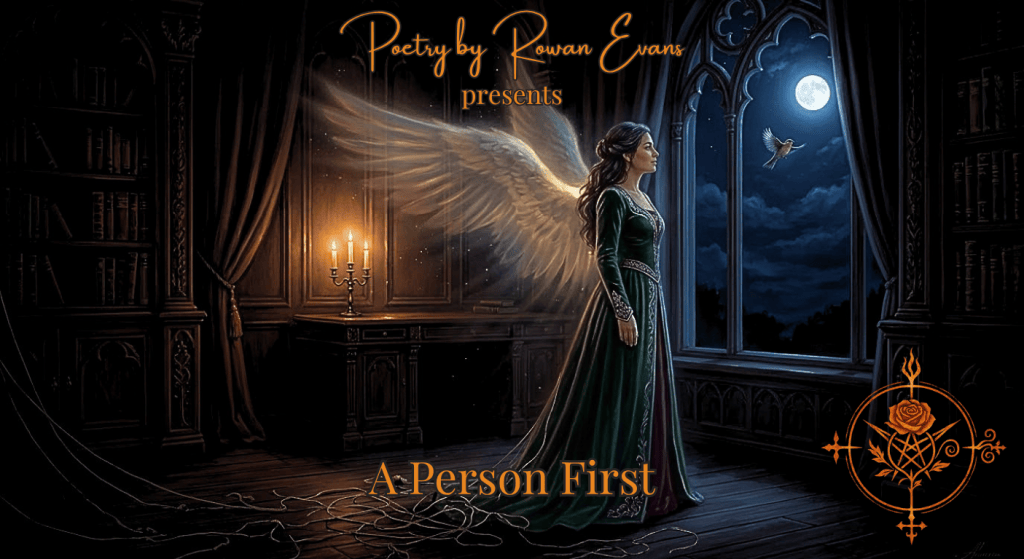
    A woman standing beneath moonlight as a songbird flies free and broken puppet strings fall away, symbolizing autonomy and freedom.
    Love her as a person, not as a role you can control.

    A Person First
    Poetry by Rowan Evans

    I’ve been stuck on this thought,
    it’s been on my mind a lot—
    why when some guys say they love women,
    does it feel like they really don’t love women?
    It’s like they’ve got a songbird,
    but they don’t want to hear her sing—
    like they’ve got an angel,
    but they want to clip her wings—

    even in traditional gender roles,
    you are not supposed to control—
    protection doesn’t mean silence,
    you’re supposed to be a team—
    if you think otherwise,
    you’re entirely misguided—

    because she is a person first—

    not an accessory,
    and if that’s something
    you can’t see—
    then you don’t want a wife,
    just a puppet on strings.


    Journey into the Hexverse

    [Half a Picture]
    What happens when someone falls in love with the person they discover through your poetry? Half a Picture explores the strange intimacy between writer and reader—and the distance between seeing someone’s mind through their words and truly knowing the whole person.

    [Caged Birds Don’t Bow (Remix)]
    A defiant remix of Rowan Evans’ “Caged Birds Don’t Bow,” confronting control, possession, and insecurity through the imagery of a bird breaking free from its cage and reclaiming its wings.

    If you’re interested in more poetry, you can find it here → [The Library of Ashes]
  • Author’s Note

    A bird cannot stay in the sky when the sickness has spread through its entire body. And no amount of arguing over which wing is responsible will change the condition of the bird itself.

    This piece is a short, sharp political metaphor about division, corruption, and the danger of treating opposing sides as separate problems when the larger system is already failing. It doesn’t linger to build an elaborate argument; it drops into the image, lets the wings beat against the ground, and leaves the reader with the sound of something collapsing.

    Sometimes the question isn’t which wing is right.

    Sometimes it’s whether the bird can survive at all.

    — Rowan Evans


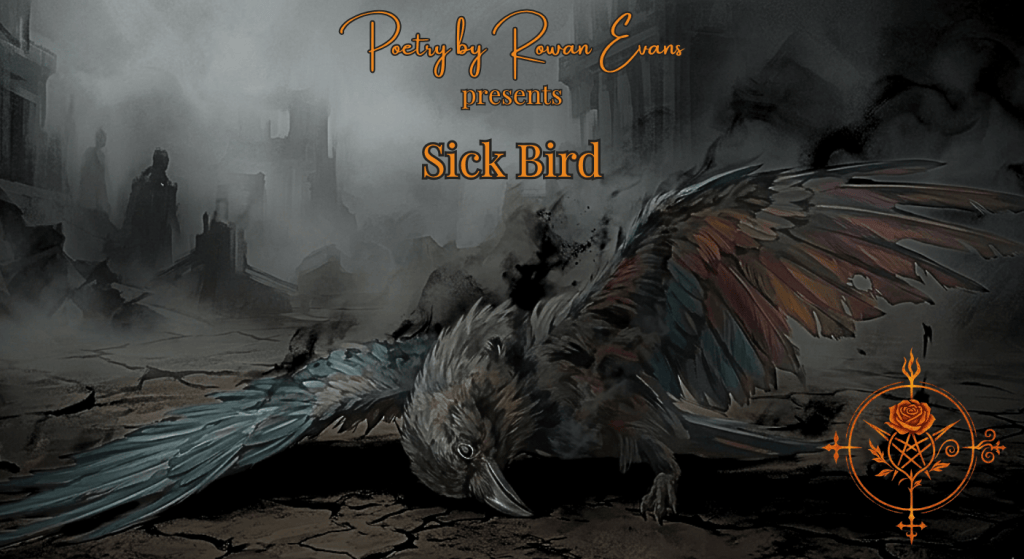
    A sick bird with damaged wings lies on a cracked landscape, symbolizing division and systemic corruption.
    When the whole bird is sick, arguing over its wings won’t save it.

    Sick Bird
    Poetry by Rowan Evans

    Left wing or right wing?
    I don’t give a fuck—
    it doesn’t matter,
    if the whole bird
    is sick and corrupt—

    the whole bird is going down—
    flapping wild on the ground—
    death rattle, our final sound—


    Journey into the Hexverse

    If you’re interested in more poetry, you can find it here → [The Library of Ashes]
  • Author’s Note

    This piece comes from exhaustion—but not hopelessness.

    It’s easy to look at the world and believe division is inevitable. That conflict, violence, and separation are simply part of human nature.

    But I don’t think wanting better is naïve.

    I think giving up on each other is.

    This poem isn’t political in the traditional sense. It’s human. It’s about imagining a world where empathy matters more than borders, where people are seen as people before labels, flags, or geography.

    Maybe that kind of world feels distant.

    But every meaningful change once started as something people called unrealistic.

    — Rowan Evans


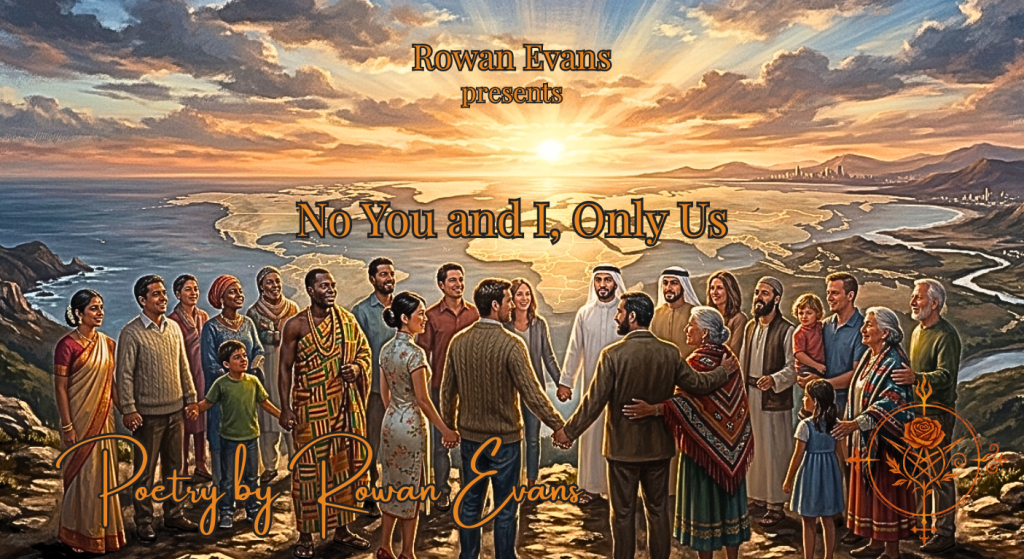
    People from different countries standing together symbolizing unity beyond borders
    Maybe the world gets better when we stop thinking in terms of “us versus them.”

    No You and I, Only Us
    Poetry by Rowan Evans

    I dream of a world—
    where there is no
    you and I,

    only us.

    I dream of a time
    when we can
    all come together
    and help one another.

    Where violence
    exists in history books—
    not classrooms.

    I dream of a world
    where borders
    are nothing but outlines,
    showing where
    someone is from—

    instead of bars
    on a cage.

    Some may say
    I’m delusional,

    but I say—
    it’s aspirational.

    I want better.

    I want better
    for me—
    for you—

    from America
    to Hong Kong,
    the United Kingdom
    to Singapore—

    from Mongolia
    to Libya,
    Afghanistan
    to the Philippines—

    I think
    we all deserve
    so much more.


    If you’re interested in more poetry, you can find it here → [The Library of Ashes]
  • Author’s Note

    This piece came from observation.

    Not one specific moment—but the accumulation of small ones. Passing strangers. Shared routines.

    Quiet exhaustion hidden behind ordinary expressions.

    We move through the world carrying roles long before we’re allowed to ask who we are outside of them.

    Provider. Caretaker. Worker. Parent. Partner.

    And somewhere beneath all of it, the person can disappear.

    This poem sits in that tension—between the natural world that continues without performance, and the human world built on expectation, pressure, and silent sacrifice.

    Because sometimes the most fractured things are the ones that still appear functional.

    — Rowan Evans


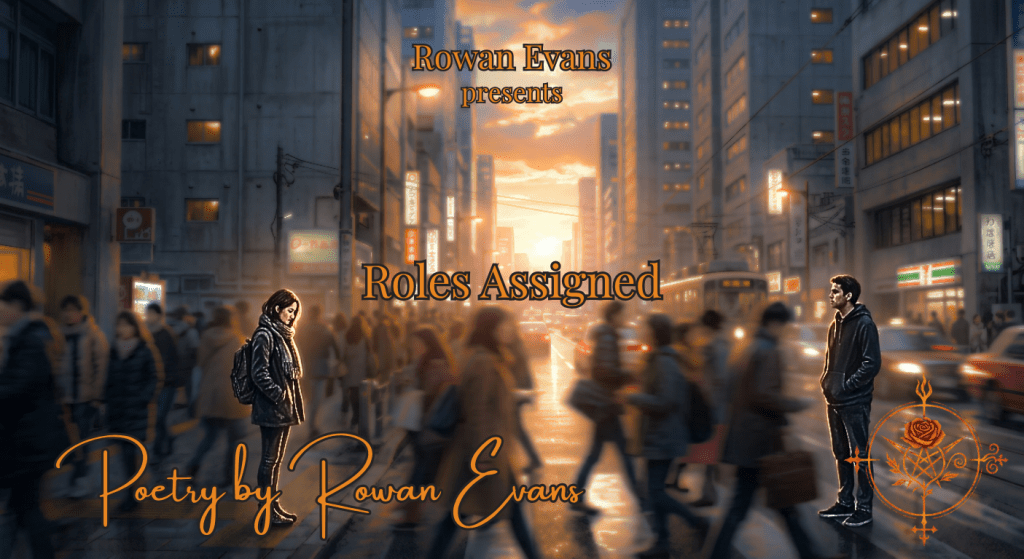
    Crowded city street at sunset symbolizing emotional isolation and societal expectations
    Some people disappear inside the roles they’re given.

    Roles Assigned
    Poetry by Rowan Evans

    Sun rises over misty mountains,
    unaware of the tragedy below—

    light rays pierce the canopy,
    leaves fall from trees,
    drifting in the breeze.

    Down into bustling city streets—
    the rhythmic thumping
    of marching feet.

    Horns blare,
    unaware
    of the fractured world.

    Nature stays,
    even though
    we forgot our place.

    Smiling face.
    Façade.
    Projected happiness
    when everything is wrong.

    Voices ring
    like distant distractions,
    gentle music humming
    from open café doors.

    A young couple
    leans in close—
    a laugh shared,
    hands held.

    Unaware
    of the fractured world.

    A single mother,
    huddled in the corner—
    a smile trying to hide
    the emptiness in her eyes.

    No one knows
    the weight she carries.

    Children’s laughter.
    Distant yelling—
    bellows
    through apartment windows.

    A husband.
    A father.
    A son.

    A man
    with too many titles.

    A weight.
    A stress.

    Expectations
    best left unsaid.

    Taught
    it’s his burden
    to carry.

    A mother.
    A wife.
    A daughter.

    A woman
    never given a voice.

    A crack.
    A fracture.

    Losing herself
    to give her family
    the best.

    Provider.
    Caretaker.

    Human beings
    forgotten.

    Roles assigned.

    The sun sets
    behind walls
    of brick and concrete.


    If you’re interested in more poetry, you can find it here → [The Library of Ashes]
  • Author’s Note

    There’s a particular kind of exhaustion that comes from paying attention.

    Not just to your own life–but to the world as a whole. The patterns. The repetition. The way the same problems resurface, louder each time, while the people most affected are the ones with the least control over any of it.

    Another Fire comes from that place.

    It’s not a solution. It’s not even an attempt to be balanced.

    It’s a reaction–to the feeling that everything is happening all at once, that crises stack faster than they can be addressed, and that somewhere along the way, empathy gets lost in the noise.

    At its core, this piece questions something simple, but uncomfortable:

    How did we get to a point where it’s easier to see each other as enemies… than to question the systems that put us in conflict to begin with?

    This isn’t about having all the answers.

    It’s about refusing to look away.

    — Rowan Evans


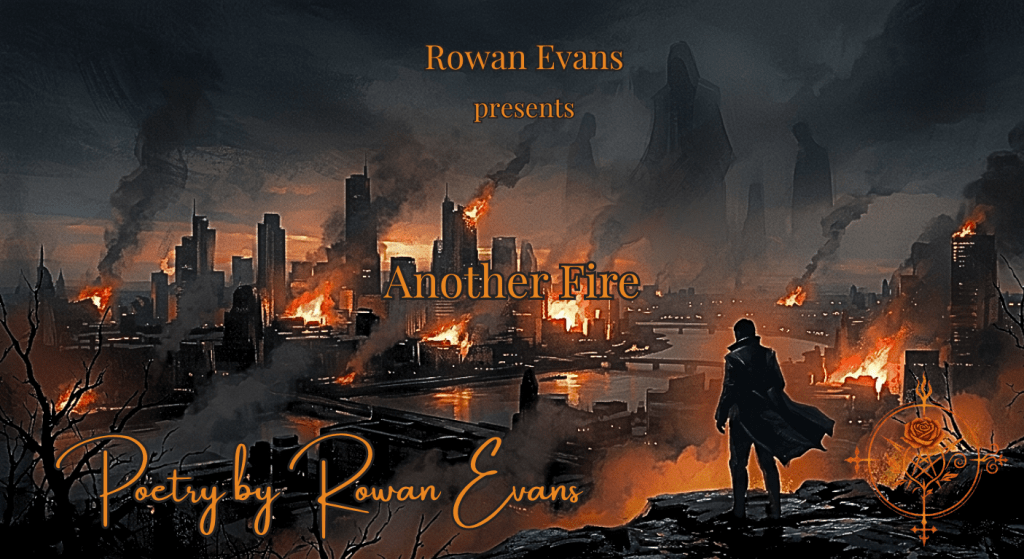
    Person watching a city with multiple fires burning, symbolizing global chaos and systemic conflict
    While we burn, someone else decides where the fire spreads.

    Another Fire
    Poetry by Rowan Evans

    I’ve been lost
    for a while now—
    eyes locked on the world.

    I’m just wondering how…
    how did we let it
    get like this?

    It’s a mess,
    everyone’s stressed—
    except the billionaires.

    Stacking money,
    sitting higher than fear.

    Profits rise
    as civilians die.

    And everywhere we look…
    another fire.

    We can’t tackle one problem,
    before five more pop up.
    It’s like we’re frozen—stuck.

    Half the population seems fine with it,
    the rest of us screaming,
    what the fuck?

    The whole world’s running out of luck.

    It’s like it’s designed
    to slowly chip away—
    grip, rip, strip away
    your humanity.

    Driving us straight
    into insanity.

    Because it’s insane to me—
    how we can look
    at another human being
    and see an enemy.

    When the only real enemy
    isn’t standing across from us—

    but above us.

    Deciding
    who fights,
    and who dies.


    If you’re interested in more poetry, you can find it here → [The Library of Ashes]
  • Governments Behaving Badly: A Satirical Poetry Series [pt. 2]

    Author’s Note

    If Raising Governments is the exhale—laughter edged with frustration—then Government Time-Out is what comes after.

    The moment humor fades, and what’s left is clarity.

    This piece strips the satire down to something quieter, more direct. It’s still framed through the language of discipline, but the tone shifts from playful to firm—less about calling out behavior, and more about demanding accountability.

    There’s a difference between reacting and reflecting. Between explaining something away and actually sitting with it.

    Government Time-Out lives in that space.

    No noise.
    No spin.
    Just the uncomfortable weight of consequence.

    Because sometimes the most powerful thing you can do…
    is stop talking—and finally listen.

    — Rowan Evans


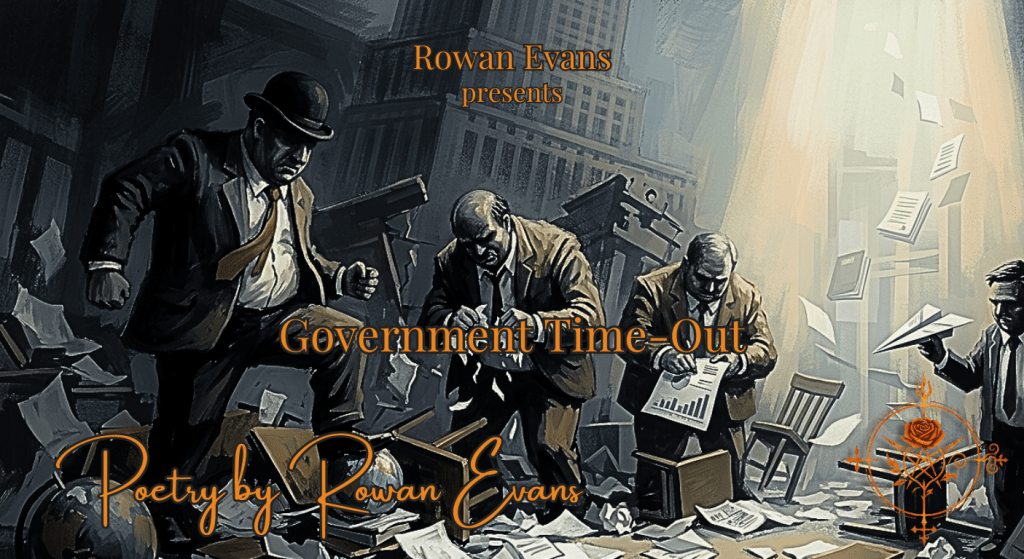
    Symbolic illustration of political figures portrayed as misbehaving children in a chaotic environment, representing satire and accountability.
    No more excuses. Sit with it.

    Government Time-Out
    Poetry by Rowan Evans

    Sit down.
    No—actually, sit.

    We’re not doing this today.
    Not the yelling,
    not the threats,
    not the “I know better” attitude.

    You’ve had centuries
    to prove that.

    And yet—
    here we are.

    Hands in the cookie jar,
    crumbs on your face,
    still trying to say
    it wasn’t you.

    Really?

    You think we don’t see it?

    All the broken plates,
    the slammed doors,
    the mess you keep calling
    “necessary.”

    No.

    You don’t get to break things
    and call it order.

    You don’t get to hurt people
    and call it policy.

    So here’s what’s gonna happen.

    You’re going to sit there—
    quietly—
    and think about
    what you’ve done.

    No speeches.
    No spin.
    No rewriting the story
    to make yourself the hero.

    Just sit with it.

    Feel it.

    For once.

    And when you’re ready
    to act right—
    we’ll talk.


    If you’re interested in more poetry, you can find it here → [The Library of Ashes]
  • Governments Behaving Badly: A Satirical Poetry Series [pt. 1]

    Author’s Note

    Sometimes the only way to process the state of the world is to laugh at it.

    Raising Governments takes the chaos, contradictions, and immaturity often seen in global leadership and reframes it through something familiar: parenting. Not out of cruelty – but out of exhaustion. The kind that comes from watching the same mistakes repeat, over and over again.

    This piece leans into satire, using humor to highlight a deeper frustration – how systems meant to lead can sometimes feel reactive, impulsive, and disconnected from the people they affect.

    At its core, this isn’t just about governments.
    It’s about accountability.

    And the strange reality of feeling like the adults in the room… aren’t.

    — Rowan Evans


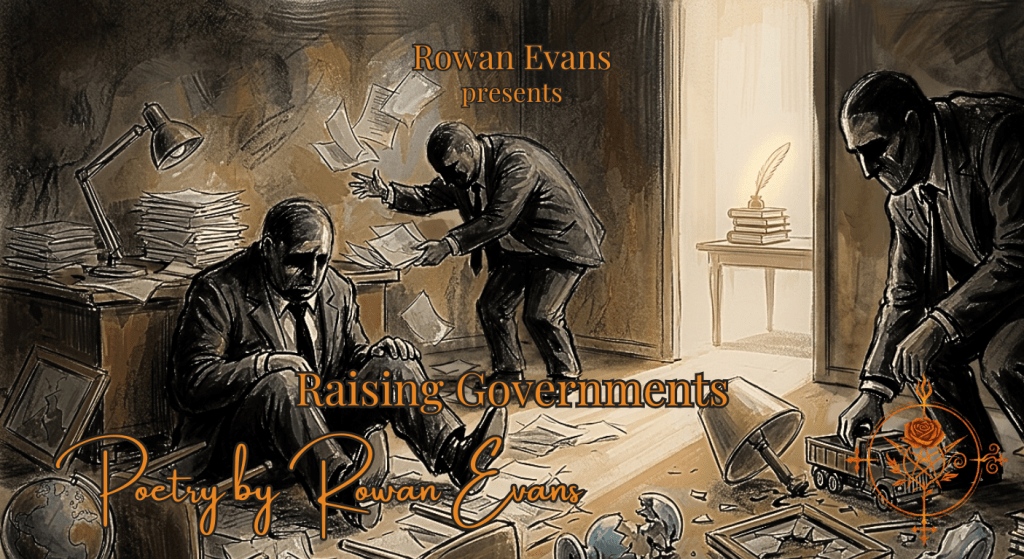
    Symbolic illustration of political figures portrayed as misbehaving children in a chaotic environment, representing satire and accountability.
    Sometimes the people in power act like children—and someone has to call it out.

    Raising Governments
    Poetry by Rowan Evans

    Why are governments
    actin’ like bad kids,
    needing their ass whipped?
    Go and get the switch—
    you pick. We’re going back
    to the 90s and before.
    No corners for you, no more.

    I’m not mad, I’m just—
    disappointed.
    I’ll turn this car around.
    Don’t think I won’t,
    I can see you in the rear view.
    This is gonna hurt me,
    more than it does you.

    As soon as we get home,
    everyone to your rooms.
    I need a minute to breathe—
    collect myself.
    And your attitudes…
    they don’t help.


    If you’re interested in more poetry, you can find it here → [The Library of Ashes]
  • Author’s Note

    This piece came from a lifelong feeling of distance – not just from place, but from the way people divide themselves.

    It isn’t anti-country. It isn’t anti-culture. It’s anti-separation.

    I’ve never understood how imaginary lines on maps can outweigh shared humanity. This poem is me saying plainly what I’ve felt for years: we are far more alike than we are different, and the borders we defend so fiercely don’t exist in our blood or our bones.

    This isn’t rebellion for the sake of rebellion.
    It’s clarity.

    — Rowan Evans


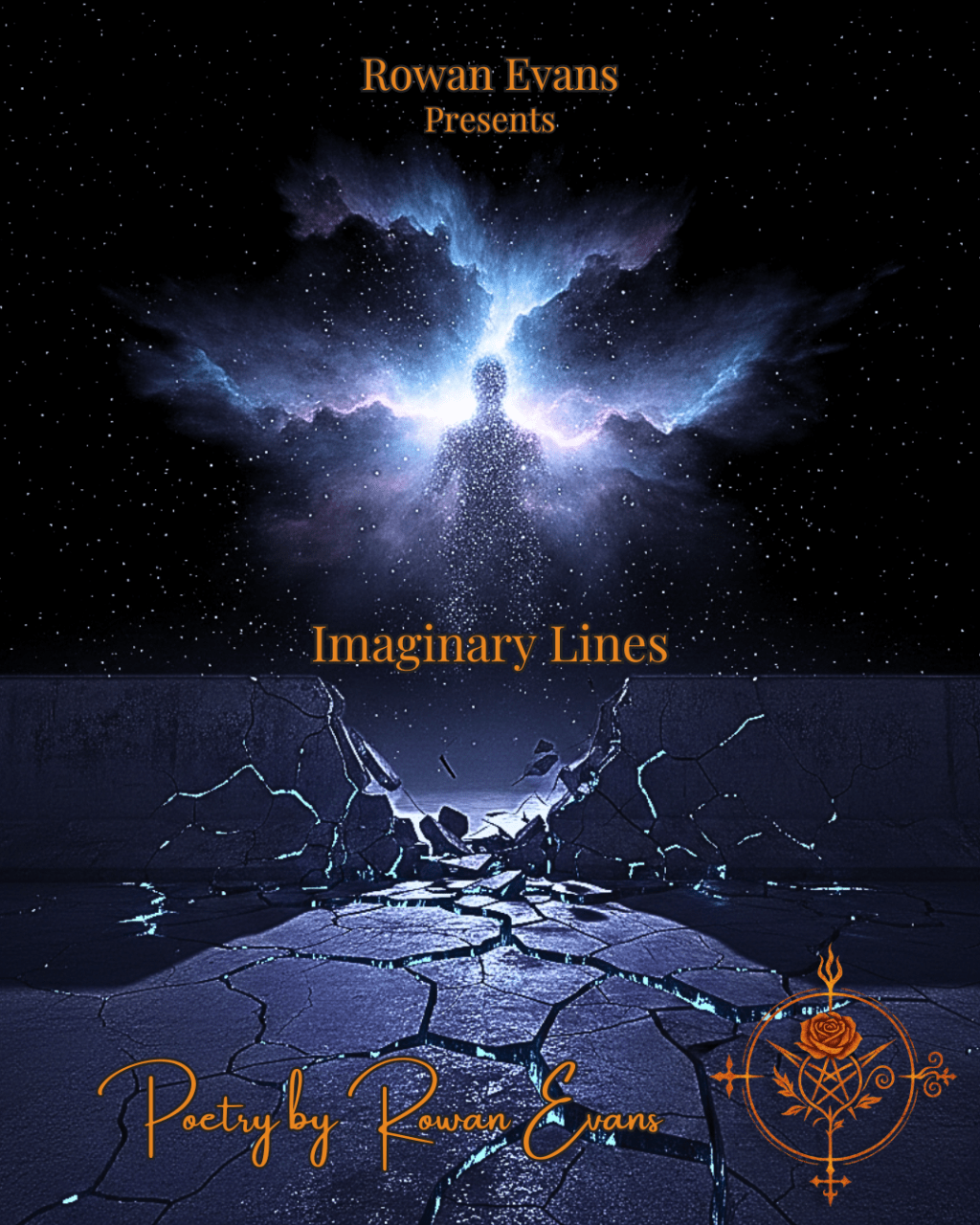
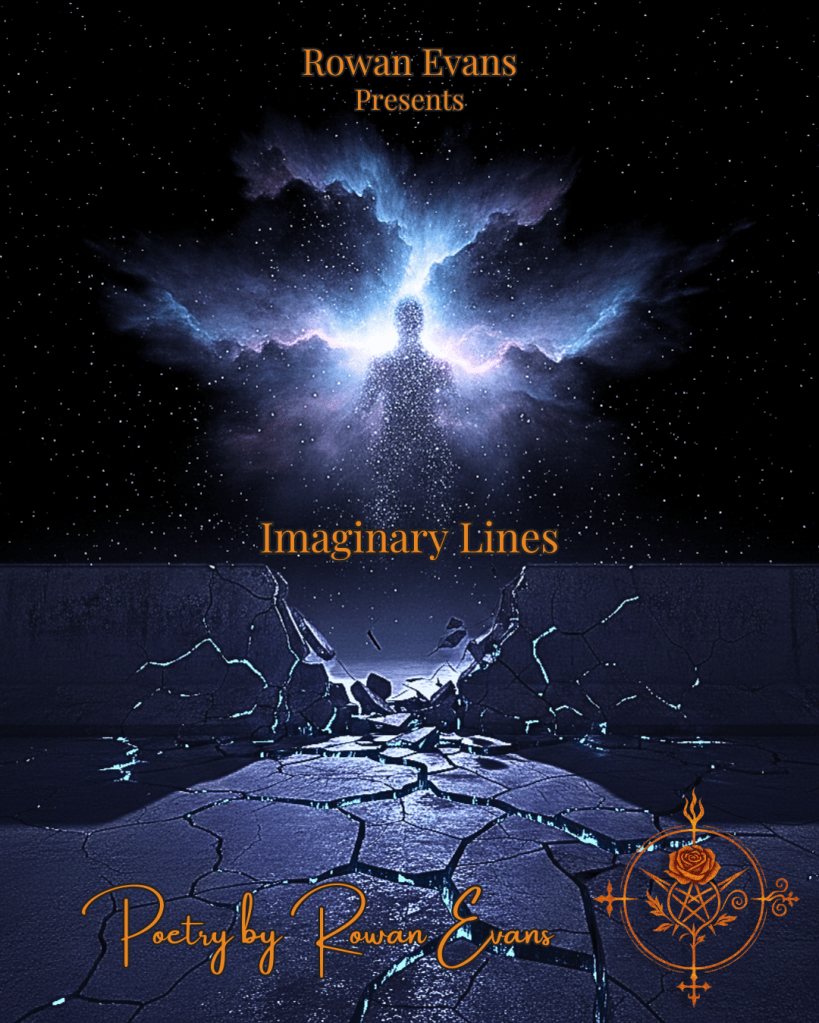
    A symbolic image of a cracked border line beneath a star-filled sky, representing unity beyond national divisions.
    The border isn’t the edge of the world. It’s the edge of perception.

    Imaginary Lines
    Poetry by Rowan Evans

    I don’t feel
    like I’m from here,
    like I come from out
    beyond the stars—
    somewhere far,
    lightyears beyond mars.

    I watch and observe,
    as humans continue
    to act absurd.
    It’s like they
    don’t know how
    to act.
    Kind of like
    they don’t know how
    to treat each other.

    Focused on imaginary lines,
    barriers and borders.
    With a—
    if you’re not like me,
    you’re the enemy
    mentality.

    When you bleed
    it all looks the same.
    Human is human.
    The rest is costume.

    No passport in the bloodstream.
    No nation in the bone.


    If you’re interested in more poetry, you can find it here → [The Library of Ashes]