Tag: pop culture

  • Author’s Note

    This poem began with one simple idea:

    What if bending wasn’t limited to the elements?

    I’ve always loved Avatar: The Last Airbender, not just because of the worldbuilding, but because every bending style reflects a philosophy. Earth is patience. Fire is will. Water is adaptability. Air is freedom.

    As I kept writing, I realized the poem wasn’t really about the characters.

    It was about poetry.

    What if writing could be its own form of bending?

    A poet bends language.

    A storyteller bends memory.

    A confessional writer bends pain into meaning.

    So the references gradually became metaphors for different ways I approach writing: anger becoming fire, healing becoming water, stubborn persistence becoming earth, and the rhythm of language becoming its own kind of element.

    The “nerd note” stays because that’s genuinely how my brain works. I noticed the line wasn’t technically accurate, paused to explain why I changed it, then immediately jumped back into the poem. I could have removed it—but it made me laugh, and sometimes leaving the fingerprints on a poem makes it feel more alive.

    This piece also continues a theme I’ve been exploring lately: treating writing as something almost supernatural. Sometimes I’m a witness. Sometimes I’m a monster in the margins.

    This time…

    I’m an Inkbender.

    Rowan Evans


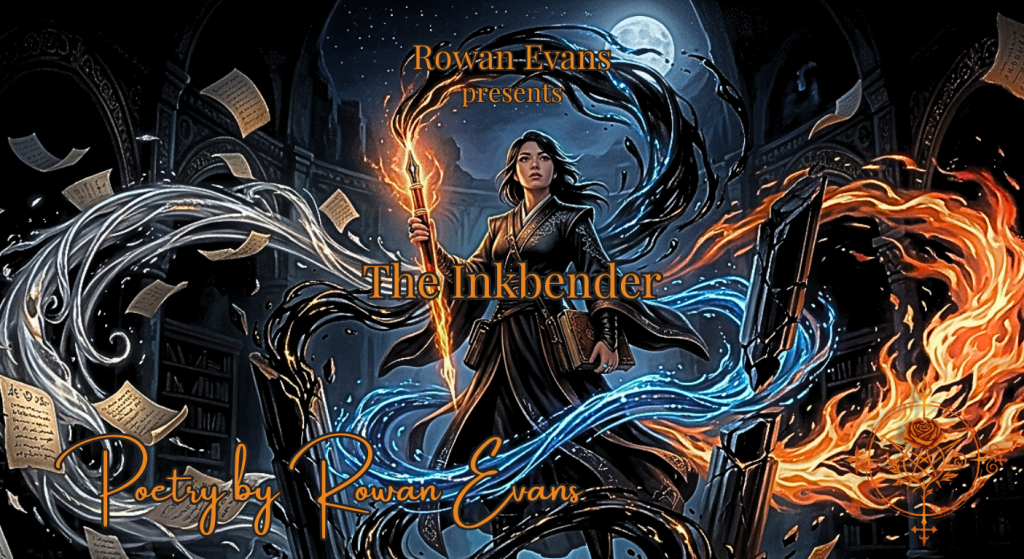
    A fantasy-inspired illustration of a poet surrounded by magical ink transforming into earth, fire, water, and air.
    Some people bend the elements. I bend the page.

    The Inkbender
    Poetry by Rowan Evans

    Tick-Tock—
    I listen to the sound of the clock.
    Eyes open to the world, I watch—
    like I carry time on my wrist.
    I slipped, keys in the lock—
    I dipped—
    ballroom dancing with a twist.
    A list of names—I check twice,
    like my name is Clause—
    kickin’ it with Rudolph.

    Shhh—
    I move earth
    like I’m from Ba Sing Se.
    Now, you must be
    from the southern temples,
    because when you speak—
    all I feel is hot air.

    You’re an airbender,
    if you weren’t aware.

    (Quick nerd note—
    it’s the Southern Air Temple,
    but I had to make it simple—
    so it could hold the rhythm
    and carry the cadence.
    With that explanation
    we can return to
    our regularly scheduled chaos.)

    I bend bars, the way Toph taught me—
    feet planted and never backing down.
    I’m never losing ground—
    I feel out the imperfections,
    bend them to my will.
    I am the originator, that is my skill.

    It starts with a spark,
    a sun with a heart—
    I’m the fire inside, the fire in the sky.
    Call me Fire Lord Ozai
    ’cause I bend
    fire with a pen.
    Leaving destruction across the page
    as I translate my rage—
    the very thing
    that could have become
    my cage.

    Then my motion smooths,
    ink becomes more precise.
    Pen moves like the tide,
    watch me flow and glide—
    my ink like water heals,
    and my mind knows
    how trauma feels.

    If you thought the nomads
    were just gonna get
    a simple diss…

    D’Aang—
    Aang,

    your people mastered letting go,
    I mastered holding on—
    you chase balance,
    I chase bars.

    You run from problems,
    I run through them—
    glider in the sky,
    I’m the storm beneath it.

    Go Avatar State if you want—
    I bend elements with ink,
    you bend them with angst.

    You know, I shouldn’t
    roast the monks too hard.
    Because Ozai did it first
    and I won’t copy that,
    but you walked into this—
    glider first,
    logic last.

    Looking to the future,
    stuck in the past.


    Journey into the Hexverse…

    [The Life of a Witness Poet]
    What does it mean to love someone when the greatest act of care is simply witnessing their life? This poem explores quiet devotion, distance, and the compassionate heart of a witness poet.

    [The Monster in the Margins]
    Drawing inspiration from horror icons like Michael Myers, Ghostface, Freddy Krueger, and Pennywise, this poem explores the darker side of creativity—where inspiration becomes an unstoppable force lurking just beyond the edge of the page.

    If you’re interested in more poetry, you can find it here → [The Library of Ashes]
  • Author’s Note

    Every writer has a toolbox.

    Mine just happens to contain an alarming number of moons, oceans, ravens, comic book characters, sports references, cartoons, and entirely too much ink.

    People occasionally notice that I return to the same imagery over and over again. They’re right.

    The funny thing is…

    I’m usually the first person to notice.

    This poem came from imagining an overly critical director sitting just off-camera, pausing every scene to point out my habits.

    “Another moon?”

    “Really? The ocean again?”

    “We’re doing ravens today?”

    It’s the internal voice every creative person develops after making enough work. The one that starts recognizing your patterns before anyone else does.

    Sometimes it’s helpful.

    Sometimes it’s insufferable.

    The joke, of course, is that the director isn’t entirely wrong.

    I do write about the moon a lot.

    I do return to oceans, tides, dreams, and ravens.

    I do compare things to comic books, cartoons, sports, horror movies, and whatever random piece of culture my brain decides belongs in the poem that day.

    Because those things aren’t decorations.

    They’re the language my mind naturally speaks.

    The final section—”Music—10/10. No Notes.”—is probably the closest thing to surrender in the entire poem.

    Apparently my inner critic has limits.

    Music gets a free pass.

    Everything else is fair game.

    Including me.

    Rowan Evans


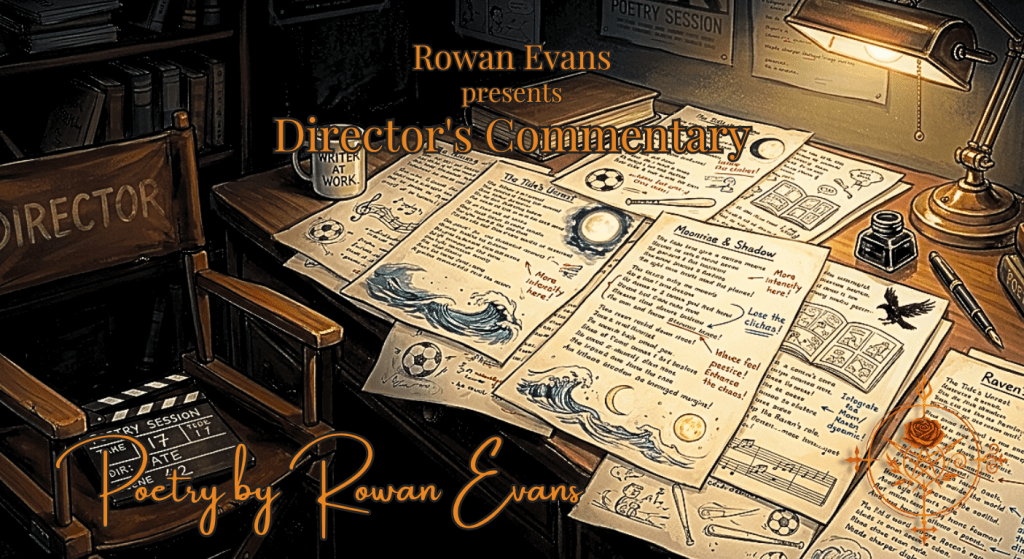
    A writer's desk covered with poetry pages, recurring symbols like moons and oceans, and film director notes critiquing the creative process.
    “Every writer has recurring motifs. Mine just happened to get their own director’s commentary.” 🎬🌙✍️

    Director’s Commentary
    Poetry by Rowan Evans

    The Moon—

    Here we go again,
    another moon metaphor.

    What is it this time?

    The moon shimmering
    above the bay?
    A stand in for her beauty—

    Ocean—

    My favorite metaphor.

    The one I’ve used
    thousands upon thousands
    of times before—
    written in thousands of lines,
    in a thousand different rhymes.

    Hyperbole.

    The Tide—

    Yes, there it is—
    the final piece
    of this overused metaphor chain,
    you say it’s different
    but it’s all the same.

    Same moon.
    over the same bay,
    and it shimmers
    in the same way.

    It’s almost like the moon,
    ocean, and tide
    are all that exist
    inside that little mind.

    Ravens—

    So spooky.
    So gothic.

    You write ravens
    like you shop
    exclusively at Hot Topic.

    They’re messengers.
    They witness.
    And once upon a time
    you even made them a centerpiece.

    You took that way too seriously
    back in your “modern-day Poe” era.

    A modern-day Poe?

    Ridiculous.

    Sports—

    You don’t even watch those.

    Why are you writing
    metaphors for the bros?

    You think you’re great?
    Yeah, you’re The Babe.
    23 years and a Jordan joke—
    okay, Shohei.

    Random Cartoon Reference—

    Which character are you
    going to grab this time?

    Which bit of nostalgia
    are you going to try
    and exploit?

    Random references,
    litter the page—
    Powerpuff Girls,
    Doug and Dexter.

    So what’s next?

    Something more obscure,
    or more mainstream?

    Comic Books—

    Tropes.

    Superheroes and capes.

    Random character grab,
    used in a metaphor
    that barely makes sense—

    like Bane
    for line breaks?
    What the “#%@$”
    was that?

    I’ll give you
    Two-Face for fakes
    and snakes, because
    that one makes sense.

    Music—

    10/10.
    No Notes.


    Journey into the Hexverse…

    [Pointing Me Home]
    The final poem in the No Metaphor Left Behind trilogy explores dreams, hope, and belonging. Through moonlight, ocean tides, and quiet conversation, Pointing Me Home reflects on carrying hope long before reaching the place you call home.

    [Chemical X]
    Chemical X explores the rapid, associative way one creative mind moves—from cartoons to sports, comic books to music—revealing that inspiration isn’t linear, but a collision of memory, humor, rhythm, and intuition.

    [Crossing the Sea]
    A deeply personal poem about relocation, longing, and the realization that some truths naturally arrive through metaphor—even when we try to leave it behind.

    [Danny Phantom Theology]
    What begins as a metaphor borrowed from a childhood cartoon becomes something deeper: a reflection on existing between survival and possibility, exhaustion and hope, the life we have and the life we long for. Danny Phantom Theology explores what it means to keep moving toward a future that feels worth living.

    [Frankenstein’s Monster (and I’m the Doctor)]
    Some poems are built to make a point. Others are built to reveal the mechanism. Frankenstein’s Monster (and I’m the Doctor) explores associative thinking, creative chaos, and the strange process of stitching disconnected ideas into something alive.

    [Ocean Waves (1, 4, 3)]
    A moonlit shoreline, a rowboat full of ducks, a piggybank with no cents, and a confession hidden in plain sight. Ocean Waves (1, 4, 3) explores how humor, wordplay, and absurdity can become a side door to vulnerability when the truth feels too difficult to say directly.

    [A Heart That Echoes in Another Language]
    A poetic journey through music across Japan, Korea, China, and the Philippines, exploring how sound becomes identity, memory, and emotional geography.

    [Global Takeover]
    What if home isn’t a place—but something you build from the music you love? Global Takeover blends sound, culture, and identity into one borderless space.

    If you’re interested in more poetry, you can find it here → [The Library of Ashes]
  • Author’s Note

    People often ask what inspires my writing, or how my mind moves from one idea to another so quickly.

    The honest answer is that I don’t think in straight lines.

    I think in association, in rhythm, in collision. One idea reminds me of another, not because they are logically connected, but because they feel connected in the moment they appear.

    This poem is built from that process.

    It began with something simple—the familiar phrase “sugar, spice, and everything nice.” But as I wrote, my mind immediately followed the same pattern it always does: connection, exaggeration, humor, memory, and cultural reference all colliding at once. What starts as something familiar quickly becomes something unpredictable.

    The title, Chemical X, comes from that idea.

    In The Powerpuff Girls, Chemical X is the unknown element that transforms something ordinary into something entirely different. For me, that “unknown element” is the way my mind blends thoughts, images, and meanings together in real time.

    This poem is not meant to be linear. It is meant to mirror the way my thoughts actually arrive: rapid, associative, sometimes chaotic, but always connected by feeling and intuition rather than structure.

    If it feels like a mix of humor, storytelling, sports commentary, and surreal imagery all at once—that’s intentional. That is the point.

    This is what happens when everything gets mixed together.

    This is Chemical X.

    Rowan Evans


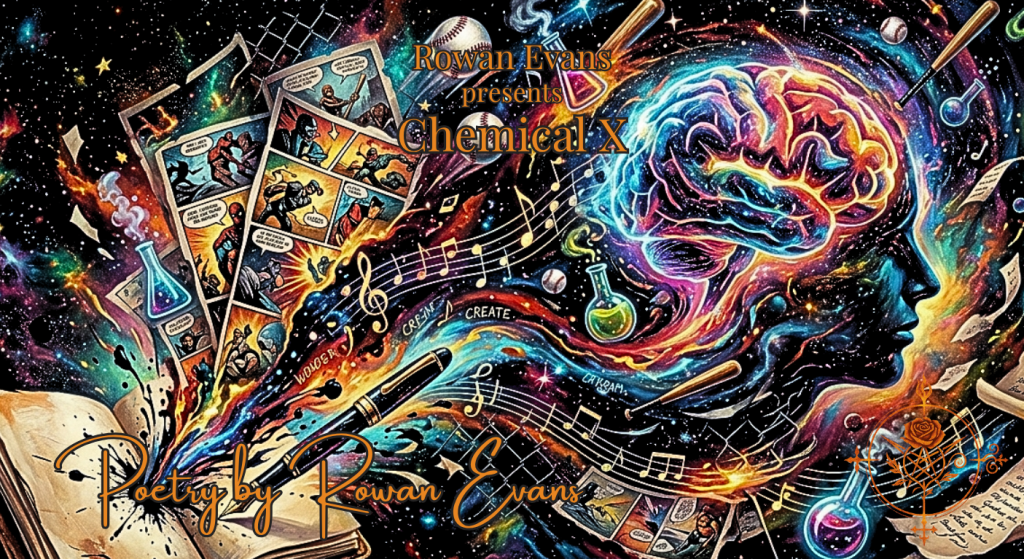
    A notebook and pen burst into colorful images of comics, sports, music, stars, and cartoons, symbolizing an imaginative mind making rapid connections.
    Some minds move in straight lines. Mine mixes everything together—and somehow, it all makes sense.

    Chemical X
    Poetry by Rowan Evans

    They say “penny for your thoughts,”
    but it takes—two cents to talk.
    Go for a walk, a mile long, in my shoes—
    use my eyes, see the world through my view.

    I’ll etch it across the page,
    world view and all—
    because I’m the on the ball
    point pen, in an ink sprint.
    Usain Bolt, the way my mind went.

    To understand the rhythm,
    you’ve got to understand the mechanism.
    You’ve got to understand the mind
    behind the rhyme—

    my thoughts are rapid fire.

    Thirty round magazine,
    three-round burst—
    that’s the way my mind works.

    I can jump from cartoons
    to comic books,
    music to sports—

    sugar, spice,
    and everything nice.

    A round of applause, Johnny—
    Bravo, you completed the Quest.
    You gained experience and leveled up.
    Still, it wasn’t enough—

    because I’m a two-way threat—
    like my name is Shohei.

    Bitch, I’m the Babe.

    At four years old,
    I was almost tossed
    out of the game.

    I was a menace—
    call me, Dennis.

    Two Hubbles
    strapped to my face,
    look up—see space.

    Fingers curled
    gripping the chain link—
    a bad call, a blind ump,
    a small child
    blind as I was,
    offering their eyes up
    like I was—

    trying to help?
    Maybe.

    Trying to insult?

    Of course…

    it’s sports…

    I was Dexter
    in the lab again,
    pen to pad again,
    and I gave
    all I had to give—

    Victor Frankenstein
    is at it again,
    patchwork metaphors
    and images galore—

    villagers are going
    to be afraid for sure.


    Journey into the Hexverse…

    [Crossing the Sea (No Metaphor Left Behind)]
    A deeply personal poem about relocation, longing, and the realization that some truths naturally arrive through metaphor—even when we try to leave it behind.

    [Only Waiting (No Metaphor Left Behind)]
    The second poem in the No Metaphor Left Behind series, exploring the quiet ache of growing up in a place that never truly felt like home—and finally saying aloud what years of metaphor had been trying to express.

    [Translating What I Feel]
    A poem about the invisible process of turning emotion into imagery, imagery into language, and language into poetry. An intimate reflection on creativity, loneliness, and twenty-three years of learning to translate what the heart feels.

    [Monster Theology]
    What if the monsters under the bed weren’t monsters at all? Monster Theology explores difference, belonging, and the human tendency to fear what we don’t understand through a conversation with the creatures we’ve spent our lives imagining.

    [Frankenstein’s Monster (and I’m the Doctor)]
    Some poems are built to make a point. Others are built to reveal the mechanism. Frankenstein’s Monster (and I’m the Doctor) explores associative thinking, creative chaos, and the strange process of stitching disconnected ideas into something alive.

    If you’re interested in more poetry, you can find it here → [The Library of Ashes]