Tag: ocean poetry

  • Author’s Note

    There are some places that become more than places.

    An ocean can be a physical distance, a horizon, a body of water stretching farther than the eye can follow. But sometimes it becomes something else entirely—a canvas, a metaphor, a meeting place between two people who happen to be standing on opposite sides of the world.

    Let Me Be Pacific began with a simple invitation: let me show you the ocean the way I see it.

    From there, the words wandered where they wanted to go.

    Purple skies. Silver moons. Dark water. Rhymes. Trees. Wordplay.

    And eventually, the Pacific became more than scenery.

    It became the space between here and there—and the reminder that something can cross an enormous distance without ever needing to disappear.

    So, for a moment, come sit beside me on the shoreline.

    Let me paint you a picture.

    Rowan Evans


    A solitary poet sits beside the Pacific at twilight beneath a silver moon, watching its reflection shimmer across the waves.
    The Pacific may separate two shores, but poetry has never been particularly good at respecting distance.

    Let Me Be Pacific
    Poetry by Rowan Evans

    Here let me take my words
    and paint a picture for you—
    the sky in shades of purple and blue,
    lit by the silver moon—
    it lingers over the bay,
    that’s where it stays—
    watching over the tide,
    and I sit on the shoreline—
    watching the ocean’s waves.

    Which ocean? Okay,
    here let me try and spell it out,
    let me be Pacific—
    it’s off the California coast,
    it touches the Philippine Sea,
    sits between Japan and Me.

    Now back to the imagery—
    there was me, next to a happy little tree,
    and the moon was shimmering,
    trembling across dark water—
    back on the shoreline,
    having written more lines,
    not less, but more rhymes.

    So let me stay Pacific—
    specific in the way I see the sea,
    how every wave feels like a message
    sent across the world to me.
    I sit, I rhyme, I watch the tide—
    the ocean’s big, but so’s my mind.

    And if you ask me why I write
    beside this ocean every night—
    it’s because the tide keeps teaching me
    how distance isn’t always far,
    how even the Pacific can carry a heart
    from California to wherever you are.


    Journey into the Hexverse…

    [My Nightmare]
    A poem about the nightmare of loving someone across distance, seeing the world from different perspectives, and holding onto the hope that the cracks can still be repaired—and that someday two separate shores might become one.

    [Rose & Ruin]
    Two minimalist poems exploring the opposing forces within creativity: the thoughts we cultivate into something beautiful and the darker thoughts we transform before they have a chance to decay.

    [Across the Page-cific]
    A playful, autobiographical journey through the strange places poetry can take me—from sandwich heartbreak and pasta diss poems to gothic monsters, mythology, ravens, ghosts, and storms across the page. Beneath the absurdity is something deeply personal: the realization that writing gave me a way to rebuild myself, piece by piece.

    If you’re interested in more poetry, you can find it here → [The Library of Ashes]
  • Author’s Note

    Beach to Beach (How I Get There) is a small exploration of the strange geography of dreams—specifically, the way my mind seems to create its own routes between familiar places and places I’ve never physically experienced.

    I’ve written before about beaches, shorelines, the ocean, moonlight, and the city streets I encounter in my dreams. This piece connects those recurring images into something almost like a map: I leave one shore, cross the imagined sea, arrive somewhere unfamiliar, and let the dream carry me from there.

    There’s also something hopeful underneath the surrealism. These places may exist in my dreams now, but part of me wants to make that journey while awake—to eventually cross those real distances and stand on those unfamiliar shores for myself.

    Sometimes the mind dreams about places before the body ever gets there.

    Rowan Evans


    A moonlit beach leading across the ocean toward an unfamiliar city coastline, symbolizing dream travel and longing.
    Sometimes the mind travels to places the body hasn’t reached yet.

    Beach to Beach (How I Get There)
    Poetry by Rowan Evans

    When I sleep—

    I don’t just rest,
    I drift, I travel—

    moving between worlds,
    between scenery—
    beach to city streets,
    the ones I’ve never known
    while my eyes are open.

    There is a logic my mind follows
    to travel from here to there—

    wherever here and there is,
    it goes like this:

    to leave the shores I know
    and get to the coasts I don’t—
    it’s beach to beach
    after a simple sea crossing—
    and then it’s city streets,
    while the moon watches.

    So I follow the tide
    in my mind—
    until I hit the shoreline.

    I never know what I’ll find—
    but it’s a trip I make often,
    nightly, you could say—
    it’s a trip I hope
    to make awake one day.


    Journey into the Hexverse…

    [Where The Metaphors Lead]
    Some truths are easier to write than they are to say aloud. “Where the Metaphors Lead” explores the quiet space between dreams, confession, and the courage it takes to let another person know how deeply they’ve become woven into your inner world.

    [The World Shifted Around Us]
    The world transformed around us—beach, city streets, jungle—but we never moved. Sometimes love isn’t found in words, but in the quiet certainty of someone remaining clear while everything else fades.

    [Every Night, The Same Flight]
    Every night begins with the same flight. Between wakefulness and sleep, an airport appears, a familiar shoreline waits beyond the journey, and the same dream asks whether some destinations find us before we’re ready to find them.

    [Where I Belonged]
    A bedroom becomes an airport in the space between sleep and waking. Where I Belonged explores liminal consciousness, uncertainty, and the strange moments when reality feels suspended between two worlds.

    [Opposite Coasts of the Same Silence]
    What separates two people isn’t always an ocean. Sometimes it’s the silence between everything left unsaid. Opposite Coasts of the Same Silence explores longing, distance, dreams, and the quiet hope that even across impossible divides, someone might still hear your voice.

    If you’re interested in more poetry, you can find it here → [The Library of Ashes]
  • Author’s Note

    Some distances aren’t measured in miles.

    They’re measured in conversations you haven’t had yet.

    In words that stayed behind your teeth.

    In the quiet space between two people who are looking toward one another but still can’t quite bridge the water between them.

    I’ve always been drawn to oceans because they represent contradiction. Water connects continents, yet it also separates them. It carries messages, memories, ships, storms—and still leaves shorelines untouched by one another.

    That became the emotional center of this poem.

    The “opposite coasts” aren’t necessarily literal places. They’re two inner worlds existing at the same time, close enough to imagine, far enough that neither person can simply step across.

    The moon became the only thing capable of visiting both shores.

    It witnesses both sides equally.

    It touches both tides.

    Yet even it cannot erase the distance.

    This poem isn’t about giving up.

    It’s about acknowledging that some silences become landscapes of their own—and learning to live honestly inside them until, perhaps, one day, the tide changes.

    Rowan Evans


    Two figures stand on opposite moonlit shores separated by a wide ocean as the full moon reflects across the water between them.
    Some distances aren’t measured in miles—they’re measured in everything left unsaid.

    Opposite Coasts of the Same Silence
    Poetry by Rowan Evans

    I sit—moon kissed,
    watching the tide
    inside my mind—
    as dreams move in,
    and thoughts roll out.

    It’s an ocean wide,
    this divide between us.
    I can see your shore in my mind,
    but I can’t seem to reach it—
    we stand on opposite coasts
    of the same silence.

    It’s a silence
    full of things I never said.
    A silence
    shaped like your name.

    The moon hangs between us
    like a quiet messenger—
    I whisper secrets for her to carry
    from my shore to yours.
    It pulls at your tide and mine,
    but never enough to close the distance.

    Sometimes I swear
    I hear your voice in the undertow.
    The distance hums
    with everything unfinished.

    Every wave reaches
    for something it can’t hold.
    The water keeps returning,
    but you don’t.
    There are whole storms between us
    I never learned to name.
    Currents I can feel but not follow.


    Journey into the Hexverse…

    [Where Intamacy Begins]
    For some, attraction begins with appearance. For others, it begins with conversation. Where Intimacy Begins explores the beauty of curiosity, deep listening, and the quiet connection that forms when two minds truly meet.

    [I’d Rather Try]
    Anyone can promise they’d die for someone. But love isn’t built on one dramatic moment—it’s built on showing up, trying again tomorrow, and proving your words through consistent action.

    [Pointing Me Home]
    The final poem in the No Metaphor Left Behind trilogy explores dreams, hope, and belonging. Through moonlight, ocean tides, and quiet conversation, Pointing Me Home reflects on carrying hope long before reaching the place you call home.

    [Ocean Waves (1, 4, 3)]
    A moonlit shoreline, a rowboat full of ducks, a piggybank with no cents, and a confession hidden in plain sight. Ocean Waves (1, 4, 3) explores how humor, wordplay, and absurdity can become a side door to vulnerability when the truth feels too difficult to say directly.

    [I’ll Be There to See Your Sunrise]
    Love has never come easily to me. This poem explores the fear, vulnerability, and quiet courage required to stay emotionally present when connection begins to matter deeply. “I’ll Be There to See Your Sunrise” is about choosing love despite the risk of heartbreak—and promising to remain long enough to witness someone fully.

    If you’re interested in more poetry, you can find it here → [The Library of Ashes]
  • Author’s Note

    Every writer has a toolbox.

    Mine just happens to contain an alarming number of moons, oceans, ravens, comic book characters, sports references, cartoons, and entirely too much ink.

    People occasionally notice that I return to the same imagery over and over again. They’re right.

    The funny thing is…

    I’m usually the first person to notice.

    This poem came from imagining an overly critical director sitting just off-camera, pausing every scene to point out my habits.

    “Another moon?”

    “Really? The ocean again?”

    “We’re doing ravens today?”

    It’s the internal voice every creative person develops after making enough work. The one that starts recognizing your patterns before anyone else does.

    Sometimes it’s helpful.

    Sometimes it’s insufferable.

    The joke, of course, is that the director isn’t entirely wrong.

    I do write about the moon a lot.

    I do return to oceans, tides, dreams, and ravens.

    I do compare things to comic books, cartoons, sports, horror movies, and whatever random piece of culture my brain decides belongs in the poem that day.

    Because those things aren’t decorations.

    They’re the language my mind naturally speaks.

    The final section—”Music—10/10. No Notes.”—is probably the closest thing to surrender in the entire poem.

    Apparently my inner critic has limits.

    Music gets a free pass.

    Everything else is fair game.

    Including me.

    Rowan Evans


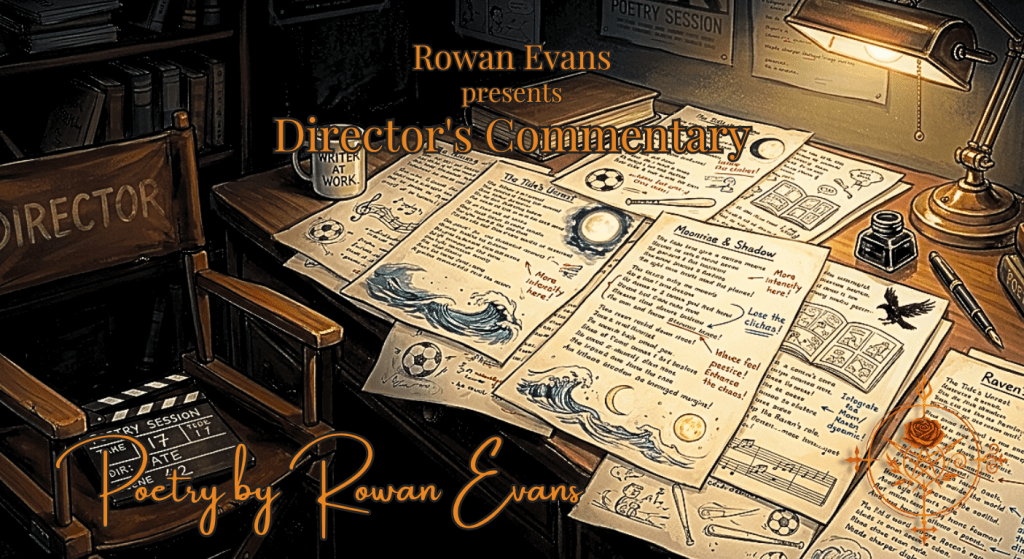
    A writer's desk covered with poetry pages, recurring symbols like moons and oceans, and film director notes critiquing the creative process.
    “Every writer has recurring motifs. Mine just happened to get their own director’s commentary.” 🎬🌙✍️

    Director’s Commentary
    Poetry by Rowan Evans

    The Moon—

    Here we go again,
    another moon metaphor.

    What is it this time?

    The moon shimmering
    above the bay?
    A stand in for her beauty—

    Ocean—

    My favorite metaphor.

    The one I’ve used
    thousands upon thousands
    of times before—
    written in thousands of lines,
    in a thousand different rhymes.

    Hyperbole.

    The Tide—

    Yes, there it is—
    the final piece
    of this overused metaphor chain,
    you say it’s different
    but it’s all the same.

    Same moon.
    over the same bay,
    and it shimmers
    in the same way.

    It’s almost like the moon,
    ocean, and tide
    are all that exist
    inside that little mind.

    Ravens—

    So spooky.
    So gothic.

    You write ravens
    like you shop
    exclusively at Hot Topic.

    They’re messengers.
    They witness.
    And once upon a time
    you even made them a centerpiece.

    You took that way too seriously
    back in your “modern-day Poe” era.

    A modern-day Poe?

    Ridiculous.

    Sports—

    You don’t even watch those.

    Why are you writing
    metaphors for the bros?

    You think you’re great?
    Yeah, you’re The Babe.
    23 years and a Jordan joke—
    okay, Shohei.

    Random Cartoon Reference—

    Which character are you
    going to grab this time?

    Which bit of nostalgia
    are you going to try
    and exploit?

    Random references,
    litter the page—
    Powerpuff Girls,
    Doug and Dexter.

    So what’s next?

    Something more obscure,
    or more mainstream?

    Comic Books—

    Tropes.

    Superheroes and capes.

    Random character grab,
    used in a metaphor
    that barely makes sense—

    like Bane
    for line breaks?
    What the “#%@$”
    was that?

    I’ll give you
    Two-Face for fakes
    and snakes, because
    that one makes sense.

    Music—

    10/10.
    No Notes.


    Journey into the Hexverse…

    [Pointing Me Home]
    The final poem in the No Metaphor Left Behind trilogy explores dreams, hope, and belonging. Through moonlight, ocean tides, and quiet conversation, Pointing Me Home reflects on carrying hope long before reaching the place you call home.

    [Chemical X]
    Chemical X explores the rapid, associative way one creative mind moves—from cartoons to sports, comic books to music—revealing that inspiration isn’t linear, but a collision of memory, humor, rhythm, and intuition.

    [Crossing the Sea]
    A deeply personal poem about relocation, longing, and the realization that some truths naturally arrive through metaphor—even when we try to leave it behind.

    [Danny Phantom Theology]
    What begins as a metaphor borrowed from a childhood cartoon becomes something deeper: a reflection on existing between survival and possibility, exhaustion and hope, the life we have and the life we long for. Danny Phantom Theology explores what it means to keep moving toward a future that feels worth living.

    [Frankenstein’s Monster (and I’m the Doctor)]
    Some poems are built to make a point. Others are built to reveal the mechanism. Frankenstein’s Monster (and I’m the Doctor) explores associative thinking, creative chaos, and the strange process of stitching disconnected ideas into something alive.

    [Ocean Waves (1, 4, 3)]
    A moonlit shoreline, a rowboat full of ducks, a piggybank with no cents, and a confession hidden in plain sight. Ocean Waves (1, 4, 3) explores how humor, wordplay, and absurdity can become a side door to vulnerability when the truth feels too difficult to say directly.

    [A Heart That Echoes in Another Language]
    A poetic journey through music across Japan, Korea, China, and the Philippines, exploring how sound becomes identity, memory, and emotional geography.

    [Global Takeover]
    What if home isn’t a place—but something you build from the music you love? Global Takeover blends sound, culture, and identity into one borderless space.

    If you’re interested in more poetry, you can find it here → [The Library of Ashes]
  • Author’s Note

    This poem became the quiet conclusion to a trilogy I never intended to write.

    Crossing the Sea was about direction.

    Only Waiting was about the reason I needed that direction in the first place.

    This piece asks a different question:

    How do you keep moving when you haven’t arrived yet?

    For me, the answer has always been dreams.

    Not because I confuse them with reality, but because they remind me that another reality is possible.

    I’ve written about dreams for years. They rarely feel random to me. They often feel like rehearsals—small glimpses of a life my mind already believes exists somewhere beyond the horizon.

    The city in this poem isn’t a specific city.

    The moon isn’t really the moon.

    Even after spending two poems trying to strip away metaphor, I found myself sitting beside it again.

    I think that’s because hope has always spoken to me symbolically.

    When I’m awake, I know where I am.

    When I’m asleep, I remember where I’m going.

    The dream doesn’t replace reality.

    It sustains me until reality catches up.

    The final image—a dream folded into my chest like a map—is probably the clearest way I’ve ever described hope.

    Hope isn’t certainty.

    It isn’t arrival.

    It’s carrying the direction with you, even when you’re still standing at the beginning of the journey.

    And maybe that’s what this trilogy has been trying to say all along.

    Sometimes home begins as a place.

    Sometimes it becomes an ache.

    Sometimes…

    it’s simply the direction you’re already walking.

    Rowan Evans


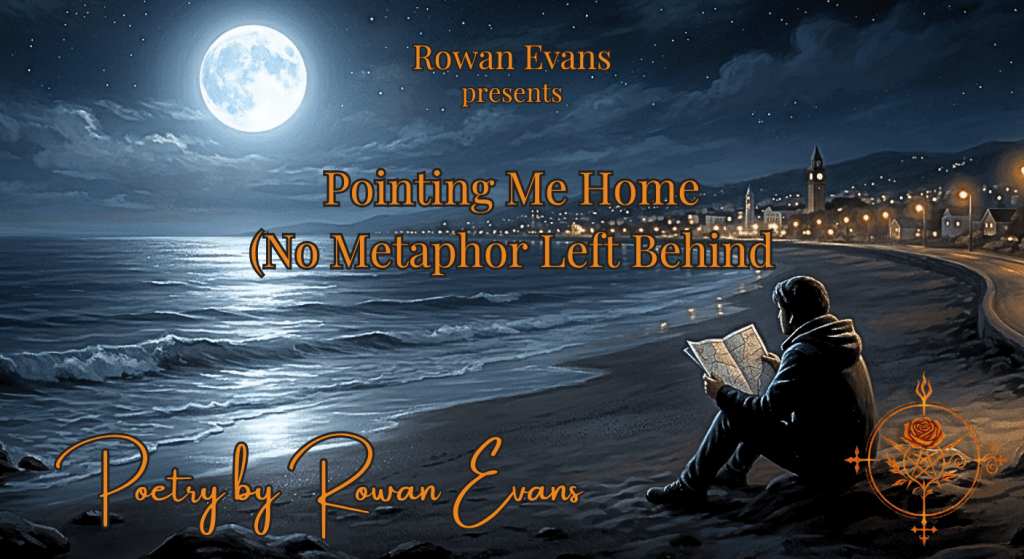
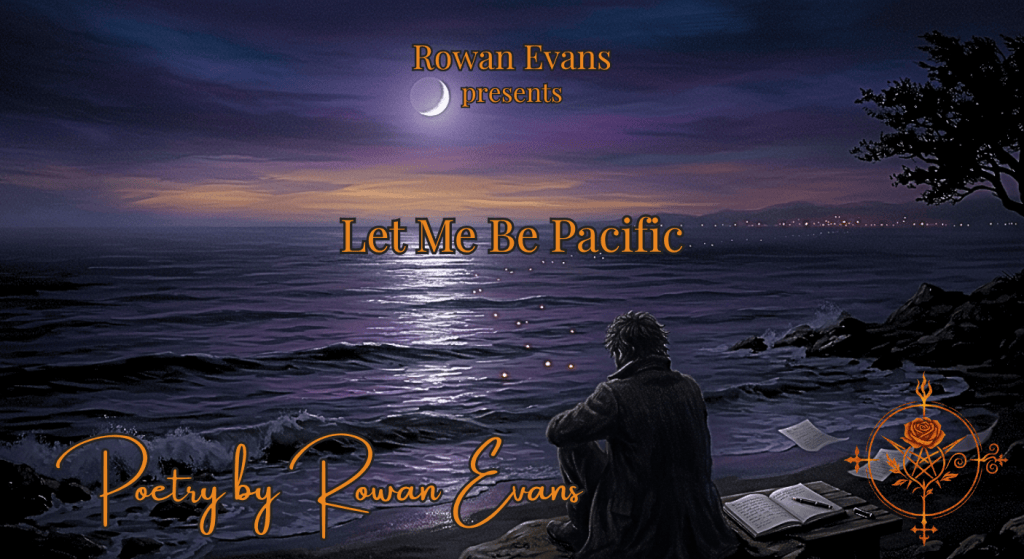
    A lone figure sits beneath a full moon where an ocean shoreline transitions into quiet city streets, holding a folded map while reflecting on hope, dreams, and the journey toward home.
    “Sometimes home isn’t where you’re standing—it’s the direction you’re already walking.” 🌙🗺️

    Pointing Me Home (No Metaphor Left Behind)
    Poetry by Rowan Evans

    Tick tock, tick tock—
    that’s the sound of the clock.
    I listen as I wait for the escape,
    a simple trip, brought on by sleep.
    Because I only feel at home
    in my dreams.

    So as I close my eyes
    and my head hits the pillow—
    I follow the moon
    to the ocean’s edge,
    I listen to the tide—
    I follow it in stride
    until I find where it’s pulling me.

    With every step,
    I move deeper in.
    Slowly sand turns to concrete
    beneath my feet,
    as the beach transitions
    into city streets.

    Streetlights flicker
    like they’re remembering
    they used to be stars.

    The hum of the city
    folds into the sound of waves,
    each echo a reminder
    of where I started
    and where I’m going.

    I walk until the moon
    hangs between buildings
    like it’s lost too—

    like it’s looking for someone to talk to.

    So I sit and conversate,
    I tell the moon all about the quiet ache—
    the feeling that I need to change
    my environment to one that aligns
    more with what I feel inside.

    And the moon sits with me,
    just listening—so I talk some more.
    Out of my heart, the words just pour.
    I spill every secret, I hold nothing back
    until I feel like I might collapse.

    The moon listens,
    patient as ever,
    its light softening
    the edges of my thoughts.

    And when I finally fall silent,
    breath trembling,
    chest heavy—

    it tilts itself
    just enough
    to remind me
    I’m not alone
    in the places I wander.

    Tick tock, tick tock.

    A return to the rhythm of the clock,
    interrupting the talk—
    the moon’s light gives way
    to the sun’s rays,
    I’m still stuck in this place—

    but I’m only waiting
    until I can cross the sea,
    Pacific and the Philippine.

    Until then,
    I carry the dream like a map,
    folded in my chest—

    pointing me home.


    Journey into the Hexverse…

    [Crossing the Sea (No Metaphor Left Behind)]
    A deeply personal poem about relocation, longing, and the realization that some truths naturally arrive through metaphor—even when we try to leave it behind.

    [Only Waiting (No Metaphor Left Behind)]
    The second poem in the No Metaphor Left Behind series, exploring the quiet ache of growing up in a place that never truly felt like home—and finally saying aloud what years of metaphor had been trying to express.

    If you’re interested in more poetry, you can find it here → [The Library of Ashes]

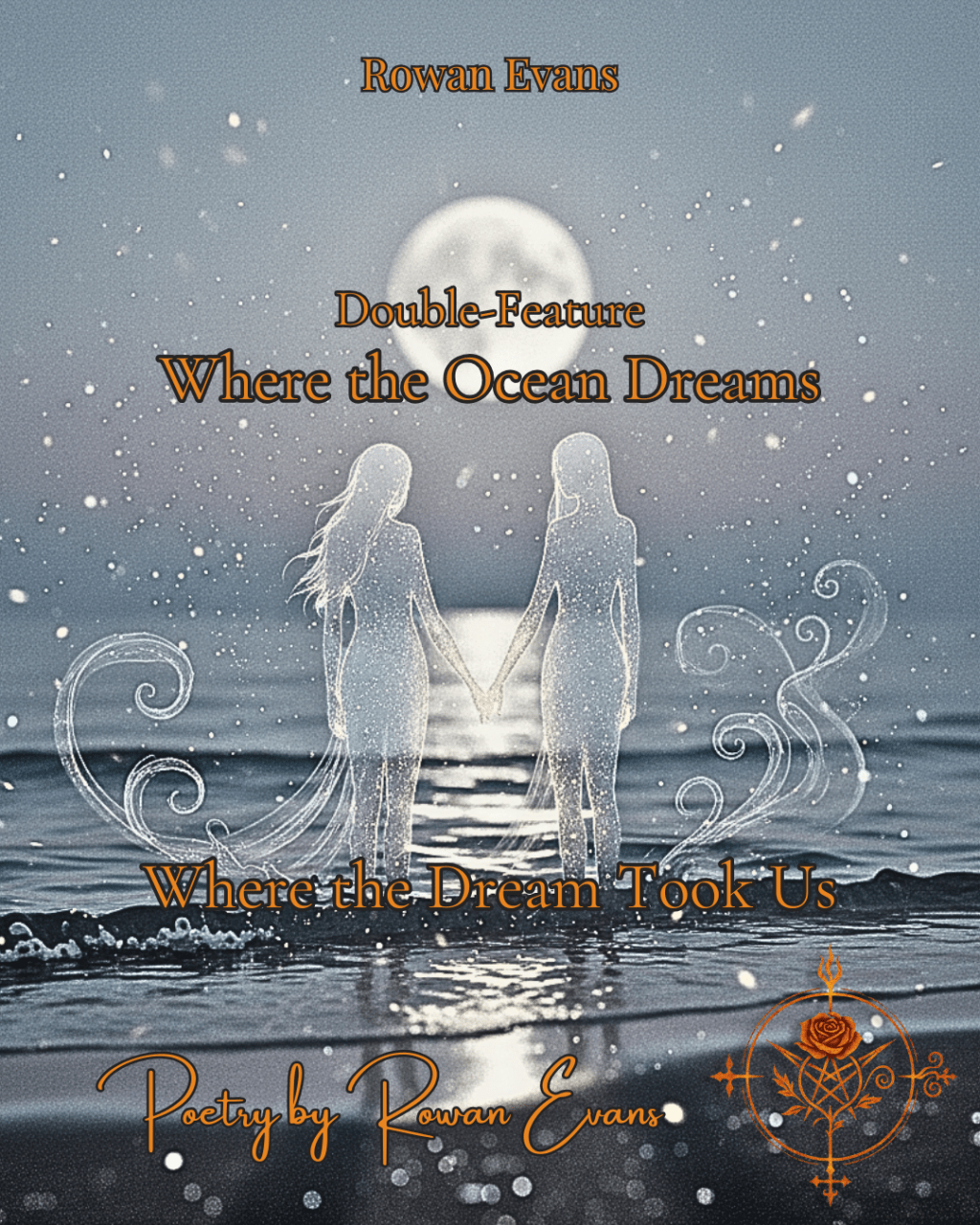
  • Where the Ocean Dreams & Where the Dream Took Us | Double-Feature by Rowan Evans


    “Dreamlike seascape at twilight with two figures holding hands at the water’s edge, surrounded by mist, symbolizing intimacy and emotional connection.”
    “Dreams of love and longing: Where the Ocean Dreams & Where the Dream Took Us, a double-feature of poetry by Rowan Evans.”

    🌊 Author’s Note

    Where the Ocean Dreams came from a dream that felt more like a visitation than a vision—an intimate moment between souls suspended somewhere between waking and eternity. It’s a poem about love that speaks in multiple languages, not just through words, but through trust, fear, and the quiet courage to hope again.

    The ocean here is both witness and mirror—reflecting two hearts learning to believe in tenderness after the wreckage of past storms. It’s a story of love as rebirth, of vulnerability as strength, of finding the divine in human connection.

    This piece continues my exploration of Neo‑Gothic Confessional Romanticism, where love and faith intertwine with the spectral and sacred. Dreams, language, and devotion converge here—not as fantasy, but as truth dressed in salt and moonlight.


    Where the Ocean Dreams
    Short Poetic Story by Rowan Evans

    The sea sighed against the waiting shore,
    its breath cool and endless,
    curling around my bare feet
    before slipping away again—
    a heartbeat, a memory, a whispered promise.

    The world was bathed in a blue hush,
    a soft exhale stitched with secrets,
    and I listened,
    not for answers,
    but for the songs folded into every wave,
    for the words the earth had never dared to speak aloud.

    Behind me,
    her voice rose—
    gentle as mist, sure as the tide—
    and the world shifted.

    I turned, slowly,
    as though waking from a thousand-year dream,
    and there she was—
    My Muse—
    woven of light and longing,
    smiling with the tenderness of all the summers I had never lived.

    My heart moved before my body did,
    drawing me to her in a single, breathless moment.
    Our hands found each other—
    a touch that asked for nothing
    and gave everything.

    I spoke the truths I had carried for what felt like forever:
    that I would wait,
    that I would be the shore for her storms,
    the steady hand,
    the quiet shelter.

    Lowering my gaze, then lifting it again—
    trembling, open, unafraid—
    meeting the ink-filled oceans of her eyes,
    I whispered into the salt-kissed silence:

    “Mahal kita, palagi.”
    I love you. Always.

    Her lips parted—
    the beginnings of a reply blooming there,
    warm as sunlight after rain—
    but she hesitated, the words hung in her throat,
    then, her lips parted again.

    At first, no words came—
    only the shimmer of tears
    rising in her eyes,
    brimming until they overflowed,
    carving rivers down her cheeks.

    Her hand trembled in mine,
    not with fear,
    but with the weight of a heart
    long kept hidden, long guarded.

    “I’m scared,” she whispered—
    so raw, so real—
    her voice cracking like a shell
    split open by the tide.

    “I don’t know how to trust this…
    but I want to.
    I want to believe you—
    believe in you.”

    Her fingers tightened around mine,
    clutching, anchoring,
    as though afraid I might vanish
    with the next breath.

    “I’ve been broken so many times,”
    she said, the words spilling now,
    “and every time, I told myself
    never again.
    Never again.”

    Her voice faltered—
    then steadied, fierce in its trembling.

    “But you…
    you make me want to try.
    You make me want to hope again.”

    I saw it then—
    the battle waging in her,
    the courage it took
    just to stand there with me.

    Tears blurred my vision too,
    but I held her gaze,
    held her heart
    as gently as I could.

    She stepped closer,
    so close I could feel the storm inside her,
    and in a voice cracked with grief,
    strength, and something achingly new,
    she said it—

    “Mahal din kita,” she breathed.
    “I love you, too.”

    And the ocean roared its approval,
    its waves thundering like a heartbeat,
    like a promise kept.

    There, where the world breathed in salt and stars,
    two hearts found each other—
    fragile, fearless, whole.


    🌙 Bridging Note

    These two pieces are born of dreams, experienced on back-to-back nights. The first, Where the Ocean Dreams, unfolded as a quiet, tender reverie—an emotional awakening, where connection and trust whispered like the tide. The very next night, Where the Dream Took Us arrived, carrying that same heart forward, immersing it in desire, intimacy, and the full weight of longing made tangible.

    Together, they form a continuum of a single emotional journey: from the soft, luminous stirrings of love to the fierce, breathless affirmation of it, each dream illuminating a different facet of devotion.


    🕯️ Author’s Note

    Where the Dream Took Us was born from a dream that lingered long after waking—one of those rare visions where desire and devotion blur until they’re indistinguishable. It’s a confession written from that in‑between space, where the spiritual and the sensual intertwine.

    This isn’t a poem about physicality alone; it’s about intimacy as revelation—about being seen, known, and adored in ways that transcend the waking world. Even in the dream, there was love, reverence, and quiet recognition: a soul remembering another through touch.

    As with much of my work, this piece belongs to the canon of Neo‑Gothic Confessional Romanticism, where vulnerability becomes sacred and longing is its own form of prayer.


    ⚠️ Content Warning

    Where the Dream Took Us contains explicit sexual content and intimate themes. Reader discretion is advised.


    Where the Dream Took Us
    Poetry by Rowan Evans

    We were borrowed warmth in an unfamiliar place,
    a quiet Air BNB where the lights were dim
    but every part of you was glowing—
    in laughter, in glances,
    in the way you leaned a little closer
    with each sip, each word.

    Your voice curled around me
    like smoke and silk,
    and every time your hand brushed mine,
    a storm stirred beneath my skin.
    You tilted your head, smiled that smile—
    the one that crumbles my guard—
    and suddenly, space didn’t exist.

    Our lips met—soft, slow,
    a breathless yes hidden inside a kiss.
    You tasted like longing and maybe,
    like all the things we never said
    but always felt.

    Your fingers found the edge of my shirt,
    tugging gently as if asking permission
    I would give a thousand times over.
    When it slid from my shoulders,
    your nails traced fire over bare skin,
    and I shivered under the weight of your gaze,
    drunk not on the wine,
    but on you.

    We moved like poetry,
    in soft lines and tender metaphors—
    me guiding you gently to the bed,
    your back arched just slightly
    as I kissed your neck,
    whispering love into the places
    where heartbreak once lived.

    I told you I loved you—
    not out of desperation,
    but devotion.
    Because even in dreams,
    your presence feels like destiny,
    like a truth I was always meant to know.

    You helped me undress you,
    hands trembling just enough to say
    this mattered,
    that this wasn’t fantasy
    but something deeper
    wearing the skin of a dream.

    When I kissed your stomach,
    your breath hitched—
    music I wanted to memorize.
    You lifted your hips with quiet need,
    and I shed your last piece of armor,
    settling between your thighs
    like this was where I was always meant to be.

    You gasped my name
    like prayer and wildfire,
    fingers laced in my hair
    as I worshipped every inch of you—
    not to prove myself,
    but to remind you
    of what it means to be adored.

    And when I woke—
    sheets cold, heart aching—
    I held the dream like a promise:
    that even if only in sleep,
    I touched the stars
    that wear your name.


    If you’ve made it this far and want to read more of my poetry, you can find it [here] in the The Library of Ashes.