Tag: metaphor

  • Author’s Note

    B.S.T.F.U. is me flexing.

    There isn’t a real target hiding behind this poem, no specific person I’m trying to call out, and no secret literary feud happening behind the scenes. I wrote this because sometimes I like to take the battle-poet side of my voice out for a walk and see what it can do.

    This piece is deliberately over-the-top. It’s swagger, insults, wordplay, internal rhyme, punchlines, and a little bit of absurdity thrown into the blender. The goal wasn’t to make a serious accusation—it was to practice the mechanics of verbal combat while having fun with the language.

    And honestly, that’s part of why I love writing: sometimes I want to write something vulnerable, sometimes I want to build mythology, sometimes I want to make conspiracy theories about fish, and sometimes I just want to look at the imaginary competition and say:

    Where are you on the ladder?

    Below me.

    It’s not that serious.

    But the pen game?

    That part is serious.

    Rowan Evans


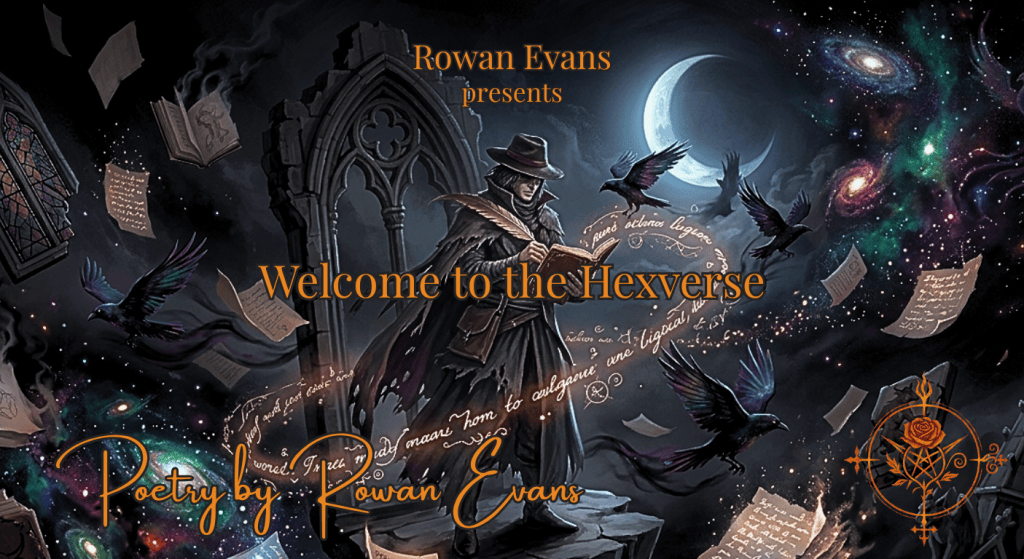
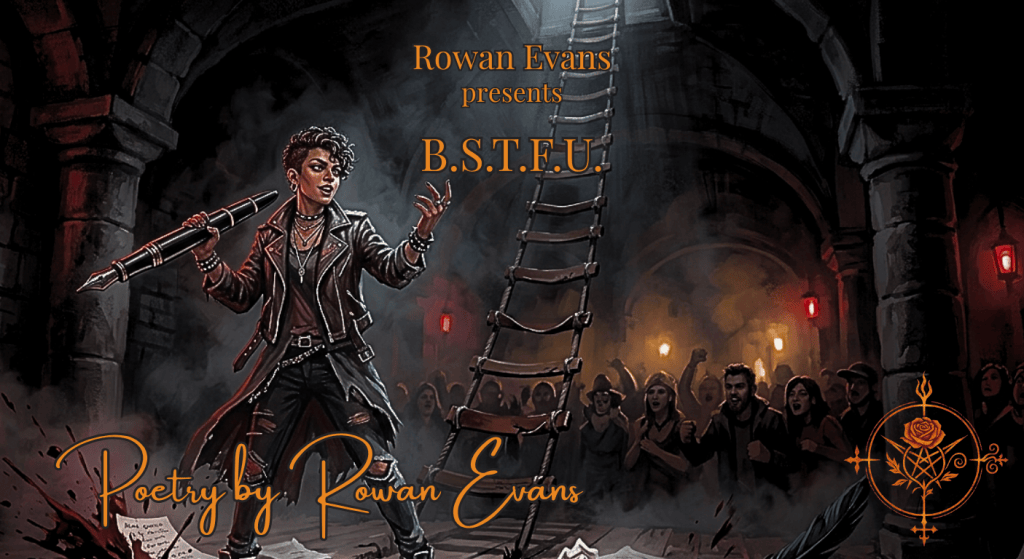
    A confident poet stands in a dark battle-poetry arena holding a fountain pen beside a towering ladder symbolizing literary skill.
    No target. No feud. Just a poet flexing the pen and climbing the imaginary ladder.

    B.S.T.F.U.
    Poetry by Rowan Evans

    Bitch, shut the fuck up—
    what’chu talkin’ about?

    Don’t think I haven’t heard—
    how you’re runnin’ your mouth.

    You thought ’cause I don’t talk a lot,
    I was open season, you should be scared—
    let me give you a reason, I’m a big dog—
    all bite, no bark and a license to write still.

    I write with precision, I write kills—

    you’re not a writer,
    you’re the one who steals—

    plagiarizing those with skill.

    It’s stolen lines
    and stolen rhymes—
    the only thing keeping you
    holding on to borrowed time—

    it’s not yours—

    it’s whoever writes for you.

    It’s me and it’s them—
    it’s the wielders of the pen.
    Those with skill,
    with lines that kill
    and lines that heal—

    we know—

    you don’t write, bitch—
    be so for real.

    You don’t know what a metaphor is—

    and a stanza?
    You hear that and you’re like—
    isn’t his first name Tony?

    Bitch, you’re a phony…

    if you were
    to try and write—
    baloney.

    All that to ask—

    when it comes
    to writing—
    where are you
    on the ladder?

    Below me.


    Journey into the Hexverse…

    [Across the Page-cific]
    A playful, autobiographical journey through the strange places poetry can take me—from sandwich heartbreak and pasta diss poems to gothic monsters, mythology, ravens, ghosts, and storms across the page. Beneath the absurdity is something deeply personal: the realization that writing gave me a way to rebuild myself, piece by piece.

    If you’re interested in more poetry, you can find it here → [The Library of Ashes]
  • Author’s Note

    People often ask what inspires my writing, or how my mind moves from one idea to another so quickly.

    The honest answer is that I don’t think in straight lines.

    I think in association, in rhythm, in collision. One idea reminds me of another, not because they are logically connected, but because they feel connected in the moment they appear.

    This poem is built from that process.

    It began with something simple—the familiar phrase “sugar, spice, and everything nice.” But as I wrote, my mind immediately followed the same pattern it always does: connection, exaggeration, humor, memory, and cultural reference all colliding at once. What starts as something familiar quickly becomes something unpredictable.

    The title, Chemical X, comes from that idea.

    In The Powerpuff Girls, Chemical X is the unknown element that transforms something ordinary into something entirely different. For me, that “unknown element” is the way my mind blends thoughts, images, and meanings together in real time.

    This poem is not meant to be linear. It is meant to mirror the way my thoughts actually arrive: rapid, associative, sometimes chaotic, but always connected by feeling and intuition rather than structure.

    If it feels like a mix of humor, storytelling, sports commentary, and surreal imagery all at once—that’s intentional. That is the point.

    This is what happens when everything gets mixed together.

    This is Chemical X.

    Rowan Evans


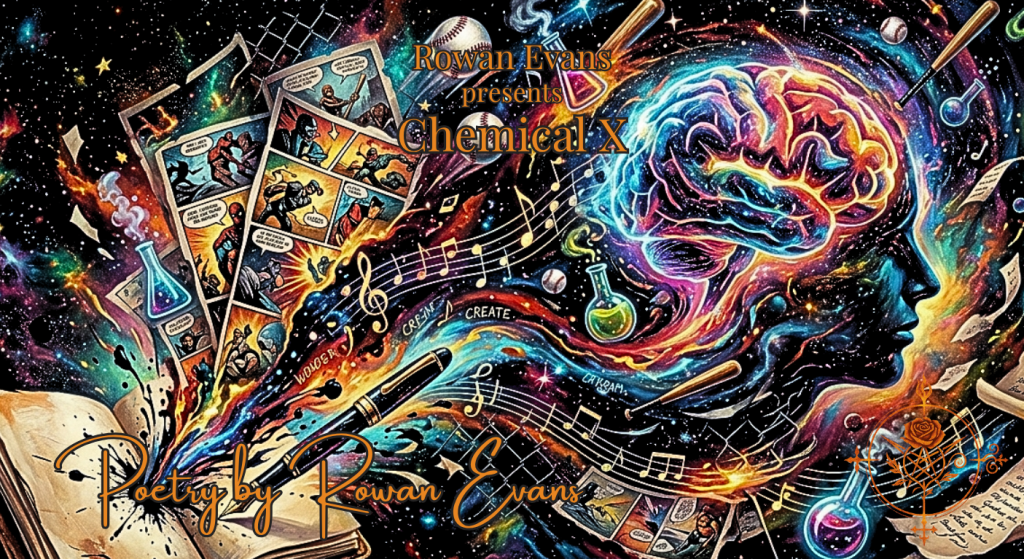
    A notebook and pen burst into colorful images of comics, sports, music, stars, and cartoons, symbolizing an imaginative mind making rapid connections.
    Some minds move in straight lines. Mine mixes everything together—and somehow, it all makes sense.

    Chemical X
    Poetry by Rowan Evans

    They say “penny for your thoughts,”
    but it takes—two cents to talk.
    Go for a walk, a mile long, in my shoes—
    use my eyes, see the world through my view.

    I’ll etch it across the page,
    world view and all—
    because I’m the on the ball
    point pen, in an ink sprint.
    Usain Bolt, the way my mind went.

    To understand the rhythm,
    you’ve got to understand the mechanism.
    You’ve got to understand the mind
    behind the rhyme—

    my thoughts are rapid fire.

    Thirty round magazine,
    three-round burst—
    that’s the way my mind works.

    I can jump from cartoons
    to comic books,
    music to sports—

    sugar, spice,
    and everything nice.

    A round of applause, Johnny—
    Bravo, you completed the Quest.
    You gained experience and leveled up.
    Still, it wasn’t enough—

    because I’m a two-way threat—
    like my name is Shohei.

    Bitch, I’m the Babe.

    At four years old,
    I was almost tossed
    out of the game.

    I was a menace—
    call me, Dennis.

    Two Hubbles
    strapped to my face,
    look up—see space.

    Fingers curled
    gripping the chain link—
    a bad call, a blind ump,
    a small child
    blind as I was,
    offering their eyes up
    like I was—

    trying to help?
    Maybe.

    Trying to insult?

    Of course…

    it’s sports…

    I was Dexter
    in the lab again,
    pen to pad again,
    and I gave
    all I had to give—

    Victor Frankenstein
    is at it again,
    patchwork metaphors
    and images galore—

    villagers are going
    to be afraid for sure.


    Journey into the Hexverse…

    [Crossing the Sea (No Metaphor Left Behind)]
    A deeply personal poem about relocation, longing, and the realization that some truths naturally arrive through metaphor—even when we try to leave it behind.

    [Only Waiting (No Metaphor Left Behind)]
    The second poem in the No Metaphor Left Behind series, exploring the quiet ache of growing up in a place that never truly felt like home—and finally saying aloud what years of metaphor had been trying to express.

    [Translating What I Feel]
    A poem about the invisible process of turning emotion into imagery, imagery into language, and language into poetry. An intimate reflection on creativity, loneliness, and twenty-three years of learning to translate what the heart feels.

    [Monster Theology]
    What if the monsters under the bed weren’t monsters at all? Monster Theology explores difference, belonging, and the human tendency to fear what we don’t understand through a conversation with the creatures we’ve spent our lives imagining.

    [Frankenstein’s Monster (and I’m the Doctor)]
    Some poems are built to make a point. Others are built to reveal the mechanism. Frankenstein’s Monster (and I’m the Doctor) explores associative thinking, creative chaos, and the strange process of stitching disconnected ideas into something alive.

    If you’re interested in more poetry, you can find it here → [The Library of Ashes]
  • Author’s Note

    This poem began as an experiment in restraint.

    I wanted to see what would happen if I stopped relying on metaphor—the oceans, tides, moons, and distant imagery that so often shape the way I write—and instead said things as directly as I could.

    What I discovered is that I don’t really think in a “non-metaphorical” way.

    Even when I try to remove symbolism, my mind still reaches for it. The language of distance, direction, and crossing appears naturally because that is how I process emotional states: spatially, geographically, in motion.

    So the poem became something else.

    Not an escape from metaphor, but an awareness of it.

    A recognition that even when I say “I won’t use the ocean this time,” I still understand my life through movement across it.

    This piece lives in that tension between clarity and instinct—between what I am trying to say plainly, and the language my mind naturally returns to.

    And in the end, it admits something simple:

    Sometimes the clearest way to say the truth… is still through the shape of the thing you tried to leave behind.

    Rowan Evans


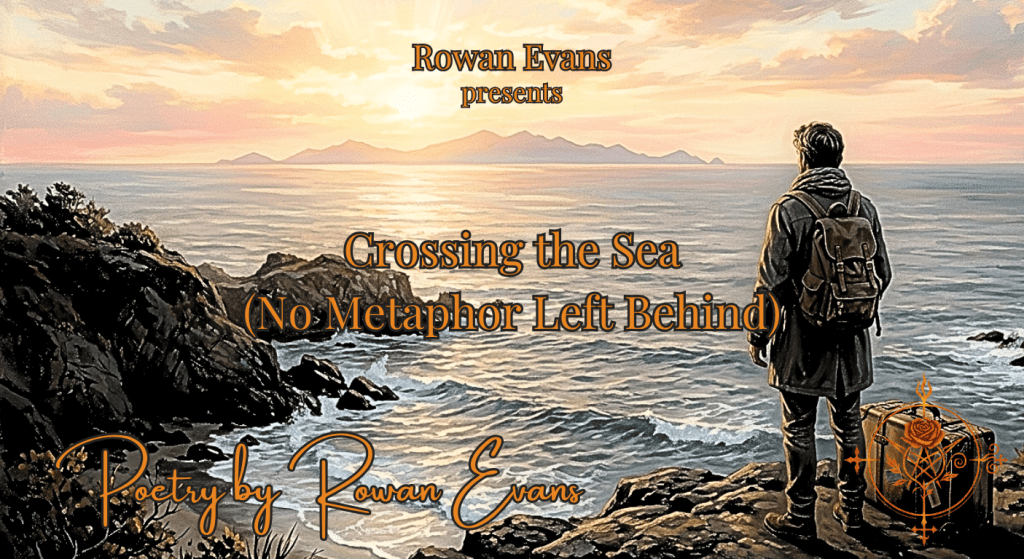
    A lone traveler stands on a Pacific shoreline looking toward distant islands across the ocean at sunrise.
    Some distances are measured in miles. Others are measured in becoming.

    Crossing the Sea (No Metaphor Left Behind)
    Poetry by Rowan Evans

    I am going to try
    something that terrifies me—
    that most of the time,
    would leave me paralyzed.

    I am going to try
    and say everything
    I hold inside—
    no metaphors
    to hide behind
    this time.

    I’m not where
    I want to be
    and part of me,
    thinks I’ll never be.

    I know that’s just
    fear and doubt—

    just because part of me
    thinks it, doesn’t make it true.

    Relocating
    is just taking
    longer than I wanted it to.

    But I know the direction.
    The destination is clear—
    I just got to get there.

    I got to leave here.

    This isn’t a new feeling—
    I’ve said this all before,
    buried in metaphors.

    Hidden behind symbolism.

    This is where
    I’d put the ocean
    and the tide,
    a way to describe
    the distance.

    Between where I am
    and where I want to be—
    and to get there,
    I have to cross the sea.

    Not a metaphor,
    I mean that literally—
    Pacific and the Philippine.


    Journey into the Hexverse…

    [Translating What I Feel]
    A poem about the invisible process of turning emotion into imagery, imagery into language, and language into poetry. An intimate reflection on creativity, loneliness, and twenty-three years of learning to translate what the heart feels.

    [Recognizes Home]
    A free-verse poem exploring the difference between love as dependency and love as choice. It challenges the idea that love must be need-based, instead centering the quiet strength of choosing someone while still remaining whole on your own.

    [Not Rebuilding You]
    A poem about love as an act of presence rather than rescue. Through construction imagery, Not Rebuilding You explores trust, devotion, emotional safety, and the quiet work of building a foundation strong enough for healing to grow.

    [The Language Her Soul Speaks]
    What if love isn’t about being understood, but learning to understand someone else? “The Language Her Soul Speaks” is a free verse poem about intimacy, communication, curiosity, and the desire to know another person beyond the limits of language.

    [Ocean Waves (1, 4, 3)]
    A moonlit shoreline, a rowboat full of ducks, a piggybank with no cents, and a confession hidden in plain sight. Ocean Waves (1, 4, 3) explores how humor, wordplay, and absurdity can become a side door to vulnerability when the truth feels too difficult to say directly.

    [L Words & Heart]
    A playful, self-aware poem about love, longing, loyalty, and the quiet ways another person can reshape our inner world. What begins as humor slowly reveals a heartfelt confession about affection, imagination, and the faces that linger in our dreams.

    [I’ll Be There to See Your Sunrise]
    Love has never come easily to me. This poem explores the fear, vulnerability, and quiet courage required to stay emotionally present when connection begins to matter deeply. “I’ll Be There to See Your Sunrise” is about choosing love despite the risk of heartbreak—and promising to remain long enough to witness someone fully.

    [Altar and Roses]
    A gothic free verse poem about poetic identity, recurring symbolism, devotion, and the quiet humanity beneath dramatic imagery.

    If you’re interested in more poetry, you can find it here → [The Library of Ashes]
  • Author’s Note

    Some poems arrive because of a grand idea.

    Others arrive because a single sentence refuses to leave.

    This was one of those.

    The poem began when I remembered a conversation. A joke, really. Someone once described themselves as being “like a drug” and we laughed about it. At the time, it felt playful, exaggerated, harmless.

    But memory has a way of revisiting things from a different angle.

    When I thought about that conversation later, I realized what interested me wasn’t the comparison itself. It was the experience of slowly realizing that someone has become part of your everyday thoughts without you noticing exactly when it happened.

    One day they’re simply someone you know.

    Then they’re someone you think about.

    Then they’re someone who quietly occupies space in your mind when nothing else is demanding your attention.

    The drug metaphor gave me a doorway into the poem, but it isn’t really what the poem is about.

    It’s about affection.

    It’s about attachment.

    It’s about the strange vulnerability of admitting that someone matters.

    More than that, it’s about the difference between being needed and being wanted.

    Need can feel transactional.

    Want feels chosen.

    The final lines became the emotional center for me because they capture a hope I think many people carry but rarely say aloud:

    Not that someone has to stay.

    Not that someone owes us their attention.

    Just that maybe, if given the choice, they would choose us too.

    Like a lot of my recent work, humor and metaphor show up first. They’re familiar territory. They’re comfortable. They make difficult things easier to approach.

    But beneath the jokes, the poem is doing what many of my poems eventually do.

    It’s confessing.

    Rowan Evans


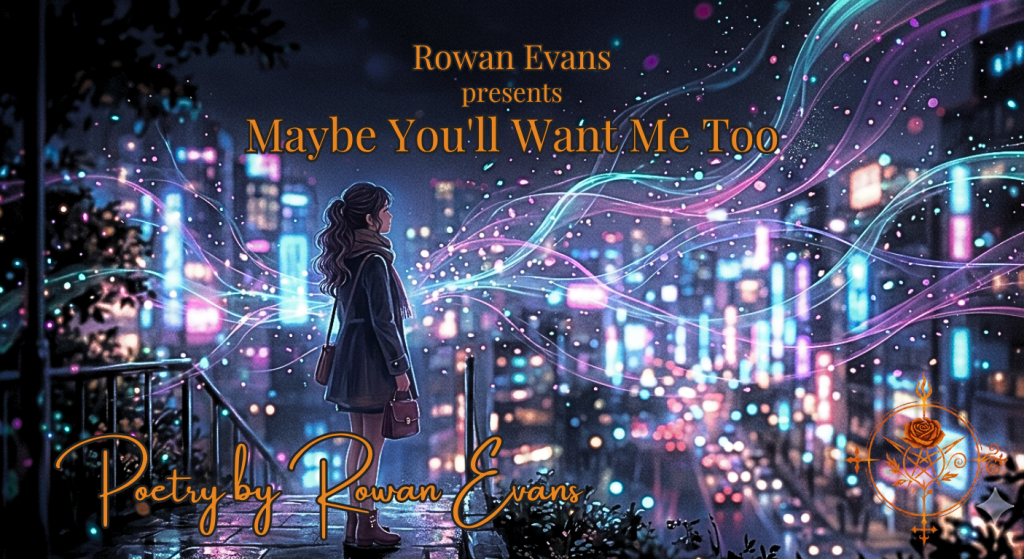
    A solitary figure standing beneath glowing city lights as colorful streams of light drift through the air, symbolizing affection, attachment, and lingering thoughts of someone special
    Sometimes affection arrives quietly—slipping into your thoughts until you realize someone has become part of your everyday world.

    Maybe You’ll Want Me Too
    Poetry by Rowan Evans

    I remember when you said—
    you are like a drug.

    It was all laughs
    about your exes being hooked,
    still shook by the thoughts of you.

    But I was getting second-hand
    contact highs—

    now I feel addicted too.

    It’s like you’re in my bloodstream.
    You’ve rewired my brain,
    rebalanced the chemical compounds—
    you’re in nearly every single thought now.

    I try to hide it behind metaphors
    and jokes—an attempt to mask
    the fragile hope—

    that you won’t need me,
    but maybe you’ll want me too.


    Journey into the Hexverse…

    [Recognizes Home]
    A free-verse poem exploring the difference between love as dependency and love as choice. It challenges the idea that love must be need-based, instead centering the quiet strength of choosing someone while still remaining whole on your own.

    [Not Rebuilding You]
    A poem about love as an act of presence rather than rescue. Through construction imagery, Not Rebuilding You explores trust, devotion, emotional safety, and the quiet work of building a foundation strong enough for healing to grow.

    [The Language Her Soul Speaks]
    What if love isn’t about being understood, but learning to understand someone else? “The Language Her Soul Speaks” is a free verse poem about intimacy, communication, curiosity, and the desire to know another person beyond the limits of language.

    [Ocean Waves (1, 4, 3)]
    A moonlit shoreline, a rowboat full of ducks, a piggybank with no cents, and a confession hidden in plain sight. Ocean Waves (1, 4, 3) explores how humor, wordplay, and absurdity can become a side door to vulnerability when the truth feels too difficult to say directly.

    [L Words & Heart]
    A moonlit shoreline, a rowboat full of ducks, a piggybank with no cents, and a confession hidden in plain sight. Ocean Waves (1, 4, 3) explores how humor, wordplay, and absurdity can become a side door to vulnerability when the truth feels too difficult to say directly.

    If you’re interested in more poetry, you can find it here → [The Library of Ashes]