Tag: creative contradiction

  • Author’s Note

    I’ve said I’m done being humble, but apparently nobody told my writing that.

    This poem is a little exploration of the contradiction between confidence and humility. I can recognize my own strengths as a writer, appreciate what I’ve accomplished, and genuinely believe I’m good at what I do without believing that makes me better than everyone else. At least, that’s the argument I’m making. Whether the poem successfully convinces anyone—including myself—is another question.

    I spend a lot of time reading other poets, and sometimes I come across a line or a rhyme that makes me stop and wonder how the hell someone managed to put those words together. There’s genuine admiration in that reaction. Other writers remind me how much possibility exists within language, and how much there is still to learn.

    Then there’s the slightly less humble side of me that occasionally wants to put myself at the top of my own imaginary leaderboard. Five positions, five versions of me. Very reasonable. Completely unbiased judging, obviously.

    The nods to Sylvia Plath and Edgar Allan Poe are sincere, though. Their work has left its fingerprints on the way I approach poetry, imagery, darkness, and vulnerability. I don’t consider myself their equal; I simply recognize the paths I’ve walked alongside the influence they’ve had on my own writing.

    Ultimately, this is a poem about being able to admire other people’s greatness while learning to acknowledge your own. Confidence doesn’t have to require comparison, and humility doesn’t have to mean pretending you have nothing to offer.

    Besides, if I can’t occasionally brag about myself in a poem, where exactly am I supposed to do it?

    I’m humble, I promise.

    Just don’t ask me to rank my top five poets.

    — Rowan Evans
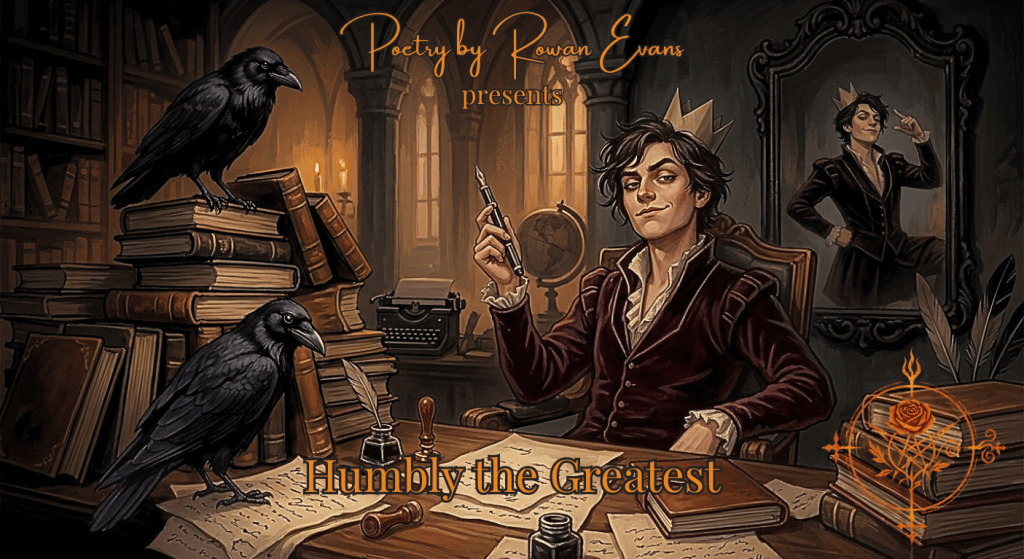

    A mischievous poet wearing a crooked paper crown sits among manuscripts and books, holding a fountain pen while two ravens perch nearby.
    Humble enough to admire the greats, confident enough to put yourself in the top five. All five positions, naturally.

    Humbly the Greatest
    Poetry by Rowan Evans

    I’ve said I’m done being humble,
    but humble is all I know how to be—
    and I’ll be humble, proudly.
    Fuck it, I’ll be humble loudly—
    humble while I’m shouting.
    I’m better than no one, bitch—
    try and change my mind.

    I read other poets all the time,
    and a couple thoughts cross my mind—
    fuck, how’d they come up with that line?
    How’d they construct that rhyme?
    Yeah, how’d they take that word
    and break that word—
    how the fuck did they make that work?

    Their writing is so good,
    it makes my brain hurt.

    But being this humble doesn’t mean
    I don’t think I’m great, because I do.
    Yeah, I know I am, it’s true—

    in my top five?

    I’d put me five times—
    but I’d be humble about it,
    I’d have my reasons—

    Number one—
    I’m the best to ever do it.
    And two,
    that’s not true—

    I just walk the same path as Plath,
    I carry a little bit of Sylvia in everything I do—
    raised in the same darkness that birthed Poe,
    I made Edgar’s ravens my own—

    So am I humble?

    Probably—

    not as much as I want to be.
    Because I still get mad
    when my greatness, they don’t see—
    I’ve said I’m done being humble,
    but…

    humble is all I know how to be.


    Journey into the Hexverse

    If you’re interested in more poetry, you can find it here → [The Library of Ashes]
  • Author’s Note

    Some poems come from a single voice.

    This one comes from the argument.

    Iron Sharpens Iron is about what happens when every version of my creative mind sits down at the same table: the gothic romantic, the absurdist comic, the mythmaker, the battle-poet, the joke creator, and whatever other voice decides to kick the door open halfway through a line.

    The notebook becomes the sparring ring. One thought throws a punch, another throws a punchline, and sometimes Batman apparently gets involved.

    I don’t always plan where the thread is going. Sometimes I just follow it until the poem lands somewhere that makes sense.

    Maybe that’s the point.

    I don’t need to silence the contradictions. I need them to sharpen each other.

    — Rowan Evans


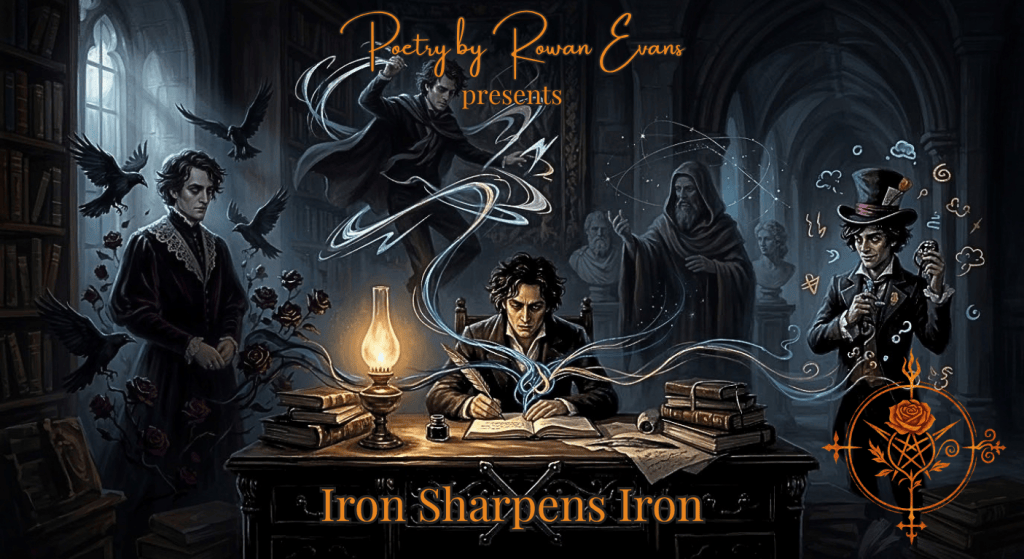
    A poet surrounded by multiple shadowy versions of themselves representing gothic romance, humor, mythology, and battle poetry, all connected by glowing strands of ink.
    I don’t silence the voices in my head. I let them sharpen each other.

    Iron Sharpens Iron
    Poetry by Rowan Evans

    I sit by myself—
    alone in body,
    crowded in mind—
    it’s a constant battle of wits,
    moon-fed goth kid
    versus the battle-poet
    turning pens to WMDs.

    The notebook—
    just a test site,
    where I drop bombs.
    It’s constant—
    the scream of the alarms.

    I write so much
    because my mind
    fights too much—
    a gothic romantic,
    an absurdist comic—
    opinions, opinions,
    too many opinions—
    constant contradictions.

    Is this a joke?

    Are the emotions sincere?

    What the fuck— (Batman!)
    is that reference doing here?

    That’s just how my mind is sometimes—
    I write a line and follow it, (Stalker.)
    I don’t plan it—I just follow the thread,
    guide the ship and land it.
    But sometimes I get lost—
    I’ll orbit the planet,
    or drift in my dreams—
    and they say to make the dreams work,
    it takes team work—
    well, I became my own team,
    every version of me.

    Gothic romantic, absurdist comic,
    mythmaker, joke creator
    and professional hater— (Jokes. Love ya!)
    a battle-poet raised on battle rappers
    and comedians—
    how I learned to land a punchline,
    can’t fight with my fists—
    but can fight with my mind,
    and I do it all the time—
    with myself, I spar,
    iron sharpens iron, after all.


    Journey into the Hexverse

    [Blindfolded & Still Winning]
    A playful battle-poetry freestyle about shutting off the inner editor, letting instinct take over, and discovering that sometimes the pen writes best when you stop watching it.

    [Literarily Speaking]
    They think silence means weakness. They should probably have paid more attention to the pen. Literarily Speaking turns gothic imagery, raven feathers, rose-petal ink, and absurd fictional geography into a playful battle-poetry flex about dismantling your enemies with words instead of hate.

    [The Playground]
    What happens when mythology stops being something to hide behind and becomes architecture for the imagination? The Playground (Language, Metaphors and More) explores Rowan Evans’s relationship with language, symbolism, metaphor, humor, and twenty-three years of turning the page into a place where anything can happen.

    If you’re interested in more poetry, you can find it here → [The Library of Ashes]